132
Linguistically Informed Relation Extraction and Neural Architectures for
Nested Named Entity Recognition in BioNLP-OST 2019
*Usama Yaseen1,2, *Pankaj Gupta1,2, Hinrich Sch ¨utze2
1Corporate Technology, Machine-Intelligence (MIC-DE), Siemens AG Munich, Germany 2CIS, University of Munich (LMU) Munich, Germany
{usama.yaseen,pankaj.gupta}@siemens.com
Abstract
Named Entity Recognition (NER) and Rela-tion ExtracRela-tion (RE) are essential tools in dis-tilling knowledge from biomedical literature. This paper presents our findings from partic-ipating in BioNLP Shared Tasks 2019. We addressed Named Entity Recognition includ-ing nested entities extraction, Entity Normal-ization and Relation Extraction. Our proposed approach of Named Entities can be general-ized to different languages and we have shown it’s effectiveness for English and Spanish text. We investigated linguistic features, hybrid loss including ranking and Conditional Random Fields (CRF), multi-task objective and token-level ensembling strategy to improve NER. We employed dictionary based fuzzy and semantic search to perform Entity Normalization. Fi-nally, our RE system employed Support Vector Machine (SVM) with linguistic features.
Our NER submission (team:MIC-CIS) ranked first in BB-2019 norm+NER task with stan-dard error rate (SER) of0.7159 and showed competitive performance on PharmaCo NER task with F1-score of0.8662. Our RE system ranked first in theSeeDev-binary Relation Ex-traction Taskwith F1-score of0.3738.
1 Introduction
Extracting knowledge from scientific articles is a challenging but very important problem. This be-comes especially critical for biomedical literature which is growing at an increasing rate of at least 4% per year, as of June 2019 there are 30
Mil-lion documents in PubMed (Lu, 2011). Named
Entity Recognition (NER) (Settles, 2004; Gupta
et al.,2016;Lample et al.,2016) in the context of biomedical domain refers to the task of identifying the name of the biological entities e.g. name of a
bacteria. Relation extraction1 (RE) (Kambhatla,
* Equal Contribution
1Event extraction is treated as RE in this work
Presence of fish pathogen Vibrio salmonicida in fish farm Lives_In
Exhibits
[OBT:002793]
Microorganism
[NCBI:40269]
Phenotype
[OBT:002669]
Habitat
[OBT:000630] Lives_In
Habitat Habitat
[OBT:002903]
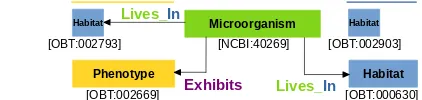
Figure 1: An illustration of (nested) NER + Normal-ization and Relation Extraction in Biomedical entities. Each rectangular box spans an entity, where the over-lapping spans indicate nested entities. E.g., fish is a nested entity (a sub-concept) of type Habitat within the parent entityfish pathogenof typePhenotype. The identifiers (e.g. OBT:002669, NCBI:40269, etc.) re-fer to unique IDs in Biomedical databases (i.e., OBT
→OntoBiotope Ontology and NCBI→NCBI Taxon-omy), used to perform entity normalization (i.e., entity linking). The arrows indicate binary relationships.
2004; McDonald et al., 2005; Lever and Jones, 2016;Gupta et al.,2018) refers to identifying re-lations among biological entities (binary or n-ary).
Figure1illustrates an example of (nested) NER
and RE consisting of five entities, where three en-tities participate in two distinct relationships. It is often required to link named entity(s) to a unique
reference in database(s). For instance, one of
the two occurrences of fish refers to marine fish
while the second refers to afarm fish, where the
two entities are linked (or normalized) to different identifiers (e.g., OBT:002793 and OBT:002903) in the biomedical database (e.g., OntoBiotope Ontol-ogy). The act of linking entities to standard
en-tities with a unique identifier is known as entity
normalizationand is challenging as several entity mentions can correspond to the same standard en-tity (or unique identifier), e.g.E. coli,Bacillus coli
andBacteriumcolirefer to the standard entity Es-cherichia coliin the database. The linking process relies on knowledge base (KB) search (heuristic OR semantic) in order to resolve entities.
[image:1.595.316.527.233.283.2]w_e c_e t_f w_e c_e t_f w_e c_e t_f w_e c_e t_f
presence of fish pathogen
LSTM LSTM LSTM LSTM
CRF CRF CRF CRF
NNE
of
<s>
NNE
fish
presence
NE
pathogen of
NE
</s> fish
w_e
a_f c_e
w_e
a_f c_e fish
pathogen
L S T M L S T M
C R F
C R F
B-S_H
Level1 NER to detect parent entities
O O B-P I-P
NER Layer NED Layer
LM Layer
m
u
lt
i-ta
sk
in
g
wordLSTM
LSTM
charLSTM LSTM LSTM LSTM
B-P L
S T M
L S T M
charLSTM wordLSTM
Level2 Nested NER to detect sub-concepts in parent entities
KB entity
normalization
[image:2.595.80.519.63.285.2]nested-entity normalization
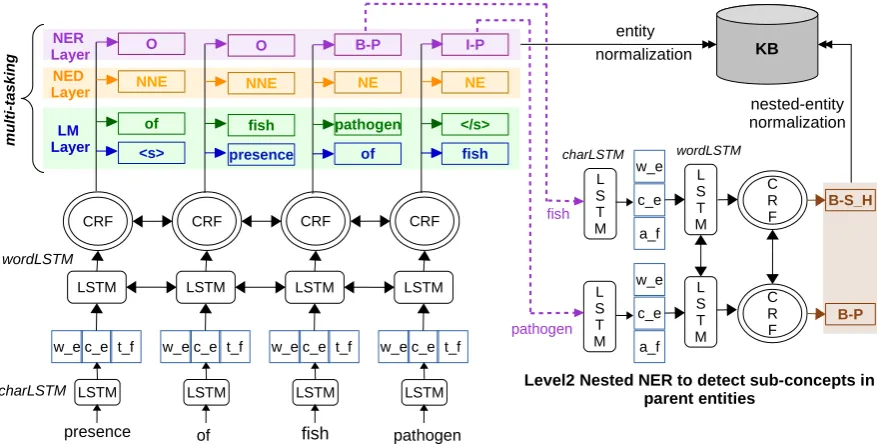
Figure 2: System Architecture for NER task, consisting of two bi-LSTM-CRF architectures: Level1 NER to detect parent entities and Level2 Nested NER to detect sub-concepts within the parent entities (output of Level1 NER). Here,w e: a word embedding vector; c_e: an embedding vector for a word computed using character-level bi-directional LSTM;t_f: a vector of additional linguistic features; B_P: B_Pathogen; B-S_H: a sub-concept of type Habitatdetected by the Level2 Nested NER run over the the parent entity.
pipeline as downstream tasks such as RE, text clas-sification, Question Answering (QA) etc., depend on it. Even though several methods have been de-vised to engineer reliable NER systems; however, most of them don’t explicitly address the extrac-tion (or recogniextrac-tion) of nested entities, especially
required in the biomedical domain. Nested
en-tity is defined as an entity or sub-concept which
is part of a longer entity (i.e., a parent). For in-stance in the Figure1,fishis a nested entity as it is part of a parent entityfish pathogen. In this work, we have also investigated extracting nested
enti-ties via two bi-LSTM-CRF (Lample et al.,2016)
networks: one for parent detection and another for nested entities with the parent entity.
2 Task Description and Contribution
We participate in the following three tasks
or-ganized by BioNLP workshop 2019: (1)
Phar-maCoNER: Recognition of pharmaceutical drugs
and chemical entities in Spanish text. (2)
BB-norm+NER: Recognition of Microorganism,
HabitatandPhenotypeentities and normalization with NCBI Taxonomy and OntoBiotope habitat
concepts. (3)SeeDev Binary RE: Binary Relation
extraction of genetic and molecular mechanisms involved in plant seed development.
Following are our multi-foldcontributions:
1. To address NER tasks, we have employed neural network based sequence classifier, i.e., bi-LSTM-CRF and investigated multi-tasking of named entity detection (NED) and language modeling (LM). We further intro-duced hybrid loss including CRF and rank-ing. We also incorporated linguistic features such as POS, orthographic features, etc. We apply the proposed modeling approaches to both English and Spanish texts. Comparing with other systems, our submission (Team:
MIC-CIS) is ranked 1st in BB-norm+NER
task (Bossy et al., 2019) with standard
er-ror rate of 0.7159. In PharmaCoNER task
(Gonzalez-Agirre et al., 2019), our
submis-sion scored F1-score of0.8662.
2. To address RE task, we employed linguistic and entity features in SVM. Our submission
(Team: MIC-CIS) is ranked 1st in
SeeDev-binary RE task (Chaix et al.,2016) with F1-score of0.3738.
The code to reproduce our results is
avail-able at: https://github.com/uyaseen/
Features Description
word-cap capitalization features POS parts-of-speech tags
ortho orthographic features
e.g.Egg Pulp, 97encoded asCcc Ccccp nn
tri-gram tri-gram as features five-gram five-gram as features length length of the word sdp-rel dependency relation tag
alpha-features detect if certain linguistic pattern occurred in the current word or the next word
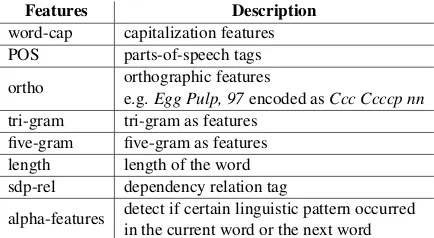
Table 1: Word-level features for NER. The features are encoded as embeddings, except thealphafeatures that are represented as one-hot vector.
3 Methodology
In the following sections we discuss our proposed model for NER and RE.
3.1 Neural Architectures for NER
Figure2 describes the architecture of our model,
where we design two sequence taggers Level1
NER and Level2 Nested NER to extract parent
and nested entities respectively. Furthermore,
Level1 NER can be configured in two modes: (1)
LSTM-CRF (Lample et al.,2016) with word
em-beddings (w e), character embeddings (c e) and
token-level features (t f) such as POS,
capitaliza-tion features, word shape, etc. (refer to table 1
for the complete list of word level features) (2)
LSTM-CRF+Multi-task that performs entity de-tection and language modelling as auxiliary tasks. Note that Level2Nested NER only operates on the parent entities detected by Level1 NER. The parent and nested entities are than normalized to unique identifiers in KB by our entity normaliza-tion algorithm.
3.1.1 BiLSTM-CRF
The input to LSTM is a sequence of word features (w1,w2, . . . ,wn) and they compute a hidden state for each element in the sequence
(h1,h2, . . . ,hn). This hidden state can be used to
jointly model tagging decisions using CRF (
Laf-ferty et al., 2001). CRF imposes ordering
con-straints on the tagging decisions e.g. I_Habitat
should always be preceded by B_Habitat. For an
input sentence,
W= (w1,w2, . . . ,wn),
we consider a matrix P of scores output by the
bidirectional LSTM. The size of P is n × k,
where k is the number of distinct tags, and Pi,j
corresponds to the score of thejth tag of theith
word in a sentence. For a sequence of predictions
y= (y1, y2, . . . , yn),
we define its score to be
s(X,y) = n
X
i=0
Ayi,yi+1+ n
X
i=1 Pi,yi
where the matrixAexpress transition scores such
thatAi,j represents the score of a transition from
the tag i to tag j. We add start and end tag to
the set of possible tags, therefore, the size of A is
k+ 2. During training, we minimize the negative
log-probability of the correct tag sequence:
log(p(y|X)) =s(X,y)−log
X
e
y∈YX es(X,ey)
=s(X,y)−logadd
e
y∈YX
s(X,ey), (1)
lossCRF =−log(p(y|X)) (2)
3.1.2 Hybrid Loss: CRF + Ranking
We use a variant of ranking loss function proposed by dos Santos et al.(2015). Ranking maximizes
the distance between the true label y+ and the
most competitive labelc−:
lossranking=max(0,1 + (γ ∗(m+−y+)) + (γ∗(m−+c−))
whereγ is the scaling factor that penalizes the
predictions, m+ and m− are margins for correct
and incorrect labels respectively. We follow Vu
et al.(2016) to set the values of margins.
The hybrid loss function hence is the sum of CRF tagging loss and ranking loss:
losshybrid =lossCRF+α · lossranking
whereα∈[0,1], weighs the contribution of
rank-ing loss in the overall loss value. Durrank-ing trainrank-ing we minimize the hybrid loss and found it to
im-prove the F1 score for both BB-norm+NER and
PharmaCoNER tasks.
3.1.3 Multi-Tasking of Named Entity Recognition, Detection and Language Modelling
[image:3.595.75.292.62.181.2]Algorithm 1Entity Normalization
Input: NE, NE Type
Output: RF ID
Output: NE PRED (Optional) 1: RF ID = None
2: IF NE Type == ’Microorganism’:
3: found, RF ID = exact match(NE, NCBI) 4: if not found:
5: found, RF ID = fuzzy match(NE, NCBI) 6: return RF ID
7: ELSE
8: found, RF ID = exact match(NE, NCBI) 9: if not found:
10: found, RF ID = fuzzy match(NE, NCBI) 11: if found:
12: # LABEL UPDATE ! 13: NE PRED = ’Microorganism’ 14: return RF ID, NE PRED
15: found, RF ID = exact match(NE, OBT) 16: if not found:
17: found, RF ID = semantic search(NE, OBT) 18: return RF ID
model. Usually these auxiliary objectives acts as
regularizes (Collobert and Weston,2008) and
im-proves the overall performance. With these multi-tasking objectives, for each word token our model predicts the NED tag, next word, previous word
and the NER tag2. LM and NED layers in figure
2 realizes NED and LM objectives respectively.
Note that Multi-tasking is only enabled at train time and requires no additional labelling.
3.1.4 Nested Entities
The dataset of BB-norm+NER task contains
17.4%nested entities3which cannot be extracted by standard Bi-LSTM CRF model. We employed
two Bi-LSTM-CRF models: Level1 NER model
to detect parent entities and Level2 Nested NER
model to detect nested entities. Figure 2 (right)
shows the architecture of Level2 Nested NER. The parent entities detected by Level1 NER are fed to Level2 Nested NER to detect nested entities in the parent entities. Level2 Nested NER has the same architecture as Level1 NER but without the multi-tasking objectives. It is easy to see that current architecture can only detect nested entities at level 2. The final output of model is the aggregation of parent entities and nested entities.
3.1.5 Entity Normalization
The goal of entity normalization (entity linking) is to map noisy predicted entities in text to canonical
2
we used IOBES tagging scheme
3https://groups.google.com/d/msg/
bb-2019/A2MuFYiPQIY/9YtMmakeBQAJ
entities in knowledge base (KB). This is challeng-ing because: (1) not all variations of textual forms for a canonical entity exists in the KB, (2) syn-tactic variations in the predicted entity mentions due to misspellings, abbreviations, acronyms and boundary errors.
ForBB-norm+NERtask, we used two
Biomed-ical databases OntoBiotope Ontology and NCBI
Taxonomy. OntoBiotope Ontology contains3,602
canonical forms of type Habitat and Phenotype.
NCBI Taxonomy contains1,082,401records for
type Microorganism. We employed exact, fuzzy and semantic (embedding) search to perform
en-tity normalization. Algorithm1illustrates the
de-tailed steps of our algorithm, note that type and order of search depends on the predicted named
entity type. We also employed cachingto
mini-mize pairwise comparisons and improve the over-all run-time efficiency.
3.1.6 Post-processing for NER+norm
Our model (see Figure2) employs CRF at
decod-ing step to impose boundary orderdecod-ing constraints
on the predicted named entity types e.g. I should
always be preceded by aBtoken. But our model
does not always respect such ordering constraints and therefore, we resolve boundary inconsisten-cies at inference time to make the NER labels
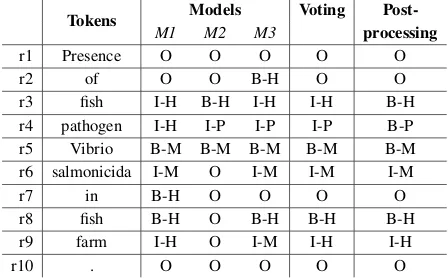
consistent. Post-processing column in the Table
3 illustrates the post-processing resolving
incon-sistent labels after the voting on majority labels,
consider row r3 where post-processing correctly
imposes the semantics of boundary ordering by
changingI-HabitattoB-Habitat.
3.2 Relation Extraction
Deep Learning based methods are state of the art
in relation extraction (Wu and He, 2019; Wang
et al., 2016) but they require large amount of
la-belled training data. In cases when enormous
training data is not available than Kernel methods like Support Vector Machines (SVM) are an op-timal choice. We employed SVM for performing relation extraction. One of the downsides of SVM is that they usually require lots of hand-crafted fea-tures to train properly. Table2lists computed gen-eral and entity features.
Our best model was trained with Radial Ba-sis Function (RBF) Kernel with value of penalty
parameter C determined by grid search for each
General Features Description Entity Features Description
bow bag-of-words (bow) representation entity-pos position of entity in the bow of the complete sentence representation
bow-partial
bow representation of the between context (i.e. word tokens between
entity-type type of the entity mentions target entities) including three
words to the target entities
bow-lemma bow representation of the lemmatized dist-entities-cat distance between target entities tokens in the between context as categorical
pos-tags part-of-speech tags dist-entities distance between target entities sdp shortest dependency path as bow entity-count count of entities in between context
sdp-len length of shortest dependency path entity-count-cat count of entities in between context
as scalar as categorical
sdp-rel dependency relation tag e1 type = e2 type if type of e1 and e2 is same emb-sdp average embeddings of sdp sdp-entity sdp with entity as bow
[image:5.595.97.503.63.241.2]keyword-vec if current word is part of feature entity-patterns check if certain linguistic patterns list of relations occur in the vicinity of target entities
Table 2: General and Entity features used in Relation Extraction
Tokens Models Voting
Post-M1 M2 M3 processing
r1 Presence O O O O O
r2 of O O B-H O O
r3 fish I-H B-H I-H I-H B-H
r4 pathogen I-H I-P I-P I-P B-P
r5 Vibrio B-M B-M B-M B-M B-M
r6 salmonicida I-M O I-M I-M I-M
r7 in B-H O O O O
r8 fish B-H O B-H B-H B-H
r9 farm I-H O I-M I-H I-H
r10 . O O O O O
Table 3: NER: Ensembling and Post-processing cor-recting individual models mistakes. Here, B, P and M refer to Habitat, Phenotype and Microorganism, re-spectively.
Surprisingly oversampling did not provide any performance improvement therefore, final models were trained only with higher class weights for mi-nority classes. We did not normalize any input fea-ture as it resulted in reduced performance.
In relation extraction participating entities are not known in advance, the usual practise is to test
every valid pair of entities for a relation. We
employed heuristic of token counts between
en-tities to filter the probable invalid relations. The value of token counts was determined using cross-validation.
3.3 Ensemble Strategy
Bagging is a helpful technique to reduce variance without impacting bias of the learning algorithm.
We employed a variant of Bagging (Breiman,
1996) which makes sure that every sample in the
training set is part of the development set at least
once and vice versa. We created three data folds and trained the model using optimal configuration on each fold, prediction on test involves majority
voting among thethreetrained models.
The commonly used tagging schemes (BIO, BIOES etc.,) for NER contains information about the boundary of an entity along with the class of an entity, which is spitted by the model at each time-step. Due to this dual information in a single output, maximum voting is not trivial as models can not only disagree on the class but also on the boundary of an entity. Empirically we found that our model is better at predicting the class of an entity rather than the boundary of an entity,
there-fore, we followed the strategyclass determines the
boundary. In cases when voting results in a tie, we take the prediction of theconfidentmodel, we treat the model trained on original train/dev split as the confident model. We also experimented with an extreme version of ensembling where we aggre-gate the output of every model with distinct spans, as expected this improves the recall but with the cost of reduced precision. One possible optimiza-tion to this ensemble strategy is to only aggregate the non-overlapping spans to control reduction in precision without much decrease in recall, we will
explore this as a future work. Table 3shows the
ensemble correcting individual model’s erroneous predictions.
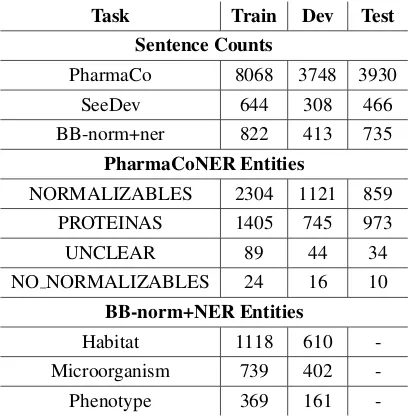
[image:5.595.73.297.284.423.2]Task Train Dev Test
Sentence Counts
PharmaCo 8068 3748 3930
SeeDev 644 308 466
BB-norm+ner 822 413 735
PharmaCoNER Entities
NORMALIZABLES 2304 1121 859
PROTEINAS 1405 745 973
UNCLEAR 89 44 34
NO NORMALIZABLES 24 16 10
BB-norm+NER Entities
Habitat 1118 610
-Microorganism 739 402
-Phenotype 369 161
-Table 4: Dataset statistics for NER
4 Experiments and Results
4.1 Dataset and Experimental Setup
Data:We employed bagging (discussed in section 3.3) to split the annotated corpus into 3-folds. We used pre-processed versions of datasets for
BB-norm+NER4 and SeeDev5 provided by the
orga-nizers. This pre-processed version comes with
sentence splitting, word tokenization and POS tag-ging.
PharmaCoNER: The dataset consists of four
entity types with very few mentions of type
UN-CLEAR andNO NORMALIZABLES as shown in
table4. Entities of typeUNCLEARare ignored in
the evaluation of this shared task but we still treat them as regular entities.
BB-norm+NER: The dataset consists of three
entity types with few mentions of typePhenotype
(see table4). The dataset also contains3.6%
dis-connected entities6, we did not employ any strat-egy to handle disconnected entities and instead treat them as separate (regular) entities.
SeeDev: The dataset consists of 22
bi-nary relations among 16 entity types. The
dataset is highly imbalanced with zero instances
of type Regulates Molecule Activity and
Com-poses Protein Complex in the default develop-ment set.
4
https://sites.google.com/view/ seedev2019/supporting-resources
5
https://sites.google.com/view/ bb-2019/supporting-resources
6https://groups.google.com/d/msg/
bb-2019/A2MuFYiPQIY/9YtMmakeBQAJ
Hyper-parameter Value
NER
learning rate 0.005
character (char) dimension 25
hidden unit::char LSTM 25
POS dimensions 25∗,50+
Ortho dimension 25∗,50+
hidden unit::word LSTM 200∗,100+
word embeddings dimension 200∗,100+
length dimension 10
sdp rel 10
alpha features 2
ranking loss::α 1.0
ranking loss::γ 1.0
RE
kernel RBF
[image:6.595.319.511.60.296.2]class-weights 10.0
Table 5: Hyper parameter settings for NER and RE. * and + denote the optimal parameters for BB-norm+ner and PharmaCoNER respectively.
Experimental Setup: We found sub-word in-formation to be very helpful in identifying enti-ties and relations in biomedical domain and all our experiments used word embeddings trained
using FastText (Bojanowski et al., 2017). For
tasks in English language we used FastText
em-beddings trained on PubMed (Zhang et al.,2019).
We don’t employ any strategy for handling imbal-anced classes for NER but have used class
weight-ing by a factor of 10 for all positive classes for
RE. Table5 lists the best configuration of
hyper-parameters for all the tasks.
PharmaCoNER: We used SPACCC
POS-TAGGER (Soares and gonzalez agirre, 2019) for sentence splitting, word tokenization and POS tagging. We trained FastText embeddings
on the following corpora: IBECS (Rodr´ıguez,
2002), IULA-Spanish-English-Corpus (Marimon
et al., 2017), MedlinePlus (Miller et al., 2000),
PubMed (Lu,2011), ScIELO (Goldenberg et al.,
2007) and PharmaCoNer (Gonzalez-Agirre et al.,
2019). We trained embeddings on two variants
[image:6.595.79.283.62.271.2]Configration PharmaCoNER BB-norm+NER
P R F1 P R F1 SER
Fold=1 Fold=1 r1 BiLSTM-CRF .884 .773 .824 .809 .474 .598 .576 r2 + word-emb .892 .857 .874 .831 .526 .644 .524 r3 + ortho .909 .846 .877 .823 .515 .633 .533 r4 + POS .906 .851 .877 .827 .523 .641 .526 r5 + multi-task .907 .851 .878 .806 .528 .638 .531
r6 + length - - - .842 .487 .617 .545
r7 + ranking .912 .860 .885 .827 .535 .650 .520
r8 + search - - - .810 .600 .690 .489
Fold=2 Fold=2 r9 BiLSTM-CRF .915 .890 .902 .630 .400 .489 -r10 all features .934 .889 .911 .719 .513 .599
-Fold=3 Fold=3 r11 BiLSTM-CRF .899 .873 .886 .784 .699 .739 -r12 all features .917 .877 .896 .813 .764 .788
-Table 6: Scores on dev set using different features on PharmaCoNERandBB-norm+NERtasks. Here, + sig-nifies feature accumulation to the last row.
provided by the organizers on the dev set7.
BB-norm+NER: For training NER model we compute macro-F18(Tsai et al.,2006) on the dev set. NER and Entity normalization together are
evaluated usingStandard Error Rate (SER)(Bossy
et al.,2015). During the entity normalization step, the fuzzy and semantic search can resolve an entity mention to multiple normalization identifiers. Our
algorithm returns top5 matched identifiers,
how-ever, we empirically found selecting the top most identifier gives superior performance.
SeeDev: We adopted two strategies to create negative relation instances for train and dev+test
set: (1)Train: only consider sentences not
par-ticipating in any positive relation (2) Dev+Test:
consider all the sentences. Negative relation in-stances are always created only among the valid combination of entity types. We also employed an
extended version of keywords match of Li et al.
(2016) as a feature (referred as keyword vectors in table2).
4.2 Results on Development Set
To investigate the impact of features we incremen-tally enabled them and observe the affect on per-formance on dev set.
NER: Table 6 shows the score on dev set for
PharmaCoNERandBB-norm+NER. Observe that
FastText embeddings (row r2) outperform ran-domly initialized embeddings (row r1) and
con-7
https://github.com/PlanTL-SANIDAD/ PharmaCoNER-CODALAB-Evaluation-Script
8evaluation measure with strict boundary detection
Features P R F1
r1 bow-between .0 .0 .0
r2 + class-weights .214 .196 .205 r3 + entity-type .157 .589 .248
r4 + sdp-entity .204 .540 .296
r5 + emb-sdp .212 .479 .294
[image:7.595.73.294.61.252.2]r6 + lemma .220 .478 .301
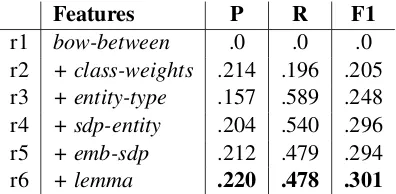
Table 7: Scores on dev set using different features on SeeDevtask. Here, + signifies feature accumulation to the last row.
tribute to biggest performance boost for both
datasets. Subsequently, Orthographic (row r3)
andPOS(row r4) features9improve the scores for
PharmaCoNER but surprisingly lower the score for BB-norm+NER. In row r5, we perform multi-tasking with auxiliary task of NED leading to im-provement only for PharmaCoNER. Next, we in-corporate hybrid loss including ranking (row r7) which consistently improves the score on both datasets. In row r8, we employed Brute Force Search (discussed in section4.3) that significantly reduce SER for BB-norm+NER. Finally, we cre-ate an ensemble of (r7, r10, r12) and (r8, r10, r12) on test set for PharmaCoNER and BB-norm+NER respectively.
RE: Table 7 shows the score on dev set for
SeeDev10. In row r1, negative instances dominate the training set resulting in no learning. Observe that introduction of class weights (row r2) com-pensate the dominance of negative instances
lead-ing to F1 score of0.205. Next, we added
entity-type(row r3) andsdp-entity(row 4) features, both
of these features significantly improves F1 score
i.e. by an absolute value of more than 4.0.
Sub-sequently, emb-sdp (row r5) and lemma(row r6)
contribute to incremental improvements. Finally,
we create an ensemble ofrow r6on all three data
folds.
4.3 Analysis on Development Set
BB-norm+NER: We also explored approaching the problem of NER and entity normalization in a reverse manner by matching every entity
men-tion from the biomedical databases (i.e.NCBI
Tax-onomyandOntobiotope) in every sentence. This
9Additionally, we have employed document-topic
propor-tion from neural topic models (Gupta et al.,2019a), however, no significant gains were observed.
10Results are only reported for standard data fold as it was
[image:7.595.318.516.62.159.2]0.4 0.6 0.8 1
bfs
L1
bfs+L1
bfs+L1+L2
0.92
0.83 0.81
0.61
0.32
0.54 0.6
0.64 0.7
0.52 0.49
0.66
[image:8.595.249.516.61.262.2]precision recall SER
Figure 3: BB-norm+NER: Impact of brute-force search, Level1 NER and their aggregation on SER. Here bfs, L1 and L2 refer tobrute-force search,Level1 NERandLevel2 Nested NERrespectively.
matching is indeed exhaustive search, we refer to
it asBrute-force search. Figure3shows the
com-parison of: (1)brute-force search(2)Level1 NER
(3) aggregation of brute-force search andLevel1
NER(4) aggregation ofbrute-force search,Level1
NER and Level2 NER. Brute-force search yields high precision but a moderately low recall with
SER value of 0.7. In comparison, Level1 NER
has significantly higher recall with a little
reduc-tion in precision yielding SER value of0.52. The
aggregation of brute-force search and Level1 NER
improves recall and lowers SER value to0.49.
Fi-nally, aggregation of brute-force search, Level1 NER and Level2 NER results in a balanced pre-cision and recall values but an overall higher value of SER. Our submission on test set employed
ag-gregation ofbrute-force searchandLevel1 NER.
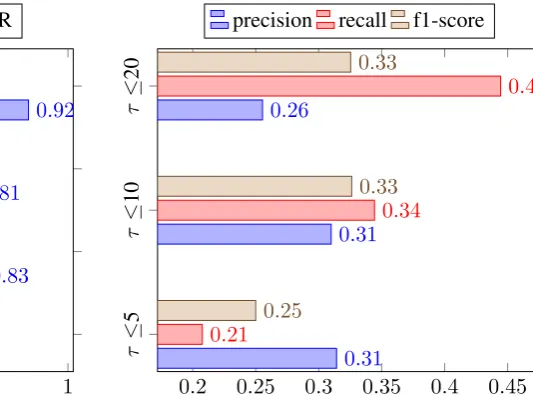
SeeDev: We employed the heuristic of token counts between target entities to filter potential negative relation instances. With this heuristic in place, we only consider sentences with entity
dis-tance less than or equal to threshold parameterτ.
Figure4shows the impact of different values ofτ
on system performance. The value ofτ ≤20gives
significant boost in precision with minor decrease in recall. Our submission employed the threshold
value ofτ ≤20between entity tokens.
4.4 Comparison with Participating Systems
SeeDev: Table 8 (left) is the official result of
SeeDev Shared Task. Our submission MIC-CIS
0.2 0.25 0.3 0.35 0.4 0.45
τ
≤
5
τ
≤
10
τ
≤
20
0.31 0.31 0.26
0.21
0.34
0.44
0.25
0.33 0.33
precision recall f1-score
Figure 4: SeeDev: Impact of ’token counts between target entities’ heuristic on system performance.
Task: SeeDev Task: BB-norm+NER Team P / R /F1 Team P /R / SER
[image:8.595.76.296.61.262.2]MIC-CIS .294/.511/.373 MIC-CIS-1 .624/ .433 /.715 YNU-junyi-1 .272 / .458 / .341 MIC-CIS-2 .560 / .449 / .786 Yunnan University-1 .045 / .132 / .067 BLAIR GMU-1 .496 /.467/ .793 Yunnan University-2 .020 / .132 / .035 BLAIR GMU-2 .499 / .466 / .805 YNUBY-1 .011 / .070 / .019 baseline-1 .572 / .327 / .823
Table 8: Comparison of our system (MIC-CIS) with top-5 participants: Scores on Test set for SeeDev and BB-norm+NER
achieves the best score among all participating
systems with F1 score of 0.373 showing
com-pelling advantage. The system attains the high-est precision (0.294) and recall (0.511). Precision and recall are not balanced however, and our sys-tem need an improvement to bring down false pos-itives.
BB-norm+NER: Table 8 (right) shows the comparison of performance among participating teams on BB-norm+NER test set. Our two sub-missions (MIC-CIS-1, MIC-CIS-2) ranked first and second with standard error rate (SER) of
0.7159and0.7867respectively. The second sub-mission employed Level2 NER to extract nested entities and hence has higher recall but with
re-duced precision. MIC-CIS-1has the highest
pre-cision 0.6242 andMIC-CIS-2has the recall close
to the best recall of BLAIR GMU-1 with score
[image:8.595.311.533.317.388.2]5 Conclusion and Future Work
In this paper, we described our system with which
we participate inPharmaCoNER,BB-norm+NER
and SeeDevshared tasks. Our NER system em-ployed linguistic features, multi-tasking via auxil-iary objectives and hybrid loss including ranking loss to extract flat and nested entities in English and Spanish text. Our RE system employed SVM with linguistic features. Compared to other
par-ticipating systems, our submissions are ranked1st
in BB-norm+NER and SeeDev task. Our system demonstrates competitive performance on
Phar-maCoNER with F1-score of0.8662.
In future, we would like to explore improved modelling strategies for nested NER and discon-tinuous entities extraction. Further, in this work we only addressed intra-sentence RE, we would be interested to explore approaches for inter-sentence RE (Peng et al.,2017;Gupta et al.,2019b). More-over, we would like to investigate interpretability
of LSTMs for NER and RE (Gupta and Sch¨utze,
2018).
Acknowledgment
This research was supported by
Bun-deswirtschaftsministerium (bmwi.de), grant
01MD19003E (PLASS, plass.io) at Siemens AG -CT Machine Intelligence, Munich Germany.
References
Gustavo Aguilar, Suraj Maharjan, Adri´an Pastor L´opez-Monroy, and Thamar Solorio. 2017. A multi-task approach for named entity recognition in social media data. In Proceedings of the 3rd Workshop on Noisy User-generated Text, NUT@EMNLP 2017, Copenhagen, Denmark, September 7, 2017, pages 148–153.
Piotr Bojanowski, Edouard Grave, Armand Joulin, and Tomas Mikolov. 2017. Enriching word vectors with subword information. TACL, 5:135–146.
Robert Bossy, Louise Del´eger, Estelle Chaix, Mouhamadou Ba, and Claire Nedellec. 2019. Bacteria Biotope at BioNLP Open Shared Tasks 2019. In Proceedings of the BioNLP Open Shared Tasks 2019 Workshop.
Robert Bossy, Wiktoria Golik, Zorana Ratkovic, Di-alekti Valsamou, Philippe Bessi`eres, and Claire Nedellec. 2015. Overview of the gene regulation network and the bacteria biotope tasks in bionlp’13 shared task. InBMC Bioinformatics.
Leo Breiman. 1996. Bagging predictors. Machine Learning, 24(2):123–140.
Estelle Chaix, Bertrand Dubreucq, Abdelhak Fatihi, Dialekti Valsamou, Robert Bossy, Mouhamadou Ba, Louise Del´eger, Pierre Zweigenbaum, Philippe Bessi`eres, Lo¨ıc Lepiniec, and Claire Nedellec. 2016. Overview of the regulatory network of plant seed de-velopment (seedev) task at the bionlp shared task 2016. In Proceedings of the 4th BioNLP Shared Task Workshop, BioNLP 2016, Berlin, Germany, Au-gust 13, 2016, pages 1–11.
Ronan Collobert and Jason Weston. 2008. A unified architecture for natural language processing: deep neural networks with multitask learning. In Ma-chine Learning, Proceedings of the Twenty-Fifth In-ternational Conference (ICML 2008), Helsinki, Fin-land, June 5-9, 2008, pages 160–167.
Saul Goldenberg, Regina C´elia Figueiredo Castro, and Fernando Redondo Moreira Azevedo. 2007. [ scielo (scientific electronic library online) statistical data interpretation]. Acta cirurgica brasileira, 22 1:1–7.
Aitor Gonzalez-Agirre, Montserrat Marimon, Ander Intxaurrondo, Obdulia Rabal, Marta Villegas, and Martin Krallinger. 2019. Pharmaconer: Pharmaco-logical substances, compounds and proteins named entity recognition track. In Proceedings of the BioNLP Open Shared Tasks (BioNLP-OST), Hong Kong, China. Association for Computational Lin-guistics.
Pankaj Gupta, Yatin Chaudhary, Florian Buettner, and Hinrich Sch¨utze. 2019a. Document informed neural autoregressive topic models with distributional prior. In The Thirty-Third AAAI Conference on Artificial Intelligence, AAAI 2019, The Thirty-First Innova-tive Applications of Artificial Intelligence Confer-ence, IAAI 2019, The Ninth AAAI Symposium on Ed-ucational Advances in Artificial Intelligence, EAAI 2019, Honolulu, Hawaii, USA, January 27 - Febru-ary 1, 2019., pages 6505–6512.
Pankaj Gupta, Subburam Rajaram, Hinrich Sch¨utze, and Thomas A. Runkler. 2019b. Neural relation extraction within and across sentence boundaries. In The Thirty-Third AAAI Conference on Artificial Intelligence, AAAI 2019, The Thirty-First Innova-tive Applications of Artificial Intelligence Confer-ence, IAAI 2019, The Ninth AAAI Symposium on Ed-ucational Advances in Artificial Intelligence, EAAI 2019, Honolulu, Hawaii, USA, January 27 - Febru-ary 1, 2019., pages 6513–6520.
Pankaj Gupta, Benjamin Roth, and Hinrich Sch¨utze. 2018. Joint bootstrapping machines for high con-fidence relation extraction. In Proceedings of the 2018 Conference of the North American Chapter of the Association for Computational Linguistics: Human Language Technologies, NAACL-HLT 2018, New Orleans, Louisiana, USA, June 1-6, 2018, Vol-ume 1 (Long Papers), pages 26–36.
pattern transformation. InProceedings of the Work-shop: Analyzing and Interpreting Neural Networks for NLP, BlackboxNLP@EMNLP 2018, Brussels, Belgium, November 1, 2018, pages 154–164.
Pankaj Gupta, Hinrich Sch¨utze, and Bernt Andrassy. 2016. Table filling multi-task recurrent neural net-work for joint entity and relation extraction. In COLING 2016, 26th International Conference on Computational Linguistics, Proceedings of the Con-ference: Technical Papers, December 11-16, 2016, Osaka, Japan, pages 2537–2547.
Nanda Kambhatla. 2004. Combining lexical, syntactic, and semantic features with maximum entropy mod-els for extracting relations. In Proceedings of the ACL 2004 on Interactive Poster and Demonstration Sessions, ACLdemo ’04, Stroudsburg, PA, USA. As-sociation for Computational Linguistics.
John D. Lafferty, Andrew McCallum, and Fernando C. N. Pereira. 2001. Conditional random fields: Probabilistic models for segmenting and labeling se-quence data. InProceedings of the Eighteenth Inter-national Conference on Machine Learning (ICML 2001), Williams College, Williamstown, MA, USA, June 28 - July 1, 2001, pages 282–289.
Guillaume Lample, Miguel Ballesteros, Sandeep Sub-ramanian, Kazuya Kawakami, and Chris Dyer. 2016. Neural architectures for named entity recognition. In NAACL HLT 2016, The 2016 Conference of the North American Chapter of the Association for Computational Linguistics: Human Language Tech-nologies, San Diego California, USA, June 12-17, 2016, pages 260–270.
Jake Lever and Steven J. Jones. 2016. VERSE: event and relation extraction in the bionlp 2016 shared task. InProceedings of the 4th BioNLP Shared Task Workshop, BioNLP 2016, Berlin, Germany, August 13, 2016, pages 42–49.
Chen Li, Zhiqiang Rao, and Xiangrong Zhang. 2016. Litway, discriminative extraction for different bio-events. In Proceedings of the 4th BioNLP Shared Task Workshop, BioNLP 2016, Berlin, Germany, Au-gust 13, 2016, pages 32–41.
Zhiyong Lu. 2011. Pubmed and beyond: a survey of web tools for searching biomedical literature. Database, 2011.
Montserrat Marimon, Jorge Vivaldi, and N´uria Bel. 2017. Annotation of negation in the IULA Spanish clinical record corpus. InProceedings of the Work-shop Computational Semantics Beyond Events and Roles, pages 43–52, Valencia, Spain. Association for Computational Linguistics.
Ryan T. McDonald, Fernando C. N. Pereira, Seth Kulick, R. Scott Winters, Yang Jin, and Peter S. White. 2005. Simple algorithms for complex rela-tion extracrela-tion with applicarela-tions to biomedical IE. In ACL 2005, 43rd Annual Meeting of the Asso-ciation for Computational Linguistics, Proceedings
of the Conference, 25-30 June 2005, University of Michigan, USA, pages 491–498.
Naomi Miller, Eve-Marie Lacroix, and Joyce E. B. Backus. 2000. Medlineplus: building and main-taining the national library of medicine’s consumer health web service. Bulletin of the Medical Library Association, 88 1:11–7.
Nanyun Peng, Hoifung Poon, Chris Quirk, Kristina Toutanova, and Wen-tau Yih. 2017. Cross-sentence n-ary relation extraction with graph lstms. TACL, 5:101–115.
Marek Rei. 2017. Semi-supervised multitask learn-ing for sequence labellearn-ing. In Proceedings of the 55th Annual Meeting of the Association for Compu-tational Linguistics, ACL 2017, Vancouver, Canada, July 30 - August 4, Volume 1: Long Papers, pages 2121–2130.
Joaqu´ın Alberto Carballido Rodr´ıguez. 2002. [the spanish bibliographic index of the health sciences (ibecs) and actas urol´ogicas espa˜nolas]. Actas uro-logicas espanolas, 26 6:381–3.
C´ıcero Nogueira dos Santos, Bing Xiang, and Bowen Zhou. 2015. Classifying relations by ranking with convolutional neural networks. In Proceedings of the 53rd Annual Meeting of the Association for Computational Linguistics and the 7th International Joint Conference on Natural Language Process-ing of the Asian Federation of Natural Language Processing, ACL 2015, July 26-31, 2015, Beijing, China, Volume 1: Long Papers, pages 626–634.
Burr Settles. 2004. Biomedical named entity recog-nition using conditional random fields and rich fea-ture sets. In Proceedings of the International Joint Workshop on Natural Language Processing in Biomedicine and its Applications, NLPBA/BioNLP 2004, Geneva, Switzerland, August 28-29, 2004.
Felipe Soares and Aitor gonzalez agirre. 2019. Spaccc-pos-tagger. Funded by the Plan de Impulso de las Tecnologas del Lenguaje (Plan TL).
Richard Tzong-Han Tsai, Shih-Hung Wu, Wen-Chi Chou, Yu-Chun Lin, Ding He, Jieh Hsiang, Ting-Yi Sung, and Wen-Lian Hsu. 2006. Various criteria in the evaluation of biomedical named entity recog-nition.BMC Bioinformatics, 7:92.
Ngoc Thang Vu, Pankaj Gupta, Heike Adel, and Hin-rich Sch¨utze. 2016. Bi-directional recurrent neu-ral network with ranking loss for spoken language understanding. In 2016 IEEE International Con-ference on Acoustics, Speech and Signal Process-ing, ICASSP 2016, Shanghai, China, March 20-25, 2016, pages 6060–6064.
Shanchan Wu and Yifan He. 2019. Enriching pre-trained language model with entity information for relation classification. CoRR, abs/1905.08284.