Learning Compositionality Functions on Word Embeddings
for Modelling Attribute Meaning in Adjective-Noun Phrases
Matthias Hartung Fabian Kaupmann Soufian Jebbara Philipp Cimiano Semantic Computing Group
CITEC, Bielefeld University
{mhartung,fkaupmann,sjebbara,cimiano}@techfak.uni-bielefeld.de
Abstract
Word embeddings have been shown to be highly effective in a variety of lexical se-mantic tasks. They tend to capture mean-ingful relational similarities between in-dividual words, at the expense of lack-ing the capabilty of maklack-ing the underly-ing semantic relation explicit. In this
pa-per, we investigate the attribute relation
that often holds between the constituents of adjective-noun phrases. We use CBOW word embeddings to represent word mean-ing and learn a compositionality function that combines the individual constituents into a phrase representation, thus captur-ing the compositional attribute meancaptur-ing. The resulting embedding model, while be-ing fully interpretable, outperforms count-based distributional vector space models that are tailored to attribute meaning in the two tasks of attribute selection and phrase similarity prediction. Moreover, as the model captures a generalized layer of at-tribute meaning, it bears the potential to be used for predictions over various attribute inventories without re-training.
1 Introduction
Attributes such as SIZE, WEIGHT or COLOR are
part of the building blocks of representing knowl-edge about real-world entities or events (Barsalou, 1992). In natural language, formal attributes find their counterpart in attribute nouns which can be used in order to generalize over individual
proper-ties, e.g.,bigorsmall in case ofSIZE,blueorred
in case ofCOLOR(Hartung, 2015).
In order to ascribe such properties to entities or events, adjective-noun phrases are a very frequent linguistic pattern. In these constructions, attribute
meaning is conveyed only implicitly, i.e., with-out being overtly realized at the phrasal surface.
Hence,attribute selectionhas been defined as the
task of predicting the hidden attribute meaning ex-pressed by a property-denoting adjective in com-position with a noun (Hartung and Frank, 2011b), as in the following examples:
(1) a.hot summer→TEMPERATURE
b.hot debate→EMOTIONALITY
c.hot soup→TASTE/TEMPERATURE
Previous work on this task has largely been car-ried out in distributional semantic models (cf. Har-tung (2015) for an overview). In the face of the re-cent rise of distributed neural representations as a means of capturing lexical meaning in NLP tasks (Collobert et al., 2011; Mikolov et al., 2013a; Pen-nington et al., 2014), our goal in this paper is to model attribute meaning based on word embed-dings. In particular, we use CBOW embeddings of adjectives and nouns (Mikolov et al., 2013a) as underlying word representations and train a com-positionality function in order to compute a phrase representation that is predictive of the implicitly conveyed attribute meaning.
In fact, word embeddings (also referred to as
predict models) have been shown to be highly ef-fective in a variety of lexical semantic tasks (Ba-roni et al., 2014b), compared to “traditional”
dis-tributional semantic models (or count models) in
the tradition of Harris (1954). However, this find-ing has been refuted to a certain extent by Levy et al. (2015), stating that much of the perceived supe-riority of word embeddings is due to hyperparam-eter optimizations rather than principled advan-tages. Moreover, the authors found that in many cases, tailoring count models to a particular task at hand is both feasible and beneficial in order to outperform the more generic embeddings.
This sheds light on a definitive plus of count models, viz. their transparency and interpretabil-ity in the sense that their semantic similarinterpretabil-ity rat-ings can (under certain conditions) be traced back to particular semantic relations, whereas word em-beddings typically yield rather vague and diver-sified similarities (Erk, 2016). Due to this lack in interpretability, word embeddings are not eas-ily interoperable with symbolic lexical resources or ontologies. Thus, we argue that modelling attribute meaning poses an interesting challenge to word embeddings for two reasons: First, be-ing rooted in ontological knowledge, attribute meaning clearly draws on interpretability of the underlying model; second, attribute meaning in adjective-noun phrases is conveyed in composi-tional processes (cf. Ex. (1)) which are under-researched in the context of word embeddings so far (Manning, 2015).
Our main contributions in this paper are: (i) We demonstrate that word embeddings can be suc-cessfully harnessed for attribute selection – a task that requires both compositional and interpretable representations of phrase meaning. (ii) This is
achieved via a learned compositionality functionf
on adjective and noun embeddings that carves out attribute meaning in their compositional phrase
meaning. (iii) We show that f captures
gener-alized attribute meaning (cf. Bride et al. (2015)) that abstracts from individual attributes. Thus, af-ter fitting the compositionality function, our model bears the potential of being applied to various ap-plication scenarios (e.g., aspect-based sentiment analysis) involving diverse attribute inventories. (iv) We show that the same model also scales to the task of predicting semantic similarity of adjective-noun phrases, which indicates both the robustness of the model and the importance of attribute mean-ing as a major source of phrase similarity.
2 Related Work
Attribute Learning from Adjectives and Nouns. Adjective-centric approaches to attribute learn-ing from text date back to Almuhareb (2006) and Cimiano (2006). Bakhshandeh and Allen (2015) present a sequence tagging model in order to extract attribute nouns from adjective glosses in WordNet. Most recently, Petersen and Hell-wig (2016) use a clustering approach based on adjective-noun co-occurrences in order to induce clusters of German adjectives that constitute the
value space of an attribute. However, their ap-proach falls short of making the respective at-tribute explicit.
These approaches have in common that they do not consider the compositional semantics of an ad-jective in its phrasal context with a noun in order to derive attribute meaning. This is in contrast to Hartung and Frank (2010; 2011b) who frame at-tribute selection in a distributional count model which (i) encodes adjectives and nouns as distri-butional word vectors over attributes as shared di-mensions of meaning and (ii) uses vector mixture operations in order to compose these word vec-tors into phrase reresentations that are predictive of compositional attribute meaning.
Tandon et al. (2014) propose a semi-supervised method for populating a knowledge base with triples of nouns, attributes and adjectives that are acquired from adjective-noun phrases. Being based on label propagation over monosemous ad-jectives as seeds, their approach depends on a lex-ical resource providing initial mappings between adjectives and attributes.
The present approach and the work by Hartung and Frank may be considered as pairs of opposites in two respects: First, our model is based on pre-trained CBOW word embeddings for representing adjective and noun meaning. Thus, we do not en-code any attribute-specific lexical information ex-plicitly at the level of word representation. Sec-ond, we apply function learning in order to em-pirically induce a compositionality function that is trained to promote aspects of attribute meaning in adjective-noun phrase embeddings.
Compositionality. Modelling compositional
processes at the intersection of word and phrase meaning in distributional semantic models has attracted considerable attention in the last years (Erk, 2012). Mitchell and Lapata (2010) have promoted a variety of vector mixture models for the task, which have been criticized for their syntactic agnosticism (Baroni and Zamparelli, 2010; Guevara, 2010).
2014a) that is centered around functional appli-cation as the general process to model composi-tionality in semantic spaces, thus emphasizing the insight that different linguistic phenomena require to be modeled in corresponding algebraic struc-tures and composition operators matching these structures (cf. Widdows (2008), Grefenstette and Sadrzadeh (2011), Grefenstette et al. (2014)).
Bride et al. (2015) observe that such composi-tion operators, by being trained on empirical cor-pus data, can either be tailored to specific lexical types (i.e., individual composition functions for each adjective in the corpus), or designed to cap-ture general compositional processes in syntactic configurations (i.e., a single lexical function for all adjective-noun phrases). In line with these au-thors, we aim at learning a lexical function which captures attribute meaning in the compositional
semantics of adjective-noun phrases, while
gener-alizingover individual attributes.
Contrary to distributional count models, there is relatively few work on applying word embeddings to linguistic problems or NLP tasks related to compositionality. Notable exceptions are Socher et al. (2013) for sentiment analysis, as well as Salehi et al. (2015) and Cordeiro et al. (2016) who focus on predicting the degree of compositional-ity in nominal compounds rather than carving out a particular semantic relation that is expressed in their compositional semantics.
3 Learning Attribute Meaning in Word Embeddings
3.1 Attribute Meaning in Natural Language Natural language refers to ontological attributes
in terms of attribute nouns such as color, sizeor
shape(Guarino, 1992; L¨obner, 2013). Therefore, despite remaining mostly implicit in adjective-noun phrases (cf. Ex. (1) above), we hypothesize that attribute meaning can be learned from contex-tual patterns of attribute nouns in natural language
text. This leads us to the assumption that
adjec-tives, nouns and attributes (via attribute nouns) can be embedded in the same semantic space.
3.2 Compositional Models of Attribute Meaning
In this work, we aim at a compositional approach to attribute meaning in adjective-noun phrases. As a consequence of the above assumption, our model represents adjectives, nouns and attributes as
vec-tors~a, ~n and attr~ , respectively, in one and the
same embedding spaceS ⊆Rd.
By designing a composition function f(~a, ~n)
that produces phrase representations ~p ∈ S, we
can use nearest neighbour search in S in order
to predict the attribute attrd that is most likely
expressed in the compositional semantics of an
adjective-noun phrasep:
d
attr := arg max
attr∈Acos(~p, ~attr) (2)
where ~p = f(~a, ~n), cos denotes cosine vector
similarity and A the set of all attributes
consid-ered. The compositional functions that we use in this work can be divided into baseline models, largely derived from Mitchell and Lapata (2010), and trainable models.
3.2.1 Baseline Models
Adjective or Noun. The simplest model is to
skip any composition and just use the representa-tion of the adjective or the noun as a surrogate:
~p=~aor~p=~n, respectively.
Pointwise Vector Addition. The first step in the
direction of compositionality is pointwise vector
addition: ~p =~a+~n. According to Mitchell and
Lapata (2010), the commutativity of addition is a disadvantage because the model ignores word or-der and thus syntactic information is lost.
Weighted Vector Addition. For the latter
rea-son, Mitchell and Lapata (2010) also propose a weighted variant of pointwise vector addition. In order to account for possibly different contribu-tions of the constituents to phrasal composition,
scalar weights α and β are applied to the word
vectors before pointwise addition:~p=α~a+β~n.
Pointwise Vector Multiplication. This
compo-sition function multiplies the individual
dimen-sions of the adjective and noun vector:pi =ai·bi.
Mitchell and Lapata (2010) point out that vector multiplication can be seen as equivalent to logical intersection. In previous work on attribute selec-tion in a count-based distribuselec-tional framework, the best results were obtained using pointwise multi-plication (Hartung, 2015).
Dilation. The dilation model of Mitchell and
to be basis-independent:
~p= (~n·~n)~a+ (λ−1)(~n·~a)~a (3)
Here, ~n is stretched by a factor λ to emphasize
the contribution of~a. λis a parameter that has to
be chosen manually. Analogously, dilation of the adjective is possible as well.
3.2.2 Trainable Models
In this section, we present a method for supervised training of compositionality functions. We pro-pose additive and multiplicative models that use weighting matrices or tensors to balance the con-tributions of adjectives and nouns. The compo-sition is trained to specifically capture attribute meaning in the resulting phrase representation. The weights are trained as part of a shallow neural network (see Section 3.2.3).
Full Weighted Additive Model. Following
Guevara (2010), the full additive model capitalizes on vector addition with weighting matrices for ad-jective and noun:
~p=A·~a+N·~n (4) As initializations of the weighting matrices, we
use an identity matrix1, which is equivalent to
non-parametric vector addition. As weighting schemes, we use one of (i) weighting only the ad-jective or noun, respectively, or (ii) weighting both adjective and noun distinctly.
Note that, in line with Guevara (2010), this model makes use of weight matrices in order to balance the contribution of adjectives and nouns to phrasal attribute meaning, whereas Mitchell and Lapata (2010) use scalar weights in their pointwise additive model (cf. Section 3.2.1). Our intuition is that full additive models should be better suited to model compositonal processes that involve inter-actions between dimensions of meaning.
Trained Tensor Product. As a weighted
mul-tiplicative model, we use multiplication of adjec-tive and noun representations with a learned
third-order tensorT, following Bride et al. (2015):
~p=~aT ·T[1:d]·~n (5)
with~a∈Rd, ~n∈Rd, T[1:d]∈Rd×d×d
1We also experimented with different initializations such
as random values, all-ones, or an identity matrix with addi-tional small random values on non-diagonal elements, but found the identity matrix to work best.
In order to compose a phrase representation ~p
from~aand~n,T is applied to the adjective vector
in a tensor dot product. The tensor dot product multiplies components of vector and tensor and sums along the third axis of the tensor:
Xi,j = d X
k=1
ak·Ti,j,k (6)
withdbeing the dimensionality of the word
em-beddings. Equation (6) results in a matrixXthat
is multiplied with the noun vector in a second step
using common matrix multiplication:~p=X·~n.
Note that the latter step corresponds to
func-tional application of the adjective to the noun as rooted in compositional distributional semantics (Baroni et al., 2014a). The result is a phrase vec-tor with the same dimensionality as adjective and noun. For initialization, we use an identity matrix
for each second-order tensor along the third axis2.
3.2.3 Training Method
The weights of the models in Section 3.2.2 are trained as part of a shallow neural network with no hidden layer. For each adjective-noun phrase and the corresponding ground truth attribute in the training dataset, the respective 300-dimensional
vectors3~a,~nandattr~ are obtained by performing
a look-up in the pre-trained word embeddings.
With~aand~nas its inputs, the neural network
computes a phrase representation~p ∈ R300 at the
output layer. The error of the computed phrase representation to the expected attribute
represen-tation attr~ is computed using the mean squared
error between the two vectors and is used as the training signal for the network parameters. Note that we do not train the embedding vectors along with the connection weights. While this could potentially benefit the results, we aim to explore whether generally trained word embeddings can be used to retrieve attribute meaning.
For our network architectures and
computa-tions, we use the deep learning library keras
(Chollet, 2016). Training takes 10 iterations over the training data; weights are optimized using the
stochastic optimization method Adam (Kingma
and Ba, 2015). For the use of pre-trained word
2We found a random initialization of all entries to perform
substantially worse.
3This is the number of dimensions in the pre-trained word
vectors (Mikolov et al., 2013b)4in a Python
envi-ronment, we rely on theGensimlibrary ( ˇReh˚uˇrek
and Sojka, 2010).
4 Attribute Selection Experiments
In this experiment, we evaluate the compositional models defined in Section 3.2 on the attribute se-lection task.
4.1 Data
We use the HeiPLAS data set (Hartung, 2015) which contains adjective-attribute-noun triples that were heuristically extracted from WordNet (Miller and Fellbaum, 1998) and manually filtered by linguistic curators. The data is separated into development and test set (comprising 869 and 729 triples, respectively, which correspond to a to-tal of 254 target attributes). The target attributes are subdivided into various semantically homoge-neous subsets, as shown in Table 1. Due to cov-erage issues in the pre-trained word2vec embed-dings (Mikolov et al., 2013a), some adjectives and nouns from HeiPLAS cannot be projected into the
embedding space5.
4.2 Experiment 1: Large-scale Attribute Selection
Experimental Procedure. Composition models
as described in Section 3.2.2 are trained on all triples in HeiPLAS-Dev (following the proce-dure described in Section 3.2.3) and evaluated on HeiPLAS-Test. The word vector representations corresponding to the adjective and the noun in a test triple are composed into a phrase vector by applying the trained composition function. Using
nearest neighbour search inSas described in
Sec-tion 3.2, all test attributes are ranked wrt. their sim-ilarity to the composed phrase vector. For
eval-uation, we use precision-at-rank to measure the
number of times the correct attribute is ranked as most similar to the phrase vector or among the first five ranks (P@1 and P@5, respectively).
Baseline Semantic Spaces. We directly
com-pare our approach against the results of two count-based distributional models, C-LDA and L-LDA (Hartung, 2015), on the same evaluation data. C-LDA and L-C-LDA induce distributional adjective
4Available from https://drive.google.com/ file/d/0B7XkCwpI5KDYNlNUTTlSS21pQmM/ edit?usp=sharing
5This affects 54 triples in HeiPLAS-Dev and 44 triples in
HeiPLAS-Test, which were removed from the evaluation.
and noun vectors over attributes as dimensions of meaning, which are composed into phrase repre-sentations using pointwise vector multiplication. Using these models for comparison enables us to assess both the impact of different types of word representations (dense CBOW word embed-dings vs. specifically tailored attribute-based dis-tributional word vectors) and different approaches to compositionality (pre-defined vector mixture operations on attribute-specific word representa-tions vs. trained composition funcrepresenta-tions for pro-moting generalized attribute meaning in word em-beddings).
Results. Results of Experiment 1 are shown in
Table 2. The upper part of the table contains the results based on word embeddings (comprising non-parametric, parametric, dilation and trainable composition models); the count-based C-LDA and L-LDA baselines are displayed below.
Focussing on the non-parametric models first, we find that relying on the adjective embedding as a surrogate of a composed representation already outperforms both count models by a wide margin. This indicates a clear advantage of CBOW embed-dings over count-based representations for captur-ing attribute meancaptur-ing at the word level. However, this holds only for adjectives; noun embeddings in isolation perform much worse.
This is confirmed by the dilation results: Di-lating the noun representation into the direction of the adjective performs considerably better than vice versa, while there is no improvement beyond the non-compositional adjective baseline. These findings are in line with Hartung (2015) and Har-tung and Frank (2011a) who also observed that ad-jective representations capture more of the com-positional attribute semantics in adjective-noun phrases than noun representations do.
Considering the trained composition models, we find that weighting either the adjective or the noun in a full additive model substantially outper-forms the respective non-compositional baseline. The overall best results are obtained by assigning trained weights to both the adjective and the noun embedding (P@1=0.56). This model also
out-performs weighted vector addition6 using scalar
weights by great margins.
6The weighted vector addition scores shown in Table 2 are
Subset AttributesNum. Train. TriplesNum. Example Phrases
Core 10 72 silvery hair(COLOR),huge wave(SIZE),longstanding conflict(DURATION) Selected 23 153 sufficient food(QUANTITY),grave decision(IMPORTANCE),broad river(WIDTH) Measurable 65 261 heavy load(WEIGHT),short hair(LENGTH),slow walker(SPEED)
Property 73 300 young people(AGE),high mountain(HEIGHT),straight line(SHAPE)
All 254 869 dry paint(WETNESS),scentless wisp(SMELL),vehement defense(STRENGTH)
Table 1: Overview of subsets of attributes contained in HeiPLAS data, together with example phrases
Compositional Model P@1 P@5
predict
models
Adjective 0.33 0.50
Noun 0.03 0.10
Vector Addition (⊕) 0.24 0.45 Weighted Vector Addition 0.33 0.51 Vector Multiplication () 0.00 0.02 Adj. Dilation (λ= 2) 0.06 0.18 Noun Dilation (λ= 2) 0.33 0.51 Full Add. Weighted Noun 0.33 0.54 Full Add. Weighted Adjective 0.46 0.71 Full Add. Weighted Adj. and Noun 0.56 0.75 Trained Tensor Product (⊗) 0.44 0.57
count
[image:6.595.79.292.187.349.2]C-LDA (Hartung, 2015) 0.09 n/a L-LDA (Hartung, 2015) 0.16 n/a
Table 2: Results of Experiment 1; evaluation on all phrases from HeiPLAS-Test
In comparison to the best full additive model, the tensor product underperforms by more than 10 points in P@1 and also falls short of weight-ing only the adjective. This is in line with a gen-eral preference of word embeddings for additive models (Mikolov et al., 2013a), which is also con-firmed by the non-parametric composition func-tions. On the other hand, we conjecture that the relatively small size of the training set used here
is not sufficient for optimally tuning the3003
pa-rameters in the learned tensor.
4.3 Experiment 2: Generalization Power In this experiment, we are interested in assessing the generalization power of the best-performing composition function as trained in Experiment 1. More precisely, we investigate the hypothesis that a full additive model captures a generalized com-positional process in the semantics of attribute-denoting adjective-noun phrases rather than the lexical meaning of individual attributes (cf. Bride et al. (2015)).
We evaluate this hypothesis wrt. (i) the fit of the composition function to different subsets of testing
0 0.2 0.4 0.6 0.8 1
Core Selected Measurable Property train-all train-specific zero-shot L-LDA (Baseline)
Figure 1: Attribute selection performance of the full additive model after training on all attributes, specific subsets, and in zero-shot learning
attributes, and (ii) its predictive capacity in a zero-shot learning scenario.
Subsets of Testing Attributes. First, we
com-pare the fit of the composition function that has been trained on all attributes (cf. Experiment 1) on the different subsets of attributes in HeiPLAS-Test, as displayed in Table 1.
The results of this experiment are shown in Fig-ure 1. As can be seen from the solid bars in the plot, the attribute selection performance on indi-vidual subsets is considerably stronger than on the entire inventory, ranging from P@1=0.82 on the Core subset to P@1=0.64 on the Property and Measurable subsets (compared to P@1=0.56 on all attributes; cf. Table 2). The cross-hatched bars in the figure indicate the relative differences that result from re-training a composition function on the specific subset of interest. The improvements are consistently small (max. +0.08 on the Selected and Measurable subsets); in case of the Property subset, there is no difference at all.
Zero-Shot Learning. As defined by Palatucci et
[image:6.595.315.519.189.316.2]un-seen during training. In order to assess the selec-tion performance of our model in a zero-shot set-ting, we create four zero-shot training sets by re-moving from HeiPLAS-Train all attributes that are contained in each of the subsets described in Ta-ble 1, respectively. The corresponding subset from HeiPLAS-Test is used for evaluation afterwards.
The zero-shot results are shown by the diago-nally hatched bars in Fig. 1. We find that Core attributes, without being seen during training, can be predicted at a performance of P@1=0.68. On larger subsets, zero-shot performance decreases (down to P@1=0.32 on Property attributes). Yet, we consider these results very decent overall, given that they are largely comparable or even su-perior (except for the Selected subset) to the best scores of the distributional L-LDA model (Har-tung, 2015) as shown by the plain bars in Fig. 1.
Even though benefits from attribute-specific training cannot be denied, we find that the trained compositionality function is largely capable of generalizing over individual target attributes. 4.4 Discussion
Our experiments on attribute selection show that CBOW word embeddings can be effectively har-nessed for carving out attribute meaning from adjective-noun phrases. Observed improvements over the previous state-of-the-art are due to the type of word representation as such (dense neu-ral embeddings vs. distributional count models) as well as a learned compositionality function based on a full additive model capitalizing on weight matrices for balancing the contributions of adjec-tives and nouns. Moreover, we were able to show that the compositionality function captures a gen-eralized compositional process in the semantics of attribute-denoting adjective-noun phrases rather than the lexical meaning of individual attributes. Therefore, the proposed approach (i) poses an interesting alternative to previous distributional models which explicitly encode attribute meaning in word vectors and rely on vector mixture opera-tions in order to compose them into attribute-based phrase representations, and (ii) bears the potential of being used as a generalized attribute extraction model on various domains of applications that de-mand for different attribute inventories.
5 Similarity Prediction Experiments
In this experiment, we assess the scalability of the previously trained composition models to different tasks by applying them to the prediction of seman-tic similarity in pairs of adjective-noun phrases. 5.1 Data
Our experiments are based on the adjective-noun section of the evaluation data set released by Mitchell and Lapata (2010). It consists of 108 pairs of adjective-noun phrases that were rated for
similarity on a 7-point scale7by 54 human judges.
In total, the data set comprises 1944 data points. 5.2 Experiment 3: Predicting
Adjective-Noun Phrase Similarity
Experimental Procedure. For a given pair of
adjective-noun phrases, we compute two phrase representations using word embeddings as word representations and compositionality functions trained on the HeiPLAS-Core subset, which achieved the best attribute selection results in Ex-periments 1 and 2. In the next step, we compute the cosine similarity between these two phrase representations. We correlate the results with
hu-man similarity ratings using Spearhu-man’s ρ and
compare the resulting correlation scores to the re-ported results of Mitchell and Lapata (2010).
Baseline Models. We compare our models
against the following approaches from the litera-ture which were evaluated on the same data set: C-LDA (Hartung and Frank, 2011a), M&L-BoW and M&L-Topic (both by Mitchell and Lapata (2010)). All baseline models are count-based dis-tributional models which differ in their underly-ing representation of word meanunderly-ing: M&L-BoW relies on bag-of-words context windows, M&L-Topic and C-LDA use topics and attribute nouns as dimensions of meaning, respectively.
Results. As shown in Table 3, the best
cor-relation scores between human similarity judg-ments and model predictions are achieved by our model that is built upon word embeddings and a trained full additive composition function based
on weighting adjective and noun vectors (ρ=0.50).
This model outperforms all distributional base-line models using vector mixtures as composition functions.
7A score of 1 expresses low similarity between phrases, 7
Underlying Word ⊕ Weighted Full Representation Addition Additive
word2vec 0.36 0.48 0.42 0.50
M&L-BoW 0.46 0.36 0.44 n/a M&L-Topic 0.25 0.37 0.38 n/a
[image:8.595.310.521.73.187.2]C-LDA 0.28 0.19 n/a n/a
Table 3: Results of Experiment 3 (Spearman’s ρ
between human judgments and model predictions)
With respect to weighted addition, all results re-ported in Table 3 are based on the weighting
pa-rameters (α=0.88; β=0.12) that have been found
as optimal by Mitchell and Lapata (2010). Based
on a grid search, we find α=0.60 and β=0.40 to
be the best weighting parameters on our data. In this setting, the performance of the weighted vec-tor addition model on word2vec embeddings can
be increased toρ=0.47, which is still slightly
be-low unweighted vector addition on embeddings
(ρ=0.48). Apparently, scalar weights in pointwise
vector addition are quite sensitive to the under-lying word representation. In the particular case of using word embeddings for similarity predic-tion, the contribution of the noun to the compo-sitional semantics of the phrase seems to be rela-tively stronger than in the attribute selection task (cf. Experiment 1).
In total, these results indicate that composition-ality functions optimized on the task of attribute selection can be effectively transferred to similar-ity prediction. This suggests that attribute mean-ing might be a prominent source of similarity in adjective-noun phrases, which will be subject to a closer investigation in the next experiment. 5.3 Experiment 4: Interpreting the Source of
Similarity
Research in distributional semantics tends to
fo-cus on thedegreeof similarity between words or
phrases, while the source of similarity is largely
neglected (cf. Hartung (2015)). In this experiment, we hypothesize that attribute meaning provides a plausible explanation for the observed degree of similarity in phrase pairs from the M&L data set.
Experimental Procedure. For a given phrase
pair, we compute the top-5 most similar attributes for each phrase in terms of their nearest
neigh-bours inS (cf. Section 3.2). Then, both phrases
0 0.1 0.2 0.3 0.4 0.5
>0 >1 >2 >3 >4 >5 >6
AST
A-5 score
Similarity Rating Level Full Additive
Weighted Addition Tensor Product Adjective Dilation Noun Dilation
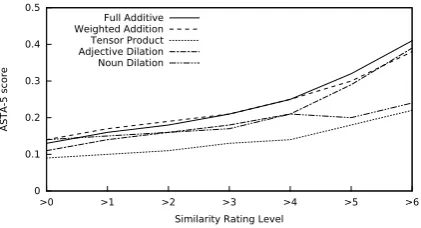
Figure 2: ASTA-5 scores over different levels of human similarity ratings (cf. Experiment 4)
are compared wrt. the proportion of shared at-tributes within these top-5 predictions. Averag-ing this score over all phrase pairs which were as-signed a particular similarity rating by the human
judges yields anAverage Shared Top-5 Attributes
(ASTA-5) score for this similarity level.
Results. Figure 2 plots ASTA-5 scores at
differ-ent levels of human similarity ratings. We observe a general trend across all compositionality func-tions investigated: The higher the rating cutoff, the higher the number of shared attributes. Thus, with increasing similarity between two phrases (according to human ratings), the proportion of shared attributes in their compositional semantics tends to increase as well. Moreover, for highly
similar pairs (rating cutoff>5), the full additive
vector addition model yields the highest ASTA-5 scores.
Beyond this quantitative analysis, two of the au-thors manually investigated the shared attributes in
38 high-similarity phrase pairs (rating cutoff>4)
as predicted by the weighted vector addition model wrt. their potential as plausible sources of similarity. We find that in 28 phrase pairs (73.6%), the predicted attribute is considered a plausible source of similarity, in eight others (26.4%), the predicted attribute does not explain the high sim-ilarity. The agreement between the annotators in
terms of Fleiss’ Kappa amounts toκ= 0.62.
5.4 Discussion
a partial source of similarity between adjective-noun phrases. In fact, this has been corroborated by a preliminary manual investigation of shared attributes between high-similarity phrases. How-ever, there is also evidence for several cases in which attribute meaning falls short of explaining high phrase similarity. This holds for phrases in-volving abstract concepts, for instance (cf. Har-tung (2015), Borghi and Binkofski (2014)).
Nevertheless, we consider it a strength of our model that it is capable of providing plausible ex-planations in cases where attribute meaning is the most prominent source of similarity.
6 Conclusions
We have presented a model of attribute mean-ing in adjective-noun phrases that capitalizes on CBOW word embeddings. In our experiments, the model proves remarkably versatile as it ad-vances the state-of-the-art in the two tasks of at-tribute selection and phrase similarity prediction. In the latter task, the property of being fully inter-pretable wrt. attributes as the potential source of similarities became apparent as an additional as-set rendering the model potentially interoperable with knowledge representation formalisms and re-sources.
Improvements over previous distributional models can be traced back to two major sources: First, CBOW word embeddings work surprisingly well at the word level for capturing attribute meaning in adjectives (not for nouns, though). Future work should investigate whether fur-ther improvements can be obtained from more adjective-specific word embeddings that are trained on symmetric coordination patterns
(Schwartz et al., 2016). Second, a learned
compositionality function is effective at pro-moting attribute meaning in composed phrase representations. Best performances across both tasks are achieved by a full additive model with distinct weight matrices for the adjective and noun constituent. A trained tensor product that comes closer to the linguistic notion of functional ap-plication also performs well beyond the previous state-of-the-art, while falling short of the additive model. Apparently, more training data is needed to exhaust the full potential of the tensor product. Alternatively, tensor decomposition techniques along the lines of Shah et al. (2015) may be a possible way of coping with the large parameter
space of the tensor approach.
Moreover, the learned compositionality func-tion turns out to generalize well over individual attributes, which we consider a very promising re-sult wrt. the suitability of the model in various NLP tasks such as aspect-based sentiment analy-sis. In future work, we are going to extend the present model to consider broader linguistic con-texts and more varied syntactic configurations.
Acknowledgments
We gratefully acknowledge feedback and com-ments by the anonymous EACL reviewers, which considerably helped to improve the paper. This work was supported by the Cluster of Excellence
Cognitive Interaction Technology’CITEC’ (EXC 277) at Bielefeld University, which is funded by the German Research Foundation (DFG), and by the German Federal Ministry of Education and
Re-search (BMBF) in theKogniHomeproject.
References
Abdulrahman Almuhareb. 2006. Attributes in lexical acquisition. Ph.D. thesis, University of Essex. Omid Bakhshandeh and James F. Allen. 2015. From
Adjective Glosses to Attribute Concepts: Learning Different Aspects That an Adjective Can Describe. InProceedings of the 11th International Conference on Computational Semantics (IWCS), pages 23–33, London, UK.
Marco Baroni and Roberto Zamparelli. 2010. Nouns are vectors, adjectives are matrices: Representing adjective-noun constructions in semantic space. In
Proceedings of the 2010 Conference on Empirical Methods in Natural Language Processing, pages 1183–1193. Association for Computational Linguis-tics.
Marco Baroni, Raffaella Bernardi, and Roberto Zam-parelli. 2014a. Frege in Space: A Program for Compositional Distributional Semantics. Linguistic Issues in Language Technology, 9:241–346. Marco Baroni, Georgiana Dinu, and Germ`an
Kruszewski. 2014b. Don’t count, predict! A systematic comparison of context-counting vs. context-predicting semantic vectors. In Kristina Toutanova and Hua Wu, editors,Proceedings of the 52nd Annual Meeting of the Association for Compu-tational Linguistics (Volume 1: Long Papers), pages 238–247, Baltimore, Maryland, June. Association for Computational Linguistics.
Anna M. Borghi and Ferdinand Binkofski. 2014.
Words as Social Tools: An Embodied View on Ab-stract Concepts. Springer Briefs in Cognition. Springer.
Antoine Bride, Tim Van de Cruys, and Nicholas Asher. 2015. A Generalisation of Lexical Functions for Composition in Distributional Semantics. In Pro-ceedings of the 53rd Annual Meeting of the Associ-ation for ComputAssoci-ational Linguistics and the 7th In-ternational Joint Conference on Natural Language Processing (Volume 1: Long Papers), pages 281– 291, Beijing, China, July. Association for Computa-tional Linguistics.
Franc¸ois Chollet. 2016. keras. https://github. com/fchollet/keras.
Philipp Cimiano. 2006. Ontology Learning and Popu-lation from Text. Algorithms, Evaluation and Appli-cations. Springer.
Ronan Collobert, Jason Weston, L´eon Bottou, Michael Karlen, Koray Kavukcuoglu, and Pavel Kuksa. 2011. Natural language processing (almost) from scratch. Journal of Machine Learning Research, 12:2493–2537.
Silvio Cordeiro, Carlos Ramisch, Marco Idiart, and Aline Villavicencio. 2016. Predicting the Com-positionality of Nominal Compounds: Giving Word Embeddings a Hard Time. In Proceedings of the 54th Annual Meeting of the Association for Compu-tational Linguistics (Volume 1: Long Papers), pages 1986–1997, Berlin, Germany, August. Association for Computational Linguistics.
Katrin Erk. 2012. Vector space models of word mean-ing and phrase meanmean-ing: A survey. Language and Linguistics Compass, 6(10):635–653.
Katrin Erk. 2016. What do you know about an alliga-tor when you know the company it keeps? Seman-tics & PragmaSeman-tics, 9:1–63.
Gottlob Frege. 1892. ¨Uber Sinn und Bedeutung.
Zeitschrift f¨ur Philosophie und philosophische Kri-tik, 100:25–50.
Edward Grefenstette and Mehrnoosh Sadrzadeh. 2011. Experimental Support for a Categorical Composi-tional DistribuComposi-tional Model of Meaning. In Pro-ceedings of the Conference on Empirical Methods in Natural Language Processing, pages 1394–1404. Association for Computiational Linguistics. Edward Grefenstette, Mehrnoosh Sadrzadeh, Stephen
Clark, Bob Coecke, and Stephen Pulman. 2014. Concrete Sentence Spaces for Compositional Dis-tributional Models of Meaning. In Harry Bunt, Jo-han Bos, and Stephen Pulman, editors, Computing Meaning, volume 4, pages 71–86. Springer. Nicola Guarino. 1992. Concepts, Attributes and
Ar-bitrary Relations. Data & Knowledge Engineering, 8:249–261.
Emiliano Guevara. 2010. A regression model of adjective-noun compositionality in distributional se-mantics. In Roberto Basili and Marco Pennac-chiotti, editors, Proceedings of the 2010 Workshop on Geometrical Models of Natural Language Se-mantics, pages 33–37, Uppsala, Sweden, July. As-sociation for Computational Linguistics.
Zellig S. Harris. 1954. Distributional structure. Word, 10(2-3):146–162.
Matthias Hartung and Anette Frank. 2010. A Struc-tured Vector Space Model for Hidden Attribute Meaning in Adjective-Noun Phrases. In Proceed-ings of the 23rd International Conference on Com-putational Linguistics (COLING), Beijing, China, pages 430–438.
Matthias Hartung and Anette Frank. 2011a. Assessing interpretable, attribute-related meaning representa-tions for adjective-noun phrases in a similarity pre-diction task. In Proceedings of the GEMS 2011 Workshop on GEometrical Models of Natural Lan-guage Semantics, pages 52–61, Stroudsburg, PA, USA. Association for Computational Linguistics. Matthias Hartung and Anette Frank. 2011b. Exploring
Supervised LDA Models for Assigning Attributes to Adjective-Noun Phrases. In Proceedings of the Conference on Empirical Methods in Natural Lan-guage Processing, pages 540–551, Stroudsburg, PA, USA. Association for Computational Linguistics. Matthias Hartung. 2015. Distributional
Seman-tic Models of Attribute Meaning in Adjectives and Nouns. Ph.D. thesis, Heidelberg University. Diederik Kingma and Jimmy Ba. 2015. Adam: A
Method for Stochastic Optimization. International Conference on Learning Representations.
Omer Levy, Yoav Goldberg, and Ido Dagan. 2015. Im-proving distributional similarity with lessons learned from word embeddings. Transactions of the Associ-ation for ComputAssoci-ational Linguistics, 3:211–225. Sebastian L¨obner. 2013. Understanding Semantics.
Routledge, 2nd edition.
Christopher D. Manning. 2015. Computational Lin-guistics and Deep Learning. Computational Lin-guistics, 41:701–707.
Tomas Mikolov, Kai Chen, Greg Corrado, and Jeffrey Dean. 2013a. Distributed representations of words and phrases and their compositionality. In Proceed-ings of NIPS.
Tomas Mikolov, Kai Chen, Greg Corrado, and Jeffrey Dean. 2013b. Efficient estimation of word repre-sentations in vector space. InProceedings of ICLR Workshop.
Jeff Mitchell and Mirella Lapata. 2010. Composition in Distributional Models of Semantics. Cognitive Science, 34(8):1388–1429.
Mark Palatucci, Dean Pomerleau, Geoffrey Hinton, and Tom M. Mitchell. 2009. Zero-shot learn-ing with semantic output codes. InProceedings of NIPS.
Jeffrey Pennington, Richard Socher, and Christopher Manning. 2014. Glove: Global vectors for word representation. In Proceedings of the 2014 Con-ference on Empirical Methods in Natural Language Processing (EMNLP), pages 1532–1543, Doha, Qatar, October. Association for Computational Lin-guistics.
Wiebke Petersen and Oliver Hellwig. 2016. Exploring the value space of attributes: Unsupervised bidirec-tional clustering of adjectives in German. In Pro-ceedings of COLING 2016, the 26th International Conference on Computational Linguistics: Techni-cal Papers, pages 2839–2848, Osaka, Japan, De-cember. The COLING 2016 Organizing Committee. Radim ˇReh˚uˇrek and Petr Sojka. 2010. Software Framework for Topic Modelling with Large Cor-pora. In Ren´e Witte, Hamish Cunningham, Jon Patrick, Elena Beisswanger, Ekaterina Buyko, Udo Hahn, Karin Verspoor, and Anni R. Coden, editors,
Proceedings of the LREC 2010 Workshop on New Challenges for NLP Frameworks, pages 45–50, Val-letta, Malta, May. ELRA.
Bahar Salehi, Paul Cook, and Timothy Baldwin. 2015. A word embedding approach to predicting the com-positionality of multiword expressions. In Proceed-ings of the 2015 Conference of the North Ameri-can Chapter of the Association for Computational Linguistics: Human Language Technologies, pages 977–983, Denver, Colorado, May–June. Association for Computational Linguistics.
Roy Schwartz, Roi Reichart, and Ari Rappoport. 2016. Symmetric patterns and coordinations: Fast and en-hanced representations of verbs and adjectives. In
Proceedings of the 2016 Conference of the North American Chapter of the Association for Computa-tional Linguistics: Human Language Technologies, pages 499–505, San Diego, California, June. Asso-ciation for Computational Linguistics.
Parikshit Shah, Nikhil Rao, and Gongguo Tang. 2015. Sparse and low-rank tensor decomposition. In Pro-ceedings of NIPS.
Richard Socher, Alex Perelygin, Jean Wu, Jason Chuang, Christopher D. Manning, Andrew Ng, and Christopher Potts. 2013. Recursive Deep Mod-els for Semantic Compositionality Over a Senti-ment Treebank. In Proceedings of the 2013 Con-ference on Empirical Methods in Natural Language Processing, pages 1631–1642, Seattle, Washington, USA, October. Association for Computational Lin-guistics.
Niket Tandon, Gerard de Melo, Fabian Suchanek, and Gerhard Weikum. 2014. WebChild: Harvesting and Organizing Commonsense Knowledge from the Web. InProceedings of the 7th ACM International Conference on Web Search and Data Mining, pages 523–532, New York, NY, USA. ACM.