A Structured Vector Space Model for Hidden Attribute Meaning
in Adjective-Noun Phrases
Matthias Hartung and Anette Frank
Computational Linguistics Department Heidelberg University
{hartung, frank}@cl.uni-heidelberg.de
Abstract
We present an approach to model hid-den attributes in the compositional se-mantics of adjective-noun phrases in a distributional model. For the represen-tation of adjective meanings, we refor-mulate the pattern-based approach for at-tribute learning of Almuhareb (2006) in a structured vector space model (VSM). This model is complemented by a struc-tured vector space representing attribute dimensions of noun meanings. The com-bination of these representations along the lines of compositional semantic principles exposes the underlying semantic relations in adjective-noun phrases. We show that our compositional VSM outperforms sim-ple pattern-based approaches by circum-venting their inherent sparsity problems.
1 Introduction
In formal semantic theory, the compositional se-mantics of adjective-noun phrases can be modeled in terms of selective binding (Pustejovsky, 1995), i.e. the adjective selects one of possibly several roles or attributes1from the semantics of the noun.
(1) a. a blue car
b. COLOR(car)=blue
In this paper, we define a distributional frame-work that models the compositional process un-derlying the modification of nouns by adjectives.
1In the original statement of the theory, adjectives se-lect qualia roles that can be considered as colse-lections of at-tributes.
We focus on property-denoting adjectives as they are valuable for acquiring concept representations for, e.g., ontology learning. An approach for au-tomatic subclassification of property-denoting ad-jectives is presented in Hartung and Frank (2010). Our goal is to expose, for adjective-noun phrases as in (1a), the attribute in the semantics of the noun that is selected by the adjective, while not being overtly realized on the syntactic level. The semantic information we intend to capture for (1a) is formalized in (1b).
Ideally, this kind of knowledge could be ex-tracted from corpora by searching for patterns that paraphrase (1a), e.g. the color of the car is blue. However, linguistic patterns that explicitly relate nouns, adjectives and attributes are very rare.
We avoid these sparsity issues by reducing the triple r=hnoun, attribute, adjectivei that encodes the relation illustrated in (1b) to tu-ples r′=hnoun, attributei and r′′=hattribute, adjectivei, as suggested by Turney and Pantel (2010) for similar tasks. Both r′ and r′′ can be observed much more frequently in text corpora thanr. Moreover, this enables us to model adjec-tive and noun meanings as distinct semantic vec-tors that are built over attributes as dimensions. Based on these semantic representations, we make use of vector composition operations in order to reconstruct r from r′ and r′′. This, in turn, al-lows us to infer complete noun-attribute-adjective
triples from individually acquired noun-attribute
and adjective-attribute representations.
by adjectives; (ii) we complement this novel rep-resentation of adjective meaning with structured vectors for noun meanings similarly built on at-tributes as meaning dimensions; (iii) we propose a composition of these representations that mirrors principles of compositional semantics in mapping adjective-noun phrases to their corresponding on-tological representation; (iv) we propose and eval-uate several metrics for the selection of meaning-ful components from vector representations.
2 Related Work
Adjective-noun meaning composition has not been addressed in a distributional framework be-fore (cf. Mitchell and Lapata (2008)). Our ap-proach leans on related work on attribute learning for ontology induction and recent work in distri-butional semantics.
Attribute learning. Early approaches to at-tribute learning include Hatzivassiloglou and McKeown (1993), who cluster adjectives that de-note values of the same attribute. A weakness of their work is that the type of the attribute cannot be made explicit. More recent attempts to attribute learning from adjectives are Cimiano (2006) and Almuhareb (2006). Cimiano uses at-tributes as features to arrange sets of concepts in a lattice. His approach to attribute acquisition har-nesses adjectives that occur frequently as concept modifiers in corpora. The association of adjec-tives with their potential attributes is performed by dictionary look-up in WordNet (Fellbaum, 1998). Similarly, Almuhareb (2006) uses adjectives and attributes as (independent) features for the pur-pose of concept learning. He acquires adjective-attribute pairs using a pattern-based approach.
As a major limitation, these approaches are confined to adjective-attribute pairs. The poly-semy of adjectives that can only be resolved in the context of the modified noun is entirely neglected. From a methodological point of view, our work is similar to Almuhareb’s, as we will also build on lexico-syntactic patterns for attribute selection. However, we extend the task to involve nouns and rephrase his approach in a distributional frame-work based on the composition of structured vec-tor representations.
Distributional semantics. We observe two re-cent trends in distributional semantics research: (i) The use of VSM tends to shift from mea-suring unfocused semantic similarity to captur-ing increascaptur-ingly fine-grained semantic informa-tion by incorporating more linguistic structure. Following Baroni and Lenci (to appear), we re-fer to such models as structured vector spaces. (ii) Distributional methods are no longer confined to word meaning, but are noticeably extended to capture meaning on the phrase level. Prominent examples for (i) are Pad´o and Lapata (2007) and Rothenh¨ausler and Sch¨utze (2009) who use syn-tactic dependencies rather than single word co-occurrences as dimensions of semantic spaces. Erk and Pad´o (2008) extend this idea to the ar-gument structure of verbs, while also accounting for compositional meaning aspects by modelling predication over arguments. Hence, their work is also representative for (ii).
Baroni et al. (2010) use lexico-syntactic pat-terns to represent concepts in a structured VSM whose dimensions are interpretable as empirical manifestations of properties. We rely on similar techniques for the acquisition of structured vec-tors, whereas our work focusses on exposing the hidden meaning dimensions involved in composi-tional processes underlying concept modification. The commonly adopted method for modelling compositionality in VSM is vector composition (Mitchell and Lapata, 2008; Widdows, 2008). Showing the benefits of vector composition for language modelling, Mitchell and Lapata (2009) emphasize its potential to become a standard method in NLP.
The approach pursued in this paper builds on both lines of research sketched in (i) and (ii) in that we model a specific meaning layer in the se-mantics of adjectives and nouns in a structured VSM. Vector composition is used to expose their hidden meaning dimensions on the phrase level.
3 Structured Vector Representations for Adjective-Noun Meaning
3.1 Motivation
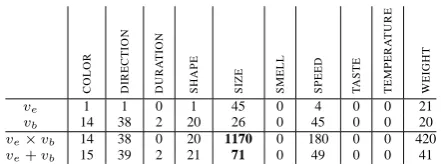
C O L O R D IR E C T IO N D U R A T IO N S H A P E S IZ E S M E L L S P E E D T A S T E T E M P E R A T U R E W E IG H T
ve 1 1 0 1 45 0 4 0 0 21
vb 14 38 2 20 26 0 45 0 0 20
ve×vb 14 38 0 20 1170 0 180 0 0 420
[image:3.595.70.291.68.152.2]ve+vb 15 39 2 21 71 0 49 0 0 41
Figure 1: Vectors for enormous (ve) and ball (vb)
adjectives, as in (2). The triple r can be bro-ken down into tuplesr′ =hnoun, attributeiand
r′′ = hattribute, adjectivei. Previous learning approaches focussed onr′(Cimiano, 2006) orr′′
(Almuhareb, 2006) only.
(2) a. a bluevaluecarconcept
b. ATTR(concept) = value
In semantic composition of adjective-noun compounds, the adjective (e.g. blue) contributes a value for an attribute (here: COLOR) that charac-terizes the concept evoked by the noun (e.g. car). Thus, the attribute in (2) constitutes a ’hidden variable’ that is not overtly expressed in (2a), but constitutes the central axis that relatesr′andr′′.
Structured vectors built on extraction patterns. We model the semantics of adjectives and nouns in a structured VSM that conveys the hidden re-lationship in (2). The dimensions of the model are defined by attributes, such as COLOR, SIZE orSPEED, while the vector components are deter-mined on the basis of carefully selected acquisi-tion patterns that are tailored to capturing the par-ticular semantic information of interest forr′ and
r′′. In this respect, lexico-syntactic patterns serve a similar purpose as dependency relations in Pad´o and Lapata (2007) or Rothenh¨ausler and Sch¨utze (2009). The upper part of Fig. 1 displays exam-ples of vectors we build for adjectives and nouns.
Composing vectors along hidden dimensions. The fine granularity of lexico-syntactic patterns that capture the tripler comes at the cost of their sparsity when applied to corpus data. Therefore, we construct separate vector representations for
r′ and r′′. Eventually, these representations are joined by vector composition to reconstruct the triple r. Apart from avoiding sparsity issues, this compositional approach has several prospects from a linguistic perspective as well.
Ambiguity and disambiguation. Building vec-tors with attributes as meaning dimensions en-ables us to model (i) ambiguity of adjectives with regard to the attributes they select, and (ii) the dis-ambiguation capacity of adjective and noun vec-tors when considered jointly. Consider, for exam-ple, the phrase enormous ball that is ambiguous for two reasons: enormous may select a set of pos-sible attributes (SIZEorWEIGHT, among others), while ball elicits several attributes in accordance with its different word senses2. As seen in Fig. 1, these ambiguities are nicely captured by the sep-arate vector representations for the adjective and the noun (upper part); by composing these repre-sentations, the ambiguity is resolved (lower part).
3.2 Building a VSM for Adjective-Noun Meaning
In this section, we introduce the methods we ap-ply in order to (i) acquire vector representations for adjectives and nouns, (ii) select appropriate at-tributes from them, and (iii) compose them.
3.2.1 Attribute Acquisition Patterns
We use the following patterns3 for the ac-quisition of vectors capturing the tuple r′′ =
hattribute, adjectivei. Even though some of these patterns (A1andA4) match triples of nouns, attributes and adjectives, we only use them for the extraction of binary tuples (underlined), thus ab-stracting from the modified noun.
(A1) ATTR of DT? NN is|was JJ
(A2) DT? RB? JJ ATTR
(A3) DT? JJ or JJ ATTR
(A4) DT? NN’s ATTR is|was JJ
(A5) is|was|are|were JJ in|of ATTR
To acquire noun vectors capturing the tuple
r′ = hnoun, attributei, we rely on the follow-ing patterns. Again, we only extract pairs, as indi-cated by the underlined elements.
(N1) NN with|without DT? RB? JJ? ATTR
(N2) DT ATTR of DT? RB? JJ? NN
(N3) DT NN’s RB? JJ? ATTR
(N4) NN has|had a|an RB? JJ? ATTR
2
WordNet senses for the noun ball include, among others: 1. round object [...] in games; 2. solid projectile, 3. object with a spherical shape, 4. people [at a] dance.
3
3.2.2 Target Filtering
Some of the adjectives extracted byA1-A5are not property-denoting and thus represent noise. This affects in particular pattern A2, which ex-tracts adjectives like former or more, or relational ones such as economic or geographic.
This problem may be addressed in different ways: By target filtering, extractions can be checked against a predicative pattern P1 that is supposed to apply to property-denoting adjectives only. Vectors that fail this test are suppressed.
(P1) DT NN is|was JJ
Alternatively, extractions obtained from low-confidence patterns can be awarded reduced weights by means of a pattern value function (de-fined in 3.3; cf. Pantel and Pennacchiotti (2006)).
3.2.3 Attribute Selection
We intend to use the acquired vectors in order to detect attributes that are implicit in adjective-noun meaning. Therefore, we need a method that selects appropriate attributes from each vec-tor. While, in general, this task consists in dis-tinguishing semantically meaningful dimensions from noise, the requirements are different depend-ing on whether attributes are to be selected from adjective or noun vectors. This is illustrated in Fig. 1, a typical configuration, with one vector representing a typical property-denoting adjective that exhibits relatively strong peaks on one or more dimensions, whereas noun vectors show a tendency for broad and flat distributions over their dimensions. This suggests using a strict selection function (choosing few very prominent dimen-sions) for adjectives and a less restrictive one (li-censing the inclusion of more dimensions of lower relative prominence) for nouns. Moreover, we are interested in finding a selection function that re-lies on as few free parameters as possible in order to avoid frequency or dimensionality effects.
MPC Selection (MPC). An obvious method for attribute selection is to choose the most promi-nent compopromi-nent from any vector (i.e., the highest absolute value). If a vector exhibits several peaks, all other components are rejected, their relative importance notwithstanding. MPC obviously fails to capture polysemy of targets, which affects
ad-jectives such as hot, in particular.
Threshold Selection (TSel). TSel recasts the approach of Almuhareb (2006), in selecting all di-mensions as attributes whose components exceed a frequency threshold. This avoids the drawback of MPC, but introduces a parameter that needs to be optimized. Also, it is difficult to apply absolute thresholds to composed vectors, as the range of their components is subject to great variation, and it is unclear whether the method will scale with increased dimensionality.
Entropy Selection (ESel). In information the-ory, entropy measures the average uncertainty in a probability distribution (Manning and Sch¨utze, 1999). We define the entropy H(v) of a vector v=hv1, . . . , vni over its components as
H(v) =−Pni=1P(vi) logP(vi), whereP(vi) =
vi/Pni=1vi.
We use H(v) to assess the impact of singular vector components on the overall entropy of the vector: We expect entropy to detect components that contribute noise, as opposed to those that con-tribute important information.
We define an algorithm for entropy-based at-tribute selection that returns a list of informa-tive dimensions. The algorithm successively sup-presses (combinations of) vector components one by one. Given that a gain of entropy is equiva-lent to a loss of information and vice versa, we as-sume that every combination of components that leads to an increase in entropy when being sup-pressed is actually responsible for a substantial amount of information. The algorithm includes a back-off to MPC for the special case that a vector contains a single peak (i.e.,H(v) = 0), so that, in principle, it should be applicable to vectors of any kind. Vectors with very broad distributions over their dimensions, however, pose a problem to this method. For ball in Fig. 1, for instance, the method does not select any dimension.
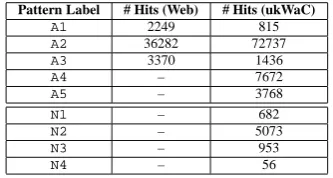
Pattern Label # Hits (Web) # Hits (ukWaC)
A1 2249 815
A2 36282 72737
A3 3370 1436
A4 – 7672
A5 – 3768
N1 – 682
N2 – 5073
N3 – 953
[image:5.595.97.264.70.159.2]N4 – 56
Table 1: Number of pattern hits on the Web (Al-muhareb, 2006) and on ukWaC
ball, WEIGHT, DIRECTION, SHAPE, SPEED and SIZEare selected.
3.2.4 Vector Composition
We use vector composition as a hinge to com-bine adjective and noun vectors in order to recon-struct the triple r=hnoun, attribute, adjectivei. Mitchell and Lapata (2008) distinguish two major classes of vector composition operations, namely multiplicative and additive operations, that can be extended in various ways. We use their standard definitions (denoted × and +, henceforth). For our task, we expect×to perform best as it comes closest to the linguistic function of intersective ad-jectives, i.e. to select dimensions that are promi-nent both for the adjective and the noun, whereas
+ basically blurs the vector components, as can be seen in the lower part of Fig. 1.
3.3 Model Parameters
We follow Pad´o and Lapata (2007) in defining a semantic space as a matrixM =B×T relating a set of target elementsT to a set of basis elements
B. Further parameters and their instantiations we use in our model are described below. We usepto denote an individual lexico-syntactic pattern.
The basis elements of our VSM are nouns de-noting attributes. For comparison, we use the at-tributes selected by Almuhareb (2006): COLOR, DIRECTION, DURATION, SHAPE, SIZE, SMELL, SPEED,TASTE, TEMPERATURE,WEIGHT.
The context selection function cont(t) deter-mines the set of patterns that contribute to the rep-resentation of each target wordt ∈ T. These are the patternsA1-A5andN1-N4(cf. Section 3.2.1). The target elements represented in the vector space comprise all adjectives TA that match the patternsA1toA5in the corpus, provided they
ex-ceed a frequency threshold n. During develop-ment,nwas set to 5 in order to filter noise.
As for the target nounsTN, we rely on a repre-sentative dataset compiled by Almuhareb (2006). It contains 402 nouns that are balanced with re-gard to semantic class (according to the WordNet supersenses), ambiguity and frequency.
As association measure that captures the strength of the association between the elements ofBandT, we use raw frequency counts4as ob-tained from the PoS-tagged and lemmatized ver-sion of the ukWaC corpus (Baroni et al., 2009). Table 1 gives an overview of the number of hits returned by these patterns.
The basis mapping function µcreates the di-mensions of the semantic space by mapping each extraction of a patternpto the attribute it contains. The pattern value function enables us to sub-divide dimensions along particular patterns. We experimented with two instantiations: pvconst considers, for each dimension, all patterns, while weighting them equally. pvf(p) awards the ex-tractions of patternpwith weight 1, while setting the weights for all patterns different frompto 0.
4 Experiments
We evaluate the performance of the structured VSM on the task of inferring attributes from adjective-noun phrases in three experiments: In Exp1 and Exp2, we evaluate vector representa-tions capturingr′andr′′independently of one an-other. Exp3 investigates the selection of hidden attributes from vector representations constructed by composition of adjective and noun vectors.
We compare all results against different gold
standards. In Exp1, we follow Almuhareb (2006),
evaluating against WordNet 3.0. For Exp2 and Exp3, we establish gold standards manually: For Exp2, we construct a test set of nouns annotated with their corresponding attributes. For Exp3, we manually annotate adjective-noun phrases with the attributes appropriate for the whole phrase. All experiments are evaluated in terms of precision, recall andF1 score.
4
4.1 Exp1: Attribute Selection for Adjectives
The first experiment evaluates the performance of structured vector representations on attribute se-lection for adjectives. We compare this model against a re-implementation of Almuhareb (2006).
Experimental settings and gold standard. To reconstruct Almuhareb’s approach, we ran his pat-ternsA1-A3on the ukWaC corpus. Table 1 shows the number of hits when applied to the Web (Al-muhareb, 2006) vs. ukWaC.A1andA3yield less extractions on ukWaC as compared to the Web.5 We introduced two additional patterns, A4 and
A5, that contribute about 10,000 additional hits. We adopted Almuhareb’s manually chosen thresh-olds for attribute selection forA1-A3; forA4,A5
and a combination of all patterns, we manually se-lected optimal thresholds.
We experiment withpvconstand all variants of
pvf(p) for pattern weighting (see sect. 3.3). For attribute selection, we compare TSel (as used by Almuhareb), ESel and MSel.
The gold standard consists of all adjectives that are linked to at least one of the ten attributes we consider by WordNet’s attributerelation (1063 adjectives in total).
Evaluation results. Results for Exp1 are dis-played in Table 2. The settings ofpvare given in the rows, the attribute selection methods (in com-bination with target filtering6) in the columns.
The results for our re-implementation of Al-muhareb’s individual patterns are comparable to his original figures7, except forA3that seems to suffer from quantitative differences of the under-lying data. Combining all patterns leads to an improvement in precision over (our reconstruc-tion of) Almuhareb’s best individual pattern when TSel and target filtering are used in combina-tion. MPC and MSel perform worse (not reported here). As for target filtering,A1andA3work best. Both TSel and ESel benefit from the combina-tion with the target filter, where the largest im-provement (and the best overall result) is
observ-5
The difference forA2is an artifact of Almuhareb’s ex-traction methodology.
6Regarding target filtering, we only report the best filter pattern for each configuration.
7P(A1)=0.176, P(A2)=0.218, P(A3)=0.504
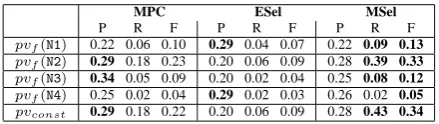
MPC ESel MSel
P R F P R F P R F
pvf(N1) 0.22 0.06 0.10 0.29 0.04 0.07 0.22 0.09 0.13
pvf(N2) 0.29 0.18 0.23 0.20 0.06 0.09 0.28 0.39 0.33
pvf(N3) 0.34 0.05 0.09 0.20 0.02 0.04 0.25 0.08 0.12
pvf(N4) 0.25 0.02 0.04 0.29 0.02 0.03 0.26 0.02 0.05
[image:6.595.302.522.69.131.2]pvconst 0.29 0.18 0.22 0.20 0.06 0.09 0.28 0.43 0.34
Table 3: Evaluation results for Experiment 2
able for ESel on pattern A1 only. This is the pattern that performs worst in Almuhareb’s orig-inal setting. From this, we conclude that both ESel and target filtering are valuable extensions to pattern-based structured vector spaces if preci-sion is in focus. This also underlines a finding of Rothenh¨ausler and Sch¨utze (2009) that VSMs intended to convey specific semantic information rather than mere similarity benefit primarily from a linguistically adequate choice of contexts.
Similar to Almuhareb, recall is problematic. Even though ESel leads to slight improvements, the scores are far from satisfying. With Al-muhareb, we note that this is mainly due to a high number of extremely fine-grained adjectives in WordNet that are rare in corpora.8
4.2 Exp2: Attribute Selection for Nouns
Exp2 evaluates the performance of attribute selec-tion from noun vectors tailored to the tupler′′.
Construction of the gold standard. For eval-uation, we created a gold standard by manually annotating a set of nouns with attributes. This gold standard builds on a random sample ex-tracted from TN (cf. section 3.3). Running N1
-N4on ukWaC returned semantic vectors for 216 concepts. From these, we randomly sampled 100 concepts that were manually annotated by three human annotators.
The annotators were provided a matrix consist-ing of the nouns and the set of ten attributes for each noun. Their task was to remove all inappro-priate attributes. They were free to decide how many attributes to accept for each noun. In order to deal with word sense ambiguity, the annotators were instructed to consider all senses of a noun and to retain every attribute that was acceptable for at least one sense.
Almuhareb (reconstr.) VSM (TSel + Target Filter) VSM (ESel) VSM (ESel + Target Filter)
P R F Thr P R F Patt Thr P R F P R F Patt
pvf(A1) = 1 0.183 0.005 0.009 5 0.300 0.004 0.007 A3 5 0.231 0.045 0.076 0.519 0.035 0.065 A3
pvf(A2) = 1 0.207 0.039 0.067 50 0.300 0.033 0.059 A1 50 0.084 0.136 0.104 0.240 0.049 0.081 A3
pvf(A3) = 1 0.382 0.020 0.039 5 0.403 0.014 0.028 A1 5 0.192 0.059 0.090 0.375 0.027 0.050 A1
pvf(A4) = 1 0.301 0.020 0.036 A3 10 0.135 0.055 0.078 0.272 0.020 0.038 A1
pvf(A5) = 1 0.295 0.008 0.016 A3 24 0.105 0.056 0.073 0.315 0.024 0.045 A3
[image:7.595.91.499.69.139.2]pvconst 0.420 0.024 0.046 A1 183 0.076 0.152 0.102 0.225 0.054 0.087 A3
Table 2: Evaluation results for Experiment 1
contains 424 attributes for 100 nouns.
Evaluation results. Results for Exp2 are given in Table 3. Performance is lower in comparison to Exp1. We hypothesize that the tupler′′might not be fully captured by overt linguistic patterns. This needs further investigation in future research.
Against this background, MPC is relatively pre-cise, but poor in terms of recall. ESel, being designed to select more than one prominent di-mension, counterintuitively fails to increase re-call, suffering from the fact that many noun vec-tors show a rather flat distribution without any strong peak. MSel turns out to be most suitable for this task: Its precision is comparable to MPC (with N3 as an outlier), while recall is consider-ably higher. Overall, these results indicate that at-tribute selection for adjectives and nouns, though similar, should be viewed as distinct tasks that re-quire different attribute selection methods.
4.3 Exp3: Attribute Selection for Adjective-Noun Phrases
In this experiment, we compose noun and adjec-tive vectors in order to yield a new combined rep-resentation. We investigate whether the seman-tic information encoded by the components of this new vector is sufficiently precise to disambiguate the attribute dimensions of the original represen-tations (see section 3.1) and, thus, to infer hidden attributes from adjective-noun phrases (see (2)) as advocated by Pustejovsky (1995).
Construction of the gold standard. For evalu-ation, we created a manually annotated test set of adjective-noun phrases. We selected a subset of property-denoting adjectives that are appropriate modifiers for the nouns fromTN using the pred-icative pattern P1(see sect. 3) on ukWaC. This
8
For instance: bluish-lilac, chartreuse or pink-lavender as values of the attributeCOLOR.
yielded 2085 adjective types that were further re-duced to 386 by frequency filtering (n = 5). We sampled our test set from all pairs in the carte-sian product of the 386 adjectives and 216 nouns (cf. Exp2) that occurred at least 5 times in a sub-section of ukWaC. To ensure a sufficient number of ambiguous adjectives in the test set, sampling proceeded in two steps: First, we sampled four nouns each for a manual selection of 15 adjectives of all ambiguity levels in WordNet. This leads to 60 adjective-noun pairs. Second, another 40 pairs were sampled fully automatically.
The test set was manually annotated by the same annotators as in Exp2. They were asked to remove all attributes that were not appropriate for a given adjective-noun pair, either because it is not appropriate for the noun or because it is not se-lected by the adjective. Further instructions were as in Exp2, in particular regarding ambiguity.
The overall agreement isκ=0.67. After adjudi-cation by majority voting, the resulting gold stan-dard contains 86 attributes for 76 pairs. 24 pairs could not be assigned any attribute, either because the adjective did not denote a property, as in
pri-vate investment, or the most appropriate attribute
was not offered, as in blue day or new house. We evaluate the vector composition methods discussed in section 3.2.4. Individual vectors for the adjectives and nouns from the test pairs were constructed using all patternsA1-A5andN1-N4. For attribute selection, we tested MPC, ESel and MSel. The results are compared against three baselines: BL-P implements a purely pattern-based method, i.e. running the patterns that ex-tract the triple r (A1, A4, N1, N3and N4, with
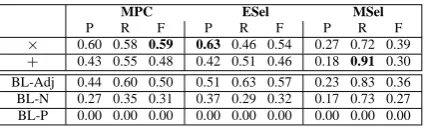
MPC ESel MSel
P R F P R F P R F
× 0.60 0.58 0.59 0.63 0.46 0.54 0.27 0.72 0.39
+ 0.43 0.55 0.48 0.42 0.51 0.46 0.18 0.91 0.30
BL-Adj 0.44 0.60 0.50 0.51 0.63 0.57 0.23 0.83 0.36
BL-N 0.27 0.35 0.31 0.37 0.29 0.32 0.17 0.73 0.27
[image:8.595.75.288.69.133.2]BL-P 0.00 0.00 0.00 0.00 0.00 0.00 0.00 0.00 0.00
Table 4: Evaluation results for Experiment 3
Evaluation results. Results are given in Table 4. Attribute selection based on the composition of adjective and noun vectors yields a considerable improvement of both precision and recall as com-pared to the individual results obtained in Exp1 and Exp2. Comparing the results of Exp3 against the baselines reveals two important aspects of our work. First, the complete failure of BL-P9 un-derlines the attractiveness of our method to build structured vector representations from patterns of reduced complexity. Second, vector composition is suitable for selecting hidden attributes from adjective-noun phrases that are jointly encoded by adjective and noun vectors: Both composition methods we tested outperform BL-N.
However, the choice of the composition method matters: × performs best with a maximum pre-cision of 0.63. This confirms our expectation that vector multiplication is a good approxima-tion for attribute selecapproxima-tion in adjective-noun se-mantics. Being outperformed by BL-Adj in most categories,+is less suited for this task.
All selection methods outperform BL-Adj in precision. Comparing MPC and ESel, ESel achieves better precision when combined with the
×-operator, while doing worse for recall. The robust performance of MPC is not surprising as the test set contains only ten adjective-noun pairs that are still ambiguous with regard to the at-tributes they elicit. The stronger performance of the entropy-based method with the ×-operator is mainly due to its accuracy on detecting false posi-tives, in that it is able to return ”empty” selections. In terms of precision, MSel did worse in general, while recall is decent. This underlines that vector composition generally promotes meaningful com-ponents, but MSel is too inaccurate to select them. Given the performance of the baselines and the noun vectors in Exp2, we consider this a very promising result for our approach to attribute
9The patterns used yield no hits for the test pairs at all.
selection from structured vector representations. The results also corroborate the insufficiency of previous approaches to attribute learning from ad-jectives alone.
5 Conclusions and Outlook
We proposed a structured VSM as a framework for inferring hidden attributes from the composi-tional semantics of adjective-noun phrases.
By reconstructing Almuhareb (2006), we showed that structured vector representations of adjective meaning consistently outperform sim-ple pattern-based learning, up to 13 pp. in preci-sion. A combination of target filtering and pat-tern weighting turned out to be effective here, by selecting particulary meaningful lexico-syntactic contexts and filtering adjectives that are not property-denoting. Further studies need to inves-tigate this phenomenon and its most appropriate formulation in a vector space framework.
Moreover, the VSM offers a natural represen-tation for sense ambiguity of adjectives. Compar-ing attribute selection methods on adjective and noun vectors shows that they are sensitive to the distributional structure of the vectors, and need to be chosen with care. Future work will investigate these selection methods in high-dimensional vec-tors spaces, by using larger sets of attributes.
Exp3 shows that the composition of pattern-based adjective and noun vectors robustly reflects aspects of meaning composition in adjective-noun phrases, with attributes as a hidden dimension. It also suggests that composition is effective in disambiguation of adjective and noun meanings. This hypothesis needs to be substantiated in fur-ther experiments.
References
Almuhareb, Abdulrahman. 2006. Attributes in
Lexi-cal Acquisition. Ph.D. Dissertation, Department of
Computer Science, University of Essex.
Baroni, Marco and Alessandro Lenci. to appear. Distributional Memory. A General Framework for Corpus-based Semantics. Computational
Linguis-tics.
Baroni, Marco, Silvia Bernardini, Adriano Ferraresi, and Eros Zanchetta. 2009. The wacky wide web: A collection of very large linguistically processed web-crawled corpora. Journal of Language Re-sources and Evaluation, 43(3):209–226.
Baroni, Marco, Brian Murphy, Eduard Barbu, and Massimo Poesio. 2010. Strudel. A Corpus-based Semantic Model of Based on Properties and Types.
Cognitive Science, 34:222–254.
Cimiano, Philipp. 2006. Ontology Learning and
Pop-ulation from Text. Algorithms, Evaluation and Ap-plications. Springer.
Erk, Katrin and Sebastian Pad ´o. 2008. A Structured Vector Space Model for Word Meaning in Context. In Proceedings of EMNLP, Honolulu, HI.
Fellbaum, Christiane, editor. 1998. WordNet: An Electronic Lexical Database. MIT Press, Cam-bridge, Mass.
Fleiss, Joseph L. 1971. Measuring nominal scale agreement among many raters. Psychological
Bul-letin, 76(5):378–382.
Hartung, Matthias and Anette Frank. 2010. A Semi-supervised Type-based Classification of Ad-jectives. Distinguishing Properties and Relations. In Proceedings of the 7th International Conference
on Language Resources and Evaluation, Valletta,
Malta, May.
Hatzivassiloglou, Vasileios and Kathleen McKeown. 1993. Towards the Automatic Identification of Ad-jectival Scales. Clustering Adjectives According to Meaning. In Proceedings of the 31st Annual
Meet-ing of the Association of Computational LMeet-inguistics,
pages 172–182.
Krengel, Ulrich. 2003. Wahrscheinlichkeitstheorie und Statistik. Vieweg, Wiesbaden.
Manning, Christopher D. and Hinrich Sch ¨utze. 1999.
Foundations of Statistical Natural Language Pro-cessing. The MIT Press, Cambridge, Mas-sachusetts.
Marcus, Mitchell P., Beatrice Santorini, Mary Ann Marcinkiewicz, and Ann Taylor. 1999. Treebank-3, ldc99t42. CD-ROM. Philadelphia, Penn.: Linguis-tic Data Consortium.
Mitchell, Jeff and Mirella Lapata. 2008. Vector-based Models of Semantic Composition. In Proceedings
of ACL-08: HLT, pages 236–244, Columbus, Ohio,
June.
Mitchell, Jeff and Mirella Lapata. 2009. Lan-guage Models Based on Semantic Composition. In
Proceedings of the 2009 Conference on Empirical Methods in Natural Language Processing,
Singa-pore, August 2009, pages 430–439, SingaSinga-pore, Au-gust.
Pad ´o, Sebastian and Mirella Lapata. 2007. Dependency-based Construction of Semantic Space Models. Computational Linguistics, 33:161–199.
Pantel, Patrick and Marco Pennacchiotti. 2006. Espresso: Leveraging generic patterns for automati-cally harvesting semantic relations. In Proceedings
of the 21st International Conference on Computa-tional Linguistics and 44th Annual Meeting of the Association for Computational Linguistics, Sydney,
Australia, 17–21 July 2006, pages 113–120.
Pustejovsky, James. 1995. The Generative Lexicon. MIT Press, Cambridge, Mass.
Rothenh¨ausler, Klaus and Hinrich Sch ¨utze. 2009. Un-supervised Classification with Dependency Based Word Spaces. In Proceedings of the EACL
Work-shop on Geometrical Models of Natural Language Semantics (GEMS), pages 17–24, Athens, Greece,
March.
Sowa, John F. 2000. Knowledge Representation. Logical, Philosophical, and Computational Foun-dations. Brooks Cole.
Turney, Peter D. and Patrick Pantel. 2010. From Fre-quency to Meaning. Vector Space Models of Se-mantics. Journal of Artificial Intelligence Research, 37:141–188.
Widdows, Dominic. 2008. Semantic Vector Products. Some Initial Investigations. In Proceedings of the
2nd Conference on Quantum Interaction, Oxford,