Detecting Non-compositional MWE Components using Wiktionary
Bahar Salehi,♣♥Paul Cook♥ and Timothy Baldwin♣♥ ♣NICTA Victoria Research Laboratory
♥Department of Computing and Information Systems The University of Melbourne
Victoria 3010, Australia
[email protected], [email protected], [email protected]
Abstract
We propose a simple unsupervised ap-proach to detecting non-compositional components in multiword expressions based on Wiktionary. The approach makes use of the definitions, synonyms and trans-lations in Wiktionary, and is applicable to any type of MWE in any language, assum-ing the MWE is contained in Wiktionary. Our experiments show that the proposed approach achieves higher F-score than state-of-the-art methods.
1 Introduction
A multiword expression (MWE) is a combina-tion of words with lexical, syntactic or seman-tic idiosyncrasy (Sag et al., 2002; Baldwin and Kim, 2009). An MWE is considered (semanti-cally) “non-compositional” when its meaning is not predictable from the meaning of its compo-nents. Conversely, compositional MWEs are those whose meaning is predictable from the meaning of the components. Based on this definition, a component is compositional within an MWE, if its meaning is reflected in the meaning of the MWE, and it is non-compositional otherwise.
Understanding which components are non-compositional within an MWE is important in NLP applications in which semantic information is required. For example, when searching for spelling bee, we may also be interested in docu-ments aboutspelling, but not those which contain onlybee. Forresearch project, on the other hand, we are likely to be interested in documents which contain eitherresearchorprojectin isolation, and forswan song, we are only going to be interested in documents which contain the phraseswan song, and not justswanorsong.
In this paper, we propose an unsupervised ap-proach based on Wikitionary for predicting which
components of a given MWE have a composi-tional usage. Experiments over two widely-used datasets show that our approach outperforms state-of-the-art methods.
2 Related Work
Previous studies which have considered MWE compositionality have focused on either the iden-tification of non-compositional MWE token in-stances (Kim and Baldwin, 2007; Fazly et al., 2009; Forthergill and Baldwin, 2011; Muzny and Zettlemoyer, 2013), or the prediction of the com-positionality of MWE types (Reddy et al., 2011; Salehi and Cook, 2013; Salehi et al., 2014). The identification of non-compositional MWE tokens is an important task when a word combination such askick the bucket orsaw logsis ambiguous between a compositional (generally non-MWE) and non-compositional MWE usage. Approaches have ranged from the unsupervised learning of type-level preferences (Fazly et al., 2009) to su-pervised methods specific to particular MWE con-structions (Kim and Baldwin, 2007) or applica-ble across multiple constructions using features similar to those used in all-words word sense disambiguation (Forthergill and Baldwin, 2011; Muzny and Zettlemoyer, 2013). The prediction of the compositionality of MWE types has tradi-tionally been couched as a binary classification task (compositional or non-compositional: Bald-win et al. (2003), Bannard (2006)), but more re-cent work has moved towards a regression setup, where the degree of the compositionality is pre-dicted on a continuous scale (Reddy et al., 2011; Salehi and Cook, 2013; Salehi et al., 2014). In ei-ther case, the modelling has been done eiei-ther over the whole MWE (Reddy et al., 2011; Salehi and Cook, 2013), or relative to each component within the MWE (Baldwin et al., 2003; Bannard, 2006). In this paper, we focus on the binary classification of MWE types relative to each component of the
MWE.
The work that is perhaps most closely related to this paper is that of Salehi and Cook (2013) and Salehi et al. (2014), who use translation data to predict the compositionality of a given MWE rel-ative to each of its components, and then combine those scores to derive an overall compositionality score. In both cases, translations of the MWE and its components are sourced from PanLex (Bald-win et al., 2010; Kamholz et al., 2014), and if there is greater similarity between the translated components and MWE in a range of languages, the MWE is predicted to be more compositional. The basis of the similarity calculation is unsuper-vised, using either string similarity (Salehi and Cook, 2013) or distributional similarity (Salehi et al., 2014). However, the overall method is su-pervised, as training data is used to select the languages to aggregate scores across for a given MWE construction. To benchmark our method, we use two of the same datasets as these two pa-pers, and repurpose the best-performing methods of Salehi and Cook (2013) and Salehi et al. (2014) for classification of the compositionality of each MWE component.
3 Methodology
Our basic method relies on analysis of lexical overlap between the component words and the def-initions of the MWE in Wiktionary, in the man-ner of Lesk (1986). That is, if a given component can be found in the definition, then it is inferred that the MWE carries the meaning of that compo-nent. For example, the Wiktionary definition of swimming poolis “An artificially constructed pool of water used for swimming”, suggesting that the MWE is compositional relative to bothswimming andpool. If the MWE is not found in Wiktionary, we use Wikipedia as a backoff, and use the first paragraph of the (top-ranked) Wikipedia article as a proxy for the definition.
As detailed below, we further extend the basic method to incorporate three types of information found in Wiktionary: (1) definitions of each word in the definitions, (2) synonyms of the words in the definitions, and (3) translations of the MWEs and components.
3.1 Definition-based Similarity
The basic method uses Boolean lexical overlap be-tween the target component of the MWE and a
definition. A given MWE will often have multiple definitions, however, begging the question of how to combine across them, for which we propose the following three methods.
First Definition (FIRSTDEF): Use only the
first-listed Wiktionary definition for the MWE, based on the assumption that this is the predom-inant sense.
All Definitions (ALLDEFS): In the case that
there are multiple definitions for the MWE, cal-culate the lexical overlap for each independently and take a majority vote; in the case of a tie, label the component as non-compositional.
Idiom Tag (ITAG): In Wiktionary, there is
fa-cility for users to tag definitions as idiomatic.1 If,
for a given MWE, there are definitions tagged as idiomatic, use only those definitions; if there are no such definitions, use the full set of definitions.
3.2 Synonym-based Definition Expansion In some cases, a component is not explicitly men-tioned in a definition, but a synonym does occur, indicating that the definition is compositional in that component. In order to capture synonym-based matches, we optionally look for synonyms of the component word in the definition,2and
ex-pand our notion of lexical overlap to include these synonyms.
For example, for the MWEchina clay, the defi-nition iskaolin, which includes neither of the com-ponents. However, we find the component word clayin the definition forkaolin, as shown below.
A fine clay, rich in kaolinite, used in ce-ramics, paper-making, etc.
This method is compatible with the three definition-based similarity methods described above, and indicated by the +SYN suffix (e.g.
FIRSTDEF+SYN is FIRSTDEF with
synonym-based expansion).
3.3 Translations
A third information source in Wiktionary that can be used to predict compositionality is sense-level translation data. Due to the user-generated na-ture of Wiktionary, the set of languages for which 1Although the recall of these tags is low (Muzny and Zettlemoyer, 2013).
ENC EVPC
WordNet 91.1% 87.5%
Wiktionary 96.7% 96.2%
Wiktionary+Wikipedia 100.0% 96.2%
Table 1: Lexical coverage of WordNet, Wik-tionary and WikWik-tionary+Wikipedia over our two datasets.
translations are provided varies greatly across lexi-cal entries. Our approach is to take whatever trans-lations happen to exist in Wiktionary for a given MWE, and where there are translations in that lan-guage for the component of interest, use the LCS-based method of Salehi and Cook (2013) to mea-sure the string similarity between the translation of the MWE and the translation of the compo-nents. Unlike Salehi and Cook (2013), however, we do not use development data to select the opti-mal set of languages in a supervised manner, and instead simply take the average of the string simi-larity scores across the available languages. In the case of more than one translation in a given lan-guage, we use the maximum string similarity for each pairing of MWE and component translation.
Unlike the definition and synonym-based ap-proach, the translation-based approach will pro-duce real rather than binary values. To combine the two approaches, we discretise the scores given by the translation approach. In the case of dis-agreement between the two approaches, we label the given MWE as non-compositional. This re-sults in higher recall and lower precision for the task of detecting compositionality.
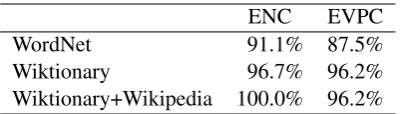
3.4 An Analysis of Wiktionary Coverage A dictionary-based method is only as good as the dictionary it is applied to. In the case of MWE compositionality analysis, our primary concern is lexical coverage in Wiktionary, i.e., what propor-tion of a representative set of MWEs is contained in Wiktionary. We measure lexical coverage rela-tive to the two datasets used in this research (de-scribed in detail in Section 4), namely 90 En-glish noun compounds (ENCs) and 160 EnEn-glish verb particle constructions (EVPCs). In each case, we calculated the proportion of the dataset that is found in Wiktionary, Wiktionary+Wikipedia (where we back off to a Wikipedia document in the case that a MWE is not found in Wiktionary) and WordNet (Fellbaum, 1998). The results are found in Table 1, and indicate perfect coverage in
Wik-tionary+Wikipedia for the ENCs, and very high coverage for the EVPCs. In both cases, the cov-erage of WordNet is substantially lower, although still respectable, at around 90%.
4 Datasets
As mentioned above, we evaluate our method over the same two datasets as Salehi and Cook (2013) (which were later used, in addition to a third dataset of German noun compounds, in Salehi et al. (2014)): (1) 90 binary English noun com-pounds (ENCs, e.g. spelling bee or swimming pool); and (2) 160 English verb particle construc-tions (EVPCs, e.g.stand upandgive away). Our results are not directly comparable with those of Salehi and Cook (2013) and Salehi et al. (2014), however, who evaluated in terms of a regression task, modelling the overall compositionality of the MWE. In our case, the task setup is a binary clas-sification task relative to each of the two compo-nents of the MWE.
The ENC dataset was originally constructed by Reddy et al. (2011), and annotated on a contin-uous [0,5] scale for both overall compositional-ity and the component-wise compositionalcompositional-ity of each of the modifier and head noun. The sampling was random in an attempt to make the dataset bal-anced, with 48% of compositional English noun compounds, of which 51% are compositional in the first component and 60% are compositional in the second component. We generate discrete la-bels by discretising the component-wise composi-tionality scores based on the partitions[0,2.5]and (2.5,5]. On average, each NC in this dataset has 1.4 senses (definitions) in Wiktionary.
The EVPC dataset was constructed by Ban-nard (2006), and manually annotated for com-positionality on a binary scale for each of the head verb and particle. For the 160 EVPCs, 76% are verb-compositional and 48% are particle-compositional. On average, each EVPC in this dataset has 3.0 senses (definitions) in Wiktionary.
5 Experiments
[image:3.595.82.285.61.118.2]Method Precision Recall F-scoreFirst Component Precision Recall F-scoreSecond Component
Baseline 66.7 68.2 67.4 66.7 83.3 74.1
LCS 60.0 77.7 67.7 81.6 68.1 64.6
DS 62.1 88.6 73.0 80.5 86.4 71.2
DS+DSL2 62.5 92.3 74.5 78.4 89.4 70.6
LCS+DS+DSL2 66.3 87.5 75.4 82.1 80.6 70.1
FIRSTDEF 59.4 93.2 72.6 54.2 88.9 67.4
ALLDEFS 59.5 100.0 74.6 52.9 100.0 69.2
ITAG 60.3 100.0 75.2 54.5 100.0 70.6
FIRSTDEF+SYN 64.9 84.1 73.3 63.8 83.3 72.3
ALLDEFS+SYN 64.5 90.9 75.5 60.4 88.9 71.9
ITAG+SYN 64.5 90.9 75.5 61.8 94.4 74.7
FIRSTDEF+SYNCOMB(LCS+DS+DSL2) 82.9 85.3 84.1 81.9 80.0 69.8
ALLDEFS+SYNCOMB(LCS+DS+DSL2) 81.2 88.1 84.5 87.3 80.6 73.3
[image:4.595.80.521.60.282.2]ITAG+SYNCOMB(LCS+DS+DSL2) 81.0 88.1 84.1 88.0 81.1 73.9
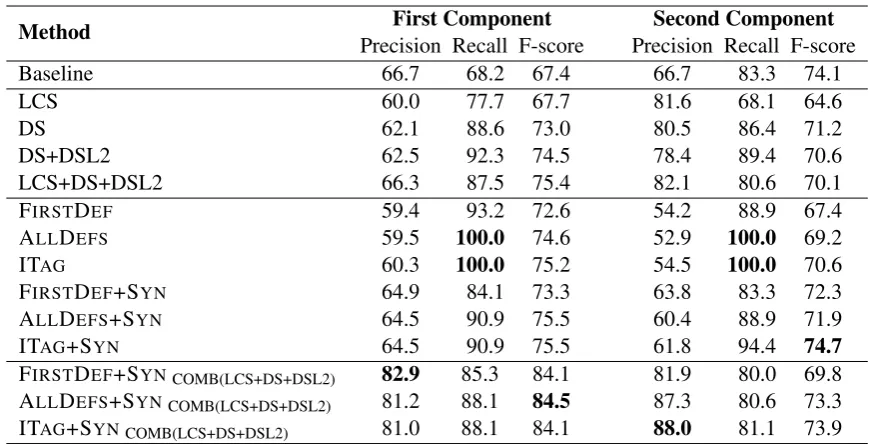
Table 2: Compositionality prediction results over the ENC dataset, relative to the first component (the modifier noun) and the second component (the head noun)
reasons: first, the guidelines given to the annota-tors of our datasets might be different from what Wiktionary contributors assume to be an idiom. Second, the baseline method assumes that for any non-compositional MWE, all components must be equally non-compositional, despite the wealth of MWEs where one or more components are com-positional (e.g. from the Wiktionary guidelines for idiom inclusion,3 computer chess, basketball
player,telephone box).
We also compare our method with: (1) “LCS”, the string similarity-based method of Salehi and Cook (2013), in which 54 languages are used; (2) “DS”, the monolingual distributional similarity method of Salehi et al. (2014); (3) “DS+DSL2”, the multilingual distributional similarity method of Salehi et al. (2014), including supervised lan-guage selection for a given dataset, based on cross-validation; and (4) “LCS+DS+DSL2”, whereby the first three methods are combined using a su-pervised support vector regression model. In each case, the continuous output of the model is equal-width discretised to generate a binary classification. We additionally present results for the combination of each of the six methods pro-posed in this paper with LCS, DS and DSL2, us-ing a linear-kernel support vector machine (rep-resented with the suffix “COMB(LCS+DS+DSL2)” for
a given method). The results are based on
cross-3http://en.wiktionary.org/wiki/
Wiktionary:Idioms_that_survived_RFD
validation, and for direct comparability, the parti-tions are exactly the same as Salehi et al. (2014).
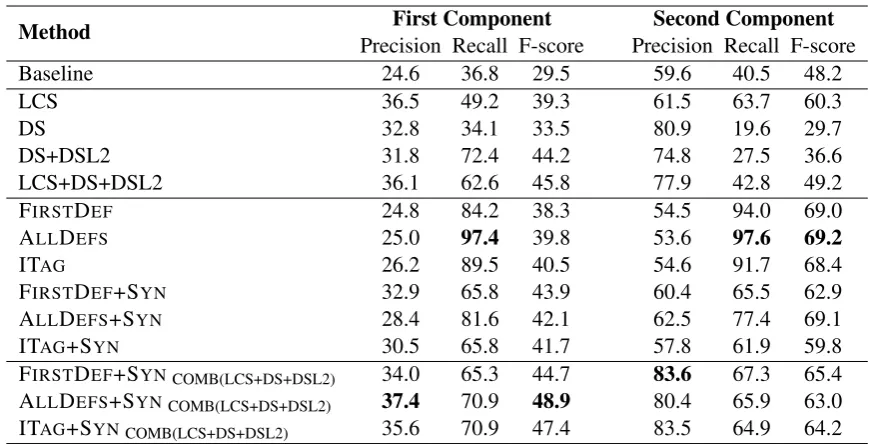
Tables 2 and 3 provide the results when our pro-posed method for detecting non-compositionality is applied to the ENC and EVPC datasets, respec-tively. The inclusion of translation data was found to improve all of precision, recall and F-score across the board for all of the proposed methods. For reasons of space, results without translation data are therefore omitted from the paper.
Overall, the simple unsupervised methods pro-posed in this paper are comparable with the unsu-pervised and suunsu-pervised state-of-the-art methods of Salehi and Cook (2013) and Salehi et al. (2014), with ITAG achieving the highest F-score for the
ENC dataset and for the verb components of the EVPC dataset. The inclusion of synonyms boosts results in most cases.
Method Precision Recall F-scoreFirst Component Precision Recall F-scoreSecond Component
Baseline 24.6 36.8 29.5 59.6 40.5 48.2
LCS 36.5 49.2 39.3 61.5 63.7 60.3
DS 32.8 34.1 33.5 80.9 19.6 29.7
DS+DSL2 31.8 72.4 44.2 74.8 27.5 36.6
LCS+DS+DSL2 36.1 62.6 45.8 77.9 42.8 49.2
FIRSTDEF 24.8 84.2 38.3 54.5 94.0 69.0
ALLDEFS 25.0 97.4 39.8 53.6 97.6 69.2
ITAG 26.2 89.5 40.5 54.6 91.7 68.4
FIRSTDEF+SYN 32.9 65.8 43.9 60.4 65.5 62.9
ALLDEFS+SYN 28.4 81.6 42.1 62.5 77.4 69.1
ITAG+SYN 30.5 65.8 41.7 57.8 61.9 59.8
FIRSTDEF+SYNCOMB(LCS+DS+DSL2) 34.0 65.3 44.7 83.6 67.3 65.4
ALLDEFS+SYNCOMB(LCS+DS+DSL2) 37.4 70.9 48.9 80.4 65.9 63.0
[image:5.595.80.521.60.282.2]ITAG+SYNCOMB(LCS+DS+DSL2) 35.6 70.9 47.4 83.5 64.9 64.2
Table 3: Compositionality prediction results over the EVPC dataset, relative to the first component (the head verb) and the second component (the particle)
that language.
6 Error Analysis
We analysed all items in each dataset where the system score differed from that of the human annotators. For both datasets, the majority of incorrectly-labelled items were compositional but predicted to be non-compositional by our sys-tem, as can be seen in the relatively low preci-sion scores in Tables 2 and 3. In many of these cases, the prediction based on definitions and syn-onyms was compositional but the prediction based on translations was non-compositional. In such cases, we arbitrarily break the tie by labelling the instance as non-compositional, and in doing so favour recall over precision.
Some of the incorrectly-labelled ENCs have a gold-standard annotation of around 2.5, or in other words are semi-compositional. For exam-ple, the compositionality score for gameingame plan is 2.82/5, but our system labels it as non-compositional; a similar thing happens withfigure and the EVPCfigure out. Such cases demonstrate the limitation of approaches to MWE composi-tionality that treat the problem as a binary clas-sification task.
On average, the EVPCs have three senses, which is roughly twice the number for ENCs. This makes the prediction of compositionality harder, as there is more information to combine across (an effect that is compounded with the addition of
syn-onyms and translations). In future work, we hope to address this problem by first finding the sense which matches best with the sentences given to the annotators.
7 Conclusion
We have proposed an unsupervised approach for predicting the compositionality of an MWE rel-ative to each of its components, based on lexi-cal overlap using Wiktionary, optionally incorpo-rating synonym and translation data. Our experi-ments showed that the various instantiations of our approach are superior to previous state-of-the-art supervised methods. All code to replicate the re-sults in this paper has been made publicly avail-able at https://github.com/bsalehi/ wiktionary_MWE_compositionality.
Acknowledgements
We thank the anonymous reviewers for their insightful comments and valuable suggestions. NICTA is funded by the Australian government as represented by Department of Broadband, Com-munication and Digital Economy, and the Aus-tralian Research Council through the ICT Centre of Excellence programme.
References
Dam-erau, editors, Handbook of Natural Language Pro-cessing. CRC Press, Boca Raton, USA, 2nd edition. Timothy Baldwin, Colin Bannard, Takaaki Tanaka, and Dominic Widdows. 2003. An empirical model of multiword expression decomposability. In Pro-ceedings of the ACL-2003 Workshop on Multiword Expressions: Analysis, Acquisition and Treatment, pages 89–96, Sapporo, Japan.
Timothy Baldwin, Jonathan Pool, and Susan M. Colowick. 2010. PanLex and LEXTRACT: Trans-lating all words of all languages of the world. In
Proceedings of the 23rd International Conference on Computational Linguistics: Demonstrations, pages 37–40, Beijing, China.
Colin James Bannard. 2006. Acquiring Phrasal Lexi-cons from Corpora. Ph.D. thesis, University of Ed-inburgh.
Afsaneh Fazly, Paul Cook, and Suzanne Stevenson. 2009. Unsupervised type and token identification of idiomatic expressions. Computational Linguistics, 35(1):61–103.
Christiane Fellbaum, editor. 1998. WordNet: An Elec-tronic Lexical Database. MIT Press, Cambridge, USA.
Richard Forthergill and Timothy Baldwin. 2011. Fleshing it out: A supervised approach to MWE-token and MWE-type classification. InProceedings of the 5th International Joint Conference on Natural Language Processing (IJCNLP 2011), pages 911– 919, Chiang Mai, Thailand.
David Kamholz, Jonathan Pool, and Susan Colowick. 2014. PanLex: Building a resource for panlingual lexical translation. In Proceedings of the Ninth In-ternational Conference on Language Resources and Evaluation (LREC’14), pages 3145–3150, Reyk-javik, Iceland.
Su Nam Kim and Timothy Baldwin. 2007. Detecting compositionality of English verb-particle construc-tions using semantic similarity. In Proceedings of the 7th Meeting of the Pacific Association for Com-putational Linguistics (PACLING 2007), pages 40– 48, Melbourne, Australia.
Michael Lesk. 1986. Automatic sense disambiguation using machine readable dictionaries: How to tell a pine cone from an ice cream cone. InProceedings of the 5th Annual International Conference on Systems Documentation, pages 24–26, Ontario, Canada. Grace Muzny and Luke Zettlemoyer. 2013.
Auto-matic idiom identification in Wiktionary. In Pro-ceedings of the 2013 Conference on Empirical Meth-ods in Natural Language Processing, pages 1417– 1421, Seattle, USA.
Siva Reddy, Diana McCarthy, and Suresh Manandhar. 2011. An empirical study on compositionality in compound nouns. InProceedings of IJCNLP, pages 210–218, Chiang Mai, Thailand.
Ivan Sag, Timothy Baldwin, Francis Bond, Ann Copes-take, and Dan Flickinger. 2002. Multiword ex-pressions: A pain in the neck for NLP. In Pro-ceedings of the 3rd International Conference on Intelligent Text Processing Computational Linguis-tics (CICLing-2002), pages 189–206, Mexico City, Mexico.
Bahar Salehi and Paul Cook. 2013. Predicting the compositionality of multiword expressions using translations in multiple languages. InProceedings of the Second Joint Conference on Lexical and Com-putational Semantics, volume 1, pages 266–275, At-lanta, USA.