Online Segment to Segment Neural Transduction
Lei Yu1, Jan Buys1 and Phil Blunsom1,2 1University of Oxford
2DeepMind
{lei.yu, jan.buys, phil.blunsom}@cs.ox.ac.uk
Abstract
We introduce an online neural sequence to se-quence model that learns to alternate between encoding and decoding segments of the input as it is read. By independently tracking the en-coding and deen-coding representations our algo-rithm permits exact polynomial marginaliza-tion of the latent segmentamarginaliza-tion during train-ing, and during decoding beam search is em-ployed to find the best alignment path to-gether with the predicted output sequence. Our model tackles the bottleneck of vanilla encoder-decoders that have to read and mem-orize the entire input sequence in their fixed-length hidden states before producing any out-put. It is different from previous attentive models in that, instead of treating the at-tention weights as output of a deterministic function, our model assigns attention weights to a sequential latent variable which can be marginalized out and permits online gener-ation. Experiments on abstractive sentence summarization and morphological inflection show significant performance gains over the baseline encoder-decoders.
1 Introduction
The problem of mapping from one sequence to an-other is an importance challenge of natural language processing. Common applications include machine translation and abstractive sentence summarisation. Traditionally this type of problem has been tackled by a combination of hand-crafted features, align-ment models, segalign-mentation heuristics, and language models, all of which are tuned separately.
The recently introduced encoder-decoder paradigm has proved very successful for machine translation, where an input sequence is encoded into a fixed-length vector and an output sequence is then decoded from said vector (Kalchbrenner and Blunsom, 2013; Sutskever et al., 2014; Cho et al., 2014). This architecture is appealing, as it makes it possible to tackle the problem of sequence-to-sequence mapping by training a large neural network in an end-to-end fashion. However it is difficult for a fixed-length vector to memorize all the necessary information of an input sequence, especially for long sequences. Often a very large encoding needs to be employed in order to capture the longest sequences, which invariably wastes capacity and computation for short sequences. While the attention mechanism of Bahdanau et al. (2015) goes some way to address this issue, it still requires the full input to be seen before any output can be produced.
In this paper we propose an architecture to tackle the limitations of the vanilla encoder-decoder model, a segment to segment neural transduction model (SSNT) that learns to generate and align simul-taneously. Our model is inspired by the HMM word alignment model proposed for statistical ma-chine translation (Vogel et al., 1996; Tillmann et al., 1997); we impose a monotone restriction on the alignments but incorporate recurrent dependencies on the input which enable rich locally non-monotone alignments to be captured. This is similar to the se-quence transduction model of Graves (2012), but we propose alignment distributions which are parame-terised separately, making the model more flexible
and allowing online inference.
Our model introduces a latent segmentation which determines correspondences between tokens of the input sequence and those of the output sequence. The aligned hidden states of the encoder and de-coder are used to predict the next output token and to calculate the transition probability of the alignment. We carefully design the input and output RNNs such that they independently update their respective hid-den states. This enables us to derive an exact dy-namic programme to marginalize out the hidden segmentation during training and an efficient beam search to generate online the best alignment path to-gether with the output sequence during decoding. Unlike previous recurrent segmentation models that only capture dependencies in the input (Graves et al., 2006; Kong et al., 2016), our segmentation model is able to capture unbounded dependencies in both the input and output sequences while still permitting polynomial inference.
While attentive models treat the attention weights as output of a deterministic function, our model as-signs attention weights to a sequential latent variable which can be marginalized out. Our model is gen-eral and could be incorporated into any RNN-based encoder-decoder architecture, such as Neural Turing Machines (Graves et al., 2014), memory networks (Weston et al., 2015; Kumar et al., 2016) or stack-based networks (Grefenstette et al., 2015), enabling such models to process data online.
We conduct experiments on two different trans-duction tasks, abstractive sentence summarisation (sequence to sequence mapping at word level) and morphological inflection generation (sequence to se-quence mapping at character level). We evaluate our proposed algorithms in both the online setting, where the input is encoded with a unidirectional LSTM, and where the whole input is available such that it can be encoded with a bidirectional network. The experimental results demonstrate the effective-ness of SSNT — it consistently output performs the baseline encoder-decoder approach while requir-ing significantly smaller hidden layers, thus show-ing that the segmentation model is able to learn to break one large transduction task into a series of smaller encodings and decodings. When bidirec-tional encodings are used the segmentation model outperforms an attention-based benchmark.
Quali-</s> . year new lunar
the for thursday
close markets financial
chinesechinese mark ets
[image:2.612.317.516.63.281.2]closed for public holiday . </s>
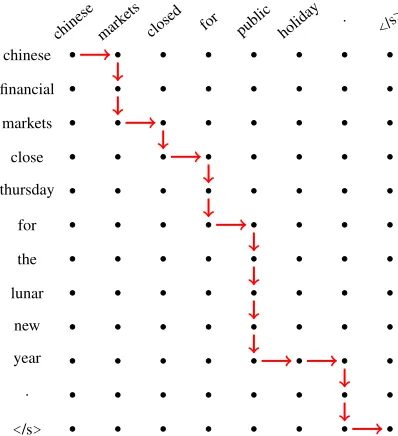
Figure 1: Example output of our recurrent segmenta-tion model on the task of abstractive sentence sum-marisation. The path highlighted is the alignment found by the model during decoding.
tative analysis shows that the alignments found by our model are highly intuitive and demonstrates that the model learns to read ahead the required number of tokens before producing output.
2 Model
LetxI1be the input sequence of lengthI andyJ1 the output sequence of lengthJ. Letyj denote the j -th token ofy. Our goal is to model the conditional distribution
p(y|x) = J
Y
j=1
p(yj|yj1−1,x). (1)
We introduce a hidden alignment sequence aJ 1 where eachaj =icorresponds to an input position
p(y|x) =Pap(y,a|x) (2)
≈ Pa
QJ
j=1p(aj|aj−1,y j−1
1 ,x)
| {z }
transition probability
·
p(yj|yj1−1, aj,x).
| {z }
word prediction
Figure 1 illustrates the model graphically. Each path from the top left node to the right-most column in the graph corresponds to an alignment. We con-strain the alignments to be monotone, i.e. only for-ward and downfor-ward transitions are permitted at each point in the grid. This constraint enables the model to learn to perform online generation. Additionally, the model learns to align input and output segments, which means that it can learn local reorderings by memorizing phrases. Another possible constraint on the alignments would be to ensure that the entire in-put sequence is consumed before last outin-put word is emitted, i.e. all valid alignment paths have to end in the bottom right corner of the grid. However, we do not enforce this constraint in our setup.
The probability contributed by an alignment is ob-tained by accumulating the probability of word pre-dictions at each point on the path and the transition probability between points. The transition probabil-ities and the word output probabilprobabil-ities are modeled by neural networks, which are described in detail in the following sub-sections.
2.1 Probabilities of Output Word Predictions
The input sentence x is encoded with a Recur-rent Neural Network (RNN), in particular an LSTM (Hochreiter and Schmidhuber, 1997). The encoder can either be a unidirectional or bidirectional LSTM. If a unidirectional encoder is used the model is able to read input and generate output symbols online. The hidden state vectors are computed as
h→i =RNN(h→i−1, v(e)(xi)), (3)
h←i =RNN(hi+1← , v(e)(xi)), (4)
wherev(e)(x
i) denotes the vector representation of the token x, and h→i andh←i are the forward and
backward hidden states, respectively. For a bidi-rectional encoder, they are concatenated as hi =
[h→i ;h←i ]; and for unidirectional encoderhi =h→i . The hidden statesj of the RNN for the output se-quenceyis computed as
sj =RNN(sj−1, v(d)(yj−1)), (5)
wherev(d)(yj−1) is the encoded vector of the
pre-viously generated output wordyj−1. That is,sj en-codesyj1−1.
To calculate the probability of the next word, we concatenate the aligned hidden state vectorssj and
haj and feed the result into a softmax layer,
p(yj =l|yj1−1, aj,x) =p(yj =l|haj,sj)
=softmax(Ww[haj;sj] +bw)l.
(6)
The word output distribution in Graves (2012) is pa-rameterised in similar way.
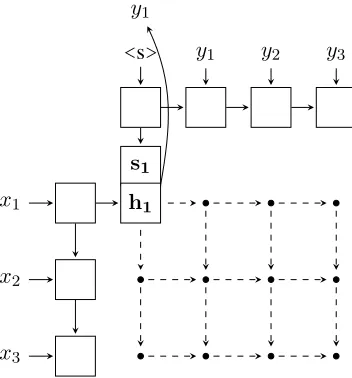
Figure 2 illustrates the model structure. Note that the hidden states of the input and output decoders are kept independent to permit tractable inference, while the output distributions are conditionally dependent on both.
2.2 Transition Probabilities
As the alignments are constrained to be monotone, we can treat the transition from timestepjtoj+1as a sequence ofshiftandemitoperations. Specif-ically, at each input position, a decision ofshift
oremit is made by the model; if the operation is
emitthen the next output word is generated; other-wise, the model willshiftto the next input word. While the multinomial distribution is an alternative for parameterising alignments, the shift/emit param-eterisation does not place an upper limit on the jump size, as a multinomial distribution would, and biases the model towards shorter jump sizes, which a multi-nomial model would have to learn.
We describe two methods for modelling the align-ment transition probability. The first approach is in-dependent of the input or output words. To parame-terise the alignment distribution in terms of shift and emit operations we use a geometric distribution,
p(aj|aj−1) = (1−e)aj−aj−1e, (7)
whereeis the emission probability. This transition
x3
x2
x1
s1
h1
<s> y1 y2 y3
[image:4.612.76.252.59.248.2]y1
Figure 2: The structure of our model. (x1, x2, x3) and (y1, y2, y3) denote the input and output se-quences, respectively. The points, e.g. (i, j), in the grid represent an alignment betweenxi andyj. For each columnj, the concatenation of the hidden
states[hi,sj]is used to predictyj.
estimated directly by maximum likelihood as
e=
P
nJn
P
nIn+PnJn
, (8)
whereInandJnare the lengths of the input and out-put sequences of training examplen, respectively.
For the second method we model the transition probability with a neural network,
p(a1=i) = i−1
Y
d=1
(1−p(ed,1))p(ei,1),
p(aj =i|aj−1 =k) = i−1
Y
d=k
(1−p(ed,j))p(ei,j),
(9) where p(ei,j) denotes the probability of emit for the alignmentaj =i. This probability is obtained by feeding[hi;sj]into a feed forward neural network,
p(ei,j) =σ(MLP(Wt[hi;sj] +bt)). (10)
For simplicity,p(aj =i|aj−1 =k,sj,hik)is abbre-viated asp(aj =i|aj−1 =k).
3 Training and Decoding
Since there are an exponential number of possi-ble alignments, it is computationally intractapossi-ble to
explicitly calculate every p(y,a|x) and then sum them to get the conditional probabilityp(y|x). We instead approach the problem using a dynamic-programming algorithm similar to the forward-backward algorithm for HMMs (Rabiner, 1989).
3.1 Training
For an input x and output y, the forward variable
α(i, j) = p(aj = i,yj1|x). The value ofα(i, j) is computed by summing over the probabilities of ev-ery path that could lead to this cell. Formally,α(i, j) is defined as follows:
Fori∈[1, I]:
α(i,1) =p(a1 =i)p(y1|hi,s1). (11)
Forj∈[2, J],i∈[1, I]:
α(i, j) =p(yj|hi,sj)· (12) i
X
k=1
α(k, j−1)p(aj =i|aj−1 =k).
The backward variables, defined as β(i, j) =
p(yJj+1|aj =i,yj1,x), are computed as: Fori∈[1, I]:
β(i, J) = 1. (13)
Forj∈[1, J −1],i∈[1, I]:
β(i, j) = I
X
k=i
p(aj+1=k|aj =i)β(k, j+ 1)·
p(yj+1|hk,sj+1). (14)
During training we estimate the parameters by minimizing the negative log likelihood of the train-ing setS:
L(θ) =− X (x,y)∈S
logp(y|x;θ)
=− X
(x,y)∈S log
I
X
i=1
α(i, J).
(15)
Letθjbe the neural network parameters w.r.t. the
model output at positionj. The gradient is computed
as:
∂logp(y|x;θ)
∂θ =
J
X
j=1 I
X
i=1
∂logp(y|x;θ)
∂α(i, j)
∂α(i, j)
∂θj .
The derivative w.r.t. the forward weights is
∂logp(y|x;θ)
∂α(i, j) =
β(i, j)
p(y|x;θ). (17) The derivative of the forward weights w.r.t. the model parameters at positionjis
∂α(i, j)
∂θj
= ∂p(yj|hi,sj)
∂θj
α(i, j)
p(yj|hi,sj)
+p(yj|hi,sj) i
X
k=1
α(j−1, k) ∂
∂θj
p(aj=i|aj−1=k).
(18) For the geometric distribution transition probabil-ity model ∂
∂θjp(aj =i|aj−1 =k) = 0.
3.2 Decoding
Algorithm 1DP search algorithm
Input: source sentencex
Output: best output sentencey∗
Initialization: Q ∈ RI×Jmax, bp ∈ NI×Jmax,
W ∈NI×Jmax,Iend,Jend.
fori∈[1, I]do
Q[i,1]←maxy∈Vp(a1=i)p(y|hi,s1)
bp[i,1]←0
W[i,1]←arg maxy∈Vp(a1 =i)p(y|hi,s1)
end for
forj∈[2, Jmax]do fori∈[1, I]do
Q[i, j]←maxy∈V,k∈[1,i]Q[k, j−1]·
p(aj =i|aj−1 =k)p(y|hi,sj)
bp[i, j], W[i, j]←arg maxy∈V,k∈[1,i]·
Q[k, j−1]p(aj =i|aj−1 =k)p(y|hi,sj)
end for
Iend ←arg maxiQ[i, j]
ifW[Iend, j] =EOS then
Jend←j break end if end for
return a sequence of words stored inW by
fol-lowing backpointers starting from(Iend, Jend).
For decoding, we aim to find the best output se-quencey∗for a given input sequencex:
y∗= arg max
y p(y|x) (19)
The search algorithm is based on dynamic program-ming (Tillmann et al., 1997). The main idea is to create a path probability matrixQ, and fill each cell Q[i, j]by recursively taking the most probable path that could lead to this cell. We present the greedy search algorithm in Algorithm 1. We also imple-mented a beam search that tracks thek best partial
sequences at position(i, j). The notation bp refers to backpointers,W stores words to be predicted,V
denotes the output vocabulary,Jmaxis the maximum
length of the output sequences that the model is al-lowed to predict.
4 Experiments
We evaluate the effectiveness of our model on two representative natural language processing tasks, sentence compression and morphological inflection. The primary aim of this evaluation is to assess whether our proposed architecture is able to outper-form the baseline encoder-decoder model by over-coming its encoding bottleneck. We further bench-mark our results against an attention model in order to determine whether our alternative alignment strat-egy is able to provide similar benefits while process-ing the input online.
4.1 Abstractive Sentence Summarisation
Sentence summarisation is the task of generating a condensed version of a sentence while preserv-ing its meanpreserv-ing. In abstractive sentence summari-sation, summaries are generated from the given vo-cabulary without the constraint of copying words in the input sentence. Rush et al. (2015) compiled a data set for this task from the annotated Gigaword data set (Graff et al., 2003; Napoles et al., 2012), where sentence-summary pairs are obtained by pair-ing the headline of each article with its first sentence. Rush et al. (2015) use the splits of 3.8m/190k/381k for training, validation and testing. In previous work on this dataset, Rush et al. (2015) proposed an attention-based model with feed-forward neural networks, and Chopra et al. (2016) proposed an attention-based recurrent encoder-decoder, similar to one of our baselines.
Due to computational constraints we place the fol-lowing restrictions on the training and validation set:
Model ROUGE-1 ROUGE-2 ROUGE-L
Seq2seq 25.16 9.09 23.06
Attention 29.25 12.85 27.32
uniSSNT 26.96 10.54 24.59
biSSNT 27.05 10.62 24.64
uniSSNT+ 30.15 13.59 27.88
biSSNT+ 30.27 13.68 27.91
Table 1: ROUGE F1 scores on the sentence sum-marisation test set. Seq2seq refers to the vanilla encoder-decoder and attention denotes the attention-based model. SSNT denotes our model with align-ment transition probability modelled as geometric distribution. SSNT+ refers to our model with tran-sition probability modelled using neural networks. The prefixes uni- and bi- denote using unidirectional and bidirectional encoder LSTMs, respectively.
and summaries are 50 and 25, respectively.
2. For each sentence-summary pair, the product of the input and output lengths should be no greater than 500.
We use the filtered 172k pairs for validation and sample 1m pairs for training. While this training set is smaller than that used in previous work (and there-fore our results cannot be compared directly against reported results), it serves our purpose for evaluat-ing our algorithm against sequence to sequence and attention-based approaches under identical data con-ditions. Following from previous work (Rush et al., 2015; Chopra et al., 2016; G¨ulc¸ehre et al., 2016), we report results on a randomly sampled test set of 2000 sentence-summary pairs. The quality of the generated summaries are evaluated by three ver-sions of ROUGE for different match lengths, namely ROUGE-1 (unigrams), ROUGE-2 (bigrams), and ROUGE-L (longest-common substring).
For training, we use Adam (Kingma and Ba, 2015) for optimization, with an initial learning rate of 0.001. The mini-batch size is set to 32. The number of hidden unitsHis set to 256 for both our
model and the baseline models, and dropout of 0.2 is applied to the input of LSTMs. All hyperparameters were optimised via grid search on the perplexity of the validation set. We use greedy decoding to gener-ate summaries.
Model Configuration Perplexity
Seq2seq
H= 128, L= 1 48.5
H= 256, L= 1 35.6
H= 256, L= 2 32.1
H= 256, L= 3 31.0
biSSNT+ H= 128, L= 1 26.7
[image:6.612.333.520.59.168.2]H= 256, L= 1 22.6
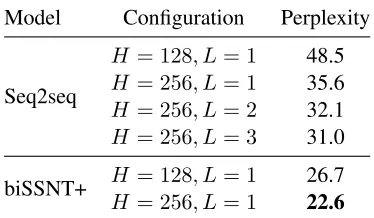
Table 2: Perplexity on the validation set with 172k sentence-summary pairs.
Table 1 displays the ROUGE-F1 scores of our models on the test set, together with baseline mod-els, including the attention-based model. Our models achieve significantly better results than the vanilla encoder-decoder and outperform the attention-based model. The fact that SSNT+ per-forms better is in line with our expectations, as the neural network-parameterised alignment model is more expressive than that modelled by geometric distribution.
To make further comparison, we experimented with different sizes of hidden units and adding more layers to the baseline encoder-decoder. Table 2 lists the configurations of different models and their cor-responding perplexities on the validation set. We can see that the vanilla encoder-decoder tends to get bet-ter results by adding more hidden units and stacking more layers. This is due to the limitation of com-pressing information into a fixed-size vector. It has to use larger vectors and deeper structure in order to memorize more information. By contrast, our model can do well with smaller networks. In fact, even with 1 layer and 128 hidden units, our model works much better than the vanilla encoder-decoder with 3 layers and 256 hidden units per layer.
4.2 Morphological Inflection
Morphological inflection generation is the task of predicting the inflected form of a given lexical item based on a morphological attribute. The transforma-tion from a base form to an inflected form usually in-cludes concatenating it with a prefix or a suffix and substituting some characters. For example, the in-flected form of a German stemabgangisabg¨angen
Model Avg. accuracy
Seq2Seq 79.08
Seq2Seq w/ Attention 95.64
Adapted-seq2seq (FTND16) 96.20
uniSSNT+ 87.85
[image:7.612.83.288.60.157.2]biSSNT+ 95.32
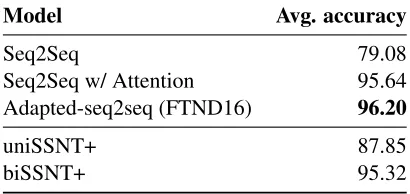
Table 3: Average accuracy over all the morpho-logical inflection datasets. The baseline results for Seq2Seq variants are taken from (Faruqui et al., 2016).
Faruqui et al. (2016). This dataset was originally created by Durrett and DeNero (2013) from Wik-tionary, containing inflections for German nouns (de-N), German verbs (de-V), Spanish verbs (es-V), Finnish noun and adjective (fi-NA), and Finnish verbs (fi-V). It was further expanded by Nicolai et al. (2015) by adding Dutch verbs (nl-V) and French verbs (fr-V). The number of inflection types for each language ranges from 8 to 57. The number of base forms, i.e. the number of instances in each dataset, ranges from 2000 to 11200. The predefined split is 200/200 for dev and test sets, and the rest of the data for training.
Our model is trained separately for each type of inflection, the same setting as the factored model described in Faruqui et al. (2016). The model is trained to predict the character sequence of the in-flected form given that of the stem. The output is evaluated by accuracies of string matching. For all the experiments on this task we use 128 hidden units for the LSTMs and apply dropout of 0.5 on the input and output of the LSTMs. We use Adam (Kingma and Ba, 2015) for optimisation with initial learning rate of 0.001. During decoding, beam search is em-ployed with beam size of 30.
Table 3 gives the average accuracy of the uniSSNT+, biSSNT+, vanilla encoder-decoder, and attention-based models. The model with the best previous average result — denoted as adapted-seq2seq (FTND16) (Faruqui et al., 2016) — is also included for comparison. Our biSSNT+ model out-performs the vanilla encoder-decoder by a large margin and almost matches the state-of-the-art result on this task. As mentioned earlier, a characteristic of these datasets is that the stems and their
corre-Dataset DDN13 NCK15 FTND16 biSSNT+
de-N 88.31 88.60 88.12 87.50
de-V 94.76 97.50 97.72 92.11
es-V 99.61 99.80 99.81 99.52
fi-NA 92.14 93.00 95.44 95.48
fi-V 97.23 98.10 97.81 98.10
fr-V 98.80 99.20 98.82 98.65
nl-V 90.50 96.10 96.71 95.90
Avg. 94.47 96.04 96.20 95.32
Table 4: Comparison of the performance of our model (biSSNT+) against the previous state-of-the-art on each morphological inflection dataset.
sponding inflected forms mostly overlap. Compare to the vanilla encoder-decoder, our model is better at copying and finding correspondences between pre-fix, stem and suffix segments.
Table 4 compares the results of biSSNT+ and pre-vious models on each individual dataset. DDN13 and NCK15 denote the models of Durrett and DeN-ero (2013) and Nicolai et al. (2015), respectively. Both models tackle the task by feature engineering. FTND16 (Faruqui et al., 2016) adapted the vanilla encoder-decoder by feeding thei-th character of the
encoded string as an extra input into thei-th position
of the decoder. It can be considered as a special case of our model by forcing a fixed diagonal alignment between input and output sequences. Our model achieves comparable results to these models on all the datasets. Notably it outperforms other models on the Finnish noun and adjective, and verbs datasets, whose stems and inflected forms are the longest.
5 Alignment Quality
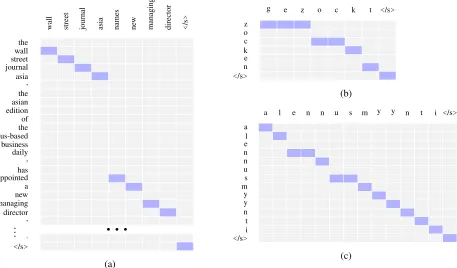
</s> . , director managingnew a appointedhas , daily business us-basedthe of editionasian the , asia journalstreet wallthe
w
all
street journal asia names new managing director </s
>
...
(a)
</s>n e kc oz
g e z o c k t </s>
(b)
</s>i t n y y ms u n ne l a
a l e n n u s m y y n t i </s>
[image:8.612.79.536.63.331.2](c)
Figure 3: Example alignments found by BiSSNT+. Highlighted grid cells represent the correspondence between the input and output tokens.
shown in Figure 3a, the mapping between ‘the wall street journal asia, the asian edition of the us-based business daily’ and ‘wall street journal asia’ demon-strates that our model learns to ignore phrasal mod-ifiers containing additional information. We also find some examples of word reordering, e.g., the phrase ‘industrial production in france’ is reordered as ‘france industrial output’ in the model’s predicted output.
6 Related Work
Our work is inspired by the seminal HMM align-ment model (Vogel et al., 1996; Tillmann et al., 1997) proposed for machine translation. In contrast to that work, when predicting a target word we addi-tionally condition on all previously generated words, which is enabled by the recurrent neural models. This means that the model also functions as a con-ditional language model. It can therefore be applied directly, while traditional models have to be com-bined with a language model through a noisy chan-nel in order to be effective. Additionally, instead of EM training on the most likely alignments at each
iteration, our model is trained with direct gradient descent, marginalizing over all the alignments.
Latent variables have been employed in neural network-based models for sequence labelling tasks in the past. Examples include connectionist tem-poral classification (CTC) (Graves et al., 2006) for speech recognition and the more recent segmental recurrent neural networks (SRNNs) (Kong et al., 2016), with applications on handwriting recogni-tion and part-of-speech tagging. Weighted finite-state transducers (WFSTs) have also been aug-mented to encode input sequences with bidirectional LSTMs (Rastogi et al., 2016), permitting exact in-ference over all possible output strings. While these models have been shown to achieve appealing per-formance on different applications, they have com-mon limitations in terms of modelling dependencies between labels. It is not possible for CTCs to model explicit dependencies. SRNNs and neural WFSTs model fixed-length dependencies, making it is diffi-cult to carry out effective inference as the dependen-cies become longer.
transduction model of Graves (2012) in being able to model unbounded dependencies between output tokens via an output RNN. This property makes it possible to apply our model to tasks like summarisa-tion and machine translasummarisa-tion that require the tokens in the output sequence to be modelled highly depen-dently. Graves (2012) models the joint distribution over outputs and alignments by inserting null sym-bols (representing shift operations) into the output sequence. During training the model uses dynamic programming to marginalize over permutations of the null symbols, while beam search is employed during decoding. In contrast our model defines a separate latent alignment variable, which adds flex-ibility to the way the alignment distribution can be defined (as a geometric distribution or parameterised by a neural network) and how the alignments can be constrained, without redefining the dynamic pro-gram. In addition to marginalizing during training, our decoding algorithm also makes use of dynamic programming, allowing us to use either no beam or small beam sizes.
Our work is also related to the attention-based models first introduced for machine transla-tion (Bahdanau et al., 2015). Luong et al. (2015) proposed two alternative attention mechanisms: a global method that attends all words in the input sen-tence, and a local one that points to parts of the input words. Another variation on this theme are pointer networks (Vinyals et al., 2015), where the outputs are pointers to elements of the variable-length in-put, predicted by the attention distribution. Jaitly et al. (2016) propose an online sequence to sequence model with attention that conditions on fixed-sized blocks of the input sequence and emits output tokens corresponding to each block. The model is trained with alignment information to generate supervised segmentations.
Although our model shares the same idea of joint training and aligning with the attention-based mod-els, our design has fundamental differences and ad-vantages. While attention-based models treat the at-tention weights as output of a deterministic func-tion (soft-alignment), in our model the attenfunc-tion weights correspond to a hidden variable, that can be marginalized out using dynamic programming. Fur-ther, our model’s inherent online nature permits it the flexibility to use its capacity to chose how much
input to encode before decoding each segment.
7 Conclusion
We have proposed a novel segment to segment neu-ral transduction model that tackles the limitations of vanilla encoder-decoders that have to read and mem-orize an entire input sequence in a fixed-length con-text vector before producing any output. By intro-ducing a latent segmentation that determines corre-spondences between tokens of the input and output sequences, our model learns to generate and align jointly. During training, the hidden alignment is marginalized out using dynamic programming, and during decoding the best alignment path is gener-ated alongside the predicted output sequence. By employing a unidirectional LSTM as encoder, our model is capable of doing online generation. Exper-iments on two representative natural language pro-cessing tasks, abstractive sentence summarisation and morphological inflection generation, showed that our model significantly outperforms encoder-decoder baselines while requiring much smaller hid-den layers. For future work we would like to incor-porate attention-based models to our framework to enable such models to process data online.
Acknowledgments
We thank Chris Dyer, Karl Moritz Hermann, Ed-ward Grefenstette, Tom´aˇs Kˇocisk´y, Gabor Melis, Yishu Miao and many others for their helpful com-ments. The first author is funded by EPSRC.
References
Dzmitry Bahdanau, Kyunghyun Cho, and Yoshua Ben-gio. 2015. Neural machine translation by jointly learning to align and translate. In Proceedings of ICLR.
Kyunghyun Cho, Bart van Merrienboer, C¸aglar G¨ulc¸ehre, Dzmitry Bahdanau, Fethi Bougares, Holger Schwenk, and Yoshua Bengio. 2014. Learning phrase represen-tations using RNN encoder-decoder for statistical ma-chine translation. InProceedings of EMNLP.
Greg Durrett and John DeNero. 2013. Supervised learn-ing of complete morphological paradigms. In Pro-ceedings of HLT-NAACL.
Manaal Faruqui, Yulia Tsvetkov, Graham Neubig, and Chris Dyer. 2016. Morphological inflection genera-tion using character sequence to sequence learning. In Proceedings of NAACL.
David Graff, Junbo Kong, Ke Chen, and Kazuaki Maeda. 2003. English gigaword. Linguistic Data Consortium, Philadelphia.
Alex Graves, Santiago Fern´andez, Faustino Gomez, and J¨urgen Schmidhuber. 2006. Connectionist temporal classification: labelling unsegmented sequence data with recurrent neural networks. In Proceedings of ICML.
Alex Graves, Greg Wayne, and Ivo Danihelka. 2014. Neural turing machines. CoRR, abs/1410.5401. Alex Graves. 2012. Sequence transduction with
recur-rent neural networks. arXiv preprint arXiv:1211.3711. Edward Grefenstette, Karl Moritz Hermann, Mustafa Su-leyman, and Phil Blunsom. 2015. Learning to trans-duce with unbounded memory. In Proceedings of NIPS, pages 1819–1827.
C¸aglar G¨ulc¸ehre, Sungjin Ahn, Ramesh Nallapati, Bowen Zhou, and Yoshua Bengio. 2016. Pointing the unknown words. CoRR, abs/1603.08148.
Sepp Hochreiter and J¨urgen Schmidhuber. 1997. Long short-term memory. Neural computation, 9(8):1735– 1780.
Navdeep Jaitly, David Sussillo, Quoc V. Le, Oriol Vinyals, Ilya Sutskever, and Samy Bengio. 2016. A neural transducer. InProceedings of NIPS.
Nal Kalchbrenner and Phil Blunsom. 2013. Recur-rent continuous translation models. InProceedings of EMNLP.
Diederik P. Kingma and Jimmy Ba. 2015. Adam: A method for stochastic optimization. InProceedings of ICIR.
Lingpeng Kong, Chris Dyer, and Noah A Smith. 2016. Segmental recurrent neural networks. InProceedings of ICLR.
Ankit Kumar, Ozan Irsoy, Jonathan Su, James Bradbury, Robert English, Brian Pierce, Peter Ondruska, Ishaan Gulrajani, and Richard Socher. 2016. Ask me any-thing: Dynamic memory networks for natural lan-guage processing. InProceedings of ICML.
Thang Luong, Hieu Pham, and Christopher D. Manning. 2015. Effective approaches to attention-based neural machine translation. InProceedings of EMNLP. Courtney Napoles, Matthew Gormley, and Benjamin
Van Durme. 2012. Annotated gigaword. In Proceed-ings of the Joint Workshop on Automatic Knowledge Base Construction and Web-scale Knowledge Extrac-tion.
Garrett Nicolai, Colin Cherry, and Grzegorz Kondrak. 2015. Inflection generation as discriminative string transduction. InProceedings of NAACL.
Lawrence R Rabiner. 1989. A tutorial on hidden markov models and selected applications in speech recogni-tion. Proceedings of the IEEE, 77(2):257–286. Pushpendre Rastogi, Ryan Cotterell, and Jason Eisner.
2016. Weighting finite-state transductions with neural context. InProceedings of NAACL.
Alexander M. Rush, Sumit Chopra, and Jason Weston. 2015. A neural attention model for abstractive sen-tence summarization. InProceedings of EMNLP. Ilya Sutskever, Oriol Vinyals, and Quoc V Le. 2014.
Se-quence to seSe-quence learning with neural networks. In Proceedings of NIPS.
Christoph Tillmann, Stephan Vogel, Hermann Ney, and Alex Zubiaga. 1997. A DP-based search using mono-tone alignments in statistical translation. In Proceed-ings of EACL.
Oriol Vinyals, Meire Fortunato, and Navdeep Jaitly. 2015. Pointer networks. InProceedings of NIPS. Stephan Vogel, Hermann Ney, and Christoph Tillmann.
1996. HMM-based word alignment in statistical trans-lation. InProceedings of COLING.