Biased Representation Learning for Domain Adaptation
Fei Huang , Alexander Yates Temple University
Computer and Information Sciences 324 Wachman Hall
Philadelphia, PA 19122
{fhuang,yates}@temple.edu
Abstract
Representation learning is a promising tech-nique for discovering features that allow su-pervised classifiers to generalize from a source domain dataset to arbitrary new domains. We present a novel, formal statement of the rep-resentation learning task. We argue that be-cause the task is computationally intractable in general, it is important for a representa-tion learner to be able to incorporate expert knowledge during its search for helpful fea-tures. Leveraging the Posterior Regularization framework, we develop an architecture for in-corporating biases into representation learn-ing. We investigate three types of biases, and experiments on two domain adaptation tasks show that our biased learners identify signif-icantly better sets of features than unbiased learners, resulting in a relative reduction in er-ror of more than 16% for both tasks, with re-spect to existing state-of-the-art representation learning techniques.
1 Introduction
Supervised natural language processing (NLP) sys-tems have been widely used and have achieved im-pressive performance on many NLP tasks. Howev-er, they exhibit a significant drop-off in performance when tested on domains that differ from their train-ing domains. (Gildea, 2001; Sekine, 1997; Pradhan et al., 2007) One major cause for poor performance on out of-domain texts is the traditional representa-tion used by supervised NLP systems (Ben-David et al., 2007). Most systems depend on lexical features, which can differ greatly between domains, so that important words in the test data may never be seen
in the training data. The connection between word-s and labelword-s may alword-so change acroword-sword-s domainword-s. For instance, “signaling” appears only as a present par-ticiple (VBG) in WSJ text (as in, “signaling that...”), but predominantly as a noun (as in “signaling path-way”) in biomedical text.
Recently, several authors have found that learning new features based on distributional similarity can significantly improve domain adaptation (Blitzer et al., 2006; Huang and Yates, 2009; Turian et al., 2010; Dhillon et al., 2011). This framework is at-tractive for several reasons: experimentally, learned features can yield significant improvements over s-tandard supervised models on out-of-domain test-s. Moreover, since the representation-learning tech-niques are unsupervised, they can easily be applied to arbitrary new domains. There is no need to supply additional labeled examples for each new domain.
Traditional representations still hold one signif-icant advantage over representation-learning, how-ever: because features are hand-crafted, these rep-resentations can readily incorporate the linguistic or domain expert knowledge that leads to state-of-the-art in-domain performance. In contrast, the on-ly guide for existing representation-learning tech-niques is a corpus of unlabeled text.
To address this shortcoming, we introduce representation-learning techniques that incorporate a domain expert’s preferences over the learned fea-tures. For example, out of the set of all possi-ble distributional-similarity features, we might pre-fer those that help predict the labels in a labeled training data set. To capture this preference, we might bias a representation-learning algorithm to-wards features with low joint entropy with the labels in the training data. This particular biased form of
representation learning is a type of semi-supervised learning that allows our system to learntask-specific
representations from a source domain’s training da-ta, rather than the single representation for all tasks produced by current, unsupervised representation-learning techniques.
We present a novel formal statement of represen-tation learning, and demonstrate that it is computa-tionally intractable in general. It is therefore criti-cal for representation learning to be flexible enough to incorporate the intuitions and knowledge of hu-man experts, to guide the search for representations efficiently and effectively. Leveraging the Posteri-or Regularization framewPosteri-ork (Ganchev et al., 2010), we present an architecture for learning representa-tions for sequence-labeling tasks that allows for bi-ases. In addition to a bias towards task-specific rep-resentations, we investigate a bias towards repre-sentations that have similar features across domain-s, to improve domain-independence; and a bias to-wards multi-dimensional representations, where d-ifferent dimensions are independent of one another. In this paper, we focus on incorporating the bias-es with HMM-type reprbias-esentations (Hidden Markov Model). However, this technique can also be ap-plied to other graphical model-based representations with little modification. Our experiments show that on two different domain-adaptation tasks, our biased representations improve significantly over unbiased ones. In a part-of-speech tagging experiment, our best model provides a 25% relative reduction in er-ror over a state-of-the-art Chinese POS tagger, and a 19% relative reduction in error over an unbiased representation from previous work.
The next section describes background and previ-ous work. Section 3 introduces our framework for learning biased representations. Section 4 describes how we estimate parameters for the biased objective functions efficiently. Section 5 details our experi-ments and results, and section 6 concludes and out-lines directions for future work.
2 Background and Previous Work
2.1 Terminology and Notation
Arepresentationis a set of features that describe da-ta points. Formally, given an insda-tance setX, it is a functionR:X → Y for some suitable spaceY
(of-tenRd), which is then used as the input space for a classifier. For instance, a traditional representation for POS tagging over vocabulary V would include (in part)|V|dimensions, and would map a word to a binary vector with a 1 in only one of the dimensions. By astructured representation, we mean a function
Rthat incorporates some form of joint inference. In this paper, we use Viterbi decoding of variants of Hidden Markov Models (HMMs) for our structured representations, although our techniques are appli-cable to arbitrary (Dynamic) Bayes Nets. Adomain
is a probability distributionDover the instance set X; R(D) denotes the induced distribution over Y. Indomain adaptationtasks, a learner is given sam-ples from asourcedomainDS, and is evaluated on
samples from atargetdomainDT.
2.2 Theoretical Background
Ben-David et al. (2010) give a theoretical analysis of domain adaptation which shows that the choice of representation is crucial. A good choice is one that minimizes error on the training data, but equally important is that the representation must make data from the two domains look similar. Ben-Davidet al.
show that for every hypothesish, we can provably bound the error ofhon the target domain by its error on the source domain plus a measure of the distance betweenDSandDT:
Ex∼DTL(x, R, f, h)≤Ex∼DSL(x, R, f, h)
+d1(R(DS), R(DT))
whereLis a loss function, f is the target function, and the variation divergenced1is given by
d1(D, D0) = 2 sup
B∈B
|P rD[B]−P rD0[B]| (1)
whereBis the set of measurable sets underD, D0.
2.3 Problem Formulation
Ben-Davidet al.’s theory provides learning bound-s for domain adaptation under a fixed R. We now reformulate this theory to define the task of repre-sentation learning for domain adaptation as the fol-lowing optimization problem: given a set of unla-beled instances US drawn from the source domain
and unlabeled instancesUT from the target domain,
the source domain, identify a functionR∗ from the space of possible representationsR:
R∗ = argmin R∈R
{min
h∈H(Ex∼DSL(x, R, f, h)) +d1(R(DS), R(DT))}
(2)
Unlike most learning problems, where the repre-sentation R is fixed, this problem formulation in-volves a search over the space of representation-s and hypotherepresentation-serepresentation-s. The equation alrepresentation-so highlightrepresentation-s an important underlying tension: the best representa-tion for the source domain would naturally include domain-specific features, and allow a hypothesis to learn domain-specific patterns. We are aiming, how-ever, for the bestgeneralclassifier, that happens to be trained on training data from one or a few do-mains. Domain-specific features would contribute to distance between domains, and to classifier errors on data taken from unseen domains. By optimizing for this combined objective function, we allow the optimization method to trade off between features that are best for classifying source-domain data and features that allow generalization to new domains.
Naturally, the objective function in Equation 2 is completely intractable. Just finding the optimal hy-pothesis for a fixed representation of the training da-ta is intracda-table for many hypothesis classes. And thed1metric is intractable to compute from samples
of a distribution, although Ben-Davidet al.propose some tractable bounds (2007; 2010). We view Equa-tion 2 as a high-level goal rather than a computable objective. We leverage prior knowledge to bias the representation learner towards attractive regions of the representations space R, and we develop effi-cient, greedy optimization techniques for learning effective representations.
2.4 Previous Work
There is a long tradition of research on representa-tions for NLP, mostly falling into one of three cat-egories: 1) vector space models and dimensionality reduction techniques (Salton and McGill, 1983; Tur-ney and Pantel, 2010; Sahlgren, 2005; Deerwester et al., 1990; Honkela, 1997) 2) using structured repre-sentations to identify clusters based on distributional similarity, and using those clusters as features (Lin and Wu, 2009; Candito and Crabb´e, 2009; Huang
and Yates, 2009; Ahuja and Downey, 2010; Turi-an et al., 2010; HuTuri-ang et al., 2011); 3) Turi-and struc-tured representations that induce multi-dimensional real-valued features (Dhillon et al., 2011; Emami et al., 2003; Morin and Bengio, 2005). Our work fall-s into the fall-second category, but buildfall-s on the pre-vious work by demonstrating how to improve the distributional-similarity clusters with prior knowl-edge. To our knowledge, we are the first to apply semi-supervised representation learning techniques for structured NLP tasks.
Most previous work on domain adaptation has fo-cused on the case where some labeled data is avail-able in both the source and target domains (Daum´e III, 2007; Jiang and Zhai, 2007; Daum´e III et al., 2010). Learning bounds are known (Blitzer et al., 2007; Mansour et al., 2009). A few authors have considered domain adaptation with no labeled data from the target domain (Blitzer et al., 2006; Huang et al., 2011) by using features based on distributional similarity. We demonstrate empirically that incorpo-rating biases into this type of representation-learning process can significantly improve results.
3 Biased Representation Learning
As before, letUSandUT be unlabeled data, andLS
be labeled data from the source domain only. Pre-vious work on representation learning with Hidden Markov Models (HMMs) (Huang and Yates, 2009) has estimated parametersθfor the HMM from un-labeled data alone, and then determined the Viterbi-optimal latent states for training and test data to pro-duce new features for a supervised classifier. The objective function for HMM learning in this case is marginal log-likelihood, optimized using the Baum-Welch algorithm:
L(θ) = X x∈US∪UT
logX y
p(x,Y=y|θ) (3)
wherex is a sentence, Y is the sequence of latent random variables for the sentence, and y is an in-stance of the latent sequence. The joint distribution in an HMM factors into observation and transition distributions, typically mixtures of multinomials:
p(x,y|θ) =P(y1)P(x1|y1) Y
i≥2
Innocent bystanders are often the
JJ NNS RB VBP DT
y1 y2 y3 y4 y5
...
victims
y6
NNS
Innocent bystanders are often the victims
...
Eφentropy(Y, z)
P(Y)
p1
p2
p3
pm
pn KL(pm||pn)
[image:4.612.76.296.59.226.2]Monday, March 26, 12
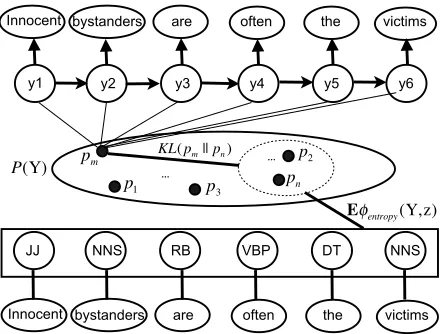
Figure 1: Illustration of how the entropy bias is incor-porated into HMM learning. The dotted oval shows the space of desired distributions in the hidden space, which have small or zero entropy with the real labels. The learn-ing algorithm aims to maximize the log-likelihood of the unlabeled data, and to minimize the KL divergence be-tween the real distribution, pm, and the closest desired
distribution,pn.
Intuitively, this form of representation learning i-dentifies clusters of distributionally-similar words: those words with the same Viterbi-optimal latent s-tate. The Viterbi-optimal latent states are then used as features for the supervised classifier. Our previ-ous work (2009) has shown that the features from the learned HMM significantly improve the accura-cy of POS taggers and chunkers on benchmark do-main adaptation datasets.
We use the HMM model from our previous work (2009) as our baseline. Our techniques follow the same general setup, as it provides an efficient and empirically-proven starting point for exploring (one part of) the space of possible representations. Note, however, that the HMM on its own does not provide even an approximate solution to the objective func-tion in our problem formulafunc-tion (Eqn. 2), since it makes no attempt to find the representation that min-imizes loss on labeled data. To address this and other concerns, we modify the objective function for HM-M training. Specifically, we encode biases for rep-resentation learning by defining a set ofpropertiesφ
that we believe a good representation function would minimize. One possible bias is that the HMM states should be predictive of the labels in labeled training
data. We can encode this as a property that computes the entropy between the HMM states and the label-s. For example, in Figure 1, we want to learn the best HMM distribution for the sentence “Innocen-t bys“Innocen-tanders are of“Innocen-ten “Innocen-the vic“Innocen-tims” for POS “Innocen-tagging task. The hidden sequencey1, y2, y3, y4, y5, y6 can
have any distribution p1, p2, p3, ..., pm, ..., pn from
the latent spaceY. Since we are doing POS tagging, we want the distribution to learn the information en-coded in the original POS labels “JJ NNS RB VBP DT NNS”. Therefore, by calculating the entropy be-tween the hidden sequence and real labels, we can identify a subset of desired distributions that have low entropy, shown in the dotted oval. By minimiz-ing the KL divergence between the learned distribu-tion and the set of desired distribudistribu-tions, we can find the best distribution which is the closest to our de-sire.
The following subsections describe the specific properties we investigate; here we show how to in-corporate them into the objective function. Let z
be the sequence of labels inLS, and letφ(x,y,z)
be a property of the completed data that we wish the learned representation to minimize, based on our prior beliefs. LetQbe the subspace of the possible distributions overYthat have a small expected val-ue forφ: Q = {q(Y)|EY∼q[φ(x,Y,z)] ≤ ξ}, for
some constantξ. We then add penalty terms to the objective function (3) for the divergence between the HMM distributionpand the “good” distributionsq, as well as forξ:
L(θ)−min
q,ξ [KL(q(Y)||p(Y|x, θ)) +σ|ξ|] (4)
s.t.EY∼q[φ(x,Y,z)]≤ξ (5)
whereKLis the Kullback-Leibler divergence, and
σ is a free parameter indicating how important the bias is compared with the marginal log likelihood.
To incorporate multiple biases, we define a vec-tor of propertiesφ, and we constrain each property
φi ≤ ξi. Everything else remains the same, except
that in the penalty term σ|ξ|, the absolute value is replaced with a suitable norm: σkξk. To allow our-selves to place weights on the relative importance of the different biases, we use a norm of the form kxkA = p(xtAx), where A is a diagonal matrix
whose diagonal entriesAiiare free parameters that
experiments, we set the free parametersσ and Aii
using a grid search over development data, as de-scribed in Section 5.1
3.1 A Bias for Task-specific Representations
Current representation learning techniques are unsu-pervised, so they will generate the exact same repre-sentation for different tasks. Yet it is exceedingly rare that two state-of-the-art NLP systems for differ-ent tasks share the same feature set, even if they do tend to share some core set of lexical features.
Traditional non-learned (i.e., manually-engineered) representations essentially always include task-specific features. In response, we propose to bias our representation learning such that the learned representations are optimized for a specific task. In particular, we propose a property that measures how difficult it is to predict the labels in training data, given the learned latent states. Our entropy property uses conditional entropy of the labels given the latent state as the measure of unpredictability:
φentropy(y,z) =−X
i ˜
P(yi, zi) log ˜P(zi|yi) (6)
whereP˜ is the empirical probability andiindicates theith position in the data. We can plug this feature into Equation 5 to obtain a new version of Equation 4 as an objective function for task-specific represen-tations. We refer to this model as HMM+E. Un-like previous formulations for supervised and semi-supervised dimensionality reduction (Zhang et al., 2007; Yang et al., 2006), our framework works effi-ciently for structured representations.
3.2 A Bias for Domain-Independent Features
Following the theory in Section 2.2, we devise a bi-ased objective to provide an explicit mechanism for minimizing the distance between the source and tar-get domain. As before, we construct a property of the completed data:
φdistance(y) =d1( ˜PS,P˜T)
where P˜S(Y) is the empirical distribution over
tent state values estimated from source-domain la-tent states, and similarly for P˜T(Y). Essentially, 1Note thatξ, unlikeAandσ, is not a free parameter. It is
explicitly minimized in the modified objective function.
minimizing this property will bias the the represen-tation towards features that appear approximately as often in the source domain as the target domain. We refer to the model trained with a bias of minimiz-ingφdistanceasHMM+D, and the model with both
φdistanceandφentropybiases asHMM+D+E.
3.3 A Bias for Multi-Dimensional Representations
Words are multidimensional objects. In English, words can be nouns or verbs, singular or plural, count or mass, just to name a few dimensions along which they may vary. Factorial HMMs (FHMM-s) (Ghahramani and Jordan, 1997) can learn multi-dimensional models, but inference and learning are complex and computationally expensive even in su-pervised settings. Our previous work (2010) creat-ed a multi-dimensional representation callcreat-ed an “I-HMM” by training several HMM layers indepen-dently; we showed that by finding several latent cat-egories for each word, this representation can pro-vide useful and domain-independent features for su-pervised learners. In this work, we also learn a sim-ilar multi-dimensional model (I-HMM+D+E), but within each layer we add in the two biases described above. While more efficient than FHMMs, the draw-back of these I-HMM-based models is that there is no mechanism to encourage the different HMM models to learn different things. As a result, the lay-ers may produce similar or equivalent features de-scribing the dominant aspect of distributional sim-ilarity in the data, but miss features that are less strong, but still important, in the data.
To encourage learning a truly multi-dimensional representation, we add a bias towards I-HMM mod-els in which each layer is different from all previ-ous layers. We define an entropy-based predictabili-typroperty that measures how predictable each pre-vious layer is, given the current one. Formally, let
yli denote the hidden state at theith position in lay-erl of the model. For a given layerl, this proper-ty measures the conditional entropy ofymgivenyl,
summed over layersm < l, and subtracts this from the maximum possible entropy:
φpredictl (y) =M AX+X i;m<l
˜
P(yli, yim) log ˜P(ymi |yil)
layer-s m measures how unpredictable the previous lay-ers are, given layer l. By biasing the model such thatM AX minus the entropy approaches zero, we encourage layerltowards completely different fea-tures from previous layers. We call the model with this biasP-HMM+D+E.
4 Efficient Parameter Estimation
Several machine learning paradigms have been de-veloped recently for incorporating biases and con-straints into parameter estimation (Liang et al., 2009; Chang et al., 2007; Mann and McCallum, 2007). We leverage the Posterior Regularization (PR) framework for our problem because of its flex-ibility in handling different kinds of biases; we pro-vide a brief overview of the technique here, but see (Ganchev et al., 2010) for full details.
4.1 Overview of PR
PR introduces a modified EM algorithm to handle constrained objectives, like Equation 4. The modi-fied E-step estimates a distributionq(Y)that is close to the current estimate of p(Y|x, θ), but also close to the ideal set of distributions that (in expectation) have φ = 0 for each propertyφ. The M step re-mains the same, except that it re-estimates parame-ters with respect to expected latent states computed withqrather thanp.
E step:
qt+1= arg min q
min
ξ KL(q(Y)||p(Y|x, θ
t)) +σkξk
s.t.Eq[φ(x,Y,z)]≤ξ
M step:
θt+1= argmax θ
Eqt+1[logp(x,Y|θt))]
To make the optimization task in the E-step more tractable, PR transforms it to a dual problem:
max
λ≥0,kλk∗≤σ −log
X
Y
p(Y|x, θ) exp{−λ·φ(x,Y,z)}
wherek·k∗ is the dual norm ofk·k. The gradient of this dual objective is−Eq[φ(x,Y,z)]. A projected
subgradient descent algorithm is used to perform the optimization.
4.2 Modifyingφfor Tractability
In unstructured settings, this optimization problem is relatively straightforward. However, for struc-tured representations, we need to ensure that the dynamic programming algorithms needed for infer-ence remain tractable for the biased objectives. For efficient PR over structured models, the propertiesφ
need to be decomposed as a sum over the cliques in the structured model. Unfortunately, the properties we mention above do not decompose so nicely, so we must resort to approximations.
In order to efficiently compute the expected val-ue of the entropy property with respect toY ∼ q, we need to be able to compute each componen-tEYi∼q[φ
entropy(Y
i, zi)]separately. YetP˜ depends
on the setting of other latent statesYj in the corpus.
To avoid this problem, we pre-compute the expected empirical distributions over the completed data. For each specific valueyandz:
˜
Pq(y, z) = 1
|LS|
X
x
|x|
X
i=1
1[zi=z]q(Yi =y)
˜
Pq(y) = 1
|LS|
X
x
|x|
X
i=1
q(Yi=y)
These expected empirical distributions P˜q can be
computed efficiently using standard inference algo-rithms, such as the forward algorithm for HMMs. Note that P˜q depends onq, but unlike the original
˜
P from Equation 6, they do not depend on the data completionsy. Thus we can compute P˜q once for
each qt, and then substitute it for P˜ for all values of Y in the computation of EY∼qφentropy(Y,z),
making this computation tractable. For the entropy-based predictability properties, the calculation is similar, but instead of using the labelz, we use the decoded statesylifrom previous layers.
pos-sible valueyof the latent states, we define:
φdisty (y) = X i|xi∈US
1[yi =y]q(Yi =y)
|US|
− X
i|xi∈UT
1[yi =y]q(Yi=y)
|UT|
Each of these individual properties is tractable for structured models. Combining these properties us-ing the k·kA norm results in a Euclidean distance (weighted byA) between the frequencies of features in each domain, rather thand1distance.
5 Experiments
We tested the structured representations with biases on two NLP tasks: Chinese POS tagging and En-glish NER. In both cases, we use a domain adapta-tion setting where no labeled data is available for the target domain — a particularly difficult setting, but one that provides a strong test for an NLP system’s ability to generalize . In our work (Huang and Yates, 2009), we used a plain HMM for domain adaptation tasks in which there is labeled source data and un-labeled source and target data, but no un-labeled target data for training. Therefore, here, we use the HMM technique as a baseline, and build on it by including biases.
5.1 Chinese POS tagging
We use the UCLA Corpus of Written Chinese, which is a part of The Lancaster Corpus of Man-darin Chinese (LCMC). The UCLA Corpus consists of 11,192 sentences of word-segmented and POS-tagged text in 13 genres. We use gold-standard word segmentation labels during training and test-ing. The LCMC tagset consists of 50 Chinese POS tags. Each genre averages 5284 word tokens, for a total of 68,695 tokens among all genres. We use the ‘news’ genre as our source domain and randomly se-lect 20% of every other genre as labeled test data. To train our representation models, we use the ‘news’ text, plus the remaining 80% of the texts from the other genres. We use 90% of the labeled news text for training, and 10% for development. We replace
hapax legomenain the unlabeled data with the spe-cial symbol *UNKNOWN*, and also do the same for word types in the labeled test sets that never ap-pear in our unlabeled training texts.
0.888 0.893 0.898 0.903 0.908 0.913 0.918 0.923 0.928
0.1 1 10 100 1000
Accur
acy
σ (log scale)
[image:7.612.313.541.56.185.2]News Domain (development data) alpha=0.01 alpha=0.1 alpha=1 alpha=10 alpha=100
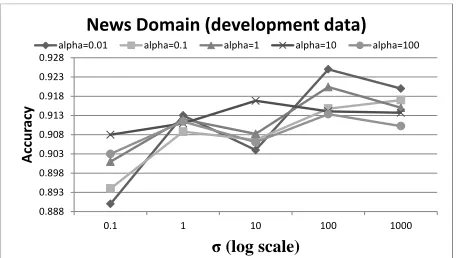
Figure 2: Grid search for parameters on news text
Following our previous HMM setup in (Huang and Yates, 2009) for consistency, we use an HMM with 80 latent states. For our multi-layer models, we use 7 layers of HMMs. We tuned the free pa-rametersσ andA on development data. We varied
σ from 0.1 to 1000. To tuneA, we start by setting the diagonal entry forφentropy to 1, without loss of generality. We then tie all the entries inAforφdist
y
to a single parameterα, and tie all of the entries for
φpredicty to a parameterβ. We varyαandβover the
set{0.01,0.1,1,10,100}. Figure 2 shows our results for σ and α on news development data. A setting ofα = 0.01and σ = 100performs best, with all
σ = 100 doing reasonably well. Results for each of these models on the general fiction test text con-firm the general trends seen on development data — a comforting sign, since this indicates we can opti-mize the free parameters on in-domain development data, rather than requiring labeled data from the tar-get domain. Our models tended to perform better with increasingβon development data, though with diminishing returns. We pick the largest setting test-ed,β = 100, for our final models.
0.82 0.83 0.84 0.85 0.86 0.87 0.88 0.89 0.9 0.91 0.92
0.1 1 10 100 1000
Accu
racy
σ (log scale)
[image:8.612.72.300.57.185.2]General Fiction Domain (test data) alpha=0.01 alpha=0.1 alpha=1 alpha=10 alpha=100
Figure 3: Validating parameter settings on fiction text
CRF Feature Set
Transition
∀z1[zj =z]
∀z,z01[zj =zandzj−1 =z0]
Word
∀w,z1[xj =wandzj =z] Radical
∀z,r1[∃c∈xjradical(c) =randzj =z]
Repeated Words
∀A,B,z1[xj =AABBandzj =z]
∀A,z1[(xj =AA orxj =AA/) andzj =z]
∀A,B,z1[xj =ABABandzj =z] Features from Representation Learning
[image:8.612.73.296.225.453.2]∀y,l,z1[yjl =yandzj =z]
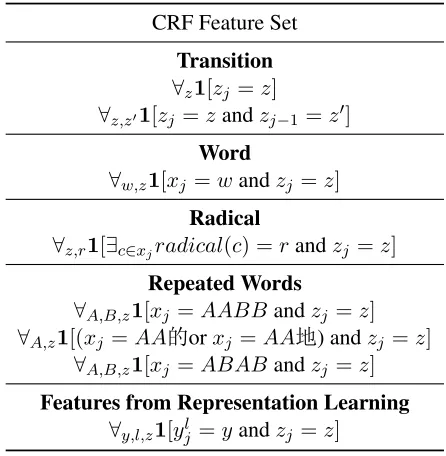
Table 1: Features used in our Chinese POS tagging CRF systems.crepresents a character within a word.
Table 2 shows our results. We compare against the Baseline CRF without any additional representa-tions and the unbiased HMM, a state-of-the-art do-main adaptation technique from previous work, over all 13 domains (source and target). We also com-pare against a state-of-the-art Chinese POS tagger for in-domain text, the CRF-based Stanford tagger (Tseng et al., 2005), retrained for this corpus. H-MM+D+E outperforms the Stanford tagger on 10 out of 12 target domains and the unbiased HMM on all domains, while the P-HMM+D+E outperform-s the Stanford tagger (2.6% average improvement) and HMM (1.7%) on all 12 target domains. The I-HMM+D+E is slightly better than the I-HMM+D+E (.3%), but incorporating the multi-dimensional bias
(P-HMM+D+E) adds an additional 0.6% improve-ment.
Our interpretation for the success of I-HMM+D+E and P-I-HMM+D+E is that the increase in the state space of the models yields improved performance. Because P-HMM+D+E biases against redundant states found in I-HMM+D+E, it effective-ly increases the state space beyond I-HMM+D+E. Ahuja and Downey (2010) and our own work with HMMs as representations (2010) have previously shown that increasing the state space of the HMM can significantly improve the representation, but memory constraints eventually prevent further
progress this way. The I-HMM+D+E and
P-HMM+D+E models can provide similar benefits, but because they split parameters across multiple HMMs, they can accommodate much greater state spaces in the same amount of memory.
We also tested the entropy and distance biases separately. Figure 4 shows the result of the distance-biased HMM+D on the general-fiction test text, as we varyσover the set{0.1,1,10,100,1000}(we ob-served similar results for other domains). For all val-ues ofσ, the biased representation outperforms the unbiased HMM. There is also a strong negative cor-relation between the expected value of kφdistancek
and the resulting accuracy, as expected from Ben-David et al.’s theoretical analysis. The HMM+E model outperforms the HMM on the (source) news domain by 0.3%, but actually performs worse for most target domains. We suspect that the entropy feature, which is learned only from labeled source-domain data, makes the representation biased to-wards features that are important in the source do-main only. However, after we add in the distance bias and a parameter to balance the weights from both biases, the representation is able to capture the label information as well as the target domain fea-tures. Thus, the representation won’t solely depend on source data. HMM+D+E, which combines both biases, outperforms HMM+D, suggesting that task-specific features for domain adaptation can be help-ful, but only if there is some control for the domain-independence of the features.
5.2 English Named Entity Recognition
news (source) lore reli humour gen-fic essay mystery romance sci-fi skill science adv-fic report avg
words 9774 5428 3248 3326 4913 5214 5774 5489 3070 5464 5262 5071 6662 5284
[image:9.612.73.550.74.194.2]CRF w/o HMM 93.8 85.0 80.0 85.4 85.0 83.8 84.7 86.0 82.8 78.2 82.2 77.1 85.3 84.5 HMM+E 97.1 88.2 83.1 87.5 87.4 89.2 89.5 87.1 86.7 82.1 87.2 79.4 91.7 88.3 Stanford 98.8 88.4 83.5 89.0 87.5 88.4 87.4 87.5 88.6 82.7 86.0 82.1 91.7 88.7 HMM 96.9 89.7 85.2 89.6 89.4 89.0 90.1 89.0 87.0 84.9 87.8 80.0 91.4 89.2 HMM+D 97.4 89.9 85.4 89.4 89.6 89.9 90.1 88.6 87.9 85.3 87.9 80.0 92.0 89.5 HMM+D+E 97.7 90.1 86.1 89.8 90.9 89.7 90.3 89.8 88.4 85.6 87.9 81.2 92.0 89.9 I-HMM+D+E 97.8 90.5 87.0 89.1 91.1 90.2 90.0 90.5 89.8 86.0 87.1 82.2 92.1 90.2 P-HMM+D+E 98.2 91.5 87.7 89.0 91.8 91.0 89.9 91.4 90.4 87.0 87.7 83.4 92.4 90.8
Table 2: POS tagging accuracy: The P-HMM+D+E tagger outperforms the unbiased HMM tagger and the Stanford tagger on all target domains.The ‘avg’ column includes source-domain development data results. Differ-ences between the P-HMM+D+E and the Stanford tagger are statistically significant atp <0.01on average and on 11 out of 12 target domain. We used the two-tailed Chi-square test with Yates’ correction.
0.894 0.895 0.896 0.897 0.898 0.899 0.9 0.901 0.902 0.903 0.904
4.55E-05 4.60E-05 4.65E-05 4.70E-05 4.75E-05 4.80E-05
Accu
racy
ǁEq(φdistance)ǁ
HMM+D on General Fiction Test
σ=1000
σ=100
σ=1 σ=0.1 σ=10
Unconstrained HMM
Figure 4: Greater distance between domains correlates with worse target-domain tagging accuracy.
CoNLL 2003 shared task for our labeled training set, consisting of 204k tokens from the newswire do-main. We tested the system on the MUC7 formal run test data, consisting of 59k tokens of stories on the telecommunications and aerospace industries.
To train our representations, we use the CoNL-L training data and the MUC7 training data without labels. We again use a CRF, with features introduced by Zhang and Johnson (2003) for our baseline. We use the same setting of free parameters from our POS tagging experiments.
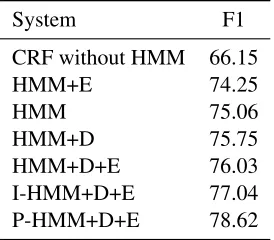
Results are shown in Table 3. Our best biased representation P-HMM+D+E outperformed the un-biased HMM representation by 3.6%, and beats the I-HMM+D+E by 1.6%. The domain-distance and multi-dimensional biases help most, while the task-specific bias helps somewhat, but only when the domain-distance bias is included. The best
sys-System F1
CRF without HMM 66.15
HMM+E 74.25
HMM 75.06
HMM+D 75.75
HMM+D+E 76.03
I-HMM+D+E 77.04
[image:9.612.359.496.271.391.2]P-HMM+D+E 78.62
Table 3: English Named Entity recognition results
tem tested on this dataset achieved a slightly bet-ter F1 score (78.84) (Turian et al., 2010), but used a much larger training corpus (they use RCV1 cor-pus which contains approximately 63 million token-s). Other studies (Turian et al., 2010; Huang et al., 2011) have performed a detailed comparison be-tween these types of systems, so we concentrate on comparisons between biased and unbiased represen-tations here.
5.3 Does the task-specific bias actually help?
[image:9.612.73.300.272.402.2]Representation/Task POS Accuracy NER F1
HMM 88.5 66.3
HMM+E(POS labels) 89.7 64.5
HMM+E(NER labels) 86.5 68.0
Table 4: Results of POS tagging and Named Entity recognition tasks with different representations. With the entropy-biased representation, the system has better per-formance on the task which the bias is trained for, but worse performance on the other task.
0-18 as our labeled training data and 500 sentences from WSJ section 20-23 as testing data. Because WSJ data does not have gold standard NER tags, we manually labeled these sentences with NER tags. For simplicity, we only use three types of NER tags: person, organization and location. The result is shown in Table 4. When the entropy bias uses la-bels from the same task as the classifier, the perfor-mance is improved: about 1.2% in accuracy on POS tagging and 1.7% in F1 score on NER. Switching the representations for the tasks actually hurts the performance compared with the unbiased represen-tation. The results suggest that the entropy bias does indeed yield a task-specific representation.
6 Conclusion and Future Work
We introduce three types of biases into represen-tation learning for sequence labeling using the PR framework. Our experiments on POS tagging and NER indicate domain-independent biases and multi-dimensional biases significantly improve the repre-sentations, while the task-specific bias improves per-formance on out-of-domain data if it is combined with the domain-independent bias. Our results indi-cate the power of representation learning in building domain-agnostic classifiers, but also the complexi-ty of the task and the limitations of current tech-niques, as even the best models still fall significantly short of in-domain performance. Important consid-erations for future work include identifying further effective and tractable biases, and extending beyond sequence-labeling to other types of NLP tasks.
Acknowledgments
This research was supported in part by NSF grant IIS-1065397.
References
Arun Ahuja and Doug Downey. 2010. Improved extrac-tion assessment through better language models. In Proceedings of the Annual Meeting of the North Amer-ican Chapter of the Association of Computational Lin-guistics (NAACL-HLT).
Shai Ben-David, John Blitzer, Koby Crammer, and Fer-nando Pereira. 2007. Analysis of representations for domain adaptation. InAdvances in Neural Infor-mation Processing Systems 20, Cambridge, MA. MIT Press.
Shai Ben-David, John Blitzer, Koby Crammer, Alex Kulesza, Fernando Pereira, and Jennifer Wortman Vaughan. 2010. A theory of learning from different domains. Machine Learning, 79:151–175.
John Blitzer, Ryan McDonald, and Fernando Pereira. 2006. Domain adaptation with structural correspon-dence learning. InEMNLP.
John Blitzer, Koby Crammer, Alex Kulesza, Fernando Pereira, and Jenn Wortman. 2007. Learning bounds for domain adaptation. InAdvances in Neural Infor-mation Processing Systems.
M. Candito and B. Crabb´e. 2009. Improving generative statistical parsing with semi-supervised word cluster-ing. InIWPT, pages 138–141.
M. Chang, L. Ratinov, and D. Roth. 2007. Guiding semi-supervision with constraint-driven learning. In Pro-ceedings of the ACL.
Hal Daum´e III, Abhishek Kumar, and Avishek Saha. 2010. Frustratingly easy semi-supervised domain adaptation. InProceedings of the ACL Workshop on Domain Adaptation (DANLP).
Hal Daum´e III. 2007. Frustratingly easy domain adapta-tion. InACL.
S. C. Deerwester, S. T. Dumais, T. K. Landauer, G. W. Furnas, and R. A. Harshman. 1990. Indexing by latent semantic analysis. Journal of the American Society of Information Science, 41(6):391–407.
Paramveer S. Dhillon, Dean Foster, and Lyle Ungar. 2011. Multi-view learning of word embeddings via cca. InNeural Information Processing Systems (NIP-S).
A. Emami, P. Xu, and F. Jelinek. 2003. Using a con-nectionist model in a syntactical based language mod-el. InProceedings of the International Conference on Spoken Language Processing, pages 372–375. Kuzman Ganchev, Jo˜ao Grac¸a, Jennifer Gillenwater, and
Ben Taskar. 2010. Posterior regularization for struc-tured latent variable models. Journal of Machine Learning Research, 11:10–49.
Daniel Gildea. 2001. Corpus Variation and Parser Per-formance. In Conference on Empirical Methods in Natural Language Processing.
T. Honkela. 1997. Self-organizing maps of words for natural language processing applications. In In Pro-ceedings of the International ICSC Symposium on Soft Computing.
Fei Huang and Alexander Yates. 2009. Distributional representations for handling sparsity in supervised se-quence labeling. InProceedings of the Annual Meet-ing of the Association for Computational LMeet-inguistics (ACL).
Fei Huang and Alexander Yates. 2010. Exploring representation-learning approaches to domain adapta-tion. In Proceedings of the ACL 2010 Workshop on Domain Adaptation for Natural Language Processing (DANLP).
Fei Huang, Alexander Yates, Arun Ahuja, and Doug Downey. 2011. Language models as representation-s for weakly representation-supervirepresentation-sed nlp tarepresentation-skrepresentation-s. In Conference on Natural Language Learning (CoNLL).
Jing Jiang and ChengXiang Zhai. 2007. Instance weight-ing for domain adaptation in NLP. InACL.
P. Liang, M. I. Jordan, and D. Klein. 2009. Learning from measurements in exponential families. In Inter-national Conference on Machine Learning (ICML). D. Lin and X Wu. 2009. Phrase clustering for
discrimi-native learning. InACL-IJCNLP, pages 1030–1038. G. S. Mann and A. McCallum. 2007. Simple, robust,
scalable semi-supervised learning via expectation reg-ularization. InIn Proc. ICML.
Y. Mansour, M. Mohri, and A. Rostamizadeh. 2009. Do-main adaptation with multiple sources. InAdvances in Neural Information Processing Systems.
F. Morin and Y. Bengio. 2005. Hierarchical probabilistic neural network language model. InProceedings of the International Workshop on Artificial Intelligence and Statistics, pages 246–252.
Sameer Pradhan, Wayne Ward, and James H. Martin. 2007. Towards robust semantic role labeling. In Pro-ceedings of NAACL-HLT, pages 556–563.
M. Sahlgren. 2005. An introduction to random indexing. InIn Methods and Applications of Semantic Indexing Workshop at the 7th International Conference on Ter-minology and Knowledge Engineering (TKE). G. Salton and M.J. McGill. 1983. Introduction to
Mod-ern Information Retrieval. McGraw-Hill.
Satoshi Sekine. 1997. The domain dependence of pars-ing. In Proc. Applied Natural Language Processing (ANLP), pages 96–102.
Huihsin Tseng, Daniel Jurafsky, and Christopher Man-ning. 2005. Morphological features help pos tagging
of unknown words across language varieties. In Pro-ceedings of the Fourth SIGHAN Workshop on Chinese Language Processing.
Joseph Turian, Lev Ratinov, and Yoshua Bengio. 2010. Word representations: A simple and general method for semi-supervised learning. In Proceedings of the Annual Meeting of the Association for Computational Linguistics (ACL), pages 384–394.
P. D. Turney and P. Pantel. 2010. From frequency to meaning: Vector space models of semantics. Journal of Artificial Intelligence Research, 37:141–188. Lijie Wang, Wanxiang Che, and Ting Liu. 2009. An
svmtool-based chinese pos tagger. InJournal of Chi-nese Information Processing.
X. Yang, H. Fu, H. Zha, and J. Barlow. 2006. Semi-supervised nonlinear dimensionality reduction. In Proceedings of the 23rd International Conference on Machine Learning.
T. Zhang and D. Johnson. 2003. A robust risk mini-mization based named entity recognition system. In CoNLL.