Search-based Structured Prediction applied to Biomedical Event Extraction
Andreas Vlachos and Mark Craven
Department of Biostatistics and Medical Informatics University of Wisconsin-Madison
{vlachos,craven}@biostat.wisc.edu
Abstract
We develop an approach to biomedical event extraction using a search-based structured pre-diction framework, SEARN, which converts the task into cost-sensitive classification tasks whose models are learned jointly. We show that SEARN improves on a simple yet strong pipeline by 8.6 points in F-score on the BioNLP 2009 shared task, while achieving the best reported performance by a joint inference method. Additionally, we consider the issue of cost estimation during learning and present an approach calledfocused costingthat improves improves efficiency and predictive accuracy.
1 Introduction
The termbiomedical event extractionis used to re-fer to the task of extracting descriptions of actions and relations involving one or more entities from the biomedical literature. The recent BioNLP 2009 shared task (BioNLP09ST) on event extraction (Kim et al., 2009) focused on event types of varying com-plexity. Each event consists of atrigger and one or more arguments, the latter being proteins or other events. Any token in a sentence can be a trigger for one of the nine event types and, depending on their associated event types, triggers are assigned appro-priate arguments. Thus, the task can be viewed as a structured prediction problem in which the output for a given instance is a (possibly disconnected) di-rected acyclic graph (not necessarily a tree) in which vertices correspond to triggers or protein arguments, and edges represent relations between them.
Despite being a structured prediction task, most of the systems that have been applied to BioNLP09ST
to date are pipelines that decompose event extrac-tion into a set of simpler classificaextrac-tion tasks. Clas-sifiers for these tasks are typically learned indepen-dently, thereby ignoring event structure during train-ing. Typically in such systems, the relationships among these tasks are taken into account by incor-porating post-processing rules that enforce certain constraints when combining their predictions, and by tuning classification thresholds to improve the ac-curacy of joint predictions. Pipelines are appealing as they are relatively easy to implement and they of-ten achieve state-of-the-art performance (Bjorne et al., 2009; Miwa et al., 2010).
Because of the nature of the output space, the task is not amenable to sequential or grammar-based ap-proaches (e.g. linear CRFs, HMMs, PCFGs) which employ dynamic programming in order to do ef-ficient inference. The only joint inference frame-work that has been applied to BioNLP09ST to date is Markov Logic Networks (MLNs) (Riedel et al., 2009; Poon and Vanderwende, 2010). However, MLNs require task-dependent approximate infer-ence and substantial computational resources in or-der to achieve state-of-the-art performance.
In this work we explore an alternative joint in-ference approach to biomedical event extraction us-ing a search-based structured prediction framework, SEARN (Daum´e III et al., 2009). SEARN is an algorithm that converts the problem of learning a model for structured prediction into learning a set of models for cost-sensitive classification (CSC). CSC is a task in which each training instance has a vector of misclassification costs associated with it, thus rendering some mistakes on some instances to be more expensive than others (Domingos, 1999). Compared to a standard pipeline, SEARN is able to
achieve better performance because its models are learned jointly. Thus, each of them is able to use fea-tures representing the predictions made by the oth-ers, while taking into account possible mistakes.
In this paper, we make the following contribu-tions. Using the SEARN framework, we develop a joint inference approach to biomedical event extrac-tion. We evaluate our approach on the BioNLP09ST dataset and show that SEARN improves on a simple yet strong pipeline by 8.6 points in F-score, while achieving the best reported performance on the task by a joint inference method. Additionally, we con-sider the issue of cost estimation and present an ap-proach calledfocused costingthat improves perfor-mance. We believe that these contributions are likely to be relevant to applications of SEARN to other natural language processing tasks that involve struc-tured prediction in complex output spaces.
2 BioNLP 2009 shared task description
BioNLP09ST focused on the extraction of events involving proteins whose names are annotated in advance. Each event has two types of arguments,
ThemeandCause, which correspond respectively to the Agent andPatient roles in semantic role label-ing (Gildea and Jurafsky, 2002). Nine event types are defined which can be broadly classified in three categories, namelySimple,BindingandRegulation.
Simpleevents include Gene expression, Transcrip-tion, Protein catabolism,Phosphorylation, and Lo-calization events. These have only one Theme ar-gument which is a protein. Binding events have one or more protein Themes. Finally, Regulation
events, which include Positive regulation, Nega-tive regulationandRegulation, have one obligatory
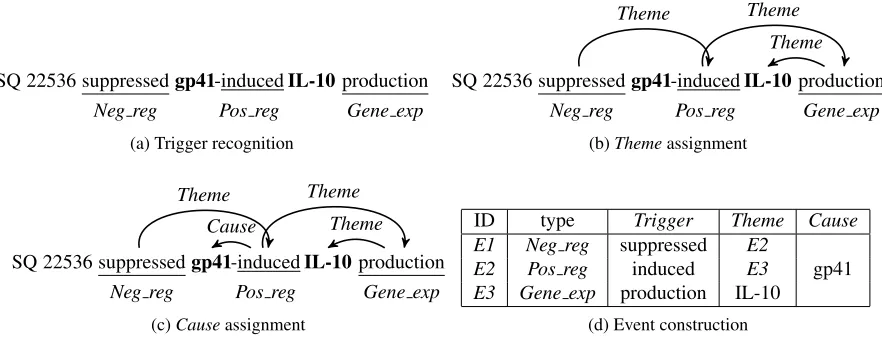
Themeand one optional Cause, each of which can be either a protein or another event. Each event has a trigger which is a contiguous string that can span over one or more tokens. Triggers and arguments can be shared across events. In an example demon-strating the complexity of the task, given the passage “. . . SQ 22536 suppressed gp41-induced IL-10 pro-duction in monocytes”, systems should extract the three appropriately nested events listed in Fig. 1d.
Performance is measured using Recall, Precision and F-score over complete events, i.e. the trigger, the event type and the arguments all must be correct
in order to obtain a true positive. It is important to note that if either the trigger, the type, or an argu-ment of a predicted event is incorrect then this event will result in one false positive and one false nega-tive. In the example of Fig. 1, if “suppressed” is rec-ognized incorrectly as aRegulationtrigger then it is better to not assign aThemeto it so that we avoid a false positive due to extracting an event with in-correct type. Finally, the evaluation ignores triggers that do not form events.
3 Event extraction decomposition
Figure 1 describes the event extraction decomposi-tion that we use throughout the paper. We assume that the sentences to be processed are parsed into syntactic dependencies and lemmatized. Each stage has its own module, which is either a learned classi-fier (trigger recognition,Theme/Cause assignment) or a rule-based component (event construction).
3.1 Trigger recognition
In trigger recognition the system decides whether a token acts as a trigger for one of the nine event types or not. Thus it is a 10-way classification task. We only consider tokens that are tagged as nouns, verbs or adjectives by the parser, as they cover the majority of the triggers in the BioNLP09ST data. The main features used in the classifier represent the lemma of the token which is sufficient to predict the event type correctly in most cases. In addition, we include features that conjoin each lemma with its part-of-speech tag. This allows us to handle words with the same nominal and verbal form that have differ-ent meanings, such as “lead”. While the domain restricts most lemmas to one event type, there are some whose event type is determined by the context, e.g. “regulation” on its own denotes a Regulation
event but in “positive regulation” it denotes a Posi-tive regulationevent instead. In order to capture this phenomenon, we add as features the conjunction of each lemma with the lemma of the tokens immedi-ately surrounding it, as well as with the lemmas of the tokens with which it has syntactic dependencies.
3.2 ThemeandCauseassignment
SQ 22536 suppressed
Neg reg
gp41-induced
Pos reg
IL-10production
Gene exp
(a) Trigger recognition
SQ 22536 suppressed
Neg reg
gp41-induced
Pos reg
IL-10production
Gene exp Theme Theme Theme
(b)Themeassignment
SQ 22536 suppressed
Neg reg
gp41-induced
Pos reg
IL-10production
Gene exp Theme Theme
Cause Theme
(c)Causeassignment
ID type Trigger Theme Cause E1 Neg reg suppressed E2
E2 Pos reg induced E3 gp41
E3 Gene exp production IL-10
[image:3.612.86.527.67.238.2](d) Event construction
Figure 1: The stages of our event extraction decomposition. Protein names are shown in bold.
Themesor not. Whenever a trigger is predicted to be associated with a Theme, we form candidate pairs between all the Regulationtriggers in the sentence and that trigger as the argument, thus allowing the prediction of nested events. Also, we remove candi-date pairs that could result in directed cycles, as they are not allowed by the task.
The features used to predict whether a trigger-argument pair should be classified as a Themeare extracted from the syntactic dependency path and the textual string between them. In particular, we extract the shortest unlexicalized dependency path connecting each trigger-argument pair, allowing the paths to follow either dependency direction. One set of features represents these paths, and in addition, we have sets of features representing each path con-joined with the lemma, the PoS tag and the event type of the trigger, the type of the argument and the first and last lemmas in the dependency path. The latter help by providing some mild lexicaliza-tion. We also add features representing the textual string between the trigger and the argument, com-bined with the event type of the trigger. While not as informative as dependency paths, such features help in sentences where the parse is incorrect, as triggers and their arguments tend to appear near each other.
InCauseassignment, we form an agenda of can-didate trigger-argument pairs using only the Regu-lationclass triggers that were assigned at least one
Theme. These are combined with protein names and other triggers that were assigned aTheme. We
ex-tract features as in Themeassignment, further fea-tures representing the conjunction of the dependency path of the candidate pair with the path(s) from the trigger to itsTheme(s).
3.3 Event construction
In event construction, we convert the predictions of the previous stages into a set of legal events. If a Binding trigger is assigned multiple Themes, we choose to form either one event perTheme or one event with multiple Themes. Following Bjorne et al. (2009), we group the arguments of eachBinding
trigger according to the first label in their syntac-tic dependency path and generate events using the cross-product of these groups. For example, assum-ing the parse was correct and all theThemes recog-nized, “interactions of Aand B with C” results in two Bindingevents with twoThemes each, Awith
C, andBwithCrespectively. We add the exception that if twoThemesare in the same token (e.g. “A/B
interactions”) or the lemma of the trigger is “bind” then they form oneBindingevent with twoThemes.
4 Structured prediction with SEARN
SEARN (Daum´e III et al., 2009) forms the struc-tured output prediction for an instance s as a se-quence ofT multiclass predictionsyˆ1:T made by a
hypothesish. The latter consists of a set of classi-fiers that are learned jointly. Each predictionyˆtcan
asactionsand we adopt this term in order to distin-guish them from the structured output predictions.
The SEARN algorithm is presented in Alg. 1. It initializes hypothesishto theoptimal policyπ(step 2) which predicts the optimal action in each step
t according to the gold standard. The optimal ac-tion at step t is the one that minimizes the overall loss over s assuming that all future actions yˆt+1:T
are also made optimally. The loss function`is de-fined by the structured prediction task considered. Each iteration begins by making predictions for all instancessin the training dataS (step 6). For each
sand each action yˆt, a cost-sensitive classification
(CSC) example is generated (steps 8-12). The fea-tures are extracted fromsand the previous actions
ˆ
y1:t−1 (step 8). The cost for each possible action
yti is estimated by predicting the remaining actions
y0t+1:T insusingh(step 10) and evaluating the cost
incurred given that action (step 11). Using a CSC learning algorithm, a new hypothesis is learned (step 13) which is combined with the current one accord-ing to the interpolation parameterβ.
Algorithm 1SEARN
1: Input: labeled instancesS,optimal policy π, CSC learning algorithmCSCL, loss function`
2: current policyh=π
3: whilehdepends significantly onπdo
4: ExamplesE=∅
5: forsinSdo
6: Predicth(s) = ˆy1:T 7: foryˆtinh(s)do
8: Extract featuresΦt=f(s,yˆ1:t−1)
9: for eachpossible actionyitdo 10: Predicty0t+1:T =h(s|yˆ1:t−1, yti) 11: Estimateci
t=`(ˆy1:t−1, yti, y0t+1:T) 12: Add(Φt, ct)toE
13: Learn a hypothesishnew=CSCL(E) 14: h=βhnew+(1−β)h
15: Output: policyhwithoutπ
In each iteration, SEARN moves away from the optimal policy and uses the learned hypotheses in-stead when predicting (steps 6 and 10). Thus, each
hnew is adapted to the actions chosen byh instead
of those of the optimal policy. When the depen-dence on the latter becomes insignificant, the algo-rithm terminates and returns the weighted ensemble of learned hypotheses without the optimal policy.
Note though that the estimation of the costs in step 11 is always performed using the gold standard.
The interpolation parameter β determines how fast SEARN moves away from the optimal policy and as a result how many iterations will be needed to minimize the dependence on it. Dependence in this context refers to the probability of using the optimal policy instead of the learned hypothesis in choos-ing an action durchoos-ing prediction. In each iteration, the features extractedΦtare progressively corrupted
with the actions chosen by the learned hypotheses instead of those of the optimal policy.
Structural information under SEARN is incorpo-rated in two ways. First, via the costs that are es-timated using the loss over the instance rather than isolated actions (e.g. in PoS tagging, the loss would be the number of incorrect PoS tags predicted in a sentence if a token is tagged as noun). Second, via the features extracted from the previous actions (yˆ1:t−1) (e.g. the PoS tag predicted for the
previ-ous token can be a feature). These types of features are possible in a standard pipeline as well, but dur-ing traindur-ing they would have to be extracted usdur-ing the gold standard instead of the actual predictions made by the learned hypotheses, as during testing. Since the prediction for each instance (yˆ1:T in step
6) changes in every iteration, the structure features used to predict the actions have to be extracted anew. The extraction of features from previous actions implies a search order. For some tasks, such as PoS tagging, there is a natural left-to-right order in which the tokens are treated, however for many tasks this is not the case.
Finally, SEARN can be used to learn a pipeline of independently trained classifiers. This is achieved using only one iteration in which the cost for each action is set to0if it follows from the gold standard and to1otherwise. This adaptation allows for a fair comparison between SEARN and a pipeline.
5 SEARN for biomedical event extraction
excluding event construction which is rule-based. Unlike PoS tagging, there is no natural ordering of the actions in event extraction. Ideally, the ac-tions predicted earlier should be less dependent on structural features and/or easier so that they can in-form the more structure dependent/harder ones. In trigger recognition, we process the tokens from left to right since modifiers appearing before nouns tend to affect the meaning of the latter, e.g. “binding ac-tivity”. InThemeandCauseassignment, we predict trigger-argument pairs in order of increasing depen-dency path length, assuming that since dependepen-dency paths are the main source of features at this stage and shorter paths are less sparse, pairs containing shorter ones should be more reliable to predict.
In addition to the features mentioned in Sec. 3, SEARN allows us to extract and learn weights for structural features for each action from the previous ones. During trigger recognition, we add as features the combination of the lemma of the current token combined with the event type (if any) assigned to the previous and the next token, as well as to the to-kens that have syntactic dependencies with it. Dur-ingThemeassignment, when considering a trigger-argument pair, we add features based on whether it forms an undirected cycle with previously predicted
Themes, whether the trigger has been assigned a pro-tein as aThemeand the candidateThemeis an event trigger (and the reverse) and whether the argument has become the Themeof a trigger with the same event type. We also add a feature indicating whether the trigger has threeThemespredicted already. Dur-ingCauseassignment, we add features representing whether the trigger has been assigned a protein as a
Causeand the candidateCauseis an event trigger. The loss function`sums the number of false pos-itive and false negative events, which is the evalua-tion measure of BioNLP09ST. The optimal policy is derived from the gold standard and returns the ac-tion that minimizes this loss over the sentence given the previous actions and assuming that all future ac-tions are optimal. In trigger recognition, it returns either the event type for tokens that are triggers or a “notrigger” label otherwise. InThemeassignment, for a given trigger-argument pair the optimal policy returnsThemeonly if the trigger is recognized cor-rectly and the argument is indeed aThemefor that trigger according to the gold standard. In case the
ar-gument is another event, we require that at least one of itsThemesto be recognized correctly as well. In
Causeassignment, the requirements are the same as those for theThemes, but we also require that at least oneThemeof the trigger in the trigger-argument pair to be considered correct. These additional checks follow from the task definition, under which events must have all their elements identified correctly.
5.1 Cost estimation
Cost estimation (steps 5-12 in Alg. 1) is crucial to the successful application of SEARN. In order to highlight its importance, consider the example of Fig. 2 focusing on trigger recognition.
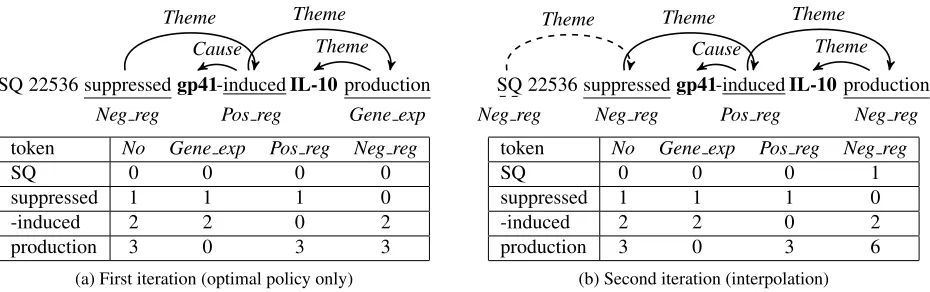
In the first iteration (Fig. 2a), the actions for the sentence will be made using the optimal policy only, thus replicating the gold standard. During costing, if a token is not a trigger according to the gold stan-dard (e.g. “SQ”), then the cost for incorrectly pre-dicting that it is a trigger is0, as the optimal policy will not assign Themes to a trigger with incorrect event type. Such instances are ignored by the cost-sensitive learner. If a token is a trigger according to the gold standard, then the cost for not predicting it as such or predicting its type incorrectly is equal to the number of the events that are dependent on it, as they will become false negatives. False positives are avoided as we are using the optimal policy in this iteration.
In the second iteration (Fig. 2b), the optimal pol-icy is interpolated with the learned hypothesis, thus some of the actions are likely to be incorrect. As-sume that “SQ” is incorrectly predicted to be a
Neg regtrigger and assigned aTheme. During cost-ing, the action of labeling “SQ” as Neg reg has a cost of 1, as it would result in a false positive event. Thus the learned hypothesis will be informed that it should not label “SQ” as a trigger as it would assign
Themesto it incorrectly and it is adapted to handle its own mistakes. Similarly, the action of labeling “production” asNeg reg in this iteration would in-cur a cost of 6, as the learned hypothesis would as-sign a Theme incorrectly, thus resulting in 3 false negative and 3 false positive events. Therefore, the learned hypothesis will be informed that assigning the wrong event type to “production” is worse than not predicting a trigger.
SQ 22536 suppressed
Neg reg
gp41-induced
Pos reg
IL-10production
Gene exp Theme Theme
Cause Theme
token No Gene exp Pos reg Neg reg
SQ 0 0 0 0
suppressed 1 1 1 0
-induced 2 2 0 2
production 3 0 3 3
(a) First iteration (optimal policy only)
SQ
Neg reg
22536 suppressed
Neg reg
gp41-induced
Pos reg
IL-10production
Neg reg Theme Theme
Cause Theme Theme
token No Gene exp Pos reg Neg reg
SQ 0 0 0 1
suppressed 1 1 1 0
-induced 2 2 0 2
production 3 0 3 6
[image:6.612.85.550.65.211.2](b) Second iteration (interpolation)
Figure 2: Prediction (top) and CSC examples for trigger recognition actions (bottom) in the first two SEARN iterations. Each CSC example has its own vector of misclassification costs.
its effect on the prediction for the whole sentence, we are able to take into account steps in the pre-diction process that are not learned as actions. For example, if the Binding event construction heuris-tic described in Sec. 3.3 cannot produce the correct events for a token that is a Bindingtrigger despite the Themesbeing assigned correctly, then this will increase the cost for tagging that trigger asBinding. The interpolation between the optimal policy and the learned hypothesis is stochastic, thus affecting the cost estimates obtained. In order to obtain more reliable estimates, one can average multiple sam-ples for each action by repeating steps 10 and 11 of Alg. 1. However, the computational cost is effec-tively multiplied by the number of samples.
In step 11 of Alg. 1, the cost of each action is esti-mated over the whole sentence. While this allows us to take structure into account, it can result in costs being affected by a part of the output that is not re-lated to that action. This is likely to occur in event extraction, as sentences can often be long and con-tain disconnected event components in their output graphs. For this reason, we refine the cost estimation of each action to take into account only the events that are connected to it through either gold standard or predicted events. For example, in Fig. 2 the cost estimation for “SQ” will ignore the predicted events in the first iteration and the gold standard, while it will take them into account in the second one. We refer to this refinement asfocused costing.
A different approach proposed by Daum´e III et al. (2009) is to assume that all actions following the
one we are costing are going to be optimal and use the optimal policy to approximate the prediction of the learned hypothesis in step 10 of Alg. 1. In tasks where the learned hypothesis is accurate enough, this has no performance loss and it is computation-ally efficient as the optimal policy is deterministic. However, in event extraction the learned hypothesis is likely to make mistakes, thus the optimal policy does not provide a good approximation for it.
5.2 CSC learning with passive-aggressive algorithms
The SEARN framework requires a multiclass CSC algorithm to learn how to predict actions. This algo-rithm must be computationally fast during parameter learning and prediction, as in every iteration we need to learn a new hypothesis and to consider each pos-sible action for each instance in order to construct the cost-sensitive examples. Daum´e III et al. (2009) showed that any binary classification algorithm can be used to perform multiclass CSC by employing an appropriate conversion between the tasks. The main drawback of this approach is its reliance on multi-ple subsamplings of the training data, which can be inefficient for large datasets and many classes.
With these considerations in mind, we implement a multiclass CSC learning algorithm using the gen-eralization of the online passive-aggressive (PA) al-gorithm for binary classification proposed by Cram-mer et al. (2006). For each training example xt,
theK-class linear classifier withK weight vectors
the case of multiclass CSC learning, each example has its own cost vectorct. If the loss is 0 then the
weight vectors of the classifier are not updated (pas-sive). Otherwise, the weight vectors are updated minimally so that the prediction on example xt is
corrected (aggressive). The update takes into ac-count the loss and the aggressiveness parameter C. Crammer et al. (2006) describe three variants to per-form the updates which differ in how the learning rateτtis set. In our experiments we use the variant
named PA-II with prediction-based updates (Alg. 2). Since we are operating in a batch learning setting (i.e. we have access to all the training examples and their order is not meaningful), we perform multiple rounds over the training examples shuffling their or-der, and average the weight vectors obtained.
Algorithm 2Passive-aggressive CSC learning
1: Input: training examplesX =x1. . . xT, cost vec-torsc1. . . cT ≥0, roundsR, aggressivenessC 2: Initializeweightsw(0k)= (0, ...,0)
3: forr= 1, ..., Rdo
4: ShuffleX
5: forxt∈ Xdo
6: Predictyˆt=argmaxk(w
(k)
t ·xt) 7: Receive cost vectorct≥0 8: ifc(ˆyt)
t >0then
9: Suffer loss`t=w
(ˆyt) t ·xt−w
(yt) t ·xt+
q
c(ˆyt) t 10: Set learning rateτt=||x `t
t||2+21C 11: Updatew(yt)
t+1 =wt+τtxt 12: Updatew(ˆyt)
t+1 =wt−τtxt 13: Averagewavg= T×1RP
T×R i=0 wi
6 Experiments
BioNLP09ST comprises three datasets – training, development and test – which consist of 800, 150 and 260 abstracts respectively. After the end of the shared task, an on-line evaluation server was activated in order to allow the evaluation on the test data once per day, without allowing ac-cess to the data itself. We report results using Recall/Precision/F-score over complete events using the approximate span matching/approximate recur-sive matching variant which was the primary perfor-mance criterion in BioNLP09ST. This variant counts a predicted event as a true positive if its trigger is
extracted within a one-token extension of the gold-standard trigger. Also, in the case of nested events, those events below the top-level need their trigger, event type andThemebut not theirCauseto be cor-rectly identified for the top-level event to be consid-ered correct. The same event matching variant was used in defining the loss as described in Sec. 5.
A pre-processing step we perform on the train-ing data is to reduce the multi-token triggers in the gold standard to their syntactic heads. This proce-dure simplifies the task of assigning arguments to triggers and, as the evaluation variant used allows approximate trigger matching, it does not result in a performance loss. For syntactic parsing, we use the output of the BLLIP re-ranking parser adapted to the biomedical domain by McClosky and Charniak (2008), as provided by the shared task organizers in the Stanford collapsed dependency format with conjunct dependency propagation. Lemmatization is performed usingmorpha(Minnen et al., 2001).
In all our experiments, for CSC learning with PA, the C parameter is set by tuning on 10% of the train-ing data and the number of rounds is fixed to10. For SEARN, we set the interpolation parameterβto0.3
and the number of iterations to 12. The costs for each action are obtained by averaging three samples as described in Sec. 5.1. β and the number of sam-ples are the only parameters that need tuning and we use the development data for this purpose.
in-pipeline SEARN focus SEARN default
R P F R P F R P F
[image:8.612.145.468.53.143.2]triggerdev 53.0 61.1 56.8 81.8 34.2 48.2 84.9 12.0 21.0 Themedev 44.2 79.6 56.9 62.0 69.1 65.4 59.0 65.1 61.9 Causedev 18.1 59.2 27.8 30.6 45.0 36.4 31.9 45.5 37.5 Eventdev 35.8 68.9 47.1 50.8 59.5 54.8 47.4 54.3 50.6 Eventtest 30.8 67.4 42.2 44.5 59.1 50.8 41.3 53.6 46.6
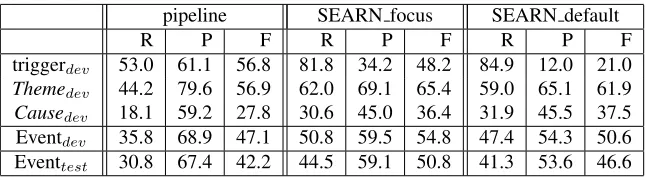
Table 1: Recall / Precision / F-score on BioNLP09ST development and test data. Left-to-right: pipeline of independently learned classifiers, SEARN with focused costing, SEARN with default costing.
dependently learned counterparts. The benefits of SEARN are more pronounced inRegulationevents which are more complex. For these events, it im-proves on the pipeline on both the development and test sets by11and14.2F-score points respectively.
The focused costing approach we proposed con-tributes to the success of SEARN. If we replace it with the default costing approach which uses the whole sentence, the F-score drops by 4.2 points on both development and test datasets. The default costing approach mainly affects the trigger recog-nition stage, which takes place first. Trigger over-prediction is more extreme in this case and renders theThemeassignment stage harder to learn. While the joint learning of the classifiers ameliorates this issue and the event extraction performance is even-tually higher than that of the pipeline, the use of fo-cused costing improves the performance even fur-ther. Note that trigger overprediction also makes training slower, as it results in evaluating more ac-tions for each sentence. Finally, using one instead of three samples per action decreases the F-score by 1.3 points on the development data.
Compared with the MLN approaches applied to BioNLP09ST, our predictive accuracy is better than that of Poon and Vanderwende (2010) which is the best joint inference performance to date and substan-tially better than that of Riedel et al. (2009) (50 and 44.4 in F-score respectively). Recently, McClosky et al. (2011) combined multiple decoders for a de-pendency parser with a reranker, achieving 48.6 in F-score. While they also extracted structure fea-tures forThemeandCauseassignment, their model is restricted to trees (ours can output directed acyclic graphs) and their trigger recognizer is learned inde-pendently.
When we train SEARN combining the training
and the development sets, we reach 52.3 in F-score, which is better than the performance of the top system in BioNLP09ST (51.95) by Bjorne et al. (2009) which was trained in the same way. The best performance to date is reported by Miwa et al. (2010) (56.3 in F-score), who experimented with six parsers, three dependency representations and vari-ous combinations of these. They found that different parser/dependency combinations provided the best results on the development and test sets.
A direct comparison between learning frame-works is difficult due to the differences in task de-composition and feature extraction. In particular, event extraction results depend substantially on the quality of the syntactic parsing. For example, Poon and Vanderwende (2010) heuristically correct the syntactic parsing used and report that this improved their performance by four F-score points.
7 Conclusions
We developed a joint inference approach to biomed-ical event extraction using the SEARN framework which converts a structured prediction task into a set of CSC tasks whose models are learned jointly. Our approach employs the PA algorithm for CSC learn-ing and a focused cost estimation procedure which improves the efficiency and accuracy of the standard cost estimation method. Our approach provides the best reported results for a joint inference method on the BioNLP09ST task. With respect to the experi-ments presented by Daum´e III et al. (2009), we em-pirically demonstrate the gains of using SEARN on a problem harder than sequential tagging.
Acknowledgments
References
Jari Bjorne, Juho Heimonen, Filip Ginter, Antti Airola, Tapio Pahikkala, and Tapio Salakoski. 2009. Extract-ing complex biological events with rich graph-based feature sets. InProceedings of the BioNLP 2009 Work-shop Companion Volume for Shared Task, pages 10– 18.
Koby Crammer, Ofer Dekel, Joseph Keshet, Shai Shalev-Shwartz, and Yoram Singer. 2006. Online passive-aggressive algorithms. Journal of Machine Learning Research, 7:551–585.
Hal Daum´e III, John Langford, and Daniel Marcu. 2009. Search-based structured prediction. Machine Learn-ing, 75:297–325.
Pedro Domingos. 1999. Metacost: a general method for making classifiers cost-sensitive. In Proceedings of the 5th International Conference on Knowledge Dis-covery and Data Mining, pages 155–164.
Daniel Gildea and Daniel Jurafsky. 2002. Automatic la-beling of semantic roles. Computational Linguistics, 28:245–288.
Jin-Dong Kim, Tomoko Ohta, Sampo Pyysalo, Yoshi-nobu Kano, and Jun’ichi Tsujii. 2009. Overview of BioNLP’09 shared task on event extraction. In Pro-ceedings of the BioNLP 2009 Workshop Companion Volume for Shared Task, pages 1–9.
David McClosky and Eugene Charniak. 2008. Self-training for biomedical parsing. In Proceedings of the 46th Annual Meeting of the Association of Compu-tational Linguistics: Human Language Technologies, pages 101–104.
David McClosky, Mihai Surdeanu, and Christopher D. Manning. 2011. Event extraction as dependency pars-ing. In Proceedings of the 49th Annual Meeting of the Association for Computational Linguistics: Hu-man Language Technologies.
Guido Minnen, John Carroll, and Darren Pearce. 2001. Applied morphological processing of English. Natu-ral Language Engineering, 7(3):207–223.
Makoto Miwa, Sampo Pyysalo, Tadayoshi Hara, and Jun’ichi Tsujii. 2010. Evaluating dependency repre-sentation for event extraction. In Proceedings of the 23rd International Conference on Computational Lin-guistics, pages 779–787.
Hoifung Poon and Lucy Vanderwende. 2010. Joint in-ference for knowledge extraction from biomedical lit-erature. InProceedings of the Human Language Tech-nologies: The 2010 Annual Conference of the North American Chapter of the Association for Computa-tional Linguistics, pages 813–821.
Sebastian Riedel, Hong-Woo Chun, Toshihisa Takagi, and Jun’ichi Tsujii. 2009. A Markov logic approach to bio-molecular event extraction. InProceedings of