Improving Feature-Based Biomedical Event Extraction System by
In-tegrating Argument Information
Lishuang Li, Yiwen Wang, Degen Huang
School of Computer Science and Technology
Dalian University of Technology
116023 Dalian, China
[email protected] [email protected]
[email protected]
Abstract
We describe a system for extracting biomedi-cal events among genes and proteins from biomedical literature, using the corpus from the BioNLP’13 Shared Task on Event Extrac-tion. The proposed system is characterized by a wide array of features based on dependency parse graphs and additional argument informa-tion in the second trigger detecinforma-tion. Based on the Uturku system which is the best one in the BioNLP’09 Shared Task, we improve the per-formance of biomedical event extraction by reducing illegal events and false positives in the second trigger detection and the second ar-gument detection. On the development set of BioNLP’13, the system achieves an F-score of 50.96% on the primary task. On the test set of BioNLP’13, it achieves an F-score of 47.56% on the primary task obtaining the 5th place in task 1, which is 1.78 percentage points higher than the baseline (following the Uturku sys-tem), demonstrating that the proposed method is efficient.
1
Introduction
Extracting knowledge from unstructured text is one of the most important goals of Natural Lan-guage Processing and Artificial Intelligence. Re-sources in the internet are expanding at an expo-nential speed, especially in the biomedical do-main. Due to the astronomical growth of biomed-ical scientific literature, it is very important and urgent to develop automatic methods for know-ledge extraction system.
In the past few years, most researchers in the field of Biomedical Natural Language Processing focused on extracting information with simple structure, such as named entity recognition (NER), protein-protein interactions (PPIs) (Air-ola et al., 2008; Miwa et al., 2009) and disease-gene association (Chun et al., 2006). While PPIs concern the flat relational schemas with no
nested structures, bio-molecular events describe the detailed behavior of bio-molecules, which capture the biomedical phenomena from texts well. The BioNLP’09 shared task (Kim et al., 2009) provides the first entry to bio-event extrac-tion. As described in BioNLP’09, a bio-event consists of a trigger and one or more arguments, where a trigger is a contiguous textual string con-taining one or more tokens and an argument is a participant (event or protein) with a correspond-ing type. For example, in the snippet “interferon regulatory factor 4 gene expression”, the event
trigger is “expression” which is tagged by the
event type “Gene_expression” and the event ar-gument is “interferon regulatory factor 4”.
Not-ably, bio-events may have arbitrary arguments and even contain other events as arguments, re-sulting in nested events.
The complex event structure makes this task particularly attractive, drawing initial interest from many researchers. Björne et al.'s (2009) system (referred to hereinafter as Uturku system) was the best pipeline system in BioNLP’09, achieving an F-score of 51.95% on the test data sets. After that, Miwa et al. (2010a, 2010b) com-pared different parsers and dependency represen-tations on bio-event extraction task and obtained an F-score of 57.79% on development data sets and 56.00% on test data sets with parser ensem-ble. In contrast to the pipeline system which di-vided the event process into three stages, triggers detection, arguments detection and post processing, Poon and Vanderwende’s (2010) and Riedel et al.’s (2009) joint models combined trigger recognition and argument detection by using a Markov logic network learning approach. After the BioNLP’09, the Genia event task (Bi-oNLP’11 task 1, hereafter) in the Bi(Bi-oNLP’11 Shared Task (Kim et al., 2011) introduced a same event extraction task on a new dataset. There were still some pipeline systems applied to Genia task 1, e.g. Björne et al.’s (2011) system and Quirk et al.’s (2011) system. To the best of
our knowledge, Miwa et al.’s (2012) pipeline system incorporating domain adaptation and co-reference resolution, is the best biomedical event extraction system on BioNLP'11 task 1 so far.
The Genia event extraction task (BioNLP'13 task 1, hereafter) (Kim et al., 2013) in Bi-oNLP'13 Shared Task is consistent with the Ge-nia task in BioNLP'11 Shared task. Nevertheless, BioNLP'13 task 1 focuses on event extraction from full texts while BioNLP’11 task 1 contains abstracts and full texts. Furthermore, the corefe-rence resolution task separated from event ex-traction task in BioNLP'11 is integrated to Bi-oNLP'13 task 1, and there are more event types in the BioNLP'13 task 1 than those in BioNLP'11 task 1. The BioNLP’13 shared task contains three parts, the training corpus, the development corpus and the test corpus. The training corpus consists of 10 full texts containing 2792 events. The development corpus for optimizing the pa-rameters involves 10 full texts containing 3184 events, while the test corpus is composed of 14 full texts including 3301 events. To avoid the researchers optimizing parameters on the test corpus, it is not published, and we have the per-mission to combine the training corpus and the development corpus as training set. However, we extend BioNLP'13 training set by adding the ab-stracts of training set and development set in Bi-oNLP'11 task 1 rather than merging the devel-opment set of BioNLP'13 into the training set.
Our system generally follows the Uturku sys-tem reported by Björne et al. (2009), and uses a simple but efficient way to reduce the cascading errors. The Uturku system was a pipeline of trig-ger detection, argument detection and post-processing. Each of its components was simple to implement by reducing event extraction task into independent classification of triggers and arguments. Moreover, the Uturku system devel-oped rich features and made extensive use of syntactic dependency parse graphs, and the rules in the post-processing step were efficient and simple. However, the stages of the pipeline in-troduced cascading errors, meaning that the trig-ger missed in the trigtrig-ger detection would never be recalled in the following stages. By changing the pipeline and adding argument information in trigger detection, we construct a model for ex-tracting complex events using rich features and achieve better performance than the baseline sys-tem implemented according to Björne et al.'s (2009) paper.
2
Our Event Extraction System
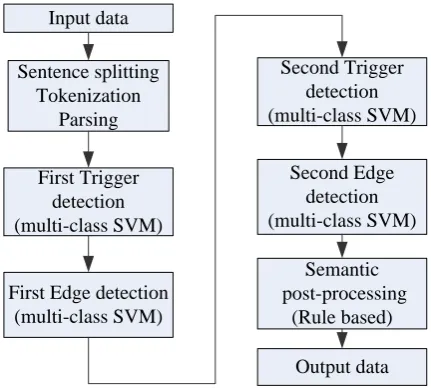
Fig.1 shows the overall architecture of the pro-posed system. Since 97% of all annotated events are fully contained within a single sentence, our system deals with one sentence at a time, which does not incur a large performance penalty but greatly reduces the size and complexity of the machine learning problems (Björne et al., 2009). The system’s components are different from those of the Uturku system by adding a second trigger detection component and a second edge detection component (argument detection). Trig-ger detection component is used to recognize the trigger words that signify the event, and edge detection component is used to identify the ar-guments that undergo the change. Semantic post-processing component generates events consis-tent with the restrictions on event argument types and combinations defined in the shared task.
Input data
Sentence splitting Tokenization
Parsing
First Trigger detection (multi-class SVM)
First Edge detection (multi-class SVM)
Second Trigger detection (multi-class SVM)
Second Edge detection (multi-class SVM)
Semantic post-processing
(Rule based)
Output data
Figure 1. The flow chart of our system.
In the following sections, we present the im-plementation for these stages in our biomedical event extraction system in detail and evaluate our system on the BioNLP’13 data sets.
2.1 Trigger Detection
nuclear extracts showed decreased or absent p65protein levels Neg_reg Pro
Theme
Figure 2. An example of the trigger consisting of two head tokens
[image:2.595.307.523.334.528.2]Type Feature
Primary features The token
Part-Of-Speech of the token Base form
The rest part of the token, getting rid of the stem word
Token feature Token has a capital letter
Token has a first letter of the sentence Token has a number
Token has a symbol like “-”,”/”,”\” N-grams (n = 2, 3) of characters Govern and Dependent feature Dependency type
Part-Of-Speech (POS) of the other token Combine the POS and the dependency type The word form of the other token
Frequency features Number of named entities in the sentence
Bag-of-word counts of token texts in the sentence
Shortest path Token features of the token in the path
N-grams of dependencies (n =2, 3, 4)
N-grams of words (base form + POS) (n =2, 3, 4)
[image:3.595.61.534.70.342.2]N-grams of consecutive words (base form + POS) representing Governor-dependent relationships (n =1, 2, 3)
Table 1: Features for the first trigger detection
Type Feature
Path feature The token in the path
The POS of the token in the path
The dependency type of edges in the path
(all these features are combined with direction, length and the entity type)
Table 2: Added feature for the second trigger detection
incur performance penalty with the approximate span matching/approximate recursive matching mode (Kim et al., 2009). Two head tokens may be chosen from one trigger when the trigger con-sists of two appositives. For example, for the snippets “decreased or absent p65 protein le-vels”, both “decreased” and “absent” are the head token of the trigger “decreased or absent”, shown in Fig 2. Rich features are extracted for the first trigger detection, shown in Table 1.
To remove the erroneous events and correct the event type assigned in the first trigger detec-tion, a second trigger detection is added in our system. Thus the second trigger detection is dif-ferent from the first one. Uturku system shows that the trigger information improves the edge detection because of the constraints on the type of arguments. Naturally, the edge information is helpful for trigger detection with the same reason. As a result, this method can improve the preci-sion of trigger performance.
[image:3.595.62.517.381.448.2]Type Features
N-grams N-grams of consecutive tokens(n=2,3,4) in the path
N-grams of vertex walks
Terminal node feature Token feature of the terminal nodes The entity type of the terminal nodes
Re-normalized confidences of all event class
Frequency feature The length of the path
The number of entities in the sentence Edges feature in the path Dependency type of the edges in the path
[image:4.595.62.526.70.214.2]The POS of the tokens in the path The tokens in the path
Table 3: Features for edge detection
2.2 Edge Detection
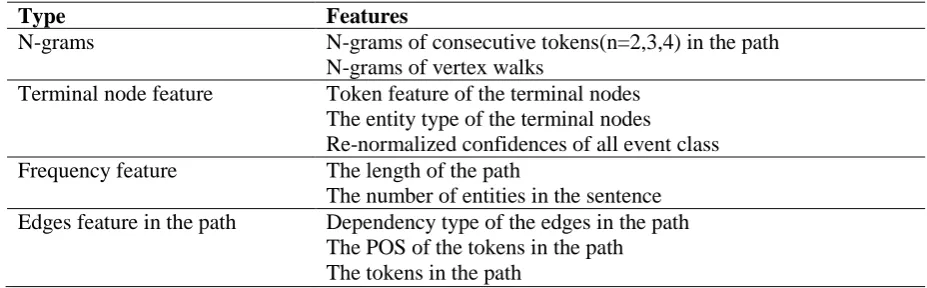
Similar to the trigger detector, the edge detector is based on a multi-class SVM classifier. An edge is from a trigger to a trigger or from a trig-ger to a protein. The edge detector classifies each candidate edge as a theme, a cause, or a negative denoting the absence of an edge between the two nodes in the given direction. The features in edge detection are shown in Table 3. As the trigger information is helpful in edge detection, the ter-minal node feature contains it. Additionally,the first edge detection is completely the same as the second one, that is, they share the same features and machine learning strategy.
2.3 Semantic Post-processing
After the trigger detection and edge detection, the biomedical event cannot be produced directly. Some simple events may be attached with sever-al proteins, and complex events may form circles. We develop a custom rule-based method to gen-erate events that are consistent with the restric-tions on event argument types and combinarestric-tions defined in the shared task. For details, Björne et al.’s (2009) paper can be referred to.
3
Tools and Component Combination
We use the support vector machine (SVM) mul-ti-class classifier (Crammer and Singer (2002), Tsochantaridis et al. (2004)) in the trigger detec-tion and edge detecdetec-tion. Besides, the dependency parser used in our system is McClosky-Charniak domain-adapted parser (McClosky and Charniak (2008)) and the dependency parse was provided in the share task1. To optimize the precision-recall trade-off, we introduce β that decreases the classifier confidence score given to the negative
1
http://2013.bionlp-st.org/supporting-resources
trigger class as formula (1) as the Uturku system does (2009).
score = score-(1-β)*abs(score) (1) where abs(score) means the absolute value of score and β∈[0,1].
4
Evaluations and Discussion
4.1 Evaluations
Firstly, our system is evaluated on the develop-ment set. Table 4 compares the performance be-tween our system and the baseline. The baseline is implemented based on Björne et al.’s (2009) paper. Compared to baseline, the precision of our system is 6.08 percentage points higher while the recall increases 0.91 percentage points. From Table 4 we can see that our system is 2.85 F-score higher than the baseline system.
Recall Precision F-score
Baseline 43.15 54.37 48.12
Ours 44.06 60.45 50.97
Table 4: Performance comparison on the development set using approximate span and recursive matching
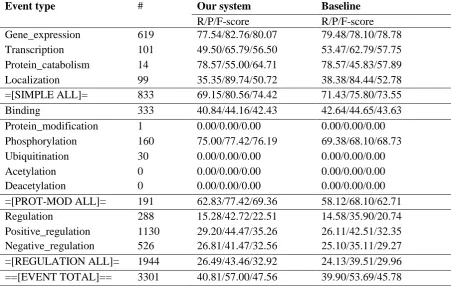
Secondly, the performance of our system is evaluated on the test data set with online evalua-tion2. Table 5 shows the results for the baseline and the proposed system with argument informa-tion to evaluate the importance of argument in-formation. Integrating argument information, our system archives 1.78% F-score improvement. Compared to the baseline, the performance for complex events is very encouraging with about 7.5 percentage points improvement in the Phos-phorylation events, 1.77 percentage points im-provement in the regulation events, 2.91
2
Event type # Our system Baseline
R/P/F-score R/P/F-score
Gene_expression 619 77.54/82.76/80.07 79.48/78.10/78.78
Transcription 101 49.50/65.79/56.50 53.47/62.79/57.75
Protein_catabolism 14 78.57/55.00/64.71 78.57/45.83/57.89
Localization 99 35.35/89.74/50.72 38.38/84.44/52.78
=[SIMPLE ALL]= 833 69.15/80.56/74.42 71.43/75.80/73.55
Binding 333 40.84/44.16/42.43 42.64/44.65/43.63
Protein_modification 1 0.00/0.00/0.00 0.00/0.00/0.00
Phosphorylation 160 75.00/77.42/76.19 69.38/68.10/68.73
Ubiquitination 30 0.00/0.00/0.00 0.00/0.00/0.00
Acetylation 0 0.00/0.00/0.00 0.00/0.00/0.00
Deacetylation 0 0.00/0.00/0.00 0.00/0.00/0.00
=[PROT-MOD ALL]= 191 62.83/77.42/69.36 58.12/68.10/62.71
Regulation 288 15.28/42.72/22.51 14.58/35.90/20.74
Positive_regulation 1130 29.20/44.47/35.26 26.11/42.51/32.35
Negative_regulation 526 26.81/41.47/32.56 25.10/35.11/29.27
=[REGULATION ALL]= 1944 26.49/43.46/32.92 24.13/39.51/29.96
[image:5.595.66.518.72.358.2]==[EVENT TOTAL]== 3301 40.81/57.00/47.56 39.90/53.69/45.78
Table 5: Approximate span matching/approximate recursive matching on test data set.
Th(E1)
Triggering of the human interleukin-6 gene by interferon-gamma and tumor necrosis factor-alpha Binding Pro Pro Pro
Th(E2) Th(E1)
Th(E2)
(a)
Th(E1)
Triggering of the human interleukin-6 gene by interferon-gamma and tumor necrosis factor-alpha Pos-Reg Pro Pro Pro
Cause(E2) Cause(E1) Th(E2)
(b)
Figure 3: (a) A result of a fragment using the first trigger detection. (b) A result of a fragment using the second trigger detection.
tage points improvement in the positive regula-tion events and 3.29 percentage points increase in the negative regulation events, but not much loss in other events. As a consequence, the total F-score of our system is 47.56%, 1.78 percentage points higher than the baseline system and ob-tains the 5th place in BioNLP'13 task 1.
4.2 Discussion
Our system achieves better performance than the baseline thanks to the second trigger detection. The second trigger detection improves the per-formance of event extraction in two ways. Firstly,
the triggers that cannot form events are directly deleted, and therefore the corresponding errone-ous events are deleted. Secondly, since the erro-neous triggers are deleted or the triggers recog-nized in the first trigger detection are given the right types in the second trigger detection, the corresponding arguments are reconstructed to form right events. Fig.3 shows an example. In the first trigger detection, the trigger “triggering”
is recognized as the illegal type of “binding” so
that “interferon-gamma” and “tumor necrosis factor-alpha” are illegally detected as theme
ar-guments of “triggering”, resulting in erroneous
[image:5.595.119.480.397.534.2]“triggering” is correctly revised as the type of
positive regulation, so the arguments are recon-structed, which makes the positive regulation events (E1 and E2) right. As a result, the preci-sion of event detection increases as well as the recall.
The proposed method is an efficient way to reduce cascading errors in pipeline system. Moreover, Riedel and McCallum (2011) pro-posed a dual decomposition-based model, anoth-er efficient method to get around cascading anoth- er-rors. Following Riedel et al.’s (2011) paper, we implement a dual decomposition-based system using the same features in our system. Table 6 shows the performance comparison on the devel-opment set of BioNLP’09 between our system and dual decomposition-based system. The com-parison indicates that the proposed method is comparable to the stat-of-the-art systems.
Recall Precision F-score Dual
Decom-position
50.08 63.66 56.06
Ours 53.88 59.67 56.63
Table 6: Performance comparison on the development set of BioNLP’09 using approximate span and recur-sive matching based on different methods
5
Conclusions
We proposed a simple but effective method to improve event extraction by boosting the trigger detection. The added edge information in the second trigger detection improves the perfor-mance of trigger detection. Features from the dependency parse graphs are the main features we use for event extraction.
The future work includes: the first trigger de-tection should classify a token into three classes: simple event type, complex event type and none event type; discovering some more helpful edge features in the second trigger detection; solving coreference problem with coreference resolution approach. Besides, the dual decomposition-based method will be improved and further compared with the pipeline system.
Acknowledgments
This work is supported by grant from the Nation-al NaturNation-al Science Foundation of China (no. 61173101, 61173100).
References
Antti Airola, Sampo Pyysalo, Jari Björne, Tapio Pa-hikkala, Filip Ginter, and Tapio Salakoski. 2008. All-paths graph kernel for protein-protein interac-tion extracinterac-tion with evaluainterac-tion of cross-corpus learning. BMC Bioinformatics, 9(Suppl 11):S2. Chris Quirk, Pallavi Choudhury, Michael Gamon, and
Lucy Vanderwend. 2011. MSR-NLP Entry in Bi-oNLP Shared Task 2011. In Proceedings of the Bi-oNLP 2011 Workshop Companion Volume for Shared Task, Portland, Oregon, June. Association for Computational Linguistics.
David McClosky and Eugene Charniak. 2008. Self-training for biomedical parsing. In Proceedings of ACL-08: HLT, Short Papers, pages 101–104. Asso-ciation for Computational Linguistics.
Hoifung Poon, Lucy Vanderwende. 2010. Joint Infe-rence for Knowledge Extraction from Biomedical Literature. In Proceedings of the North American Chapter of the Association for Computational Lin-guistics-Human Language Technologies 2010 con-ference.
Hong-Woo Chun, Yoshimasa Tsuruoka, Jin-Dong Kim, Rie Shiba, Naoki Nagata, Teruyoshi Hishiki, and Jun’ichi Tsujii. 2006. Extraction of gene-disease relations from medline using domain dic-tionaries and machine learning. In Proceedings of the Pacific Symposium on Biocomputing (PSB’06), pages 4–15.
Ioannis Tsochantaridis, Thomas Hofmann, Thorsten Joachims, and Yasemin Altun. 2004. Support vec-tor machine learning for interdependent and struc-tured output spaces. In Proceedings of the Twenty-first International Conference on Machine Learn-ing (ICML’04), pages 104–111. ACM.
Jari Björne, Juho Heimonen, Filip Ginter, Antti Airola, Tapio Pahikkala, and Tapio Salakoski. 2009. Ex-tracting complex biological events with rich graph-based feature sets. In Proceedings of the BioNLP 2009 Workshop Companion Volume for Shared Task, pages 10–18, Boulder, Colorado, June. Asso-ciation for Computational Linguistics.
Jari Björne and Tapio Salakoski. 2011. Generalizing biomedical event extraction. In Proceedings of the BioNLP 2011 Workshop Companion Volume for Shared Task, Portland, Oregon, June. Association for Computational Linguistics.
Jin-Dong Kim, Tomoko Ohta, Sampo Pyysalo, Yo-shinobu Kano, and Junichi Tsujii. 2009. Overview of BioNLP’09 Shared Task on event extraction. In
Proceedings of the NAACL-HLT 2009 Workshop on Natural Language Processing in Biomedicine (BioNLP’09). ACL.
Bi-oNLP Shared Task 2011. In Proceedings of the Bi-oNLP 2011 Workshop Companion Volume for Shared Task, Portland, Oregon, June. Association for Computational Linguistics.
Jin-Dong Kim, Yue Wang and Yamamoto Yasunori. 2013. The Genia Event Extraction Shared Task, 2013 Edition - Overview. In Proceedings of the Bi-oNLP Shared Task 2013 Workshop, Sofia, Bulgaria, Aug. Association for Computational Linguistics. Koby Crammer and Yoram Singer. 2002. On the
al-gorithmic implementation of multiclass kernel-based vector machines. Journal of Machine Learn-ing Research, 2:265–292.
Makoto Miwa, Rune Sætre, Yusuke Miyao, and-Jun’ichi Tsujii. 2009. A rich feature vector for protein–protein interaction extraction from mul-tiple corpora. In EMNLP’09: Proceedings of the
2009 Conference on Empirical Methods in Natu-ral Language Processing, pages 121–130, Morris-town, NJ, USA. Association for Computational Linguistics.
Makoto Miwa, Sampo Pyysalo, Tadayoshi Hara, and Jun’ichi Tsujii. 2010a . A comparative study of syntactic parsers for event extraction. In Proceed-ings of BioNLP’10 p. 37–45.
Makoto Miwa, Sampo Pyysalo, Tadayoshi Hara, and Jun’ichi Tsujii. 2010b. Evaluating dependency re-presentation for event extraction. In Proceedings of the 23rd International Conference on Computa-tional Linguistics, COLING ’10, Association for Computational Linguistics, 2010; p. 779–787. Makoto Miwa, Paul Thompson, and Sophia
Anania-dou. 2012. Boosting automatic event extraction from the literature using domain adaptation and co-reference resolution. Bioinformatics.
Sebastian Riedel, Hong-Woo Chun, Toshihisa Taka-gi,and Jun’ichi Tsujii. 2009. A Markov logic ap-proach to bio-molecular event extraction. In Bi-oNLP’09: Proceedings of the Workshop on BioNLP, pages 41-49, Morristown, NJ, USA. Association for Computational Linguistics.
Sebastian Riedel and Andrew McCallum. 2011. Ro-bust Biomedical Event Extraction with Dual De-composition and Minimal Domain Adaptation. In