Proceedings of NAACL-HLT 2019, pages 4060–4067 4060
Pragmatically Informative Text Generation
Sheng Shen† Daniel Fried† Jacob Andreas‡ Dan Klein†
†Computer Science Division, UC Berkeley
‡Computer Science and Artificial Intelligence Laboratory, MIT
{sheng.s,dfried,klein}@berkeley.edu, [email protected]
Abstract
We improve the informativeness of models for conditional text generation using techniques from computational pragmatics. These tech-niques formulate language production as a game between speakers and listeners, in which a speaker should generate output text that a lis-tener can use to correctly identify the original input that the text describes. While such ap-proaches are widely used in cognitive science and grounded language learning, they have re-ceived less attention for more standard lan-guage generation tasks. We consider two prag-matic modeling methods for text generation: one where pragmatics is imposed by informa-tion preservainforma-tion, and another where pragmat-ics is imposed by explicit modeling of distrac-tors. We find that these methods improve the performance of strong existing systems for ab-stractive summarization and generation from structured meaning representations.
1 Introduction
Computational approaches to pragmatics cast lan-guage generation and interpretation as game-theoretic or Bayesian inference procedures ( Gol-land et al., 2010; Frank and Goodman, 2012). While such approaches are capable of modeling a variety of pragmatic phenomena, their main ap-plication in natural language processing has been to improve the informativenessof generated text in grounded language learning problems (Monroe et al., 2018). In this paper, we show that prag-matic reasoning can be similarly used to improve performance in more traditional language genera-tion tasks like generagenera-tion from structured meaning representations (Figure 1) and summarization.
Our work builds on a line of learned Rational Speech Acts (RSA) models (Monroe and Potts, 2015; Andreas and Klein, 2016), in which gen-erated strings are selected to optimize the
behav-Input meaning representation (i):
NAME[FITZBILLIES], EATTYPE[COFFEE SHOP], FOOD[ENGLISH], PRICERANGE[CHEAP], CUSTOMERRATING[5 OUT OF 5], AREA[RIVERSIDE], FAMILYFRIENDLY[YES]
Human-written
A cheap coffee shop in riverside with a 5 out of 5 customer rating is Fitzbillies. Fitzbillies is family friendly and serves English food.
Base sequence-to-sequence model (S0)
Fitzbillies is a family friendly coffee shop located near the river.
Distractor-based pragmatic system (SD
1)
Fitzbillies is a family friendly coffee shop that serves English food. It is located in riverside area. It has a customer rating of 5 out of 5 and is cheap.
Reconstructor-based pragmatic system (SR
1)
Fitzbillies is a family friendly coffee shop that serves cheap English food in the riverside area. It has a customer rating of 5 out of 5.
Figure 1: Example outputs of our systems on the E2E generation task. While a base sequence-to-sequence model (S0, Sec. 2) fails to describe all attributes in the input meaning representation, both of our prag-matic systems (SR
1, Sec.3.1andS1D, Sec.3.2) and the
human-written reference do.
ior of an embedded listener model. The canoni-cal presentation of the RSA framework (Frank and Goodman,2012) is grounded in reference resolu-tion: models of speakers attempt to describe ref-erents in the presence of distractors, and models of listeners attempt to resolve descriptors to ref-erents. Recent work has extended these models to more complex groundings, including images (Mao et al.,2015) and trajectories (Fried et al., 2018). The techniques used in these settings are similar, and the primary intuition of the RSA framework is preserved: from the speaker’s perspective, a good description is one that picks out, as discrimina-tively as possible, the content the speaker intends for the listener to identify.
Outside of grounding, cognitive modeling
to a distinct class of language generation prob-lems that use as referents structured descriptions of lingustic content, or other natural language
texts. In accordance with the maxim of
quan-tity (Grice,1970) or the Q-principle (Horn,1984), pragmatic approaches naturally correct underin-formativeness problems observed in state-of-the-art language generation systems (S0inFigure 1).
We present experiments on two language gener-ation tasks: genergener-ation from meaning representa-tions (Novikova et al., 2017) and summarization. For each task, we evaluate two models of pragmat-ics: the reconstructor-based model of Fried et al. (2018) and the distractor-based model of Cohn-Gordon et al.(2018). Both models improve per-formance on both tasks, increasingROUGEscores by 0.2–0.5 points on the CNN/Daily Mail ab-stractive summarization dataset and BLEU scores by 2 points on the End-to-End (E2E) generation dataset, obtaining new state-of-the-art results.
2 Tasks
We formulate a conditional generation task as tak-ing an input ifrom a space of possible inputs I (e.g., input sentences for abstractive summariza-tion; meaning representations for structured gen-eration) and producing an outputoas a sequence of tokens (o1, . . . , oT). We build our pragmatic
approaches on top of learned base speaker mod-els S0, which produce a probability distribution
S0(o|i)over output text for a given input. We
fo-cus on two conditional generation tasks where the information in the input context should largely be preserved in the output text, and apply the prag-matic procedures outlined in Sec. 3to each task. For these S0 models we use systems from past
work that are strong, but may still be underinfor-mative relative to human reference outputs (e.g., Figure 1).
Meaning Representations Our first task is gen-eration from structured meaning representations (MRs) containing attribute-value pairs (Novikova et al., 2017). An example is shown in Figure 1, where systems must generate a description of the restaurant with the specified attributes. We ap-ply pragmatics to encourage output strings from which the input MR can be identified. For ourS0
model, we use a publicly-released neural gener-ation system (Puzikov and Gurevych, 2018) that achieves comparable performance to the best pub-lished results inDuˇsek et al.(2018).
Abstractive Summarization Our second task is multi-sentence document summarization. There is a vast amount of past work on summariza-tion (Nenkova and McKeown,2011); recent neu-ral models have used large datasets (e.g.,Hermann et al.(2015)) to train models in both the extractive (Cheng and Lapata,2016;Nallapati et al., 2017) and abstractive (Rush et al.,2015;See et al.,2017) settings. Among these works, we build on the re-cent abstractive neural summarization system of Chen and Bansal(2018). First, this system uses a sentence-level extractive modelRNN-EXTto iden-tify a sequence of salient sentencesi(1), . . . i(P)in each source document. Second, the system uses an abstractive modelABSto rewrite eachi(p)into an outputo(p), which are then concatenated to pro-duce the final summary. We rely on the fixedRNN -EXT model to extract sentences as inputs in our pragmatic procedure, usingABS as ourS0 model
and applying pragmatics to the i(p) → o(p)
ab-stractive step.
3 Pragmatic Models
To produce informative outputs, we consider prag-matic methods that extend thebase speaker mod-els,S0, usinglistenermodels,L, which produce a
distributionL(i|o)over possible inputs given an output. Listener models are used to derive prag-matic speakers, S1(o | i), which produce output that has a high probability of making a listener model L identify the correct input. There are a large space of possible choices for designing L and derivingS1; we follow two lines of past work
which we categorize as reconstructor-based and distractor-based. We tailor each of these prag-matic methods to both our two tasks by develop-ing reconstructor models and methods of choosdevelop-ing distractors.
3.1 Reconstructor-Based Pragmatics
Pragmatic approaches in this category (Duˇsek and Jurˇc´ıˇcek,2016;Fried et al.,2018) rely on a recon-structor listenermodelLRdefined independently
of the speaker. This listener model produces a dis-tributionLR(i|o)over all possible input contexts i ∈ I, given an output description o. We use sequence-to-sequence or structured classification models forLR (described below), and train these models on the same data used to supervise theS0
models.
together define a pragmatic speaker, with output score given by:
S1R(o|i) =LR(i|o)λ·S0(o|i)1−λ (1)
where λ is a rationality parameter that controls how much the model optimizes for discriminative outputs (seeMonroe et al.(2017) andFried et al. (2018) for a discussion). We select an output text sequence o for a given input i by choosing the highest scoring output under Eq.1 from a set of candidates obtained by beam search inS0(· |i).
Meaning Representations We constructLRfor the meaning representation generation task as a multi-task, multi-class classifier, defining a dis-tribution over possible values for each attribute. Each MR attribute has its own prediction layer and attention-based aggregation layer, which con-ditions on a basic encoding ofoshared across all attributes. See AppendixA.1for architecture de-tails. We then defineLR(i| o)as the joint prob-ability of predicting all input MR attributes in i fromo.
Summarization To construct LR for
summa-rization, we train an ABS model (of the type we use forS0,Chen and Bansal(2018)) but in reverse,
i.e., taking as input a sentence in the summary and producing a sentence in the source document. We train LR on the same heuristically-extracted and aligned source document sentences used to train S0(Chen and Bansal,2018).
3.2 Distractor-Based Pragmatics
Pragmatic approaches in this category (Frank and Goodman,2012;Andreas and Klein,2016; Vedan-tam et al.,2017;Cohn-Gordon et al.,2018) derive pragmatic behavior by producing outputs that dis-tinguish the inputifrom an alternatedistractor in-put (or inin-puts). We construct a distractoreı for a
given inputiin a task-dependent way.1
We follow the approach of Cohn-Gordon et al. (2018), outlined briefly here. The base speakers we build on produce outputs incrementally, where the probability ofot, the word output at timet, is
conditioned on the input and the previously gen-erated words: S0(ot |i, o<t). Since the output is
generated incrementally and there is no separate
1
In tasks such as contrastive captioning or referring ex-pression generation, these distractors are given; for the condi-tional generation task, we will show that pragmatic behavior can be obtained by constructing or selecting a single distrac-tor that contrasts with the inputi.
listener model that needs to condition on entire output decisions, the distractor-based approach is able to make pragmatic decisions at each word rather than choosing between entire output candi-dates (as in the reconstructor approaches).
The listenerLD and pragmatic speakerS1D are derived from the base speakerS0 and a belief
dis-tributionpt(·)maintained at each timestep tover
the possible inputsID:
LD(i|o<t)∝S0(o<t |i)·pt−1(i) (2)
S1D(ot|i, o<t)∝LD(i|o<t)α·S0(ot|i, o<t) (3)
pt(i)∝S0(ot|i, o<t)·LD(i|o<t) (4)
whereα is again a rationality parameter, and the initial belief distribution p0(·) is uniform, i.e.,
p0(i) =p0(eı) = 0.5. Eqs.2and4are normalized
over the true inputiand distractoreı; Eq.3is
nor-malized over the output vocabulary. We construct an output text sequence for the pragmatic speaker S1D incrementally using beam search to approxi-mately maximize Eq.3.
Meaning Representations A distractor MR is
automatically constructed for each input to be the most distinctive possible against the input. We construct this distractor by masking each present input attribute and replacing the value of each non-present attribute with the value that is most fre-quent for that attribute in the training data. For ex-ample, for the input MR inFigure 1, the distractor is NEAR[BURGERKING].
Summarization For each extracted input sen-tencei(p), we use the previous extracted sentence i(p−1)from the same document as the distractor in-puteı(for the first sentence we do not use a
distrac-tor). This is intended to encourage outputso(p) to contain distinctive information against other sum-maries produced within the same document.
4 Experiments
For each of our two conditional generation tasks we evaluate on a standard benchmark dataset, following past work by using automatic evalua-tion against human-produced reference text. We choose hyperparameters for our models (beam size, and parameters α and λ) to maximize task metrics on each dataset’s development set; see Ap-pendixA.2for the settings used.2
2Our code is publicly available athttps://github.
System BLEU NIST METEOR R-L CIDEr
T-Gen 65.93 8.61 44.83 68.50 2.23
Best Prev. 66.19† 8.61† 45.29‡ 70.83 2.27•
S0 66.52 8.55 44.45 69.34 2.23
S0×2 65.93 8.31 43.52 69.58 2.12
SR
1 68.60 8.73 45.25 70.82 2.37 SD
1 67.76 8.72 44.59 69.41 2.27
Table 1: Test results for the E2E generation task, in comparison to the T-Gen baseline (Duˇsek and Jurˇc´ıˇcek,
2016) and the best results from the E2E challenge, re-ported byDuˇsek et al.(2018): †Juraska et al.(2018),
‡Puzikov and Gurevych(2018),Zhang et al. (2018),
and•Gong (2018). We bold our highest performing model on each metric, as well as previous work if it outperforms all of our models.
4.1 Meaning Representations
We evaluate on the E2E task of generation from meaning representations containing restaurant at-tributes (Novikova et al., 2017). We report the task’s five automatic metrics: BLEU (Papineni et al.,2002), NIST(Doddington, 2002),METEOR (Lavie and Agarwal,2007),ROUGE-L(Lin,2004) andCIDEr (Vedantam et al.,2015).
Table 1 compares the performance of our base S0 and pragmatic models to the baseline T-Gen
system (Duˇsek and Jurˇc´ıˇcek, 2016) and the best previousresult from the 20 primary systems eval-uated in the E2E challenge (Duˇsek et al., 2018). The systems obtaining these results encompass a range of approaches: a template system (Puzikov and Gurevych,2018), a neural model (Zhang et al., 2018), models trained with reinforcement learning (Gong,2018), and systems using ensembling and reranking (Juraska et al.,2018). To ensure that the benefit of the reconstructor-based pragmatic ap-proach, which uses two models, is not due solely to a model combination effect, we also compare to an ensemble of two base models (S0 ×2). This
ensemble uses a weighted combination of scores of two independently-trained S0 models,
follow-ing Eq.1(with weights tuned on the development data).
Both of our pragmatic systems improve over the strong baselineS0system on all five metrics, with
the largest improvements (2.1BLEU, 0.2NIST, 0.8 METEOR, 1.5ROUGE-L, and 0.1CIDEr) from the S1Rmodel. ThisSR1 model outperforms the previ-ous best results obtained by any system in the E2E challenge onBLEU,NIST, andCIDEr, with compa-rable performance onMETEORandROUGE-L.
System R-1 R-2 R-L METEOR
Extractive
Lead-3 40.34 17.70 36.57 22.21
Inputs 38.93 18.23 35.90 24.66
Abstractive
Best Previous 41.69† 19.47† 39.08‡ 21.00
S0 40.88 17.80 38.54 20.38
S0×2 40.76 17.88 38.46 19.88
SR
1 41.23 18.07 38.76 20.57
S1D 41.39 18.30 38.78 21.70
Table 2: Test results for the non-anonymized CNN/Daily Mail summarization task. We compare to extractive baselines, and the best previous abstractive results of †Celikyilmaz et al. (2018), ‡Paulus et al.
(2018) and Chen and Bansal (2018). We bold our highest performing model on each metric, as well as previous work if it outperforms all of our models.
4.2 Abstractive Summarization
We evaluate on the CNN/Daily Mail summariza-tion dataset (Hermann et al.,2015;Nallapati et al., 2016), using See et al.’s (2017) non-anonymized preprocessing. As in previous work (Chen and Bansal,2018), we evaluate usingROUGEandME -TEOR.
Table 2compares our pragmatic systems to the baseS0 model (with scores taken fromChen and
Bansal (2018); we obtained comparable perfor-mance in our reproduction3), an ensemble of two of these base models, and the best previous ab-stractive summarization result for each metric on this dataset (Celikyilmaz et al.,2018;Paulus et al., 2018;Chen and Bansal,2018). We also report two extractive baselines: Lead-3, which uses the first three sentences of the document as the summary (See et al.,2017), andInputs, the concatenation of the extracted sentences used as inputs to our mod-els (i.e.,i(1), . . . , i(P)).
The pragmatic methods obtain improvements of
0.2–0.5 in ROUGE scores and 0.2–1.8 METEOR
over the baseS0 model, with the distractor-based
approach S1D outperforming the reconstructor-based approachS1R. S1D is strong across all met-rics, obtaining results competitive to the best pre-vious abstractive systems.
3
We use retrained versions ofChen and Bansal(2018)’s sentence extractor and abstractiveS0models in all our experi-ments, as well as their n-gram reranking-based inference pro-cedure, replacing scores from the base modelS0with scores fromSR
FF ET Food PR Area CR
Meaning Representation Attribute
0.4 0.5 0.6 0.7 0.8 0.9 1.0
Coverage Ratio
S0
SD1 SR1
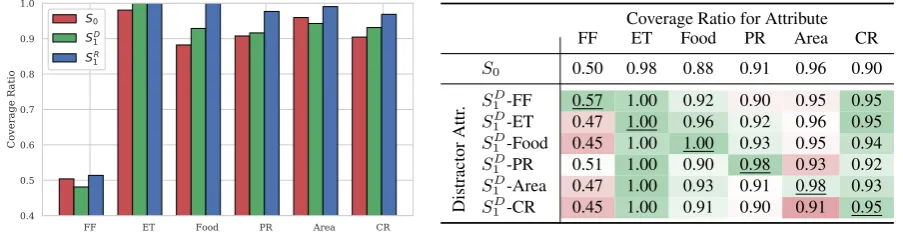
(a) Coverage ratios by attribute type for the base model S0 and pragmatic models S1R andSD1. The pragmatic models typically improve coverage ratios across attribute types when compared to the base model.
Coverage Ratio for Attribute
FF ET Food PR Area CR
S0 0.50 0.98 0.88 0.91 0.96 0.90
S1D-FF 0.57 1.00 0.92 0.90 0.95 0.95 S1D-ET 0.47 1.00 0.96 0.92 0.96 0.95 S1D-Food 0.45 1.00 1.00 0.93 0.95 0.94 S1D-PR 0.51 1.00 0.90 0.98 0.93 0.92 S1D-Area 0.47 1.00 0.93 0.91 0.98 0.93
Distractor
Attr
.
S1D-CR 0.45 1.00 0.91 0.90 0.91 0.95
[image:5.595.79.531.63.179.2](b) Coverage ratios by attribute type (columns) for the base modelS0, and for the pragmatic systemS1Dwhen construct-ing the distractor by maskconstruct-ing the specified attribute (rows). Cell colors are the degree the coverage ratio increases (green) or decreases (red) relative toS0.
Figure 2: Coverage ratios for the E2E task by attribute type, estimating how frequently the values for each attribute from the input meaning representations are mentioned in the output text.
5 Analysis
The base speaker S0 model is often
underinfor-mative, e.g., for the E2E task failing to mention certain attributes of a MR, even though almost all the training examples incorporate all of them. To better understand the performance improvements from the pragmatic models for E2E, we compute acoverage ratioas a proxy measure of how well content in the input is preserved in the generated outputs. The coverage ratio for each attribute is the fraction of times there is an exact match between the text in the generated output and the attribute’s value in the source MR (for instances where the attribute is specified).4
Figure 2(a) shows coverage ratio by attribute category for all models. TheS1R model increases the coverage ratio when compared toS0across all
attributes, showing that using the reconstruction model score to select outputs does lead to an in-crease in mentions for each attribute. Coverage ratios increase for S1D as well in four out of six categories, but the increase is typically less than that produced byS1R.
WhileSD
1 optimizes less explicitly for attribute
mentions than S1R, it still provides a potential method to control generated outputs by choosing alternate distractors. Figure 2(b) shows cover-age ratios forS1D when masking only a single at-tribute in the distractor. The highest coverage ratio for each attribute is usually obtained when mask-ing that attribute in the distractor MR (entries on the main diagonal, underlined), in particular for FAMILYFRIENDLY (FF), FOOD, PRICERANGE
4Note that this measure roughly provides a lower bound
on the model’s actual informativeness for each attribute, since the measure does not assign credit for paraphrases.
(PR), and AREA. However, masking a single at-tribute sometimes results in decreasing the cov-erage ratio, and we also observe substantial in-creases from masking other attributes: e.g., mask-ing either FAMILYFRIENDLYor CUSTOMERRAT -ING(CR) produces an equal increase in coverage ratio for the CUSTOMERRATING attribute. This may reflect underlying correlations in the training data, as these two attributes have a small number of possible values (3 and 7, respectively).
6 Conclusion
Our results show that S0 models from previous
work, while strong, still imperfectly capture the behavior that people exhibit when generating text; and an explicit pragmatic modeling procedure can improve results. Both pragmatic methods eval-uated in this paper encourage prediction of out-puts that can be used to identify their inout-puts, either by reconstructing inputs in their entirety or distin-guishing true inputs from distractors, so it is per-haps unsurprising that both methods produce sim-ilar improvements in performance. Future work might allow finer-grained modeling of the tradeoff betweenunder- andover-informativity within the sequence generation pipeline (e.g., with a learned communication cost model) or explore applica-tions of pragmatics for content selection earlier in the generation pipeline.
Acknowledgments
References
Jacob Andreas and Dan Klein. 2016. Reasoning about pragmatics with neural listeners and speakers. In
Proceedings of the Conference on Empirical Meth-ods in Natural Language Processing.
Dzmitry Bahdanau, Kyunghyun Cho, and Yoshua Ben-gio. 2014. Neural machine translation by jointly learning to align and translate. arXiv preprint arXiv:1409.0473.
Asli Celikyilmaz, Antoine Bosselut, Xiaodong He, and Yejin Choi. 2018. Deep communicating agents for abstractive summarization. In Proceedings of the Annual Meeting of the North American Chap-ter of the Association for Computational Linguistics, pages 1662–1675, New Orleans, Louisiana. Associ-ation for ComputAssoci-ational Linguistics.
Yen-Chun Chen and Mohit Bansal. 2018. Fast abstrac-tive summarization with reinforce-selected sentence rewriting. InProceedings of the Annual Meeting of the Association for Computational Linguistics.
Jianpeng Cheng and Mirella Lapata. 2016. Neural summarization by extracting sentences and words. In Proceedings of the Annual Meeting of the Asso-ciation for Computational Linguistics, pages 484– 494, Berlin, Germany. Association for Computa-tional Linguistics.
Kyunghyun Cho, Bart van Merrienboer, Caglar Gul-cehre, Dzmitry Bahdanau, Fethi Bougares, Holger Schwenk, and Yoshua Bengio. 2014. Learning phrase representations using RNN encoder–decoder for statistical machine translation. InProceedings of the Conference on Empirical Methods in Natu-ral Language Processing, pages 1724–1734, Doha, Qatar. Association for Computational Linguistics.
Reuben Cohn-Gordon, Noah Goodman, and Chris Potts. 2018. Pragmatically informative image cap-tioning with character-level reference. In Proceed-ings of the Annual Meeting of the North American Chapter of the Association for Computational Lin-guistics.
George Doddington. 2002. Automatic evaluation of machine translation quality using n-gram co-occurrence statistics. InProceedings of the second international conference on Human Language Tech-nology Research, pages 138–145. Morgan Kauf-mann Publishers Inc.
Ondrej Duˇsek and Filip Jurˇc´ıˇcek. 2016. Sequence-to-sequence generation for spoken dialogue via deep syntax trees and strings. InACL.
Ondˇrej Duˇsek, Jekaterina Novikova, and Verena Rieser. 2018. Findings of the E2E NLG challenge. In Pro-ceedings of the International Conference on Natural Language Generation.
Michael C Frank and Noah D Goodman. 2012. Pre-dicting pragmatic reasoning in language games. Sci-ence, 336(6084):998–998.
Michael C Frank, Noah D Goodman, Peter Lai, and Joshua B Tenenbaum. 2009. Informative commu-nication in word production and word learning. In
Proceedings of the 31st annual conference of the cognitive science society, pages 1228–1233.
Daniel Fried, Jacob Andreas, and Dan Klein. 2018. Unified pragmatic models for generating and follow-ing instructions. InProceedings of the Annual Meet-ing of the North American Chapter of the Associa-tion for ComputaAssocia-tional Linguistics.
Dave Golland, Percy Liang, and Dan Klein. 2010. A game-theoretic approach to generating spatial de-scriptions. InProceedings of the 2010 conference on Empirical Methods in Natural Language Process-ing, pages 410–419. Association for Computational Linguistics.
Heng Gong. 2018. Technical report for E2E NLG chal-lenge. InE2E NLG Challenge System Descriptions.
Herbert P Grice. 1970. Logic and conversation.
Karl Moritz Hermann, Tom´as Kocisk´y, Edward Grefenstette, Lasse Espeholt, Will Kay, Mustafa Su-leyman, and Phil Blunsom. 2015. Teaching ma-chines to read and comprehend. InAdvances in Neu-ral Information Processing Systems.
Laurence Horn. 1984. Toward a new taxonomy for pragmatic inference: Q-based and r-based implica-ture. Meaning, form, and use in context: Linguistic applications, 11:42.
Juraj Juraska, Panagiotis Karagiannis, Kevin Bowden, and Marilyn Walker. 2018. A deep ensemble model with slot alignment for sequence-to-sequence natu-ral language generation. InProceedings of the An-nual Meeting of the North American Chapter of the Association for Computational Linguistics, pages 152–162, New Orleans, Louisiana. Association for Computational Linguistics.
Alon Lavie and Abhaya Agarwal. 2007.METEOR: An automatic metric for MT evaluation with high levels of correlation with human judgments. In Proceed-ings of the Second Workshop on Statistical Machine Translation, pages 228–231, Prague, Czech Repub-lic. Association for Computational Linguistics.
Chin-Yew Lin. 2004. Rouge: A package for automatic evaluation of summaries. In Text Summarization Branches Out: Proceedings of the ACL-04 Work-shop.
Junhua Mao, Jonathan Huang, Alexander Toshev, Oana Camburu, Alan Yuille, and Kevin Murphy. 2015. Generation and comprehension of unambiguous ob-ject descriptions. arXiv preprint arXiv:1511.02283.
Will Monroe, Jennifer Hu, Andrew Jong, and Christo-pher Potts. 2018. Generating bilingual pragmatic color references. In Proceedings of the Annual Meeting of the North American Chapter of the As-sociation for Computational Linguistics.
Will Monroe and Christopher Potts. 2015. Learning in the Rational Speech Acts model. InProceedings of 20th Amsterdam Colloquium, Amsterdam. ILLC.
Ramesh Nallapati, Feifei Zhai, and Bowen Zhou. 2017. Summarunner: A recurrent neural network based se-quence model for extractive summarization of docu-ments. InProceedings of the Meeting of the Associ-ation for the Advancement of Artificial Intelligence.
Ramesh Nallapati, Bowen Zhou, Cicero dos Santos, Caglar Gulcehre, and Bing Xiang. 2016. Abstrac-tive text summarization using sequence-to-sequence rnns and beyond. InSIGNLL Conference on Com-putational Natural Language Learning, pages 280– 290, Berlin, Germany. Association for Computa-tional Linguistics.
Ani Nenkova and Kathleen McKeown. 2011. Auto-matic summarization. Foundations and Trends in Information Retrieval, 5(2–3):103–233.
Jekaterina Novikova, Ondˇrej Duˇsek, and Verena Rieser. 2017. The E2E dataset: New challenges for end-to-end generation. InProceedings of the Annual SIG-dial Meeting on Discourse and Dialogue.
Naho Orita, Eliana Vornov, Naomi Feldman, and Hal Daum´e III. 2015. Why discourse affects speak-ers’ choice of referring expressions. InProceedings of the 53rd Annual Meeting of the Association for Computational Linguistics and the 7th International Joint Conference on Natural Language Processing (Volume 1: Long Papers), volume 1, pages 1639– 1649.
Kishore Papineni, Salim Roukos, Todd Ward, and Wei-Jing Zhu. 2002. Bleu: a method for automatic eval-uation of machine translation. In Proceedings of the Annual Meeting of the Association for Compu-tational Linguistics, pages 311–318. Association for Computational Linguistics.
Romain Paulus, Caiming Xiong, and Richard Socher. 2018. A deep reinforced model for abstractive sum-marization. In Proceedings of the International Conference on Learning Representations, volume abs/1705.04304.
Yevgeniy Puzikov and Iryna Gurevych. 2018. E2E NLG challenge: Neural models vs. templates. In
Proceedings of the International Conference on Nat-ural Language Generation.
Alexander M. Rush, Sumit Chopra, and Jason Weston. 2015. A neural attention model for abstractive sen-tence summarization. In Proceedings of the 2015 Conference on Empirical Methods in Natural Lan-guage Processing, pages 379–389, Lisbon, Portugal. Association for Computational Linguistics.
Abigail See, Peter J. Liu, and Christopher D. Manning. 2017.Get to the point: Summarization with pointer-generator networks. InProceedings of the Annual Meeting of the Association for Computational Lin-guistics, pages 1073–1083, Vancouver, Canada. As-sociation for Computational Linguistics.
Ramakrishna Vedantam, Samy Bengio, Kevin Murphy, Devi Parikh, and Gal Chechik. 2017. Context-aware captions from context-agnostic supervision.
Ramakrishna Vedantam, C. Lawrence Zitnick, and Devi Parikh. 2015. CIDEr: Consensus-based im-age description evaluation. In Proceedings of the Conference on Computer Vision and Pattern Recog-nition.
A Supplemental Material
A.1 Reconstructor Model Details
For the reconstructor-based speaker in the E2E task, we first follow the same data preprocessing steps asPuzikov and Gurevych(2018), which in-cludes a delexicalization module that deals with sparsely occurring MR attributes (NAME, NEAR) by mapping such values to placeholder tokens.
MRs have only a few possible values for most attributes: six out of eight attributes have fewer than seven unique values, and the remaining two attributes (NAME, NEAR) are handled by our S0
andS1D using delexicalized placeholders, follow-ingPuzikov and Gurevych(2018). In this way, the reconstructor only needs to predict the presence of these two attributes with a boolean variable, and other attributes with the corresponding categorical variable. We use a one layer bi-directional GRU (Cho et al.,2014) for the shared sentence encoder. We concatenate the latent vectors from both direc-tions to construct a bi-directional encoded vector hi for every single word vectordias:
→ hi =
−→
GRU(di, hi−1),
← hi=
←−
GRU(di, hi+1)
hi = [
→ hi,
←
hi], i∈[1, L]
Since not all words contribute equally to predict-ing each MR attribute, we thus use an attention mechanism (Bahdanau et al., 2014) to determine the importance of every single word. The aggre-gated sentence vector for taskkis calculated by
a(ik)= exp(W (k)
a hi) PL
j=1exp(W (k)
a hj)
, v(k)=
L X
i=1
a(ik)hi,
The task-specific sentence representation is then used as input toklayers with softmax outputs, re-turning a probability vectorY(k)for each of thek MR attributes.
A.2 Hyperparameters
For structured generation, we use beam size 10, λ = 0.4, and α = 0.2, tuned to maximize the normalized average of all five metrics on the de-velopment set.