Proceedings of the 2019 Conference on Empirical Methods in Natural Language Processing
1304
Modeling Multi-Action Policy for Task-Oriented Dialogues
Lei Shu, Hu Xu, Bing Liu
University of Illinois at Chicago
{lshu3, hxu48, liub}@uic.edu
Piero Molino
Uber AI [email protected]
Abstract
Dialogue management (DM) plays a key role in the quality of the interaction with the user in a task-oriented dialogue system. In most existing approaches, the agent predicts only one DM policy action per turn. This sig-nificantly limits the expressive power of the conversational agent and introduces unwanted turns of interactions that may challenge users’ patience. Longer conversations also lead to more errors and the system needs to be more robust to handle them. In this paper, we com-pare the performance of several models on the task of predicting multiple acts for each turn. A novel policy model is proposed based on a recurrent cell called gated Continue-Act-Slots (gCAS) that overcomes the limitations of the existing models. Experimental results show that gCAS1outperforms other approaches.
1 Introduction
In a task-oriented dialogue system, the dialogue manager policy module predicts actions usually in terms of dialogue acts and domain specific slots. It is a crucial component that influences the ef-ficiency (e.g., the conciseness and smoothness) of the communication between the user and the agent. Both supervised learning (SL) (Stent,2002;
Williams et al.,2017a;Williams and Zweig,2016;
Henderson et al., 2005,2008) and reinforcement learning (RL) approaches (Walker, 2000; Young et al., 2007; Gasic and Young, 2014; Williams et al., 2017b;Su et al., 2017) have been adopted to learn policies. SL learns a policy to predict acts given the dialogue state. Recent work (Wen et al., 2017; Liu and Lane, 2018) also used SL as pre-training for RL to mitigate the sam-ple inefficiency of RL approaches and to reduce the number of interactions. Sequence2Sequence
1The code is available at https://leishu02.
github.io/
user msg Hi! I’m looking for good thriller. Are there any playing right now? agent msg Yes, there are! The Witch, The Other Side of the Door,
and The Boy are all thrillers. Would you like to find tickets for a showing for any of them?
agent acts inform(moviename=The Witch, The Other Side of the Door, The Boy; genre=thriller) multiple choice(moviename)
Table 1: Dialogue example.
(Seq2Seq) (Sutskever et al., 2014) approaches have also been adopted in user simulators to pro-duce user acts (Gur et al., 2018). These ap-proaches typically assume that the agent can only produce one act per turn through classification. Generating only one act per turn significantly lim-its what an agent can do in a turn and leads to lengthy dialogues, making tracking of state and context throughout the dialogue harder. An exam-ple in Table 1 shows how the agent can produce both aninformand amultiple choiceact, reducing the need for additional turns.
The use of multiple actions has previously been used in interaction managers that keep track of the floor (who is speaking right now) (Raux and Esk´enazi, 2007; Khouzaimi et al., 2015; Hastie et al.,2013, among others), but the option of gen-erating multiple acts simultaneously at each turn for dialogue policy has been largely ignored, and only explored in simulated scenarios without real data (Chandramohan and Pietquin,2010).
This task can be cast as a multi-label classifica-tion problem (if the sequential dependency among the acts is ignored) or as a sequence generation one as shown in Table2.
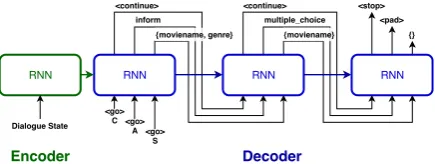
In this paper, we introduce a novel policy model to output multiple actions per turn (called multi-act), generating a sequence of tuples and expand-ing agents’ expressive power. Each tuple is de-fined as (continue,act,slots), where continue in-dicates whether to continue or stop producing new acts,actis anact type(e.g.,informorrequest), and
RNN RNN RNN RNN
Encoder Decoder
<go> C <go>
[image:2.595.73.291.64.146.2]A <go> S <continue> inform {moviename, genre} <continue> multiple_choice {moviename} <stop> <pad> {} Dialogue State
Figure 1: CAS decoder: at each step, a tuple of (con-tinue, act, slots) is produced. The KB vector k re-garding the queried result from knowledge base is not shown for brevity.
(Figure1) is proposed to produce such sequences. Each tuple is generated by a cell called gated Continue Act Slots (gCAS, as in Figure2), which is composed of three sequentially connected gated units handling the three components of the tuple. This decoder can generate multi-acts in a double recurrent manner (Tay et al., 2018). We compare this model with baseline classifiers and sequence generation models and show that it consistently outperforms them.
2 Methodology
The proposed policy network adopts an encoder-decoder architecture (Figure1). The input to the encoder is the current-turn dialogue state, which follows Li et al. (2018)’s definition. It contains policy actions from the previous turn, user dia-logue acts from the current turn, user requested slots, the user informed slots, the agent requested slots and agent proposed slots. We treat the dia-logue state as a sequence and adopt a GRU (Cho et al., 2014) to encode it. The encoded dialogue state is a sequence of vectors E = (e0, . . . , el)
and the last hidden state is hE. The CAS de-coder recurrently generates tuples at each step. It takes hE as initial hidden stateh0. At each
de-coding step, the input contains the previous (con-tinue, act, slots) tuple (ct−1, at−1, st−1). An
ad-ditional vectorkcontaining the number of results from the knowledge base (KB) query and the cur-rent turn number is given as input. The output of the decoder at each step is a tuple(c, a, s), where c ∈ {hcontinuei,hstopi,hpadi}, a ∈ A (one act from the act set), and s ⊂ S (a subset from the slot set).
2.1 gCAS Cell
As shown in Figure2, the gated CAS cell contains three sequentially connected units for outputting continue, act, and slots respectively.
ct-1 at-1 st-1 gate
ht-1
ct
at-1 st-1 gate at act unit st-1 gate st slots unit ht
ct-1 at-1 st-1
continue unit
Figure 2: The gated CAS recurrent cell contains three units: continue unit, act unit and slots unit. The three units use a gating mechanism and are sequentially con-nected. The KB vectorkis not shown for brevity.
The Continue unit maps the previous tuple
(ct−1, at−1, st−1) and the KB vector k into xct.
The hidden state from the previous stepht−1 and
xct are inputs to a GRUcunit that produces output gct and hidden statehct. Finally,gtcis used to pre-dictctthrough a linear projection and a softmax.
xct=W c
x[ct−1, at−1, st−1, k] +bcx,
gct, h c t =GRU
c
(xct, ht−1),
P(ct) =softmax(Wgcg c t+b
c g),
Lc
=−X t
logP(ct).
(1)
TheAct unitmaps the tuple(ct, at−1, st−1)and
the KB vector k into xat. The hidden state from the continue cellhct andxat are inputs to a GRUa unit that produces output ga
t and hidden statehat.
Finally, gta is used to predict at through a linear
projection and a softmax.
xat =W a
x[ct, at−1, st−1, k] +bax,
gat, h a t =GRU
a
(xat, h c t),
P(at) =softmax(Wgag a t +b
a g),
La=−X t
logP(at).
(2)
TheSlots unitmaps the tuple(ct, at, st−1)and
the KB vectorkintoxst. The hidden state from the act cellhat andxst are inputs to a GRUs unit that produces outputgtsand hidden statehst. Finally,gta is used to predictstthrough a linear projection and
a sigmoid. Letzitbe thei-th slot’s ground truth.
xst =W s
x[ct, at, st−1, k] +bsx,
gts, h s t=GRU
s
(xst, h a t),
st=sigmoid(Wgsgst+bsg),
Ls=−X t
|S|
X
i=0
ztilogs i
t+ (1−z i
t) log 1−s i t
.
(3)
[image:2.595.309.523.64.158.2]annotation inform(moviename=The Witch, The Other Side of the Door, The Boy; genre=thriller) multiple choice(moviename) classification inform+moviename, inform+genre, multiple choice+moviename
sequence ‘inform’ ‘(’ ‘moviename’ ‘=’ ‘;’ ‘genre’ ‘=’ ‘)’ ‘multiple choice’ ‘(’ ‘moviename’ ‘)’ ‘heosi’
[image:3.595.309.525.146.213.2]cas sequence (hcontinuei, inform,{moviename, genre}) (hcontinuei, multiple choice,{moviename}) (hstopi,hpadi,{})
Table 2: Multiple dialogue act format in different architectures.
domain total train valid test acts slots pairs movie 2888 1445 433 1010 11 29 90
taxi 3093 1548 463 1082 11 23 63 restaurant 4101 2051 615 1435 11 31 91
Table 3: Dataset: train, validation and test split, and the count of distinct acts, slots and act-slot pairs.
domain & speaker 1 act 2 acts 3 acts 4 acts movie user 9130 1275 106 11 movie agent 5078 4982 427 33 taxi user 10544 762 50 8 taxi agent 7855 3301 200 8 restaurant user 12726 1672 100 3 restaurant agent 10333 3755 403 10
Table 4: Dialogue act counts by turn.
3 Experiments
The experiment dataset comes from Microsoft Re-search (MSR)2. It contains three domains: movie, taxi, and restaurant. The total count of dialogues per domain and train/valid/test split is reported in Table 3. At every turn both user and agent acts are annotated, we use only the agent side as tar-gets in our experiment. The acts are ordered in the dataset (each output sentence aligns with one act). The size of the sets of acts, slots, and act-slot pairs are also listed in Table3. Table4shows the count of turns with multiple act annotations, which amounts to 23% of the dataset. We use MSR’s di-alogue management code and knowledge base to obtain the state at each turn and use it as input to every model.
3.1 Evaluation Metrics
We evaluate the performance at the act, frame and task completion level. For a frame to be correct, both the act and all the slots should match the ground truth. We report precision, recall, F1score
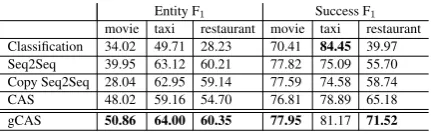
of turn-level acts and frames. For task comple-tion evaluacomple-tion, Entity F1 score and Success F1
score (Lei et al.,2018) are reported. The Entity F1 score, differently from the entity match rate in
state tracking, compares the slots requested by the
2https://github.com/xiul-msr/e2e_
dialog_challenge
Entity F1 Success F1
movie taxi restaurant movie taxi restaurant Classification 34.02 49.71 28.23 70.41 84.45 39.97 Seq2Seq 39.95 63.12 60.21 77.82 75.09 55.70 Copy Seq2Seq 28.04 62.95 59.14 77.59 74.58 58.74 CAS 48.02 59.16 54.70 76.81 78.89 65.18
[image:3.595.75.288.148.190.2]gCAS 50.86 64.00 60.35 77.95 81.17 71.52
Table 5: Entity F1and Success F1at dialogue level.
agent with the slots the user informed about and that were used to perform the KB query. We use it to measure agent performance in requesting infor-mation. The Success F1 score compares the slots
provided by the agent with the slots requested by the user. We use it to measure the agent perfor-mance in providing information.
Critical slots and Non-critical slots: By ‘non-critical’, we mean slots that the user informs the system about by providing their values and thus it is not critical for the system to provide them in the output. Table 1 shows an example, with the genre slot provided by the user and the system repeat-ing it in its answer. Critical slots refers to slots that the system must provide like moviename in the Table 1 example. Although non-critical slots do not impact task completion directly, they may influence the output quality by enriching the dia-logue state and helping users understand the sys-tem’s utterance correctly. Furthermore, given the same dialog state, utterances offering non-critical slots or not offering them can both be present in the dataset, as they are optional. This makes the prediction of those slots more challenging for the system. To provide a more detailed analysis, we report the precision, recall, F1 score of turn-level
for all slots, critical slots and non-critical slots of theinformact.
3.2 Baseline
We compare five methods on the multi-act task.
[image:3.595.73.288.234.321.2]Act Frame
movie taxi restaurant movie taxi restaurant method P R F1 P R F1 P R F1 P R F1 P R F1 P R F1
[image:4.595.72.526.64.132.2]classification 84.19 50.24 62.93 92.20 55.48 69.27 79.71 33.94 47.60 63.91 18.39 28.56 65.87 44.31 52.98 49.63 12.32 19.74 Seq2Seq 73.44 73.62 73.53 77.52 69.29 73.17 65.66 66.01 65.83 42.88 24.81 31.43 57.12 50.32 53.51 39.97 25.40 31.06 Copy Seq2Seq 67.56 73.61 70.46 73.99 69.21 71.52 64.93 65.69 65.31 41.90 23.12 29.80 51.66 50.23 50.93 36.96 27.22 31.35 CAS 70.46 76.08 73.16 79.85 72.54 76.02 65.40 72.43 68.73 43.12 31.60 36.47 51.66 54.29 52.94 33.72 25.45 29.01 gCAS 73.08 75.78 74.41 79.47 75.39 77.37 68.30 74.39 71.22 42.24 35.50 38.58 53.77 56.24 54.98 36.86 32.41 34.49
Table 6: Precision (P), Recall (R) and F1score (F1) of turn-level acts and frames.
example 1 example 2
groundtruth request(date; starttime) inform(restaurantname=; starttime =) multiple choice(restaurantname) classification request+date []
Seq2Seq ‘request’ ‘(’ ‘date’ ‘;’ ‘starttime’ ‘)’ ‘inform’ ‘(’ ‘restaurantname’ ‘=’ ‘)’ ‘multiple choice’ ‘=’ ‘restaurantname’ ‘)’ Copy Seq2Seq ‘request’ ‘(’ ‘date’ ‘=’ ‘)’ ‘inform’ ‘(’ ‘restaurantname’ ‘=’ ‘;’ ‘;’, ‘;’, ‘=’, ‘;’ ‘starttime’ ‘=’ ‘)’
CAS request{} inform{restaurantname}
gCAS request{date; starttime} inform{restaurantname}multiple choice{restaurantname}
Table 7: Examples of predicted dialogue acts in the restaurant domain.
loss is the sum of the binary cross-entropy of all of them.
Seq2Seq (Sutskever et al., 2014) encodes the dialogue state as a sequence, and decodes agent acts as a sequence with attention (Bahdanau et al.,
2015).
Copy Seq2Seq (Gu et al., 2016) adds a copy mechanism to Seq2Seq, which allows copying words from the encoder input.
CASadopts a single GRU (Cho et al.,2014) for decoding and uses three different fully connected layers for mapping the output of the GRU to con-tinue, act and slots. For each step in the sequence of CAS tuples, given the output of the GRU, con-tinue, act and slot predictions are obtained by sep-arate heads, each with one fully connected layer. The hidden state of the GRU and the predictions at the previous step are passed to the cell at the next step connecting them sequentially.
gCAS uses our proposed recurrent cell which contains separate continue, act and slots unit that are sequentially connected.
The classification architecture has two fully connected layers of size 128, and the remaining models have a hidden size of 64 and a teacher-forcing rate of 0.5. Seq2Seq and Copy Seq2Seq use a beam search with beam size 10 during in-ference. CAS and gCAS do not adopt a beam search since their inference steps are much less than Seq2Seq methods. All models use Adam op-timizer (Kingma and Ba, 2015) with a learning rate of 0.001.
3.3 Result and Error Analysis
As shown in Table5, gCAS outperforms all other methods on Entity F1 in all three domains.
Com-pared to Seq2Seq, the performance advantage of gCAS in the taxi and restaurant domains is small, while it is more evident in the movie domain. The reason is that in the movie domain the propor-tion of turns with multiple acts is higher (52%), while in the other two domains it is lower (30%). gCAS also outperforms all other models in terms of Success F1 in the movie and restaurant domain
but is outperformed by the classification model in the taxi domain. The reason is that in the taxi domain, the agent usually informs the user at the last turn, while in all previous turns the agent usu-ally requests information from the user. It is easy for the classification model to overfit this pattern. The advantage of gCAS in the restaurant domain is much more evident: the agent’sinformact usu-ally has multiple slots (see example 2 in Table7) and this makes classification and sequence gener-ation harder, but gCAS multi-label slots decoder handles it easily.
Table6shows the turn-level acts and frame pre-diction performance. CAS and gCAS outperform all other models in acts prediction in terms of F1
All Slots Non-critical slots
movie taxi restaurant movie taxi restaurant method P R F1 P R F1 P R F1 P R F1 P R F1 P R F1
[image:5.595.72.526.63.132.2]classification 67.90 21.48 32.64 73.52 72.66 73.08 45.16 12.71 19.84 62.98 13.39 22.08 43.91 60.03 50.72 33.61 11.15 16.75 Seq2Seq 53.25 29.54 38.00 64.09 74.32 68.83 42.36 17.73 25.00 47.90 13.95 21.61 64.15 48.45 55.20 35.28 12.95 18.94 Copy Seq2Seq 52.78 28.43 36.95 56.92 74.06 64.37 38.15 22.38 28.21 40.45 12.48 19.07 45.95 55.46 50.26 34.90 19.11 24.70 CAS 63.61 33.16 43.59 61.90 80.39 69.94 51.12 22.57 31.31 56.21 26.96 36.44 43.03 68.03 52.72 37.31 15.87 22.27 gCAS 54.75 38.70 45.35 62.31 79.76 69.96 44.20 29.65 35.49 48.23 36.68 41.67 44.35 62.15 51.77 31.26 29.60 30.41
Table 8:P,RandF1of turn-levelinformall slots and non-critical slots.
Critical Slots
movie taxi restaurant method P R F1 P R F1 P R F1
[image:5.595.74.290.175.235.2]Classification 70.29 29.13 41.19 85.18 75.90 80.27 55.66 13.76 22.07 Seq2Seq 55.08 44.26 49.08 64.08 80.97 71.54 46.24 20.97 28.86 Copy Seq2Seq 57.54 43.49 49.54 59.49 78.83 67.81 40.11 24.59 30.49 CAS 69.59 39.02 50.00 68.15 83.57 75.08 59.93 27.10 37.32 gCAS 61.89 40.62 49.04 67.48 84.28 74.95 61.35 29.69 40.01
Table 9:P,RandF1of turn-levelinformcritical slots.
difference between CAS and gCAS on frames be-comes much more evident, suggesting that gCAS is more capable of predicting slots that are consis-tent with the act. This finding is also consisconsis-tent with their Entity F1 and Success F1 performance.
However, gCAS’s act-slot pair performance is far from perfect. The most common failure case is on non-critical slots (like ‘genre’ in the example in Table2): gCAS does not predict them, while it predicts the critical ones (like ‘moviename’ in the example in Table2).
Table 7shows predictions of all methods from two emblematic examples. Example 1 is a fre-quent single-act multi-slots agent act. Example 2 is a complex multi-act example. The baseline classification method can predict frequent pairs in the dataset, but cannot predict any act in the complex example. The generated sequences of Copy Seq2Seq and Seq2Seq show that both mod-els struggle in following the syntax. CAS cannot predict slots correctly even if the act is common in the dataset. gCAS returns a correct prediction for Example 1, but for Example 2 gCAS cannot predict ‘starttime’, which is a non-critical slot.
Tables8and9show the results of all slots, criti-cal slots and non-criticriti-cal slots under theinformact. gCAS performs better than the other methods on all slots in the movie and restaurant domains. The reason why classification performs the best here in the taxi domain is the same as the Success F1. In
the taxi domain, the agent usually informs the user at the last turn. The non-critical slots are also re-peated frequently in the taxi domain, which makes their prediction easier. gCAS’s performance is close to other methods on critical-slots. The rea-son is that theinformact is mostly the first act in
multi-act and critical slots are usually frequent in the data. All methods can predict them well.
In the movie and restaurant domains, theinform
act usually appears during the dialogue and there are many optional non-critical slots that can ap-pear (see Table 3, movie and restaurant domains have more slots and pairs than the taxi domain). gCAS can better predict the non-critical slots than other methods. However, the overall performance on non-critical slots is much worse than critical slots since their appearances are optional and in-consistent in the data.
4 Conclusion and Future Work
In this paper, we introduced a multi-act dialogue policy model motivated by the need for a richer interaction between users and conversation agents. We studied classification and sequence generation methods for this task, and proposed a novel recur-rent cell, gated CAS, which allows the decoder to output a tuple at each step. Experimental results showed that gCAS is the best performing model for multi-act prediction. The CAS decoder and the gCAS cell can also be used in a user simulator and gCAS can be applied in the encoder. A few directions for improvement have also been identi-fied: 1) improving the performance on non-critical slots, 2) tuning the decoder with RL, 3) text gener-ation from gCAS. We leave them as future work.
Acknowledgments
References
Dzmitry Bahdanau, Kyunghyun Cho, and Yoshua Ben-gio. 2015. Neural machine translation by jointly learning to align and translate. InInternational Con-ference on Learning Representations, San Diego, California, USA.
Senthilkumar Chandramohan and Olivier Pietquin. 2010. User and noise adaptive dialogue manage-ment using hybrid system actions. InSpoken Dia-logue Systems for Ambient Environments, pages 13– 24. Springer.
Kyunghyun Cho, Bart van Merrienboer, C¸ aglar G¨ulc¸ehre, Dzmitry Bahdanau, Fethi Bougares, Hol-ger Schwenk, and Yoshua Bengio. 2014. Learning phrase representations using RNN encoder-decoder for statistical machine translation. InEMNLP, pages 1724–1734. ACL.
Milica Gasic and Steve J. Young. 2014. Gaussian pro-cesses for pomdp-based dialogue manager optimiza-tion. IEEE/ACM Transactions on Audio, Speech, and Language Processing, 22:28–40.
Jiatao Gu, Zhengdong Lu, Hang Li, and Victor O. K. Li. 2016. Incorporating copying mechanism in sequence-to-sequence learning. InACL (1). The As-sociation for Computer Linguistics.
Izzeddin Gur, Dilek Z. Hakkani-Tur, Gokhan Tur, and Pararth Shah. 2018. User modeling for task oriented dialogues. 2018 IEEE Spoken Language Technology Workshop (SLT), pages 900–906.
Helen F. Hastie, Marie-Aude Aufaure, Panos Alex-opoulos, Heriberto Cuay´ahuitl, Nina Dethlefs, Milica Gasic, James Henderson, Oliver Lemon, Xingkun Liu, Peter Mika, Nesrine Ben Mustapha, Verena Rieser, Blaise Thomson, Pirros Tsiakoulis, and Yves Vanrompay. 2013. Demonstration of the parlance system: a data-driven incremental, spoken dialogue system for interactive search. InSIGDIAL Conference.
James Henderson, Oliver Lemon, and Kallirroi Georgila. 2005. Hybrid reinforcement/supervised learning for dialogue policies from communicator data. In IJCAI workshop on knowledge and rea-soning in practical dialogue systems, pages 68–75. Citeseer.
James Henderson, Oliver Lemon, and Kallirroi Georgila. 2008. Hybrid reinforcement/supervised learning of dialogue policies from fixed data sets.
Computational Linguistics, 34(4):487–511.
Hatim Khouzaimi, Romain Laroche, and Fabrice Lef`evre. 2015. Turn-taking phenomena in incre-mental dialogue systems. InEMNLP.
Diederik P Kingma and Jimmy Ba. 2015. Adam: A method for stochastic optimization. In Interna-tional Conference on Learning Representations, San Diego, California, USA.
Wenqiang Lei, Xisen Jin, Min-Yen Kan, Zhaochun Ren, Xiangnan He, and Dawei Yin. 2018. Sequic-ity: Simplifying task-oriented dialogue systems with single sequence-to-sequence architectures. InACL.
Xiujun Li, Sarah Panda, Jingjing Liu, and Jianfeng Gao. 2018. Microsoft dialogue challenge: Building end-to-end task-completion dialogue systems. vol-ume abs/1807.11125.
Bing Liu and Ian Lane. 2018. End-to-end learning of task-oriented dialogs. In Proceedings of the NAACL-HLT.
Antoine Raux and Maxine Esk´enazi. 2007. A multi-layer architecture for semi-synchronous event-driven dialogue management.2007 IEEE Workshop on Automatic Speech Recognition and Understand-ing (ASRU), pages 514–519.
Amanda J Stent. 2002. A conversation acts model for generating spoken dialogue contributions. Com-puter Speech & Language, 16(3-4):313–352.
Pei-Hao Su, Pawel Budzianowski, Stefan Ultes, Mil-ica Gasic, and Steve J. Young. 2017. Sample-efficient actor-critic reinforcement learning with su-pervised data for dialogue management. In Proceed-ings of the 18th Annual SIGdial Meeting on Dis-course and Dialogue, Saarbr¨ucken, Germany, Au-gust 15-17, 2017, pages 147–157. Association for Computational Linguistics.
Ilya Sutskever, Oriol Vinyals, and Quoc V. Le. 2014. Sequence to sequence learning with neural net-works. InNIPS, pages 3104–3112.
Yi Tay, Anh Tuan Luu, and Siu Cheung Hui. 2018. Recurrently controlled recurrent networks. In Ad-vances in Neural Information Processing Systems, pages 4736–4748.
Marilyn A. Walker. 2000. An application of reinforce-ment learning to dialogue strategy selection in a spo-ken dialogue system for email. J. Artif. Intell. Res., 12:387–416.
Tsung-Hsien Wen, Yishu Miao, Phil Blunsom, and Steve J. Young. 2017. Latent intention dialogue models. InICML, volume 70 ofProceedings of Ma-chine Learning Research, pages 3732–3741. PMLR.
Jason D. Williams, Kavosh Asadi, and Geoffrey Zweig. 2017a. Hybrid code networks: practical and effi-cient end-to-end dialog control with supervised and reinforcement learning. InACL (1), pages 665–677. Association for Computational Linguistics.
Jason D. Williams, Kavosh Asadi, and Geoffrey Zweig. 2017b. Hybrid code networks: practical and effi-cient end-to-end dialog control with supervised and reinforcement learning. InACL.