Extracting Opinion Targets in a Single- and Cross-Domain Setting
with Conditional Random Fields
Niklas Jakob
Technische Universit¨at Darmstadt Hochschulstraße 10 64289 Darmstadt, Germany
Iryna Gurevych
Technische Universit¨at Darmstadt Hochschulstraße 10 64289 Darmstadt, Germany
http://www.ukp.tu-darmstadt.de/people
Abstract
In this paper, we focus on the opinion tar-get extraction as part of the opinion ming task. We model the problem as an in-formation extraction task, which we address based on Conditional Random Fields (CRF). As a baseline we employ the supervised al-gorithm by Zhuang et al. (2006), which rep-resents the state-of-the-art on the employed data. We evaluate the algorithms comprehen-sively on datasets from four different domains annotated with individual opinion target in-stances on a sentence level. Furthermore, we investigate the performance of our CRF-based approach and the baseline in a single- and cross-domain opinion target extraction setting. Our CRF-based approach improves the perfor-mance by 0.077, 0.126, 0.071 and 0.178 re-garding F-Measure in the single-domain ex-traction in the four domains. In the cross-domain setting our approach improves the per-formance by 0.409, 0.242, 0.294 and 0.343 re-garding F-Measure over the baseline.
1 Introduction
The automatic extraction and analysis of opinions has been approached on several levels of granular-ity throughout the last years. As opinion mining is typically an enabling technology for another task, this overlaying system defines requirements regard-ing the level of granularity. Some tasks only require an analysis of the opinions on a document or sen-tence level, while others require an extraction and analysis on a term or phrase level. Amongst the tasks which require the finest level of granularity
are: a) Opinion question answering - i.e. with ques-tions regarding an entity as in “What do the people like / dislike aboutX?”. b) Recommender systems - i.e. if the system shall only recommend entities which have received good reviews regarding a cer-tain aspect. c) Opinion summarization - i.e. if one wants to create an overview of all positive / negative opinions regarding aspectY of entityXand cluster them accordingly. All of these tasks have in com-mon that in order to fulfill them, the opinion min-ing system must be capable of identifymin-ing what the opinions in the individual sentences are about, hence extract the opinion targets.
Our goal in this work is to extract opinion tar-gets from user-generated discourse, a discourse type which is quite frequently encountered today, due to the explosive growth of Web 2.0 community web-sites. Typical sentences which we encounter in this discourse type are shown in the following examples. The opinion targets which we aim to extract are un-derlined in the sentences, the corresponding opinion expressions are shown in italics.
(1) While none of the features are
earth-shattering, eCircles does provide agreat
place to keep in touch.
(2) Hyundai’smore-than-modestrefresh has largely addressed all the original car’s
weaknesseswhile maintaining its price
competitiveness.
The extraction of opinion targets can be consid-ered as an instance of an information extraction (IE) task (Cowie and Lehnert, 1996). Conditional
Random Fields (CRF) (Lafferty et al., 2001) have been successfully applied to several IE tasks in the past (Peng and McCallum, 2006). A recur-ring problem, which arises when working with su-pervised approaches, concerns the domain portabil-ity. In the opinion mining context this question has been prominently investigated with respect to opin-ion polarity analysis (sentiment analysis) in previ-ous research (Aue and Gamon, 2005; Blitzer et al., 2007). Terms as “unpredictable” can express a pos-itive opinion when uttered about the storyline of a movie but a negative opinion when the handling of a car is described. Hence the effects of training and testing a machine learning algorithm for sentiment analysis on data from different domains have been analyzed in previous research. However to the best of our knowledge, these effects have not been inves-tigated regarding the extraction of opinion targets.
The contribution of this paper is a CRF-based ap-proach for opinion targets extraction which tackles the problem of domain portability. We first evalu-ate our approach in three different domains against a state-of-the art baseline system and then evaluate the performance of both systems in a cross-domain setting. We show that our CRF-based approach out-performs the baseline in both settings, and how the diffrerent combinations of features we introduce in-fluence the results of our CRF-based approach. The remainder of this paper is structured as follows: In Section 2 we discuss the related work, and in tion 3 we describe our CRF-based approach. Sec-tion 4 comprises our experimental setup including the description of the dataset we employ in our ex-periments in Section 4.1 and the baseline system in Section 4.2. The results of our experiments and their discussion follow in Section 5. Finally we draw our conclusions in Section 6.
2 Related Work
In the following we will discuss the related work re-garding opinion target extraction and domain adap-tation in opinion mining. The discussion of the re-lated work on opinion target extraction is separated in supervised and unsupervised approaches. We conclude with a discussion of the related work on domain adaptation in opinion mining.
2.1 Unsupervised Opinion Target Extraction
The first work on opinion target extraction was done on customer reviews of consumer electronics. Hu and Liu (2004) introduce the task of feature based summarization, which aims at creating an overview of the product features commented on in the re-views. Their approach relies on a statistical analysis of the review terms based on association mining. A dataset of customer reviews from five domains was annotated by the authors regarding mentioned prod-uct features with respective opinion polarities. The association mining based algorithm yields a preci-sion of 0.72 and a recall of 0.80 in the extraction of a manually selected subset of product features. The same dataset of product reviews was used in the work of Yi et al. (2003). They present and evalu-ate a complete system for opinion extraction which is based on a statistical analysis based on the Like-lihood Ratio Test for opinion target extraction. The Likelihood Ratio Test yields a precision of 0.97 and 1.00 in the task of opinion target (product feature) extraction, recall values are not reported.
Popescu and Etzioni (2005) present the OPINE system for opinion mining on product reviews. Their algorithm is based on an information extrac-tion system, which uses the pointwise mutual infor-mation based on the hitcounts of a web-search en-gine as an input. They evaluate the opinion target extraction separately on the dataset by Hu and Liu (2004). OPINE’s precision is on average 22% higher than the association mining based approach, while having an average 3% lower recall.
Bloom et al. (2007) manually create taxonomies of opinion targets for two datasets. With a hand-crafted set of dependency tree paths their algorithm identifies related opinion expressions and targets. Due to the lack of a dataset annotated with opinion expressions and targets, they just evaluate the accu-racy of several aspects of their algorithm by man-ually assessing an output sample. Their algorithm yields an accuracy of 0.75 in the identification of opinion targets.
im-plement an approach based on a dependency parser, which identifies the targets following the dependen-cies of opinion expressions. They measure the over-lap between two human annotators and their algo-rithm as well as the baseline system. The algoalgo-rithm based on semantic role labeling yields an F-Measure of 0.315 with annotator1 and 0.127 with annotator2, while the baseline yields an F-Measure of 0.107 and 0.109 regarding opinion target extraction
2.2 Supervised Opinion Target Extraction
Zhuang et al. (2006) present a supervised algorithm for the extraction of opinion expression - opinion target pairs. Their algorithm learns the opinion tar-get candidates and a combination of dependency and part-of-speech paths connecting such pairs from an annotated dataset. They evaluate their system in a cross validation setup on a dataset of user-generated movie reviews and compare it to the results of the Hu and Liu (2004) system as a baseline. Thereby, the system by Zhuang et al. (2006) yields an F-Measure of 0.529 and outperforms the baseline which yields an F-Measure of 0.488 in the task of extracting opin-ion target - opinopin-ion expressopin-ion pairs.
Kessler and Nicolov (2009) solely focus on iden-tifying which opinion expression is linked to which opinion target in a sentence. They present a dataset of car and camera reviews in which opinion expres-sions and opinion targets are annotated. Starting with this information, they train a machine learn-ing classifier for identifylearn-ing related opinion expres-sions and targets. Their algorithm receives the opion expressopion and opinopion target annotatopions as in-put during runtime. The classifier is evaluated us-ing the algorithm by Bloom et al. (2007) as a base-line. The support vector machine based approach by Kessler and Nicolov (2009) yields an F-Measure of 0.698, outperforming the baseline which yields an F-Measure of 0.445.
2.3 Domain Adaptation in Opinion Mining
The task of creating a supervised algorithm, which when trained on data from domainA, also performs well on data from another domain B, is a domain adaptation problem (Daum´e III and Marcu, 2006; Jiang and Zhai, 2007). Aue and Gamon (2005) have investigated this challenge very early in the task of document level sentiment classification (positive /
negative). They observe that increasing the amount of training data raises the classification accuracy, but only if the training data is from one source domain. Increasing the training data by mixing domains does not yield any consistent improvements. Blitzer et al. (2007) introduce an extension to a structural cor-respondence learning algorithm, which was specifi-cally designed to address the task of domain adap-tation. Their enhancement aims at identifying pivot features, which are stable across domains. In a series of experiments in document level sentiment classi-fication they show that their extension outperforms the original structural correspondence learning ap-proach. In their error analysis, the authors observe the best results were reached when the training - test-ing combinations wereBooks - DVDsorElectronics - Kitchen appliances. They conclude that the topi-cal relatedness of the domains is an important factor. Furthermore they observe that training the algorithm on a smaller amount of data from a similar domain is more effective than increasing the amount of train-ing data by mixtrain-ing domains.
3 CRF-based Approach for Opinion Target Extraction
In the following we will describe the features we employ as input for our CRF-based approach. As the development data, we used 29 documents from the movies dataset, 23 documents from the web-services dataset and 15 documents from the cars & cameras datasets.
Token
This feature represents the string of the current token as a feature. Even though this feature is rather ob-vious, it can have considerable impact on the target extraction performance. If the vocabulary of targets is rather compact for a certain domain (correspond-ing to a low target type / target ratio), the train(correspond-ing data is likely to contain the majority of the target types, which should hence be a good indicator. We will refer to this feature astkin our result tables.
POS
This feature represents the part-of-speech tag of the current token as identified by the Stanford POS Tag-ger1. It can provide some means of lexical
disam-1
biguation, e.g. indicate that the token “sounds” is a noun and not a verb in a certain context. At the same time, the CRF algorithm is provided with ad-ditional information to extract opinion targets which are multiword expressions, i.e. noun combinations. We will refer to this feature asposin our result ta-bles.
Short Dependency Path
Previous research has successfully employed paths in the dependency parse tree to link opinion expres-sions and the corresponding targets (Zhuang et al., 2006; Kessler and Nicolov, 2009). Both works iden-tify direct dependency relations such as “amod” and “nsubj” as the most frequent and at the same time highly accurate connections between a target and an opinion expression. We hence label all tokens which have a direct dependency relation to an opinion ex-pression in a sentence. The Stanford Parser2is em-ployed for the constituent and dependency parsing. We will refer to this feature asdLnin our result ta-bles.
Word Distance
From the work of Zhuang et al. (2006) we can infer that opinion expressions and their target(s) are not always connected via short paths in the dependency parse tree. Since we cannot capture such paths with the abovementioned feature we introduce another feature which acts as heuristic for identifying the target to a given opinion expression. Hu and Liu (2004) and Yi et al. (2003) have shown that (base) noun phrases are good candidates for opinion targets in the datasets of product reviews. We therefore la-bel the token(s) in the closest noun phrase regarding word distance to each opinion expression in a sen-tence. We will refer to this feature aswrdDistin our result tables.
Opinion Sentence
With this feature, we simply label all tokens occur-ring in a sentence containing an opinion expression. This feature shall enable the CRF algorithm to distinguish between the occurence of a certain token in a sentence which contains an opinion vs. a sentence without an opinion. We will refer to this feature assSnin our result tables.
2http://nlp.stanford.edu/software/lex-parser.shtml
Our goal is to extract individual instances of opinion targets from sentences which contain an opinion expression. This can be modeled as a sequence segmentation and labeling task. The CRF algorithm receives a sequence of tokens t1...tn for which
it has to predict a sequence of labels l1...ln. We
represent the possible labels following the IOB scheme: B-Target, identifying the beginning of an opinion target,I-Targetidentifying the continuation of a target, andOfor other (non-target) tokens. We model the sentences as a linear chain CRF, which is based on an undirected graph. In the graph, each node corresponds to a token in the sentence and edges connect the adjacent tokens as they appear in the sentence. In our experiments, we use the CRF implementation from the Mallet toolkit3.
4 Experimental Setup
4.1 Datasets
In our experiments, we employ datasets from three different sources, which span four domains in total (see Table 1). All of them consist of reviews col-lected from Web 2.0 sites. The first dataset con-sists of reviews for 20 different movies collected from the Internet Movie Database. It was presented in Zhuang et al. (2006) and annotated regarding opinion target - opinion expression pairs. The sec-ond dataset consists of 234 reviews for two different web-services collected from epinions.com, as de-scribed in Toprak et al. (2010). The third dataset is an extended version of the data presented in Kessler and Nicolov (2009). The authors have provided us with additional documents, which have been anno-tated in the meantime. The version of the dataset used in our experiments consists of 179 blog post-ings regarding different digital cameras and 336 re-views of different cars. In the description of their annotation guidelines, Kessler and Nicolov (2009) refer to opinion targets as mentions. Mentions are all aspects of the review topic, which can be targets of expressed opinions. However, not only mentions which occur as opinion targets were originally anno-tated, but also mentions which occur in non-opinion sentences. In our experiments, we only use the men-tions which occur as targets of opinion expressions.
3
All three datasets contain annotations regarding the antecedents of anaphoric opinion targets. In our experimental setup, we do not require the algorithms to also correctly resolve the antecedent of an opin-ion target representy by a pronoun, as we are solely interested in evaluating the opinion target extraction not any anaphora resolution.
As shown in rows 4 and 5 of Table 1, the docu-ments from the cars and the cameras datasets exhibit a much higher density of opinions per document. 53.5% of the sentences from the cars dataset contain an opinion and in the cameras dataset even 56.1% of the sentences contain an opinion, while in the movies and the web-services reviews just 22.1% and 22.4% of the sentences contain an opinion. Further-more in the cars and the cameras datasets the lexical variability regarding the opinion targets is substan-tially larger than in the other two datasets: We calcu-latetarget typesby counting the number of distinct opinion targets in a dataset. We divide this by the sum of all opinion target instances in the dataset. For the cars dataset this ratio is 0.440 and for the cam-eras dataset it is 0.433, while for the web-services dataset it is 0.306 and for the movies dataset only 0.122. In terms of reviews this means, that in the movie reviews the same movie aspects are repeat-edly commented on, while in the cars and the cam-eras datasets many different aspects of these entities are discussed, which in turn each occur infrequently.
Table 1: Dataset Statistics
movies web- cars cameras
services
Documents 1829 234 336 179
Sentences 24555 6091 10969 5261
Tokens /
20.3 17.5 20.3 20.4
sentence Sentences with
21.4% 22.4% 51.1% 54.0% target(s)
Sentences with
21.4% 22.4% 53.5% 56.1% opinion(s)
Targets 7045 1875 8451 4369
Target types 865 574 3722 1893
Tokens / target 1.21 1.35 1.29 1.42 Avg. targets /
1.33 1.37 1.51 1.53
opinion sent.
4.2 Baseline System
In the task of opinion target extraction the super-vised algorithm by Zhuang et al. (2006) represents the state-of-the-art on the movies dataset we also employ in our experiments. We therefore use it as a baseline. The algorithm learns two aspects from the labeled training data:
1. A set of opinion target candidates
2. A set of paths in a dependency tree which iden-tify valid opinion target - opinion expression pairs
In our experiments, we learn the full set of opin-ion targets from the labeled training data in the first step. This is slightly different from the approach in (Zhuang et al., 2006), but we expect that this mod-ification should be beneficial for the overall perfor-mance in terms of recall, as we do not remove any learned opinion targets from the candidate list. In the second step, the annotated sentences are parsed and a graph containing the words of a sentence is created, which are connected by the dependency re-lations between them. For each opinion target -opinion expression pair from the gold standard, the shortest path connecting them is extracted from the dependency graph. A path consists of the part-of-speech tags of the nodes and the dependency types of the edges. Example 3 shows a typical dependency path.
(3) NN - nsubj - NP - amod - JJ
4.3 Metrics
We employ the following requirements in our eval-uation of the opinion target extraction: An opin-ion target must be extracted with exactly the span boundaries as annotated in the gold standard. This is especially important regarding multiword tar-gets. Extracted targets which partially overlap with the annotated gold standard are counted as errors. Hence a target extracted by the algorithm which does not exactly match the boundaries of a target in the gold standard is counted as a false positive (FP), e.g. if “battery life” is annotated as the tar-get in the gold standard, only “battery” or “life” extracted as targets will be counted as FPs. Exact matches between the targets extracted by the algo-rithm and the gold standard are true positives (TP). We refer to the number of annotated targets in the gold standard as TGS. Precision is calculated as
P recision = T PT P+F P, and recall is calculated as
Recall= TT P
GS. F-Measure is the harmonic mean of precision and recall.
5 Results and Discussion
We investigate the performance of the baseline and the CRF-based approach for opinion target extrac-tion in a single- and cross-domain setting. The single-domain approach assumes that there is a set of training data available for the same domain as the domain the algorithm is being tested on. In this setup, we will both run the baseline and our CRF based system in a 10-fold cross-validation and report results macro averaged over all runs. In the cross-domain approach, we will investigate how the algo-rithm performs if given training data from domainA
while being tested on another domainB. In this set-ting, we will train the algorithm on the entire dataset
A, and test it on the entire datasetB, we hence report one micro averaged result set. In Subsection 5.1 we present the results of both the baseline system and our CRF-based approach in the single-domain set-ting, in Subsection 5.2 we present the results of the two systems in the cross-domain opinion target ex-traction.
Table 2: Single-Domain Extraction with Zhuang Baseline
Dataset Precision Recall F-Measure
movies 0.663 0.592 0.625
web-services 0.624 0.394 0.483
cars 0.259 0.426 0.322
cameras 0.423 0.431 0.426
5.1 Single-Domain Results
5.1.1 Zhuang Baseline
As shown in Table 2, the state-of-the-art algo-rithm of Zhuang et al. (2006) performs best on the movie review dataset and worst on the cars dataset. The results on the movie dataset are higher than originally reported in (Zhuang et al., 2006) (Preci-sion 0.483, Recall 0.585, F-Measure 0.529). We as-sume that this is due to two reasons: 1. In our task, the algorithm uses the opinion expression annotation from the gold standard. 2. We do not remove any learned opinion target candidates from the training data (See Section 4.2).
Table 3: Single-Domain Extraction with our CRF-based Approach
movies web-services cars cameras
Features Prec Rec F-Me Prec Rec F-Me Prec Rec F-Me Prec Rec F-Me
tk, pos 0.639 0.133 0.220 0.500 0.051 0.093 0.438 0.110 0.175 0.300 0.085 0.127 tk, pos, wDs 0.542 0.181 0.271 0.451 0.272 0.339 0.570 0.354 0.436 0.549 0.375 0.446 tk, pos, dLn 0.777 0.481 0.595 0.634 0.380 0.475 0.603 0.372 0.460 0.569 0.376 0.453 tk, pos, sSn 0.673 0.637 0.653 0.604 0.397 0.476 0.453 0.180 0.257 0.398 0.172 0.238 tk, pos, dLn, wDs 0.792 0.481 0.598 0.620 0.354 0.450 0.603 0.389 0.473 0.596 0.425 0.496 tk, pos, sSn, wDs 0.662 0.656 0.659 0.664 0.461 0.544 0.564 0.370 0.446 0.544 0.381 0.447 tk, pos, sSn, dLn 0.791 0.477 0.594 0.654 0.501 0.568 0.598 0.384 0.467 0.586 0.391 0.468 tk, pos, sSn, dLn, wDs 0.749 0.661 0.702 0.722 0.526 0.609 0.622 0.414 0.497 0.614 0.423 0.500
pos, sSn, dLn, wDs 0.672 0.441 0.532 0.612 0.322 0.422 0.612 0.369 0.460 0.674 0.398 0.500
5.1.2 Our CRF-based Approach
Table 3 shows the results of the opinion target ex-traction using the CRF algorithm. Row 8 contains the results of the feature configuration, which yields the best performance regarding F-Measure across all datasets. We observe that our aproach outperforms the Zhuang baseline on all datasets. The gain in F-Measure is between 0.077 in the movies domain and 0.175 in the cars domain. Although the CRF-based approach clearly outperforms the baseline system on all four datasets, we also observe the same gen-eral trend regarding the individual results: The CRF yields the best results on the movies dataset and the worst results on the cars & cameras dataset.
As shown in the first row, the results when using just the token string and part-of-speech tags as fea-tures are very low, especially regarding recall. We observe that the higher the lexical variability of the opinion targets is in a dataset, the lower the results are. If we add the feature based on word distance (row 2), the recall is improved on all datasets, while the precision is slightly lowered on the movies and web-services datasets. The dependency path based feature performs better compared to the word dis-tance heuristic as shown in row 3. The precision is considerably increased on all datasets, on the movies and cars & cameras datasets even reaching the over-all highest value. At the same time, we observe an increase of recall on all datasets. The obser-vation made in previous research that short paths in the dependency graph are a high precision indi-cator of related opinion expressions - opinion tar-gets (Kessler and Nicolov, 2009) is confirmed on all datasets. Adding the information regarding opinion sentences to the basic features of the token string and
the part-of-speech tag (row 4) yields the biggest im-provements regarding F-Measure on the movies and web-services dataset (+0.433 / +0.383). On the cars & cameras dataset the recall is relatively low again. We assume that this is again due to the high lexical variability, so that the CRF algorithm will encounter many actual opinion targets in the testing data which have not occurred in the training data and will hence not be extracted.
in turn resulting in stable F-Measure of 0.500 as in the full feature set of row 8.
We have run some additional experiments in which we did not rely on the annotated opinion ex-pressions, but employed a general pupose subjectiv-ity lexicon4. Already in the single-domain
extrac-tion, we observed that the results declined substan-tially (e.g. web-services F-Measure: 0.243, movies F-Measure: 0.309, cars F-Measure: 0.192 and cam-eras F-Measure: 0.198).
We performed a quantitative error analysis on the results of the CRF-based approach in the single-domain setting. In doing so, we focused on misclas-sifications of B-Target and I-Target instances, as the recall is consistently lower than the precision across all datasets. We observe that most of the recall errors result from one-word opinion targets or the begin-ning of opinion targets (B-Targets) being missclassi-fied as non-targets (movies 83%, web-services 73%, cars 68%, cameras 64%). For the majority of these missclassifications neither thedLnnor thewDs fea-tures were present (movies 82%, web-services 56%, cars 64%, cameras 61%). We assume that our fea-tures cannot capture the structure of more complex sentences very well. Our results indicate that the
dLnandwDsfeatures are complementary, but appar-ently there are quite a few cases in which the opin-ion target is neither directly related to the opinopin-ion expression in the dependency graph nor close to it in the sentence. One of these sentences, in this case from a camera review, in shown in Example 4.
(4) A lens cap and a strap may not sound very important, but it makes ahuge differencein the speed and usability of the camera.
In this sentence, thedLn andwDsfeatures both la-beled “speed” which was incorrectly extracted as the target of the opinion. None of the actual targets “lens cap”, “strap” and “camera” have a short dependency path to the opinion expression and “speed” is sim-ply the closest noun to it. Note that although both “speed” and “usability” are attributes of a camera, the opinion in this sentence is about the “lens cap” and “strap”, hence only these attributes are anno-tated as targets.
4http://www.cs.pitt.edu/mpqa/
5.2 Cross-Domain Results
5.2.1 Zhuang Baseline
Table 4 shows the results of the opinion target ex-traction with the state-of-the-art system in the cross-domain setting. We observe that the results on all domain combinations are very low. A quantitative error analysis has revealed that there is hardly any overlap in the opinion target candidates between do-mains, as reflected by the low recall in all config-urations. The vocabularies of the opinion targets are too different, hence the performance of the algo-rithm by Zhuang et al. (2006) is so low. The overlap regarding the dependency paths between domains was however higher. Especially identical short paths could be found across domains which at the same time typically occured quite often. For future work it might be interesting to investigate how the algo-rithm by Zhuang et al. (2006) performs in the cross-domain setting if the target candidate learning is per-formed differently, e.g. with a statistical approach as outlined in Section 2.1.
5.2.2 CRF-based Approach
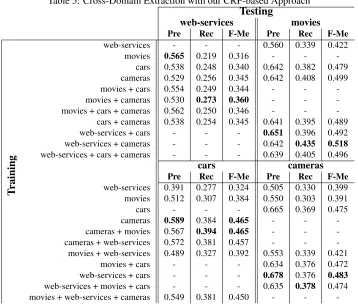
The results of the cross-domain target extraction with the CRF-based algorithm are shown in Table 5. Due to the increase of system configurations intro-duced by the training - testing data combinations, we had to limit results of the feature combinations reported in the Table. The feature combinationpos, sSn, wDs, dLnyielded the best results regarding F-Measure. Hence, we report its result as the basic fea-ture set. When comparing the results of the best per-forming feature / training data combination of our CRF-based approach with the baseline, we observe that our approach outperforms the baseline on all four domains. The gain in F-Measure is 0.409 in the movies domain, 0.242 in the web-services domain, 0.294 in the cars domain and 0.343 in the cameras domain.
Effects of Features
Interestingly with the best performing feature com-bination from the single-domain extraction, the re-sults regarding recall in the cross-domain extraction are very low5. This is due to the fact that the CRF at-tributed a relatively large weight to the token string
5
Table 4: Cross-Domain Extraction with Zhuang Baseline
Training Testing Precision Recall F-Measure
web-services movies 0.194 0.032 0.055
cars movies 0.032 0.034 0.033
cameras movies 0.155 0.084 0.109
cars + cameras movies 0.071 0.104 0.084
web-services + cars + cameras movies 0.070 0.103 0.083
movies web-services 0.311 0.073 0.118
cars web-services 0.086 0.091 0.089
cameras web-services 0.164 0.081 0.108
cars + cameras web-services 0.086 0.104 0.094 movies + cars + cameras web-services 0.074 0.100 0.080
movies cars 0.182 0.014 0.026
web-services cars 0.218 0.028 0.049
cameras cars 0.250 0.121 0.163
cameras + web-services cars 0.247 0.131 0.171
movies + web-services cars 0.246 0.045 0.076
movies cameras 0.108 0.012 0.022
web-services cameras 0.268 0.048 0.082
cars cameras 0.125 0.160 0.140
cars + web-services cameras 0.119 0.157 0.136 movies + web-services cameras 0.245 0.063 0.100
feature. As we also observed in the analysis of the baseline results, the overlap of the opinion target vo-cabularies between domains is low, which resulted in a very small number of targets extracted by the CRF. As shown in Table 5 the results are promising regarding F-Measure if we just leave the token fea-ture out of the configuration.
Effects of Training Data
When analyzing the results of the different training - testing domain configurations we observe the fol-lowing: In isolation training data from the cameras domain consistently yields the best results regarding F-Measure when the algorithm is run on the datasets from the other three domains. This is particularly interesting since the cameras dataset is the smallest of the four (see Table 1). We investigated whether the CRF algorithm was overfitting to the training datasets by reducing their size to the size of the cam-eras dataset. However, the reduction of the train-ing data sizes never improved the extraction results regarding F-Measure for the movies, web-serviecs and cars datasets. The good results when training on the cameras dataset are in line with our obser-vations from Section 5.1.2. We noticed that on the cameras dataset the results regarding F-Measure re-mained stable if the token feature is not used in the training.
In isolation, training only on the cars data yields the second highest results on the movies and web-services datasets and the highest results regarding F-Measure on the cameras data. However, the re-sults of the cars + cameras training data combination indicate that the cameras data does not contribute any additional information during the learning, since the results on both the movies and the web-services datasets are lower than when training only on the cameras data.
Our results also confirm the insights gained by Blitzer et al. (2007), who observed that in cross-domain polarity analysis adding more training data is not always beneficial. Apparently even the small-est training dataset (cameras) contain enough feature instances to learn a model which performs well on the testing data.
vocabu-Table 5: Cross-Domain Extraction with our CRF-based Approach
Testing
web-services movies
Pre Rec F-Me Pre Rec F-Me
T
raining
web-services - - - 0.560 0.339 0.422
movies 0.565 0.219 0.316 - -
-cars 0.538 0.248 0.340 0.642 0.382 0.479 cameras 0.529 0.256 0.345 0.642 0.408 0.499 movies + cars 0.554 0.249 0.344 - - -movies + cameras 0.530 0.273 0.360 - - -movies + cars + cameras 0.562 0.250 0.346 - -
-cars + cameras 0.538 0.254 0.345 0.641 0.395 0.489 web-services + cars - - - 0.651 0.396 0.492 web-services + cameras - - - 0.642 0.435 0.518
web-services + cars + cameras - - - 0.639 0.405 0.496
cars cameras
Pre Rec F-Me Pre Rec F-Me
web-services 0.391 0.277 0.324 0.505 0.330 0.399 movies 0.512 0.307 0.384 0.550 0.303 0.391
cars - - - 0.665 0.369 0.475
cameras 0.589 0.384 0.465 - -
-cameras + movies 0.567 0.394 0.465 - - -cameras + web-services 0.572 0.381 0.457 - -
-movies + web-services 0.489 0.327 0.392 0.553 0.339 0.421
movies + cars - - - 0.634 0.376 0.472
web-services + cars - - - 0.678 0.376 0.483
web-services + movies + cars - - - 0.635 0.378 0.474 movies + web-services + cameras 0.549 0.381 0.450 - -
-lary.
6 Conclusions
In this paper, we have shown how a CRF-based approach for opinion target extraction performs in a single- and cross-domain setting. We have pre-sented a comparative evaluation of our approach on datasets from four different domains. In the single-domain setting, our CRF-based approach out-performs a supervised baseline on all four datasets. Our error analysis indicates that additional features, which can capture opinions in more complex sen-tences, are required to improve the performance of the opinion target extraction. Our CRF-based ap-proach also yields promising results in the cross-domain setting. The features we employ scale well across domains, given that the opinion target vocab-ularies are substantially different. For future work, we might investigate how machine learning algo-rithms, which are specifically designed for the prob-lem of domain adaptation (Blitzer et al., 2007; Jiang and Zhai, 2007), perform in comparison to our ap-proach. Since three of the features we employed in
our CRF-based approach are based on the respec-tive opinion expressions, it is to investigate how to mitigate the possible negative effects introduced by errors in the opinion expression identification if they are not annotated in the gold standard. We observe similar challenges as Choi et al. (2005) regarding the analysis of complex sentences. Although our data is user-generated from Web 2.0 communities, a man-ual inspection has shown that the documents were of relatively high textual quality. It is to investigate to which extent the approaches taken in the analysis of newswire, such as identifying targets with coref-erence resolution, can also be applied to our task on user-generated discourse.
Acknowledgments
[image:10.612.127.485.68.376.2]References
Anthony Aue and Michael Gamon. 2005. Customizing sentiment classifiers to new domains: A case study. In Proceedings of the 5th International Conference on Recent Advances in Natural Language Processing, Borovets, Bulgaria, September.
John Blitzer, Mark Dredze, and Fernando Pereira. 2007. Biographies, bollywood, boom-boxes and blenders: Domain adaptation for sentiment classification. In
Proceedings of the 45th Annual Meeting of the Asso-ciation of Computational Linguistics, pages 440–447, Prague, Czech Republic, June.
Kenneth Bloom, Navendu Garg, and Shlomo Argamon. 2007. Extracting appraisal expressions. In Proceed-ings of Human Language Technologies 2007: The Conference of the North American Chapter of the As-sociation for Computational Linguistics, pages 308– 315, Rochester, New York, USA, April.
Yejin Choi, Claire Cardie, Ellen Riloff, and Siddharth Patwardhan. 2005. Identifying sources of opinions with conditional random fields and extraction patterns. InProceedings of Human Language Technology Con-ference and ConCon-ference on Empirical Methods in Nat-ural Language Processing, pages 355–362, Vancou-ver, Canada, October.
James R. Cowie and Wendy G. Lehnert. 1996. In-formation extraction. Communications of the ACM, 39(1):80–91.
Hal Daum´e III and Daniel Marcu. 2006. Domain adap-tation for statistical classifiers. Journal of Artificial Intelligence Research (JAIR), 26:101–126.
Minqing Hu and Bing Liu. 2004. Mining and summa-rizing customer reviews. In Proceedings of the 10th ACM SIGKDD International Conference on Knowl-edge Discovery and Data Mining, pages 168–177, Seattle, Washington, USA, August.
Jing Jiang and ChengXiang Zhai. 2007. Instance weight-ing for domain adaptation in nlp. InProceedings of the 45th Annual Meeting of the Association of Computa-tional Linguistics, pages 264–271, Prague, Czech Re-public, June. Association for Computational Linguis-tics.
Jason Kessler and Nicolas Nicolov. 2009. Targeting sen-timent expressions through supervised ranking of lin-guistic configurations. InProceedings of the Third In-ternational AAAI Conference on Weblogs and Social Media, pages 90–97, San Jose, California, USA, May. Soo-Min Kim and Eduard Hovy. 2006. Extracting opin-ions, opinion holders, and topics expressed in online news media text. InProceedings of the ACL Workshop on Sentiment and Subjectivity in Text, pages 1–8, Syd-ney, Australia, July.
John D. Lafferty, Andrew McCallum, and Fernando C. N. Pereira. 2001. Conditional random fields: Probabilis-tic models for segmenting and labeling sequence data. In Proceedings of the 18th International Conference on Machine Learning, pages 282–289, Williamstown, MA, USA, June.
Fuchun Peng and Andrew McCallum. 2006. Information extraction from research papers using conditional ran-dom fields. Information Processing and Management, 42(4):963–979, July.
Ana-Maria Popescu and Oren Etzioni. 2005. Extract-ing product features and opinions from reviews. In
Proceedings of Human Language Technology Confer-ence and ConferConfer-ence on Empirical Methods in Natu-ral Language Processing, pages 339–346, Vancouver, Canada, October.
Cigdem Toprak, Niklas Jakob, and Iryna Gurevych. 2010. Sentence and expression level annotation of opinions in user-generated discourse. InProceedings of the 48th Annual Meeting of the Association for Computational Linguistics, pages 575–584, Uppsala, Sweden, July.