Using Random Walks for Question-focused Sentence Retrieval
Jahna Otterbacher1, G ¨unes¸ Erkan2, Dragomir R. Radev1,2
1School of Information,2Department of EECS
University of Michigan
{jahna,gerkan,radev}@umich.edu
Abstract
We consider the problem of question-focused sentence retrieval from complex news articles describing multi-event sto-ries published over time. Annotators gen-erated a list of questions central to under-standing each story in our corpus. Be-cause of the dynamic nature of the stories, many questions are time-sensitive (e.g. “How many victims have been found?”) Judges found sentences providing an an-swer to each question. To address the sentence retrieval problem, we apply a stochastic, graph-based method for com-paring the relative importance of the tex-tual units, which was previously used suc-cessfully for generic summarization. Cur-rently, we present a topic-sensitive version of our method and hypothesize that it can outperform a competitive baseline, which compares the similarity of each sentence to the input question via IDF-weighted word overlap. In our experiments, the method achieves a TRDR score that is sig-nificantly higher than that of the baseline.
1 Introduction
Recent work has motivated the need for systems that support “Information Synthesis” tasks, in which a user seeks a global understanding of a topic or story (Amigo et al., 2004). In contrast to the clas-sical question answering setting (e.g. TREC-style
Q&A (Voorhees and Tice, 2000)), in which the user presents a single question and the system returns a corresponding answer (or a set of likely answers), in this case the user has a more complex information need.
Similarly, when reading about a complex news story, such as an emergency situation, users might seek answers to a set of questions in order to un-derstand it better. For example, Figure 1 shows the interface to our Web-based news summarization system, which a user has queried for information about Hurricane Isabel. Understanding such stories is challenging for a number of reasons. In particular, complex stories contain many sub-events (e.g. the devastation of the hurricane, the relief effort, etc.) In addition, while some facts surrounding the situation do not change (such as “Which area did the hurri-canefirst hit?”), others may change with time (“How many people have been left homeless?”). There-fore, we are working towards developing a system for question answering from clusters of complex sto-ries published over time. As can be seen at the bot-tom of Figure 1, we plan to add a component to our current system that allows users to ask questions as they read a story. They may then choose to receive either a precise answer or a question-focused sum-mary.
empha-Hurricane Isabel's outer bands moving onshore
produced on 09/18, 6:18 AM 2% Summary
The North Carolina coast braced for a weakened but still potent Hurricane Isabel while already rain-soaked areas as far away as Pennsylvania prepared for possibly ruinous flooding. (2:3) A hurricane warning was in effect from Cape Fear in southern North Carolina to the Virginia-Maryland line, and tropical storm warnings extended from South Carolina to New Jersey. (2:14)
While the outer edge of the hurricane approached the North Carolina coast Wednesday, the center of the storm was still 400 miles south-southeast of Cape Hatteras, N.C., late Wednesday morning. (3:10) BBC NEWS World Americas Hurricane Isabel prompts US shutdown (4:1)
Ask us:
What states have been affected by the hurricane so far?
Around 200,000 people in coastal areas of North Carolina and Virginia were ordered to evacuate or risk getting trapped by flooding from storm surges up to 11 feet. (5:8) The storm was expected to hit with its full fury today, slamming into the North Carolina coast with 105-mph winds and 45-foot wave crests, before moving through Virginia and bashing the capital with gusts of about 60 mph. (7:6)
Figure 1: Question tracking interface to a summa-rization system.
sized it. The specific problem we consider differs from the classic task of PR for a Q&A system in interesting ways, due to the time-sensitive nature of the stories in our corpus. For example, one challenge is that the answer to a user’s question may be up-dated and reworded over time by journalists in order to keep a running story fresh, or because the facts themselves change. Therefore, there is often more than one correct answer to a question.
We aim to develop a method for sentence re-trieval that goes beyond finding sentences that are similar to a single query. To this end, we pro-pose to use a stochastic, graph-based method. Re-cently, graph-based methods have proved useful for a number of NLP and IR tasks such as document re-ranking in ad hoc IR (Kurland and Lee, 2005) and analyzing sentiments in text (Pang and Lee, 2004). In (Erkan and Radev, 2004), we introduced the LexRank method and successfully applied it to generic, multi-document summarization. Presently, we introduce topic-sensitive LexRank in creating a sentence retrieval system. We evaluate its perfor-mance against a competitive baseline, which con-siders the similarity between each sentence and the question (using IDF-weighed word overlap). We demonstrate that LexRank significantly improves question-focused sentence selection over the base-line.
2 Formal description of the problem
Our goal is to build a question-focused sentence re-trieval mechanism using a topic-sensitive version of the LexRank method. In contrast to previous PR sys-tems such as Okapi (Robertson et al., 1992), which
ranks documents for relevancy and then proceeds to
find paragraphs related to a question, we address the
finer-grained problem offinding sentences contain-ing answers. In addition, the input to our system is a set of documents relevant to the topic of the query that the user has already identified (e.g. via a search engine). Our system does not rank the input docu-ments, nor is it restricted in terms of the number of sentences that may be selected from the same docu-ment.
The output of our system, a ranked list of sen-tences relevant to the user’s question, can be sub-sequently used as input to an answer selection sys-tem in order to find specific answers from the ex-tracted sentences. Alternatively, the sentences can be returned to the user as a question-focused sum-mary. This is similar to “snippet retrieval” (Wu et al., 2004). However, in our system answers are ex-tracted from a set of multiple documents rather than on a document-by-document basis.
3 Our approach: topic-sensitive LexRank
3.1 The LexRank method
In (Erkan and Radev, 2004), the concept of graph-based centrality was used to rank a set of sentences, in producing generic multi-document summaries. To apply LexRank, a similarity graph is produced for the sentences in an input document set. In the graph, each node represents a sentence. There are edges between nodes for which the cosine similar-ity between the respective pair of sentences exceeds a given threshold. The degree of a given node is an indication of how much information the respec-tive sentence has in common with other sentences. Therefore, sentences that contain the most salient in-formation in the document set should be very central within the graph.
score of a sentence is determined by a mixture model of the relevance of the sentence to the query and the similarity of the sentence to other high-scoring sen-tences.
3.2 Relevance to the question
In topic-sensitive LexRank, wefirst stem all of the sentences in a set of articles and compute word IDFs by the following formula:
idfw= log
N+ 1
0.5 +sfw
(1)
whereN is the total number of sentences in the clus-ter, andsfwis the number of sentences that the word
wappears in.
We also stem the question and remove the stop words from it. Then the relevance of a sentencesto the questionqis computed by:
rel(s|q) =X
w∈q
log(tfw,s+ 1)×log(tfw,q+ 1)×idfw (2)
where tfw,s and tfw,q are the number of times w
appears in s and q, respectively. This model has proven to be successful in query-based sentence re-trieval (Allan et al., 2003), and is used as our com-petitive baseline in this study (e.g. Tables 4, 5 and 7).
3.3 The mixture model
The baseline system explained above does not make use of any inter-sentence information in a cluster. We hypothesize that a sentence that is similar to the high scoring sentences in the cluster should also have a high score. For instance, if a sentence that gets a high score in our baseline model is likely to contain an answer to the question, then a related sen-tence, which may not be similar to the question it-self, is also likely to contain an answer.
This idea is captured by the following mixture model, wherep(s|q), the score of a sentencesgiven a question q, is determined as the sum of its rele-vance to the question (using the same measure as the baseline described above) and the similarity to the other sentences in the document cluster:
p(s|q) =dPrel(s|q)
z∈Crel(z|q)
+(1−d)X
v∈C
sim(s, v)
P
z∈Csim(z, v)
p(v|q) (3)
whereCis the set of all sentences in the cluster. The value ofd, which we will also refer to as the “ques-tion bias,” is a trade-off between two terms in the
Vertices:
Sentence Index
Sentence Index SalienceSalience SentenceSentence
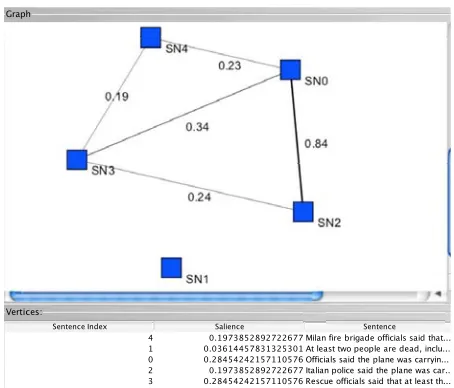
[image:3.612.313.540.54.248.2]4 0.1973852892722677 Milan fire brigade officials said that... 1 0.03614457831325301 At least two people are dead, inclu... 0 0.28454242157110576 Officials said the plane was carryin... 2 0.1973852892722677 Italian police said the plane was car.. 3 0.28454242157110576 Rescue officials said that at least th... Graph
Figure 2: LexRank example: sentence similarity graph with a cosine threshold of 0.15.
equation and is determined empirically. For higher values of d, we give more importance to the rele-vance to the question compared to the similarity to the other sentences in the cluster. The denominators in both terms are for normalization, which are de-scribed below. We use the cosine measure weighted by word IDFs as the similarity between two sen-tences in a cluster:
sim(x, y) =
P
w∈x,ytfw,xtfw,y(idfw)2
qP
xi∈x(tfxi,xidfxi)2×qPyi∈y(tfyi,yidfyi)2
(4) Equation 3 can be written in matrix notation as follows:
p= [dA+ (1−d)B]Tp (5)
Ais the square matrix such that for a given indexi, all the elements in theith column are proportional torel(i|q). Bis also a square matrix such that each entryB(i, j)is proportional tosim(i, j). Both ma-trices are normalized so that row sums add up to 1. Note that as a result of this normalization, all rows of the resulting square matrixQ= [dA+ (1−d)B]
also add up to 1. Such a matrix is calledstochastic
and defines a Markov chain. If we view each sen-tence as a state in a Markov chain, thenQ(i, j) spec-ifies the transition probability from stateito statej
under-stood by the concept of a random walk on the graph representation of the Markov chain.
With probability d, a transition is made from the current node (sentence) to the nodes that are simi-lar to the query. With probability (1-d), a transition is made to the nodes that are lexically similar to the current node. Every transition is weighted according to the similarity distributions. Each element of the vectorp gives the asymptotic probability of ending up at the corresponding state in the long run regard-less of the starting state. The stationary distribution of a Markov chain can be computed by a simple it-erative algorithm, called power method.1
A simpler version of Equation 5, where A is a uniform matrix andBis a normalized binary matrix, is known as PageRank (Brin and Page, 1998; Page et al., 1998) and used to rank the web pages by the Google search engine. It was also the model used to rank sentences in (Erkan and Radev, 2004).
3.4 Experiments with topic-sensitive LexRank
We experimented with different values of don our training data. We also considered several threshold values for inter-sentence cosine similarities, where we ignored the similarities between the sentences that are below the threshold. In the training phase of the experiment, we evaluated all combinations of LexRank with din the range of [0,1] (in incre-ments of 0.10) and with a similarity threshold rang-ing from [0,0.9] (in increments of 0.05). We then found all configurations that outperformed the base-line. These configurations were then applied to our development/test set. Finally, our best sentence re-trieval system was applied to our test data set and evaluated against the baseline. The remainder of the paper will explain this process and the results in de-tail.
4 Experimental setup
4.1 Corpus
We built a corpus of 20 multi-document clusters of complex news stories, such as plane crashes, polit-ical controversies and natural disasters. The data 1The stationary distribution is unique and the power method
is guaranteed to converge provided that the Markov chain is ergodic (Seneta, 1981). A non-ergodic Markov chain can be made ergodic by reserving a small probability for jumping to any other state from the current state (Page et al., 1998).
clusters and their characteristics are shown in Ta-ble 1. The news articles were collected from various sources. “Newstracker” clusters were collected au-tomatically by our Web-based news summarization system. The number of clusters randomly assigned to the training, development/test and test data sets were 11, 3 and 6, respectively.
Next, we assigned each cluster of articles to an annotator, who was asked to read all articles in the cluster. He or she then generated a list of factual questions key to understanding the story. Once we collected the questions for each cluster, two judges independently annotated nine of the training clus-ters. For each sentence and question pair in a given cluster, the judges were asked to indicate whether or not the sentence contained a complete answer to the question. Once an acceptable rate of inter-judge agreement was verified on the first nine clus-ters (Kappa (Carletta, 1996) of 0.68), the remaining 11 clusters were annotated by one judge each.
In some cases, the judges did not find any sen-tences containing the answer for a given question. Such questions were removed from the corpus. The
final number of questions annotated for answers over the entire corpus was 341, and the distributions of questions per cluster can be found in Table 1.
4.2 Evaluation metrics and methods
Cluster Sources Articles Questions Data set Sample question
Algerian terror AFP, UPI 2 12 train What is the condition under which
threat GIA will take its action?
Milan plane MSNBC, CNN, ABC, 9 15 train How many people were in the
crash Fox, USAToday building at the time of the crash?
Turkish plane BBC, ABC, 10 12 train To where was the plane headed?
crash FoxNews, Yahoo
Moscow terror UPI, AFP, AP 7 7 train How many people were killed in
attack the most recent explosion?
Rhode Island MSNBC, CNN, ABC, Lycos, 10 8 train Who was to blame for
clubfire Fox, BBC, Ananova thefire?
FBI most AFP, UPI 3 14 train How much is the State Department offering
wanted for information leading to bin Laden’s arrest?
Russia bombing AP, AFP 2 11 train What was the cause of the blast?
Bali terror CNN, FoxNews, ABC, 10 30 train What were the motivations
attack BBC, Ananova of the attackers?
Washington DC FoxNews, Ha’aretz, BBC, 8 28 train What kinds of equipment or weapons
sniper BBC, Washington Times, CBS were used in the killings?
GSPC terror Newstracker 8 29 train What are the charges against
group the GSPC suspects?
China Novelty 43 25 18 train What was the magnitude of the
earthquake earthquake in Zhangjiakou?
Gulfair ABC, BBC, CNN, USAToday, 11 29 dev/test How many people
FoxNews, Washington Post were on board?
David Beckham AFP 20 28 dev/test How long had Beckham been playing for
trade MU before he moved to RM?
Miami airport Newstracker 12 15 dev/test How many concourses does
evacuation the airport have?
US hurricane DUC d04a 14 14 test In which places had the hurricane landed?
EgyptAir crash Novelty 4 25 29 test How many people were killed?
Kursk submarine Novelty 33 25 30 test When did the Kursk sink?
Hebrew University bombing Newstracker 11 27 test How many people were injured?
Finland mall bombing Newstracker 9 15 test How many people were in the mall
at the time of the bombing?
Putin visits Newstracker 12 20 test What issue concerned British
[image:5.612.86.529.52.356.2]England human rights groups?
Table 1: Corpus of complex news stories.
and sentence numbers of the top 20 sentences. The “gold standard” extracts list the sentences judged as containing answers to a given question by the anno-tators (and therefore have variable sizes) in no par-ticular order.2
We evaluated the performance of the systems us-ing two metrics - Mean Reciprocal Rank (MRR) (Voorhees and Tice, 2000) and Total Reciprocal Document Rank (TRDR) (Radev et al., 2005). MRR, used in the TREC Q&A evaluations, is the reciprocal rank of the first correct answer (or sen-tence, in our case) to a given question. This measure gives us an idea of how far down we must look in the ranked list in order tofind a correct answer. To con-trast, TRDR is the total of the reciprocal ranks of all answers found by the system. In the context of an-swering questions from complex stories, where there is often more than one correct answer to a question, and where answers are typically time-dependent, we should focus on maximizing TRDR, which gives us
2For clusters annotated by two judges, all sentences chosen
by at least one judge were included.
a measure of how many of the relevant sentences were identified by the system. However, we report both the average MRR and TRDR over all questions in a given data set.
5 LexRank versus the baseline system
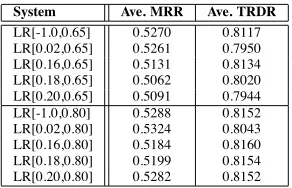
In the training phase, we searched the parameter space for the values ofd(the question bias) and the similarity threshold in order to optimize the resulting TRDR scores. For our problem, we expected that a relatively low similarity threshold pair with a high question bias would achieve the best results. Table 2 shows the effect of varying the similarity threshold.3 The notationLR[a, d]is used, where ais the simi-larity threshold anddis the question bias. The opti-mal range for the parameterawas between 0.14 and 0.20. This is intuitive because if the threshold is too high, such that only the most lexically similar sen-tences are represented in the graph, the method does notfind sentences that are related but are more
lex-3A threshold of -1 means that no threshold was used such
System Ave. MRR Ave. TRDR LR[-1.0,0.65] 0.5270 0.8117 LR[0.02,0.65] 0.5261 0.7950 LR[0.16,0.65] 0.5131 0.8134 LR[0.18,0.65] 0.5062 0.8020 LR[0.20,0.65] 0.5091 0.7944 LR[-1.0,0.80] 0.5288 0.8152 LR[0.02,0.80] 0.5324 0.8043 LR[0.16,0.80] 0.5184 0.8160 LR[0.18,0.80] 0.5199 0.8154 LR[0.20,0.80] 0.5282 0.8152
Table 2: Training phase: effect of similarity thresh-old (a) on Ave. MRR and TRDR.
System Ave. MRR Ave. TRDR
LR[0.02,0.65] 0.5261 0.7950 LR[0.02,0.70] 0.5290 0.7997 LR[0.02,0.75] 0.5299 0.8013 LR[0.02,0.80] 0.5324 0.8043 LR[0.02,0.85] 0.5322 0.8038 LR[0.02,0.90] 0.5323 0.8077 LR[0.20,0.65] 0.5091 0.7944 LR[0.20,0.70] 0.5244 0.8105 LR[0.20,0.75] 0.5285 0.8137 LR[0.20,0.80] 0.5282 0.8152 LR[0.20,0.85] 0.5317 0.8203 LR[0.20,0.90] 0.5368 0.8265
Table 3: Training phase: effect of question bias (d) on Ave. MRR and TRDR.
ically diverse (e.g. paraphrases). Table 3 shows the effect of varying the question bias at two different similarity thresholds (0.02 and 0.20). It is clear that a high question bias is needed. However, a small prob-ability for jumping to a node that is lexically simi-lar to the given sentence (rather than the question itself) is needed. Table 4 shows the configurations of LexRank that performed better than the baseline system on the training data, based on mean TRDR scores over the 184 training questions. We applied all four of these configurations to our unseen devel-opment/test data, in order to see if we could further differentiate their performances.
5.1 Development/testing phase
The scores for the four LexRank systems and the baseline on the development/test data are shown in
System Ave. MRR Ave. TRDR
Baseline 0.5518 0.8297
[image:6.612.113.259.53.147.2]LR[0.14,0.95] 0.5267 0.8305 LR[0.18,0.90] 0.5376 0.8382 LR[0.18,0.95] 0.5421 0.8382 LR[0.20,0.95] 0.5404 0.8311
Table 4: Training phase: systems outperforming the baseline in terms of TRDR score.
System Ave. MRR Ave. TRDR
Baseline 0.5709 1.0002
LR[0.14,0.95] 0.5882 1.0469 LR[0.18,0.90] 0.5820 1.0288 LR[0.18,0.95] 0.5956 1.0411 LR[0.20,0.95] 0.6068 1.0601
Table 5: Development testing evaluation.
Cluster B-MRR LR-MRR B-TRDR LR-TRDR
Gulfair 0.5446 0.5461 0.9116 0.9797
[image:6.612.314.547.150.196.2]David Beckham trade 0.5074 0.5919 0.7088 0.7991 Miami airport 0.7401 0.7517 1.7157 1.7028 evacuation
Table 6: Average scores by cluster: baseline versus LR[0.20,0.95].
Table 5. This time, all four LexRank systems outper-formed the baseline, both in terms of average MRR and TRDR scores. An analysis of the average scores over the 72 questions within each of the three clus-ters for the best system, LR[0.20,0.95], is shown in Table 6. While LexRank outperforms the base-line system on the first two clusters both in terms of MRR and TRDR, their performances are not sub-stantially different on the third cluster. Therefore, we examined properties of the questions within each cluster in order to see what effect they might have on system performance.
[image:6.612.113.258.195.306.2] [image:6.612.112.262.611.666.2]Ave. MRR Ave. TRDR
Baseline 0.5780 0.8673
LR[0.20,0.95] 0.6189 0.9906
[image:7.612.316.540.52.270.2]p-value na 0.0619
Table 7: Testing phase: baseline vs. LR[0.20,0.95].
system versus the baseline to our unseen test set of 134 questions.
5.2 Testing phase
As shown in Table 7, LR[0.20,0.95] outperformed the baseline system on the test data both in terms of average MRR and TRDR scores. The improve-ment in average TRDR score was statistically sig-nificant with a p-value of 0.0619. Since we are in-terested in a passage retrieval mechanism thatfinds sentences relevant to a given question, providing in-put to the question answering component of our sys-tem, the improvement in average TRDR score is very promising. While we saw in Section 5.1 that LR[0.20,0.95] may perform better on some question or cluster types than others, we conclude that it beats the competitive baseline when one is looking to op-timize mean TRDR scores over a large set of ques-tions. However, in future work, we will continue to improve the performance, perhaps by develop-ing mixed strategies usdevelop-ing different configurations of LexRank.
6 Discussion
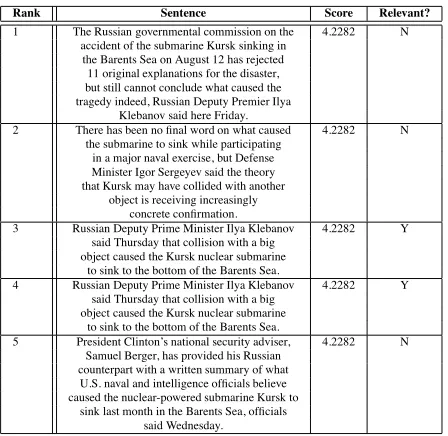
The idea behind using LexRank for sentence re-trieval is that a system that considers only the sim-ilarity between candidate sentences and the input query, and not the similarity between the candidate sentences themselves, is likely to miss some impor-tant sentences. When using any metric to compare sentences and a query, there is always likely to be a tie between multiple sentences (or, similarly, there may be cases where fewer than the number of de-sired sentences have similarity scores above zero). LexRank effectively provides a means to break such ties. An example of such a scenario is illustrated in Tables 8 and 9, which show the top ranked sentences by the baseline and LexRank, respectively for the question “What caused the Kursk to sink?” from the Kursk submarine cluster. It can be seen that all top
five sentences chosen by the baseline system have
Rank Sentence Score Relevant?
1 The Russian governmental commission on the 4.2282 N accident of the submarine Kursk sinking in
the Barents Sea on August 12 has rejected 11 original explanations for the disaster, but still cannot conclude what caused the tragedy indeed, Russian Deputy Premier Ilya
Klebanov said here Friday.
2 There has been nofinal word on what caused 4.2282 N the submarine to sink while participating
in a major naval exercise, but Defense Minister Igor Sergeyev said the theory that Kursk may have collided with another
object is receiving increasingly concrete confirmation.
3 Russian Deputy Prime Minister Ilya Klebanov 4.2282 Y said Thursday that collision with a big
object caused the Kursk nuclear submarine to sink to the bottom of the Barents Sea.
4 Russian Deputy Prime Minister Ilya Klebanov 4.2282 Y said Thursday that collision with a big
object caused the Kursk nuclear submarine to sink to the bottom of the Barents Sea.
5 President Clinton’s national security adviser, 4.2282 N Samuel Berger, has provided his Russian
counterpart with a written summary of what U.S. naval and intelligence officials believe caused the nuclear-powered submarine Kursk to
sink last month in the Barents Sea, officials said Wednesday.
Table 8: Top ranked sentences using baseline system on the question “What caused the Kursk to sink?”.
the same sentence score (similarity to the query), yet the top ranking two sentences are not actually rele-vant according to the judges. To contrast, LexRank achieved a better ranking of the sentences since it is better able to differentiate between them. It should be noted that both for the LexRank and baseline sys-tems, chronological ordering of the documents and sentences is preserved, such that in cases where two sentences have the same score, the one published earlier is ranked higher.
7 Conclusion
We presented topic-sensitive LexRank and applied it to the problem of sentence retrieval. In a Web-based news summarization setting, users of our sys-tem could choose to see the retrieved sentences (as in Table 9) as a question-focused summary. As in-dicated in Table 9, each of the top three sentences were judged by our annotators as providing a com-plete answer to the respective question. While the
[image:7.612.112.258.54.93.2]Rank Sentence Score Relevant? 1 Russian Deputy Prime Minister Ilya Klebanov 0.0133 Y
said Thursday that collision with a big object caused the Kursk nuclear submarine
to sink to the bottom of the Barents Sea.
2 Russian Deputy Prime Minister Ilya Klebanov 0.0133 Y said Thursday that collision with a big
object caused the Kursk nuclear submarine to sink to the bottom of the Barents Sea.
3 The Russian navy refused to confirm this, 0.0125 Y but officers have said an explosion in the
torpedo compartment at the front of the submarine apparently caused the Kursk to sink.
4 President Clinton’s national security adviser, 0.0124 N Samuel Berger, has provided his Russian
counterpart with a written summary of what U.S. naval and intelligence officials believe caused the nuclear-powered submarine Kursk to
sink last month in the Barents Sea, officials said Wednesday.
5 There has been nofinal word on what caused 0.0123 N the submarine to sink while participating
in a major naval exercise, but Defense Minister Igor Sergeyev said the theory that Kursk may have collided with another
object is receiving increasingly concrete confirmation.
Table 9: Top ranked sentences using the
LR[0.20,0.95] system on the question “What caused the Kursk to sink?”
answers from the retrieved sentences. In this case, the sentences selected by our system would be sent to an answer identification component for further processing. As discussed in Section 2, our goal was to develop a topic-sensitive version of LexRank and to use it to improve a baseline system, which had previously been used successfully for query-based sentence retrieval (Allan et al., 2003). In terms of this task, we have shown that over a large set of unal-tered questions written by our annotators, LexRank can, on average, outperform the baseline system, particularly in terms of TRDR scores.
8 Acknowledgments
We would like to thank the members of the CLAIR group at Michigan and in particular Siwei Shen and Yang Ye for their assistance with this project.
References
James Allan, Courtney Wade, and Alvaro Bolivar. 2003. Retrieval and novelty detection at the sentence level. InSIGIR ’03: Proceedings of the 26th annual interna-tional ACM SIGIR conference on Research and devel-opment in informaion retrieval, pages 314–321. ACM Press.
Enrique Amigo, Julio Gonzalo, Victor Peinado, Anselmo Pe˜nas, and Felisa Verdejo. 2004. An Empirical Study
of Information Synthesis Task. InProceedings of the
42nd Meeting of the Association for Computational Linguistics (ACL’04), Main Volume, pages 207–214, Barcelona, Spain, July.
Sergey Brin and Lawrence Page. 1998. The anatomy of
a large-scale hypertextual Web search engine.
Com-puter Networks and ISDN Systems, 30(1–7):107–117.
Jean Carletta. 1996. Assessing Agreement on Classifi ca-tion Tasks: The Kappa Statistic. CL, 22(2):249–254.
Gunes Erkan and Dragomir Radev. 2004. LexRank: Graph-based Lexical Centrality as Salience in Text.
JAIR, 22:457–479.
Robert Gaizauskas, Mark Hepple, and Mark Greenwood. 2004. Information Retrieval for Question Answering:
a SIGIR 2004 Workshop. InSIGIR 2004 Workshop on
Information Retrieval for Question Answering.
Oren Kurland and Lillian Lee. 2005. PageRank without hyperlinks: Structural re-ranking using links induced by language models. InSIGIR 2005, Salvador, Brazil, August.
L. Page, S. Brin, R. Motwani, and T. Winograd. 1998. The pagerank citation ranking: Bringing order to the web. Technical report, Stanford University, Stanford, CA.
Bo Pang and Lillian Lee. 2004. A Sentimental Educa-tion: Sentiment Analysis Using Subjectivity
Summa-rization Based on Minimum Cuts. InAssociation for
Computational Linguistics.
Dragomir Radev, Weiguo Fan, Hong Qi, Harris Wu, and Amardeep Grewal. 2005. Probabilistic Question
An-swering on the Web. Journal of the American
So-ciety for Information Science and Technology, 56(3), March.
Stephen E. Robertson, Steve Walker, Micheline
Hancock-Beaulieu, Aarron Gull, and Marianna Lau.
1992. Okapi at TREC. InText REtrieval Conference,
pages 21–30.
G. Salton, J. Allan, and C. Buckley. 1993. Approaches to Passage REtrieval in Full Text Information Systems. InProceedings of the 16th Annual International ACM SIGIR Conference on Research and Development in Information Retrieval, pages 49–58.
E. Seneta. 1981. Non-negative matrices and markov
chains. Springer-Verlag, New York.
Ellen Voorhees and Dawn Tice. 2000. The TREC-8
Question Answering Track Evaluation. In Text
Re-trieval Conference TREC-8, Gaithersburg, MD.
Harris Wu, Dragomir R. Radev, and Weiguo Fan. 2004. Towards Answer-focused Summarization Using
Search Engines. New Directions in Question