Open-Source Platform for Language Service Sharing
Yohei Murakami, Masahiro Tanaka,
Donghui Lin
National Institute of Information and
Communications Technology
{yohei, mtnk,
lindh}@nict.go.jp
Toru Ishida
Department of Social Informatics
Kyoto University
[email protected]
Abstract
The Language Grid is an infrastructure for en-abling users to share language services devel-oped by language specialists and end user communities. Users can also create new ser-vices to support their intercultural/multilingual activities by composing various language ser-vices. In the Language Grid, there are several stakeholders with different incentives: service users, service providers, and a Language Grid operator. For enhancing the language service sharing, it is significant that the Language Grid can coordinate them to match their incen-tives. However, their incentives vary with the operation model of the Language Grid. To support the various operation models, the Language Grid should employ not a general platform dealing with various types of opera-tion models, but a customizable platform. To this end, we have developed an open-source platform consisting of two types of nents: core components and optional compo-nents. The former assures interoperability of Language Grids, while the latter provides flex-ibility of system configuration. It allows de-velopers to extend the platform, and each op-erator to adapt the platform to his/her opera-tion model by selecting the components. To validate the customizability, we have con-structed the private Language Grid for Wiki-media using the same platform as public Lan-guage Grid.
1
Introduction
Although there are many language resources (both data and programs) on the Internet (Chouk-ri, 2004), most intercultural collaboration activi-ties still lack multilingual support. To overcome
language barriers, we aim to construct a novel language infrastructure to improve accessibility and usability of language resources on the Inter-net. To this end, the Language Grid has been proposed (Ishida, 2006). The Language Grid takes a service-oriented collective intelligence approach to sharing language resources and cre-ating new services to support intercultur-al/multilingual activities by combining language resources.
In previous work, many efforts have been ma-de to combine language resources, such as UI-MA (Ferrucci and Lally, 2004), GATE (Cun-ningham et al., 2002), D-Spin (Boehlke, 2009), Hart of Gold (Callmeier et al., 2004), and CLARIN (Varadi et al., 2008). Their purpose is to analyze a large amount of text data by linguis-tic processing pipelines. These pipelines consist of language resources, most of which are provid-ed as open source by universities and research institutes. Users can thus collect language re-sources and freely combine them on those frameworks without considering other stakehold-ers.
Different from the above frameworks, the pur-pose of the Language Grid is to multilingualize texts for supporting intercultural collaboration by service workflows. PANACEA (Toral et al., 2011) is also a project to overcome language bar-riers by automatically acquiring, producing, up-dating, and maintaining language resources for MT by service workflow. The difference of them is that a workflow in the Language Grid bines language resources associated with com-plex intellectual property issues. These resources are provided by service providers who want to protect their ownership, and used by service us-ers who need a part of the resources. Therefore, the Language Grid must coordinate these stake-holders’ motivations. However, their incentives
vary with the operation model of the Language Grid. To support the various operation models, we proposes open-source platform that enables developers to implement several modules and Language Grid operators to adapt their platforms to their operation models by selecting the mod-ules. Moreover, by connecting their platforms, we can enhance language service sharing among different platforms.
The rest of this paper is organized as follows. Section 2 explains the design concept of the plat-form considering stakeholders’ needs. Section 3 presents system architecture to satisfy require-ments of the design concept. Section 4 illustrates how to extend and customize the platform. Sec-tion 5 introduces two types of system configura-tions to realize a public Language Grid and a private Language Grid. To validate the customi-zability, we show the case study of constructing the Language Grid for Wikimedia in Section 6.
2
Design Concept
The purpose of Language Grid is to accumulate language services and compose them. To realize Language Grid, system architecture should be designed to satisfy requirements of different op-eration models. Therefore, this section summa-rizes requirements of each of the operation mod-els, and clarifies the required functions of Lan-guage Grid.
2.1 Requirements
Language Grid operators require flexibility of system configuration so that they can adapt the configuration to their two types of operation models: public Language Grid and private Lan-guage Grid. The former model is more open than the latter one. Every stakeholder is different or-ganization in the public one, while an operator operates Language Grid for his/her use in the private one. For example, an operator operates a private Language Grid on a single cluster of ma-chines and deploys on the cluster services, the provision policies of which are relaxed. Mean-while, another operator operates a public Lan-guage Grid in a distributed environment by de-ploying services on each provider’s server be-cause the provision policies of the services are too strict. In the former case, the operator places high priority on performance of services. In the latter case, the other operator puts priority on resource security. Further, both of them may want to expand available services by allowing
their users to access services on other Language Grids.
2.2 Functions
The Language Grid platform should provide the following functions extracted from the require-ments in the previous subsection.
1. Modularization of system components:
Language Grid operators can change im-plementations of each component in Lan-guage Grid platform in order to build their own Language Grids compliant with their operation models. In particular, it is neces-sary to switch communication components so that they can operate the platform both in a centralized environment and a distrib-uted environment. The platform combines implementations of each component based on a configuration file defined by operators.
2. Language Grid composition: Language
Grid operators can compose several Lan-guage Grids in order to increase the number of language services. The Language Grid platform realizes information sharing among Language Grids, and service invo-cation across Language Grids.
In designing the Language Grid architecture that provides the above functions, there are sev-eral technical constraints. For example, the archi-tecture should be independent of service inter-faces because language service interinter-faces vary depending on operators. In addition, the architec-ture should be independent of specifications of service invocations because there are several such specifications over HTTP, such as SOAP, REST, JSON, and Protocol Buffers. Moreover, it is necessary to distribute the platform to handle physically distributed services if the services are deployed on their providers’ severs. In the next section, we explain the system architecture of the Language Grid platform considering these con-straints.
3
System Architecture
3.1 Overview
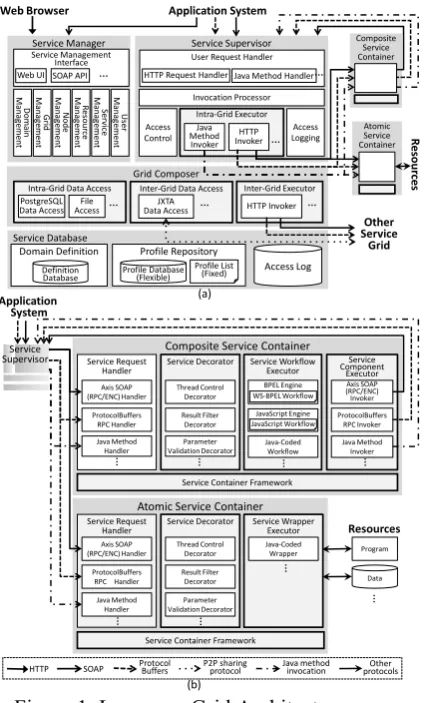
The Language Grid architecture consists of six
parts: Service Manager, Service Supervisor, Grid
Figure 1. Language Grid Architecture
The Service Manager manages domain definition, grid information, node information, user mation, service information and resource infor-mation registered in Language Grid. The service information includes access control settings and access logs. Since the information is registered
through the Service Manager, it plays a front-end
role for any functions other than service
invoca-tion. The Service Supervisor controls service
in-vocations according to the requirements of the service providers. Before invoking the services
on the Composite Service Container and Atomic
Service Container, it validates whether the
re-quest satisfies providers’ policies. The Grid
Composer connects its Language Grid to other Language Grids to realize Language Grid com-position for operators. The connection target is
set through the Service Manager. The Service
Database is a repository to store various types of
information registered through the Service
Man-ager and service invocation logs. The Composite
Service Container provides composite service deployment, composite service execution, and dynamic service binding so that service users can
customize services. The Atomic Service
Contain-er provides several utilities that service providers
need in deploying atomic services.
In the remaining parts of this section, we
provide the details of the Service Manager,
Ser-vice Supervisor, Grid Composer, and Compo-site/Atomic Service Container.
3.2 Service Manager
The Service Manager consists of components managing various types of information necessary for Language Grid, such as domain definition, and grid, node, resource, service, and user infor-mation.
The Domain Management handles a domain definition that defines language service types, standard interfaces of language services, and at-tributes of language service profiles.
The Grid Management sets a target Language
Grid connected by the Grid Composer. Based on
the settings, the Grid Composer determines
available services on other Language Grids. The
Node Management handles information of nodes constituting its Language Grid and the connected Language Grid. Based on this information, the
Grid Composer decides whether to save infor-mation registered on other nodes, and whether to distribute information to other nodes.
The Resource Management and Service Man-agement handle language resource and language service information registered on Language Grid and the connected Language Grid. The infor-mation includes access control settings, service endpoints, intellectual properties associated with the language resources, and access logs. Based
on this information, the Service Supervisor
vali-dates service invocation, locates service end-points, and attaches intellectual property infor-mation to service responses.
Finally, the User Management manages user
information registered on Language Grid. Based
on this information, the Service Supervisor
au-thenticates users’ service requests.
3.3 Service Supervisor
The Service Supervisor controls service invoca-tion by service users. The control covers access control, endpoint locating, load balancing, and access logging. To realize architecture inde-pendent of service specifications such as SOAP
and REST, the Service Supervisor conducts such
service invocation control based on an HTTP header.
The User Request Handler extracts infor-mation necessary to invoke a service from the service request over HTTP, and then
authenti-Service Database Service Manager
Service Management Interface
Service Supervisor
Invocation Processor Intra-‐Grid Executor Web UI
Composite Service Container
Atomic Service Container
Application System
Re
sour
ce
s
Web Browser
Access
Control LoggingAccess SOAP API
HTTP Invoker Us er M an ag eme nt Se rvic e M an ag eme nt Re so urc e M an ag eme nt N ode M an ag eme nt G rid M an ag eme nt Dom ain M an ag emen t (a) Domain Definition Profile Repository
Access Log
Java Method Invoker User Request Handler HTTP Request Handler Java Method Handler
Grid Composer
Inter-‐Grid Data Access Intra-‐Grid Data Access
PostgreSQL Data Access
Other Service
Grid
JXTA Data Access
Inter-‐Grid Executor HTTP Invoker
Profile Database (Flexible) Profile List(Fixed) Definition
Database File Access
Composite Service Container
Service Component
Executor Service Decorator
Service Request
Handler Service Workflow Executor
ProtocolBuffers RPC Handler
Thread Control Decorator Result Filter
Decorator Axis SOAP
(RPC/ENC) Handler
BPEL Engine Axis SOAP (RPC/ENC) Invoker ProtocolBuffers
RPC Invoker Java Method
Invoker
Service Container Framework
Java-‐Coded Workflow Java Method
Handler
Resources
Atomic Service Container
Service Decorator Service Request
Handler Service Wrapper Executor
ProtocolBuffers RPC Handler
Thread Control Decorator Result Filter
Decorator Axis SOAP
(RPC/ENC) Handler Java-‐Coded Wrapper
Service Container Framework
Java Method Handler
Program
Data
Application System
JavaScript Engine
Parameter Validation Decorator
Parameter Validation Decorator
WS-‐BPEL Workflow
JavaScript Workflow
HTTP SOAP ProtocolBuffers P2P sharingprotocol Java methodinvocation
cates the requester. The extracted information is
sent to the Invocation Processor. Using the
in-formation, the Invocation Processor executes a
sequence of pre-process, service invocation, post-process, and logging process. The access control is implemented as the pre-process, or the post-process.
After passing the access control, the
Intra-Grid Executor invokes the service within its
Language Grid. To invoke the service, the
Intra-Grid Executor locates the service endpoint using the service ID. If there are multiple endpoints associated with the service ID, it chooses the endpoint with the lowest load. Finally, it invokes
the service using Java Method Invoker
imple-mentation or HTTP Invoker implementation,
which are selected according to the endpoint lo-cation.
3.4 Grid Composer
The Grid Composer not only creates a P2P grid network within its Language Grid, but also con-nects to other Language Grids. The former is needed to improve latency if the services are physically distributed. The latter is necessary to realize composition of Language Grids operated by different operators.
The Intra-Grid Data Access provides
read/write interfaces for the Service Database
within its Language Grid. In writing data, the
Intra-Grid Data Access broadcasts the data to other nodes using a P2P network framework so that it can share the data with other nodes in the same Language Grid. As a result, service users can improve latency by sending their requests to a node located near the service. In this way, us-age of the P2P network framework contributes to scalability of Language Grid.
On the other hand, the Inter-Grid Data Access
shares various types of information with other
Language Grids. The Inter-Grid Data Access
also uses the P2P network to share information with other nodes across Language Grids. How-ever, based on grid information registered
through the Service Manager, the Inter-Grid
Data Access saves only information related to the connected Language Grids.
The Inter-Grid Executor invokes services reg-istered on a different Language Grid. To invoke a service across Language Grids, it replaces a requester’s ID with the operator’s user ID be-cause the different Language Grid does not store user information of the requester, but rather of the operator as a Language Grid user. In addition, to control access to the services on a different
Language Grid, the Inter-Grid Executor inserts
the user ID of the requester into the request in invoking the service. By separating Language Grid that performs user authentication from the different Language Grid that performs access control, the two Language Grids do not have to share users’ passwords.
3.5 Service Container
The Service Container executes composite
ser-vices and atomic serser-vices. The Composite
Ser-vice Container that executes composite services provides service workflow deployment and
exe-cution, and dynamic service binding. The Atomic
Service Container that executes atomic services wraps language resources of service providers as language services with standard interfaces.
The Service Request Handler has multiple im-plementations according to service invocation
protocols. If the Service Container is deployed
on the same server as the Service Supervisor, the
Java Method Handler implementation can be selected. When receiving a service request, the
Service Request Handler receives from the Ser-vice Container Framework a chain of Service Decorator, Service Workflow/Wrapper Executor, and Service Component Executor, and executes the chain.
In invoking a component service of a
compo-site service, the Service Workflow Executor can
select a concrete service based on binding infor-mation included in a service request. This dy-namic service binding is realized because lan-guage service interfaces are standardized.
4
Open Source Customization
user authentication and access control. That is, priority is placed on service performance.
Thus, the types of stakeholders rely on Lan-guage Grid operators. This implies that it is im-possible to develop a general platform dealing with various types of operation models before-hand. Therefore, we selected open-source style customization so that each operator can adapt the platform to his/her operation model.
We have published the source codes of the Language Grid platform under an LGPL license and begun an open source project wherein each operator can freely customize the platform. In the project, the source codes are classified into a core component and optional component with different development policies because unregu-lated derivatives prevent interoperability of Lan-guage Grids. The specifications of core compo-nents are decided by core members in the open source community. On the other hand, the speci-fications of optional components can be freely changed by developers in the open source project, and derivatives can be created. This classifica-tion is done to improve the interoperability of Language Grids. As shown in Figure 1, the core components are thick-frame rectangles, and op-tional components thin-frame ones. In nested rectangles, outside ones are APIs and in-side ones are their implementations. These implemen-tations can be changed.
The Intra-Grid Data Access, Inter-Grid Data Access, Intra-grid Service Executor, and Inter-Grid Service Executor are core components be-cause they are used to communicate with other Language Grids, and they share information with other Language Grids. In addition to this, Service Decorator, Service Workflow/Wrapper Executor, Service Component Executor, and Service Con-tainer Framework in Composite/Atomic Service Container are also core components because the implementations of the components are inter-leaved in atomic services or composite services by the Service Container Framework. On the other hand, the Service Supervisor and Service Manager are optional components so that opera-tors can extend them according to their operation model, because their functions are used only within the single Language Grid.
5
Configuration of the Language Grid
In this section, we introduce the system configu-ration of a public Language Grid and private Language Grid. In the public Language Grid, third parties are expected to join it and every
stakeholder is different from the operator. In the private Language Grid, the operator uses lan-guage services for its private use. The operator often employs language resources published un-der open source license to reduce the operation cost and increase the performance. Moreover, the operator of the private Language Grid may con-nect the private Language Grid with a public Language Grid in order to use more language services on the private Language Grid.
5.1 Public Language Grid
The Department of Social Informatics in Kyoto University operates a public Language Grid. Service providers may have several provision policies to protect their language resources. Therefore, the Language Grid prefers security of language resources to performance of language services. For this reason, the Language Grid ena-bles service providers to protect their resources on their servers, and therefore should coordinate the resources deployed on the providers’ servers. To realize these functions on the Language Grid, we construct it with two different types of server nodes: the service node and core node.
[image:5.595.310.521.517.668.2]The service node provides only atomic ser-vices by deploying service wrappers to standard-ize interfaces of language resources. The service nodes are distributed to their service providers. On the other hand, the core node controls access to services and composes services. Moreover, it communicates with other core nodes in other Language Grids to realize federated operation of the Language Grid.
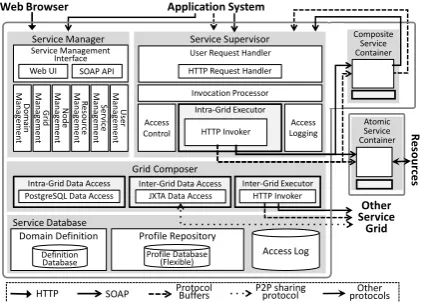
Figure 2. System Configuration of Public Lan-guage Grid
To instantiate the service node and core node, the Language Grid is configured as shown in Figure 2. The components surrounded by gray lines in the figure are deployed on the same
serv-Service Database Service Manager
Service Management Interface
Service Supervisor
Invocation Processor Intra-‐Grid Executor Web UI
Composite Service Container
Atomic Service Container
Application System
Re
sour
ce
s
Web Browser
Access
Control LoggingAccess SOAP API
HTTP Invoker
Us er M an ag eme nt Se rv ice M an ag eme nt Re so urc e M an ag eme nt N ode M an ag eme nt G rid M an ag emen t Do mai n M an ag eme nt
Domain Definition Profile Repository
Access Log
User Request Handler HTTP Request Handler
Grid Composer
Inter-‐Grid Data Access Intra-‐Grid Data Access
PostgreSQL Data Access
Other Service Grid
JXTA Data Access Inter-‐Grid ExecutorHTTP Invoker
Profile Database(Flexible) Definition
Database
er. The server on which the Service Manager,
Service Supervisor, Composite Service Container,
Grid Composer, and Service Database are de-ployed is called the core node, while that on
which the Atomic Service Container is deployed
is called the service node. This system
configura-tion employs an HTTP invoker as the Intra-Grid
Executor to communicate with language services
on the Atomic Service Container physically
dis-tributed. Furthermore, the core node includes the
Inter-Grid Data Access to share language
ser-vices with other Language Grids and the
Inter-Grid Executor to invoke language services on other Language Grids.
5.2 Private Language Grid
[image:6.595.70.284.330.532.2]Unlike the system configuration of the public Language Grid, a private Language Grid priori-tizing performance of language services is some-times required.
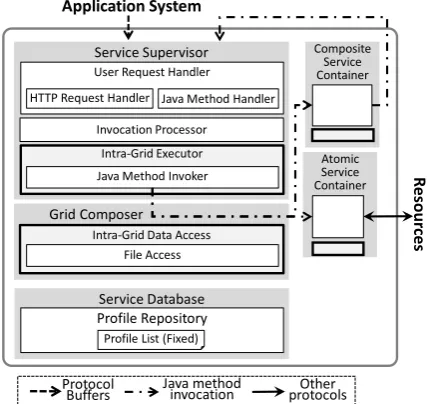
Figure 3. System Configuration of Private Lan-guage Grid
Figure 3 shows the system configuration of private Language Grid to satisfy the operator preferring performance and simplicity. The
sys-tem configuration excludes the Service Manager,
Access Control, and Access Logging components because the private Language Grid handles only language services associated with simple licenses. The Inter-Grid Data Access and Inter-Grid Ex-ecutor are also removed if necessary language services can be aggregated into a single location. Moreover, the system configuration employs Java method invocation for communication
be-tween the Service Supervisor and
Compo-site/Atomic Service Container to improve the latency of communication.
6
Case Study: Multilingual
Environ-ment for Wikimedia
In the case of employing a Language Grid to multilingualize Wikipedia, one of Wikimedia projects, by supporting multilingual discussion for Wikipedia translation community, the per-formance of language services should be given higher priority due to the huge amount of articles and users. Furthermore, the smaller the code size of the platform is, the more the Wikipedia opera-tor likes it due to the low maintenance cost. We designed multilingual environment for Wiki-media considering technical requirements of the existing Wikimedia systems.
6.1 Technical Requirements
Numerous MediaWiki Extensions are available to add new features or enhance the functionality of the MediaWiki software from the users’ point of view. Our goal in the development was that the actual Wikipedia community, which has a great number of users internationally, would ac-cept the multilingual support system. From a technical point of view, as in any system devel-opment project, there are some technical re-quirements raised by the open-source community.
The first one is performance. Because Wiki-media projects such as Wikipedia are viewed by a great number of people every day, in particular a short response time is one of the very critical elements of the system design.
The second is usability. MediaWiki has its own look and feel, which should be consistent throughout any other MediaWiki extensions. Since Wikimedia projects are viewed by a varie-ty of people of different age and computer skill, usability is one of the key elements to attract us-ers.
Lastly, neutrality and independence is im-portant for the Wikipedia community. The com-munity does not depend too much on specific vendors, services or influence of third parties, but employs open source software and services.
6.2 System Design
Figure 4 shows the system architecture of multi-lingual environment using the Language Grid for Wikimedia. From the software point of view, the architecture consists of MediaWiki, the Lan-guage Grid for Wikimedia, the LanLan-guage Grid Extension and Multilingual LiquidThreads Ex-tension.
In order to develop a multilingual support sys-tem for Wikipedia discussion, we have
intro-Service Database Service Supervisor
Invocation Processor Intra-‐Grid Executor
Composite Service Container
Atomic Service Container
Application System
Re
sour
ce
s
Profile Repository Java Method Invoker User Request Handler HTTP Request Handler Java Method Handler
Grid Composer Intra-‐Grid Data Access
Profile List (Fixed) File Access
Protocol
duced a private Language Grid, called Language Grid for Wikimedia. This employs the same sys-tem configuration as Figure 3 to prioritize per-formance and maintainability described in the first technical requirement. Wikimedia adminis-trator operates the private Language Grid and aggregates several language services provided by volunteers for Wikimedia such as Microsoft and Google. Locating the Language Grid between MediaWiki and language services, we have pre-vented strong dependency to the language ser-vices described in the third technical requirement. Since the Language Grid is a multilingual service infrastructure, the Language Grid services should allow access via Language Grid Extension by any other MediaWiki extensions for general pur-poses. By unifying the access to the Language Grid, MediaWiki extensions can employ lan-guage services by invoking PHP function on the Language Grid Extension same as other Me-diaWiki extensions. This allows MeMe-diaWiki de-velopers to use language services with Me-diaWiki’s look and feel, as described in the second technical requirement.
Figure 4. Multilingual Environment for Wiki-media
7
Conclusion
In this paper, we have proposed open source platform to share and compose services while satisfying various stakeholders’ needs. This plat-form allows an operator to operate two types of Language Grid: private Language Grid and pub-lic Language Grid. The former prioritizes per-formance and maintainability, while the latter prioritizes intellectual property management. Moreover, combination of two types of Lan-guage Grid can complement lanLan-guage services on the private Language Grid with language ser-vices on the public Language Grid.
This diversity and interoperability of Lan-guage Grids are realized by classifying system architecture of Language Grid into two types of components: core components that guarantee the interoperability and optional components that provide alternative implementations. An open source project of Language Grid is expected to accelerate the diversity of Language Grid and produce other types of operation models of Lan-guage Grid.
Acknowledgments
We acknowledge the considerable support of National Institute of Information and Communi-cations Technology, and Department of Social Informatics, Kyoto University. A part of this work was supported by Strategic Information and Communications R&D Promotion Programme from Ministry of Internal Affairs.
References
Volker Boehlke. 2009. A prototype infrastructure for D-spin-services based on a flexible multilayer ar-chitecture. Text Mining Services Conference (TMS’09)
Ulrich Callmeier, Andreas Eisele, Ulrich Schäfer, Melanie Siegel. 2004. The Deep Thought core ar-chitecture frame-work. The Fourth International Conference on Language Resources and Evaluation (LREC’04): 1205-1208.
Khalid Choukri. 2004. European Language Resources Association history and recent developments. SCALLA Working Conference KC 14/20.
Hamish Cunningham, Diana Maynard, Kalina Bon-techeva, Valentin Tablan. 2002. GATE: an archi-tecture for devel-opment of robust HLT applica-tions. The Fortieth Annual Meeting of the Associa-tion for ComputaAssocia-tional Linguistics (ACL’02): 168-175.
David Ferrucci, Adam Lally. 2004. UIMA: an archi-tectural approach to unstructured information pro-cessing in the corporate research environment. Journal of Natural Language Engineering 10: 327-348.
Toru Ishida. 2006. Language Grid: an infrastructure for intercultural collaboration. The IEEE/IPSJ Symposium on Applications and the Internet (SAINT’06): 96-100.
Antonio Toral, Pavel Pecina, Andy Way, Marc Poch. 2011. Towards a User-Friendly Webservice Archi-tecture for Statistical Machine Translation in the PANACEA project. The 15th Conference of the