Language-Independent Named Entity Identification using Wikipedia
Mahathi Bhagavatula Search and
Information Extraction Lab IIIT Hyderabad [email protected]
Santosh GSK Search and
Information Extraction Lab IIIT Hyderabad
Vasudeva Varma Search and
Information Extraction Lab IIIT Hyderabad
Abstract
Recognition of Named Entities (NEs) is a dif-ficult process in Indian languages like Hindi, Telugu, etc., where sufficient gazetteers and annotated corpora are not available compared to English language. This paper details a novel clustering and co-occurrence based approach to map English NEs with their equivalent rep-resentations from different languages recog-nized in a language-independent way. We have substituted the required language specific resources by the richly structured multilgual content of Wikipedia. The approach in-cludes clustering of highly similar Wikipedia articles. Then the NEs in an English article are mapped with other language terms in in-terlinked articles based on co-occurrence fre-quencies. The cluster information and the term co-occurrences are considered in ex-tracting the NEs from non-English languages. Hence, the English Wikipedia is used to boot-strap the NEs for other languages. Through this approach, we have availed the structured, semi-structured and multilingual content of the Wikipedia to a massive extent. Experi-mental results suggest that the proposed ap-proach yields promising results in rates of pre-cision and recall.
1 Introduction
Named entity recognition (NER) is an important subtask of information extraction that seeks to locate and classify atomic elements in text into predefined categories such as the names of persons, organizations, locations, etc.
The state-of-art NER systems for English pro-duce near-human performance. However, for non-English languages the state-of-art NER systems perform below par. And for languages that have a lack of resources (e.g., Indian Languages) a NER system with a near-human performance is a distant future.
NER systems so far developed involved linguistic grammar-based techniques as well as statistical models. The grammar-based techniques require linguistic expertise and requires strenuous efforts to build a NER system for every new language. Such techniques can be safely avoided when there is a requirement to build a generic NER system for several languages (e.g., Indian Languages). Statistical NER systems typically require a large amount of manually annotated training data. With the serious lack of such manually annotated training data, the task of high-performance NER system projects as a major challenge for Indian languages.
This paper focuses on building a generic-purpose NE identification system for Indian languages. Given the constraints for resource-poor languages, we restrain from developing a regular NE Recogni-tion system. However, the goal here is to identify as many NEs available in Indian languages without using any language-dependent tools or resources.
Wikipedia is a free, web-based, collaborative, multilingual encyclopedia. There are 283 language editions available as of now. Wikipedia has both structured (e.g., Infoboxes, Categories, Hyperlinks,
InterLanguage links, etc.) and semi-structured (content and organization of the page) information. Hence, the richly linked structure of Wikipedia present across several languages (e.g., English, Hindi, Marathi) has been used to build and enhance many NLP applications including NE identification systems. However, the existing approaches that exploit Wikipedia for recognizing NEs concentrates only on the structured parts which results in less recall. Our approach concentrates on exploiting structured and semi-structured parts of Wikipedia and hence yielding better results.
The approach used is simple, efficient, easily reproducible and can be extended to any language as it doesn’t use any of the language specific resources.
2 Related Work
Wikipedia has been the subject of a considerable amount of research in recent years including Gabrilovich and Markovitch (2005), Milne et al. (2006), Zesch et al. (2007), Timothy Weale (2006) and Richman and Schone (2008). The most relevant work to this paper are Kazama and Tori-sawa (2007), Toral and Munoz (2006), Cucerzan (2007), Richman and Schone (2008). More details follow, however it is worth noting that all known prior research is fundamentally monolingual, often developing algorithms that can be adapted to other languages pending availability of the appropriate semantic resources.
Toral and Munoz (2006) used Wikipedia to create lists of NE’s. They used the first sentence of Wikipedia articles as likely definitions of the article titles, and used them in attempting to classify the titles as people, locations, organizations, or none. Unlike the method presented in our paper, their algorithm relied on WordNet (or an equivalent resource in another language). The authors noted that their results would need to pass a manual supervision step before being useful for the NER task, and thus did not evaluate their results in the context of a full NER system.
Similarly, Kazama and Torisawa (2007) used
Wikipedia, particularly the first sentence of each ar-ticle, to create lists of entities. Rather than building entity dictionaries, associating words and phrases to the classical NE tags (PERSON, LOCATION, etc.), they used a noun phrase following the verb forms ’to be’ to derive a label. For example, they used the sentence ’Franz Fischler ... is an Austrian politician’ to associate the label ’politician’ to the surface form ’Franz Fischler’. They proceeded to show that the dictionaries generated by their method are useful when integrated into an NER system. It is to be noted that their technique relies upon a part-of-speech tagger.
Cucerzan (2007), by contrast to the above, used Wikipedia primarily for Named Entity Dis-ambiguation, following the path of Bunescu and Pasca (2006). As in our paper, and unlike the above mentioned works, Cucerzan (2007) made use of the explicit Category information found within Wikipedia. In particular, Category and related list derived data were key pieces of information used to differentiate between various meanings of an ambiguous surface form. Cucerzan (2007) did not make use of the Category information in identifying the class of a given entity. It is to be noted that the NER component was not the focus of their research, and was specific to the English language.
Richman and Schone (2008) emphasized on the use of links between articles of different lan-guages, specifically between English (the largest and best linked Wikipedia) and other languages. The approach uses English Wikipedia structure namely categories and hyperlinks to get NEs and then use language specific tools to derive multilin-gual NEs.
The following are the majors differences be-tween any of the above approaches to the approach followed in this paper.
• No language resource has been used at any stage of NE identification, unlike the above ap-proaches that used at least one of the language dependent tools like dictionary, POS tagger,etc.
Cate-gories, Sub-titles, Article Text), which has been by far the best exploitation of various structural aspects of Wikipedia.
• Language-independent mapping of mul-tilingual similar content (i.e., the paral-lel/comparable topics or sentences of different languages) can be used as a reference to any future work. Further details can be found in the Section 4.2.
3 Wikipedia Structure
From Wikipedia, we exploited the following three major units:
Category links: These are the links from an article to ’Category’ pages, represented in the form of [[Category:Luzerne County, Pennsylvania]], [[Category:Rivers of Pennsylvania]], etc.
InterLanguage links: Links from an article to a presumably equivalent article in another lan-guage. For example, in the English language article ’History of India’, one finds a set of links including [[hi: ]]. In almost all cases, the articles linked in this manner represent articles on the same subject.
Subtitles of the document: These are consid-ered to be semi-structured parts of a Wikipedia article. Every page in Wikipedia consists of a title and subtitles. Considering the data below the subtitles, they can be referred as subparts of the article. For example, the article regarding Jimmy Wales has subtitles ’Early life and education’, ’Career’, etc.
4 Architecture
The system architecture involves 3 main steps and are detailed as follows:
4.1 Related Document Clustering:
Hierarchical clustering outputs a hierarchy, a struc-ture that is more informative than the unstrucstruc-tured set of clusters returned by flat clustering. This paper deals with large amounts of semi-structured data and requires structured clusters as output rather
than unstructured clusters. Moreover, specifying the number of clusters beforehand is difficult. Hence, we prefer Hierarchical clustering over Flat clus-tering in rest of the paper. Bottom-up algorithms can reach a cluster configuration with a better homogeneity than Top-Down clustering. Hence, we prefer bottom-up clustering over top-down clustering.
Within bottom-up clustering there are several similarity measures that can be employed namely single-linkage, complete-linkage, group-average and centroid-measure. This single-link merge criterion is local. Priority is given solely to the area where the two clusters come closest to each other. Other, more distant parts of the cluster and the clusters’ overall structure are not taken into account. In complete-link clustering or complete-linkage clustering, the similarity of two clusters is the similarity of their most dissimilar members. In centroid clustering, the similarity of two clusters is defined as the similarity of their centroids. Group-average agglomerative clustering or GAAC evaluates cluster quality based on all similarities between documents, thus avoiding the pitfalls of the single-link and complete-link criteria. Hence, in this paper, we made use of the Group-average agglomerative clustering.
We have considered the English Wikipedia ar-ticles which contain InterLanguage links to Hindi articles. The English articles are clustered based on the overlap of terms, i.e., the number of common terms present between articles. The clustering algorithm is detailed as follows:
Initially, consider English Wikipedia data, each article in the dataset is considered as a single document cluster. Now, the distance between two clusters is calculated using
SIM-GA(ωi, ωj) = (Ni+Nj)(1Ni+N
j−1)
P
dm∈ωi∪ωj
P
dn∈ωi∪ωj,dm6=dn
~ dm·d~n
whered~is the length-normalized vector of document
d,·denotes the dot product, andNi andNj are the
number of documents inωiandωj, respectively.
pro-cess is repeated till we reach a certain threshold (set to 0.2) and thus the hierarchical clusters of English data are formed. In order to cluster documents of other languages, we availed the InterLanguage links and structure of English clusters. The InterLanguage links are used in replicating the cluster structure of English Wikipedia articles across other language ar-ticles. Therefore, we avoided the repetition of the clustering step for non-English articles. These dif-ferent language clusters, being interconnected, are further utilized in our approach.
4.2 Mapping related content within interlinked documents:
As the clustering technique used is hierarchical, the intermediate clustering steps are gathered and are called as subclusters. For example, if two clusters (say Diseases, Hospitals) are merged to form a cluster (say Medicine). Then the Diseases, Hospitals are called subclusters for the Medicine cluster.
We measured the average of cosine similarities between the subtitle lists of the articles in a given cluster. If the average similarity exceeds a threshold (set to 0.72), it would mean the articles in the cluster (e.g., Diseases) all share similar subtitles. Other-wise, we go for a subcluster, until the threshold criteria is met. E.g., any two articles of the cluster Diseases share the common subtitles like Symptoms of Disease, Causes, Precautions, etc. This is illustrated in figure 1. As per our observation, the articles of different languages pertaining to same cluster will have same subtitles but depicted in different languages. The Hindi articles of cluster ’Diseases’ share the same subtitles with those in English. This is illustrated in figure 2.
[image:4.612.317.539.55.177.2]In order to map subtitles across languages, in each cluster, consider the non-English article with maximum number of subtitles and its corresponding English article. A lookup in a bilingual dictionary developed by Rohit et al. (2010) would help in mapping certain subtitles. The rest of the subtitles are mapped based on their order of occurrences. The subtitles are likely to occur at the same order in interlinked articles with high number of sub-titles. The dictionary is expanded by adding the
Figure 1: Subtitles of Cancer and Multiple Sclerosis
mapped subtitles obtained from such interlinked articles. This process is repeated with the remaining interlinked articles. Rohit et al. had developed the bilingual dictionary availing Wikipedia titles and abstract information. Hence, their approach is language-independent and doesn’t hinder our algorithm from being applied to other languages.
Consider each subtitle of an article in a cluster and collect its subtitle data from that article and from its corresponding interlinked article in Hindi. For example, consider the subtitle ’Causes’, collect the subtitle data from an English article (say Cancer) and map it with the subtitle data from the Hindi equivalent page on Cancer. We now have a mapping titled ’Causes - Cancer’ for the Cancer articles across languages. Repeat this for all articles and group the mappings of common subtitles. Then, a major group ’Causes’ is formed. This group will now have a set of mappings like ’Causes - Cancer’, ’Causes - Multiple Sclerosis’, etc. Thus the multi-lingual grouping and mapping is done. This step maps similar content of different languages. This is one of the important contributions of the paper which has the potential to be applied elsewhere.
4.3 Term co occurrences model:
Figure 2: Subtitles of Cancer article across languages
For a given map and preprocessed data, every English NE is paired with every non-tagged Hindi word. Attach a default weight (=1) for each pair. Hence, a pair may look like (tagged English word, non tagged Hindi word, 1). This step is repeated with all other mappings present in a group (Ex: ’Causes - Cancer’, ’Causes - Multiple Sclerosis’ in the group ’Causes’). On repeated occurrence of the same pair, weight of that pair increases (by 1). Finally, for a English NE term, the Hindi term with which it has highest frequency is identified. Then the NE tag of English term is assigned to Hindi term. Hence, Hindi word is labeled. This step is repeated with the remaining English NEs and Hindi terms.
For example, consider two small mappings, each with two English NEs and one sentence in Hindi. Consider the first map, with ”Alexan-der/PERSON”, ”India/LOCATION” as English NEs and
as Hindi sentence. Then each NE of English is attached with each Hindi word (except the stop words) like Alexander - , Alexander
-, Alexander - , India - , etc., in all
combinations. Consider the second map with ’Alexander/PERSON’, ’Philip/PERSON’ as
En-glish NEs and as Hindi
sentence. The pairs would be Alexander - , Alexander - etc. Hence, the maximum co oc-curred pair would be Alexander - (Alexander in Hindi). Then the NE tag of Alexander/PERSON is attached to /PERSON. Similarly, for the
remaining English NEs and Hindi terms, the max-imum co-occurred pair is identified and the Hindi term is tagged.
5 Evaluation and Experimental setup:
As our approach requires InterLanguage links, we are only interested in a subset of English and Hindi Wikipedia articles which are interconnected. There are 22,300 articles in English and Hindi Wikipedia that have InterLanguage links. The output of Hierar-chical GAAC clustering on this subset was observed to be 345 clusters. We have manually tagged Hindi articles of 50 random clusters (as cluster size can dictate accuracies) with three NE tags (i.e., Person, Organization, Location), resulting in 2,328 Hindi articles with around 11,000 NE tags. All further experiments were performed on this tagged dataset. Precision, Recall and F-measure are the evaluation metrics used to estimate the performance of our system.
In order to compare our system performance with a baseline, we have availed the Hindi NER system developed by Gali et al. (2008) at LTRC (Language Technologies Research Center) 1 that recognizes and annotates Hindi NEs in a given text using Conditional Random Fields (CRF) as the sequential labeling mechanism. Their system is reproduced on our dataset with a 5-fold cross validation using spell variations, pattern of suffixes and POS tagging as the features.
6 Experiments and Results:
The experiments conducted are broadly classified as follows:
Experiment 1: Using the structure of Wikipedia namely Category terms, we can cluster the articles which are having similar category terms. Another approach for clustering is to consider the Wikipedia page as an unstructured page and then cluster the ar-ticles based on the similarity of words present in it. We have performed Hierarchical GAAC based clus-tering for these experiments.
Experiment 2: Different clustering metrics will yield different accuracies for a given data. Here, we will measure which similarity metric is appropriate
1
for the dataset under study following a Category in-formation based clustering of articles.
6.1 Experiment 1: Whether to use structure of the Wikipedia page:
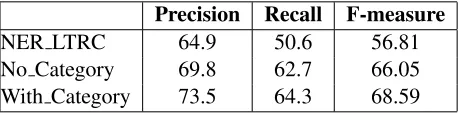
No Category: Clustering without using the
Cate-gory information: As the first experiment, the
arti-cles are clustered based on the article text and not using the category terms.
With Category: Clustering using the Category
in-formation: In this experiment, the category terms
are used for clustering the documents. The F-measure suggests that category terms better capture the semantics of an article when compared to the text of the article. Adding to the fact that category terms suggest a compact representation of an article whereas the text include noisy terms. The compact representation of articles has proved to be crucial by our next set of experiments.
Precision Recall F-measure
NER LTRC 64.9 50.6 56.81
No Category 69.8 62.7 66.05
[image:6.612.313.536.178.249.2]With Category 73.5 64.3 68.59
Table 1: Experiment to determine the impact of structure based clustering
6.2 Experiment 2: Similarity metrics for Clustering
SLAC: Single-linkage Agglomerative Clustering:
Single-linkage algorithm would make use of mini-mum distance between the clusters as similarity met-ric. One of the drawback for this measure is that if we have even a single document related to two clus-ters, the clusters are merged. In Wikipedia, we will not have un-related documents, all the documents will be having a certain overlap of terms with each other. Hence, the number of clusters formed are rel-atively less compared to other two similarity mea-sures. Thus the measures of Precision, Recall and F-measure are quite less.
CLAC: Complete-linkage Agglomerative Cluster-ing: Complete-linkage algorithm would make use of maximum distance between the clusters as simi-larity metric. This results in a preference for com-pact clusters with small diameters over long. Hence, the accuracies are improved. The drawback is that it
causes sensitivity to outliers.
GAAC:Group Average Agglomerative Clustering:
Group Average is the average between single-linkage metric and complete-single-linkage metric. Hence, covers the advantages of the both, overcoming the drawbacks of both metrics to some extent. Thus, the accuracies have improved considerably over previ-ous experiments.
Precision Recall F-measure
NER LTRC 64.9 50.6 56.81
SLAC 67.6 60.3 63.74
CLAC 70.3 61.1 65.38
[image:6.612.72.301.325.383.2]GAAC 73.5 64.3 68.59
Table 2: Experiment to evaluate similarity metrics
7 Discussions:
From the above results, we have made the follow-ing observations. (I) Experiment 1: The Category information of Wikipedia was able to capture the se-mantics and represent the articles in a compact way resulting in higher accuracies over the article text information. (II) Experiment 2: As each cluster is processed independently while identifying NEs, the compactness and uniformity of the clusters matter in our approach. This is studied by considering dif-ferent similarity metrics while forming clusters. Fi-nally, from the experiments we conclude that forma-tion of hard clusters matter more for better results of the approach.
8 Conclusions
References
Daniel M. Bikel and Richard Schwartz and Ralph M. Weischedel 1999. An Algorithm that Learns What’s in a Name, volume 34. Journal of Machine Learning Research.
Silviu Cucerzan 2007. Large-scale named entity dis-ambiguation based on Wikipedia data. In Proc. 2007 Joint Conference on EMNLP and CNLL, pages 708– 716.
Evgeniy Gabrilovich and Shaul Markovitch 2007. Com-puting semantic relatedness using Wikipedia-based ex-plicit semantic analysis. In Proceedings of the 20th In-ternational Joint Conference on Artificial Intelligence, pages 1606–1611.
Evgeniy Gabrilovich and Shaul Markovitch 2006. Over-coming the brittleness bottleneck using wikipedia: en-hancing text categorization with encyclopedic knowl-edge. proceedings of the 21st national conference on Artificial intelligence - Volume 2, pages 1301–1306. Evgeniy Gabrilovich and Shaul Markovitch 2005.
Fea-ture generation for text categorization using world knowledge. In IJCAI05, pages 1048–1053.
Jun’ichi Kazama and Kentaro Torisawa 2007. Exploiting Wikipedia as External Knowledge for Named Entity Recognition. Joint Conference on Empirical Methods in Natural Language Processing and Computational Natural Language Learning, pages 698–707.
David Milne and Olena Medelyan and Ian H. Wit-ten 2006. Mining Domain-Specific Thesauri from Wikipedia: A Case Study. Proceedings of the 2006 IEEE/WIC/ACM International Conference on Web In-telligence, pages 442–448.
Antonio Toral and Rafael Munoz 2006. A proposal to automatically build and maintain gazetteers for named entity recognition by using Wikipedia. In EACL 2006. Timothy Weale 2006. Utilizing Wikipedia Categories for
Document Classification. Evaluation, pages 4. Torsten Zesch and Iryna Gurevych and Max M¨uhlh¨auser
2007. Analyzing and Accessing Wikipedia as a Lex-ical Semantic Resource. Biannual Conference of the Society for Computational Linguistics and Language Technology.
Alexander E. Richman and Patrick Schone 2008.Mining Wiki Resources for Multilingual Named Entity Recog-nition. ACL08.
Razvan Bunescu and Marius Pasca 2006. Using En-cyclopedic Knowledge for Named Entity Disambigua-tion. EACL’06.
Karthik Gali and Harshit Surana and Ashwini Vaidya and Praneeth Shishtla and Dipti M Sharma. 2008 Aggre-gating Machine Learning and Rule Based Heuristics for Named Entity Recognition. IJCNLP’08.