Head Finalization: A Simple Reordering Rule for SOV Languages
Hideki Isozaki, Katsuhito Sudoh, Hajime Tsukada, Kevin Duh
NTT Communication Science Laboratories, NTT Corporation 2-4 Hikaridai, Seikacho, Sorakugun, Kyoto, 619-0237, Japan
{isozaki,sudoh,tsukada,kevinduh}@cslab.kecl.ntt.co.jp
Abstract
English is a typical SVO (Subject-Verb-Object) language, while Japanese is a typ-ical SOV language. Conventional Statis-tical Machine Translation (SMT) systems work well within each of these language families. However, SMT-based translation from an SVO language to an SOV lan-guage does not work well because their word orders are completely different. Re-cently, a few groups have proposed rule-based preprocessing methods to mitigate this problem (Xu et al., 2009; Hong et al., 2009). These methods rewrite SVO sen-tences to derive more SOV-like sensen-tences by using a set of handcrafted rules. In this paper, we propose an alternative single re-ordering rule: Head Finalization. This is a syntax-based preprocessing approach that offers the advantage of simplicity. We do not have to be concerned about part-of-speech tags or rule weights because the powerful Enju parser allows us to imple-ment the rule at a general level. Our ex-periments show that its result, Head Final English (HFE), follows almost the same order as Japanese. We also show that this rule improves automatic evaluation scores.
1 Introduction
Statistical Machine Translation (SMT) is useful for building a machine translator between a pair of languages that follow similar word orders. How-ever, SMT does not work well for distant language pairs such as English and Japanese, since English is an SVO language and Japanese is an SOV lan-guage.
Some existing methods try to solve this word-order problem in language-independent ways. They usually parse input sentences and learn a re-ordering decision at each node of the parse trees.
For example, Yamada and Knight (2001), Quirk et al. (2005), Xia and McCord (2004), and Li et al. (2007) proposed such methods.
Other methods tackle this problem in language-dependent ways (Katz-Brown and Collins, 2008; Collins et al., 2005; Nguyen and Shimazu, 2006). Recently, Xu et al. (2009) and Hong et al. (2009) proposed rule-based preprocessing methods for SOV languages. These methods parse input sen-tences and reorder the words using a set of hand-crafted rules to get SOV-like sentences.
If we could completely reorder the words in in-put sentences by preprocessing to match the word order of the target language, we would be able to greatly reduce the computational cost of SMT sys-tems.
In this paper, we introduce a single reordering rule: Head Finalization. We simply move syntac-tic heads to the end of the corresponding syntacsyntac-tic constituents (e.g., phrases and clauses). We use only this reordering rule, and we do not have to consider part-of-speech tags or rule weights be-cause the powerful Enju parser allows us to im-plement the rule at a general level.
Why do we think this works? The reason is simple: Japanese is a typical head-final language. That is, a syntactic head word comes after non-head (dependent) words. SOV is just one as-pect of head-final languages. In order to imple-ment this idea, we need a parser that outputs syn-tactic heads. Enju is such a parser from the University of Tokyo (http://www-tsujii.is.s. u-tokyo.ac.jp/enju). We discuss other parsers
in section 5.
There is another kind of head: semantic heads. Hong et al. (2009) used Stanford parser (de Marn-effe et al., 2006), which outputs semantic head-based dependencies; Xu et al. (2009) also used the same representation.
The use of syntactic heads and the number of dependents are essential for the simplicity of
Head Finalization (See Discussion). Our method simply checks whether a tree node is a syntactic head. We do not have to consider what we are moving and how to move it. On the other hand, Xu et al. had to introduce dozens of weighted rules, probably because they used the semantic head-based dependency representation without restric-tion on the number of dependents.
The major difference between our method and the above conventional methods, other than its simplicity, is that our method moves not only verbs and adjectives but also functional words such as prepositions.
2 Head Finalization
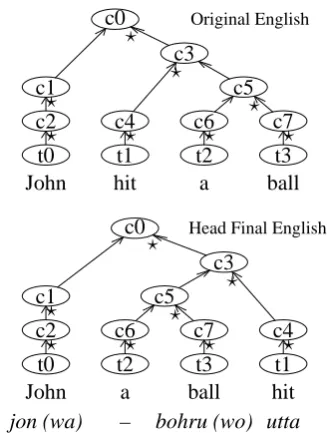
Figure 1 shows Enju’s XML output for the simple sentence: “John hit a ball.” The tag <cons>
indicates a nonterminal node and<tok>indicates
a terminal node or a word (token). Each node has a unique id. Head information is given by the
node’sheadattribute. For instance, nodec0’s head
is nodec3, and c3is a VP, or verb phrase. Thus, Enju treats not only words but also non-terminal nodes as heads.
Enju outputs at most two child nodes for each node. One child is a head and the other is a depen-dent.c3’s head isc4, which isVX, or a fragment of
a verb phrase. c4’s head ist1orhit, which isVBD
or a past-tense verb. The upper picture of Figure 2 shows the parse tree graphically. Here,?indicates an edge that is linked from a ‘head.’
Our Head Finalization rule simply swaps two children when the head child appears before the dependent child. In the upper picture of Fig. 2,c3
has two children c4 andc5. Here, c3’s headc4
appears beforec5, soc4andc5are swapped.
The lower picture shows the swapped result. Then we get John a ball hit, which has the same word order as its Japanese translation jon wa bohru wo utta except for the functional wordsa,
wa, and wo.
We have to add Japanese particles wa (topic marker) or ga (nominative case marker) forJohn
and wo (objective case marker) forballto get an
acceptable Japanese sentence.
It is well known that SMT is not good at gen-erating appropriate particles from English, whitch does not have particles. Particle generation was tackled by a few research groups (Toutanova and Suzuki, 2007; Hong et al., 2009).
Here, we use Enju’s output to generate seeds
hsentence id=”s0” parse status=”success”i hcons id=”c0” cat=”S” xcat=”” head=”c3”i
hcons id=”c1” cat=”NP” xcat=”” head=”c2”i hcons id=”c2” cat=”NX” xcat=”” head=”t0”i
htok id=”t0” cat=”N” pos=”NNP” base=”john”iJohnh/toki h/consi
h/consi
hcons id=”c3” cat=”VP” xcat=”” head=”c4”i hcons id=”c4” cat=”VX” xcat=”” head=”t1”i
htok id=”t1” cat=”V” pos=”VBD” base=”hit”
arg1=”c1” arg2=”c5”ihith/toki h/consi
hcons id=”c5” cat=”NP” xcat=”” head=”c7”i hcons id=”c6” cat=”DP” xcat=”” head=”t2i
htok id=”t2” cat=”D” pos=”DT” base=”a” arg1=”c7”iah/toki
h/consi
hcons id=”c7” cat=”NX” xcat=”” head=”t3”i htok id=”t3” cat=”N” pos=”NN”
base=”ball”iballh/toki h/consi
h/consi h/consi h/consi
[image:2.595.307.523.96.355.2].h/sentencei
Figure 1: Enju’s XML output (some attributes are removed for readability).
t0 John
t1 hit
t2 a
t3 ball
c7? c6?
c5
?
c4? c3
?
c2? c1?
c0 Original English ?
t0 John jon (wa)
t1 hit utta t2
a –
t3 ball bohru (wo)
c7? c6?
c5
?
c4? c3
?
c2? c1?
[image:2.595.334.498.467.684.2]c0 Head Final English ?
2 John
5 went
7 to
9 the
10 police
12 because
15 Mary
17 lost
19 his
20 wallet
1? 8 14?
? 18?
6
?
4
?
16
?
13
?
11
?
3
?
0 Original English
?
2 John jon (wa)
5 Mary meari (ga)
19 his kare no
20 wallet saifu (wo)
17 lost nakushita
12 because
node
9 the
–
10 police keisatsu
7 to ni
5 went
itta
1? 14? 8
?
18
?
6
?
4
?
16
?
13?
11
?
3 ?
[image:3.595.86.502.78.345.2]0 ? Head Final English
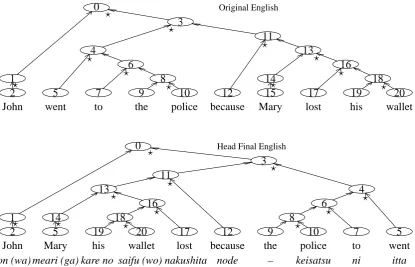
Figure 3: Head-Finalizing a complex sentence.
for particles. As Fig. 1 shows, the verb hit has arg1="c1"andarg2="c5". This indicates thatc1 (John) is the subject ofhitandc5 (a ball)is the object of hit. We add seed words va1 after arg1 and va2 afterarg2. Then, we obtainJohn va1 a ball va2 hit. We do not have to add
arg2forbebecausebe’sarg2is not an object but
a complement. We introduced the idea of particle seed words independently but found that it is very similar to Hong et al. (2009)’s method for Korean. Figure 3 shows Enju’s parse tree for a more complicated sentence “John went to the police because Mary lost his wallet.” For
brevity, we hide the terminal nodes, and we re-moved the nonterminal nodes’ prefixc.
Conventional Rule-Based Machine Translation (RBMT) systems swap X and Y of “X because Y” and move verbs to the end of each clause. Then we get “Mary his wallet lost because John the police to went.” Its word-to-word translation is a fluent Japanese sentence: meari (ga) kare no saifu (wo) nakushita node jon (wa) keisatsu ni itta.
On the other hand, our Head Finalization with particle seed words yields a slightly different word order “John va1 Mary va1 his wallet va2 lost because the police to went.” Its word-to-word translation is jon wa meari ga kare no saifu wo nakushita node keisatsu ni itta. This is also an
ac-ceptable Japanese sentence.
This difference comes from the syntactic role of ‘because.’ In our method, Enju states that
because is a dependent ofwent, whereas RBMT
systems treatbecauseas a clause conjunction.
When we use Xu et al.’s preprocessing method, ‘because’ moves to the beginning of the sentence. We do not know a good monotonic translation of the result.
Preliminary experiments show that HFE looks good as a first approximiation of Japanese word order. However, we can make it better by intro-ducing some heuristic rules. (We did not see the test set to develop these heuristic rules.)
From a preliminary experiment, we found that coordination expressions such asA and B andA or B are reordered as B and A and B or A. Al-thoughAandBhave syntactically equal positions,
the order of these elements sometimes matters. Therefore, we decided to stop swapping them at coordination nodes, which are indicated cat and xcat attributes of the Enju output. We call this
the coordination exception rule. In addition, we avoid Enju’s splitting of numerical expressions such as “12,345” and “(1)” because this splitting
3 Experiments
In order to show how closely our Head Finaliza-tion makes English follow Japanese word order, we measured Kendall’s τ, a rank correlation co-efficient. We also measured BLEU (Papineni et al., 2002) and other automatic evaluation scores to show that Head Finalization can actually improve the translation quality.
We used NTCIR7 PAT-MT’s Patent corpus (Fu-jii et al., 2008). Its training corpus has 1.8 mil-lion sentence pairs. We used MeCab (http:// mecab.sourceforge.net/) to segment Japanese
sentences.
3.1 Rough evaluation of reordering
First, we examined rank correlation between Head Final English sentences produced by the Head Fi-nalization rule and Japanese reference sentences. Since we do not have handcrafted word alignment data for an English-to-Japanese bilingual corpus, we used GIZA++ (Och and Ney, 2003) to get au-tomatic word alignment.
Based on this automatic word alignment, we measured Kendall’sτ for the word order between HFE sentences and Japanese sentences. Kendall’s
τ is a kind of rank correlation measure defined as follows. Suppose a list of integers such as L = [2, 1, 3, 4]. The number of all integer pairs in this list is4C2 = 4×3/(2×1) = 6. The number of
in-creasing pairs is five: (2,3), (2,4), (1,3),(1,4), and(3,4). Kendall’sτ is defined by
τ = #increasing pairs
#all pairs ×2−1.
In this case, we getτ = 5/6×2−1 = 0.667. For each sentence in the training data, we calculate τ based on a GIZA++ align-ment file, en-ja.A3.final. (We also tried ja-en.A3.final, but we got similar results.) It
looks something like this:
John hit a ball .
NULL ({3}) jon ({1}) wa ({}) bohru ({4}) wo ({}) utta ({2}) . ({5})
Numbers in ({ }) indicate corresponding
En-glish words. The article ‘a’ has no
correspond-ing word in Japanese, and such words are listed inNULL ({ }). From this alignment information,
we get an integer list [1, 4, 2, 5]. Then, we get
τ = 5/4C2×2−1 = 0.667.
For HFE in Figure 2, we will get the following alignment.
John va1 a ball va2 hit . NULL ({3}) jon ({1}) wa ({2}) bohru ({4})
wo ({5}) utta ({6}) . ({7})
Then, we get [1, 2, 4, 5, 6, 7] andτ = 1.0. We useτor the average ofτ over all training sentences to observe the tendency.
Sometimes, one Japanese word corresponds to an English phrase:
John went to Costa Rica .
NULL ({}) jon ({1}) wa ({}) kosutarika ({4 5}) ni ({3}) itta ({2}) . ({6})
We get [1, 4, 5, 3, 2, 6] from this alignment. When the same word (or derivative words) ap-pears twice or more in a single English sentence, two or more non-consecutive words in the English sentence are aligned to a single Japanese word:
rate of change of speed NULL ({}) sokudo ({5}) henka ({3})
no ({2 4}) wariai ({1})
We excluded the ambiguously aligned words(2 4) from the calculation ofτ. We use only [5, 3,
1] and get τ = −1.0. The exclusion of these words will be criticized by statisticians, but even this rough calculation ofτ sheds light on the weak points of Head Finalization.
Because of this exclusion, the best value τ = 1.0 does not mean that we obtained the perfect word ordering, but lowτ values imply failures. In section 4, we useτ to analyze failures.
By examining low τ sentences, we found that patent documents have a lot of expressions such as “motor 2.” These are reordered (2 motor) and slightly degradeτ. We did not notice this problem until we handled the patent corpus because these expressions are rare in other documents such as news articles. Here, we added a rule to keep these expressions.
We did not use any dictionary in our experi-ment, but if we add dictionary entries to the train-ing data, it raisesτ because most entries are short. One-word entries do not affectτ because we can-not calculateτ. Most multi-word entries are short noun phrases that are not reordered (τ = 1.0). Therefore, we should exclude dictionary entries from the calculation ofτ.
3.2 Quality of translation
0%
5%
10%
15%
20%
-1.0 -0.8 -0.6 -0.4 -0.2 0.0 0.2 0.4 0.6 0.8 1.0 τof English sentences
0%
5%
10%
15%
20%
[image:5.595.86.514.61.197.2]-1.0 -0.8 -0.6 -0.4 -0.2 0.0 0.2 0.4 0.6 0.8 1.0 τof Head Finalized English sentences
Figure 4: Distribution ofτ
We used the development set (915 sentences) in the NTCIR7 PAT-MT PSD data as well as the for-mal run test set (1,381 sentences).
In the NTCIR7 PAT-MT workshop held in 2008, its participants used different methods such as hi-erarchical phrase-based SMT, RBMT, and EBMT (Example-Based Machine Translation). However, the organizers’ Moses-based baseline system ob-tained the best BLEU score.
4 Results
First, we show τ values to evaluate word order, and then we show BLEU and other automatic eval-uation scores.
4.1 Rank correlation
The original English sentences have τ = 0.451. Head Finalization improved it to 0.722. Figure 4 shows the distribution ofτ for all training sen-tences. HFE reduces the percentage of lowτ sen-tences: 49.6% of the 1.8 million HFE sentences haveτ ≥0.8and 15.1% haveτ = 1.0.
We also implemented Xu et al.’s method with the Stanford parser 1.6.2. Its τ was 0.624. The rate of the sentences withτ ≥0.8was 30.6% and the rate ofτ = 1.0was 4.3%.
We examined low τ sentences of our method and found the following reasons for lowτ values.
• The sentence pair is not an exact one-to-one translation. A Japanese reference sentence for “I bought the cake.” can be
some-thing like “The cake I bought.” or “The person who bought the cake is me.”
• Mistakes in Enju’s tagging or parsing. We encountered certain POS tag mistakes:
– VBZ/NNS mistake: ‘advances’ of “. . . device advances along . . .” is VBZ,
main cause count
tagging/parsing mistakes 12 VBN/VBD mistake (4) VBZ/NNS mistake (2) comma orand (2)
inexact translation 7 wrong alignment 1
Table 1: Main causes of 20 worst sentences
but NNS is assigned.
– VBN/VBD mistake: ‘encoded’ of
“. . . the error correction encoded data is supplied . . .” is VBN, but
VBD is assigned.
These tagging mistakes lead to global parsing mistakes. In addition, just like other parsers, Enju tends to make mistakes when a sentence has a comma or ‘and.’
• Mistakes/Ambiguity of GIZA++ automatic word alignment. Ambiguity happens when a single sentence has two or more occur-rences of a word or derivatives of a word (e.g., difference/different/differential). As we described above, ambiguously aligned words are removed from calculation ofτ, and small reordering mistakes in other words are em-phasized.
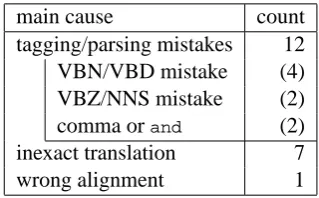
We analyzed the 20 worst sentences with τ <
[image:5.595.336.496.234.333.2]Method BLEU WER TER proposed (0) 30.79 0.663 0.554 proposed (3) 30.97 0.665 0.554 proposed (6) 31.21 0.660 0.549 proposed (9) 31.11 0.661 0.549 proposed (12) 30.98 0.662 0.551 proposed (15) 31.00 0.662 0.552 no va (6) 30.99 0.669 0.559 Organizer 30.58 0.755 0.592
Table 2: Automatic Evaluation of Translation Quality (Numbers in parentheses indicate distor-tion limits).
sentence pairs, only 11 sentences had τ < −0.5 among the 1.8 million sentences.
4.2 Automatic Evaluation of Translation Quality
In general, it is believed that translation between English and Japanese requires a large distortion limit (dl), which restricts how far a phrase can move. SMT reasearchers working on E-J or J-E translation often use dl=−1 (unlimited) as a default value, and this takes a long translation time.
For PATMT J-E translation, Katz-Brown and Collins (2008) showed that dl=unlimited is the best and it requires a very long translation time. For PATMT E-J translation, Kumai et al. (2008) claimed that they achieved the best result “when the distortion limit was 20 instead of−1.”
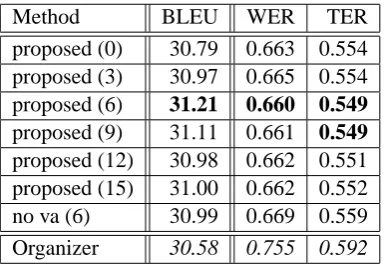
Table 2 compares the single-reference BLEU score of the proposed method and that of the Moses-based system by the NTCIR-7 PATMT organizers. This organizers’ system was better than all participants (Fujii et al., 2008) in terms of BLEU. Here, we used Bleu Kit (http:// www.mibel.cs.tsukuba.ac.jp/norimatsu/
bleu kit/) following the PATMT’s overview
paper (Fujii et al., 2008). The table shows that dl=6 gives the best result, and even dl=0 (no reordering in Moses) gives better scores than the organizers’ Moses.
Table 2 also shows Word Error Rates (WER) and Translation Error Rates (TER) (Snover et al., 2006). Since they are error rates, smaller is better. Although the improvement of BLEU is not very impressive, the score of WER is greatly reduced. This difference comes from the fact that BLEU measures only local word order, while WER
mea-Method ROUGE-L IMPACT PER proposed (6) 0.480 0.369 0.390 no va (6) 0.475 0.368 0.398 Organizer 0.403 0.339 0.384
Table 3: Improvement in word order
sures global word order. Another line ‘no va’ stands for our method without vas or particle seeds. Without particle seeds, all scores slightly drop.
Echizen-ya et al. (2009) showed that IMPACT and ROUGE-L are highly correlated to human evaluation in evaluating J-E patent translation. Therefore, we also used these evaluation methods here for E-J translation. Table 3 shows that the proposed method is also much better than the or-ganizers’ Moses in terms of these measures. With-out particle seeds, these scores also drop slightly.
On the other hand, Position-independent Word Error Rate (PER), which completely disregards word order, does not change very much. These facts indicate that our method improves word or-der, which is the most important problem in E-J translation.
The organizers’ Moses uses dl=unlimited, and it has been reported that its MERT training took two weeks. On the other hand, our MERT training with dl=6 took only eight hours on a PC: Xeon X5570 2.93 GHz. Our method takes extra time to parse sentences by Enju, but it is easy to run the parser in parallel.
5 Discussion
Our method used an HPSG parser, which gives rich information, but it is not easy to build such a parser. It is much easier to build word dependency parsers and Penn Treebank-style parsers. In order use these parsers, we have to add some heuristic rules.
5.1 Word Dependency Parsers
At first, we thought that we could substitute a word dependency parser for Enju by simply rephrasing a head with a modified word. Xu et al. (2009) used a semantic head-based dependency parser for a similar purpose. Even when we use a syntac-tic head-based dependency parser instead, we en-countered their ‘excessive movement’ problem.
[image:6.595.311.524.62.125.2]3 John
5 hit
7 the
8 ball
10 but
13 Sam
15 threw
17 the
18 ball 16
?
14
?
12? 11
?
9
?
6
?
4
?
2? 1
?
0
?
xcat="COOD"
[image:7.595.81.286.65.177.2]cat="COOD"
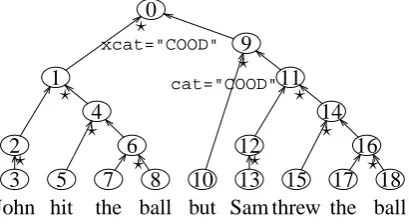
Figure 5: Head Finilization does not mix up clauses
(0) John hit the ball but Sam threw the ball.
to
(1) John the ball but Sam the ball threw hit.
Here, the two clauses are mixed up. To prevent this, they disallow any movement across punctua-tion and conjuncpunctua-tions. Then they get a better re-sult:
(2) John the ball hit but Sam the ball threw.
When we used Enju, these clauses were not mixed up. Enju-based Head Finalization gave the same word order as (2):
(3) John va1 ball va2 hit but Sam va1 ball va2 throw.
Figure 5 shows Enju’s parse tree. When Head Fi-nalization swaps the children of a mother node, the children do not move beyond the range of the mother node. Therefore, Head Finalization based on Enju does not mix up the first clause
John hit the ballcovered by Node 1 with the second clause Sam threw the ball covered by
Node 11. Moreover, our coordination exception rule keeps the order of these clauses. Thus, non-terminal nodes in Enju’s output are useful to pro-tect clauses.
When we use a word-dependency parser, we as-sume that the modified words are heads. Further-more, the Head Finalization rule is rephrased as “move modified words after modifiers.” There-fore, hit is moved after threw just like (2), and
the two clauses become mixed up. Consequently, we need a heuristic rule like Xu’s.
5.2 Penn Treebank-style parsers
We also tried Charniak-Johnson’s parser (Char-niak and Johnson, 2005). PyInputTree (http://www.cs.brown.edu/˜dmcc/software/ PyInputTree/) gives heads. Enju outputs at
most two children for a mother node, but Penn
Treebank-style parsers do not have such a limita-tion on the number of children. This fact causes a problem.
When we use Enju, ‘This toy is popular in Japan’ is reordered as ‘This toy va1 Japan in popular is.’ Its monotonic translation is fluent:
kono omocha wa nihon de ninki ga aru.
On the other hand, Charniak-Johnson’s parser outputs the following S-expression for this sen-tence (we added asterisks (*) to indicate heads). (S (NP (DT This) (NN* toy))
(VP* (AUX* is)
(ADJP (JJ* popular))
(PP (IN* in) (NP (NNP* Japan)))))
Simply moving heads to the end introduces ‘Japan in’ between ‘is’ and ‘popular’: this toy va1 popular Japan in is. It is difficult to translate this monotonically because of this interruption.
Reversing the children order (Xu et al., 2009) reconnects is and popular. We get ‘This toy (va1) Japan in popular is’ from the
follow-ing reversed S-expression.
(S (NP (DT This) (NN* toy))
(VP* (PP (IN* in) (NP (NNP* Japan))) (ADJP (JJ* popular))
(AUX* is)))
5.3 Limitation of Head Finalization
Head Finalization gives a good first approximation of Japanese word order in spite of its simplicity. However, it is not perfect. In fact, a small distor-tion limit improved the performance.
Sometimes, the Japanese language does not have an appropriate word for monotonic transla-tion. For instance, ‘I have no time’ becomes
‘I va1 no time va2 have.’ Its monotonic trans-lation is ‘watashi wa nai jikan wo motteiru,’
but this sentence is not acceptable. An acceptable literal translation is ‘watashi wa jikan ga nai.’
Here, ‘no’ corresponds to ‘nai’ at the end of the
sentence.
6 Conclusion
However, Head Finalization requires a sophis-ticated HPSG tagger such as Enju. We showed that severe failures are caused by Enju’s POS tag-ging mistakes. We discussed the problems of other parsers and how to solve them.
Our future work is to build our own parser that makes fewer errors and to apply Head Finalization to other SOV languages such as Korean.
Acknowledgements
We would like to thank Dr. Yusuke Miyao for his useful advice on the usage of Enju. We also thank anonymous reviewers for their valuable sug-gestions.
References
Eugene Charniak and Mark Johnson. 2005. Coarse-to-fine n-best parsing and MaxEnt discriminative reranking. In Proc. of the Annual Meeting of the As-sociation of Computational Linguistics (ACL), pages 173–180.
Michael Collins, Philipp Koehn, and Ivona Kucerova. 2005. Clause restructuring for statistical machine translation. In Proc. of the Annual Meeting of the Association of Computational Linguistics (ACL).
Marie-Catherine de Marneffe, Bill MacCartney, and Christopher D. Manning. 2006. Generating typed dependency parses from phrase structure parses. In Proc. of the Language Resources and Evaluation Conference (LREC), pages 449–454.
Hiroshi Echizen-ya, Terumasa Ehara, Sayori Shimo-hata, Atsushi Fujii, Masao Utiyama, Mikio Ya-mamoto, Takehito Utsuro, and Noriko Kando. 2009. Meta-evaluation of automatic evaluation methods for machine translation using patent translation data in NTCIR-7. In Proceedings of the 3rd Workshop on Patent Translation, pages 9–16.
Atsushi Fujii, Masao Utiyama, Mikio Yamamoto, and Takehito Utsuro. 2008. Overview of the patent translation task at the NTCIR-7 workshop. In Work-ing Notes of the NTCIR Workshop MeetWork-ing (NTCIR), pages 389–400.
Gumwon Hong, Seung-Wook Lee, and Hae-Chang Rim. 2009. Bridging morpho-syntactic gap be-tween source and target sentences for English-Korean statistical machine translation. In Proc. of ACL-IJCNLP, pages 233–236.
Jason Katz-Brown and Michael Collins. 2008. Syn-tactic reordering in preprocessing for Japanese →
English translation: MIT system description for NTCIR-7 patent translation task. In Working Notes of the NTCIR Workshop Meeting (NTCIR).
Philipp Koehn, 2010. MOSES, Statistical Machine Translation System, User Manual and Code Guide.
Hiroyuki Kumai, Hirohiko Segawa, and Yasutsugu Morimoto. 2008. NTCIR-7 patent translation ex-periments at Hitachi. In Working Notes of the NT-CIR Workshop Meeting (NTNT-CIR), pages 441–444.
Chi-Ho Li, Dongdong Zhang, Mu Li, Ming Zhou, Minghui Li, and Yi Guan. 2007. A probabilistic approach to syntax-based reordering for statistical machine translation. In Proc. of the Annual Meet-ing of the Association of Computational LMeet-inguistics (ACL), pages 720–727.
Thai Phuong Nguyen and Akira Shimazu. 2006. Improving phrase-based statistical machine transla-tion with morphosyntactic transformatransla-tion. Machine Translation, 20(3):147–166.
Franz Josef Och and Hermann Ney. 2003. A sys-tematic comparison of various statistical alignment models. Computational Linguistics, 29(1):19–51.
Kishore Papineni, Salim Roukos, Todd Ward, and Wei-Jing Zhu. 2002. BLEU: a method for automatic evaluation of machine translation. In Proc. of the Annual Meeting of the Association of Computational Linguistics (ACL), pages 311–318.
Chris Quirk, Arul Menezes, and Colin Cherry. 2005. Dependency treelet translation: Syntactically in-formed phrasal SMT. In Proc. of the Annual Meet-ing of the Association of Computational LMeet-inguistics (ACL), pages 271–279.
Matthew Snover, Bonnie Dorr, Richard Schwartz, Lin-nea Micciulla, and John Makhoul. 2006. A study of translation edit rate with targeted human annotation. In Proceedings of Association for Machine Transla-tion in the Americas.
Kristina Toutanova and Hisami Suzuki. 2007. Gener-ating case markers in machine translation. In Proc. of NAACL-HLT, pages 49–56.
Fei Xia and Michael McCord. 2004. Improving a statistical MT system with automatically learned rewrite patterns. In Proc. of the International Con-ference on Computational Linguistics (COLING), pages 508–514.
Peng Xu, Jaeho Kang, Michael Ringgaard, and Franz Och. 2009. Using a dependency parser to improve SMT for Subject-Object-Verb languages. In Proc. of NAACL-HLT, pages 245–253.