Detecting noun compounds and light verb constructions: a contrastive study
Veronika Vincze1, Istv´an Nagy T.2 and G´abor Berend2
1Hungarian Academy of Sciences, Research Group on Artificial Intelligence
2Department of Informatics, University of Szeged
{nistvan,berendg}@inf.u-szeged.hu
Abstract
In this paper, we describe our methods to detect noun compounds and light verb con-structions in running texts. For noun com-pounds, dictionary-based methods and POS-tagging seem to contribute most to the per-formance of the system whereas for light verb constructions, the combination of POS-tagging, syntactic information and restrictions on the nominal and verbal component yield the best result. However, focusing on deverbal nouns proves to be beneficial for both types of MWEs. The effect of syntax is negligible on noun compound detection whereas it is un-ambiguously helpful for identifying light verb constructions.
1 Introduction
Multiword expressions are lexical items that can be decomposed into single words and display idiosyn-cratic features (Sag et al., 2002; Calzolari et al., 2002; Kim, 2008). They are frequent in language use and they usually exhibit unique and idiosyn-cratic behavior, thus, they often pose a problem to NLP systems. A compound is a lexical unit that consists of two or more elements that exist on their own. Light verb constructions are verb and noun combinations in which the verb has lost its meaning to some degree and the noun is used in one of its original senses (e.g.have a walkorgive advice).
In this work, we aim at identifyingnominal com-pounds andlight verb constructions by using rule-based methods. Noun compounds belong to the most frequent MWE-classes (in the Wikipedia cor-pus we developed for evaluation (see 3.2), about
75% of the annotated multiword expressions were noun compounds) and they are productive, i.e. new nominal compounds are being formed in language use all the time, which yields that they cannot be listed exhaustively in a dictionary (as opposed to e.g. prepositional compounds). Their inner syntactic structure varies: they can contain nouns, adjectives and prepositions as well.
Light verb constructions are semi-productive, that is, new light verb constructions might enter the lan-guage following some patterns (e.g. give a Skype callon the basis ofgive a call). On the other hand, they are less frequent in language use (only 9.5% of multiword expressions were light verb constructions in the Wikipedia database) and they are syntactically flexible, that is, they can manifest in various forms: the verb can be inflected, the noun can occur in its plural form and the noun can be modified. The nom-inal and the verbal component may not even be ad-jacent in e.g. passive sentences.
Our goal being to compare how different ap-proaches perform in the case of the different types of multiword expressions, we have chosen these two types of MWEs that are dissimilar in several aspects.
2 Related work
There are several applications developed for identi-fying MWEs, which can be classified according to the methods they make use of (Piao et al., 2003). First, statistical models rely on word frequencies, co-occurrence data and contextual information in deciding whether a bigram or trigram (or even an n-gram) of words can be labeled as a multiword ex-pression or not. Such systems are used for several
languages and several types of multiword expres-sions, see e.g. Bouma (2010). The advantage of statistical systems is that they can be easily adapted to other languages and other types of multiword ex-pressions, however, they are not able to identify rare multiword expressions (as Piao et al. (2003) empha-size, 68% of multiword expressions occur at most twice in their corpus).
Some hybrid systems make use of both statisti-cal and linguistic information as well, that is, rules based on syntactic or semantic regularities are also incorporated into the system (Evert and Kermes, 2003; Bannard, 2007; Cook et al., 2007; Al-Haj and Wintner, 2010). This results in better coverage of multiword expressions. On the other hand, these methods are highly language-dependent because of the amount of linguistic rules encoded, thus, it re-quires much effort to adapt them to different lan-guages or even to different types of multiword ex-pressions. However, the combination of different methods may improve the performance of MWE-extracting systems (Pecina, 2010).
Several features are used in identifying multi-word expressions, which are applicable to differ-ent types of multiword expressions to various de-grees. Co-occurrence statistics and POS-tags seem to be useful for all types of multiword expressions, for instance the toolmwetoolkit(Ramisch et al., 2010a) makes use of such features, which is illus-trated through the example of identifying English compound nouns (Ramisch et al., 2010b).
Caseli et al. (2010) developed an alignment-based method for extracting multiword expressions from parallel corpora. This method is also applied to the pediatrics domain (Caseli et al., 2009). Zarrieß and Kuhn (2009) argue that multiword expressions can be reliably detected in parallel corpora by using dependency-parsed, word-aligned sentences. Sinha (2009) detects Hindi complex predicates (i.e. a com-bination of a light verb and a noun, a verb or an ad-jective) in a Hindi–English parallel corpus by iden-tifying a mismatch of the Hindi light verb meaning in the aligned English sentence. Van de Cruys and Moir´on (2007) describe a semantic-based method for identifying verb-preposition-noun combinations in Dutch, which relies on selectional preferences for both the noun and the verb. Cook et al. (2007) dif-ferentiate between literal and idiomatic usages of
verb and noun constructions in English. They make use of syntactic fixedness of idioms when develop-ing their unsupervised method. Bannard (2007) also seeks to identify verb and noun constructions in En-glish on the basis of syntactic fixedness. Samardˇzi´c and Merlo (2010) analyze English and German light verb constructions in parallel corpora. They found that linguistic features (i.e. the degree of composi-tionality) and the frequency of the construction both have an effect on aligning the constructions.
3 Experiments
In order to identify multiword expressions, simple methods are worth examining, which can serve as a basis for implementing more complex systems and can be used as features in machine learning set-tings. Our aim being to compare the effect of dif-ferent methods on the identification of noun com-pounds and light verb constructions, we considered it important to develop methods for both MWE types that make use of their characteristics and to adapt those methods to the other type of MWE – in this way, the efficacy and the MWE-(in)dependence of the methods can be empirically evaluated, which can later have impact on developing statistical MWE-detectors.
Earlier studies on the detection of light verb con-structions generally take syntactic information as a starting point (Cook et al., 2007; Bannard, 2007; Tan et al., 2006), that is, their goal is to classify verb + object constructions selected on the basis of syn-tactic pattern as literal or idiomatic. However, we do not aim at classifying LVC candidates filtered by syntactic patterns but at identifying them in running text without assuming that syntactic information is necessarily available. In our investigations, we will pay distinctive attention to the added value of syn-tactic features on the system’s performance.
3.1 Methods for MWE identification
candidate was marked if it occurred in the list. The second method we applied for noun compounds in-volved the merge of two possible noun compounds: if A B and B C both occurred in the list, A B C was also accepted as a noun compound (‘Merge’). Since the methodology of dictionary building was not ap-plicable for collecting light verb constructions (i.e. they do not function as links in Wikipedia), we could not apply these two methods to them.
In the case of ‘POS-rules’, a noun compound candidate was marked if it occurred in the list and its POS-tag sequence matched one of the previ-ously defined patterns (e.g. JJ (NN|NNS)). For light verb constructions, the POS-rule method meant that each n-gram for which the pre-defined patterns (e.g.VB.? (NN|NNS)) could be applied was ac-cepted as light verb constructions. For POS-tagging, we used the Stanford POS Tagger (Toutanova and Manning, 2000). Since the methods to follow rely on morphological information (i.e. it is required to know which element is a noun), matching the POS-rules is a prerequisite to apply those methods to identify MWEs.
The ‘Suffix’ method exploited the fact that many nominal components in light verb constructions are derived from verbs. Thus, in this case only construc-tions that contained nouns ending in certain deriva-tional suffixes were allowed and for nominal com-pounds the last noun had to have this ending.
The ‘Most frequent’ (MF) method relied on the fact that the most common verbs function typically as light verbs (e.g. do,make,take,haveetc.) Thus, the 15 most frequent verbs typical of light verb con-structions were collected and concon-structions where the stem of the verbal component was among those of the most frequent ones were accepted. As for noun compounds, the 15 most frequent nouns in En-glish were similarly collected1and the lemma of the last member of the possible compound had to be among them.
The ‘Stem’ method pays attention to the stem of the noun. In the case of light verb constructions, the nominal component is typically one that is derived from a verbal stem (make a decision) or coincides with a verb (have a walk). In this case, we accepted
1
as listed at http://en.wikipedia.org/wiki/ Most\_common\_words\_in\_English
only candidates that had the nominal component / the last noun whose stem was of verbal nature, i.e. coincided with a stem of a verb.
Syntactic information can also be exploited in identifying MWEs. Typically, the syntactic relation between the verb and the nominal component in a light verb construction is dobj or prep – using Stanford parser (Klein and Manning, 2003)). The re-lation between the members of a typical noun com-pound is nn or amod in attributive constructions. The ‘Syntax’ method accepts candidates among whose members these syntactic relations hold.
We also combined the above methods to identify noun compounds and light verb constructions in our databases (the union of candidates yielded by the methods is denoted by ∪ while the intersection is denoted by∩in the respective tables).
3.2 Results
For the evaluation of our models, we developed a corpus of 50 Wikipedia articles, in which several types of multiword expressions (including nomi-nal compounds and light verb constructions) and Named Entities were marked. The database contains 2929 occurrences of nominal compounds and 368 occurrences of light verb constructions and can be downloaded under the Creative Commons licence at
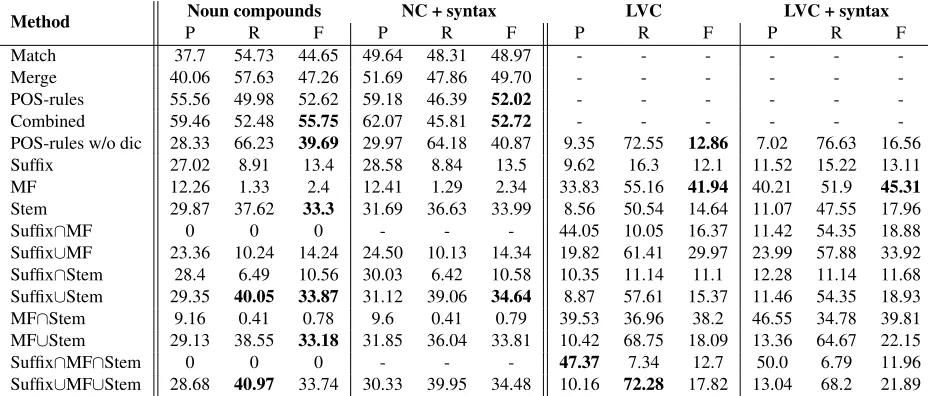
http://www.inf.u-szeged.hu/rgai/mwe. Table 1 shows the results of our experiments. Methods were evaluated on the token level, i.e. each occurrence of a light verb construction had to be identified in text. It can be seen that the best result for noun compound identification can be obtained if the three dictionary-based methods are combined. We also evaluated the method of POS-rules without taking into account dictionary matches (POS-rules w/o dic), which result serves as the baseline for com-paring the effect of LVC-specific methods on noun compound detection.
other hand, the 15 most frequent nouns in English are not derived from verbs hence they do not end in any of the pre-defined suffixes, thus, the intersection of the features ‘MFN’ and ‘Suffix’ does not yield any noun compound (the intersection of all the three methods also behaves similarly). It must be men-tioned, however, that the union of all features yields the best recall as expected and the best F-measure can be achieved by the union of ‘Suffix’ and ‘Stem’. The effect of adding syntactic rules to the system is not unequivocal. In many cases, the improvement is marginal (it does not exceed 1% except for the POS-rules w/o dic method) or the performance even degrades. The latter is most obvious in the case of the combination of dictionary-based rules, which is mainly caused by the decline in recall, however, pre-cision improves. The overall decline in F-score may thus be related to possible parsing errors.
In the case of light verb constructions, the recall of the baseline (POS-rules) is high, however, its pre-cision is low (i.e. not all of the candidates defined by the POS patterns are light verb constructions). The ‘Most frequent verb’ (MFV) feature proves to be the most useful: the verbal component of the light verb construction is lexically much more restricted than the noun, which is exploited by this feature. The other two features put some constraints on the nominal component, which is typically of verbal na-ture in light verb constructions: ‘Suffix’ simply re-quires the noun to end in a given n-gram (without ex-ploiting further grammatical information) whereas ‘Stem’ allows nouns derived from verbs. When combining a verbal and a nominal feature, union re-sults in high recall (the combinations typical verb + non-deverbal noun or atypical verb + deverbal noun are also found) while intersection yields high preci-sion (typical verb + deverbal noun combinations are found only).
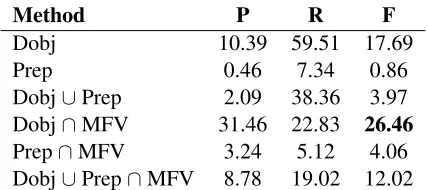
We also evaluated the performance of the ‘Syn-tax’ method without directly exploiting POS-rules. Results are shown in Table 2. It is revealed that the featuredobjis much more effective in identify-ing light verb constructions than the featureprep, on the other hand, dobj itself outperforms POS-rules. If we combine the dobj feature with the best LVC-specific feature (namely, MFV), we can achieve an F-measure of 26.46%. The featuredobj
can achieve a recall of 59.51%, which suggests
Method P R F
Dobj 10.39 59.51 17.69
Prep 0.46 7.34 0.86
Dobj∪Prep 2.09 38.36 3.97 Dobj∩MFV 31.46 22.83 26.46
[image:4.612.320.534.54.149.2]Prep∩MFV 3.24 5.12 4.06 Dobj∪Prep∩MFV 8.78 19.02 12.02
Table 2: Results of syntactic methods for light verb con-structions in terms of precision (P), recall (R) and F-measure (F). Dobj: verb + object pairs, Prep: verb + prepositional complement pairs, MFV: the verb is among the 15 most frequent light verbs.
that about 40% of the nominal components in our database are not objects of the light verb. Thus, ap-proaches that focus on only verb-object pairs (Cook et al., 2007; Bannard, 2007; Tan et al., 2006) fail to identify a considerable part of light verb construc-tions found in texts.
The added value of syntax was also investigated for LVC detection as well. As the results show, syn-tax clearly helps in identifying LVCs – its overall effect is to add up to 4% to the F-score. The best result, again, is yielded by the MFV method, which is about 30% above the baseline.
4 Discussion
When contrasting results achieved for light verb constructions and noun compounds, it is revealed that the dictionary-based method applying POS-rules yields the best result for noun compounds and the MFV feature combined with syntactic informa-tion is the most useful for LVC identificainforma-tion. If no dictionary matches were taken into consideration, the combination of the features ‘Suffix’ and ‘Stem’ achieved the best result, however, ‘Stem’ alone can also perform similarly. Since ‘Stem’ identifies de-verbal nouns, that is, nouns having an argument structure, it is not surprising that this feature is valu-able in noun compound detection because the first part in the compound is most probably an argument of the deverbal noun (as innoun compound detection
the object ofdetectionis noun compound, in other words, we detect noun compounds). Thus, it will be worth examining how the integration of the ‘Stem’ feature can improve dictionary-based models.
Method Noun compounds NC + syntax LVC LVC + syntax
P R F P R F P R F P R F
Match 37.7 54.73 44.65 49.64 48.31 48.97 - - -
-Merge 40.06 57.63 47.26 51.69 47.86 49.70 - - -
-POS-rules 55.56 49.98 52.62 59.18 46.39 52.02 - - -
-Combined 59.46 52.48 55.75 62.07 45.81 52.72 - - -
-POS-rules w/o dic 28.33 66.23 39.69 29.97 64.18 40.87 9.35 72.55 12.86 7.02 76.63 16.56 Suffix 27.02 8.91 13.4 28.58 8.84 13.5 9.62 16.3 12.1 11.52 15.22 13.11
MF 12.26 1.33 2.4 12.41 1.29 2.34 33.83 55.16 41.94 40.21 51.9 45.31
Stem 29.87 37.62 33.3 31.69 36.63 33.99 8.56 50.54 14.64 11.07 47.55 17.96
Suffix∩MF 0 0 0 - - - 44.05 10.05 16.37 11.42 54.35 18.88
Suffix∪MF 23.36 10.24 14.24 24.50 10.13 14.34 19.82 61.41 29.97 23.99 57.88 33.92 Suffix∩Stem 28.4 6.49 10.56 30.03 6.42 10.58 10.35 11.14 11.1 12.28 11.14 11.68 Suffix∪Stem 29.35 40.05 33.87 31.12 39.06 34.64 8.87 57.61 15.37 11.46 54.35 18.93 MF∩Stem 9.16 0.41 0.78 9.6 0.41 0.79 39.53 36.96 38.2 46.55 34.78 39.81 MF∪Stem 29.13 38.55 33.18 31.85 36.04 33.81 10.42 68.75 18.09 13.36 64.67 22.15
Suffix∩MF∩Stem 0 0 0 - - - 47.37 7.34 12.7 50.0 6.79 11.96
[image:5.612.73.537.55.253.2]Suffix∪MF∪Stem 28.68 40.97 33.74 30.33 39.95 34.48 10.16 72.28 17.82 13.04 68.2 21.89
Table 1: Experimental results in terms of precision (P), recall (R) and F-measure (F). Match: dictionary match, Merge: merge of two overlapping noun compounds, POS-rules: matching of POS-patterns, Combined: the union of Match, Merge and POS-rules, POS-rules w/o dic: matching POS-patterns without dictionary lookup, Suffix: the (head) noun ends in a given suffix, MF: the head noun/verb is among the 15 most frequent ones, Stem: the (head) noun is deverbal.
be satisfactory for LVC detection. However, the most useful feature for identifying LVCs, namely, MFV/MFN proves to perform poorly for noun com-pounds, which can be explained by the fact that the verbal component of LVCs usually comes from a well-defined set of frequent verbs, thus, it is lexically more restricted than the parts of noun compounds. The feature ’Stem’ helps improve recall and this fea-ture can be further enhanced since in some cases, the Porter stemmer did not render the same stem to derivational pairs such asassumption–assume. For instance, derivational information encoded in word-net relations might contribute to performance.
Concerning syntactic information, it has clearly positive effects on LVC identification, however, this influence is ambiguous in the case of noun com-pounds. Since light verb constructions form a syn-tactic phrase and noun compounds behave syntac-tically as one unit (having an internal syntactic hi-erarchy though), this result suggests that for noun compound detection, POS-tagging provides enough information while for light verb constructions, syn-tactic information is expected to improve the system.
5 Conclusions
In this paper, we aimed at identifying noun com-pounds and light verb constructions in running texts
with rule-based methods and compared the effect of several features on detecting those two types of multiword expressions. For noun compounds, dictionary-based methods and POS-tagging seem to contribute most to the performance of the sys-tem whereas for light verb constructions, the com-bination of POS-tagging, syntactic information and restrictions on the nominal and verbal component yield the best result. Although the effect of syntax is negligible on noun compound detection, it is un-ambiguously helpful for identifying light verb con-structions. Our methods can be improved by extend-ing the set and scope of features and refinextend-ing POS-and syntactic rules POS-and they can be also adapted to other languages by creating language-specific POS-rules, lists of suffixes and light verb candidates.
For higher-level of applications, it is necessary to know which tokens form one (syntactic or semantic) unit, thus, we believe that our results in detecting noun compounds and light verb constructions can be fruitfully applied in e.g. information extraction or machine translation as well.
Acknowledgments
References
Hassan Al-Haj and Shuly Wintner. 2010. Identifying multi-word expressions by leveraging morphological and syntactic idiosyncrasy. InProceedings of Coling 2010, Beijing, China, August.
Colin Bannard. 2007. A measure of syntactic flexi-bility for automatically identifying multiword expres-sions in corpora. InProceedings of the Workshop on a
Broader Perspective on Multiword Expressions, MWE
’07, pages 1–8, Morristown, NJ, USA. ACL.
Gerlof Bouma. 2010. Collocation extraction beyond the independence assumption. InProceedings of the ACL
2010 Conference Short Papers, pages 109–114,
Upp-sala, Sweden, July. ACL.
Nicoletta Calzolari, Charles Fillmore, Ralph Grishman, Nancy Ide, Alessandro Lenci, Catherine MacLeod, and Antonio Zampolli. 2002. Towards best practice for multiword expressions in computational lexicons.
InProceedings of LREC-2002, pages 1934–1940, Las
Palmas.
Helena de Medeiros Caseli, Aline Villavicencio, Andr´e Machado, and Maria Jos´e Finatto. 2009. Statistically-driven alignment-based multiword expression identi-fication for technical domains. In Proceedings of the Workshop on Multiword Expressions: Identifica-tion, InterpretaIdentifica-tion, Disambiguation and Applications, pages 1–8, Singapore, August. ACL.
Helena de Medeiros Caseli, Carlos Ramisch, Maria das Grac¸as Volpe Nunes, and Aline Villavicencio. 2010. Alignment-based extraction of multiword expressions.
Language Resources and Evaluation, 44(1-2):59–77.
Paul Cook, Afsaneh Fazly, and Suzanne Stevenson. 2007. Pulling their weight: exploiting syntactic forms for the automatic identification of idiomatic expres-sions in context. InProceedings of the Workshop on a
Broader Perspective on Multiword Expressions, pages
41–48, Morristown, NJ, USA. ACL.
Stefan Evert and Hannah Kermes. 2003. Experiments on candidate data for collocation extraction. In
Proceed-ings of EACL 2003, pages 83–86.
Su Nam Kim. 2008. Statistical Modeling of Multiword
Expressions. Ph.D. thesis, University of Melbourne,
Melbourne.
Dan Klein and Christopher D. Manning. 2003. Accurate unlexicalized parsing. InProceedings of the 41st An-nual Meeting on Association for Computational
Lin-guistics, ACL ’03, pages 423–430, Stroudsburg, PA,
USA. Association for Computational Linguistics.
Pavel Pecina. 2010. Lexical association measures and collocation extraction. Language Resources and Eval-uation, 44(1-2):137–158.
Scott S. L. Piao, Paul Rayson, Dawn Archer, Andrew Wilson, and Tony McEnery. 2003. Extracting multi-word expressions with a semantic tagger. In Proceed-ings of the ACL 2003 workshop on Multiword expres-sions: analysis, acquisition and treatment, pages 49– 56, Morristown, NJ, USA. ACL.
Carlos Ramisch, Aline Villavicencio, and Christian Boitet. 2010a. Multiword Expressions in the wild? The mwetoolkit comes in handy. In Coling 2010: Demonstrations, Beijing, China, August.
Carlos Ramisch, Aline Villavicencio, and Christian Boitet. 2010b. Web-based and combined language models: a case study on noun compound identifica-tion. InColing 2010: Posters, Beijing, China, August. Ivan A. Sag, Timothy Baldwin, Francis Bond, Ann Copestake, and Dan Flickinger. 2002. Multiword Ex-pressions: A Pain in the Neck for NLP. InProceedings
of CICLing-2002, pages 1–15, Mexico City, Mexico.
Tanja Samardˇzi´c and Paola Merlo. 2010. Cross-lingual variation of light verb constructions: Using paral-lel corpora and automatic alignment for linguistic re-search. InProceedings of the 2010 Workshop on NLP
and Linguistics: Finding the Common Ground, pages
52–60, Uppsala, Sweden, July. ACL.
R. Mahesh K. Sinha. 2009. Mining Complex Predicates In Hindi Using A Parallel Hindi-English Corpus. In
Proceedings of the Workshop on Multiword Expres-sions: Identification, Interpretation, Disambiguation
and Applications, pages 40–46, Singapore, August.
ACL.
Yee Fan Tan, Min-Yen Kan, and Hang Cui. 2006. Ex-tending corpus-based identification of light verb con-structions using a supervised learning framework. In
Proceedings of the EACL Workshop on Multi-Word Expressions in a Multilingual Contexts, pages 49–56, Trento, Italy, April. ACL.
Kristina Toutanova and Christopher D. Manning. 2000. Enriching the knowledge sources used in a maxi-mum entropy part-of-speech tagger. InProceedings of
EMNLP 2000, pages 63–70, Stroudsburg, PA, USA.
ACL.
Tim Van de Cruys and Bego˜na Villada Moir´on. 2007. Semantics-based multiword expression extraction. In
Proceedings of the Workshop on a Broader Perspective
on Multiword Expressions, MWE ’07, pages 25–32,
Morristown, NJ, USA. ACL.
Sina Zarrieß and Jonas Kuhn. 2009. Exploiting Transla-tional Correspondences for Pattern-Independent MWE Identification. In Proceedings of the Workshop on Multiword Expressions: Identification, Interpretation,
Disambiguation and Applications, pages 23–30,