DUTIR in BioNLP-ST 2016
:
Utilizing Convolutional Network and
Distributed Representation to Extract Complicate Relations
Honglei Li, Jianhai Zhang, Jian Wang, Hongfei Lin, Zhihao Yang
School of Computer Science and Technology Dalian University of Technology
116024 Dalian, China
[email protected] [email protected]
[email protected] [email protected] [email protected]
Abstract
We participate in the two event extraction tasks of BioNLP 2016 Shared Task: bina-ry relation extraction of SeeDev task and localization relations extraction of Bacte-ria Biotope task. Convolutional neural network (CNN) is employed to model the sentences by convolution and max-pooling operation from raw input with word embedding. Then, full connected neural network is used to learn senior and significant features automatically. The proposed model mainly contains two modules: distributive semantic representa-tion building, such as word embedding, POS embedding, distance embedding and entity type embedding, and CNN model training. The results with F-score of 0.370 and 0.478 in our participant tasks, which were evaluated on the test data set, show that our proposed method contributes to binary relation extraction effectively and can reduce the impact of artificial feature engineering through automatically feature learning.
1 Introduction
Information extraction devotes to finding useful data and hidden knowledge for researchers from amounts of texts. With the demands of rapidly and accurately locating key issues about life and biology increasing, bio-IE appears timely and has attracted more and more researchers to ad-dress this question (Krallinger et al., 2005; Zweigenbaum et al., 2007). Much progress has been made in named entity identification, pro-tein-protein relations classification (Blaschke et al., 1999) and drug-drug interaction extraction (Rodrigues et al., 2008). Furthermore,
fine-grained information extraction in biology, in par-ticular event extraction has entered the spotlight of people and, appeared many meaningful and challenge tasks for event extraction, which can gather the community-wide efforts and contrib-ute to the development of biology information extraction (Kim et al., 2009; Kim et al., 2011; Nédellec et al., 2013).
The BioNLP Shared Task series (Kim et al., 2009; Kim et al., 2011; Nédellec et al., 2013) is a representative for biomolecular event extraction, which has been held four times including this year. The topics of the series range from fine-grained extraction, generalization to knowledge base construction. In addition, the scope that this task involved has become much broader at each edition. For example, BioNLP-ST 2013 (Nédellec et al., 2013) covers many new hot top-ics compared to the previous editions, such as Cancer Genetics, Pathway Curation and Gene Regulation Network in Bacteria.
BioNLP-ST 2016 further broadens the scope of the text-mining application domains in biology by introducing a new issue on seed de-velopment, named the issue as the SeeDev task. The development of the seed is a critical issue in agriculture and presents an opportunity for the community to contribute the common efforts in bio-IE. The other task, Bacteria Biotope of the BioNLP-St’13 expands on the previous editions by replacing the Web Pages with scientist papers abstracts to organize the corpus, which is much closer to the actual needs of detailed and scien-tific information for biologists. The third task focuses on the Genia corpus as previous edition, but gives more emphasis in the contribution from any aspect of knowledge extraction, which is an open question to participants.
We focus on the two events extraction sub-tasks of BioNLP 2016 Shared Task: binary
tion extraction of SeeDev task and localization relations extraction of Bacteria Biotope task. Both tasks broaden the scope of fine-grained in-formation extraction in biology, and contribute to the development of the actual application in text mining.
The SeeDev task has not been introduced in the previous BioNLP-ST and aims at exploring the knowledge of the molecular network underly-ing the regulation of seed development. The SeeDev task is similar to the GRN (Gene Regu-lation Network in Bacteria) task in BioNLP’13, aiming at extracting a regulation network that links and integrates a variety of molecular (Bossy et al., 2013) or processes interactions be-tween entities. Therefore, the superior systems from the GRN can give us some useful heuristics. Five systems participated in GRN and all sys-tems applied machine learning algorithms with many different resources of information and pre-processing in BioNLP’13. Lots of features, such as linguistic features, semantic and syntactic in-formation between two entities, were added into these systems. However, they implemented dif-ferent ML algorithms, including SVM, CRF and KNN (Bossy et al., 2013). For example, Provoost (2013) employed a basic Support Vector Ma-chine framework and focused more on the do-main of feature definition and exploration. They achieved an F-score of 0.313, standing on second place in GRN task of BioNLP’13. IRISA system (Claveau, 2013) emphasized the similarity be-tween the known instances and the closest known examples based on K-Nearest Neighbor algorithm.
Bacteria Biotope task in the BioNLP-ST 2016, our second participation, was the third edi-tion that focuses on extracting localizaedi-tion rela-tions between bacteria and their habitats from scientific papers abstracts. Many systems had contributed their efforts to the task in the pre-cious editions. Boun system (Karadeniz et al., 2013) used the shallow linguistic knowledge of the corpus to implement the prediction based on previously defined syntactic rules and discourse-based rules, coming the F-score of 0.27. The Al-vis system (Ratkovic et al., 2011) also employed hand-designed patterns to detect the relations between bacteria and habitat with the linguistic and lexical knowledge. UTurku and JAIST (Ka-radeniz et al., 2013) systems in BioNLP’11 ex-plored different approaches from the above men-tioned and regarded the binary event extraction as a classification problem, thus applying ma-chine learning methods. In BioNLP’13,
TEES-2.1 and IRISA (Bossy et al., 2013) also em-ployed the same idea to this question, and achieved the state-of-the-art results with F-score of 0.42 and 0.40, respectively, which were much higher than the two hand-designed rules methods: LIMSI and Boun.
Most of systems delivered their good ideas and achieved the better results for these tasks in BioNLP-ST, which have positively promoted the development of biology information extraction. So, it is an opportunity for researchers to apply various approaches and new ideas to these tasks. Over recent years, the landscape of Convolution-al NeurConvolution-al Network (CNN) has been obviously prosperous and pushed forward through the ex-pansion of actual application of various fields. The introduction of convolution layers and pool-ing layers in CNN has helped to improve the per-formance of features automatically learnt in net-works. Therefore, in our work, we explore the CNN to learn features automatically for the two binary relations extraction tasks, significantly differenced from previous systems in BioNLP-ST.
2 Method
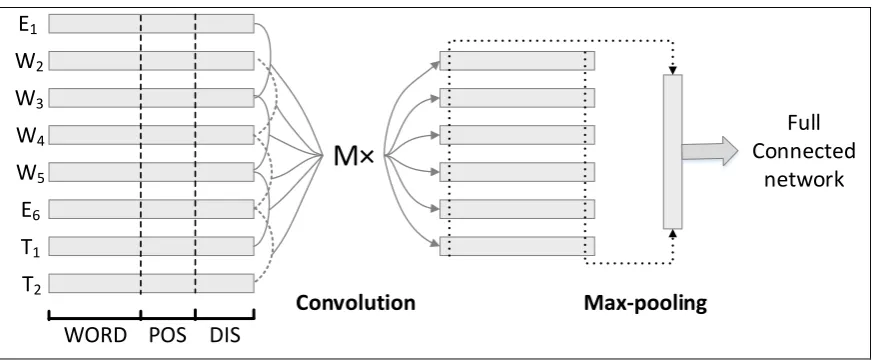
The tasks of SeeDev-binary and BB-event both can be treated as binary relation extraction which specifics whether there is interaction between two entities. In relation extraction, the semantic and syntactic information for sentence act as a significant role. Traditional method usually need to design and extract complex features from sen-tence based on domain-specific knowledge, such as tree kernel and graph kernel, to model the sen-tences. As a result, this will lead to much lower ability of generation for corpus dependent. Con-sequently, instead of complicate hand-designed feature engineering, we employ convolutional neural network, also called CNN, to model the sentences by convolution and max-pooling oper-ation from raw input with word embedding and full connected neural network to learn senior fea-tures automatically. Furthermore, we employ POS embedding to enrich the semantic infor-mation of words, distance embedding to capture the information of relative distance between the entities and entity type embedding as the sup-plement features of the sentence. All the feature embedding is combined to build final distributive semantic representation which is fed to convolu-tional neural network.
se-mantic representation building, such as word embedding, POS embedding, distance embed-ding and entity type embedembed-ding, and CNN model training. In the next parts, we will introduce more details.
2.1 Build Distributive Semantic Representa-tion
Traditional one-hot representation, which is em-ployed by mostly machine learning methods, can vectorize the text and plays an important role. However, it can result in the problems of seman-tic gap and dimension disaster which restrict its application. Consequently, in our proposed
method, we employ distributive semantic repre-sentation, proposed by Hinton (1986) at first, as the feature representation of the model. And then, we exploit the advantage of convolutional neural network at modeling the sentences to learn sen-tence-level representation from raw input. The distributive semantic representation is built as follows. For simply definition, we assume S = 𝐸1𝑊1𝑊2𝑊3… 𝑊𝑛𝐸2 as the word sequence
be-tween two entities in one sentence, where 𝐸1,𝐸2 stand for the entities and 𝑊1…𝑊𝑛 stand for the words between two entities.
M×
Convolution Max-pooling
Full Connected
network E1
W2
W3
W4
W5
E6
T1
T2
[image:3.595.81.518.260.440.2]WORD POS DIS
Figure 1: The model of convolutional neural network with distributive vector
2.1.1 Word Embedding
Instead of traditional one-hot representation, we utilize the distributive semantic representation of words for solving the problem of dimension dis-aster and semantic gap. Firstly, we employ word2vec tool, which can effectively learn dis-tributive representation of words from massive and unlabeled data, to train word embedding from massive available Pubmed abstracts. The embedding with low dimension and realistic val-ue contains rich semantic information and can be treated as feature representation of words instead of one-hot.
Inspired by language model, we employ the contexts of two entities to predict the relation type. In our experiments, the contexts are ex-pressed by the words between two entities in one sentence. Then, the word sequence is trans-formed into word embedding matrix by looking up the word embedding table. The word embed-ding matrix can be treated as local feature of the sentence and fed to CNN model to learn global
feature which can contribute to the relation iden-tification. The word embedding matrix is repre-sented as follows:
𝐿𝑇𝑊(𝑆) = [〈𝑊〉𝐸1, 〈𝑊〉𝑊1, 〈𝑊〉𝑊2, … , 〈𝑊〉𝑊𝑛, 〈𝑊〉𝐸2]
Where 𝑊ϵℝ|𝒟|×𝑑𝑖𝑚 (|𝒟| is the size of dictionary and 𝑑𝑖𝑚 is the dimension of word embedding) is the word embedding table trained by word2vec with Pubmed abstracts and fine-tuned while training.
2.1.2 Entity Type Embedding
sequence. 〈𝑊𝑇〉
𝑡𝑦𝑝𝑒(𝐸1), 〈𝑊𝑇〉𝑡𝑦𝑝𝑒(𝐸2) are added
as the extra features of the relation:
𝐿𝑇𝑊,𝑊𝑇(𝑆) =
[〈𝑊〉𝐸1, 〈𝑊〉𝑊1, … , , 〈𝑊〉𝐸2, 〈𝑊 𝑇〉
𝑡𝑦𝑝𝑒(𝐸1), 〈𝑊 𝑇〉
𝑡𝑦𝑝𝑒(𝐸2)]
Where 𝑊𝑇ϵℝ|𝒟𝑇|×𝑑𝑖𝑚 is type embedding which
is randomly initialized by random sampling from the uniform distribution ([-0.25, 0.25]). 𝑡𝑦𝑝𝑒(∙) stands for the entity type. 𝒟𝑇 is the dictionary of entity types.
2.1.3 POS Embedding
Word semantics usually have several aspects containing similarity, POS (part-of-speech) and so on. For enriching the semantic representation of each word, POS embedding is introduced as the supplement of word embedding:
𝐿𝑇𝑊𝑝(𝑆) =
[〈𝑊𝑝〉
p(𝐸1), 〈𝑊𝑝〉p(𝑊1), … , 〈𝑊𝑝〉p(𝑊𝑛), 〈𝑊𝑝〉p(𝐸2), 𝕆, 𝕆]
We denote 𝑊𝑝ϵℝ|𝒟𝑝|×𝑑𝑖𝑚𝑝 as the POS
embed-ding which is randomly initialized as well as type embedding, where 𝒟𝑝 is the size of POS diction-ary and, 𝑑𝑖𝑚𝑝, a hyper-parameter, is the dimen-sion of POS embedding. We set 𝑑𝑖𝑚𝑝= 5 through trying different configuration. Zero vec-tor (𝕆) is used to pad the sentence.
2.1.4 Distance Embedding
In relation classification tasks, distance infor-mation usually plays an important role. Distance can capture the relative position between two entities. As shown in followed formulas, 𝐿𝑇𝑊𝑑(𝑆)1 stands for the relative distance
be-tween words and the first entity, and 𝐿𝑇𝑊𝑑(𝑆)2
stands for the relative distance between words and the second entity.
𝐿𝑇𝑊𝑑(𝑆)1=
[〈𝑊𝑑〉
𝑑(𝐸1,𝐸1), … , 〈𝑊 𝑑〉
d(𝑊𝑛,𝐸1), 〈𝑊 𝑑〉
d(𝐸2,𝐸1), 𝕆, 𝕆]
𝐿𝑇𝑊𝑑(𝑆)2=
[〈𝑊𝑑〉
𝑑(𝐸1,𝐸2), … , 〈𝑊𝑑〉d(𝑊𝑛,𝐸2), 〈𝑊𝑑〉d(𝐸2,𝐸2), 𝕆, 𝕆]
Where 𝑊𝑑ϵℝ|𝒟𝑑|×𝑑𝑖𝑚𝑑 stands for the distance
embedding and|𝒟𝑑|is the number of different
distances. The embedding is randomly initial-ized and fine-tuned while training. We set 𝑑𝑖𝑚𝑑= 5 through trying different confiuration.
Zero vector (𝕆) is also used to pad the sentence.
As shown in followed formula, the final dis-tributive semantic representation is acquired by joining the word embedding, type embedding, POS embedding and distance embedding.
φ(𝑆) =
[
𝐿𝑇𝑊,𝑊𝑇(𝑆)
𝐿𝑇𝑊𝑝(𝑆)
𝐿𝑇𝑊𝑑(𝑆)1
𝐿𝑇𝑊𝑑(𝑆)2]
2.2 Model Training and Parameters Tuning
After building the distributive semantic represen-tation of relation, we employ convolution and max-pooling to learn the global feature represen-tation from raw input. The detailed compurepresen-tation procedure is described as follows.
〈𝑓〉𝑡= 𝑓(𝑊 ∙ φ(𝑆) + 𝑏)
〈ℎ〉 = max
𝑡 〈𝑓〉𝑡
Where W is the convolution filter, it extracts lo-cal features from given window of word se-quence. 〈ℎ〉 can be treated as the global feature representation learned from raw distributive rep-resentation φ(𝑆) and be fed to the full connec-tion layer to learn hidden and senior features.
optimal parameters of CNN model are described in Table 1.
hyper-parameter value
Word embedding 50 filter 1800 window [3,5,7]
layer 3
dropout 0.3
[image:5.595.95.265.111.202.2]batch 128
Table 1: The parameters of CNN model
3 Results and Discussions
This section presents our results on the SeeDev-binary and BB-event tasks respectively.
3.1 The results of SeeDev-binary task
The SeeDev-binary task datasets contains three parts, namely the training set, development set and test set respectively, which are totally 87 segments from 20 full articles on seed develop-ment of Arabidopsis thaliana. The task defines 17 different types of entities and 22 different types of binary relations. Table 2 shows the de-tailed distribution of data.
# Train Dev Test
Segments 87 39 19 29 Entities 7082 3259 1607 2216 Binary
relations
[image:5.595.74.294.416.481.2]3575 1628 819 1128
Table 2: Detailed statistics of SeeDev-binary task corpus
We aim at extracting the relation between the two target entities and reducing the
participa-tion of hand-designed feature engineering by us-ing our proposed model. Table 3 lists the results of our method on the development and test da-tasets for SeeDev-binary task. The first two lines are the systems with the two best F-score in offi-cial results in BioNLP-ST 2016.
Our method achieved the F-score of 0.368 and 0.370 on the development set and test set, respectively. Compared to the official results from different systems, we stood the similar place with the second best system UniMelb which achieved the F-score of 0.364. It demon-strates that our proposed method has a good per-formance on binary relations extraction.
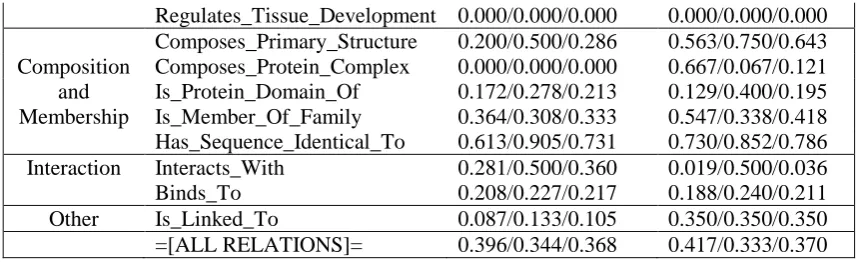
In previous methods to binary relations clas-sification, more systems prefer to rules-based or feature engineering methods. However, we em-ploy a different idea, which utilizes the ad-vantages of distributive semantic representation and the CNN model. From the detailed results in Table 4, we can find that the proposed model is of benefit to SeeDev binary task. Moreover, the better recall than precision is achieved on the test datasets. In Table 4, four relations, such as “Oc-curs_In_Genotype”, and “Regu-lates_Molecule_Activity”, are not identified by the system, which may be a reason that the size of these relations in corpus is very small.
Methods Recall Precision F-score
LitWay 0.448 0.417 0.432 UniMelb 0.386 0.345 0.364 Our method
(on dev set)
0.396 0.344 0.368
Our method (on test set)
0.417 0.333 0.370
Table 3: Results of our method on the develop-ment and test data sets for SeeDev-binary task
Binary relation type Dev data set Test data set
R/P/F-score R/P/F-score
When and Where
Exists_In_Genotype 0.506/0.273/0.355 0.520/0.361/0.426 Occurs_In_Genotype 0.000/0.000/0.000 0.000/0.000/0.000 Exists_At_Stage 0.125/0.100/0.111 0.100/0.045/0.063 Occurs_During 0.200/0.333/0.250 0.083/0.143/0.105 Is_Localized_In 0.426/0.253/0.318 0.290/0.231/0.257
Function
Is_Involved_In_Process 0.000/0.000/0.000 0.000/0.000/0.000 Transcribes_Or_Translates_To 0.154/0.286/0.200 0.313/0.208/0.250 Is_Functionally_Equivalent_To 0.575/0.821/0.677 0.636/0.745/0.686
Regulation
[image:5.595.87.512.573.768.2]Regulates_Tissue_Development 0.000/0.000/0.000 0.000/0.000/0.000
Composition and Membership
[image:6.595.83.512.73.204.2]Composes_Primary_Structure 0.200/0.500/0.286 0.563/0.750/0.643 Composes_Protein_Complex 0.000/0.000/0.000 0.667/0.067/0.121 Is_Protein_Domain_Of 0.172/0.278/0.213 0.129/0.400/0.195 Is_Member_Of_Family 0.364/0.308/0.333 0.547/0.338/0.418 Has_Sequence_Identical_To 0.613/0.905/0.731 0.730/0.852/0.786 Interaction Interacts_With 0.281/0.500/0.360 0.019/0.500/0.036 Binds_To 0.208/0.227/0.217 0.188/0.240/0.211 Other Is_Linked_To 0.087/0.133/0.105 0.350/0.350/0.350 =[ALL RELATIONS]= 0.396/0.344/0.368 0.417/0.333/0.370
Table 4: Detailed results of our method on the development and test data sets for SeeDev-binary task
3.2 The results of BB-event task
For localization relations extraction of Bacteria Biotope task, we also use our proposed system to evaluate the performance. Table 5 shows the re-sults on the development and test datasets. The F-score of 0.478 on test dataset suggest that the proposed method has positive effects on identify-ing the binary relation. However, the recall on the test dataset is lower than the precision, which may be overfitting on training data. The F-score of 0.499 on the development data set achieve better performance than that on test data set.
The prediction of location relations remains many challenges. First, high diversity of bacteria and locations increases the difficult of the correct pairing. Second, cross-sentences relations caused by coreferences usually are ignored by most sys-tem due to complexity and difficulties. In our system, we only considered the relations in one sentence, which many relations in cross sentenc-es were ignored and might cause some reduce on the performance.
Data set Recall Precision F-score
Dev 0.561 0.449 0.499 Test 0.397 0.600 0.478
Table 5: Results of our method on the develop-ment and test data sets for BB-event task
From above analysis, the cross-sentences re-lations extraction is a big challenge, due to much coreferences relations and increasing negative examples. We conduct another experiment to extract relations at the documental level, but not considering the coreferences resolution. Table 6 shows the evaluated results of our method on the development set and test sets at the documental level and sentence level.
At the documental level, the F-score has an about 2% increase on development dataset, while the F-score increases by 6% on test dataset. It
may be because the distribution of relations on two datasets has large different, which there are more cross-sentence relations on test dataset than development dataset. Furthermore, Table 7 shows the statistics of positive and negative ex-amples on training data and development data at the two levels. (It is not nearly possible to have relations between two candidate entities if their distance is too large. Therefore, we remove the candidate examples if the distance is larger than 60.) We can find that, the ratio between positive and negative examples at the documental level is significantly higher than that at the sentence lev-el. The imbalance between positive and negative examples can significantly influence the perfor-mance of models. Therefore, we should devote more techniques and good designs to cross-sentences relation extraction.
Models Recall Precision F-score
CNN-Doc (on dev set)
0.552 0.496 0.523
CNN-Sen (on dev set)
0.561 0.449 0.499
CNN-Doc (on test set)
0.563 0.515 0.538
CNN-Sen (on test set)
0.397 0.600 0.478
Table 6: Results of our method on the develop-ment and test data sets for BB-event task
Models #Positive examples
#Negative examples
Ratio
Doc-level (on train set)
16%(298) 84%(1525) 5.1
Sen-level (on train set)
45%(227) 55%(275) 1.2
Doc-level (on dev set)
13%(210) 87%(1462) 6.9
Sen-level (on dev set)
[image:6.595.301.528.630.756.2]Table 7: Statistics of positive and negative ex-amples on training data and development data at the documental and sentence levels for BB-event task (ratio = #negative examples / #positive ex-amples).
We conduct another experiment on SVM1 to
analysis the superiority of CNN model compared with SVM model. Each raw input into the SVM and CNN models is same, which contains words between two candidate entities, distance between two candidate entities, and the types of two can-didate entities. Then, the raw input for SVM is represented traditional one-hot features, and the raw input for CNN is represented by distributed representation. In Table 8, we compared the two models. F-score of using CNN model is higher than that using SVM model on two data sets, which shows that the effectiveness of using CNN model and distributed representation.
Models Recall Precision F-score
SVM (on dev set)
0.459 0.490 0.474
CNN (on dev set)
0.561 0.449 0.499
SVM (on test set)
0.336 0.594 0.429
CNN (on test set)
0.397 0.600 0.478
Table 8: Results of using SVM and CNN models on the development and test data sets for BB-event task
4 Conclusions
Instead of complicate hand-designed feature en-gineering, we employed the distributed semantic representation and CNN model to extract binary relations between entities. SeeDev-binary task and BB-event task are regarded as classification problems. And then, Word embedding, POS em-bedding, distance embedding and entity type embedding, which contain rich semantic knowledge, are built to be fed into Convolutional neural network and to learn the inner relationship between candidate entities. The results with F-score of 0.370 and 0.478 in our participant tasks, which were evaluated on the test data set with online evaluation2 show that our proposed
meth-od has been contributed to binary relation extrac-tion.
1 http://www.cs.cornell.edu/People/tj/svm_light/
2 http://2016.bionlp-st.org/tasks/seedev/seedev-evaluation
Only using embedding of original words fed into CNN, may be not sufficient for understand-ing the hidden information among words. There-fore, in our future work, we will still concentrate more on the building of rich distributed semantic embedding and construct a better representation with human knowledge for CNN model. Fur-thermore, we will also explore various neural networks with multi-layer architectures, such as RNN, to address binary relation or event extrac-tion.
5 Acknowledge
This work is supported by the grants from the National Natural Science Foundation of China (No. 61572098, 61572102, 61272373 and 61300088), Trans-Century Training Program Foundation for the Talents by the Ministry of Education of China (NCET-13-0084) and the Fundamental Research Funds for the Central Universities (No. DUT13JB09).
References
Blaschke C, Andrade M A, Ouzounis C A, et al. Automatic extraction of biological information from scientific text: protein-protein interac-tions[C]//Ismb. 1999, 7: 60-67.
Bergstra J, Breuleux O, Bastien F, et al. Theano: a CPU and GPU math expression compil-er[C]//Proceedings of the Python for scientific computing conference (SciPy). 2010, 4: 3.
Bastien F, Lamblin P, Pascanu R, et al. Theano: new features and speed improvements[J]. arXiv preprint arXiv:1211.5590, 2012.
Bossy R, Bessières P, Nédellec C. Bionlp shared task 2013–an overview of the genic regulation network task[J]. ACL 2013, 2013: 153.
Bossy R, Golik W, Ratkovic Z, et al. BioNLP Shared Task 2013–an overview of the bacteria biotope task[C]//Proceedings of the BioNLP Shared Task 2013 Workshop. 2013: 161-169.
Claveau V. IRISA participation to BioNLP-ST 2013: lazy-learning and information retrieval for information extraction tasks[C]//BioNLP Work-shop, colocated with ACL 2013. 2013: 188-196.
Hinton G E. Learning distributed representations of concepts[C]//Proceedings of the eighth annual conference of the cognitive science society. 1986, 1: 12.
bi-omedicine[J]. Drug discovery today, 2005, 10(6): 439-445.
Kim J D, Ohta T, Pyysalo S, et al. Overview of BioNLP'09 shared task on event extrac-tion[C]//Proceedings of the Workshop on Cur-rent Trends in Biomedical Natural Language Processing: Shared Task. Association for Com-putational Linguistics, 2009: 1-9.
Kim J D, Pyysalo S, Ohta T, et al. Overview of BioNLP shared task 2011[C]//Proceedings of the BioNLP Shared Task 2011 Workshop. Associa-tion for ComputaAssocia-tional Linguistics, 2011: 1-6.
Karadeniz I, Ozgür A. Bacteria biotope detection, ontology-based normalization, and relation ex-traction using syntactic rules[C]//Proceedings of the BioNLP Shared Task 2013 Workshop. 2013: 170-177.
Nédellec C, Bossy R, Kim J D, et al. Overview of BioNLP shared task 2013[C]//Proceedings of the BioNLP Shared Task 2013 Workshop. 2013: 1-7.
Provoost T, Moens M F. Detecting relations in the gene regulation network[C]//Proceedings of BioNLP shared task 2013 workshop: the Genia event extraction shared task. 2013: 135-138.
Rodrigues A D (Ed). Drug-drug interactions. CRC Press. 2008.
Ratkovic Z, Golik W, Warnier P, et al. BioNLP 2011 task bacteria biotope: the Alvis sys-tem[C]//Proceedings of the BioNLP Shared Task 2011 Workshop. Association for Computational Linguistics, 2011: 102-111.
Srivastava N, Hinton G, Krizhevsky A, et al. Dropout: A simple way to prevent neural net-works from overfitting[J]. The Journal of Ma-chine Learning Research, 2014, 15(1): 1929-1958.
Zweigenbaum P, Demner-Fushman D, Yu H, Cohen KB. Frontiers of biomedical text mining: current progress. Brief Bioinform. 2007, 8:358-375.