D S Sharma, R Sangal and A K Singh. Proc. of the 13th Intl. Conference on Natural Language Processing, pages 81–89, Varanasi, India. December 2016. c2016 NLP Association of India (NLPAI)
Improving Document Ranking using Query Expansion and Classification
Techniques for Mixed Script Information Retrieval
Subham Kumar, Anwesh Sinha Ray, Sabyasachi Kamila, Asif Ekbal, Sriparna Saha, Pushpak Bhattacharyya
Department of Computer Science and Engineering Indian Institute of Technology Patna
Bihta, Patna-801103 (Bihar)
{shubham.ee12,anwesh.cs12,sabyasachi.pcs16,asif,sriparna,pb}@iitp.ac.in
Abstract
A large amount of user-generated translit-erated contents in Roman scripts are avail-able in the Web for the languages that use non-Roman based indigenous scripts. This creates a mixed script space which is mono-lingual or multilingual having more than one script. Information retrieval (IR) in the mixed-script space is challenging as both query and documents can be writ-ten in either native or Roman script, or may be in both the scripts. Moreover, due to lack of any standard ways of spelling a word in a non-native script, translit-erated contents can be written with dif-ferent spelling variations. In this paper, we propose the effective techniques for query expansion and query classification for mixed-script IR. The proposed tech-niques are based on deep learning, word embedding and traditional TF-IDF. We generate our own resources for creating the test-bed for our experiments. Exten-sive empirical analyses show that our pro-posed methods achieve significantly better performance (20.44% increase in MRR, 22.43% increase in NDCG@1 & 15.61% increase in MAP) over a state-of-the-art baseline model.
1 Introduction
Information Retrieval (Manning et al., 2008) refers to finding material (usually, in the form of documents) of a semi-structured nature (usually, in text) that satisfies an information need within a large document collections. Nowadays, due to var-ious socio-cultural and technological reasons, of-ten the websites and the user-generated conof-tents in languages such as Arabic, Russian, Indic etc., are
written using Roman scripts. Such contents create a mono-lingual or multi-lingual space with more than one script which we refer to as the Mixed-Script space. Information retrieval in the mixed-script space, known as Mixed-Script IR (MSIR), is more challenging because queries can be writ-ten in both the native as well as Roman scripts, and these should also be matched to the documents written in both the scripts.
Transliteration (Lopez, 2008) is the process of phonetically describing the words of a given lan-guage using a non-native script. For both the web documents and intended search queries to retrieve those documents, transliteration, especially into Roman script, is generally used. Since no stan-dard ways of spelling any word into a non-native script exist, transliterated contents offer extensive spelling variations; typically, we can transliterate a native term into Roman script in many ways (Gupta et al., 2012). For example, the word khus-boo(”fragrance”) can be written in Roman script using different variations such askushboo,khusbu,
portant research problem. Classifying queries into predefined target categories, also known as query classification, is important to improve search rel-evance. Successfully classifying incoming gen-eral user queries to topical categories can bring improvements in both the efficiency and the ef-fectiveness of general web search. Query classi-fication encounters two important challenges: (i) many queries are very short and contain noise. (ii) a query can often have multiple meanings. In our work we propose a query classification tech-nique for improving document ranking in mixed-script IR scenario. The query can be in multiple scripts, and the dataset is of mixed-domain1. At
first we develop a baseline model for query ex-pansion in line with (Gupta et al., 2014) using a deep learning architecture. We develop the query classification technique based on distributed word representation and traditional TF-IDF weighting scheme. The proposed method is proven to be ef-fective in improving the ranking of relevant doc-uments.We present an extensive empirical analy-sis of the proposed technique that achieves sig-nificantly better performance (20.44% increase in MRR, 22.43% increase in NDCG@1 & 15.61% increase in MAP) over the baseline model. We summarize the contributions of our current work as follows:
(i) proposal of an effective query classification (traditional tf-idf along with word-embedding) technique that improves the performance in a mixed-script IR scenario.
(ii) development of a model of query expansion based on deep learning architecture.
(iii) creation of resources for mixed-script IR. The remaining of the paper is organized as fol-lows. In Section 2, we introduce the concept of MSIR in correspondence to our task and show the possible application scenarios and challenges. Section 3 presents different approaches that we de-veloped to improve the document ranking in an ad-hoc retrieval setting of mixed-script IR over the baseline. In Section 4, we present the details of re-sources that we created for our experiments. Sec-tion 5 reports the experimental setup and the re-sults of evaluation with some empirical analysis. Finally, we conclude in Section 6.
1Refers to the dataset that contains texts written in more than one domain
2 MSIR: Definition and Challenges
In this section, we present the definition of mixed-script information retrieval (MSIR) with respect to our work.
2.1 Mixed Script IR
The task of IR engine is to rank the documents retrieved from a document pool D, such that doc-uments which are relevant to query q appear at the top of the ranked list. For aMixed Script IRsetup, the queries and the documents are all in the same language, i.e., Hindi in our case, but those are writ-ten in more than one different scripts, i.e., Roman and Devanagari scripts in our case. The task of IR engine is to search across the scripts.
More specifically, we define our problem state-ment as: Given a query in Roman or Devanagari script, the system has to retrieve the top-k doc-uments from a corpus that contain mixed scripts (i.e., either Roman or Devanagari or both). Input: a query written in Roman (transliterated) or Devanagari script
Output: a ranked list of ten (k=10 here) documents both in Devanagari and Roman scripts generated from some given document collections.
As part of our contribution to FIRE 2015 shared task (Sequiera et al., 2015), we had access to the queries which cover three different genres, i.e., Hindi songs lyrics, movie reviews, and astrology. In line with this we prepare 25 queries as a test collection for various information needs. Queries related to lyrical documents express the need to re-trieve relevant song lyrics while queries related to movie reviews and astrology are informational in nature (Sequiera et al., 2015).
2.2 Challenges in MSIR
Here the words can be matched to obtain variants of a query word across scripts.
In mixed query processing, language identifica-tion of query words adds another interesting chal-lenge. Query words should be assigned appropri-ate semantic classes, which denote either native or transliterated scripts. This is challenging as de-pending upon the context of the query a same word may have different meanings. For example a word
mancan be a representative of the English word
man, or the transliterated Hindi word ofman hav-ing meanhav-ingmind, or another transliterated Hindi wordmaanmeaningreputation. Hence, language identification seems to be an extremely important problem in MSIR setting, especially when mul-tiple languages are involved. Our algorithm for language identification is based on supervised ma-chine learning, which is in line with the system as described in (Gupta et al., 2015).
There are some other problems apart from these basic challenges like how to present information etc. This requires some additional information to be known in advance like whether the user can read all the scripts, or prefer some scripts over the other.
3 Methodology
Having defined the basic MSIR setting, and es-tablishing its prevalence in Web search through availability of several mixed-script contents in the web, i.e., Indian Astrology, Bollywood movie re-views, Hindi song lyrics etc., we now present the approaches that we develop along with the base-line system. An overall architecture of the system showing the basic components is depicted in Fig-ure 1.
3.1 Baseline System
[image:3.612.315.543.40.376.2]We develop a baseline model based on deep-learning architecture in line with the prior work as proposed in (Gupta et al., 2014). This is based on restricted Boltzmann machine(RBMs) (Hinton, 2010) model. Our baseline, though uses the concept proposed in (Gupta et al., 2014), is developed to handle a bigger dataset comprising of multiple domains instead of only Hindi song lyrics dataset of FIRE 2014, thus extending the research challenges in a MSIR setup. The base-line proposes a principled solution to handle the mixed-script term matching and spelling variation. The mixed-script features are modeled jointly in
Figure 1: Block Diagram of the system
a deep-learning architecture in such a way that these can be compared in a low-dimensional ab-stract space where term equivalents are close to each other. The principle behind the formation of common abstract space for mixed-script mod-eling is that original words and the correspond-ing transliterated words into a non-native script share the same sound/pronunciation. This process can help in determining possible equivalents of the query term across the script. Finally the expansion of the original query can be done using the thus found equivalents.
3.1.1 Formulation
The phonemes are considered as character-level
topicsin the terms. Terms are the representatives of mixtures oftopics, with each topic representing a probability distribution over character n-grams. Let us assume that the feature set F ={f1, ..., fK}
contain character grams of scripts si for all i ∈
{1, ., r}and|F|= K.
t1= [
i=1....r w1,i
represents a data-point from training data T of languagel1wherew1,idenotes word w written in
languagel1 and scriptsi. Here r counts the
num-ber of jointly modeled scripts. Each data-point is assumed to be a K-dimensional feature vector x wherexk is a measurement ofkth feature fk ∈F
in data-point t1. The count for character grams
within terms can be measured using Dirichlet multi-nomial distribution2. We have considered
total N independent draws from a categorical distribution with K different output classes. In the current context, the value of N can be computed as follows:
N = Pk
i=1xi and {f1, . . . , fK} denote K
cate-gories. Herexk indicates the number of times a
particular featurefk appears in the data-point t1.
Here x = {x1, . . . , xK} satisfies a multinomial
distribution with two parameters N and p. Here p = (p1, . . . , pK) andpk denotes the probability
that kth feature obtains the value of xk. The
parameter p can not be directly computed in our case rather it is computed using a conjugate prior distribution.
In the current paper we have proposed a model based on non-linear dimensionality reduction procedures like deep auto-encoder. A deep learn-ing based architecture is proposed after stacklearn-ing several RBMs together. The bottom-most RBM in our framework is used for modeling the input terms. This can be viewed as a character-level variant of the replicated softmax (RSM) model presented in for documents. In general character n-grams follow Dirichlet multi-nomial distribu-tion. But in the current work RSM has been used to model these as at the time of applying the inference, methods like Gibbs sampling, Dirichlet prior distributions are often marginalized out. We assume that v ∈ {0,1, , N}k denotes the visible
multinomial units and h ∈ {0,1}m denotes a
stochastic binary hidden latent unit. Also assume that v is a K-dimensional input vector such as feature vector x for data-point t1. h denotes
the m-dimensional latent feature vector and N = Pk
i=1xi. The energy of the state {v, h} is
calculated as follows:
E(v, h) =−X
i
aivi−
X
j
bjhj−
X
i
X
j
viwi,jhj
2http://en.wikipedia.org/wiki/Dirichlet-multinomial distribution
Here the following terms are used: videnotes the
measurement of xi, wi,j is the weight matrix
en-try between ith visible node andjth hidden node,
whileaiandbjare bias terms of visible and hidden
layers, respectively. A large number of layers are inserted to develop a deep auto-encoder. A cas-caded structure of binary RBMs is created in such a way that output of a lower RBM is passed as an input to the immediate next RBM.
3.1.2 Training
In our proposed model, the visible layer of the bottom-most RBM is the character-level replicated soft-max layer. The feature spaceF is a
combina-tion of character uni- and bi-grams of training data (r = 2). The terms are represented as low dimen-sional embedding in the abstract space. The hid-den layer of the top-most RBM is kept linear for this purpose. A two-phased training procedure is carried out for the developed auto-encoder i) pre-training the layers in a greedy manner and; ii) up-dation of the weights using backpropagation pro-cess.
3.1.3 Finding Equivalents
After the training of the model is finished, the pro-cess of equivalent- discovery has started. This is composed of two steps: i) the index of mining lexicon in abstract space is produced and; ii) the equivalents for the query term are generated. The mining-lexicon is a lexicon of reference collection (ideally, mixed-script) . This is later on utilized to extract term equivalents. This is executed after projecting each term in the mining lexicon into an abstract space. For each term, one index entry is stored which contains the corresponding projected term. Finally the query term xq is also projected
into the abstract space hq and the corresponding
cosine similarity with respect to all terms in the index is calculated. For a given query word, xq,
the terms with cosine similarity > θ are
consid-ered as equivalents. Hereθis used as the similar-ity threshold.
For developing the baseline system, similarity thresholds of 0.95 and 0.98 are considered.
3.2 Query Classification
Query classification helps identifying intents be-hind each query, which, in turn, provides better retrieval search results.We divide our dataset into 3 broad domains, namelyMusic Lyrics,Movie Re-viewsandAstrology.
3.2.1 TF-IDF based Technique
Term frequency (TF)-inverse document frequency (IDF) is a technique to show the importance of a word in a document given a large collection of documents or corpus. TF-IDF technique is widely used in information retrieval or text mining as a weighting factor. In general if a word appears multiple times in a document then TF value would be more. But this is offset by the frequency of the word appearing in the other documents of the corpus. This way the TF-IDF scores of words which appear frequently in general can be reduced.
We create the minion lexicon for each domain through indexing along with the normalized TF-IDF scores of each term in that respective domain.
For each domain d, we obtain normalized term frequency of the term t as follows:
T F(t, d) = tf(t, d) maxttf(t, d)
Here,tf(t, d): term frequency of thetth term in documentd;maxttf(t, d): frequency of the most
frequent term.
For each domain d, we obtain normalized in-verse document frequency of the term t
IDF(t, d) = idf(t, d) maxtidf(t, d)
Here, idf(t, d): inverse document frequency of
termt in documentd; maxtidf(t, d): maximum
inverse document frequency obtained throughout the corpus.
The corresponding normalized TF-IDF score of a term t is obtained by
T F −IDF(t, d) =T F(t, d).IDF(t, d)
After obtaining the above TF-IDF score for each minion lexicon of each domain, the TF-IDF score of a query for a domain is obtained by summing up the TF-IDF score of every expanded query term obtained from that domain. If a expanded query term is not found in that domain, its TF-IDF score is set to 0. Once the score for a query is obtained for each domain, the query is classified to the do-main for which it has the highest score.
3.2.2 Word Embedding based Technique
We use word2vec tool (Mikolov et al., 2013) which efficiently captures the semantic properties of words in the corpus. Word2vec is a group of related models (i.e., CBOW: continuous bag-of-words model and Skip-grams) which can be utilized to generate different word embeddings. The linguistic contexts of words can be gener-ated using some models based on shallow-ed, two-layered neural networks. A word is given as an input to the network and the task is to predict the words which can appear in adjacent positions given an input text. Order of the remaining words is not important.
For each domain d, we merge the contents of all the documents belonging to that domain to obtain its respective document collection. We train Word2Vec using CBOW model for each domain dataset by setting window size to 5, and dimen-sion of the final vectors to 100. For each domain, we create a normalized vector norm vec(d) by summing up all the vectors of all the tokens t of that domain, and dividing resultant vector by the total number of documents N(d) in that domain. For the expanded query vectorization, we obtain the vectorsvec(t,d)of each query term t from the trained model of the domains in which that term is present, sum up the vectors, and divide the final vector by the number of domains in which it has occurred (denoted byN(t,d): number of domains d in which the term appears). The final vector of a query Q is obtained by summing up the individual word vectors of each query term. The processes are described mathematically as follows: N(t, d)
= No. of domains where the term t has occurred;
N(d)= No. of documents in the domain d; vec(t, d)= Vector of term t in domain d;
norm vec(d)= Normalized vector for domain d; norm vec(Q)= Query vector of a query Q;
norm vec(d) =
P
t∈dvec(t, d) N(d)
norm vec(Q) =X
t∈Q
P
dvec(t, d) N(t, d)
For classifying the queries into one of the 3 do-mains, we use two similarity measures (i.e., co-sine similarity and Euclidean distance) between the query vectornorm vec(Q)and the domain vec-tornorm vec(d).
4 Dataset
4.1 Resource Creation
We create our own resources for experiments. We develop a web crawler using Python mod-ules -BeautifulSoup,mechanizeto crawl the doc-uments from different web sources. For data cre-ation we had to deal with the following issues: (i) very few web-sites having good amount of transliterated contents of Devanagari documents; (ii) no standard html tag containing actual con-tents of documents, and so manual intervention was necessary. We crawl total 1,503 documents covering all the 3 domains- Astrology, Bolly-wood Movie Reviews and Bollywood Movie Di-alogues. Following sources were used: Bol-lywood movie reviews: http://www.jagran.com/, Astrology: http://astrology.raftaar.in/ and Bolly-wood movie dialogues: http://filmyquotes.com/. We contributed to the FIRE-2015 Shared Task on MSIR in Subtask 2 problem3, which is related to
the mixed-script Ad-hoc retrieval. In Table 1, we present some statistics for the datasets.
Domain No. of documents Script
Astrology 343 Devanagari Movie Reviews 97 Devanagari Movie Dialogues 1,063 Mixed
Table 1: Statistics of Crawled Datasets
4.2 Pre-processing
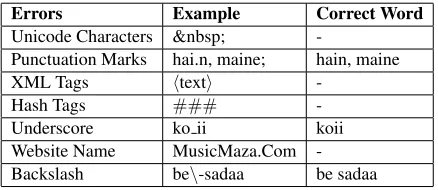
The dataset has to be pre-processed for removing inconsistencies and other typical errors. Some of the examples are shown in Table 2. The errors were manually corrected. Some typical examples are shown in Table 2.
Errors Example Correct Word
Unicode Characters
-Punctuation Marks hai.n, maine; hain, maine
XML Tags htexti
-Hash Tags ###
-Underscore ko ii koii
[image:6.612.86.523.372.426.2]Website Name MusicMaza.Com -Backslash be\-sadaa be sadaa
Table 2: Typical Examples of the Dataset
3http://fire.irsi.res.in/fire/2015/home
4.3 Dataset Statistics
We use the FIRE 2013 shared task collection on Transliterated Search (Roy et al., 2007) for training the deep auto-encoder (stacked RBMs). The dataset comprises of document collection (D), queryset (Q) and relevance judgments. The collec-tion contains 63,334 documents containing song titles and lyrics in Roman, Devanagari and mixed scripts; Hindu astrology and Bollywood movie re-views in Devanagari. Statistics are shown in Ta-ble 3. The query set (Q) contains 25 lyrics search queries covering Bollywood songs; Movie reviews and Hindu astrology in Roman and Devanagari scripts with mean query length of 4.04 words. Queries related to lyrics documents express the need to retrieve relevant song lyrics, while queries related to movie reviews and astrology are infor-mational in nature. The queries are of different difficulty levels: word level joining and splitting, ambiguous short queries, different script queries and mixing of different language keywords. On an average, there are 47.52 qrels per query with aver-age relevant documents per query is set to 5.00. Some example queries are shown in Table 4.
No. of documents 63,334
No. of tokens 1,40,39,002
No. of vocabulary words 1,45,478
Table 3: Corpus Statistics
Sample Queries
tujho nahi lyrics
vicky donor movie reviews ill effects of rahu kaal
Table 4: Example of Queries
5 Experiments and Results
In this section we describe the experimental results along with necessary analysis for evaluating the effectiveness of the proposed method for retrieval inmixed-script space.
5.1 Baseline System
[image:6.612.82.301.581.676.2](i) for lyrical retrieval, the sequential information among the terms is crucial for effectiveness evalu-ation (Gupta et al., 2014), e.g.,love me babyand
baby love meare completely different songs. In or-der to capture the word-oror-dering we consior-der word bi-grams as a unit for indexing and retrieval; and (ii) for bollywood movie reviews and astrology, we consider word uni-gram as a unit for indexing and retrieval4Every query is enriched with
equiv-alents of the query terms using the deep-learning based query expansion technique (c.f. Section 3.1.3).Suppose a query has n terms in it, and has m equivalents, then the query gets expanded into
mnqueries. After the queries are expanded, they
are first pre-processed, i.e., converted to word bi-grams for song lyrics and word uni-bi-grams for as-trology and movie reviews, and then fed to the re-trieval engine to get the top 10 relevant documents.
5.2 Results using Query Classification
Here we present the results using different query classification techniques.
• Query Classification using TF-IDF: After expanding the queries with term equivalents (0.98 as the similarity threshold), the docu-ment collection is divided into 3 pre-defined domains, and are indexed separately. We consider the same indexing schemes as that of the baseline model (i.e., word bi-gram for song lyrics and word uni-gram for astrology and movie reviews).Every query is classified into one of the 3 domains in which the corre-sponding TF-IDF score is the highest, and the documents are retrieved from their respective classified domain.
• Rule-based Query Classification using TF-IDF and Word Embedding: We compute word embeddings using the process as de-scribed in Section 3.2.2. Once the similarity scores of each query for all the three domains are obtained using the word embedding tech-nique as described in Section 3, we propose a rule-based system to classify the queries. We first classify using the traditional TF-IDF based approach. If the score is below a cer-tain threshold level (in this case, it is 0.85), we use the word embedding based approach for query classification. Vector representa-tion of each word in the query is obtained by
4Since the queries are informational in nature.
following the process as mentioned in Sec-tion 3.2.2. For Euclidean distance based clas-sification, we classify the queries to the do-main for which the distance is minimum and for cosine similarity based classification, we classify the queries to the domain for which the score is the highest.
5.3 Results and Analysis
We evaluate the effectiveness of the proposed methods, referred to asDeep-TF-IDFand Deep-Rule-based and compare with the baseline sys-tem which we refer to as Deep-baseline. For a fair comparison between the baseline and our proposed methods, we develop the baseline from scratch, and evaluate using the cleaned dataset keeping the parameter θ to be 0.98. The re-trieval performance of the proposed systems are computed using three evaluation measures, mean average precision (MAP), mean reciprocal rank (MRR) and normalized discounted cumulative gain (NDCG@1). The optimal value θ is set by
conducting experiments for a range of θ values starting from 0.90 to 0.99 with a step size of 0.01 and finding the value ofθ which yields the
high-est MAP, MRR and NDCG@1 values. For a par-ticular query, the ranked-list which is a collection of top 10 documents is first created. The rank-ing model used in the current work is a param-eter free divergence from randomness (unsuper-vised DFR) as described in (Amati, 2006). This model is suitable for short-queries. The obtained average results over Q measured in terms of MAP, MRR and NDCG@1 are illustrated in Table 5. We chooseθforDeep-baselinefollowing the process
as described in (Gupta et al., 2014). The proposed Deep-Rule-based technique attains the high MRR score. This shows its utility in fetching the first relevant document at very high ranks which is re-quired in case of web search. Moreover Deep-Rule-based technique also attains the highest value of MAP compared to all other techniques. High NDCG@1 describes its ability to fetch useful and the most relevant documents at the first position.
Results of query classification using TF-IDF technique are presented in Table 6. This shows the TF-IDF scores of each query for each domain.
Method NDCG@1 MRR MAP θ
[image:8.612.85.299.39.95.2]Deep 0.6633 0.5613 0.3338 0.95 Deep 0.7133 0.6144 0.3587 0.98 Deep-TF-IDF 0.7633 0.6600 0.3347 0.98 Deep-Rule-Based 0.8733 0.7400 0.4147 0.98
Table 5: Results of Retrieval Performance Mea-sured by MAP, MRR & NDCG@1
[image:8.612.320.531.39.191.2]Query No. Music Movie Astrology 51 158.93 0.0 4.21 52 461.02 3.97 0.0 53 33.53 0.0 0.0 54 473.83 0.0 846.14 55 389.19 0.0 175.04 56 306.56 31.14 21.60 57 101.15 61.44 74.01 58 525.55 81.94 273.98 59 981.11 84.30 138.07 60 188.33 3.97 4.21 61 1.58 33.73 0.0 62 13.52 7.95 21.33 63 2.88 0.0 4.21 64 0.30 3.97 0.0 65 1.37 29.75 0.0 66 1.29 25.77 0.0 67 12.71 23.85 14.85 68 34.53 3.97 366.12 69 146.84 25.06 1054.97 70 33.07 12.79 125.16 71 6.11 0.0 140.84 72 208.50 15.02 209.04 73 4.41 13.45 645.70 74 4.11 6.72 149.76 75 249.27 10.09 343.47
Table 6: TF-IDF Score of Queries(X10−4)
25 queries, there are three queries (i.e., 54,62,63) that are incorrectly classified into astrology do-main.Results of query classification using word embedding technique are presented in Table 7 and Table 8 for music queries, and movie and astrol-ogy queries, respectively. We use Euclidean dis-tance to classify music queries as this metric gives weight-age to long documents. In our case, out of total 63,334 documents, Hindi song lyrics domain has 62,894 documents. For movie and astrology queries, we use cosine similarity which penalizes long documents by normalizing the vector length.
From the above results, it is evident that the
Query No. Music Movie Astrology 51 267.89 1393.75 540.52 52 414.86 1412.81 593.60 53 272.40 1398.45 542.50 54 597.42 1390.06 702.43 55 398.54 1410.33 665.43 56 260.86 1397.78 542.05 57 279.56 1394.62 559.91 58 2491.55 2771.60 2556.23 59 4112.95 4249.52 4245.69 60 331.28 1399.07 613.57
Table 7: Euclidean Distance Measures between Queries and Domains: Music, Movie and Astrol-ogy
[image:8.612.90.288.145.515.2]Query No. Music Movie Astrology 61 0.22 0.30 0.27 62 0.07 0.19 0.12 63 0.11 0.135 0.132 64 0.10 -0.17 -0.18 65 0.27 0.13 0.03 66 0.18 0.25 0.09 67 0.14 0.34 0.21 68 0.08 0.23 0.44 69 0.35 0.24 0.36 70 0.171 0.178 0.24 71 0.09 0.11 0.06 72 0.15 0.28 0.31 73 0.15 0.17 0.33 74 0.07 0.30 0.29 75 0.16 0.44 0.50
Table 8: Cosine Similarity between Queries Do-mains: Music, Movie and Astrology
queries which are incorrectly classified by simple TF-IDF based technique (i.e., 54,62,63) are now correctly classified using word embedding based technique.
6 Conclusion
[image:8.612.328.523.254.479.2]ses of the proposed techniques for ad-hoc retrieval settings of Hindi songs lyrics, Astrology and Bol-lywood Movie reviews, where the proposed meth-ods achieve significantly better results (20.44% in-crease in MRR, 22.43% inin-crease in NDCG@1 & 15.61% increase in MAP) over the baseline. In future we would like to investigate a more gen-eral setup of MSIR such as Mixed-Script Multilin-gual IR (MS-MLIR).
References
Giambattista Amati. 2006. Frequentist and bayesian approach to information retrieval. InProceedings of the 28th European Conference on Advances in In-formation Retrieval, ECIR’06, pages 13–24, Berlin, Heidelberg. Springer-Verlag.
Nigel Collier, Hideki Hirakawa, and Akira Kumano. 1998. Machine translation vs. dictionary term trans-lation: A comparison for english-japanese news ar-ticle alignment. InProceedings of the 36th Annual Meeting of the Association for Computational Lin-guistics and 17th International Conference on Com-putational Linguistics - Volume 1, ACL ’98, pages 263–267, Stroudsburg, PA, USA. Association for Computational Linguistics.
James C. French, Allison L. Powell, and Eric Schul-man. 1997. Applications of approximate word matching in information retrieval. InProceedings of the Sixth International Conference on Information and Knowledge Management, CIKM ’97, pages 9– 15, New York, NY, USA. ACM.
Kanika Gupta, Monojit Choudhury, and Kalika Bali. 2012. Mining hindi-english transliteration pairs from online hindi lyrics. In Proceedings of the Eighth International Conference on Language Re-sources and Evaluation (LREC-2012), Istanbul, Turkey, May 23-25, 2012, pages 2459–2465. Parth Gupta, Kalika Bali, Rafael E. Banchs, Monojit
Choudhury, and Paolo Rosso. 2014. Query expan-sion for mixed-script information retrieval. InThe 37th International ACM SIGIR Conference on Re-search and Development in Information Retrieval, SIGIR ’14, Gold Coast , QLD, Australia July 06 -11, 2014, pages 677–686.
Deepak Kumar Gupta, Shubham Kumar, and Asif Ek-bal. 2015. Machine learning approach for lan-guage identification & transliteration. In Proceed-ings of the Forum for Information Retrieval Evalua-tion, FIRE ’14, pages 60–64, New York, NY, USA. ACM.
Geoffrey Hinton. 2010. A practical guide to train-ing restricted boltzmann machines. Momentum, 9(1):926.
Adam Lopez. 2008. Statistical machine translation. ACM Comput. Surv., 40(3):8:1–8:49, August.
Christopher D. Manning, Prabhakar Raghavan, and Hinrich Sch¨utze. 2008. Introduction to Information Retrieval. Cambridge University Press, New York, NY, USA.
Tomas Mikolov, Kai Chen, Greg Corrado, and Jef-frey Dean. 2013. Efficient Estimation of Word Representations in Vector Space. arXiv preprint arXiv:1301.3781.
Rishiraj Saha Roy, Monojit Choudhury, Prasenjit Ma-jumder, and Komal Agarwal. 2007. Overview of the fire 2013 track on transliterated search. In Post-Proceedings of the 4th and 5th Workshops of the Fo-rum for Information Retrieval Evaluation, FIRE ’12 & ’13, pages 4:1–4:7, New York, NY, USA. ACM.
Royal Sequiera, Monojit Choudhury, Parth Gupta, Paolo Rosso, Shubham Kumar, Somnath Banerjee, Sudip Kumar Naskar, Sivaji Bandyopadhyay, Gokul Chittaranjan, Amitava Das, and Kunal Chakma. 2015. Overview of FIRE-2015 shared task on mixed script information retrieval. InFIRE Work-shops, volume 1587 ofCEUR Workshop Proceed-ings, pages 19–25. CEUR-WS.org.
Xuerui Wang, Andrei Z. Broder, Evgeniy Gabrilovich, Vanja Josifovski, and Bo Pang. 2009. Cross-language query classification using web search for exogenous knowledge. In Proceedings of the Sec-ond International Conference on Web Search and Web Data Mining, WSDM 2009, Barcelona, Spain, February 9-11, 2009, pages 74–83.
Justin Zobel and Philip Dart. 1996. Phonetic string matching: Lessons from information retrieval. In Proceedings of the 19th Annual International ACM SIGIR Conference on Research and Development in Information Retrieval, SIGIR ’96, pages 166–172, New York, NY, USA. ACM.