Using Cross-Lingual Explicit Semantic Analysis for
Improving Ontology Translation
Kar tik Asoo ja
1J or ge Gracia
1N itish Ag garwal
2Asunci
on G
´
´
omez P
´
erez
1(1) Ontology Engineering Group, UPM, Madrid, Spain (2) DERI, NUIG, Galway, Ireland
[email protected], [email protected], [email protected], [email protected]
A
BSTRACTSemantic Web aims to allow machines to make inferences using the explicit conceptualisa-tions contained in ontologies. By pointing to ontologies, Semantic Web-based applicaconceptualisa-tions are able to inter-operate and share common information easily. Nevertheless, multilin-gual semantic applications are still rare, owing to the fact that most online ontologies are monolingual in English. In order to solve this issue, techniques for ontology localisation and translation are needed. However, traditional machine translation is difficult to apply to ontologies, owing to the fact that ontology labels tend to be quite short in length and linguistically different from the free text paradigm. In this paper, we propose an approach to enhance machine translation of ontologies based on exploiting the well-structured concept descriptions contained in the ontology. In particular, our approach leverages the seman-tics contained in the ontology by using Cross Lingual Explicit Semantic Analysis (CLESA) for context-based disambiguation in phrase-based Statistical Machine Translation (SMT). The presented work is novel in the sense that application of CLESA in SMT has not been performed earlier to the best of our knowledge.
1 Introduction
An ontology is a formal specification of a shared conceptualization (Gruber, 1993). Since the rise of Semantic Web, many ontology-based applications have been developed, for instance in the fields of ontology-based information extraction (Buitelaar et al., 2008), semantic search (Fernandez et al., 2008) and cross lingual information extraction (Embley et al., 2011). Nevertheless, due to the fact that most of the ontologies have been documented only in English and multilingual ontologies are rare, semantic applications that exploit information across natural language barriers are uncommon. In order to cross such barriers, a critical mass of multilingual ontologies is needed, as well as methods and techniques for ontology localisation and translation. In fact, ontology localisation, or the adaptation of an ontology to a particular language and culture (Espinoza et al., 2008a) has been identified as one of the key challenges of the multilingual Semantic Web (Gracia et al., 2012).
Translation of an ontology documented in a source language into target language is one of the most important steps in ontology localisation. Translating the ontology affects the lexical layer of an ontology. This layer includes all the natural language description including labels, comments, definitions, and associated documentation to make that ontology understandable for humans (Cimiano et al., 2010).
Ideally, ontology translation has to be supported by automatic methods, as finding domain experts knowing many languages is very difficult and expensive. It can be achieved by using machine translation (MT) techniques. Unfortunately, the labels in the ontologies pose extra challenges for standard practices in MT because of the different linguistic structure and short text length of the ontology labels compared to the free text paradigm (McCrae et al., 2011). In fact, ontology labels need not to be fully grammatically-correct sentences. Thus, a single ontology label typically constitutes a poor context to disambiguate the candidate translations of a lexical entry contained in that label.
It has been shown that performing word sense disambiguation (WSD) using the surrounding words for disambiguating the possible translations improve machine translation (Carpuat and Wu, 2007) (Chan et al., 2007). Following a similar intuition, such context disambiguation can also be applied to the translation of ontologies (Espinoza et al., 2008a). In that case, the ontology concepts are precisely defined and related to other concepts. Thus, the context of a concept can be enriched with the labels and textual descriptions of its connected concepts, and such context can be exploited for semantic disambiguation.
Therefore, we want to leverage the context from the ontology for improving the translation of labels. In this work, we use Cross Lingual Explicit Semantic Analysis (CLESA) based context disambiguation between the ontology context and the translation candidates, to rank the candidates, in the phrase-based Statistical Machine Translation (SMT) architecture. In our experiments, we use the labels of the connected entities of the source label in the ontology as the ontological context for any lexical entry, which comes from the source label.
is structured as follows: Section 2 discusses some background required for better understanding of the rest of the paper. Section 3 describes the approach for using CLESA based WSD in SMT for ontology translation. Section 4 explains the evaluation setup and reports the experimental results. Section 5 describes some related work about the translation of ontologies. Finally, conclusions and future work are reported in the final section of the paper.
2 Background
In order to allow a better understanding of the rest of the paper, we briefly introduce here some basic notions of the techniques used in our approach.
2.1 Statistical Machine Translation
The statistical machine translation model utilizes the standard source-channel approach for statistically modeling the translation problem (Koehn et al., 2003) as follows:
ar gmaxt g tP(t g t|src) =ar gmaxt g tP(src|t g t) PLang M odel(t g t) (1)
In equation 1, src and tgt refer to the source phrase and translated phrase respectively. The heuristic-based search is performed by the machine translation decoder to deduce the translation candidate with the maximum probability given the source phrase.
Phrase-based models generally perform better than word-based models as the phrase-based model tries to learn more of the local context and reduces the restrictions of word-based translation by translating whole sequences of words (Koehn et al., 2003). The phrases here are a sequence of words with all possible n-grams rather than only the linguistically correct phrases.
2.2 Cross Lingual Explicit Semantic Analysis
Explicit Semantic Analysis (ESA) was introduced by (Gabrilovich and Markovitch, 2007), and allows the semantic comparison of two texts with the help of explicitly defined concepts. In contrast, other techniques such as Latent Semantic Analysis (Landauer and Foltz, 1998) and Latent Dirichlet Allocation (Blei et al., 2003) build unsupervised concepts considering the correlations of the terms in the data. ESA is an algebraic model in which the text is represented with a vector of the explicit concepts as dimensions. The magnitude of each dimension in the vector is the associativity weight of the text to that explicit concept/dimension. To quantify this associativity, the textual content related to the explicit concept/dimension is utilized. This weight can be calculated by considering different methods, for instance, tf-idf score. A possible way of defining concepts in ESA is by means of using the Wikipedia1titles as dimensions of the model and the corresponding articles
for calculating the associativity weight (Gabrilovich and Markovitch, 2007), thus taking advantage of the vast coverage of the community-developed Wikipedia. A compelling characteristic of Wikipedia is the large collective knowledge available in multiple languages, which facilitates an extension of existing ESA for multiple languages called Cross-lingual
Explicit Semantic Analysis (CLESA) (Sorg and Cimiano, 2008). The articles in Wikipedia are linked together across language, and this cross-lingual linked structure can provide a mapping of a vector in one language to the other. Thus, Wikipedia provides the comparable corpus in different languages, which is required by CLESA.
To understand CLESA, lets take two terms ts in source language and tt in the
tar-get language. As a first step, a concept vector fortsis created using the Wikipedia corpus in
the source language. Similarly, the concept vector forttis created in the target language.
Then, one of the concept vectors can be converted to the other language by using the cross-lingual mappings provided by Wikipedia. After obtaining both of the concept vectors in one language, the relatedness of the termstsandttcan be calculated by using cosine
product, similar to ESA. For better efficiency, we chose to make a multilingual index by composing poly-lingual Wikipedia articles using the cross-lingual mappings. In such a case, no conversion of the concept vector in one language to the other is required. It is possible by representing the Wikipedia concept with some unique name common to all languages such as, for instance, the Uniform Resource Identifier (URI) of the English Wikipedia.
3 CLESA with SMT for Translating Ontologies
SMT systems implicitly use the local context for a better lexical choice during the translation (Carpuat and Wu, 2005). Accordingly, it is natural to assume that a focused WSD system integrated with SMT system might produce better translations. We follow the direct incorporation of WSD into SMT system as a multi-word phrasal lexical disambiguation system (Carpuat and Wu, 2007).
The WSD probability score calculated by using CLESA is added as an additional feature in the log-linear translation model. The CLESA based score would depend on the ontology in which the source label lies and ergo, the context of the ontology would be used to disambiguate the translation candidates. Equation 2 shows the integration of WSD in the standard phrase-based MT.
ar gmaxt g tP(t g t|src,O) =ar gmaxt g tPTranslation(src|t g t)PLang M odel(t g t)PSemantic(t g t|O)
(2) Here, the computation of equation 2 requires a heuristic search by the decoder to seek the best translation given the ontology O and the source phrase. The factorPSemantic(t g t|O)
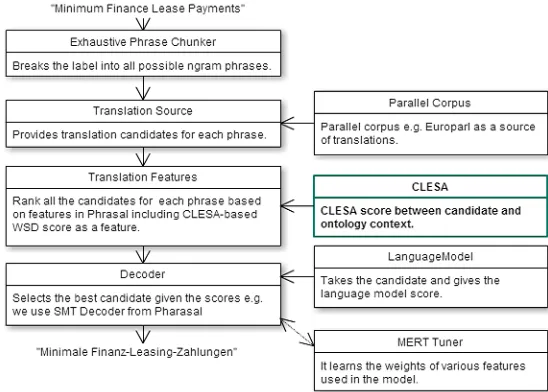
Figure 1: Phrase-based SMT architecture with CLESA integration.
Fig.1 shows the architecture applied for translating the ontologies. As an example, suppose that the SMT system has already been trained with some parallel corpus, for instance, Europarl corpus (Koehn, 2005). It receives an example English label "Minimum Finance Lease Payments" from a source ontology to translate it into German. The label is broken into a phrase chunk list containing all the possible phrases by theExhaustive Phrase Chunker. As a next step, theTranslation Sourceprovides all the possible translation candidates for each phrase chunk in the chunk list. Translation Sourcecan be a phrase table made from some parallel corpus like Europarl. Then, scores are assigned to all the translation candidates based on several standardTranslation Featuresexisiting in the Phrasal library. As an additional feature, we introduce one more score based on theCLESAbased semantic relevance of the candidate against the source ontology context, which includes all its labels. All these feature scores are combined by a log-linear model. TheMERT Tuner
(Och, 2003) is just used once to learn the weights of various features used in the model for a particular language pair. In the final step, the decoder performs search over all the translation candidates given the scores fromTranslation Featuresand theLanguage Model, and makes the German translation "Minimale Finanz-Leasing-Zahlungen".
For implementing CLESA, we followed an information retrieval based approach by creating a Lucene2inverted index of a Wikipedia dump from Jan, 2012. As a preprocessing
step, all the Wikipedia namespace type articles such as mediaWiki, talk, help etc. were removed. For creating the weighted vector of concepts for a translation candidate in the
target language, the term is searched over the Wikipedia index of the respective language to retrieve the top associated Wikipedia concepts and the Lucene ranking scores are taken as the associativity weights of the concepts to the term. We took the top 2000 Wikipedia concepts for our experiment as we found that increasing this number did not have any major effect on the translation metrics, but it significantly increases the computational time. As the ontological context for any phrase chunk, we use the source label along with the labels from the connected entities to the source label in the ontology. Thus, the concept vector for the ontological context is created by searching the ontological context in the Wikipedia index of the source language.
4 Evaluation
To evaluate the integration of CLESA in the SMT architecture, we perform the translation of several ontologies and compare the results, against reference translations, with the translations performed by a baseline SMT system. We used widely accepted machine translation metrics in our evaluation: WER (Popovi´c and Ney, 2007), BLEU (Papineni et al., 2002), NIST(Doddington, 2002), METEOR (Banerjee and Lavie, 2005). All the translations were performed for English to Spanish, English to German and English to Dutch language pairs.
4.1 Experimental Setup
To build a baseline SMT system, we used the Stanford Phrasal library trained on EuroParl corpus (Koehn, 2005). In order to define our benchmark, we have used some multilingual ontologies available online (See table 1). For tuning the SMT system using MERT tuner, IFRS ontology was used as it contains 2757 labels (McCrae et al., 2011) for each language in the consideration, which is quite large against the number of labels present in the ontologies used for evaluation. We used a monolingual version of each ontology as input to the evaluation process. Then, we used the labels in the target language as reference translations and compared them to the translations obtained in the process. Finally, the evaluation metrics were computed. To test the effect of CLESA-based disambiguation in SMT, we run the experiments both with our SMT baseline system and with the CLESA integrated in the baseline system.
4.2 Results and Discussions
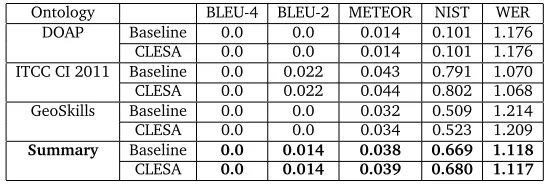
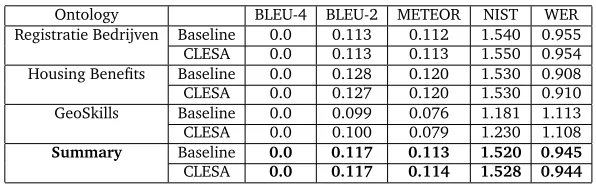
Tables 2, 3 and 4 show the results in our experiments for the English to German, English to Spanish and English to Dutch language pairs respectively.
Ontology English Spanish German Dutch
GeoSkills 211 46 238 360
Crop-Wild Relatives Ontology 1030 1025 0 0
FOAF 88 79 0 0
Housing Benefits 841 0 0 841
Open EHR Reference 36 36 0 0
Registratie Bedrijven 854 0 0 854
DOAP 47 36 35 0
ITCC CI 2011 417 0 417 0
[image:7.420.93.344.71.176.2]Open EHR Demographics 24 24 0 0
Table 1: Multilingual Ontologies with the number of labels in the respective languages Ontology BLEU-4 BLEU-2 METEOR NIST WER
DOAP Baseline 0.0 0.0 0.014 0.101 1.176 CLESA 0.0 0.0 0.014 0.101 1.176 ITCC CI 2011 Baseline 0.0 0.022 0.043 0.791 1.070 CLESA 0.0 0.022 0.044 0.802 1.068 GeoSkills Baseline 0.0 0.0 0.032 0.509 1.214 CLESA 0.0 0.0 0.034 0.523 1.209
Summary Baseline 0.0 0.014 0.038 0.669 1.118
CLESA 0.0 0.014 0.039 0.680 1.117
Table 2: Baseline and Baseline+CLESA scores for English to German
do not suit well to the task of ontology translation as they do in the free text paradigm (McCrae et al., 2011). Therefore, there is a need for the development of new metrics for evaluating the translation of ontologies.
From the result tables, we can see that the use of the CLESA ranker slightly im-proves the baseline results in most of the cases. The improvement is little because the integration of CLESA does not provide new translation candidates to the system, it just gives more weightage to the ones which are semantically more related to the ontological context.
5 Related Work
[image:7.420.80.353.205.298.2]Ontology BLEU-4 BLEU-2 METEOR NIST WER DOAP Baseline 0.0 0.145 0.204 1.891 0.853 CLESA 0.0 0.149 0.211 1.985 0.853 Open EHR Demographics Baseline 0.0 0.0 0.095 0.736 1.028 CLESA 0.0 0.0 0.095 0.736 1.028 CWR Baseline 0.075 0.180 0.170 3.072 0.983 CLESA 0.074 0.180 0.175 3.152 0.986 Open EHR Reference Baseline 0.0 0.152 0.206 1.516 0.933 CLESA 0.0 0.155 0.220 1.600 0.920 GeoSkills Baseline 0.256 0.254 0.246 2.289 0.938 CLESA 0.0 0.230 0.240 2.202 0.954 FOAF Baseline 0.0 0.187 0.204 2.487 0.874 CLESA 0.0 0.187 0.204 2.487 0.874
Summary Baseline 0.069 0.177 0.175 2.888 0.971
[image:8.420.47.358.68.221.2]CLESA 0.061 0.177 0.179 2.958 0.973
Table 3: Baseline and Baseline+CLESA scores for English to Spanish
Ontology BLEU-4 BLEU-2 METEOR NIST WER
Registratie Bedrijven Baseline 0.0 0.113 0.112 1.540 0.955 CLESA 0.0 0.113 0.113 1.550 0.954 Housing Benefits Baseline 0.0 0.128 0.120 1.530 0.908 CLESA 0.0 0.127 0.120 1.530 0.910 GeoSkills Baseline 0.0 0.099 0.076 1.181 1.113 CLESA 0.0 0.100 0.079 1.230 1.108
Summary Baseline 0.0 0.117 0.113 1.520 0.945
CLESA 0.0 0.117 0.114 1.528 0.944
Table 4: Baseline and Baseline+CLESA scores for English to Dutch
that it relies on the existence of the candidate translations in EuroWordNet (or similar resources) in order to operate. On the contrary, the CLESA-based approach does not suffer such limitation. Our approach does not, therefore, depend on the availability of external translation services. Furthermore, thanks to the wide language coverage of Wikipedia, the extension of the CLESA-based approach to other language pairs is straightforward.
The problem of translating ontologies has already been discussed in the context of SMT (McCrae et al., 2011), although, not much work has been done in actually experiment-ing with WSD in a SMT system for translatexperiment-ing ontologies.
[image:8.420.54.352.246.341.2]Conclusion
We have presented an approach for ontology translation that uses CLESA for leveraging the ontological context in a Statistical Machine Translation process. Integration of CLESA based disambiguation using all the ontology labels in SMT architecture, provides the selection of the translation candidates given the ontological context, in contrast to the standard phrase-based model, which considers only the local context in the label. The results show little improvements over the baseline scores for most of the evaluation metrics, thus proving that exploring the ontology context based disambiguation may be beneficial in the process of translating the ontologies. Nevertheless, more research is needed in that direction in order to attain better results. As future work, we plan to investigate better ways of exploiting the ontological context for machine translation of labels and to compare our system against the Label-Translator.
Acknowledgements
This work is supported in part by the European Union under Grant No. 248458 for the Monnet project.
References
Banerjee, S. and Lavie, A. (2005). Meteor: An automatic metric for mt evaluation with improved correlation with human judgments. pages 65–72.
Blei, D. M., Ng, A. Y., and Jordan, M. I. (2003). Latent dirichlet allocation.J. Mach. Learn. Res., 3:993–1022.
Buitelaar, P., Cimiano, P., Frank, A., Hartung, M., and Racioppa, S. (2008). Ontology-based information extraction and integration from heterogeneous data sources.International Journal of Human Computer Studies (JHCS), 66:759–788.
Carpuat, M. and Wu, D. (2005). Evaluating the word sense disambiguation performance of statistical machine translation.
Carpuat, M. and Wu, D. (2007). Improving statistical machine translation using word sense disambiguation. InIn The 2007 Joint Conference on Empirical Methods in Natural Language Processing and Computational Natural Language Learning (EMNLP-CoNLL 2007, pages 61–72.
Cer, D., Galley, M., Jurafsky, D., and Manning, C. D. (2010). Phrasal: a toolkit for statistical machine translation with facilities for extraction and incorporation of arbitrary model features. InProceedings of the NAACL HLT 2010 Demonstration Session, HLT-DEMO ’10, pages 9–12, Stroudsburg, PA, USA. Association for Computational Linguistics.
Chan, Y. S., Ng, H. T., and Chiang, D. (2007). Word sense disambiguation improves statistical machine translation. InProceedings of the 45th Annual Meeting of the Associa-tion of ComputaAssocia-tional Linguistics, pages 33–40, Prague, Czech Republic. Association for Computational Linguistics.
Cimiano, P., Schultz, A., Sizov, S., Sorg, P., and Staab, S. (2009). Explicit versus latent concept models for cross-language information retrieval. InProceedings of the 21st interna-tional jont conference on Artifical intelligence, IJCAI’09, pages 1513–1518, San Francisco, CA, USA. Morgan Kaufmann Publishers Inc.
Doddington, G. (2002). Automatic evaluation of machine translation quality using n-gram co-occurrence statistics. InProceedings of the second international conference on Human Language Technology Research, HLT ’02, pages 138–145, San Francisco, CA, USA. Morgan Kaufmann Publishers Inc.
Embley, D. W., Liddle, S. W., Lonsdale, D. W., and Tijerino, Y. (2011). Multilingual ontologies for cross-language information extraction and semantic search. InProceedings of the 30th international conference on Conceptual modeling, ER’11, pages 147–160, Berlin, Heidelberg. Springer-Verlag.
Espinoza, M., Gómez-Pérez, A., and Mena, E. (2008a). Enriching an ontology with multilingual information. InProceedings of the 5th European semantic web conference on The semantic web:research and applications, ESWC’08, pages 333–347, Berlin, Heidelberg. Springer-Verlag.
Espinoza, M., Gómez-Pérez, A., and Mena, E. (2008b). Labeltranslator - a tool to automati-cally localize an ontology. InProceedings of the 5th European semantic web conference on The semantic web: research and applications, ESWC 08, pages 792–796, Berlin, Heidelberg. Springer-Verlag.
Fernandez, M., Lopez, V., Sabou, M., Uren, V., Vallet, D., Motta, E., and Castells, P. (2008). Semantic search meets the web. InProceedings of the 2008 IEEE International Conference on Semantic Computing, ICSC ’08, pages 253–260, Washington, DC, USA. IEEE Computer Society.
Gabrilovich, E. and Markovitch, S. (2007). Computing semantic relatedness using wikipedia-based explicit semantic analysis. InProceedings of the 20th international joint conference on Artifical intelligence, IJCAI’07, pages 1606–1611, San Francisco, CA, USA. Morgan Kaufmann Publishers Inc.
Gracia, J., Montiel-Ponsoda, E., Cimiano, P., Gómez-Pérez, A., Buitelaar, P., and McCrae, J. (2012). Challenges for the multilingual web of data.Web Semant., 11:63–71.
Gruber, T. R. (1993). A translation approach to portable ontology specifications. KNOWL-EDGE ACQUISITION, 5:199–220.
Koehn, P. (2005). Europarl: A Parallel Corpus for Statistical Machine Translation. In Con-ference Proceedings: the tenth Machine Translation Summit, pages 79–86, Phuket, Thailand. AAMT, AAMT.
Koehn, P., Och, F. J., and Marcu, D. (2003). Statistical phrase-based translation. In
Proceedings of the 2003 Conference of the North American Chapter of the Association for Computational Linguistics on Human Language Technology - Volume 1, NAACL ’03, pages 48–54, Stroudsburg, PA, USA. Association for Computational Linguistics.
McCrae, J., Espinoza, M., Montiel-Ponsoda, E., Aguado-de Cea, G., and Cimiano, P. (2011). Combining statistical and semantic approaches to the translation of ontologies and tax-onomies. InProceedings of the Fifth Workshop on Syntax, Semantics and Structure in Statistical Translation, SSST-5, pages 116–125, Stroudsburg, PA, USA. Association for Computational Linguistics.
Och, F. J. (2003). Minimum error rate training in statistical machine translation. In
Proceedings of the 41st Annual Meeting on Association for Computational Linguistics - Volume 1, ACL ’03, pages 160–167, Stroudsburg, PA, USA. Association for Computational Linguistics.
Papineni, K., Roukos, S., Ward, T., and jing Zhu, W. (2002). Bleu: a method for automatic evaluation of machine translation. pages 311–318.
Popovi´c, M. and Ney, H. (2007). Word error rates: decomposition over pos classes and applications for error analysis. InProceedings of the Second Workshop on Statistical Machine Translation, StatMT ’07, pages 48–55, Stroudsburg, PA, USA. Association for Computational Linguistics.
Sorg, P. and Cimiano, P. (2008). Cross-lingual information retrieval with explicit semantic analysis. InWorking Notes for the CLEF 2008 Workshop.