Recurrent Convolutional Neural Networks for Discourse Compositionality
Nal Kalchbrenner
Department of Computer Science Oxford University
Phil Blunsom
Department of Computer Science Oxford University
Abstract
The compositionality of meaning extends beyond the single sentence. Just as words combine to form the meaning of sen-tences, so do sentences combine to form the meaning of paragraphs, dialogues and general discourse. We introduce both a sentence model and a discourse model cor-responding to the two levels of composi-tionality. The sentence model adopts con-volution as the central operation for com-posing semantic vectors and is based on a novel hierarchical convolutional neural network. The discourse model extends the sentence model and is based on a recur-rent neural network that is conditioned in a novel way both on the current sentence and on the current speaker. The discourse model is able to capture both the sequen-tiality of sentences and the interaction be-tween different speakers. Without feature engineering or pretraining and with simple greedy decoding, the discourse model cou-pled to the sentence model obtains state of the art performance on a dialogue act clas-sification experiment.
1 Introduction
There are at least two levels at which the mean-ing of smaller lmean-inguistic units is composed to form the meaning of larger linguistic units. The first level is that of sentential compositionality, where the meaning of words composes to form the mean-ing of the sentence or utterance that contains them (Frege, 1892). The second level extends beyond the first and involves general discourse composi-tionality, where the meaning of multiple sentences or utterances composes to form the meaning of the paragraph, document or dialogue that com-prises them (Korta and Perry, 2012; Potts, 2011).
The problem of discourse compositionality is the problem of modelling how the meaning of general discourse composes from the meaning of the sen-tences involved and, since the latter in turn stems from the meaning of the words, how the meaning of discourse composes from the words themselves. Tackling the problem of discourse composition-ality promises to be central to a number of differ-ent applications. These include sdiffer-entimdiffer-ent or topic classification of single sentences within the con-text of a longer discourse, the recognition of di-alogue acts within a conversation, the classifica-tion of a discourse as a whole and the attainment of general unsupervised or semi-supervised repre-sentations of a discourse for potential use in di-alogue tracking and question answering systems and machine translation, among others.
To this end much work has been done on mod-elling the meaning of single words by way of se-mantic vectors (Turney and Pantel, 2010; Col-lobert and Weston, 2008) and the latter have found applicability in areas such as information retrieval (Jones et al., 2006). With regard to modelling the meaning of sentences and sentential compo-sitionality, recent proposals have included sim-ple additive and multiplicative models that do not take into account sentential features such as word order or syntactic structure (Mitchell and Lapata, 2010), matrix-vector based models that do take into account such features but are lim-ited to phrases of a specific syntactic type (Ba-roni and Zamparelli, 2010) and structured mod-els that fully capture such features (Grefenstette et al., 2011) and are embedded within a deep neu-ral architecture (Socher et al., 2012; Hermann and Blunsom, 2013). It is notable that the additive and multiplicative models as well as simple, non-compositional bag ofn-grams and word vector av-eraging models have equalled or outperformed the structured models at certain phrase similarity (Bla-coe and Lapata, 2012) and sentiment
tion tasks (Scheible and Sch¨utze, 2013; Wang and Manning, 2012).
With regard to discourse compositionality, most of the proposals aimed at capturing semantic as-pects of paragraphs or longer texts have focused on bag of n-grams or sentence vector averaging approaches (Wang and Manning, 2012; Socher et al., 2012). In addition, the recognition of dialogue acts within dialogues has largely been treated in non-compositional ways by way of language mod-els coupled to hidden Markov sequence modmod-els (Stolcke et al., 2000). Principled approaches to discourse compositionality have largely been un-explored.
We introduce a novel model for sentential com-positionality. The composition operation is based on a hierarchy of one dimensional convolutions. The convolutions are applied feature-wise, that is they are applied across each feature of the word vectors in the sentence. The weights adopted in each convolution are different for each feature, but do not depend on the different words being com-posed. The hierarchy of convolution operations involves a sequence of convolution kernels of in-creasing sizes (Fig. 1). This allows for the com-position operation to be applied to sentences of any length, while keeping the model at a depth of roughly √2l where l is the length of the sen-tence. The hierarchy of feature-wise convolution operations followed by sigmoid non-linear acti-vation functions results in a hierarchical convo-lutional neural network (HCNN) based on a con-volutional architecture (LeCun et al., 2001). The HCNN shares with the structured models the as-pect that it is sensitive to word order and adopts a hierarchical architecture, although it is not based on explicit syntactic structure.
We also introduce a novel model for discourse compositionality. The discourse model is based on a recurrent neural network (RNN) architecture that is a powerful model for sequences (Sutskever et al., 2011; Mikolov et al., 2010). The model aims at capturing two central aspects of discourse and its meaning: the sequentiality of the sentences or utterances in the discourse and, where applica-ble, the interactions between the different speak-ers. The underlying RNN has its recurrent and out-put weights conditioned on the respective speaker, while simultaneously taking as input at every turn the sentence vector for the current sentence gener-ated through the sentence model (Fig. 2).
Recurrent Convolutional Neural Networks for Discourse Compositionality
Nal Kalchbrenner
Department of Computer Science Oxford University [email protected]
Phil Blunsom
Department of Computer Science Oxford University [email protected]
Abstract
The compositionality of meaning extends beyond the single sentence. Just as words combine to form the meaning of an sen-tence, so do sentences in turn combine se-quentially to form the meaning of general discourse. Discourse may take the form of paragraphs, soliloqui or conversations between multiple speakers. The problem of cross-sentential compositionality is the problem of modelling how the meaning of the various forms of discourse arises from the meaning of the utterances and the words involved.
We here introduce
1 Introduction
2 Compositionality Models 2.1 Sentence Model
2.2 Discourse Model
3
4 Credits
This document has been adapted from the instruc-tions for earlier ACL proceedings, including those for ACL-2012 by Maggie Li and Michael White, those from ACL-2010 by Jing-Shing Chang and Philipp Koehn, those for ACL-2008 by Johanna D. Moore, Simone Teufel, James Allan, and Sadaoki Furui, those for ACL-2005 by Hwee Tou Ng and Kemal Oflazer, those for ACL-2002 by Eugene Charniak and Dekang Lin, and earlier ACL and EACL formats. Those versions were written by several people, including John Chen, Henry S. Thompson and Donald Walker. Additional ele-ments were taken from the formatting instructions of theInternational Joint Conference on Artificial Intelligence.
5 Introduction
Word vectors Compositionality
Discourse compositionality
*Applications in context of a discourse
Sentence(n)
Agent(n)
Agent(n 1)
Words(n)
Class(n)
Class(n 1)
k= 2 k= 3 k= 4
6 General Instructions
Manuscripts must be in two-column format. Ex-ceptions to the two-column format include the ti-tle, authors’ names and complete addresses, which must be centered at the top of the first page, and any full-width figures or tables (see the guidelines in Subsection 6.5). Type single-spaced. Start all pages directly under the top margin. See the guidelines later regarding formatting the first page. The manuscript should be printed single-sided and its length should not exceed the maximum page limit described in Section 8. Do not number the pages.
6.1 Electronically-available resources ACL 2013 provides this description in LATEX2e
(acl2013.tex) and PDF format (acl2013.pdf), along with the LATEX2e style file used to format
Recurrent Convolutional Neural Networks for Discourse Compositionality
Nal Kalchbrenner
Department of Computer Science Oxford University [email protected]
Phil Blunsom
Department of Computer Science Oxford University [email protected]
Abstract
The compositionality of meaning extends beyond the single sentence. Just as words combine to form the meaning of an sen-tence, so do sentences in turn combine se-quentially to form the meaning of general discourse. Discourse may take the form of paragraphs, soliloqui or conversations between multiple speakers. The problem of cross-sentential compositionality is the problem of modelling how the meaning of the various forms of discourse arises from the meaning of the utterances and the words involved.
We here introduce
1 Introduction
2 Compositionality Models 2.1 Sentence Model
2.2 Discourse Model
3
4 Credits
This document has been adapted from the instruc-tions for earlier ACL proceedings, including those for ACL-2012 by Maggie Li and Michael White, those from ACL-2010 by Jing-Shing Chang and Philipp Koehn, those for ACL-2008 by Johanna D. Moore, Simone Teufel, James Allan, and Sadaoki Furui, those for ACL-2005 by Hwee Tou Ng and Kemal Oflazer, those for ACL-2002 by Eugene Charniak and Dekang Lin, and earlier ACL and EACL formats. Those versions were written by several people, including John Chen, Henry S. Thompson and Donald Walker. Additional ele-ments were taken from the formatting instructions of theInternational Joint Conference on Artificial Intelligence.
5 Introduction
Word vectors Compositionality
Discourse compositionality
*Applications in context of a discourse
Sentence(n)
Agent(n)
Agent(n 1)
Words(n)
Class(n)
Class(n 1)
k= 2 k= 3 k= 4
6 General Instructions
Manuscripts must be in two-column format. Ex-ceptions to the two-column format include the ti-tle, authors’ names and complete addresses, which must be centered at the top of the first page, and any full-width figures or tables (see the guidelines in Subsection 6.5). Type single-spaced. Start all pages directly under the top margin. See the guidelines later regarding formatting the first page. The manuscript should be printed single-sided and its length should not exceed the maximum page limit described in Section 8. Do not number the pages.
6.1 Electronically-available resources ACL 2013 provides this description in LATEX2e
(acl2013.tex) and PDF format (acl2013.pdf), along with the LATEX2e style file used to format
Recurrent Convolutional Neural Networks for Discourse Compositionality
Nal Kalchbrenner
Department of Computer Science Oxford University [email protected]
Phil Blunsom
Department of Computer Science Oxford University [email protected]
Abstract
The compositionality of meaning extends beyond the single sentence. Just as words combine to form the meaning of an sen-tence, so do sentences in turn combine se-quentially to form the meaning of general discourse. Discourse may take the form of paragraphs, soliloqui or conversations between multiple speakers. The problem of cross-sentential compositionality is the problem of modelling how the meaning of the various forms of discourse arises from the meaning of the utterances and the words involved.
We here introduce
1 Introduction
2 Compositionality Models 2.1 Sentence Model
2.2 Discourse Model
3
4 Credits
This document has been adapted from the instruc-tions for earlier ACL proceedings, including those for ACL-2012 by Maggie Li and Michael White, those from ACL-2010 by Jing-Shing Chang and Philipp Koehn, those for ACL-2008 by Johanna D. Moore, Simone Teufel, James Allan, and Sadaoki Furui, those for ACL-2005 by Hwee Tou Ng and Kemal Oflazer, those for ACL-2002 by Eugene Charniak and Dekang Lin, and earlier ACL and EACL formats. Those versions were written by several people, including John Chen, Henry S. Thompson and Donald Walker. Additional ele-ments were taken from the formatting instructions of theInternational Joint Conference on Artificial Intelligence.
5 Introduction
Word vectors Compositionality
Discourse compositionality
*Applications in context of a discourse
Sentence(n)
Agent(n)
Agent(n 1)
Words(n)
Class(n)
Class(n 1)
k= 2 k= 3 k= 4
6 General Instructions
Manuscripts must be in two-column format. Ex-ceptions to the two-column format include the ti-tle, authors’ names and complete addresses, which must be centered at the top of the first page, and any full-width figures or tables (see the guidelines in Subsection 6.5). Type single-spaced. Start all pages directly under the top margin. See the guidelines later regarding formatting the first page. The manuscript should be printed single-sided and its length should not exceed the maximum page limit described in Section 8. Do not number the pages.
6.1 Electronically-available resources ACL 2013 provides this description in LATEX2e
(acl2013.tex) and PDF format (acl2013.pdf), along with the LATEX2e style file used to format
Recurrent Convolutional Neural Networks for Discourse Compositionality
Nal Kalchbrenner
Department of Computer Science Oxford University [email protected]
Phil Blunsom
Department of Computer Science Oxford University [email protected]
Abstract
The compositionality of meaning extends beyond the single sentence. Just as words combine to form the meaning of an sen-tence, so do sentences in turn combine se-quentially to form the meaning of general discourse. Discourse may take the form of paragraphs, soliloqui or conversations between multiple speakers. The problem of cross-sentential compositionality is the problem of modelling how the meaning of the various forms of discourse arises from the meaning of the utterances and the words involved.
We here introduce
1 Introduction
2 Compositionality Models 2.1 Sentence Model
2.2 Discourse Model
3
4 Credits
This document has been adapted from the instruc-tions for earlier ACL proceedings, including those for ACL-2012 by Maggie Li and Michael White, those from ACL-2010 by Jing-Shing Chang and Philipp Koehn, those for ACL-2008 by Johanna D. Moore, Simone Teufel, James Allan, and Sadaoki Furui, those for ACL-2005 by Hwee Tou Ng and Kemal Oflazer, those for ACL-2002 by Eugene Charniak and Dekang Lin, and earlier ACL and EACL formats. Those versions were written by several people, including John Chen, Henry S. Thompson and Donald Walker. Additional ele-ments were taken from the formatting instructions of theInternational Joint Conference on Artificial Intelligence.
5 Introduction
Word vectors Compositionality
Discourse compositionality
*Applications in context of a discourse
Sentence(n)
Agent(n)
Agent(n 1)
Words(n)
Class(n)
Class(n 1)
k= 2 k= 3 k= 4
6 General Instructions
Manuscripts must be in two-column format. Ex-ceptions to the two-column format include the ti-tle, authors’ names and complete addresses, which must be centered at the top of the first page, and any full-width figures or tables (see the guidelines in Subsection 6.5). Type single-spaced. Start all pages directly under the top margin. See the guidelines later regarding formatting the first page. The manuscript should be printed single-sided and its length should not exceed the maximum page limit described in Section 8. Do not number the pages.
6.1 Electronically-available resources ACL 2013 provides this description in LATEX2e
(acl2013.tex) and PDF format (acl2013.pdf), along with the LATEX2e style file used to format
Figure 1: A hierarchical convolutional neural net-work for sentential compositionality. The bottom layer represents a single feature across all the word vectors in the sentence. The top layer is the value for that feature in the resulting sentence vector. Lines represent single weights and color coded lines indicate sharing of weights. The parameter k indicates the size of the convolution kernel at the corresponding layer.
We experiment with the discourse model cou-pled to the sentence model on the task of recog-nizing dialogue acts of utterances within a conver-sation. The dataset is given by 1134 transcribed and annotated telephone conversations amounting to about 200K utterances from the Switchboard Dialogue Act Corpus (Calhoun et al., 2010).1 The model is trained in a supervised setting without previous pretraining; word vectors are also ran-domly initialised. The model learns a probability distribution over the dialogue acts at step igiven the sequence of utterances up to step i, the se-quence of acts up to the previous stepi−1and the
binary sequence of agents up to the current step i. Predicting the sequence of dialogue acts is per-formed in a greedy fashion.2
We proceed as follows. In Sect. 2 we give the motivation and the definition for the HCNN sen-tence model. In Sect. 3 we do the same for the RCNN discourse model. In Sect. 4 we describe the dialogue act classification experiment and the training procedure. We also inspect the discourse vector representations produced by the model. We conclude in Sect. 5.
1The dataset is available at compprag.
christopherpotts.net/swda.html
S
I Oi
xi-1 P(x )i
i-1
H
[image:3.595.73.288.66.262.2]Hello HAL do you read me si
Figure 2: Recurrent convolutional neural network (RCNN) discourse model based on a RNN archi-tecture. At each step the RCNN takes as input the current sentence vector si generated through the HCNN sentence model and the previous label xi−1 to predict a probability distribution over the
current labelP(xi). The recurrent weightsHi−1 are conditioned on the previous agent ai−1 and
the output weights are conditioned on the current agentai. Note also the sentence matrixMsof the sentence model and the hierarchy of convolutions applied to each feature that is a row inMsto pro-duce the corresponding feature insi.
2 Sentence Model
The general aim of the sentence model is to com-pute a vector for a sentencesgiven the sequence of words insand a vector for each of the words. The computation captures certain general consid-erations regarding sentential compositionality. We first relate such considerations and we then pro-ceed to give a definition of the model.
2.1 Sentential compositionality
There are three main aspects of sentential compo-sitionality that the model aims at capturing. To relate these, it is useful to note the following basic property of the model: a sentencesis paired to the matrixMs whose columns are given sequentially by the vectors of the words ins. A row inMs cor-responds to the values of the corresponding feature across all the word vectors. The first layer of the network in Fig. 1 represents one such row ofMs, whereas the whole matrixMs is depicted in Fig. 2. The three considerations are as follows.
First, at the initial stage of the composition, the value of a feature in the sentence vector is a function of the values of the same feature in the word vectors. That is, them-th value in the sentence vector of s is a function of the m-th row of Ms. This aspect is preserved in the ad-ditive and multiplicative models where the com-position operations are, respectively, addition +
and component-wise multiplication . The cur-rent model preserves the aspect up to the compu-tation of the sentence vector s by adopting one-dimensional, feature-wise convolution operations. Subsequently, the discourse model that uses the sentence vectorsincludes transformations across the features ofs(the transformationSin Fig. 2).
The second consideration concerns the hierar-chical aspect of the composition operation. We take the compositionality of meaning to initially yield local effects across neighbouring words and then yield increasingly more global effects across all the words in the sentence. Composition oper-ations like those in the structured models that are guided by the syntactic parse tree of the sentence capture this trait. The sentence model preserves this aspect not by way of syntactic structure, but by adopting convolution kernels of gradually in-creasing sizes that span an inin-creasing number of words and ultimately the entire sentence.
The third aspect concerns the dependence of the composition operation. The operation is taken to depend on the different features, but not on the dif-ferent words. Word specific parameters are intro-duced only by way of the learnt word vectors, but no word specific operations are learnt. We achieve this by using a single convolution kernel across a feature, and by utilizing different convolution ker-nels for different features. Given these three as-pects of sentential compositionality, we now pro-ceed to describe the sentence model in detail.
2.2 Hierarchical Convolutional Neural Network
k
k
k
k m
m
m
m
1
1 2
2 3
3
4
4
(k m)
*
1Figure 3: Convolution of a vectormwith a kernel kof size 4.
2.2.1 Kernel and One-dimensional Convolution
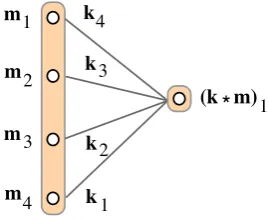
Given a sentencesand its paired matrix Ms, let m be a feature that is a row in Ms. Before defining kernels and the convolution operation, let us consider the underlying operation of local weighted addition. Let w1, ..., wk be a sequence ofkweights; given the featurem, local weighted addition over thefirstkvalues ofmgives:
y =w1m1+...+wkmk (1) Then, a kernel simply defines the value of k by specifying the sequence of weightsw1, ..., wk and the one-dimensional convolution applies local weighted addition with thekweights to each sub-sequence of values ofm.
More precisely, let a one-dimensional kernelk be a vector of weights and assume |k| ≤ |m|, where | · | is the number of elements in a vec-tor. Then we define the discrete, valid, one-dimensional convolution(k∗m)of kernelkand featuremby:
(k∗m)i := k X
j=1
kj·mk+i−j (2)
wherek =|k|and|k∗m|=|m| −k+ 1. Each
value ink∗mis a sum ofkvalues ofmweighted by values ink(Fig. 3). To define the hierarchical architecture of the model, we need to define a se-quence of kernel sizes and associated weights. To this we turn next.
2.2.2 Sequence of Kernel Sizes
Let l be the number of words in the sentence s. The sequence of kernel sizeshkliii≤t depends
only on the length ofs and itself has lengtht = d√2le −1. It is given recursively by:
kl1= 2, kli+1 =kli+ 1, ktl=l− t−1
X
j=1
(klj−1)
[image:4.595.113.248.77.187.2](3) That is, kernel sizes increase by one until the re-sulting convolved vector is smaller or equal to the last kernel size; see for example the kernel sizes in Fig. 1. Note that, for a sentence of lengthl, the number of layers in the HCNN including the input layer will be t + 1 as convolution with the
cor-responding kernel is applied at every layer of the model. Let us now proceed to define the hierarchy of layers in the HCNN.
2.2.3 Composition Operation in a HCNN Given a sentence s, its length l and a sequence of kernel sizes hkilii≤t, we may now give the
recursive definition that yields the hierarchy of one-dimensional convolution operations applied to each feature f that is a row in Ms. Specifi-cally, for each featuref, let Kfi be a sequence of tkernels, where the size of the kernel|Kfi|= kil. Then we have the hierarchy of matrices and corre-sponding features as follows:
M1f,:=Msf,: (4)
Mif,+1: =σ(Kfi ∗Mif,:+bif ) (5)
for some non-linear sigmoid functionσ and bias bi
f, where i ranges over 1, ..., t. In sum, one-dimensional convolution is applied feature-wise to each feature of a matrix at a certain layer, where the kernel weights depend both on the layer and the feature at hand (Fig. 1). A hierarchy of matri-ces is thus generated with the top matrix being a single vector for the sentence.
2.2.4 Multiple merged HCNNs
Optionally one may consider multiple parallel HCNNs that are merged according to different strategies either at the top sentence vector layer or at intermediate layers. The weights in the word vectors may be tied across different HCNNs. Al-though potentially useful, multiple merged HC-NNs are not used in the experiment below.
Open the pod bay doors HAL s I'm afraid I can't do that Dave
S S
i si+1
I
H
O O
i
i i+1
P(x ) P(x )
i+1
i
xi-1
I
[image:5.595.82.513.76.276.2]xi
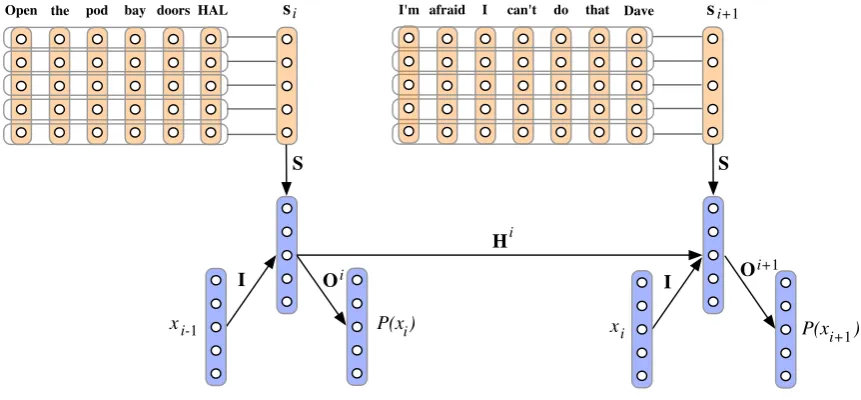
Figure 4: Unravelling of a RCNN discourse model to depth d = 2. The recurrent Hi and outputOi weights are conditioned on the respective agentsai.
3 Discourse Model
The discourse model adapts a RNN architecture in order to capture central properties of discourse. We here first describe such properties and then de-fine the model itself.
3.1 Discourse Compositionality
The meaning of discourse - and of words and utter-ances within it - is often a result of a rich ensemble of context, of speakers’ intentions and actions and of other relevant surrounding circumstances (Ko-rta and Perry, 2012; Potts, 2011). Far from cap-turing all aspects of discourse meaning, we aim at capturing in the model at least two of the most prominent ones: the sequentiality of the utterances and the interactions between the speakers.
Concerning sequentiality, just the way the meaning of a sentence generally changes if words in it are permuted, so does the meaning of a para-graph or dialogue change if one permutes the sen-tences or utterances within. The change of mean-ing is more marked the larger the shift in the order of the sentences. Especially in tasks where one is concerned with a specific sentence within the con-text of the previous discourse, capturing the order of the sentences preceding the one at hand may be particularly crucial.
Concerning the speakers’ interactions, the meaning of a speaker’s utterance within a dis-course is differentially affected by the speaker’s previous utterances as opposed tootherspeakers’
previous utterances. Where applicable we aim at making the computed meaning vectors reflect the current speaker and the sequence of interactions with the previous speakers. With these two aims in mind, let us now proceed to define the model. 3.2 Recurrent Convolutional Neural Network The discourse model coupled to the sentence model is based on a RNN architecture with inputs from a HCNN and with the recurrent and output weights conditioned on the respective speakers.
We take as given a sequence of sentences or ut-terancess1, ..., sT, each in turn being a sequence of words si = y1i...yli, a sequence of labels x1, ..., xT and a sequence of speakers or agents a1, ..., aT, in such way that the i-th utterance is performed by thei-th agent and has labelxi. We denote bysithe sentence vector computed by way of the sentence model for the sentence si. The RCNN computes probability distributions pi for the label at stepiby iterating the following equa-tions:
hi=σ(Ixi−1+Hi−1hi−1+Ssi+bh) (6) pi=sof tmax(Oihi+bo) (7) where I,Hi,Oi are corresponding weight matri-ces for each agentaiandsof tmax(y)k=
eyk
P jeyj returns a probability distribution. Thuspi is taken to model the following predictive distribution:
Dialogue Act Label Example Train (%) Test (%)
Statement And, uh, it’s a legal firm office. 36.9 31.5 Backchannel/Acknowledge Yeah, anything could happen. 18.8 18.2
Opinion I think that would be great. 12.7 17.1
Abandoned/Uninterpretable So, - 7.6 8.6
Agreement/Accept Yes, exactly. 5.5 5.0
Appreciation Wow. 2.3 2.2
Yes−No−Question Is that what you do? 2.3 2.0
Non−Verbal [Laughter], [Throat-clearing] 1.7 1.9
Other labels (34) 12.2 13.5
Total number of utterances 196258 4186
[image:6.595.103.494.61.230.2]Total number of dialogues 1115 19
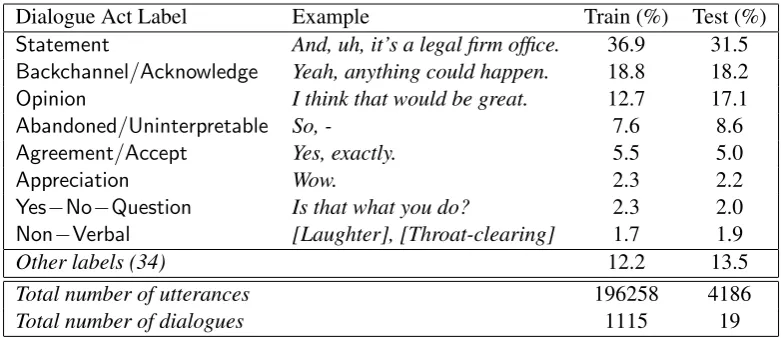
Table 1: Most frequent dialogue act labels with examples and frequencies in train and test data.
An RCNN and the unravelling to depthd= 2are
depicted respectively in Fig. 2 and Fig. 4. With regards to vector representations of discourse, we take the hidden layer hi as the vector represent-ing the discourse up to stepi. This concludes the description of the discourse model. Let us now consider the experiment.
4 Predicting Dialogue Acts
We experiment with the prediction of dialogue acts within a conversation. A dialogue act spec-ifies the pragmatic role of an utterance and helps identifying the speaker’s intentions (Austin, 1962; Korta and Perry, 2012). The automated recog-nition of dialogue acts is crucial for dialogue state tracking within spoken dialogue systems (Williams, 2012). We first describe the Switch-board Dialogue Act (SwDA) corpus (Calhoun et al., 2010) that serves as the dataset in the experi-ment. We report on the training procedure and the results and we make some qualitative observations regarding the discourse representations produced by the model.
4.1 SwDA Corpus
The SwDA corpus contains audio recordings and transcripts of telephone conversations between multiple speakers that do not know each other and are given a topic for discussion. For a given utter-ance we use the transcript of the utterutter-ance, the dia-logue act label and the speaker’s label; no other an-notations are used in the model. Overall there are 42 distinct dialogue act labels such asStatement
andOpinion(Tab.1). We adopt the same data split
of 1115 train dialogues and 19 test dialogues as used in (Stolcke et al., 2000).
4.2 Objective Function and Training
We minimise the cross-entropy error of the pre-dicted and the true distributions and include an l2 regularisation parameter. The RCNN is
trun-cated to a depth d = 2 so that the prediction of
a dialogue act depends on the previous two utter-ances, speakers and dialogue acts; adopting depths > 2 has not yielded improvements in the
experi-ment. The derivatives are efficiently computed by back-propagation (Rumelhart et al., 1986). The word vectors are initialised to random vectors of length 25 and no pretraining procedure is per-formed. We minimise the objective using L-BFGS in mini-batch mode; the minimisation converges smoothly.
4.3 Prediction Method and Results
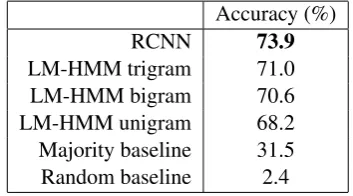
The prediction of a dialogue act is performed in a greedy fashion. Given the two previously pre-dicted actsxˆi−1,xˆi−2, one chooses the actxˆi that has the maximal probability in the predicted dis-tribution P(xi). The LM-HMM model of (Stol-cke et al., 2000) learns a language model for each dialogue act and a Hidden Markov Model for the sequence of dialogue acts and it requires all the utterances in a dialogue in order to predict the dia-logue act of any one of the utterances. The RCNN makes the weaker assumption that only the utter-ances up to utteranceiare available to predict the dialogue actxˆi. The accuracy results of the
mod-els are compared in Tab. 3.
4.4 Discourse Vector Representations
Center A:Do you repair your own car? A:– I guess we can start. A:Did you use to live around here?
Dialogue B:I try to, whenever I can. B:Okay. B:Uh, Redwood City.
First NN A:Do you do it every day? A:I think for serial murder – A:Can you stand up in it?
B:I try to every day. B:Uh-huh. B:Uh, in parts.
Second NN A:Well, do you have any children? A:The USSR – wouldn’t do it A:[Laughter] Do you have any kids that you take fishing?
B:I’ve got one. B:Uh-huh. B:Uh, got a stepdaughter.
Third NN A:Do you manage the money? A:It seems to me there needs A:Is our five minutes up? to be some ground, you know,
some rules –
B:Well, I, we talk about it. B:Uh-huh. B:Uh, pretty close to it.
Fourth NN A: Um, do you watch it every A:It sounds to me like, uh, A:Do you usually go out, uh, Sunday? you are doing well. with the children or without them?
[image:7.595.73.534.62.206.2]B:[Breathing] Uh, when I can. B:My husband’s retired. B:Well, a variety. Table 2: Short dialogues and nearest neighbours (NN).
Accuracy (%)
RCNN 73.9
LM-HMM trigram 71.0
LM-HMM bigram 70.6
LM-HMM unigram 68.2
Majority baseline 31.5 Random baseline 2.4
Table 3: SwDA dialogue act tagging accuracies. The LM-HMM results are from (Stolcke et al., 2000). Inter-annotator agreement and theoretical maximum is 84%.
to be the vector representation for the dialogue (Sect. 3.2). Table 2 includes three randomly cho-sen dialogues composed of two utterances each; for each dialogue the table reports the four near-est neighbours. As the word vectors and weights are initialised randomly without pretraining, the word vectors and the weights are induced during training only through the dialogue act labels at-tached to the utterances. The distance between two word, sentence or discourse vectors reflects a notion of pragmatic similarity: two words, sen-tences or discourses are similar if they contribute in a similar way to the pragmatic role of the utter-ance signalled by the associated dialogue act. This is suggested by the examples in Tab. 2, where a centre dialogue and a nearest neighbour may have some semantically different components (e.g. “re-pair your own car” and “manage the money”), but be pragmatically similar and the latter similarity is captured by the representations. In the examples, the meaning of the relevant words in the utter-ances, the speakers’ interactions and the sequence of pragmatic roles are well preserved across the nearest neighbours.
5 Conclusion
Motivated by the compositionality of meaning both in sentences and in general discourse, we have introduced a sentence model based on a novel convolutional architecture and a discourse model based on a novel use of recurrent networks. We have shown that the discourse model together with the sentence model achieves state of the art results in a dialogue act classification experiment with-out feature engineering or pretraining and with simple greedy decoding of the output sequence. We have also seen that the discourse model pro-duces compelling discourse vector representations that are sensitive to the structure of the discourse and promise to capture subtle aspects of discourse comprehension, especially when coupled to fur-ther semantic data and unsupervised pretraining.
Acknowledgments
We thank Ed Grefenstette and Karl Moritz Her-mann for great conversations on the matter. The authors gratefully acknowledge the support of the Clarendon Fund and the EPSRC.
[image:7.595.92.269.245.343.2]References
[Austin1962] John L. Austin. 1962. How to do things with words. Oxford: Clarendon.
[Baroni and Zamparelli2010] Marco Baroni and Roberto Zamparelli. 2010. Nouns are vectors, ad-jectives are matrices: Representing adjective-noun constructions in semantic space. InEMNLP, pages 1183–1193.
[Calhoun et al.2010] Sasha Calhoun, Jean Carletta, Ja-son M. Brenier, Neil Mayo, Dan Jurafsky, Mark Steedman, and David Beaver. 2010. The nxt-format switchboard corpus: a rich resource for investigat-ing the syntax, semantics, pragmatics and prosody of dialogue. Language Resources and Evaluation, 44(4):387–419.
[Collobert and Weston2008] R. Collobert and J. We-ston. 2008. A unified architecture for natural lan-guage processing: Deep neural networks with mul-titask learning. InInternational Conference on Ma-chine Learning, ICML.
[Frege1892] Gottlob Frege. 1892. ¨Uber Sinn und Bedeutung. Zeitschrift f¨ur Philosophie und philosophische Kritik, 100.
[Grefenstette et al.2011] Edward Grefenstette,
Mehrnoosh Sadrzadeh, Stephen Clark, Bob
Coecke, and Stephen Pulman. 2011. Concrete sentence spaces for compositional distributional models of meaning. CoRR, abs/1101.0309.
[Hermann and Blunsom2013] Karl Moritz Hermann and Phil Blunsom. 2013. The Role of Syntax in Vector Space Models of Compositional Semantics. InProceedings of the 51st Annual Meeting of the As-sociation for Computational Linguistics (Volume 1: Long Papers), Sofia, Bulgaria, August. Association for Computational Linguistics. Forthcoming.
[Jones et al.2006] Rosie Jones, Benjamin Rey, Omid Madani, and Wiley Greiner. 2006. Generating query substitutions. InWWW, pages 387–396.
[Korta and Perry2012] Kepa Korta and John Perry. 2012. Pragmatics. In Edward N. Zalta, editor,The Stanford Encyclopedia of Philosophy. Winter 2012 edition.
[LeCun et al.2001] Y. LeCun, L. Bottou, Y. Bengio, and P. Haffner. 2001. Gradient-based learning applied to document recognition. InIntelligent Signal Pro-cessing, pages 306–351. IEEE Press.
[Mikolov et al.2010] Tomas Mikolov, Martin Karafi´at, Lukas Burget, Jan Cernock´y, and Sanjeev Khudan-pur. 2010. Recurrent neural network based lan-guage model. In INTERSPEECH, pages 1045– 1048.
[Mitchell and Lapata2010] Jeff Mitchell and Mirella Lapata. 2010. Composition in distributional models of semantics. Cognitive Science, 34(8):1388–1429.
[Potts2011] Christopher Potts. 2011. Pragmatics. In Ruslan Mitkov, editor, The Oxford Handbook of Computational Linguistics. Oxford University Press, 2 edition.
[Rumelhart et al.1986] D. E. Rumelhart, G. E. Hinton, and R. J. Williams. 1986. Learning internal repre-sentations by error propagation. MIT Press Compu-tational Models Of Cognition And Perception Series, page 318362.
[Scheible and Sch¨utze2013] Christian Scheible and Hinrich Sch¨utze. 2013. Cutting recursive autoen-coder trees. CoRR, abs/1301.2811.
[Socher et al.2012] Richard Socher, Brody Huval, Christopher D. Manning, and Andrew Y. Ng. 2012. Semantic Compositionality Through Recursive Matrix-Vector Spaces. InProceedings of the 2012 Conference on Empirical Methods in Natural Language Processing (EMNLP).
[Stolcke et al.2000] Andreas Stolcke, Klaus Ries, Noah Coccaro, Elizabeth Shriberg, Rebecca A. Bates, Daniel Jurafsky, Paul Taylor, Rachel Martin, Carol Van Ess-Dykema, and Marie Meteer. 2000. Dialog act modeling for automatic tagging and recognition of conversational speech. Computa-tional Linguistics, 26(3):339–373.
[Sutskever et al.2011] Ilya Sutskever, James Martens, and Geoffrey E. Hinton. 2011. Generating text with recurrent neural networks. In ICML, pages 1017– 1024.
[Turney and Pantel2010] Peter D. Turney and Patrick Pantel. 2010. From frequency to meaning: Vec-tor space models of semantics. J. Artif. Intell. Res. (JAIR), 37:141–188.
[Wang and Manning2012] Sida Wang and Christo-pher D. Manning. 2012. Baselines and bigrams: Simple, good sentiment and topic classification. In ACL (2), pages 90–94.