Exploring Features For Localized Detection of Speech Recognition Errors
Eli Pincus
and
Svetlana Stoyanchev
and
Julia Hirschberg
Department of Computer Science, Columbia University, USA
[email protected] & [email protected]
& [email protected]
Abstract
We address the problem of localized error detection in Automatic Speech Recognition (ASR) output to support the generation of tar-geted clarifications in spoken dialogue sys-tems. Localized error detection finds specific mis-recognized words in a user utterance. Tar-geted clarifications, in contrast with generic ‘please repeat/rephrase’ clarifications, target a specific mis-recognized word in an utter-ance (Stoyanchev et al., 2012a) and require accurate detection of such words. We extend and modify work presented in (Stoyanchev et al., 2012b) by experimenting with a new set of features for predicting the likelihood of a local error in an ASR hypothesis on an un-sifted version of the original dataset. We im-prove over baseline results, where only ASR-generated features are used, by constructing optimal feature sets for utterance and word mis-recognition prediction. The f-measure for identifying incorrect utterances improves by 2.2% and by 3.9% for identifiying incorrect words.
1 Introduction
Spoken Dialogue Systems typically indicate their lack of understanding of user input by simple requests for repetition or rephrasing – “I’m sorry, I didn’t under-stand you.”, or “Can you please repeat?”. However human conversational partners generally provide more targeted clarification requests. Corpus analysis of hu-man conversations have shown that people are more likely to indicate what they have understood and what they have not understood by producing reprise clar-ification questions (Purver, 2004; Stoyanchev et al., 2012a), as illustrated in the following exchange where XXX indicates a word misunderstood by speaker B:
A: Do you have any XXX in your bag? B: Do I have any what in my bag?
A reprise clarification question targets a specific mis-recognized word and incorporates mis-recognized context
into a clarification question.
We investigate replacing genericplease repeat clari-fications with more natural targeted clariclari-fications in au-tomatic spoken systems. Targeted clarifications allow users to provide a concise response to a clarification question which is beneficial for spoken systems accept-ing broad vocabulary and flexible syntax. Examples of such systems include tutoring systems, intelligent as-sistants, and spoken translation systems (Litman and Silliman, 2004; Dzikovska et al., 2009; Akbacak et al., 2009).
To enable Spoken Dialogue Systems (SDS) to gen-erate targeted clarification questions, we must first be able to identify mis-recognized words with high accu-racy. We term such mis-recognition detectionlocalized error detection. Accurate distinction between correctly and incorrectly recognized words is essential to the cre-ation of appropriate targeted clarificcre-ation questions.
In previous research on recognition error detection in dialogue systems, researchers have addressed error de-tection at the utterance level (Hirschberg et al., 2004; Komatani and Okuno, 2010). In this paper we present results of classification experiments designed to de-tect localized errors within the utterance. Our base-line results are obtained from a classifier trained only on word posterior probabilities generated by an Auto-matic Speech Recognition (ASR) engine. ASR confi-dence score computation is an active research area, re-lying upon acoustic and lexical collocation information to compute confidence scores. We determine whether improvement over baseline can be achieved by training a classifier for utterance and word mis-recognition pre-diction on an expanded feature set that includes lexical, positional, prosodic, semantic, syntactic as well as ad-ditional ASR score features. All of the features we ex-periment with can be computed from an ASR hypothe-sis without affecting the performance of a SDS materi-ally. After determining optimal feature sets we experi-ment with one- and two-stage approaches for localized error detection. The first simply identifies whether a word is correctly recognized or not. The second first classifies an utterance as incorrect or correct and then classifies errors only on utterances labeled incorrect.
This work extends earlier work in which we eval-uated a smaller set of syntactic and prosodic fea-tures (Stoyanchev et al., 2012b). In addition to im-provements implemented in the ASR engine that we use to produce ASR hypotheses, our current work re-ports results on a larger dataset which includes com-mands to the system and utterances containing disflu-encies. Here, we propose a framework for localized error detection that does not rely upon pre-filtering of the dataset.
In Section 2 we describe our corpus. In Section 3 we discuss our classification experiments. In Section 4 we discuss our results. In Section 5 we present our conclusions and discuss future research.
2 Data
We conduct our machine learning experiments on the DARPA TRANSTAC corpus (Weiss et al., 2008). The TRANSTAC corpus is comprised of staged conversa-tions between American military personnel and Ara-bic interviewees utilizing IraqComm speech-to-speech translation system (Akbacak et al., 2009). This data was collected by NIST between 2005 and 2008 in eval-uation exercises. The dataset contains audio record-ings and manual transcript of English and Arabic utter-ances. We used SRI’s DynaSpeak (Franco et al., 2002) speech recognition system to recognize the English ut-terances and use posterior probabilities from DynaS-peak as our baseline feature. We create a corpus from this dataset that contains over 99% of the English ut-terances. 38 utterances were removed from the dataset either for lack of actual speech data or errors in refer-ence transcription. 26.2% of our cleaned corpus con-sist of mis-recognized instances and 6.4% of the total words in it are incorrectly recognized by DynaSpeak (see Table 1). We are using an unsifted version of the corpus used in our previous work (Stoyanchev et al., 2012b) whose hypotheses were produced with a new version of the DynaSpeak ASR system. In our previous work utterances containing disfluencies and commands to the system were excluded. We seek to avoid the cas-cading errors that would follow from implementing a 2-step framework for localized error detection where the first step is command and disfluency detection and the second step is localized error detection. The 1-step framework also has the advantage of working for all ut-terances including ones that contain commands or dis-fluencies. Due to these differences, our current results are not directly comparable with our previous results.
Table 1: Corpus statistics
Overall Correct ASR Incorr ASR All utts. 3,952 2,914 (73.7%) 1,038 (26.2%) All wrds. 25,333 23,705 (93.6%) 1,628 (6.4%) wrds in err utts 7,888 6,260 (79.4%) 1,628 (20.6%)
3 Method
We analyze how the performance of predicting mis-recognized utterances and words is affected by the use of lexical, positional, prosodic, semantic, and syn-tactic features in addition to ASR confidence scores. We perform machine learning experiments using the Weka Machine Learning Library to construct a J48 decision tree classifier boosted with MultiBoostAB method (Witten and Eibe, 2005).
Baseline confidence featuresWe use ASR posterior scores extracted from the log files output by Dynaspeak as a baseline feature set in our experiments. In the utter-ance mis-recognition prediction experiment, we calcu-late the average of the logarithm of the ASR posterior scores over all words in the hypothesis. In the word mis-recognition prediction experiment we use the log-arithm of the posterior score of a given word.
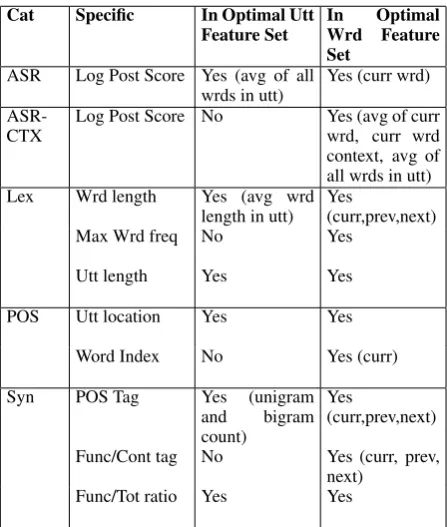
Feature selection We run a heuristic feature ex-ploration experiment to identify optimal feature sets for predicting recognized utterances and mis-recognized words. We first use a greedy approach adding one feature at a time to the baseline ASR feature set and only keep a feature in the set if it improves F-measure predicting mis-recognition. We then use an al-ternate greedy approach in which we begin with a fea-ture set composed of all extracted feafea-tures and proceed to remove one feature at a time and only leave it out of the set if incorrect F-measure improved or remained the same with its absence. The second approach yields the optimal feature sets for both utterance and word mis-recognition prediction. Table 2 lists the features that make up these optimal sets. For incorrect utter-ance prediction, we run a 10-fold cross validation on all utterances. For incorrect word prediction, we run a 10-fold cross validation on all words in mis-recognized utterances.1 We next describe the features we found to
be useful in prediction and those that did not improve performance.
3.1 Useful Features
ASR context featuresWe use the logarithm of the pos-terior score of a given word and the average of the log-arithm of the posterior scores for both a given word and its surrounding context. We use one word context be-fore and after the given word. We also use the average of the logarithm of the posterior scores for all words in the utterance.
Lexical featuresWe hypothesize that properties of words such as length and frequency are predictive of whether a word is correctly recognized. In particular, noting that words of greater length are often better rec-ognized by an ASR engine, we examine the length, fre-quency, and posterior score of the maximum and
min-1Because of the size limitations of our dataset feature
imum words in an utterance. For mis-recognized ut-terance prediction, we find that the average length of a word in the utterance are useful features for predicting both recognized utterances and words. For mis-recognized word prediction, we find the word length of the surrounding words, the current word, and the fre-quency of the longest word in an utterance are useful. We also find thatutterance lengthcalculated in words is a useful feature for predicting both utterance and word mis-recognition.
Positional featuresMotivated by the use of dialogue history features in Lopes et al (2011), we find that the location of the hypothesis relative to the speaker’s first utterance in the dialogue (utterance location) is a use-ful feature. Similarly, we obtain improvement from the
word indexfeature, the distance of the word from the first word in the utterance.
SyntacticPOS tags were shown to be helpful in our previous work and we find that these tags improve the current results as well. We obtain these from the Stan-ford POS tagger (et al., 2003). In mis-recognized ut-terance prediction, we use unigram and bigram counts of POS tags as a feature. For mis-recognized word pre-diction, we use the word’s POS tag as well as the POS tag for the surrounding one or two words.
We obtain a binary Func/Content feature using a function word list to distinguish function from content words. The list includes certain adverbs, conjunctions, determiners, modal verbs, primary verbs such as be, prepositions, pronouns, and WP-pronouns. These tags also boost our ability to identify mis-recognized words. The feature Func/Tot ratiois the fraction of function words to total words in an ASR hypothesis. We hy-pothesize that an extreme value of theFunc/Tot ratio
may indicate a potential mis-recognition, and it does improve both utterance and word mis-recognition pre-diction.
3.2 Less Useful Features
Features we do not find helpful include information as-sociated with the minimum length word in the utter-ance, the fraction of words in an utterance that pos-sess greater length than the average length word in the corpus, as well as syntactic features such as a depen-dency tag assigned to the word. Additional unhelp-ful features include prosodic features, such as shimmer and jitter identified by PRAAT (Boersma and Weenink, 2013) and pitch and phrase information extracted from AuToBI(Rosenberg, 2010) software. Performing a se-mantic role label of our hypotheses with the software SENNA (Collobert et al., 2011) also did not provide helpful semantic features.
System Performance To evaluate performance of our mis-recognized word classifier, we use the selected features in 1-stage and 2-stage approaches. First, we train models for utterance and word classification
sep-Table 2: Features Cat Specific In Optimal Utt
Feature Set InWrd FeatureOptimal Set
ASR Log Post Score Yes (avg of all
wrds in utt) Yes (curr wrd)
ASR-CTX Log Post Score No Yes (avg of currwrd, curr wrd context, avg of all wrds in utt) Lex Wrd length Yes (avg wrd
length in utt) Yes(curr,prev,next)
Max Wrd freq No Yes
Utt length Yes Yes
POS Utt location Yes Yes
Word Index No Yes (curr)
Syn POS Tag Yes (unigram and bigram count)
Yes
(curr,prev,next)
Func/Cont tag No Yes (curr, prev, next)
Func/Tot ratio Yes Yes
arately on 80% of the dataset with up-sampling (35%)2
of the incorrect instances as well as with the actual dis-tribution of incorrect instances in the corpus (20.6% ut-terances, 6.4% words). We then test these models on the remaining 20% of the dataset using the 1-stage and 2-stage approach. In the 1-stage approach we test on 20% of the total words in the corpus. In the 2-stage ap-proach we first test on 20% of the total utterances in the corpus and then only test on the words in the utterances labeled as mis-recognized.
4 Results
New Feature Experiments Using our newly
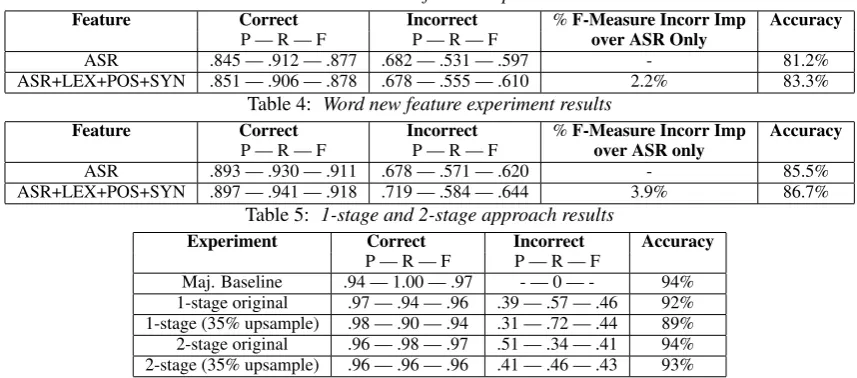
con-structed utterance feature set we are able to boost incor-rect utterance classification F-measure by 2.2% from .597 to .610 (see Table 3). The increase in F-measure for incorrect utterance mis-recognition is due to an in-crease in incorrect utterance recall from .531 to .555. There is a slight decrease in incorrect utterance pre-cision from .682 to .678. Overall classification accu-racy improves by 2.1% points (absolute) from 81.2% to 83.3%. Using our newly constructed word feature set we are able to improve incorrect word classification F-measure by 3.9% from .620 to .644 (see Table 4). For incorrect word classification there is an increase in both mis-recognized word precision and recall; the former increasing from .678 to .719 and the latter increasing from .571 to .584. The results for incorrect word clas-sification represent a statistically significant
[image:3.595.303.527.135.399.2]Table 3: Utterance new feature experiment results
Feature Correct Incorrect %F-Measure Incorr Imp Accuracy
P — R — F P — R — F over ASR Only
ASR .845 — .912 — .877 .682 — .531 — .597 - 81.2%
ASR+LEX+POS+SYN .851 — .906 — .878 .678 — .555 — .610 2.2% 83.3%
Table 4: Word new feature experiment results
Feature Correct Incorrect %F-Measure Incorr Imp Accuracy
P — R — F P — R — F over ASR only
ASR .893 — .930 — .911 .678 — .571 — .620 - 85.5%
ASR+LEX+POS+SYN .897 — .941 — .918 .719 — .584 — .644 3.9% 86.7%
Table 5: 1-stage and 2-stage approach results
Experiment Correct Incorrect Accuracy P — R — F P — R — F
Maj. Baseline .94 — 1.00 — .97 - — 0 — - 94% 1-stage original .97 — .94 — .96 .39 — .57 — .46 92% 1-stage (35% upsample) .98 — .90 — .94 .31 — .72 — .44 89% 2-stage original .96 — .98 — .97 .51 — .34 — .41 94% 2-stage (35% upsample) .96 — .96 — .96 .41 — .46 — .43 93%
ment3. Overall classification accuracy improves by
1.2% points (absolute) from 85.5% to 86.7%.
1-stage and 2-stage experimentsTo estimate how well a dialogue system could perform incorrect word classification we run our 1-stage and 2-stage ap-proaches. The 1-stage approaches (with and without up-sampling) are able to achieve higher recall; while the 2-stage approaches (with and without up-sampling) are able to achieve higher precision. The 2-stage re-sult’s higher precision is not surprising given that this approach has two chances to filter out correct words — first with utterance classification and then with word classification. In our 1-stage approach with up-sampling we are able to identify almost 3/4 (72%) of the incorrect words in the corpus (see Table 5). In our 2-stage approach without up-sampling we are able to accurately label just over 1/2 (51%) of the total in-stances we identify as incorrect. In future work we will experiment with additional features in order to boost precision for incorrect word classification to a level suitable for use in the construction of reprise clarifi-cation questions.
5 Conclusions
We have presented results of machine learning exper-iments that utilize new features to improve localized detection of ASR errors to assist spoken dialogue sys-tem’s production of reprise clarification questions. We conducted feature selection experiments to find optimal feature sets to train classifiers for utterance and word mis-recognition prediction. We find that certain lexi-cal, positional, and syntactic features improve classi-fication results over a baseline feature set containing only ASR posterior score features. We improve incor-rect F-measure for utterance mis-recognition prediction by 2.2% by adding utterance length, location, fraction
3χ2test(p < .01)
of function words to total words, average word length, and unigram and bigram count to the baseline feature set. By removing average word length as well as uni-gram and biuni-gram count from this optimal set for utter-ances and adding the current word’s ASR-context fea-tures, length, distance from first word, POS tag, Con-tent/Function tag as well as the length of the current’s words surrounding 1 or 2 word contexts, we improve incorrect F-measure for word mis-recognition predic-tion by 3.9% . We then employ these feature sets in 1-stage and 2-stage approached to obtain our final re-sults. The 2-stage (no up-sampling) approach yields the highest precision for detection of word mis-recognition at 51% while the 1-stage (with 35% up-sampling) ap-proach yields the highest recall for detection of word mis-recognition at 72%.
In order to implement this approach in a working dialog system we would need to increase our word mis-recognition precision. The presence of false pos-itives in mis-recognition prediction (correctly recog-nized words classified as mis-recogrecog-nized) could lead to unnecessary clarification requests — potentially de-railing the dialogue.
In future work we will experiment with additional corpora as well as with an even more fine-grained ap-proach to local error detection, looking for deletions, insertions, and substitutions. Potentially, optimal clas-sifiers could be found for each of these types of mis-recognition. If we are able to identify the type of ASR error as well as its location, we should be able to im-prove our construction of clarifications questions.
References
M. Akbacak, H. Franco, M. Frandsen, S. Hasan, H. Jameel, A. Kathol, S. Khadivi, X. Lei, A. Man-dal, S. Mansour, K. Precoda, C. Richey, D. Ver-gyri, W. Wang, M. Yang, and J. Zheng. 2009. Re-cent advances in sri’s iraqcomm; iraqi arabic-english speech-to-speech translation system. InAcoustics, Speech and Signal Processing, 2009. ICASSP 2009. IEEE International Conference on, pages 4809– 4812.
P. Boersma and D. Weenink. 2013. Praat: do-ing phonetics by computer [computer program]. http://www.fon.hum.uva.nl/praat/.
R. Collobert, J. Weston, L. Bottou, M. Karlen, K. Kavukcuoglu, and P. Kuksa. 2011. Natural lan-guage processing (almost) from scratch.
M. O. Dzikovska, C. B. Callaway, E. Farrow, J. D. Moore, N. Steinhauser, and G. Campbell. 2009. Dealing with interpretation errors in tutorial dia-logue. InProceedings of the SIGDIAL 2009 Con-ference: The 10th Annual Meeting of the Special In-terest Group on Discourse and Dialogue, SIGDIAL ’09, pages 38–45, Stroudsburg, PA, USA. Associa-tion for ComputaAssocia-tional Linguistics.
K. Toutanova et al. 2003. Feature-rich part-of-speech tagging with a cyclic dependency network. In Pro-ceedings of the 2003 Conference of the North Amer-ican Chapter of the Association for Computational Linguistics on Human Language Technology - Vol-ume 1.
H. Franco, J. Zheng, J. Butzberger, F. Cesari, M. Fr, J. Arnold, V. Ramana, A. Stolcke R. Gadde, and V. Abrash. 2002. Dynaspeak: Sri’s scalable speech recognizer for embedded and mobile systems. In
Proceedings of the second international conference on Human Language Technology Research, HLT ’02, pages 25–30, San Francisco, CA, USA. Morgan Kaufmann Publishers Inc.
J. Hirschberg, D. J. Litman, and M. Swerts. 2004. Prosodic and other cues to speech recognition fail-ures.Speech Communication, 43(1-2):155–175. K. Komatani and H. G. Okuno. 2010. Online error
detection of barge-in utterances by using individual users utterance histories in spoken dialogue system. D. J. Litman and S. Silliman. 2004. Itspoke: an intelligent tutoring spoken dialogue system. In
Demonstration Papers at HLT-NAACL 2004, HLT-NAACL–Demonstrations ’04, pages 5–8, Strouds-burg, PA, USA.
J. Lopes, M. Eskenazi, and I. Trancoso. 2011. To-wards choosing better primes for spoken dialog sys-tems. In Proceedings of the IEEE Workshop on
Automatic Speech Recognition and Understanding (ASRU), Keystone, CO.
M. Purver. 2004. The Theory and Use of Clarification Requests in Dialogue. Ph.D. thesis, King’s College, University of London.
A. Rosenberg. 2010. Autobi - a tool for auto-matic tobi annotation. In Takao Kobayashi, Kei-kichi Hirose, and Satoshi Nakamura, editors, IN-TERSPEECH, pages 146–149. ISCA.
S. Stoyanchev, A. Liu, and J. Hirschberg. 2012a. Clar-ification questions with feedback 2012. In Interdis-ciplinary Workshop on Feedback Behaviors in Dia-log.
S. Stoyanchev, P. Salletmayr, J. Yang, and J. Hirschberg. 2012b. Localized detection of speech recognition errors. In Spoken Language Technology Workshop (SLT), 2012 IEEE, pages 25–30.
B. Weiss, C. Schlenoff, G. Sanders, M. Steves, S. Con-don, J. Phillips, and D. Parvaz. 2008. Perfor-mance evaluation of speech translation systems. In Nicoletta Calzolari (Conference Chair) et al., editor,
Proceedings of the Sixth International Conference on Language Resources and Evaluation (LREC’08), Marrakech, Morocco, may. European Language Resources Association (ELRA). http://www.lrec-conf.org/proceedings/lrec2008/.