Five Shades of Noise:
Analyzing Machine Translation Errors in User-Generated Text
Marlies van der Wees Arianna Bisazza Christof Monz
Informatics Institute, University of Amsterdam {m.e.vanderwees,a.bisazza,c.monz}@uva.nl
Abstract
It is widely accepted that translating user-generated (UG) text is a difficult task for modern statistical machine translation (SMT) systems. The translation quality metrics typically used in the SMT litera-ture reflect the overall quality of the sys-tem output but provide little insight into what exactly makes UG text translation difficult. This paper analyzes in detail the behavior of a state-of-the-art SMT sys-tem on five different types of informal text. The results help to demystify the poor SMT performance experienced by re-searchers who use SMT as an intermedi-ate step of their UG-NLP pipeline, and to identify translation modeling aspects that the SMT community should more urgently address to improve translation of UG data.
1 Introduction
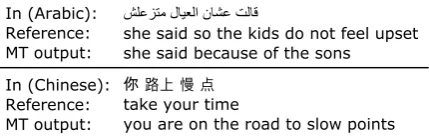
User-generated (UG) text such as found on social media and web forums poses different challenges to statistical machine translation (SMT) than for-mal text. This is reflected by poor translation qual-ity for informal genres (see for example Figure 1), which is typically measured with automatic qual-ity metrics such as BLEU (Papineni et al., 2002), METEOR (Banerjee and Lavie, 2005), or TER (Snover et al., 2006). These scores alone, however, only reflect the overall translation quality, and do not provide any insight in what exactly makes translating UG text hard. While such knowledge is crucial for improving SMT of UG text, surpris-ingly little work on error analysis for SMT of user-generated text has been reported.
Moreover, the notion of user-generated content
你路上慢点
take your time
you are on the road to slow points In (Chinese):
Reference: MT output:
she said so the kids do not feel upset she said because of the sons
In (Arabic): Reference: MT output:
[image:1.595.310.525.249.318.2]ﻗﺎ ﻟ ﺕ ﻋ ﺷ ﺎ ﻥ ﺍﻟ ﻌ ﻳﺎ ﻝ ﻣ ﺗ ﺯ ﻋ ﻠ ﺵ
Figure 1: SMS examples with poor SMT output.
only partially specifies the exact nature of docu-ments. What all documents that can be classified as being UG have in common is the fact that they have been written by a lay-person, as opposed to a journalist or professional author, and that they have not undergone any editorial control. UG text also tends to express the writer’s opinion to a larger degree than news articles which generally strive for balance and nuance. Within UG text, we can distinguish several subclasses, including (i) message and dialog-oriented content such as short message service (SMS) texts, Internet chat mes-sages, and transcripts of conversational speech, (ii) commentaries to news articles, often expressing an opinion about the corresponding articles and relat-ing the content to the reader’s situation, and (iii) weblogs, which can bear some resemblance to ed-itorial pieces published by news organizations.
While UG text processing tasks are becoming more and more common, the research in SMT is still mostly driven by formal translation tasks1,
and existing error analysis approaches are only partially useful for UG. In this work, we conduct a series of analyses on five different UG benchmark sets for two language pairs, Arabic-English and Chinese-English, with the goals of (i) explaining the typically poor SMT performance observed for UG texts, and (ii) identifying translation modeling
1One of the very few exceptions is NIST OpenMT 2015,
which focusses entirely on translating informal genres.
aspects that should be addressed to improve trans-lation of UG data. We not only contrast our obser-vations with two news data sets, but we also show that SMT quality can vary significantly across dif-ferent types of UG content, and that difdif-ferent UG types exhibit dissimilar error distributions. Specif-ically, we summarize our main findings as follows:
• The SMS and chat benchmarks are the most distant from formal text at all the analyzed levels. Errors in other types of UG are often more similar to news errors than to those in SMS and chat messages.
• SMT model coverage dramatically deterio-rates for phrases of length 3 or longer in most of the UG benchmarks.
• Errors due to out-of-vocabulary (OOV) words in the source text substantially in-crease in number for UG data sets, but are considerably less common than errors due to
source-targetOOVs, i.e., phrase pairs that are not covered by the SMT models.
2 Related Work
Identifying and analyzing different types of SMT errors is an essential step towards the development of translation approaches that can achieve more ro-bust performance, and has been the focus of earlier work. Popovi´c and Ney (2011), for example, com-bine word error rates with morpho-syntactic infor-mation to classify errors into five categories; in-flectional errors, reordering errors, lexical errors, word deletions, and word insertions. Irvine et al. (2013) use word alignment links to quantify in-correct lexical choices, and determine how such errors change when shifting domains. Other work
Dev set Test set
Genre Lines Tokens Lines Tokens Refs
SMS 2.7K 23.3K 7.6K 44.9K 1
Chat 3.5K 22.5K 7.1K 44.5K 1
CTS 2.4K 23.1K 3.6K 40.6K 1
Comments 1.1K 25.8K 1.7K 45.5K 1 Weblogs 0.8K 14.6K 1.3K 39.9K 4 News 1 1.0K 26.9K 1.6K 46.3K 1 News 2 1.0K 34.4K 1.4K 46.6K 4
Table 1: Statistics of the Arabic-English UG (top) and contrastive news (bottom) evaluation sets. To-kens are counted on the Arabic side.
on SMT error analysis studies the effect of domain adaptation on SMT, for example by examining in which stage of the SMT pipeline the available in-domain data can best be used (Duh et al., 2010), or whether it is more promising to improve either phrase extraction or scoring (Bisazza et al., 2011; Haddow and Koehn, 2012).
The vast majority of SMT research, includ-ing the above described work on error analysis, is evaluated on data containing formallanguage. Work on SMT ofinformal text mostly targets re-duction of OOV words in the source text, for ex-ample by correcting spelling errors (Bertoldi et al., 2010), normalizing noisy text to more formal text (Banerjee et al., 2012; Ling et al., 2013a), or en-hancing the training data with bilingual segments extracted from Twitter (Jehl et al., 2012; Ling et al., 2013b). Other work improves SMT of UG text by combining statistical and rule-based MT (Carrera et al., 2009), or models trained on for-mal and inforfor-mal data (Banerjee et al., 2011). Fi-nally, Roturier and Bensadoun (2011) conduct a comparative study to determine the ability of sev-eral SMT systems to translate UG text, but they do not examine what errors the systems make. To our knowledge, our work is the first that looks inside an SMT system to systematically inspect its be-havior across a diverse spectrum of UG text types.
3 Experimental setup
We perform our error analysis on two language pairs, Arabic-English and Chinese-English.
3.1 Evaluation sets
For both language pairs we use evaluation sets for five types of user-generated text: SMS mes-sages, chat mesmes-sages, manual transcripts of phone conversations (called Conversational Telephone
Dev set Test set
Genre Lines Tokens Lines Tokens Refs
SMS 1.8K 15.3K 4.2K 36.3K 1
Chat 4.0K 25.6K 6.0K 45.7K 1
CTS 2.2K 25.1K 2.9K 44.8K 1
Comments 1.0K 26.5K 1.5K 41.0K 1
Weblogs 0.5K 8.8K 0.7K 14.4K 4
News 1 0.8K 24.5K 1.5K 41.9K 1
News 2 1.2K 29.4K 0.7K 17.7K 4
News 1 News 2 Weblogs Comments CTS Chat SMS 0
5 10 15 20 25 30 35
BLEU (1 reference)
Translation performance of Arabic-English benchmarks
Online In-house
News 1 News 2 Weblogs Comments CTS Chat SMS
0 5 10 15 20 25 30 35
BLEU (1 reference)
Translation performance of Chinese-English benchmarks
[image:3.595.78.512.63.182.2]Online In-house
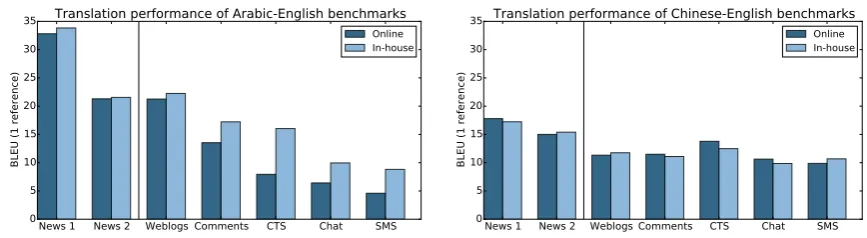
Figure 2: Translation performance of baseline experiments for various Arabic-English (left) and Chinese-English (right) data sets, measured in case-insensitive BLEU for one reference translation.
Speech (CTS)), weblogs, and readers’ comments to news articles. The first four data sets orig-inate from BOLT and NIST OpenMT, and are distributed by the Linguistic Data Consortium (LDC), while the last data set is crawled from the web. All UG experiments are contrasted with two news data sets; the news portions of NIST evalua-tion sets, and web-crawled news articles.
For Arabic-English, the web-crawled news arti-cles and comments originate from the Gen&Topic data set (van der Wees et al., 2015), in which both genres cover the same distributions over various topics. Consequently, any observed differences between the news and UG portions of this data set can be entirely attributed to genre differences and not to potential topical variation.
We have created similar-sized benchmark sets as much as possible, however sometimes limited by availability. Tables 1 and 2 show the data specifications of the Arabic-English and Chinese-English evaluation sets, respectively.2
3.2 SMT systems
All experiments presented in this paper are per-formed with our in-house state-of-the-art system based on phrase-based SMT and similar to Moses (Koehn et al., 2007). Our Arabic-English system is built from 1.75M lines (52.9M source tokens) of parallel text, and our Chinese-English system from 3.13M lines (55.4M source tokens) of paral-lel text. We tokenize all Arabic data using MADA (Habash and Rambow, 2005), ATB scheme, and we segment the Chinese data following Tseng et al. (2005). Both systems use an adapted 5-gram English language model that linearly interpolates different English Gigaword subcorpora with the
2Note that two evaluation sets contain four reference
translations instead of one. To allow for fair comparison, we average the scores of the four references in all our analyses.
English side of our bitexts, containing both news and UG data.
While parallel data is scarce in general, the sit-uation is much worse for UG data, where there are hardly any sizable parallel corpora for any language pair. As a consequence, the training data of both systems comprises 70-75% news data, mostly LDC-distributed, and 25-30% data in var-ious other genres (weblogs, comments, editori-als, speech transcripts, and small amounts of chat data), mostly harvested from the web. Per lan-guage pair, all experiments use the same SMT models, but we tune parameters separately for each benchmark set using pairwise ranking opti-mization (PRO) (Hopkins and May, 2011).
To put the results of our system into perspective, we also run a first series of experiments on a well-known and established online SMT system. 4 Error analysis and results
We perform four series of experiments, each with the goal of answering different questions about SMT for UG text:
1. How large is the gap in translation quality be-tween news and different types of UG data? (§4.1). To answer this question, we measure the BLEU score of two state-of-the-art SMT system outputs on all our data sets.
2. What kind of translation choices does the SMT system make for UG data? To answer this question, we measure phrase lengths used during the translation (or decoding) pro-cess (§4.2).
News 1 News 2 Weblogs Comments CTS Chat SMS 0.0
0.5 1.0 1.5 2.0
Average phrase length (#tokens)
Decoding phrase lengths for Arabic-English benchmarks
Source Target
News 1 News 2 Weblogs Comments CTS Chat SMS 0.0
0.5 1.0 1.5 2.0
Average phrase length (#tokens)
Decoding phrase lengths for Chinese-English benchmarks
[image:4.595.80.511.64.182.2]Source Target
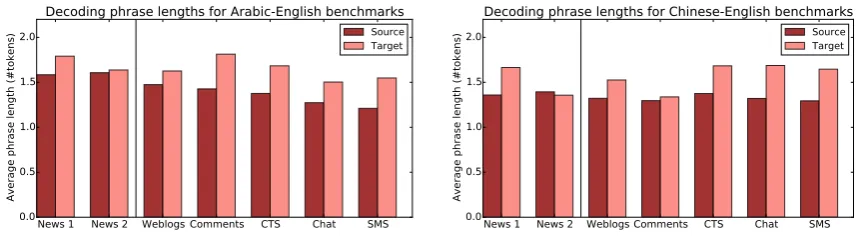
Figure 3: Average source-side and target-side phrase lengths used during decoding.
4. Why did the SMT system make the transla-tion choices that it made? What errors are ob-served for each benchmark, and how often? To answer these questions, we reimplement the word-alignment driven error analysis ap-proach by Irvine et al. (2013) and perform a qualitative analysis on the results (§4.4).
4.1 Overall translation quality
A first important indication of SMT quality across different genres can be given by translation quality measures that are based on the similarity between the SMT output and a reference human translation. To estimate the gap in translation quality between news and UG text, but also among various types of UG text, we measure the BLEU scores (1 refer-ence) of our in-house SMT system and that of the online system on all our evaluation sets.
The results in Figure 2 (left) show that trans-lation quality differs greatly between the Arabic-English data sets. In particular, the News 1 data set (from NIST) yields considerably higher BLEU scores than all other evaluation sets, including the News 2 (web-crawled) set, which represents the same genre but is visibly more difficult to trans-late. On the other end of the spectrum, we see that translation quality of the SMS and chat data sets is very poor. Note that our in-house system is optimized per genre, whereas the online system is optimized for general language and speed.
For Chinese-English (Figure 2, right) the differ-ences in BLEU are less pronounced, both across the different data sets and between the two SMT systems. Still, translation quality is worse for the UG data sets than for news, indicating that also for this language pair translating UG text is more challenging than translating news.
As all subsequent analyses require system-internal information, we carry out the experiments with our in-house system only.
4.2 Translation phrase length analysis
Most state-of-the-art SMT systems, including our in-house system, are phrase-based, with transla-tions being generated phrase by phrase rather than word by word (Koehn et al., 2003). An abundant use of small phrases during decoding indicates that the system is not taking advantage of the model’s ability to memorize large contextual and possi-bly non-compositional translation blocks. It is therefore interesting to measure the average phrase length (i.e., number of tokens) used by the system, for the source as well as the target language (Fig-ure 3). For Arabic-English we see that source-side phrases are noticeably longer for both news bench-marks than for the UG data sets. The average target-side phrase length, on the other hand, shows less correlation with the genres of the data sets. Similar trends are observed for Chinese-English, however differences are less extreme.
In general, SMT systems incur higher model costs when utilizing many small phrases rather than few large phrases. If, in spite of that, a sys-tem selects many short phrases, which is the case for most of our UG benchmarks, this can be due to (i) unreliable translation probabilities or (ii) to the mere lack of correct translation options in the models. We investigate both issues in the follow-ing analyses.
4.3 Model coverage analysis
Source phrase recall Target phrase recall Phrase pair recall
Genre BLEU LM PP 1 2 3 4 1 2 3 4 1 2 3 4
[image:5.595.75.525.64.183.2]News 1 33.8 65 99.7 88.9 56.3 26.1 99.7 91.1 61.5 29.6 84.9 54.4 23.6 8.1 News 2 21.5 86 99.6 88.1 53.7 21.8 99.5 88.1 53.4 23.6 77.4 46.9 18.8 5.9 Weblogs 22.3 152 99.2 80.5 40.6 13.5 99.5 86.3 48.9 17.8 78.4 41.5 12.9 2.9 Comments 17.2 117 97.7 80.2 43.0 15.3 99.7 89.8 55.3 21.9 59.1 33.2 11.1 2.8 CTS 16.0 103 97.4 66.3 25.1 6.4 99.8 90.8 54.3 21.5 66.7 25.7 6.1 1.0 Chat 10.0 179 94.1 56.0 19.4 4.7 98.6 86.1 47.3 16.7 60.8 21.3 4.5 0.8 SMS 8.8 196 93.7 57.8 17.5 3.3 99.1 86.3 47.0 14.6 62.0 21.1 3.7 0.4
Table 3: Target language model perplexity and translation model coverage of Arabic-English bench-marks. Phrase pair recall values are broken down by source phrase length. Intensities of the cell colors indicate relative recall values with respect to the best scoring benchmark (measured in BLEU).
Source phrase recall Target phrase recall Phrase pair recall
Genre BLEU LM PP 1 2 3 4 1 2 3 4 1 2 3 4
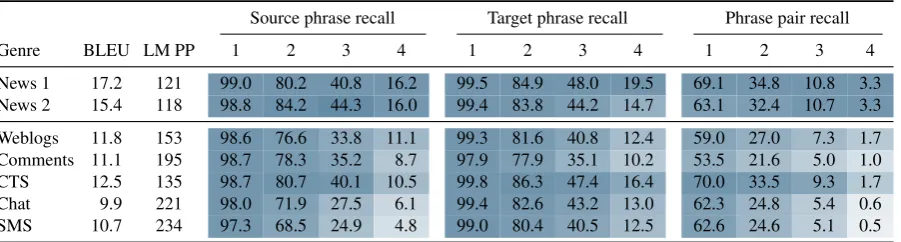
News 1 17.2 121 99.0 80.2 40.8 16.2 99.5 84.9 48.0 19.5 69.1 34.8 10.8 3.3 News 2 15.4 118 98.8 84.2 44.3 16.0 99.4 83.8 44.2 14.7 63.1 32.4 10.7 3.3 Weblogs 11.8 153 98.6 76.6 33.8 11.1 99.3 81.6 40.8 12.4 59.0 27.0 7.3 1.7 Comments 11.1 195 98.7 78.3 35.2 8.7 97.9 77.9 35.1 10.2 53.5 21.6 5.0 1.0 CTS 12.5 135 98.7 80.7 40.1 10.5 99.8 86.3 47.4 16.4 70.0 33.5 9.3 1.7 Chat 9.9 221 98.0 71.9 27.5 6.1 99.4 82.6 43.2 13.0 62.3 24.8 5.4 0.6 SMS 10.7 234 97.3 68.5 24.9 4.8 99.0 80.4 40.5 12.5 62.6 24.6 5.1 0.5
Table 4: Target language model perplexity and translation model coverage of Chinese-English bench-marks. See Table 3 for explanation on colors and categories.
have been extracted using the same procedure, we can compute the following statistics:
1. Source phrase recall, defined as the fraction
of reference phrase pairs whosesource side is found in the SMT models.
2. Target phrase recall, defined as the fraction of reference phrase pairs whosetargetside is found in the SMT models.
3. Phrase pair recall, defined as the fraction of reference phrase pairs whose source and tar-get side are jointly found in the SMT models.
Low recall values indicate that the models lack phrases or phrase pairs that match the test data, which can be addressed by adding additional rele-vant training data or by generating new phrases. In addition, we measure language model perplexity as an indication of how predictable each bench-mark is for the language model. Note that high perplexity corresponds to lower coverage.
The model coverage results for Arabic-English and Chinese-English are shown in Tables 3 and 4, respectively. All recall scores are broken down by
phrase length, up to phrases of four tokens.3 We
use cell color intensity to represent relative recall values with respect to the best scoring benchmark according to BLEU, i.e., News 1. The results show that source phrase recall is substantially lower for the UG benchmarks than for news, particularly for longer phrases. Regarding target phrase recall, differences between various data sets and genres are much smaller. This suggests that many of the reference phrases could potentially be generated by the system, even for the UG data. However, to be able to output the available target phrases, the system needs a match with the input source phrases, which is exactly what is being measured with phrase pair recall. Here, we see that for the majority of single-word source phrases, the ex-pected target phrase is accessible by the system. For longer phrases, though, there is again a drastic decline in recall, with almost no phrases of length 4 or longer having the expected target covered by the models. Similar to source phrase recall, this decline is notably bigger for UG than for news.
3The source-target phrase pair recall (last four columns) is
[image:5.595.76.527.244.365.2]Looking at the differences between the various types of UG data, we see that the SMS and chat benchmarks are most severely affected by over-all poor model coverage. As for weblogs, the target phrase recall is similar to SMS and chat, whereas both source phrase and phrase pair recall are much higher. For CTS and web comments, there are notable differences between model cov-erage for the two language pairs, despite similar BLEU scores. While comments have better cover-age in the Arabic-English models, CTS has higher recall values for Chinese-English.
Finally, we see that language model perplexity is on average lower for Arabic-English than for the Chinese-English benchmarks. This is some-what surprising given that perplexity is measured on the English side, but it can partially explain the low BLEU scores on, for example, the Chinese-English News 1 benchmark. All news benchmarks have relatively low perplexities, which is expected since the language model covers more news than UG data. Of the UG benchmarks, CTS has a remarkably low perplexity value, suggesting that for this genre the language model can potentially compensate for low translation model coverage.
4.4 WADE: Word Alignment Driven Evaluation
Next, to gain a more fine-grained insight in why
our SMT system makes its translation choices, we reimplement an evaluation approach proposed by Irvine et al. (2013), which analyzes SMT error types at the word alignment level. The analysis exploits automatic word alignments between (i) a given source sentence and its reference translation, and (ii) the same source sentence and its automatic translation. Each aligned source-reference word pair is examined for whether the alignment link is matched by the decoder. Formally,fi is a foreign
ﺣ ﺑﻳ ﺑﺗ ﻲ
ﻱ
0.2 0.4 ﺍﻟ
ﺣ ﻣ ﺩ
ﻝ
ﺍﻟ ﺣ ﻣ ﺩ
ﻝ
ﺍﻟ ﺣ ﻣ ﺩ
ﻝ
praise be to
praise for
thank
my dear
my love
0.3 source phrase target phrase probability
Source phrase not in phrase table:
SEEN error
Target phrase not in phrase table:
SENSE error
Source and target phrases both in table,
but other translation preferred: SCORE error
ﺣ ﺑﻳ ﺑﺗ ﻲ
[image:6.595.73.289.618.727.2]
ﻱ
Figure 4: Graphical overview ofSEEN,SENSEand SCOREerrors in a toy phrase table.
word,ej is a reference word aligned tofi,ai,j is
the alignment link between fi and ej, and Hi is
the set of output words that are aligned to fi by
the decoder. Ifej ∈Hi, the alignment linkai,j is
marked as correct. Otherwise, ai,j is categorized
with one of the following error types:
1. A SEEN error indicates an unseen source
word, i.e., out-of-vocabulary (OOV) item. This error is assigned to ai,j if fi does not
appear in the phrase table used for transla-tion. This type of error inversely correlates with length-1 source phrase recall (§4.3). 2. A SENSE error indicates an unseen target
word. This error is assigned to ai,j if fi
does appear in the phrase table but never with translation candidateej.
3. ASCORE error indicates suboptimal scoring
of translation options. This error is assigned to ai,j if fi exists in the phrase table with
translation candidateej, but another
transla-tion candidate is preferred by the decoder. Figure 4 shows a graphical representation of these error types and their ‘location’ in the phrase table. In addition to the listed error types, Irvine et al. defineSEARCH errors as errors due to pruning in
beam search, and refer to the complete set of errors as theS4 taxonomy. For this analysis, however,
SEARCHerrors are indistinguishable fromSCORE
errors, and are therefore never assigned.
A final category that can be considered are free-bies: OOVs that are copied over verbatim to the output sentence and accidentally match the ref-erence translation (e.g., urls, proper nouns, etc.). For the language pairs that we study, they are very rare; at most 0.35% for Arabic-English (in CTS) and 0.63% for Chinese-English (in SMS). Manual inspection reveals that nearly all freebies are En-glish words in the foreign source text. Since they are so rare, we omit freebies from our results.
News 1 News 2 Weblogs Comments CTS Chat SMS 0
10 20 30 40 50 60
Relative frequency
Word-level error statistics for Arabic-English benchmarks
Correct Seen Sense Score
News 1 News 2 Weblogs Comments CTS Chat SMS
0 10 20 30 40 50 60
Relative frequency
Word-level error statistics for Chinese-English benchmarks
[image:7.595.80.522.64.184.2]Correct Seen Sense Score
Figure 5: Aggregate error statistics for Arabic-English (left) and Chinese-English (right) benchmark sets.
Quantitative results. The aggregate error
statis-tics for each data set are shown in Figure 5. To put our results into perspective, we recall the findings of Irvine et al. (2013). They find that for formal
domains using a French-English system, 50–60% of the alignment links are correct, andSCORE
er-rors are more common than SENSE errors, which
in turn are more common thanSEENerrors. While
we observe a similar distribution for our Arabic-English news benchmarks, these numbers do not generalize to the Arabic-English UG benchmarks nor to any of the Chinese-English data sets.
First, the portion of SEEN errors increases
dra-matically for the Arabic-English UG translation tasks. For Chinese-English this trend is less pro-nounced yet also clearly observable. Next,SENSE
errors also increase substantially for most of the UG data, making up the majority of the errors for Chinese-English SMS and chat. This indicates that a promising strategy for adapting SMT sys-tems to translating UG data involves generating new target-side translation candidates that match the source phrases in the input sentences. Finally, we evaluate the fraction of SCORE errors. While
this is the most commonly observed error type in most of the data sets, there seems to be very lit-tle correspondance with the genre or BLEU scores of the benchmarks. This is an interesting finding since most work in system adaptation for SMT fo-cuses on better scoring of existing translation can-didates (Matsoukas et al., 2009; Foster et al., 2010; Axelrod et al., 2011; Chen et al., 2013, among oth-ers). However, for UG translation tasks this does not appear as the most profitable approach.
Qualitative results. The generated
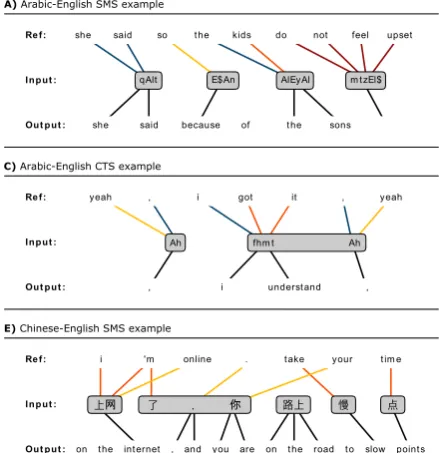
sentence-level error annotations allow us to examine the var-ious error types in detail. The first phenomenon that we repeatedly observe in the UG data are
SEEN errors due to misspellings or, in the case of
Arabic, dialectal forms. Two such examples are shown in Figures 6A and 6B: In the first, the SMT system does not recognize the dialectal form of verb negation ‘mtzEl$’, which is a morphologi-cally complex word containing both a prefix and a suffix. In the second, the input word ‘AlmwbAyl’ (‘mobile’) is wrongly spelled ‘AlmwyAyl’. It is interesting to note that ‘b’ and ‘y’ are very similar in the Arabic script. This type of errors is partic-ularly frequent in chat and SMS, which can partly explain the different distribution of errors across the Arabic-English data sets (Figure 5).
Also frequently observed in the UG data are SMT lexical choices that are more formal than the reference translations. This is not surprising given the large amount of formal data in the SMT mod-els, but it does illustrate the need for adaptation to UG data. Often, the optimal lexical choice is simply absent from the SMT models, resulting in
SENSEerrors. This can be observed in Figure 6A,
where ‘sons’ is output instead ‘kids’, and in Fig-ure 6C, where ‘i understand’ is output instead of the colloquial ‘i got it’. In other situations, the annotated SCORE errors indicate that the correct
choice was available to the SMT system without being selected for translation. For example in Fig-ure 6D, the output ‘my parents’ is preferred to the more colloquial ‘mom and dad’ in the reference.
Another phenomenon, particularly common for Chinese-English UG translations, is that idioms are translated in small chunks, thereby losing their meaning as a phrase. In Figure 6D, the char-acters ‘说’, ‘⼀’, and ‘声’ mean ‘to say’, ‘one’,
and ‘sound’, respectively. The phrase ‘说⼀声’ as a whole means ‘talk a bit about something’ but is not covered by the SMT models. Similarly,
‘你路上慢点’ in Figure 6E literally means ‘you on
Input : qAlt E$An AlEyAl m t zEl$ Re f: she said so t he kids do not feel upset
Out put : she said because of t he sons A) Arabic-English SMS example
Input : Ah fhm t Ah
Re f: yeah , i got it , yeah
Out put : , i underst and ,
C) Arabic-English CTS example
Input :
Re f: i 'm online . t ake your t im e
Out put : on t he int ernet , and you are on t he road t o slow point s
上网 了 , 你 路上 慢 点
E) Chinese-English SMS example
Input : Ely Alm wyAyl
Re f: for t he m obile phone
Out put : on t he
Correct Seen error
Sense error Score error B) Arabic-English chat example
Input :
Out put : you t alk t o m y parent s said a voices
Re f: can you t ell m om and dad ?
爸妈 说 ⼀ 声 你 跟
[image:8.595.71.291.64.291.2]D) Chinese-English SMS example
Figure 6: Sentence-level error annotations from various UG benchmarks illustrating common is-sues in SMT of UG data. We use Buckwalter transliteration to represent the Arabic source text.
your way’ or ‘take your time’. These examples il-lustrate that the low phrase pair recall for longer phrases severely complicates SMT of UG data.
A final recurring issue in SMS and chat mes-sages is the omission of first person pronouns, see for example Figure 6E. The Chinese source phrase ‘上网了’ literally means ‘get online’ (+ auxiliary word marking past tense). A native speaker un-derstands that this concerns the sender, which is reflected by a first person pronoun in the reference. The SMT system, on the other hand, cannot infer the subject of this phrase and instead generates a translation without pronouns.
Other, less common, types of errors occurring in the UG data are due to inconsistent segmentation or tokenization of input text, which mostly affects rare words, emoticons, and repeating punctation. Finally,SEENerrors for named entities are overall
rare but occur in both news and UG benchmarks. 5 Conclusions and future directions Translating user-generated (UG) text is a diffi-cult task for SMT. To explain the poor transla-tion quality observed for UG data, we have per-formed a detailed error analysis on two language pairs (Arabic-English and Chinese-English) and five different types of UG data (SMS, chat, CTS, weblogs, and comments). Our quantitative re-sults show among others that (i) UG data is trans-lated with shorter source phrases than news, (ii) UG translation model coverage deteriorates sub-stantially for longer phrases, and (iii) phrase-pair
OOVs pose a bigger challenge to UG translation tasks than source OOVs. In our qualitative anal-ysis we found that common issues in UG data in-clude (i) OOVs due to misspellings or Arabic di-alectal forms, (ii) lexical choices that do not reflect colloquial formulations, (iii) phrasal idioms being translated word by word, and (iv) omitted first per-son pronouns in SMS and chat.
Finally, different types of UG exhibit dissimi-lar error distributions, demanding diverse strate-gies to improve SMT quality. For example, SMS and chat data might benefit from text normaliza-tion (Bertoldi et al., 2010; Yvon, 2010; Ling et al., 2013a) or otherwise resolving source OOVs, which also has been the main focus of previ-ous work on SMT for UG. On the other hand, while research in domain adaptation for SMT of-ten aims at better scoring of existing translation candidates, we have shown that for many UG tasks the most promising direction involves increasing phrase pair recall of the SMT models (i.e., re-ducing phrase pair OOVs), for example by para-phrasing (Callison-Burch et al., 2006) or transla-tion synthesis (Irvine and Callison-Burch, 2014). Acknowledgments
References
Amittai Axelrod, Xiaodong He, and Jianfeng Gao. 2011. Domain adaptation via pseudo in-domain data selection. InProceedings of the 2011 Conference on Empirical Methods in Natural Language Process-ing, pages 355–362.
Satanjeev Banerjee and Alon Lavie. 2005. METEOR: an automatic metric for MT evaluation with im-proved correlation with human judgments. In Pro-ceedings of the ACL Workshop on Intrinsic and Ex-trinsic Evaluation Measures for Machine Transla-tion, pages 65–72.
Pratyush Banerjee, Sudip Kumar Naskar, Johann Ro-turier, Andy Way, and Josef van Genabith. 2011. Domain adaptation in statistical machine translation of user-forum data using component level mixture modelling. In Proceedings of the XIII Machine Translation Summit, pages 285–292.
Pratyush Banerjee, Sudip Kumar Naskar, Johann Ro-turier, Andy Way, and Josef van Genabith. 2012. Domain adaptation in SMT of user-generated forum content guided by OOV word reduction: Normal-ization and/or supplementary data. InProceedings of the 16th Conference of the European Association for Machine Translation, pages 169–176.
Nicola Bertoldi, Mauro Cettolo, and Marcello Fed-erico. 2010. Statistical machine translation of texts with misspelled words. InHuman Language Tech-nologies: The 2010 Annual Conference of the North American Chapter of the Association for Computa-tional Linguistics, pages 412–419.
Arianna Bisazza, Nick Ruiz, and Marcello Federico. 2011. Fill-up versus interpolation methods for phrase-based SMT adaptation. In Proceedings of the 8th International Workshop on Spoken Language Translation, pages 136–143.
Chris Callison-Burch, Philipp Koehn, and Miles Os-borne. 2006. Improved statistical machine trans-lation using paraphrases. In Proceedings of the Human Language Technology Conference of the NAACL, Main Conference, pages 17–24.
Jordi Carrera, Olga Beregovaya, and Alex Yanishevsky. 2009. Machine translation for cross-language social media.
Boxing Chen, Roland Kuhn, and George Foster. 2013. Vector space model for adaptation in statistical ma-chine translation. InProceedings of the 51st Annual Meeting of the Association for Computational Lin-guistics, pages 1285–1293.
Kevin Duh, Katsuhito Sudoh, and Hajime Tsukada. 2010. Analysis of translation model adaptation in statistical machine translation. In Proceedings of the 7th International Workshop on Spoken Language Translation (IWSLT 2010), pages 243–250.
George Foster, Cyril Goutte, and Roland Kuhn. 2010. Discriminative instance weighting for domain adap-tation in statistical machine translation. In Proceed-ings of the 2010 Conference on Empirical Methods in Natural Language Processing, pages 451–459.
Nizar Habash and Owen Rambow. 2005. Arabic tok-enization, part-of-speech tagging and morphological disambiguation in one fell swoop. InProceedings of the 43rd Annual Meeting on Association for Compu-tational Linguistics, pages 573–580.
Barry Haddow and Philipp Koehn. 2012. Analysing the effect of out-of-domain data on SMT systems. In Proceedings of the Seventh Workshop on Statistical Machine Translation, pages 422–432.
Mark Hopkins and Jonathan May. 2011. Tuning as ranking. In Proceedings of the 2011 Conference on Empirical Methods in Natural Language Pro-cessing, pages 1352–1362. Association for Compu-tational Linguistics.
Ann Irvine and Chris Callison-Burch. 2014. Halluci-nating phrase translations for low resource MT. In Proceedings of the Eighteenth Conference on Com-putational Natural Language Learning, pages 160– 170.
Ann Irvine, John Morgan, Marine Carpuat, Hal Daum´e III, and Dragos Stefan Munteanu. 2013. Measuring machine translation errors in new do-mains. Transactions of the Association for Compu-tational Linguistics, 1:429–440.
Laura Jehl, Felix Hieber, and Stefan Riezler. 2012. Twitter translation using translation-based cross-lingual retrieval. In Proceedings of the Seventh Workshop on Statistical Machine Translation, pages 410–421.
Philipp Koehn, Franz Josef Och, and Daniel Marcu. 2003. Statistical phrase-based translation. In Pro-ceedings of the 2003 Conference of the North Amer-ican Chapter of the Association for Computational Linguistics on Human Language Technology, pages 48–54.
Philipp Koehn, Hieu Hoang, Alexandra Birch, Chris Callison-Burch, Marcello Federico, Nicola Bertoldi, Brooke Cowan, Wade Shen, Christine Moran, Richard Zens, Chris Dyer, Ondrej Bojar, Alexan-dra Constantin, and Evan Herbst. 2007. Moses: Open source toolkit for statistical machine transla-tion. InProceedings of the 45th Annual Meeting of the Association for Computational Linguistics Com-panion Volume Proceedings of the Demo and Poster Sessions, pages 177–180.
Wang Ling, Guang Xiang, Chris Dyer, Alan Black, and Isabel Trancoso. 2013b. Microblogs as parallel cor-pora. InProceedings of the 51st Annual Meeting of the Association for Computational Linguistics (Vol-ume 1: Long Papers), pages 176–186.
Spyros Matsoukas, Antti-Veikko I. Rosti, and Bing Zhang. 2009. Discriminative corpus weight estima-tion for machine translaestima-tion. InProceedings of the 2009 Conference on Empirical Methods in Natural Language Processing, pages 708–717.
Franz Josef Och and Hermann Ney. 2003. A sys-tematic comparison of various statistical alignment models. Computational Linguistics, 29(1):19–51. Kishore Papineni, Salim Roukos, Todd Ward, and
Wei-Jing Zhu. 2002. BLEU: a method for automatic evaluation of machine translation. In Proceedings of the 40th Annual Meeting of the Association for Computational Linguistics, pages 311–318.
Maja Popovi´c and Hermann Ney. 2011. Towards au-tomatic error analysis of machine translation output. Computational Linguistics, 37(4):657–688.
Johann Roturier and Anthony Bensadoun. 2011. Eval-uation of MT systems to translate user generated content. InProceedings of the XIII Machine Trans-lation Summit, pages 244–251.
Matthew Snover, Bonnie Dorr, Richard Schwartz, Lin-nea Micciulla, and John Makhoul. 2006. A study of translation edit rate with targeted human annotation. InProceedings of the Seventh Conference of the As-sociation for Machine Translation in the Americas, pages 223–231.
Huihsin Tseng, Pichuan Chang, Galen Andrew, Daniel Jurafsky, and Christopher Manning. 2005. A con-ditional random field word segmenter. In Proceed-ings of the fourth SIGHAN workshop on Chinese language Processing, volume 171, pages 168–171. Marlies van der Wees, Arianna Bisazza, Wouter
Weerkamp, and Christof Monz. 2015. What’s in a domain? Analyzing genre and topic differences in statistical machine translation. InProceedings of the Joint Conference of the 53th Annual Meeting of the ACL and the 7th International Joint Conference on Natural Language Processing of the AFNLP. Franc¸ois Yvon. 2010. Rewriting the orthography of