ISSN Online: 2327-4379 ISSN Print: 2327-4352
DOI: 10.4236/jamp.2018.67119 Jul. 12, 2018 1425 Journal of Applied Mathematics and Physics
Delay Harmonic Oscillator
Philipp Kornreich
1,2 11090 Wien, Austria 2King of Prussia, PA, USAAbstract
The motion of two point objects at the end of a spring is analyzed. The objects interact by an elastic wave propagating through the spring. A new compre-hensive method, Reaction Mechanics, for the analysis of this motion is used. This analysis is valid when the propagation of the interaction through the spring wire takes less time than the period of the oscillating frequency. The propagation delay couples the oscillating and center of mass motions. If the masses are equal, the center of mass velocity is a constant, and the objects os-cillate with a frequency which is a modification of the oscillation frequency with no delay. If the masses are not equal, the center of mass also oscillates. In the case of zero delay, the motion of the objects reverts to the motion of a Simple Harmonic Oscillator.
Keywords
Lagrangian, Equation of Motion, Hamiltonian, Delay, Oscillation
1. Introduction
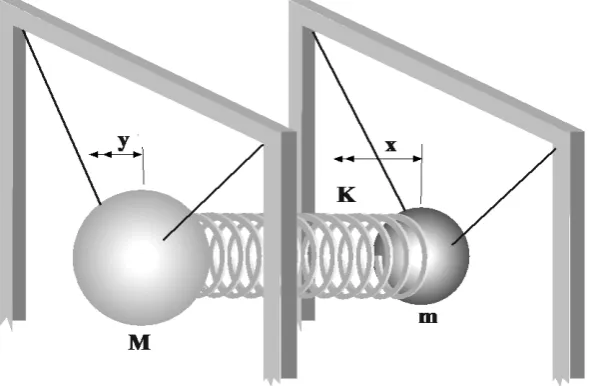
The motion of two objects connected by a spring is analyzed. The interaction propagates between the objects as a mechanical wave through the spring as shown in Figure 1. The mechanical wave propagates through the spring with a velocity [1] that depends on the stiffness of the spring and the mass of the spring per unit length. Therefore, there is a time delay τ required for the deformation applied to one end of the spring to reach the other end. The interaction is not instantaneous. This is seldom taken into consideration when systems of springs and masses are calculated.
In this paper, a new comprehensive method called Reaction Mechanics [2] is used for the analysis of the motion of a system that takes the propagation delay of the interaction into account.
How to cite this paper: Kornreich, P.
(2018) Delay Harmonic Oscillator. Journal
of Applied Mathematics and Physics, 6, 1425-1433.
https://doi.org/10.4236/jamp.2018.67119 Received: June 5, 2018
Accepted: July 9, 2018 Published: July 12, 2018 Copyright © 2018 by author and Scientific Research Publishing Inc. This work is licensed under the Creative Commons Attribution International License (CC BY 4.0).
http://creativecommons.org/licenses/by/4.0/
DOI: 10.4236/jamp.2018.67119 1426 Journal of Applied Mathematics and Physics
Figure 1. Two objects with unequal masses m and M connected by a spring with a spring constant K. The interaction travels between the objects as a mechanical wave through the spring.
The interaction travels between the two objects, through the spring, with a velocity vS equal to the square root of the ratio of the spring stiffness constant in
Newtons, divided by the mass density of the spring in kg per m. The spring stiffness is equal to an elastic constant times a cross sectional area. The analysis is valid when the propagation of the interaction through the spring wire takes less time than the period of the oscillating frequency. The propagation delay through the spring couples the Oscillatory and Center of Mass motions of the objects.
It is demonstrated that the delayed interaction [2] is completely causal. A force FR that was radiated by object TWO in the past is received currently by
ob-ject ONE. Obob-ject ONE also radiates a force FA currently that object TWO might
or might not receive in the future.
By Newton’s law of action and reaction object ONE experiences a recoil force
FRecoil equal in magnitude and opposed in direction to the force FA it radiated.
The recoil force is independent whether or not object TWO receives the radiated force in the future. The forces are continually radiated and received.
Two forces act on object ONE. The force FR radiated by object TWO in the
past and the recoil force FRecoil. These two forces are equal to the mass of object
ONE times its acceleration. Thus, the formulation is causal [2].
The calculations show that the two masses and the spring oscillate. But, if the two masses are not equal, the Center of Mass of the objects will also os-cillate.
up-DOI: 10.4236/jamp.2018.67119 1427 Journal of Applied Mathematics and Physics
per mass is the body, chassis and engine, and the lower mass is the axels and wheels. The upper mass is much heavier than the lower mass. Therefore, the center of mass will vibrate. If the vibration dampers were not there, it would cause a large vibration of the upper mass.
If one uses the standard calculation, neglecting the propagation delay through the spring, one would then obtain that the two masses vibrate about the statio-nary center of mass.
This type of motion also occurs when an electric motor is mounted on a plat-form that is suspended on elastic supports. Even if the rotation of the motor is well balanced, the platform might still vibrate because there are different masses on both sides of the elastic support.
The intake and exhaust valves with their springs of an internal combustion engine can cause oscillations in the engine block.
2. Equation of Motion
In this analysis, the masses are treated as point objects and the model of the spring includes the propagation delay. The propagation delay is modeled by considering that the forces, implicit in Equation (1), with components Kxµk
and Kyµ −k 2 at the two ends of the spring, do not occur simultaneously. It is
as-sumed that the time difference tk −tk−2 between the forces occurring is equal to
the propagation delay through the spring. This eliminates the necessity of de-scribing the spring by a Continuum Mechanics model. It is assumed that the mechanical signal propagates through the spring, from one object to the other, in a shorter time than the period of oscillation of the masses and the spring. In this case, the causal Lagrangian [4] for the Delay Harmonic Oscillator (DHO) can be approximated as follows:
(
)(
)
(
)(
)
2 2
1 1
1 1 1
2 2 4
1 4
k k k k k k k k k
k k k k
L mx x My y K x y x y
K y x y x
µ µ µ µ µ µ µ µ
µ µ µ µ
− −
− −
= + − − −
− − −
(1)
where summation over repeated Greek indices is implied. The subscripts µ = 1, 2, 3, range over the tree dimensions of the coordinates. Single superior dots xµk
denote time derivatives and double superior dots xµk denote second time
de-rivatives. Here xµk at time step tk is a coordinate component, and m is the mass
of Object ONE, and yµk at time step tk is a coordinate component, and M is the
mass of Object TWO. K is a spring constant in Newtons per m. Forming a sum S of Lagrangians.
k k
k
S =∞ L
=−∞
=
∑
(2)Only the Lagrangians Lk and Lk+1 contain the coordinate components xµk
and yµk occurring at time step tk. The Lagrangian Lk is advanced to the next
ad-DOI: 10.4236/jamp.2018.67119 1428 Journal of Applied Mathematics and Physics
vances to xµ +k1, xµ −k1 advances to xµk, yµk advances to yµ +k 2 and yµ −k 2
advances to yµk.
As shown in Equation (1) and Equation (3), tk−1 is a time step of object ONE
in the past and tk−2 is a time step of object TWO in the past. The time tk−2 in
the past, at which object TWO radiated an interaction that object ONE is re-ceiving currently at time tk, is not the same as the time tk−1 in the past at which
Object ONE was radiating an interaction that object TWO is receiving currently. A similar condition exists for the future coordinate times. The future forces ra-diated by the objects do not act on the objects. Recoil forces due to the objects radiating interactions act on the objects. The Lagrangian at time step tk+1 is:
(
)(
)
(
)(
)
1 1 1 2 2 1 1
2 2
1 1 1
2 2 4
1 4
k k k k k k k k k
k k k k
L mx x My y K x y x y
K y x y x
µ µ µ µ µ µ µ µ
µ µ µ µ
+ + + + + + +
+ +
= + − − −
− − −
(3)
Making a transformation of variables [4].
)
)
a b
k k k k m k M k
r x y R x y
m M m M
µ = µ − µ µ = + µ + + µ (4)
where rµk and Rµk are also in rectangular coordinates. Here rµk is a
oscilla-tion coordinate component and Rµk is a center of mass coordinate component.
Inverting Equation (4).
)
)
a b
k M k k k m k k
x r R y r R
m M m M
µ = + µ + µ µ = − + µ + µ (5)
Substituting the transformation of variables, Equation (5) into the Lagrangian of Equation (1).
(
)
1 1
1 1
1 1
1 1
1 1
2 2
1 4
1 4
k R k k k k
k k k k
k k k k
k k k k
k k k k
L m r r m M R R
M m
K r R r R
m M m M
M r R m r R
m M m M
m M
K r R r R
m M m M
m r R M r R
m M m M
µ µ µ µ
µ µ µ µ
µ µ µ µ
µ µ µ µ
µ µ µ µ
− −
− −
− −
− −
= + +
− + + −
+ +
× + + −
+ +
− − + − −
+ +
× − + − −
+ +
(6)
where mR is the reduced mass.
R mM
m
m M
≡
+ (7) As described previously, the coordinate components xµ −k1 and yµ −k 2 do not
DOI: 10.4236/jamp.2018.67119 1429 Journal of Applied Mathematics and Physics
(
)
1 1 1 1 1
1 1 1 1 1 1 1 1 1 1 2 2 1 4 1 4
k R k k k k
k k k k
k k k k
k k k k
k k k k
L m r r m M R R
M m
K r R r R
m M m M
M r R m r R
m M m M
m M
K r R r R
m M m M
m r R M r R
m M m M
µ µ µ µ
µ µ µ µ
µ µ µ µ
µ µ µ µ
µ µ µ µ
+ + + + + + + + + + + + + = + + − + + − + + × + + − + + − − + − − + + × − + − − + + (8)
The Euler Lagrange equations of motion of Reaction Mechanics [2] for the oscillating and center of mass motions are:
)
d)
da 0 b 0
dk k k dk k k
S S S S
t rµ rµ t Rµ Rµ
∂ ∂ ∂ ∂
− = − =
∂ ∂ ∂ ∂ (9)
Substituting the Lagangians of Equation (6) and Equation (8) into Equation (2) and the resulting sum of Lagrangians into the Euler Lagrange equation of mo-tion, Equation (9a) to obtain the oscillation equation of motion.
1 1 1 1 1 1 1 1 2 2 2 0 2
R k k k k k
k k k k
k k k k
k k k k
M K M m
m r r R r R
m M m M m M
m K m r R M r R
m M m M m M
m K M r R m r R
m M m M m M
M K m r R M r R
m M m M m M
µ µ µ µ µ
µ µ µ µ
µ µ µ µ
µ µ µ µ
− − − − + + + + + + + − + + + + − + + + + + + + + − + + + + − + + = + + + (10)
Performing a first step of collecting terms:
(
)
(
)
(
)
1 1 2 1 1 2 2 0 2R k k k k k
k k k
MmK
m r Kr r r r
m M
M m K R R R
M m
µ µ µ µ µ
µ µ µ
− + − + + − + + + − + − − = + (11)
Performing a second step of collecting terms:
(
)
1 1 2 1 1 2 2 2 0 2k k k k k
R
R k k
k k
k k k k k
k k
r r r r r
m K
m r Kr
m M r r
r r R R R
M m K
m M r r
µ µ µ µ µ µ µ
µ µ
µ µ µ µ µ µ µ τ τ − + − + − − + − + − − − + = + (12)
where the delay time τ is approximately:
2 k k
k k r r r r µ µ µ µ
τ
= (13)
DOI: 10.4236/jamp.2018.67119 1430 Journal of Applied Mathematics and Physics
motion, Equation (9b) to obtain the center of mass equation of motion.
(
)
1 11 1 1 1 1 1 1 2 1 2 1 2 1 2
k k k k k
k k k k
k k k k
k k
M m
m M R K r R r R
m M m M
m M
K r R r R
m M m M
M m
K r R r R
m M m M
m M
K r R
m M m
µ µ µ µ µ
µ µ µ µ
µ µ µ µ
µ µ − − − − + + + + + + + + − + + + − + − − + + + − − − + + + + − + + + 0 k k r R
M µ µ
+ =
(14)
Collecting terms:
(
)
2 1 1 2 1 12 2
2 2
0 2
k k k k k k
k
R R R K M m r r r
m M R K
m M
µ µ µ µ µ µ
µ τ τ − + τ τ− +
− − − − −
+ + + =
+
(15)
where the second and third terms have been multiplied and divided by the square of the delay time τ2. Approximating the second differences divided by τ2 such as
1 1
2
2rµk rµk rµk
τ
− +
− −
by the second derivatives times the square τ2 of the propagation delay time τ.
)
1 1)
1 -12 2
2 2
a k k k b k k k
k k
r r r R R R
r R
µ µ µ µ µ µ
µ µ
τ τ
+ − + − ≈ + − + ≈
(16)
Substituting Equation (16) into Equation (12) and dividing by the reduced mass mR.
(
)
2 2
1 0
2
R R
K r K r M m K R
m M µ m µ m M m µ
τ τ
−
− + + =
+ +
(17)
Substituting Equation (16) into Equation (15).
(
)
2 2
2
1 0
2
K R K M m r
m M µ m M µ
τ
τ
− − − =
+
+
(18) Solving Equation (18) for Rµ and substituting the resulting equation into
Equation (17) to obtain the oscillation equation of motion of the Delay Har-monic Oscillator.
(
)
(
)
2 2
2 2 4 2
2
1 1 0
4 R
M m
K K r K K r
m M mM m M µ m m M µ
τ τ τ
−
− + + − =
+ +
+
(19)
Solving Equation (17) for rµ and substituting the resulting equation into
Equation (18) to obtain the center of mass equation of motion of the Delay Harmonic Oscillator.
(
)
(
)
2 2
2 2 4 2 4
2
1 0
4 2
M m
K K R K M mr
m M mM m M µ mM m M µ
τ τ τ
− −
− + + =
+ +
+
(20)
DOI: 10.4236/jamp.2018.67119 1431 Journal of Applied Mathematics and Physics
In the limit when both masses are equal, m = M, the center of mass accelera-tion components Rµ are equal to zero, and the center of mass, at most, moves
at a constant velocity and the objects oscillate with an approximate modified angular frequency.
2
2
1 m M
R
K K m
m M
ω
τ
= ≈
−
+
(21)
Note from Equation (13) that the delay time τ is not constant.
In the limit when the delay time τ goes to zero, the equations of motions 19 and 20 revert to the equations of motion of a Simple Harmonic Oscillator [4].
)
)
a m rRµ+Krµ=0 b Rµ =0 (22)
3. Conservation of Energy
In this conservative system, it is assumed that the energy is equal to the Hamil-tonian H of the system. In order to calculate the Hamiltonian, we must first cal-culate the momentum component pµ of the system. The total momentum
component pµ is:
S S
p
r R
µ
µ µ
∂ ∂
= +
∂ ∂ (23)
Substituting Equation (6) and Equation (8) into Equation (2) and the resulting equation into Equation (23),
(
)
k R k k
pµ =m rµ + m M R+ µ (24)
The Hamiltonian sum is equal to the Legender Transform of Sum of Lagran-gians with respect to the velocities rµk and Rµk [2]:
(
)
1R k k k k k k
H m r r= µ µ + m M R R+ µ µ −L −L+ (25)
where the Lagrangian Lk at time step tk is given by equation 6 and the Lagrangian
Lk+1 at time step tk+1 is given by Equation (8). Taking the derivative with respect
to the time tk of the Hamiltonian of Equation (25) using Equation (6) and
Equa-tion (8) one obtains:
(
)
1 1
1 1
1 1
d d
1 2 1 2 1 2
R k k k k
k
k k k k k k
k k k k k k
k k k k k k
H m r r m M R R
t
M m M
K r R r R r R
m M m M m M
m M m
K r R r R r R
m M m M m M
M m m
K r R r R r R
m M m M m M
µ µ µ µ
µ µ µ µ µ µ
µ µ µ µ µ µ
µ µ µ µ µ µ
− −
− −
+ +
= + +
+ + + − +
+ + +
+ − + − − − +
+ + +
+ + + − −
+ + +
1 1
1
2K m Mm rµk+ Rµk+ m MM rµk Rµk m MM rµk Rµk
+ − + − − −
+ + +
(26)
Equa-DOI: 10.4236/jamp.2018.67119 1432 Journal of Applied Mathematics and Physics
tion (10) and Equation (14) are equal to zero, the change of the Hamiltonian H with time is equal to zero, and therefore the Hamiltonian and thus the energy are constant.
)
d)
)
a 0 b constant Energy constant dk
H H c
t = = = (27)
4. Conclusions
In this paper, the propagation delay of a deformation traveling through the spring is considered, and therefore, is called the Delay Harmonic Oscillator. The Equations of Motion of two masses at the end of a spring through which a de-formation propagates with a finite velocity are derived. The effect of the delay is modeled by assuming that the forces at both ends of the spring are not simulta-neous. The difference in time of the occurrence of these forces is equal to the propagation delay of the deformation signal traveling through the spring. This effect couples the oscillatory and center of mass motions. But this derivation is valid when the propagation of the interaction through the spring wire takes less time than the period of the oscillating frequency. It demonstrates that if the masses are unequal, the center of mass of this system oscillates. Also, the effect of the finite propagation delay causes the oscillation to be non sinusoidal. In the case of zero delay, the motion of the masses reverts to the motion of a Simple Harmonic Oscillator. The effect of the propagation delay through the spring is rarely discussed in literature.
The Equations of Motion derived here are useful for the design of mechanical systems with coil springs and masses. The vehicle suspention [3] is the most ob-vious application. It has two masses connected by coil springs and vibration dampers. However, the vibration dampers are not part of this analysis. The up-per mass consists of the body, chassis and engine and the lower mass consists of the axels, differential and wheels. The upper mass is much heavier than the low-er mass. Thlow-erefore, the centlow-er of mass will vibrate. If the vibration damplow-ers wlow-ere not there, this would cause a large vibration of the upper mass.
If one uses the standard calculation neglecting the propagation delay through the spring, one would obtain that the two masses vibrate about the stationary center of mass.
Another example of this type of motion occurs when an electric motor is mounted on a platform that is suspended on elastic supports. Even if the rota-tion of the motor is well balanced, the platform may still vibrate because there are different masses on both sides of the elastic support.
The Equations of Motion of the Delay Harmonic Oscillator are derived in this paper.
Acknowledgements
DOI: 10.4236/jamp.2018.67119 1433 Journal of Applied Mathematics and Physics
References
[1] Achenbach, J.D. (1984) Wave Propagation in Elastic Solids. North Holland. Elsevier Science, Amsterdam.
[2] Kornreich, P. (2017) Reaction Mechanics of Point Objects. Journal of Applied Ma-thematics and Physics, 5, 137-152.
https://doi.org/10.4236/jamp.2017.51015
[3] Lavanayal, N., Rao Sampath, P. and Redd Promod, M. (2014) Design and Analysis of a Suspension Coil Spring for Automotive Vehicle. Journal of Engineering Re-search and Applications, 4, 151-157.