© 2019, IRJET | Impact Factor value: 7.211 | ISO 9001:2008 Certified Journal
| Page 2046
Developing a Model of Risk Allocation and Risk Handling for Effective
Risk Management System in Construction Project
Ashish D. Awalekar
1, Dr. D. N. Mudgal
2, Prof. S.B. Patil
31
P. G. Student, Department of Civil Engineering, A.M.G.O.I. Vathar, Kolhapur, Maharashtra, India
2
Director, A.M.G.O.I. Vathar, Kolhapur, Maharashtra, India
3
P.G. coordinator, Department of Civil Engineering A.M.G.O.I. Vathar, Kolhapur, Maharashtra, India
---***---Abstract -
Every construction project consists of various risks. During project life cycle, uncertain events take place. Due to these uncertain events, positive or negative impact takes place on project objectives such as time, cost and quality. It is impossible to remove all risks, so we try to identify and mitigate them to prevent project failure. Risk is also defined as probability of occurrence of undesirable event and will have impact on project objectives such as time, cost and quality. Success of an construction project is greatly influenced by proper management of the risks. Risk management is increasingly a critical success factor for major construction projects. This paper aims to identify risks associated with the construction projects and assessment of risks with and classifies them into six types. The process followed by allocation of risks to different parties. After that mitigation strategies are proposed and implemented for case study and risks are again assessed.Key Words: Construction, Risk, Project, Assessment, Impact.
1. INTRODUCTION
Risk is the chance that an event would occur which will lead to change in the project objectives. To ensure that these events do not lead to failure of the projects, there is a need to manage the risks associated with the projects through adoption of appropriate risk management framework. The concept of risk management, therefore, deals with identifying the risks associated with the project, assessing their probability of occurrence and their potential impact on critical project performance measures, and employing direct and indirect means for either reducing the exposure of the underlying project activities to these risks or shifting some of the exposure to other. Risk management is an ongoing process which continues through the lifecycle of project. The process of risk management involves following stages:
Risk identification
Risk assessment
Risk allocation
Risk mitigation
Project gets various benefits on undertaking an effective risk management exercise in a structured manner. Risk management should not be considered as a process
established at the beginning of the project conceptualization but it is a continuous process which has to be carried in all the phases of project lifecycle. Risk management also play a role in strategic decision making for the project stakeholders by improving the strategic management through selection of better objectives and associated targets as a result of risk identification, analysis, evaluation, treatment and monitoring process.
2. METHODOLOGY
The research methodologies are used in order to collect data, analysis data and report on findings and results. The research methodology selected for this risk management project comprised comprehensive literature review, followed by open interviews and distributing questionnaire surveys to the respondents. Qualitative analysis technique used for data analysis
Literature review
Problem Statement
Questionnaire Data collection Interviews
Data Analysis
Qualitative Analysis
Results and discussions
Conclusions
Fig-1: Methodology adopted for research
3. RISK MANAGEMENT PROCESS
A. RISK IDENTIFICATION
© 2019, IRJET | Impact Factor value: 7.211 | ISO 9001:2008 Certified Journal
| Page 2047
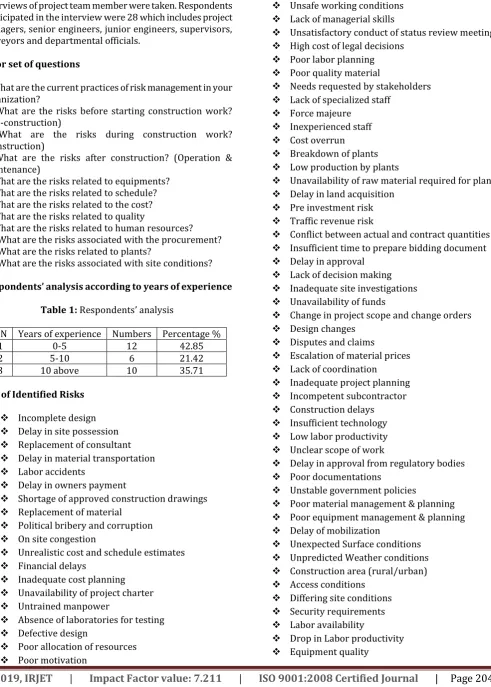
interviews of project team member were taken. Respondents participated in the interview were 28 which includes project managers, senior engineers, junior engineers, supervisors, surveyors and departmental officials.
Prior set of questions
1. What are the current practices of risk management in your organization?
2. What are the risks before starting construction work? (Pre-construction)
3. What are the risks during construction work? (Construction)
4. What are the risks after construction? (Operation & Maintenance) 5. What are the risks related to equipments? 6. What are the risks related to schedule?
7. What are the risks related to the cost? 8. What are the risks related to quality
9. What are the risks related to human resources? 10. What are the risks associated with the procurement? 11. What are the risks related to plants?
12. What are the risks associated with site conditions?
[image:2.595.54.546.94.782.2]Respondents’ analysis according to years of experience
Table 1: Respondents’ analysis
S.N Years of experience Numbers Percentage %
1 0-5 12 42.85
2 5-10 6 21.42
3 10 above 10 35.71
List of Identified Risks
Incomplete design
Delay in site possession
Replacement of consultant
Delay in material transportation
Labor accidents
Delay in owners payment
Shortage of approved construction drawings
Replacement of material
Political bribery and corruption
On site congestion
Unrealistic cost and schedule estimates
Financial delays
Inadequate cost planning
Unavailability of project charter
Untrained manpower
Absence of laboratories for testing
Defective design
Poor allocation of resources
Poor motivation
Unsafe working conditions
Lack of managerial skills
Unsatisfactory conduct of status review meetings
High cost of legal decisions
Poor labor planning
Poor quality material
Needs requested by stakeholders
Lack of specialized staff
Force majeure
Inexperienced staff
Cost overrun
Breakdown of plants
Low production by plants
Unavailability of raw material required for plants
Delay in land acquisition
Pre investment risk
Traffic revenue risk
Conflict between actual and contract quantities
Insufficient time to prepare bidding document
Delay in approval
Lack of decision making
Inadequate site investigations
Unavailability of funds
Change in project scope and change orders
Design changes
Disputes and claims
Escalation of material prices
Lack of coordination
Inadequate project planning
Incompetent subcontractor
Construction delays
Insufficient technology
Low labor productivity
Unclear scope of work
Delay in approval from regulatory bodies
Poor documentations
Unstable government policies
Poor material management & planning
Poor equipment management & planning
Delay of mobilization
Unexpected Surface conditions
Unpredicted Weather conditions
Construction area (rural/urban)
Access conditions
Differing site conditions
Security requirements
Labor availability
Drop in Labor productivity
© 2019, IRJET | Impact Factor value: 7.211 | ISO 9001:2008 Certified Journal
| Page 2048
Equipment breakdown
Equipment maintenance
Material theft & damage
Material storage
Defective work
Change in currency rate
Fluctuation in prices
Unavailability of land
Improper construction methods B. RISK ASSESSMENT
After identifying the risks in the projects, the next stage in the risk management process is to carry out risk assessment in order to quantify the risk by estimating the probability of occurrence of the risk and the impact of the consequence if the risk occurs. Qualitative risk analysis quantifies the magnitude of the potential consequences and the likelihood that those consequences will occur in linguistic terms using words. Qualitative risk analysis is normally use as a technique for prioritization of the identified risks for further detailed analysis. Linguistics scale with descriptions can be used to describe the probability and impact of risks. Linguistic scale to solicit responses from experts on probability of risk event occurring could be a five point scale with the levels described by the linguistic terms, very low, low, medium, High and very High, in ascending order. Similarly, the scale for soliciting consequence of risk can be a three point scale with the five levels described with the linguistic terms: low, medium, High in ascending order.
Table 2: Values of linguistics scale for Probability
Linguistics
scale Very low Low Medium High Very high Probability
score 0.1 0.3 0.5 0.7 0.9
Table 3: Values of linguistics scale for Impact
Linguistics scale Low Medium High
Impact Score 03 05 10
Risk factor
Probability of occurrence and impact is taken from respondents by distributing questionnaire among them. For every risk events risk factor is calculated for all the respondents and average of the every event is calculated and risk factor used for risk prioritization. Risk factor is important to know which risk will have significant impact on project objectives. According to risk factor risks are prioritized. After assigning values to the probability and impact risk factor (R) is calculated.
Risk factor = Probability X Impact R=P X I
Where P= probability occurrence I= Impact
Risk factors of identified risks
Table 4: Risk Factors
Risk Risk
Factor
Incomplete design 1.04
Delay in site possession 5.69
Replacement of consultant 1.51
Delay in material transportation 3.05
Labor accidents 1.31
Delay in owners payment 7.14
Shortage of approved construction drawings 1.53
Replacement of material 1.67
Political bribery and corruption 8.41
On site congestion 1.21
Unrealistic cost and schedule estimates 1.99
Financial delays 2.67
Inadequate cost planning 1.41
Unavailability of project charter 1.85
Untrained manpower 0.63
Absence of laboratories for testing 0.54
Defective design 0.95
Poor allocation of resources 1.89
Poor motivation 1.16
Unsafe working conditions 1.26
Lack of managerial skills 2.54
Unsatisfactory conduct of status review
meetings 6.89
High cost of legal decisions 5.48
Poor labor planning 1.79
Poor quality material 1.31
Needs requested by stakeholders 8.22
Lack of specialized staff 1.54
Force majeure 7.37
Inexperienced staff 1.20
Cost overrun 7.34
Breakdown of plants 2.73
Low production by plants 1.33
Unavailability of raw material required for
plants 1.11
Delay in land acquisition 8.33
Pre investment risk 3.09
Traffic revenue risk 3.05
Conflict between actual and contract quantities 2.46 Insufficient time to prepare bidding document 1.54
Delay in approval 1.33
Lack of decision making 1.58
© 2019, IRJET | Impact Factor value: 7.211 | ISO 9001:2008 Certified Journal
| Page 2049
Unavailability of funds 8.00
Change in project scope and change orders 2.15
Design changes 2.36
Disputes and claims 7.55
Escalation of material prices 2.67
Lack of coordination 1.70
Inadequate project planning 1.60
Incompetent subcontractor 1.04
Construction delays 7.52
Insufficient technology 1.43
Low labor productivity 1.96
Unclear scope of work 1.20
Delay in approval from regulatory bodies 1.66
Poor documentations 0.98
Unstable government policies 1.47
Poor material management & planning 1.40 Poor equipment management & planning 2.43
Delay of mobilization 4.04
Unexpected Surface conditions 1.16
Unpredicted Weather conditions 1.28 Construction area (rural/urban) 3.39
Access conditions 1.56
Differing site conditions 2.18
Security requirements 1.44
Labor availability 2.33
Drop in Labor productivity 2.20
Equipment quality 1.57
Equipment breakdown 6.51
Equipment maintenance 1.90
Material theft & damage 2.98
Material storage 1.75
Defective work 0.94
Change in currency rate 1.19
Fluctuation in prices 1.37
Unavailability of land 8.05
Improper construction methods 1.63
Risk Priority
Risk prioritization is necessary to find out which risk has significant impact on projects objectives. Most significant risks are mitigated using mitigation strategies. Risk prioritized according to their risk factor in ascending order. Most significant risk according to risk factors.
Table 5: Most significant risks
S.N Risk Risk Factor
1 Political bribery and corruption 8.41 2 Delay in land acquisition 8.33 3 Needs requested by stakeholders 8.22
4 Unavailability of land 8.05
5 Unavailability of funds 8.00
6 Disputes and claims 7.55
7 Construction delays 7.52
8 Force majeure 7.37
9 Cost overrun 7.34
10 Delay in owners payment 7.14
11 Unsatisfactory conduct of status review meetings 6.89
12 Equipment breakdown 6.51
13 Delay in site possession 5.69 14 High cost of legal decisions 5.48
15 Delay of mobilization 4.04
C. RISK ALLOCATION
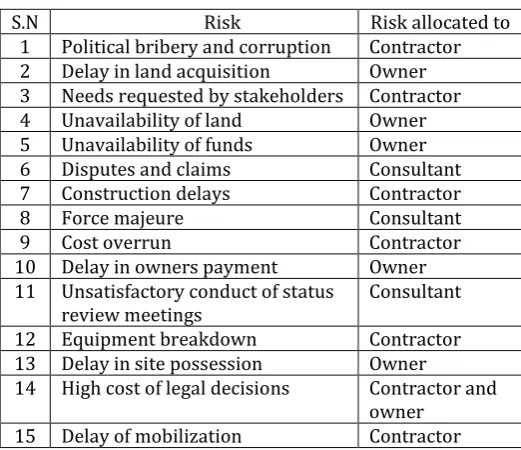
As per the risk allocation principles, risks should be allocated to the party who is in the best position to manage the risk.If the party responsible for mitigating the risk uses its capacity for the overall interests of the project, then there is opportunity to maximize the value for money outcome for the government. After taking questionnaires from respondents, the identified risks are allocated to the parties according to respondent’s experience.
[image:4.595.303.564.425.650.2]Results of risk allocated to parties
Table 6: Risks allocated to parties
S.N Risk Risk allocated to
1 Political bribery and corruption Contractor 2 Delay in land acquisition Owner 3 Needs requested by stakeholders Contractor 4 Unavailability of land Owner 5 Unavailability of funds Owner 6 Disputes and claims Consultant 7 Construction delays Contractor
8 Force majeure Consultant
9 Cost overrun Contractor
10 Delay in owners payment Owner 11 Unsatisfactory conduct of status
review meetings Consultant
12 Equipment breakdown Contractor 13 Delay in site possession Owner
14 High cost of legal decisions Contractor and owner
15 Delay of mobilization Contractor
D. RISK MITIGATION
© 2019, IRJET | Impact Factor value: 7.211 | ISO 9001:2008 Certified Journal
| Page 2050
which approach has maximum responses of mitigation is used approach for mitigation of risks. The strategies are:
Risk Avoidance
Risk Reduction
Risk Transfer and
Risk Retention
Results of Risk mitigation
Table 7: Results of mitigation approaches
S.N Risk Mitigation approach
1 Political bribery and
corruption Risk Reduction
2 Delay in land acquisition Risk Transfer 3 Needs requested
by stakeholders Risk Avoidance 4 Unavailability of land Risk Transfer 5 Unavailability of funds Risk Transfer 6 Disputes and claims Risk Reduction +
Risk Transfer 7 Construction delays Risk Avoidance
8 Force majeure Risk Retention
9 Cost overrun Risk Reduction
10 Delay in owners payment Risk Transfer 11 Unsatisfactory conduct of
status review meetings Risk Avoidance 12 Equipment breakdown Risk Avoidance 13 Delay in site possession Risk Reduction 14 High cost of legal decisions Risk Reduction 15 Delay of mobilization Risk Avoidance
E. IMPLEMENTATION OF MITIGATION STRATEGIES
It is necessary to implement the strategies for significant risks. It is helpful to know which mitigation strategies are working effectively.
Results of risk factors after implementing mitigation strategies
Table 8: Risk factors after implementing mitigation strategies
S.N Risk Risk factor
1 Political bribery and corruption 3.60 2 Delay in land acquisition 3.74 3 Needs requested by stakeholders 0.86
4 Unavailability of land 3.69
5 Unavailability of funds 1.14
6 Disputes and claims 1.24
7 Construction delays 2.34
8 Force majeure 4.44
9 Cost overrun 2.89
10 Delay in owners payment 0.6
11 Unsatisfactory conduct of status
review meetings 0.36
12 Equipment breakdown 1.24
13 Delay in site possession 1.76 14 High cost of legal decisions 2.8
15 Delay of mobilization 1.96
4. CONCLUSIONS
1) For the road projects total 77 risks identified after taking interviews of the respondents.
2) Most significant risks are taken into account according to risk factors.
3) These are political bribery and corruption, delay in land acquisition, needs requested by stakeholders, unavailability of land, unavailability of funds, disputes and claims, construction delays, force majeure, cost overrun, delay in owners payment, unsatisfactory conduct of status review meetings, equipment breakdown, delay in site possession, high cost of legal decisions, delay of mobilization. 4) Risks are allocated to parties according to
responses of respondents. Six risks are allocated to contractor, five risks to the owner, three risks to the consultant and one risk is shared between contractor and owner.
5) Mitigation approaches which are used for mitigation of risks. Risk Transfer and risk reduction approach used for risk Dispute and claims. Mitigation strategies are used for mitigating risks.
6)
Risks are assessed after implementing mitigation strategies. Before implementation highest risk factor was 8.40 for political bribery and corruption .After implementation it was reduced to 3.6 and after implementation highest risk factor is 4.44 for force majeure initially it was 7.37. For the risks whose risk factor is less than 2.5 after implementing strategies are mitigation strategies are effective. These risks are needs requested by stakeholders, unavailability of funds, disputes and claims, construction delays, delay in owners payment, unsatisfactory conduct of status review meetings, equipment breakdown, delay in site possession, delay of mobilization.REFERENCES
[1] Sameh M. El-Sayegh, Mahmoud H. Mansour (2015), “Risk Assessment and Allocation in Highway Construction Projects in the UAE”, Journal of Management in Engineering, ASCE, 31(6): 04015004
© 2019, IRJET | Impact Factor value: 7.211 | ISO 9001:2008 Certified Journal
| Page 2051
Egypt according to political and economic variables From January 2011 to January 2013”. 11,129–135 [3] Anthony J. Perrenoud, Jake B. Smithwick, Kristen C. Hurtado ,Kenneth T.Sullivan (2016),“Project Risk Distribution during the Construction Phase of Small Building Projects”, Journal of Management in Engineering , ASCE, 32(3): 04015050
[4] Shahid IQBAL, Rafiq M. Choudhry, Klaus Holschemacher, Ahsan ALId, JolantaTamosaitiene (2015),“Risk management in construction projects” Technological and Economic Development of Economy,21:1,65-78,DOI:10.3846/ 20294913. 2014 .994582