An evaluation of modelling approaches and column removal time on
progressive collapse of building
David Stephen
a,, Dennis Lam
b, John Forth
c, Jianqiao Ye
d, Konstantinos Daniel Tsavdaridis
c a Dudley College of Technology, Broadway, Dudley DY1 4AS, UKb School of Engineering Design and Technology, Bradford BD7 1DP, UK
c School of Civil Engineering, University of Leeds, Leeds LS2 9JT, UK
d Lancaster University Engineering Building, Lancaster LA1 4YR, UK ABSTRACT
Over the last few decades, progressive collapse disasters have drawn the attention of codified bodies around the globe; as a consequence, there has been a renewed research interest. Structural engineering systems are prone to progressive collapse when subjected to abnormal loads beyond the ultimate capacity of critical structural members. Sudden loss of critical structural member(s) triggers failure mechanisms which may result in a total or partial collapse of the structure proportionate or disproportionate to the triggering event. Currently, researchers adopt different modelling techniques to simulate the loss of critical load bearing members for progressive collapse assessment. GSA guidelines recommend a column removal time less than a tenth of the period of the structure in the vertical vibration mode. Consequently, this recommendation allows a wide range of column removal time which produces inconsistent results satisfying GSA recommendation. A choice of a load time history function assumed for gravity and the internal column force interaction affects the response of the structure. This paper compares different alternative numerical approaches to simulate the sudden column removal in frame buildings and to investigate the effect of rising time on the structural response.
1. Introduction
Abnormal loads such as extreme temperature, explosions, earthquake, detonations, and impact constitute extreme events on building structures. Evaluation of progressive collapse focusing on these specific abnormal loads is relatively efficient as compared to situations where the abnormal loads are uncertain. International codes and specifications such as General Service Administration [1], Department of Defence [2], and Eurocode 1 (CEN [3]) recommend prescriptive strategies for limiting progressive collapse. However, none of these guidelines defines an explicit and simplified numerical performance-based approach for the evaluation of progressive collapse. Though, sudden column removal is recommended in design guidelines without stating the steps on how to achieve it considering different modelling software. Consequently, various researchers adopt different methods and approaches in assessing building structures for progressive collapse. It is important to note that research-based conclusions and recommendations are a function of the assumptions primarily used in modelling the sudden loss of critical structural elements (e.g. key element removal). The interest in progressive collapse can be traced back to 1968 due to the partial collapse of the residential apartment building located in London called Ronan Point; other occurrences include the collapse of Alfred Murrah building in the USA in 1995 and the total collapse of World Trade Centre building in the USA in 2001 [4–6]. In view of these significant events, a series of design guidelines was developed each of which were followed by extensive research investigations. Different methods of modelling the sudden column loss exist in current literature, while the results obtained depend on the modelling technique adopted. Further reviews on code provisions, comparison of standards, merits, and demerits of analysis methods for progressive collapse assessment are available [7–9]. As a result, there are uncertainties associated with the design to resist progressive collapse. Undoubtedly, one of the major challenges is the inability to predict the nature and magnitude of unforeseen events to which the structure may be subjected to during its design life. For instance, if a structure is to be designed explicitly for blast loading, the magnitude of the explosion and the standoff distance possesses another challenge. In view of this and considering the fact that there are numerous other uncertain factors that could trigger a progressive collapse, codes and design guidelines around the world recommended a threat-independent design approach which requires sudden removal of critical columns. The concept is that gravity and wind loads on structural systems result in the development of axial forces, shear forces, moments, and torsional forces in structural members. These forces determine the static equilibrium state of the structure and are accounted for during the conventional design stage. However, unforeseen events result in the redistribution of these forces in magnitude and direction.
assumptions for sudden column loss. Therefore, incorrect assumptions for modelling sudden column loss for progressive collapse assessment could mislead design engineers as observed by Kim, Kim and An [17] and Pujol and Paul Smith-Pardo [18]. This paper investigates the length of column removal time on structural response and compared commonly used assumptions for performing column removal analysis for progressive collapse assessment.
2. Description of model
A ten-storey moment resisting building is used for this investigation as shown in Fig. 1. The model was built using a commercial FE program SAP2000. The structural system consists of five equal spans of 6m along the primary y-axis and four equal spans of 4.5malong the secondary x axis. A constant floor-to-floor height of 3.5mwas adopted for the structural system. Design of the structure was based on the provision of Eurocode 3 (2005). The design of the structural frame sections was based on the target design capacity ratio of 6.5 to 8.0 using auto selection list. The beam section used along the y-axis is 406 × 140 × 39UB and along the x axis is 254 × 102 × 22UB. The slab was modelled using shell elements connected to the beam center of gravity and then offset vertically, above the beam to model composite action. The shell elements are offset such that the slab soffit is located above the top of the beam flange to simulate composite action [19].
The locations of the columns which considered for removals are shown on the plan in Fig. 1 for Corner Column Removal scenario (CCRS), Interior Column Removal Scenario (ICRS), and Edge Column Removal Scenario (ECRS). Column sections from the ground floor to the fourth floor are designed as 305 × 305 × 198UC, from the fifth to the seventh floor as 254 × 254 × 167UC and from the eighth to the tenth floor as 203 × 203 × 60UC. All section configurations are summarized in Table 1.
For the purpose of this investigation, the slab thickness is assumed to be 130mm, the unit weight of concrete to be 23.6kN/m3,
and a perimeter wall loading of 15kN/m, excluding the roof level, was assumed.
[image:2.595.90.488.457.613.2]2.1. Material model
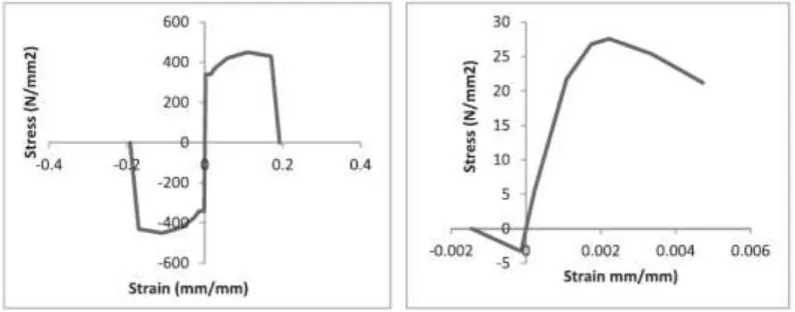
Fig. 2 depicts the stress versus strain material models for steel and concrete used for the purpose of this investigation (both tension and compression zones). The modulus of elasticity of steel used for the investigation was 200GPa, the minimum yield strength, fy of steel was 345 MPa (N/mm2), the minimum tensile stress,fu was 448 MPa, ultimate tensile stress, fue was 493 MPa, and Poisson's ratio of 0.3. These properties define the standard SAP2000 steel properties for A992Fy50 steel. A concrete compressive strength of 27.6 MPa was adopted with a modulus of elasticity of 24.9GPa, and Poisson's ratio of 0.2.
2.2. General Services Administration (GSA 2003)
The General Services Administration (GSA, 2003) design guidelines are aimed at mitigating the likelihood of progressive collapse of new and existing buildings. This guideline sets aside conditions under which a building is assessed for progressive collapse, this depends on the type, functionality, and the size of the building. Otherwise, the building shall be exempt from progressive collapse; and the detailed criteria are referenced in Section 3 of GSA 2003. The GSA guideline offers different analysis techniques for linear and nonlinear static and dynamic analysis. Irrespective of the technique used for the assessment, the guideline recommends two forms of loading conditions for both static and dynamic loads, i.e. Eq. (1) and [2]. A factor of 2.0, as shown in Eq. (1), accounts for the dynamic amplification factor when using static analysis procedures; the acceptance criteria is based on the demand-capacity ratio as defined in Eq. (3).
For the dynamic analysis procedures
(2)
The variable Nd and Ns is the dynamic and static loading, DL is the dead load and LL is the live load. If the linear static analysis
case is used for assessing the progressive collapse potential of a building, the guideline recommends a demand capacity ratio check as shown in Eq. (3) below.
DCR=AF/CE (3)
The acceptance criteria for steel structures are found in Section 5, Table 5.1 of the GSA guideline. The acting force demand (AF) or the applied force on a component or connection could either be a moment, axial or shear force. CE is the ultimate un-factored capacity of the component or connection which again could be moment, axial or shear force criteria. If the nonlinear analysis criteria are used for the assessment, as it is more accurate, Table 2.1 of GSA sets out the acceptance criteria for different types of construction (i.e. steel, reinforced concrete, masonry) based on the ductility and rotational response of the connections for nonlinear analysis. Table 2 presents the initial progressive collapse assessment checks based on the linear static acceptance criteria and the demand-capacity ratio checks for columns.
The Demand Capacity Ratio (DCR) acceptance criteria for steel structures ranges from 1.0 to 2.0; it is a function of the thickness of the web, (tw) the ratio of the applied load to its carrying capacity ( P/ Pcl), and the flange width. It is recommended that DCR should not
exceed 3.0, otherwise the structure will be considered severely damaged. The demand-capacity ratio requirements were checked for maximum beam moment within the region of the column loss as presented in Table 3. For a DCR of less than the acceptable criteria, the structure is deemed to have a low risk of progressive collapse.
If the nonlinear analysis procedure is used for assessment, the plastic hinge rotation, and the ductility ratios are checked to ensure they are within acceptable limits. Preliminary assessment was carried out to ensure that the chosen section was adequate before assessing the response of the structure to the various modelling techniques.
3. Progressive collapse principles
The alternative path method is recommended in most of the design codes when considering progressive collapse evaluation and design. The principle is based on bridging the column loss as a result of an unforeseen event. Consequently, the modelling phases require basic computational assumptions to capture the interaction of the gravity loading with the internal force of the column chosen for removal such that the internal forces of the column diminish to zero over a short period of time depending on the event. Phases describing the initial condition of the structural system through to the stage the column is lost are presented in Fig. 3. The variable P, V, M represents the axial force, the shear force, and the moment of the removed column modelled to simulate the stability state of the structure before modelling sudden column loss.
Available codes recommend that the structure should be capable of safely bridging the removal of the critical structural member. To adequately propose a performance-based approach for progressive collapse adopting this widely-used philosophy, it is necessary to model the loss of the structural members accurately. The modelling of instantaneous column loss is independent of the event triggering it, however, it is recognised that blast waves last a couple of ms. Thus, this approach is a conservative approach in capturing post-blast structural response as the structure is not sensitive to the removal time. If the conservatism needs to be reduced, the removal time should be limited by the time needed to remove the column by the blast. Such time is limited by the inertia effects, i.e. the mass of the column and the supplied impulse from the explosive load.
The modelling techniques commonly used in progressive collapse assessment are presented herein. Four techniques are assessed; each technique considers three locations within the structural system; details of these techniques are discussed in subsequent subsections. As it was aforementioned, displacement and rotational response criteria are the two variables considered during the comparison of the four techniques. The deformation state of the structure under the corner column removal scenario (CCRS), interior column removal scenario (ICRS) and edge column removal scenario (ECRS) are depicted in Fig. 4.
3.1. Technique one: diminishing column internal forces
Fig. 4 is a two-dimensional portal frame used to illustrate the concept of modelling sudden column loss using this approach. The first step is to determine the internal forces in the column employing static analysis of the structural system. Fig. 4a shows the initial state of the structure with the proposed column to be removed under gravity loading. Fig. 4b represents the replacement of the removed column with internal forces determined from Fig. 4a. The concept of modelling sudden column loss based on this technique is to rapidly reduce the internal column reactive forces to zero over a short period of time as shown in Fig. 4c. The stability period (Sp) is introduced to ensure the
initial equilibrium state of the structure before simulating the column loss scenario. The variable Rt is the length of the column removal time
(Figs. 5, 9 and 11).
Achieving equilibrium of reactive internal forces produced from the removal of the column and the gravity load is crucial before carrying out the progressive collapse assessment. This idea hypothetically captures the sudden removal of the column under the gravity loading condition. However, to determine how reliable the response of the structure is, an evaluation of the techniques under the same initial conditions is required. The application of this technique while employing this simple concept can be found in the literature [20].
3.2. Technique two: sudden application of gravity loading
One of the key assumptions to this approach is to impact gravity loads on the structural system suddenly without the missing column. It is assumed that the sudden application of the gravity load without the missing column captures the response of the structure to progressive collapse. Researchers [21–23] have adopted this technique, although this approach does not require the internal forces of the removed column to be modelled. An experimental approach where the gravity loading is induced on the structure has been conducted, as
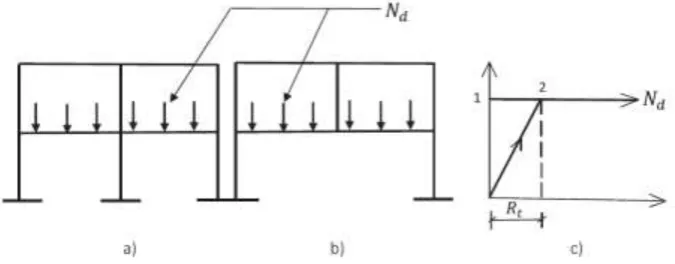
well [24]. However, this approach could be modelled to consider the time lapse at which the maximum gravity load is being applied to the structure. The initial state of the structure under gravity loading conditions is represented with a typical 2D portal frame shown in Fig. 6a, while Fig. 6b replicates the model without the missing column. Fig. 6c is the time history function that is used in modelling the gravity load (N) to conservatively capture the instantaneous loss of the interior column. The original state of the structure is represented by Fig. 6a, while Fig. 6b is the second phase when the column is deleted or the structure modelled without it. There are two similar ways to model the sudden impact of gravity loading, either using the UNIFTH default function path in [19] defined by 1-2-N (Fig. 6) or using a customised path defined by 0-2-N. For the default function path, the column removal time of zero is hypothetically undefined. However, for a column removal time tending to zero the response of the structure is constant (Rt→ 0). Since one of the objectives is to compare the response of all
these functions, the path defined by 0-2-N will be used hereby. The region defined by 0–2, is the linear path at which the gravity load is applied on the structure; from the origin of the plot. This region defines the column removal time (Rt). This approach does not require the modelling of the sudden column loss using the internal reaction forces, as the assumption of sudden application of gravity load
approximately replicates the dynamic response of instantaneous column loss. The load path defined by 0–2 in Fig. 6c was used by [25] to simulate the inelastic and post-buckling behaviour of a two-dimensional truss system. The time lapse at which the load was applied by the authors was four times the natural period (0.024 s) of the structural system. This is considered as possible since the natural period of the structure is small; this assumption may not hold for a 3D high-rise building under progressive collapse scenario though.
3.3. Technique three: balancing of gravity to internal reactive forces
Kim and An, [26] have adopted this technique in proposing an integrated system for building structures considering dynamic effects. The concept of sudden column removal using this technique requires a method of balancing the gravity load and the internal forces. The concept is illustrated using the plane portal frame as shown in Fig. 7.
Fig. 7c represents the time-history function; the internal forces and the gravity load increase linearly up to the maximum time period to approximately simulate the initial stability state of the structure (Sp). This is then kept constant over a period (Rt) before reducing
3.4. Technique four: sudden removal of opposite applied column forces
[image:6.595.106.444.276.408.2]This technique for modelling sudden column loss is based on the time-history function. Again, a plane portal frame structure is employed to illustrate the concept of this method of modelling the column loss. The structure is originally analysed for static forces, thus, the internal forces for the proposed column to be removed are determined. The initial state of the structure is shown in Fig. 8a.
Fig. 8a represents the state of the structure under gravity loading as defined by GSA 2003. The internal forces in the column determined from the linear static analysis are recorded and applied at the nodal point from the top and bottom of the node having the same magnitude but opposite in direction as shown in Fig. 8b. The internal forces applied at the top are modelled as a time-history function as shown in Fig. 8c. At t=0, the structure in Fig. 8a and Fig. 8b are the same. After a time period (Rt), the stress resultant (P1V1M1) in Fig. 8b
at the top cancels the effect of the stress resultants, representing the column (PVM) to simulate the sudden column loss.
4. Effect of sudden column loss
To effectively compare all the techniques described above, there is an important need to evaluate the effect of column removal time on the response of the structure. The effects of column removal time within the range 0.001 ≤ Rt ≤ 5 swere studied at three different locations
of the building. The maximum displacement and rotational responses of the building structure at each column removal time were recorded. Statistical regression analysis was performed to obtain the behaviour that approximately describes the response of the structure to the column removal time (Rt) employing the software package Origin Pro. The results at different column removal locations are presented in the
subsequent sections below. The magnitude of Rt for any design cannot be readily available or estimated since this is a threat-independent
approach.
4.1. Effect of column removal time (ECRS)
This section presents the results of the study at the edge column removal scenario (ECRS) using the four techniques described in Section 4. Displacement and rotational plots for all four techniques are presented in Fig. 10. Function 1 is the time-history loading function for technique one described previously in the Subsection 4.1.
As observed from the plots, the maximum displacement response is
approximately 58mm; this corresponded to a maximum rotational response of 0.37%rads. The turning point (Tp) occurs at 0.19 s and 0.15 s, respectively. At 2 s, the dynamic effects stabilise and are approximately equal to the static response of the structure; the dynamic effect due to sudden column loss was, therefore, negligible. The maximum displacement response achieved using Technique 2 (i.e. Function 2) is 128.9 mm; this corresponds to a maximum rotation of 0.92%rads.
Structural stability (i.e. the structural equilibrium state) begins at approximately 2 s; this corresponds to a displacement and rotational response of 71.9mm and 0.0054rads, respectively.
this approach, the turning point occurs at 0.17 s and 0.18 s, respectively. Though, at 2 s the structure stabilises approximately to a static response such that the dynamic effects are negligible.
4.2. Effect of column removal time on the CCRS
This section presents the responses of the structure when corner column removal scenario (CCRS) using the four techniques described previously.
A similar response to that seen in the ECRS was observed when the corner column removal scenario (CCRS) is examined except for the magnitude of the responses (Fig. 12). Generally, the maximum response of the structure occurs when the column removal time tends to zero (Rt→ 0).
4.3. Effect of column removal time on the ICRS
This section presents the response of column removal time on the structure observed when the interior column removal scenario (ICRS) is investigated. Since the rotational response of the structure at the ICRS is negligible, only the displacement response is considered at this location.
4.4. Summary of assessment
The column removal time was treated as a random variable which represents different scenarios for the impact of an unforeseen event on structures using different loading paths. It was observed that the ‘critical’ response of the structure occurred within the range 0.001≤Rtb0.02 s of column removal time. It was also realised that the structural stability from the dynamic equilibrium state to the static
state happened within the range 0.2≤Rtb2 s for this particular but typical case study. This phase of the structure could be viewed as a
transitory one, since the dynamic effect is approximately 10% greater than the static response. The first mode of the structure has a period of approximately 2 s, which corresponds to the sway mode while the period corresponding to the vertical mode is a tenth of the sway mode approximately. Correlating the column removal time with the period of the structure under vertical vibration mode, it can be concluded that the critical structural response for progressive collapse should be 1/100 of the natural period of the structure. Thus, the result is satisfying GSA criteria which recommends that the length of column removal time should be less than a tenth of the period of the vertical mode of the structure (Rt<T/10 s). This recommendation allows a varied number of choices satisfying this criteria, therefore a proposal for maximum
response of structural system is shown in Fig. 13.
In view of this study, a column removal time of 0.002 s was adopted for comparing the responses of four different techniques as in Section 6. Using regression statistical analysis, a correlation between the displacement and the rotational responses with respect to the column removal time(x)was established for each technique. The concept is based on the logistical equation for fitting which requires five parameters to accurately predict the correlation between two variables. In this case, the variables are the displacement (Dy) and rotational response (Ry) on the y-axis to column removal time (Rt) on the x-axis. Eq. (4-1) presents the relationship between these variables and column removal
time, as follows:
Where A1 and A2are the initial and final responses on the y-axis, x0 is the centre value, and p is the power. The function y(x0) is obtained
from averaging the initial (A1) and final responses, (A2). Taking corresponds to a maximum displacement (Dy) or rotational (Ry) responses, respectively. A summary of the statistical analysis regression parameters for Eq. (4-1) is presented in Table 4. It is worth to note that the variable x stands for the column removal time (Rt) and is also in seconds.
The maximum response for all cases examined, occurred for the corner column removal scenario. It was observed that for Rt ≥ 2
5. Assessment of techniques
5.1. Edge column removal scenario (ECRS) – Comparison of techniques
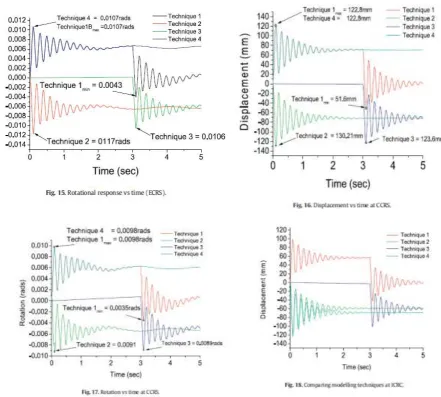
Fig. 14 and Fig. 15 present a comparison of the techniques based on the displacement and rotational responses of the building structure, respectively. Although Technique 1, which considers the stability period of the reacting gravity load and the internal column force, has a maximum displacement and rotational response of 117.7 mm and 0.0107rads, respectively. Using Technique 1 to model sudden column loss suggests a consideration of the equilibrium of the gravity and reaction forces before the loss of the column is imposed, otherwise the response of the structure could be inaccurate. Technique 2, which is the approximate method, shows a maximum displacement and rotational response of 129.7mm and 0.0117 rad, respectively, as depicted with the green colour code of the plot figures. The maximum displacement and rotational response for Technique 3 are 119mmand 0.0106 rad, respectively. This technique is the most commonly used one in the existing literature for progressive collapse assessment. It was observed that the response of Technique 1 (DT1) is approximately the same with Technique 4 within the stability period. Technique 4 has a maximum displacement and rotational response of 117.5mm and 0.0107rads, respectively.
Using the edge column removal scenario (ECRS) for this investigation, three functions (Techniques 1, 3, and 4) are
By using the edge column removal scenario to analyse the four techniques identified, it can be concluded that Technique 2 or 3 will be an optimum option for progressive collapse assessment. The advantage of Technique 2 over 3 is the ease of modelling and that it does not require the reactive internal forces in the column to be determined. However, Technique 3 is the most widely-used approach adopted in the literature and this is so as it considers the stability of the gravity load and the reaction forces in order to ensure the equilibrium of the forces before progressive collapse assessment.
5.2. Corner column removal scenario (CCRS) - comparison of techniques
This subsection is to evaluate the response and behaviour of the structure using the corner column removal scenario (CCRS). Relative structural responses of the four techniques are compared to evaluate the extent at which such modelling techniques differ.
The results for the investigation of the behaviour of the four techniques due to the corner column removal is presented in Fig. 16 based on the displacement response criteria. Generally, there is a higher increase in the response of the structure when the corner column location is used for comparing the response of the four techniques relative to the edge column removal location. Technique 1 has a two-phase response; the process of stabilising the gravity loading and the column removal phase. The behaviour of this function is unique; the maximum dynamic response (Technique 1=122.8mm) for this function occurs at the process of stabilising the gravity load to the reactive force. The second phase, which actually defines the sudden column removal phase, has a maximum displacement response of 51.6 mm. Techniques 2, 3, and 4 have maximum displacements of 130.21 mm, 123.6 mm, and 122.8mm, respectively. This implies that the approximate method (Technique 2) exceeds Technique 3 and 4 by 5.3% and 6%, respectively. Techniques 3 and 4 differ by just 0.7%. There is no significant variation between Techniques 3 and 4 using the displacement response of the structure. Relative connection rotation is shown in Fig. 17. The rotational responses of the structure increases in the order Technique 1, Technique 3, Technique 2, and Technique 4 are of 0.0035rads, 0.0089rads, 0.0091rads, and 0.0098rads, respectively. It is important to note that Technique 1 has a two-phase response; the phase of stabilising the gravity load to the reactive internal column force and the phase of column removal scenario. It is observed that maximum rotational response for this function normally takes place during the stabilising phase of the gravity loads and reactive forces, as it can be seen in Fig. 17. The maximum rotation at the connection occurs in Technique 4 and the stabilising phase of Technique 1 with a magnitude of 0.0098rads.
5.3. Interior column removal scenario (ICRS) - comparison of techniques
Technique 3 has a maximum displacement of 101.6mm. Technique 1 has maximum displacement of 98.7 mm and 42.5 mm for the stabilising phase and column removal phase, respectively. Technique 2 which is the approximate method and Technique 4 have the maximum displacement response of 123.2mmwhich exceeds that of Technique 3 by 21%.
6. Summary
This investigation shows that column removal time for progressive collapse assessment using time history function impacts on the response of the structure. Though, GSA design guidelines recommend a column removal time less than a tenth of the period of the structure which allows a wide range of values satisfying this recommendation. However, in this paper it is observed that the stability of structural columns occurs when the column removal tends to zero such that the column removal time has no impact on the response of the structure. Consequently, it is herein proposed that the column removal time should be less than a hundredth of the period of the structure in the vertical vibration mode.
The summary of the investigation carried out for the modelling techniques at the interior column removal scenario (ICRS), edge column removal scenario (ECRS), and corner column removal scenario (CCRS) is plotted in Fig. 19 and Fig. 20.
The rotational response of the structure at the ICRS is very small relatively to the responses at the CCRS and ECRS, therefore, it is not included in Fig. 20. Using the displacement response criteria, Technique 2(DT2) gives the maximum response relative to Technique 1 (DT1), Technique 3 (DT3), and Technique 4 (DT4) as shown in Fig. 19. Comparing the four techniques, it can be concluded that sudden application of gravity loads represented by Technique 2 (DT2), otherwise known as the approximate method, gives the maximum structural response relative to other techniques. This approach is computationally more efficient relatively to the other methods, as it does not require the modelling of the reactive forces.
7. Conclusions and recommendations
This paper explores commonly used approaches for the application of column removal loads for progressive collapse analysis of building structures. A commercial FE code (SAP2000) was used in capturing the response of a ten-storey prototype model while varying the length of the column removal time. Detailed descriptions of key techniques to progressive collapse modelling were compared at the three different typical locations within the structural system. It was observed that the loading time-history adopted for modelling the sudden column loss affects the response of the structure. Maximum responses of the structure occurred at the corner column removal scenario (CCRS) relatively to the interior (ICRS) and the edge column removal scenarios (ECRS).
A proposed length of column removal time (Rt ≤ T/100) for the critical response is proposed here, where T is the period of
vibration of the structure under column loss scenario. However, the use of such a small rising time requires a comparable time step in the time history dynamic analysis, leading to highly time-consuming computation without much improvement in the predicted accuracy. Hence, the application of gravity load function is computationally more efficient as compared to the other methods, as this approach does not require the determination of the internal forces of the column to be removed. In addition to that, it yields maximum structural response relatively to other commonly used techniques. Hence, for the ease of numerical simulation, the sudden application of gravity loads on the structural system as described in Technique 2 is recommended. It is computationally efficient as this approach does not consider the length of column removal time in the modelling process for progressive collapse assessment of building structures.
References
[1] GSA, General Service Admnistration, Alternate Path Analysis and Design Guidelines for Progressive Collapse Resistance, 2013 1–143. [2] Department of Defence, D, Design of Building to Resist Progressive Collapse, 2005 USA.
[3] CEN, Eurocode 1 - Actions on Structures - Part 1- Bais of Design, European Pre Standard ENV 1991–1, Comite Europeen de Normalaization 250, General Actions – Accidental actions, Brussels, Belgium, 1994.
[4] B.R. Ellingwood, D.O. Dusenberry, Building Design for Abnormal Loads and Progressive Collapse, Computer-Aided Civil and Infrastructure Engineering 20 (3) (2005) 194–205.
[5] D. Stevens, B. Crowder, D. Sunshine, K. Marchand, R. Smilowitz, E. Williamson, M. Waggoner, DoD research and criteria for the Design of Buildings to resist progressive collapse, J. Struct. Eng. 137 (9) (2011) 870–880.
[6] R. Nair, Preventing disproportionate collapse, J. Perform. Constr. Facil. 20 (4) (2006) 309–314.
[7] S. Marjanishvili, E. Agnew, Comparison of various procedures for progressive collapse analysis, J. Perform. Constr. Facil. 20 (4) (2006) 365–374. [8] S. Marjanishvili, Progressive analysis procedure for progressive collapse, J. Perform. Constr. Facil. 18 (2) (2004) 79–85.
[9] O. Mohamed, Progressive collapse of structures: annotated bibliography and comparison of codes and standards, J. Perform. Constr. Facil. 20 (4) (2006) 418–425. [10] B. Yang, K. Tan, Robustness of bolted-angle connections against progressive collapse: experimental tests of beam-column joints and development of component based models, J. Struct. Eng. 139 (9) (2013) 1498–1514.
[11] K. Qian, B. Li, Strengthening of multibay reinforced concrete flat slabs to mitigate progressive collapse, Journal of Structural Engineering (2014) 04014154. [12] J.Main, F. Sadek, Modeling and analysis of single-plate shear connections under column loss, J. Struct. Eng. 140 (3) (2014), 04013070.
[13] J. Weigand, J. Berman, Integrity of steel single plate shear connections subjected to simulated column removal, J. Struct. Eng. 140 (5) (2014), 04013114. [14] J. Yu, K. Tan, Structural behavior of RC beam-column subassemblages under a middle column removal scenario, J. Struct. Eng. 139 (2) (2013) 233–250.
[15] F. Sadek, J. Main, H. Lew, Y. Bao, Testing and analysis of steel and concrete beam-column assemblies under a column removal scenario, J. Struct. Eng. 137 (9) (2011) 881–892.
[16] P. Dat, K. Tan, Experimental response of beam-slab substructures subject to penultimate- external column removal, J. Struct. Eng. 141 (7) (2015) 04014170. [17] H.-S. Kim, J. Kim, D.-W. An, Development of integrated system for progressive collapse analysis of building structures considering dynamic effects, Adv. Eng. Softw. 40 (1) (2009) 1–8.
[18] S. Pujol, J. Paul Smith-Pardo, A new perspective on the effects of abrupt column removal, Eng. Struct. 31 (4) (2009) 869–874. [19] SAP, Integrated software for structural analysis and design, Computers and Structures, 2000 Berkeley, California.
[20] Kokot, S., Anthoine, A., Negro, P., and Solomos, G. (2012). "Static and dynamic analysis of a reinforced concrete flat slab frame building for progressive collapse." Eng. Struct., 40(0), 205–217.
[21] A.G. Vlassis, B.A. Izzuddin, A.Y. Elghazouli, D.A. Nethercot, Progressive collapse of multi-storey buildings due to sudden column loss—part II: application, Eng. Struct. 30 (5) (2008) 1424–1438.
[22] A.G. Vlassis, B.A. Izzuddin, A.Y. Elghazouli, D.A. Nethercot, Progressive collapse of multi-storey buildings due to failed floor impact, Eng. Struct. 31 (7) (2009) 1522–1534.
[23] J.P. Jinkoo Kim, Design of Steel Moment frames considering progressive collapse, Steel and Composite Structures 8 (1) (2008) 85–98.
[24] S. El-Tawil, H. Li, S. Kunnath, Computational simulation of gravity-induced progressive collapse of steel-frame buildings: current trends and future research needs, J. Struct. Eng. 140 (8) (2014), A2513001.
[25] R.B. Malla, P. Agarwal, R. Ahmad, Dynamic analysis methodology for progressive failure of truss structures considering inelastic postbuckling cyclic member behavior, Eng. Struct. 33 (5) (2011) 1503–1513.