VIBRATION ANALYSIS OF BORING TOOL TO IMPROVE SURFACE FINISH
Ukrant R. Kapadnis
1, Pramod E. Chaudhari
21
Post Graduate Student, Department of Mechanical Engineering, MIT School of Engineering, MIT ADT University,
Pune, India
2
Associate Professor, Department of Mechanical Engineering, MIT School of Engineering, MIT ADT University,
Pune, India
---***---Abstract
- In the field of manufacturing industries, manynew concepts and techniques have been introduced to improve its performance and adaptability to the international standards [2]. In industries, boring operation suffer vibrations due to high over hang of the tool. In this report an innovative shatter suppression method based on particle damping technique is attempted to reduce chatter in boring tool and thereby study the improvement in surface finish. Slight structural alteration will be done to minimize the vibration in boring tool. The impact of particle filled boring tool on surface finish will be obtained by measuring the surface roughness of work piece. Granules of different metals, ceramics and polymers of various sizes will be used [
Key Words— Boring, Vibration, Carbon fiber, Glass fiber, Surface finish.
1. INTRODUCTION
Boring is a commonly used operation to enlarge the existing holes of machine structures. When boring tool is slender and long, it is subjected to excessive static deflections or self-excited chatter vibrations which are detrimental to the accuracy and surface finish of the hole. It also causes accelerated wear and chipping of the tool. Internal turning frequently requires a long and slender boring tool in order to machine inside a cavity, and the vibrations generally become highly correlated with one of the fundamental bending modes of the boring tool. Different methods can be applied to reduce the vibrations, the implementation of the most efficient and stable methods require in-depth knowledge concerning the dynamic properties of the tooling system. Furthermore, the interface between the boring tool and the clamping house has a significant influence on the dynamic properties of the clamped boring tool [3]. This report focuses on the behavior of a boring tool that arises under different overhang lengths which are commonly used in the manufacturing industry.[4]
1.1 PROBLEM STATEMENT
During deep boring process, usually when l/d (overhang length/boring tool diameter) ratio is higher, the excessive vibrations are induced at tip of boring tool which hampers the surface finish consequently quality of the products. Moreover it reduces life of cutting tool.
1.2 METHODOLOGY
The stiffness and damping of the boring tool should be increased in order to reduce the vibration. In this project, to achieve the maximum damping effect, the boring tool is laminated with carbon fiber and with glass fiber.
i. Original Mild Steel
ii. Carbon fiber
iii. Glass fiber
To assess the effect of carbon fiber and glass fiber on the acceleration amplitude, experimentation is carried out with different cutting parameters.
2.
EXPERIMENTAL ANALYSIS
To determine the dynamic behavior of boring tool while performing boring operations on mild steel work piece three boring tools were selected. The experimental set-up is designed and engineered to alter the variation of the parameters to be studied. Acceleration amplitude of a vibration is measured for 3 different boring tools, a standard boring tool, a boring tool laminated carbon fiber, and a boring tool laminated glass fiber. In cutting test, experiments were conducted with and without the passive damper to acquire acceleration data in the frequency domain. The data is later used for studying the damping characteristics of the system. A full factorial design is used to evaluate the effect of independent variables such as spindle speeds, depths of cut, feed rates, overhang lengths, and lamination of carbon fiber and glass fiber. The dependent variable is acceleration response amplitude of the boring tool. Total 135 experiments were performed to cover maximum combinations of variables.
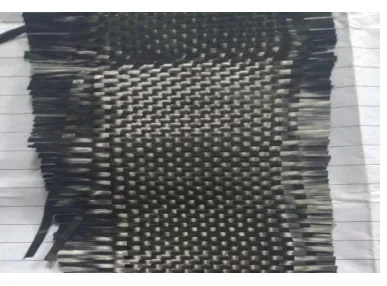
2.1 CARBON FIBER
extremely chemically resistant and have heat tolerance with low thermal expansion and corrosion resistance.[5]
Figure 1: Carbon fiber martial
2.2 GLASS FIBER MATRIAL
Glass fiber (or glass fiber) is a material consisting of
numerous extremely fine fibers of glass. Glass fiber has
roughly comparable mechanical properties to other fibers such as polymers and carbon fiber. Although not as rigid as carbon fiber, it is much cheaper and significantly less brittle when used in composites. Glass fibers are therefore used as a reinforcing agent for many polymer products; to form a very strong and relatively lightweight fiber-reinforced polymer (FRP) composite material called glass-reinforced plastic (GRP), also popularly known as "fiberglass". This material contains little or no air or gas, is denser, and is a much poorer thermal insulator than is glass wool.[5]
Figure 2: Glass fiber material
2.3 CONSTRUCTION OF THE DAMPED BORING TOOL
The carbide tip steel boring tool of diameter 16 mm is used for the boring of mild steel work piece of 80 mm diameter. Because of dynamic stiffness and natural frequency of high-speed steel, boring with high slenderness ratio is very difficult as it induces vibrations in boring operation. It is difficult to perform a boring operation at low feed rate, low speed and high depth of cut due to poor properties of the boring tool. Therefore, in this project work the boring tool of diameter 19 mm is constructed by using carbon fiber as a passive damper. The unidirectional carbon fiber is wrapped to the high-speed steel boring tool to increase the damping with the help of epoxy resin as an adhesive agent.
Steel has less stiffness as compared to the composite material. Hence to improve longitudinal and bending stiffness, lamination of carbon fiber and glass fiber was done on the shank of the boring tool. Adhesive used for lamination of a carbon fiber is the epoxy resin. Epoxy resin is not only act as an adhesive but also it improves the stiffness of the structure.
Figure 3: Laminated Boring Tool
[image:2.595.309.567.186.235.2]Once the epoxy resin is applied over the carbon fiber, glass fiber and boring tool, the wrapping has to be done quickly because epoxy resin starts getting thick once it is mixed with a hardener and exposed to air. After wrapping carbon fiber around the shank of the boring tool it was kept aside for 2 days to become hard. The hardening process continuous for 16 days but it will not largely affect the properties of carbon fiber and glass fiber. To put the accelerometer over the boring tool for measuring the data, after hardening of the carbon fiber, small piece of laminated material was removed and that metal part was polished to remove the adhesive. The laminated boring tools prepared for the experimentation are shown in figure.
Figure 4: Boring Tools Prepared for Experimentation
2.4 EXPERIMENTAL SETUP
[image:2.595.72.256.468.597.2]Figure 5: Experimental setup
[image:3.595.304.486.91.267.2]The F.F.T. analyzer has been used to obtain the vibration acceleration amplitude and the displacement of the boring tool under different combinations of cutting parameters. An accelerometer has been mounted with the help of adhesive at the tip of the boring tool in order to get efficient results of the tip of the tool under different conditions. The F.F.T. analyzer is connected to a laptop by using USB cable in order to get a graphical representation of the output of the experiments.
Table 1: Cutting parameters used for experimentation
Parameters Levels
1 2 3
Spindle speed
(rpm) 280 280 280
Feed rate (mm/rev) 0.1 0.1 0.1
Depth of cut (mm) 0.2 0.2 0.2
Overhang length of
tool (mm) 96 112 128
3. FINITE ELEMENT ANALYSIS
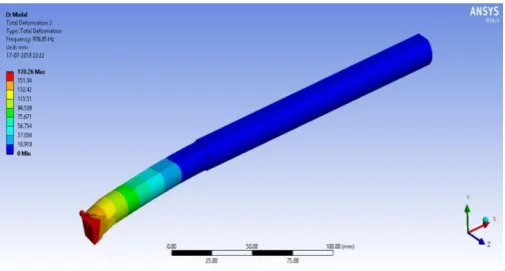
Finite element analysis is done to show natural frequency changes as the laminated material changes. By doing this experiment is validate for further readings. In FEA all boring tools are overhang at length of 96 mm and forces are applied at tip of boring tool.
I. Force Acting on Boring Tool:
Tangential cutting force is given by
Where,
S = cutting speed (m/min) = 113.09 (mm/min)
f = feed rate (mm/rev) = 0.1 mm/rev
D = depth of cut (mm) = 0.2 mm
r = tool nose radius (mm) = 0.4 mm
L = tool length (mm) = 96 mm
Radial cutting force is given by
Resultant force is given by
√
This forces are applied in ANYSIS at tip of the tool in radial and tangential directions.
Figure 6: Total deformation of tool without lamination
Frequency obtained by this analysis is 1249 Hz. After specifying properties of carbon fiber and glass fiber in ANYSIS library layer is applied on boring tool of 1.5 mm and orientation is given by using ACP module in ANSYS. Then by doing modal analysis results obtained are as follows
Figure 7: Total deformation of tool with glass fiber lamination
[image:3.595.307.560.309.438.2] [image:3.595.308.561.553.688.2]Figure 8: Total deformation of boring tool with carbon fiber lamination
Frequency obtained by carbon fiber lamination tool is 893 Hz.
4. RESULTS
In order to study the effect of different lamination on boring tool three tools were prepared. First tool is prepared with no lamination that having shank of mild steel and cutting tip of cemented carbide. Second tool is prepared with glass fiber lamination on shank made of mild steel. Third tool is prepared with carbon fiber lamination on Shank made of mild steel. To obtain the results spindle speed is kept same for all set i.e. 280 rpm. Depth of cut is also same for all i.e. 0.2mm. And feed rate is also same 0.1 mm/rev. Nine readings were taken by using combination of overhang length (96mm, 112mm, 128mm). From the pilot experiments, it is found that tool with carbon fiber coating gives the better results over the other two tools.
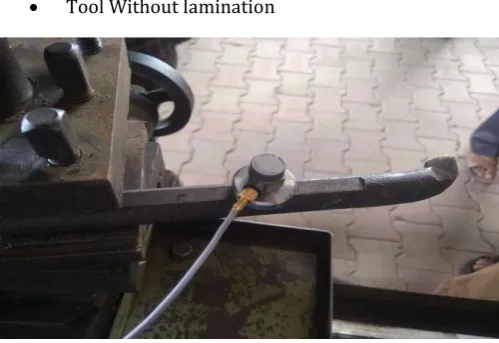
[image:4.595.307.556.254.443.2] Tool Without lamination
Figure 9: Sensor mounted on tool without lamination
FFT analyzer shows that for no lamination tool frequency is same but acceleration changes as the overhang length increases. Increase in acceleration means increase in vibration.
Table 2: Readings for tool without lamination
Material Overhang
length (mm)
Frequency(Hz) Acceleration
(g)
Mild steel 96 6.10 2.79
112 6.10 3.41
128 6.10 4.87
Tool with glass fiber lamination
Figure 10: Sensor mounted on tool with glass fiber lamination
FFT analyzer shows that for glass fiber lamination tool frequency is same but acceleration changes as the overhang length increases. Increase in acceleration means increase in vibration. Results obtained are better than no lamination tool. Acceleration reduces for glass fiber lamination than no lamination. Vibration is less compared to no lamination tool.
Table 3: Readings for tool with glass fiber lamination
Material Overhang
length (mm)
Frequency(Hz) Acceleration
(g)
Glass
fiber 96 5.49 1.4
112 5.49 1.77
128 5.49 1.95
[image:4.595.39.289.513.684.2]Figure 11: Sensor mounted on a tool with carbon fiber lamination
FFT analyzer shows that for carbon fiber lamination tool frequency is same but acceleration changes as the overhang length increases. Increase in acceleration means increase in vibration. Results obtained are better than glass fiber lamination tool. Acceleration reduces for carbon fiber lamination than glass fiber lamination. Vibration is less compared to glass fiber lamination tool.
Table 4: Readings for tool with carbon fiber lamination
Material Overhang
length (mm)
Frequency(Hz) Acceleration
(g)
Carbon
fiber 112 96 4.88 4.88 1.19 1.21
128 4.88 1.6
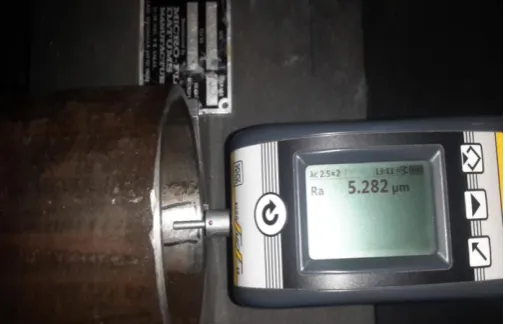
4.1 SURFACE ROUGHNESS TEST
Measuring condition
Probe type= SB10 (inductive)
Measuring Range= 160 μm
LV= Rugosurf 20
Travese length= 5.00 mm
Speed= 1 mm/s
LC (Cut Off)= 2.5 mm
Filter= ISO 11562
Table 5: Surface finish readings
Material Surface finish
(μm)
No lamination shank tool 11.157
Glass fiber lamination shank tool 5.28
[image:5.595.308.561.123.285.2]Carbon fiber lamination shank tool 4.485
Table shows the surface finish obtained by three different work pieces which was machined by three different tools.
Figure 12: Surface roughness test machine
5. CONCLUSIONS
In order to study the effect of different fiber on the damping of the boring tool, full factorial experimental analysis has been performed. And to validate the results, surface roughness testing was done. For no lamination tool and laminated tool, readings were taken under the same cutting conditions to check the damping effectiveness of each tool.
1. At overhang length of 96 mm reduction in acceleration
is by 49% in glass fiber laminated shank tool and 57% in carbon fiber laminated shank tool.
2. At overhang length of 112 mm reduction in
acceleration is by 48% in glass fiber laminated shank tool and 64% in carbon fiber laminated shank tool.
3. At overhang length of 128 mm reduction in
acceleration is by 59% in glass fiber laminated shank tool and 67% in carbon fiber laminated shank tool.
4. Using laminated shank boring tool reduction in
acceleration amplitude is observed compared to no laminated shank boring tool.
5. Surface finish when machining of work piece by glass
fiber laminated shank and carbon fiber laminated shank is improved by 52.73% and 59.86% respectively than no laminated shank.
6. Surface finish when machining of work piece by
carbon fiber laminated shank tool is improved by 15.1% than glass fiber laminated shank tool.
REFRENCES
1. F. Atabey, I. Lazoglu, Y. Altintas, “Mechanics of
2. Dai Gil Lee, Hui Yun Hwang, Jin Kook Kim, “Design and manufacture of a carbon fibre epoxy rotating boring tool”, Composite Structures 60 (2003) 115 – 124.
3. Satoshi Ema, Etsuo Marui, “Suppression of chatter
vibration of boring tools using impact Dampers”, International Journal of Machine Tools & Manufacture 40, (2000) 1141 – 1156.
4. Shuzo Nagano, Takayuki Koizumi, Toru Fujii, Nobutaka
Tsujiuchi, Hiroki Ueda & Kobe Steel, “Development of a composite boring tool”, Composite Structures vol. 38, No. l-4, pp, 531-539, 1997.
5. D. G. Lee, “Manufacturing and Testing of chatter free
boring tools”, Korea Institute of Technology - Sponsored by N. P. Suh ( I ) , M".I.T. Received on January 4, 1988.
6. R. Chandra, S.P. Singh, K. Gupta, “Damping studies in
fibre-reinforced composites - a review”, Composite Structures 46, 41 – 51, 1999.
7. Kyo-Nam Koo, “Vibration and damping analysis of