© 2016, IRJET | Impact Factor value: 4.45 | ISO 9001:2008 Certified Journal | Page 90
Implementation of PGM Protocol under Linux Environment and checking
it’s reliability
Rohit Chaudhary
1, Nisha Pandey
21
M.Tech in Computer Science & Engineering from SRCEM, Palwal, Haryana, INDIA
2
Assistant Professor Department of Computer Science & Engineering, SRCEM, Palwal, Haryana, INDIA
---***---Abstract – In this paper we introduce PGM Protocol which
is a reliable protocol mainly designed to minimize the bad or lost acknowledgements and to minimize the load on network which is caused due to retransmission of lost packets With the help of this protocol we can send frames from multiple source destinations to multiple receivers without any risk of loss of any data or frame. This protocol mainly aimed for applications that require ordered, duplicate-free, multicast data delivery from multiple sources to multiple receivers presents. We have implemented this protocol using a NS2 in LINUX Environment.
Key Words: PGM, NAK, NE, NS2, C++.
1. INTRODUCTION
"Pragmatic General Multicast (PGM) is a reliable multicast transport protocol mainly aimed for applications that require ordered, duplicate-free, multicast data delivery from multiple sources to multiple receivers. The advantage of PGM over traditional multicast protocols is that it guarantees that a receiver in the group either receives all data packets from transmissions and retransmissions, or is able to detect unrecoverable data packet loss. PGM is specifically intended as a workable solution for multicast applications with basic reliability requirements. Its central design goal is simplicity of operation with due regard for scalability and network efficiency.
The main aim of this project, as stated in the specification, is to develop the host side implementation for PGM on LINUX Environment, based only on the specification provided by the RFC. The PGM is implemented on NS2.
[image:1.595.313.564.230.331.2]Pragmatic General Multicast (PGM) is a departure from previous end to end reliable protocols that exploit Internet Multicast. It has both end system and router elements to the protocol. This is an attempt to overcome the scaling problems of protocol reliability techniques (ACK or NAK, retransmission) when operating them over intermediate lossy IP Networks. PGM is targeted at one to many applications, but of course could be used for many to many, simply by using multiple sessions.
Figure 1: Operations of PGM In Network
1.1
Infrastructure
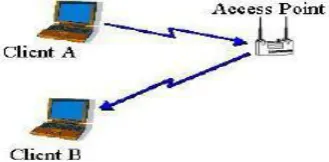
Wireless mobile networks have traditionally been based on the cellular concept and relied on good infrastructure support, in which mobile devices communicate with access points like base stations connected to the fixed network infrastructure. Typical examples of this kind of wireless networks are GSM, WLL, WLAN, etc.
Figure 2: Infrastructure base network
1.2
Infrastructure Less
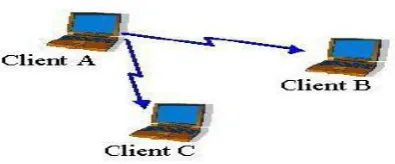
In infrastructure less approach, the mobile wireless
network is commonly known as a mobile ad hoc network
[image:1.595.343.508.467.548.2]© 2016, IRJET | Impact Factor value: 4.45 | ISO 9001:2008 Certified Journal | Page 91 Figure 3: Infrastructure less Adhoc network
2. Literature Review
Yatin Chawathe et al :Although IP Multicast is an effective
network primitive for best-effort, large-scale, multi-point communication, many multicast applications such as shared whiteboards, multi-player games and software distribution require reliable data delivery. Building services like reliable sequenced delivery on top of IP Multicast has proven to be a hard problem. The enormous extent of network and end-system heterogeneity in multipoint communication exacerbates the design of scalable end-to-end reliable multicast protocols. In this paper, we propose a radical departure from the traditional end-to-end model for reliable multicast and instead propose a hybrid approach that leverages the successes of unicast reliability protocols such as TCP while retaining the efficiency of IP multicast for multi-point data delivery. Our approach splits a large heterogeneous reliable multicast session into a number of multicast data groups of co-located homogeneous participants. A collection of application-aware agents—Reliable Multicast proXies (RMXs)—organizes these data groups into a spanning tree using an overlay network of TCP connections. Sources transmit data to their local group, and the RMX in that group forwards the data towards the rest of the data groups. RMXs use detailed knowledge of application semantics to adapt to the effects of heterogeneity in the environment. To demonstrate the efficacy of our architecture, we have built a prototype implementation that can be customized for different kinds of applications. To limit the scope of retransmitted data, we use a scheme based on PGM (Pragmatic Multicast) [9]
Koichi Yanoe et al : If ubiquitously deployed, IP Multicast promises to provide an efficient datagram service for an arbitrary sending host to reach an arbitrary and dynamic set of destination hosts anywhere in the Internet. Unfortunately, two very difficult problems inter domain multicast routing and viable end to end multicast transport have yet to be solved and deployed satisfactorily. This paper proposes that two existing but independent network mechanisms— the EXPRESS service model and the network component of the Pragmatic Multicast protocol(PGM)—be synthesized in a scheme we call the
Breadcrumb Forwarding Service (BCFS) to simultaneously tackle the problems of inter domain multicast routing and end to end reliable multicast. Like EXPRESS, BCFS utilizes explicit source group join and like PGM, enhances the network forwarding architecture with finer grained group control. In this paper, we detail BCFS service model and router mechanisms to support the service. To demonstrate the flexibility and efficiency of BCFS, we describe the application examples built on this service model, which can accommodate not only PGM and also a novel reliable multicast transport protocol.
Tie Liao et al : This paper describes the design and implementation of LRMP, the Light-weight Reliable Multicast Protocol, which has been in use by a significant number of projects .LRMP provides a minimum set of functions for end-to-end reliable multicast network transport suitable for bulk data transfer to multiple receivers. LRMP is designed to work in heterogeneous network environments and support multiple data senders. A totally distributed control scheme is adopted for local error recovery so that no prior configuration and no router support are required. Subgroups are formed implicitly and have no group leaders. Packet loss is reported upon a random timeout first to the lowest level subgroup, then to a higher subgroup and so on until it is repaired. This simple scheme is rather efficient in duplicate NACK and repair suppression. Some congestion control mechanisms are included to fairly share network bandwidth with other data flows.
Hrishikesh Gossain et al:Recently there has been an increasing demand for applications like multiplayer online gaming, where players residing in different parts of the world participate in the same gaming session through the Internet. Multicasting could prove to be an efficient way of providing necessary services for these applications. Furthermore, with increasing popularity of handheld devices and mobile equipment, it is imperative to determine the best way to provide these services in a wireless environment. Due to very diverse requirements, it is necessary to investigate and discern the applicability of existing multicast protocols and qualify which is more suitable for which types of applications. This article provides a detailed description and comparison of IP-based wired and wireless multicast protocols. We hope that the discussion presented here will be helpful to application developers in selecting an appropriate multicast protocol for their specific needs.
© 2016, IRJET | Impact Factor value: 4.45 | ISO 9001:2008 Certified Journal | Page 92 support, but need specialized receivers. There are others
protocols, such as Pragmatic General Multicast Protocol (PGMP) and Large-Scale Multicast Scheme (LMS), which propose to modify routers so that repair packets can be localized to the most effective region. Special routers need to be widely deployed to enhance the effectiveness of these protocols.
3. What is PGM?
"Pragmatic General Multicast (PGM) is a reliable multicast transport protocol mainly aimed for applications that require ordered, duplicate-free, multicast data delivery from multiple sources to multiple receivers. The advantage of PGM over previously used multicast protocols is that it guarantees that a receiver in the group either receives all data packets from transmissions and retransmissions, or is able to detect unrecoverable data packet loss. PGM is purposely proposed as a workable solution for multicast applications with basic reliability requirements. Its central design goal is ease of operation with due regard for scalability and network efficiency
3.1 Multicast protocols
Multicast is one-to-many communication. There are numerous applications today that involve communications between one or more sources and many receivers. These applications include push technologies and multimedia applications as well as shared whiteboard applications, data conferencing, software distribution etc. Multicasting is a technique that enables a single packet transmission to reach one or more destinations or group. The primary benefits of a packet reaching multiple destinations from a single transmission are the following: bandwidth minimization, parallelism in the network, and optimization of transmitter costs.
3.2 Reliable Multicast
Reliable multicast communication is becoming increasingly important, especially for applications such as multimedia conferencing, replicated file servers, distributed interactive simulation and many others. Due to the fact that group communication applications have a wide variety of reliability requirements, many different reliable multicast protocols have been developed, none of which are dominant standards as TCP is for reliable unicast. Group communication can be one-to-many or many-to-many with small or large group sizes. Some applications require packets to be delivered in order, while others do not. Some applications require stability (the fact that the sender knows that a packet has been received), while others do not. Different protocols provide different levels of reliability
depending on their particular application. The protocol reliability can be sender-initiated or receiver-initiated. That is, either of two is responsible for the detection of lost packets. A sender-initiated reliability protocol places the burden of loss detection on the sender. A positive acknowledgement (ACK) is required from every receiver for every packet sent. A lost packet is detected when the sender fails to receive an ACK from every receiver within some time limit. When a loss is detected, the packet is retransmitted and the sender again waits for an ACK from every receiver.
3.3 PGM loss detection and recovery - NAK suppression Receivers detect lost packets based on gaps in the received sequence number sequence and unicast a NAK for each missing packet to the next-hop upstream PGM network element on the distribution tree for the TSI. That PGM network element multicasts a NAK Confirmation (NCF) on the receiving interface in response to any NAK it receives on that interface. As soon as the receivers receive the corresponding NCF, they stop unicasting NAKs. Note that NCFs are not propagated by PGM network elements; they confirm the receipt of a NAK across a single PGM hop. However, the receiver does not send a NAK immediately when it detects a gap. First it delays the transmission of the NAK for a small random interval. If a corresponding NCF is received during that interval, the receiver cancels its NAK generation. This way only, one receiver in a LAN unicasts a NAK for a given TSI/SQN.
3.3 PGM loss detection and recovery - NAK elimination PGM network elements create Retransmit State for each NAK they receive. The Retransmit State is associated with the interface on which the NAK is forwarded. It records the TSI and SQN of the NAK along with a list of the interfaces on which any instance of the NAK was received. Once the retransmit state exists for a given TSI/SQN, the PGM network elements confirm but do not forward further instances of that NAK. This results in only one instance of a NAK being forwarded by a PGM network element.
© 2016, IRJET | Impact Factor value: 4.45 | ISO 9001:2008 Certified Journal | Page 93
4. SIMULATION ENVIRONMENT
4.1 Simulation Languages
NS2 uses two languages because simulator has two different kinds of things it needs to do. On one hand, detailed simulations of protocols requires a systems programming language which can efficiently manipulate bytes, packet headers, and implement algorithms that run over large data sets. For these tasks run-time speed is important and turn-around time (run simulation, find bug, fix bug, recompile, re-run) is less important. On the other hand, a large part of network research involves slightly varying parameters or configurations, or quickly exploring a number of scenarios. In these cases, iteration time (change the model and re-run) is more important. Since configuration runs once (at the beginning of the simulation), run-time of this part of the task is less important. NS2 meets both of these needs with two languages, C++ and OTcl. C++ is fast to run but slower to change, making it suitable for detailed protocol implementation. OTcl runs much slower but can be changed very quickly (and interactively), making it ideal for simulation configuration. ns (via tclcl) provides glue to make objects and variables appear on both langauges.
4.2 Experimental graph
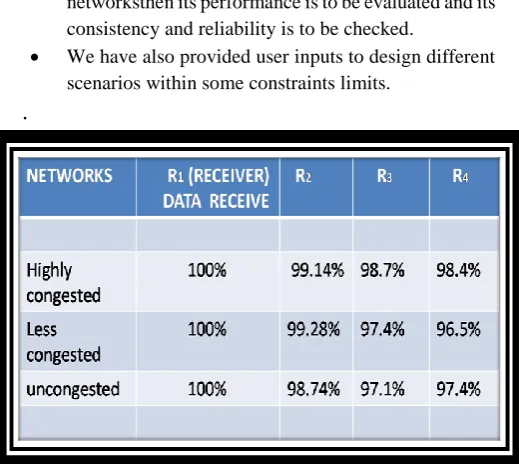
[image:4.595.311.571.185.417.2]To check the reliability of PGM protocol we tried to experiment the efficiency of PGM protocol with other multicast protocols we check the scenario in a highly congested network. Then we conclude, after how much delay the network will produce its first acknowledgment , how much the number of packets that drops, what amount of data is retransmitted and what is retransmission rate, and at what frequency the retransmission occurs. Then we compare these results with other multicast protocols and after summarizing the whole scenario we depicted a graph which is shown below:
Figure 4: Feedback of PGM Protocol
4.3 Protocol Testing On Networks
We have implemented PGM protocol on ns2.
Simulations were carried out with the checking of
reliability of the PGM Protocol and checking its situations on different networks mainly Highly
congested, Less congested and uncongested
networksthen its performance is to be evaluated and its consistency and reliability is to be checked.
We have also provided user inputs to design different
scenarios within some constraints limits.
[image:4.595.37.288.574.755.2].
Figure 5: Efficiency on Different Networks
5. CONCLUSION
© 2016, IRJET | Impact Factor value: 4.45 | ISO 9001:2008 Certified Journal | Page 94
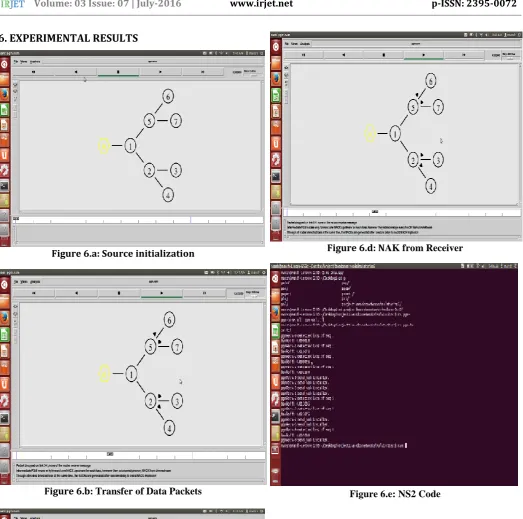
6. EXPERIMENTAL RESULTS
Figure 6.a: Source initialization
Figure 6.b: Transfer of Data Packets
Figure 6.c: Delivery of Data Packets
[image:5.595.38.562.68.587.2]Figure 6.d: NAK from Receiver
Figure 6.e: NS2 Code
7. FUTURE WORK
© 2016, IRJET | Impact Factor value: 4.45 | ISO 9001:2008 Certified Journal | Page 95
REFERENCES
[1] Yatin Chawathe, Steven McCanne, Eric A. Brewer, Reliable Multicast for Heterogeneous Networks .Computer Science Division, University of California at Berkeley
[2] Yatin Chawathe, Steve Fink, Steven McCanne, and Eric Brewer, ―A Proxy Architecture for Reliable Multicast in Heterogeneous Environments,‖ in Proceedings of ACM Multimedia ’98, Bristol, U.K., Sept. 1998.
[3] Koichi Yano, Steven McCanne, The Breadcrumb Forwarding Service: A Synthesis of PGM and EXPRESS to Improve and Simplify Global IP Multicast University of California, Berkeley
[4] Tie Liao, ―Light-weight Reliable Multicast Protocol
Specification‖, available at http://webcanal.
inria.fr/lrmp/lrmp_v1.html.
[5] Hrishikesh Gossain, Carlos De Morais Cordeiro, And Dharma P. Agrawal, Multicast: Wired To Wireless. IEEE Communications Magazine. University Of Cincinnati June 2002
[6] R. Kermode, ―Smart Network Caches: Localized Content and ApplicationNegotiated Recovery Mechanisms for Multicast Media Distribution,‖ Ph.D. dissertation, MIT, 1998.
[7] J. Metzner, ―An Improved Broadcast Retransmission Protocol,‖ IEEE Trans.Commun., vol. 32, no. 6, June 1984, pp. 679–83.
[8] J. Nonnenmacher and E. W. Biersack, ―Reliable multicast: Where to useFEC,‖ Proc. IFIP 5th Int’l. Wksp. Protocols for High Speed Networks, Sophia Antipolis, France, Oct. 1996, pp. 134–48.
[9] J. Nonnenmacher, E. Biersack, and D. Towsley, ―Parity-Based Loss Recovery for Reliable Multicast Transmission,‖ ACM SIGCOMM, Sept. 1997.
[10] L. Rizzo, ―Effective Erasure Codes for Reliable Computer Communication Protocols,‖ Comp. Commun. Rev., Apr. 1997.
[11] Speakman et al., ―PGM Reliable Transport Protocol
Specification,‖ RFC 3208, Dec. 2001,
http://www.ietf.org/rfc/rfc3208.txt
[12] L. Rizzo, ―pgmcc: A TCP-friendly Single-Rate Multicast Congestion Control Scheme,‖ Proc. ACM SIGCOMM, Aug. 2000.
[13] J.C. Bolot, T. Turletti, and I. Wakeman, ―Scalable Feedback Control for Multicast Video Distribution 1994, pp. 58–67.
BIOGRAPHIES
Rohit Chaudhary
(M.Tech in Computer Science & Engineering from Shri Ram College of Engineering & Management, Palwal Haryana, INDIA)
Email ID- [email protected]
Nisha Pandey
Assistant Professor Department of Computer Science & Engineering SRCEM, Palwal, Haryana, INDIA.