© 2016, IRJET | Impact Factor value: 4.45 | ISO 9001:2008 Certified Journal
| Page 1320
Multiobjective Optimization of WEDM Process Parameters on
Al5052/Sic/Gr Hybrid MMC Using Grey Fuzzy
U. Munuswamy
1, T. Pratheep Reddy
21,2
S.V.College of Engineering, Dept. of Mechanical Engineering, Tirupati, Andhra Pradesh, India – 517501.
---***---Abstract -
In this study, Grey integrated fuzzy is used for multi-objective optimization of Wire Electrical Discharge Machining parameters, which converts the multi responses into a single fuzzy grade. Based on fuzzy grade, optimal combination of parameters are determined. L27 orthogonal array is used for Design of experiments. Maximum Material removal rate and Minimum surface roughness were chosen as the objectives. In this study Al5052/Sic/Gr Hybrid MMC is considered as the target material for Wire Electrical discharge Machining, because of high corrosion resistance, good mechanical strength and relatively low cost. The process parameters viz., pulse on time, pulse off time, Peak Current and wire feed were optimized with consideration of Grey Relational Grade. The confirmation run, results shows that the better quality is achieved by the optimal combination of process parameters.)Key Words: Al5052/Sic/Gr Hybrid MMC; WEDM; Multiobjective Optimization; Grey Relational Analysis; Fuzzy Logic; Grey Fuzzy.
1. INTRODUCTION
Aluminium based Metal matrix composites possess many advantages such as low density, better mechanical properties and economical compared to pure metals for real time applications in aerospace, structural, marine, industrial, chemical and architecture [1]. Among the various useful aluminium alloys, Al5052 is typically characterized by properties such as good corrosion resistance to seawater, very good weldability and cold formability. AMC properties can be tailored by incorporating hard ceramic phase such as SiC, Al2O3, B4C, TiC, TiB2, MgO, TiO2 and BN to a relatively soft matrix. At present, hybrid metal matrix composites are of intense studies [2]. Wire Electrical Discharge Machining (WEDM) is an unconventional manufacturing process, used to machine the metals with high precision using thermal energy, makes advantage in the manufacture of parts with complex shapes and hard material [3]. WEDM has been widely used in many industries, which requires high precision and quality. The research in WEDM processing has been focused on rapid machining with best quality. Manufacturing industries applies various methodologies to identify the effect of machining parameters on material removal rate and surface roughness, which are the most important objectives in the manufacturing.
The best quality and good functionality of the product, depends on selecting the suitable, optimal process parameters and its levels. Generally, Taguchi method is used to optimize the single response characteristics of process parameters to achieve high quality [4], which is not suitable for present scenario in industries. At present, handling multi-response characteristics are an interesting and challenging research. Grey relational analysis is used to determine the optimal parameters by converting multi responses into single response (grey relational grade) [5].
Fuzzy logic theory, evolved as a new technique and attracts many researchers [6] in recent times, as an effective way of solving the complex problems which consists of uncertain and vague information. Many researchers observed that grey integrated fuzzy [7] system improves the system performance, by minimizing the error in prediction. ANOVA is carried out to determine the percentage of contribution of each factor on the response of the system.
2. EXPERIMENTAL SETUP/OUTPUT MEASUREMENT
[image:1.595.318.549.607.729.2]Al5052/SiC/Gr Hybrid MMC is used as target material in the present study as shown in Fig 1. Experiments were conducted by choosing a brass wire of 0.25 mm dia as electrode and distilled water as dielectric fluid. The experiments were conducted as per the design of experiments shown in Table 2. In this study three process parameters with three levels are chosen for machining. The Process parameters and its levels are shown in Table 1. Full factorial design was chosen for experimentation, i.e., 33 = 27 runs for accurate results.
© 2016, IRJET | Impact Factor value: 4.45 | ISO 9001:2008 Certified Journal
| Page 1321
Table -1: Process parameters and their levelsS. No. Process parameters Levels
1 2 3 Units
1 Pulse-on time (ON) 10 15 20 µs
2 Pulse-off time (OFF) 10 15 20 µs
[image:2.595.50.564.232.793.2]3 Pulse current 2 4 6 A
Table -2: Design of Experiments and Responses
Expt.
No Pulse On A Pulse
Off B
Pulse Current
C
MRR
(mm3/min) (μm) Ra
1 15 10 2 13.38 5.6
2 15 15 2 14.46 5.54
3 15 15 4 14.129 5.45
4 20 10 6 15.432 5.78
5 10 20 2 15.129 5.47
6 20 15 2 15.947 5.56
7 15 20 2 16.53 5.4
8 10 10 4 16.527 5.52
9 10 10 2 16.135 5.46
10 20 20 6 12.202 5.57
11 20 10 4 11.884 6.14
12 15 20 6 11.913 5.85
13 10 15 6 12.328 5.9
14 15 20 4 12.328 5.68
15 10 20 4 13.148 5.93
16 20 20 4 14.151 6.23
17 10 15 4 12.586 5.98
18 20 10 2 13.295 5.55
19 15 15 6 9.117 5.67
20 20 20 2 8.894 5.83
21 20 15 4 8.952 5.94
22 10 20 6 9.784 5.74
23 20 15 6 9.761 6.04
24 10 10 6 10.073 5.7
25 15 10 4 10.825 5.59
26 10 15 2 10.454 5.76
27 15 10 6 10.454 6.35
3. GREY RELATIONAL ANALYSIS:
Grey relational analysis is applied to optimize process parameters having multi-responses through grey relational grade. The use of GRA includes the following steps:
1. Conduct the experiments as per plan of experiments. 2. Transform the experimental results into signal-to-noise ratio.
3. Normalize the values of signal-to-noise ratio. 4. Perform the grey relational generating and calculate the grey relational coefficient.
5. Calculate the grey relational grade by averaging the grey relational coefficient.
3.1 Normalization:
Convert the original sequences to a set of comparable sequences by normalizing the data. Depending upon the response characteristic, three main categories for normalizing the data is as follows:
3.2 Grey relational coefficient and grey relational
grade
Grey relational coefficient and grey relational grade: Grey relation coefficient (αij) is calculated for each of the performance characteristics, which expresses the relationship between ideal and actual normalized experimental results, as shown in “Eq.(4).”
Grey relational grade can be calculated by taking the average of is the weighted grey relational coefficient and defined as follows:
© 2016, IRJET | Impact Factor value: 4.45 | ISO 9001:2008 Certified Journal
| Page 1322
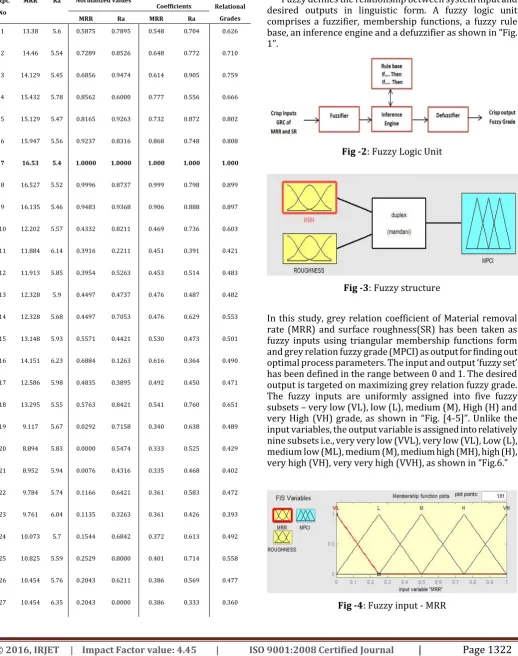
Table -3: Grey Relational gradesExpt. No
MRR Ra Normalized values Grey Relational Coefficients
Grey Relational
Grades MRR Ra MRR Ra
1 13.38 5.6 0.5875 0.7895 0.548 0.704 0.626
2 14.46 5.54 0.7289 0.8526 0.648 0.772 0.710
3 14.129 5.45 0.6856 0.9474 0.614 0.905 0.759
4 15.432 5.78 0.8562 0.6000 0.777 0.556 0.666
5 15.129 5.47 0.8165 0.9263 0.732 0.872 0.802
6 15.947 5.56 0.9237 0.8316 0.868 0.748 0.808
7 16.53 5.4 1.0000 1.0000 1.000 1.000 1.000
8 16.527 5.52 0.9996 0.8737 0.999 0.798 0.899
9 16.135 5.46 0.9483 0.9368 0.906 0.888 0.897
10 12.202 5.57 0.4332 0.8211 0.469 0.736 0.603
11 11.884 6.14 0.3916 0.2211 0.451 0.391 0.421
12 11.913 5.85 0.3954 0.5263 0.453 0.514 0.483
13 12.328 5.9 0.4497 0.4737 0.476 0.487 0.482
14 12.328 5.68 0.4497 0.7053 0.476 0.629 0.553
15 13.148 5.93 0.5571 0.4421 0.530 0.473 0.501
16 14.151 6.23 0.6884 0.1263 0.616 0.364 0.490
17 12.586 5.98 0.4835 0.3895 0.492 0.450 0.471
18 13.295 5.55 0.5763 0.8421 0.541 0.760 0.651
19 9.117 5.67 0.0292 0.7158 0.340 0.638 0.489
20 8.894 5.83 0.0000 0.5474 0.333 0.525 0.429
21 8.952 5.94 0.0076 0.4316 0.335 0.468 0.402
22 9.784 5.74 0.1166 0.6421 0.361 0.583 0.472
23 9.761 6.04 0.1135 0.3263 0.361 0.426 0.393
24 10.073 5.7 0.1544 0.6842 0.372 0.613 0.492
25 10.825 5.59 0.2529 0.8000 0.401 0.714 0.558
26 10.454 5.76 0.2043 0.6211 0.386 0.569 0.477
27 10.454 6.35 0.2043 0.0000 0.386 0.333 0.360
4. DETERMINATION OF OVERALL FUZZY GRADE:
[image:3.595.41.560.136.793.2]Fuzzy defines the relationship between system input and desired outputs in linguistic form. A fuzzy logic unit comprises a fuzzifier, membership functions, a fuzzy rule base, an inference engine and a defuzzifier as shown in “Fig. 1”.
Fig -2: Fuzzy Logic Unit
Fig -3: Fuzzy structure
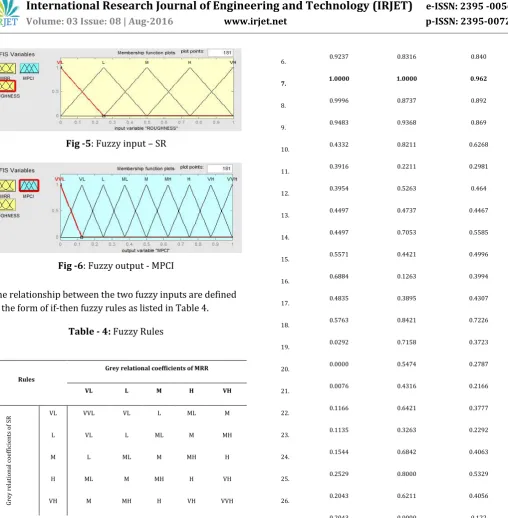
In this study, grey relation coefficient of Material removal rate (MRR) and surface roughness(SR) has been taken as fuzzy inputs using triangular membership functions form and grey relation fuzzy grade (MPCI) as output for finding out optimal process parameters. The input and output ‘fuzzy set’ has been defined in the range between 0 and 1. The desired output is targeted on maximizing grey relation fuzzy grade. The fuzzy inputs are uniformly assigned into five fuzzy subsets – very low (VL), low (L), medium (M), High (H) and very High (VH) grade, as shown in “Fig. [4-5]”. Unlike the input variables, the output variable is assigned into relatively nine subsets i.e., very very low (VVL), very low (VL), Low (L), medium low (ML), medium (M), medium high (MH), high (H), very high (VH), very very high (VVH), as shown in “Fig.6.”
[image:3.595.305.562.196.427.2]© 2016, IRJET | Impact Factor value: 4.45 | ISO 9001:2008 Certified Journal
| Page 1323
Fig -5: Fuzzy input – SRFig -6: Fuzzy output - MPCI
The relationship between the two fuzzy inputs are defined in the form of if-then fuzzy rules as listed in Table 4.
Table - 4: Fuzzy Rules
Rules
Grey relational coefficients of MRR
VL L M H VH
Gr
ey
r
el
at
io
na
l c
oe
ff
ic
ie
nt
s o
f S
R VL VVL VL L ML M
L VL L ML M MH
M L ML M MH H
H ML M MH H VH
VH M MH H VH VVH
Table -5: Fuzzy output - MPCI
Expt. No
Fuzzy Inputs Fuzzy Output
(MPCI)
MRR SR
1. 0.5875 0.7895 0.701
2. 0.7289 0.8526 0.788
3. 0.6856 0.9474 0.799
4. 0.8562 0.6000 0.737
5. 0.8165 0.9263 0.840
6. 0.9237 0.8316 0.840
7. 1.0000 1.0000 0.962
8. 0.9996 0.8737 0.892
9. 0.9483 0.9368 0.869
10. 0.4332 0.8211 0.6268
11. 0.3916 0.2211 0.2981
12. 0.3954 0.5263 0.464
13. 0.4497 0.4737 0.4467
14. 0.4497 0.7053 0.5585
15. 0.5571 0.4421 0.4996
16. 0.6884 0.1263 0.3994
17. 0.4835 0.3895 0.4307
18. 0.5763 0.8421 0.7226
19. 0.0292 0.7158 0.3723
20. 0.0000 0.5474 0.2787
21. 0.0076 0.4316 0.2166
22. 0.1166 0.6421 0.3777
23. 0.1135 0.3263 0.2292
24. 0.1544 0.6842 0.4063
25. 0.2529 0.8000 0.5329
26. 0.2043 0.6211 0.4056
27. 0.2043 0.0000 0.122
[image:4.595.30.555.224.777.2]From the Table 3 and 5, it is confirmed that Experiment number 7 shows the optimal parameters for better surface finish and MRR, i.e., Pon – 15 μs, Poff –20 μs and Current – 2A corresponding to Table 2.
© 2016, IRJET | Impact Factor value: 4.45 | ISO 9001:2008 Certified Journal
| Page 1324
5. ANALYSIS OF VARIANCE:
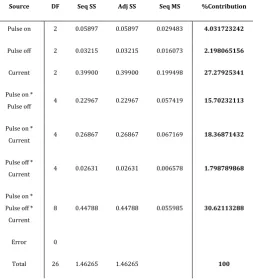
ANOVA is performed to identify the process parameters of WEDM that significantly affect MPCI’s. This is accomplished by separating the total variability of the grey fuzzy grades, which is measured by the sum of the squared deviations from the total mean of the grey fuzzy reasoning grade, into contributions by each machining process parameters and the error. An ANOVA table consists of sums of squares, corresponding degrees of freedom, the F-ratios, and the contribution percentages of the machining factors. These contribution percentages can be used to assess the importance of each factor for the interested MPCI.
Table -6: Analysis of Variance
Source DF Seq SS Adj SS Seq MS %Contribution
Pulse on 2 0.05897 0.05897 0.029483 4.031723242
Pulse off 2 0.03215 0.03215 0.016073 2.198065156
Current 2 0.39900 0.39900 0.199498 27.27925341
Pulse on *
Pulse off 4 0.22967 0.22967 0.057419 15.70232113
Pulse on *
Current 4 0.26867 0.26867 0.067169 18.36871432
Pulse off *
Current 4 0.02631 0.02631 0.006578 1.798789868
Pulse on * Pulse off * Current
8 0.44788 0.44788 0.055985 30.62113288
Error 0
Total 26 1.46265 1.46265 100
The relative effect among the control factors for the MPCI’s can be verified by using the ANOVA so that the optimal combinations of the machining factors can be accurately determined. From Table 6. it is evident that the control factors PULSE ON and CURRENT have the most significant effects on the MPCI. Moreover, the variance due to the noise factors is 0%, indicating that the selection and arrangement of the control factors is adequate and logical and the results are highly reliable.
6. CONFIRMATION RUN:
[image:5.595.36.290.305.586.2]After determining the optimal combination of parameters, the last phase is to verify the MRR, surface roughness by conducting the confirmation experiment. The A2B3C1 is an optimal parameter combination of the machining process by Grey integrated fuzzy logic. The confirmation test is carried out with the optimal parameter combination A2B3C1, and the results are tabulated in Table 7, and the fuzzy grade is increased by 10%. It is clear that the MRR and SR increased greatly with the optimal parameters.
Table -7: Confirmation Test Results
Type Initial Optimal/Predicted Experimental
Level combination A2B3C1 A2B3C1 A2B3C1
MRR (mm3/sec) 16.53 16.56
SR (μm) 5.4 5.36
MPCI 0.962 0.962 0.966
7. CONCLUSION:
The effect of process parameters i.e. pulse on-time, pulse off-time, Pulse current on response variables such as material removal rate, surface roughness has been thoroughly studied.
The levels of significance of process parameters for each response variable has been investigated using ANOVA.
Pulse on and Pulse current were found to be the most significant factors influencing all responses investigated for both the experiment sets.
The A2B3C1 is an optimal parameter combination of the machining process by Grey coupled fuzzy logic.
The fuzzy grade is increased by 10%. It is clear that the MRR and SR increased greatly with the optimal parameters.
REFERENCES
[1] Bala G Narasimha, Vamsi M Krishna and Anthony M
Xavior, “A Review on Processing of Particulate Metal
Matrix Composites and its Properties,” International Journal
of Applied Engineering Research, vol. 8(6), 2013, , pp.
647-666.
[2] G. Bala Narasimha, M. Vamsi Krishna and Anthony M
© 2016, IRJET | Impact Factor value: 4.45 | ISO 9001:2008 Certified Journal
| Page 1325
Experimental Buckling Stability of Metal Matrix Composite
Columns with Fixed & Hinged Ends,” International Journal
of Applied Engineering Research, vol. 9(2), 2014, pp.
191-196.
[3] Vivek Aggarwal, Sehijpal Singh Khangura and R. K. Garg,
“Parametric modeling and optimization for wire electrical discharge machining of Inconel 718 using response surface methodology” Int J Adv Manuf Technol, vol 79, 2015, pp.31–47.
[4] M.Vamsi Krishna, G.Bala Narasimha, N.Rajesh And
Anthony M .Xavior, “Optimization of Influencial parameters on Mechanical behavior of AlMg1 SiCu Hybrid Metal Matrix Composites using Taguchi integrated Fuzzy Approach”, Procedia Materials today, vol.2(4),2015, pp.1464-1468.
[5] G. Bala Narasimha, M. Vamsi Krishna and R.Sindhu,
“Prediction of Wear Behaviour of Almg1sicu Hybrid MMC Using Taguchi with Grey Rational Analysis” Procedia Engineering, vol. 97(2), 2014, pp. 555-562.
[6] Rajyalakshmi.G, Venkata Ramaiah. P, “Optimization of
Process Parameters of Wire Electrical Discharge Machining Using Fuzzy logic Integrated with Taguchi Method”, International Journal of Scientific Engineering and Technology, vol.2 (6), 2013, pp.600 – 606.
[7] G. Rajyalakshmi and P. Venkata Ramaiah, “Application of