NANO EXPRESS
Open Access
A High Diffusive Model for Nanomaterials
P Di Sia
1,2*, V Dallacasa
1,3Abstract
Considerable attention is today devoted to the engineering of films widely used in photocatalytic, solar energy converters, photochemical and photoelectrochemical cells, dye-sensitized solar cells (DSSCs), to optimize electronic time response following photogeneration. However, the precise nature of transport processes in these systems has remained unresolved. To investigate such aspects of carrier dynamics, we have suggested a model for the calcula-tion of correlacalcula-tion funccalcula-tions, expressed as the Fourier transform of the frequency-dependent complex conductivity s(ω). Results are presented for the velocity correlation functions, the mean square deviation of position and the diffusion coefficient in systems, like TiO2and doped Si, of large interest in present devices. Fast diffusion occurs in short time intervals of the order of few collision times. Consequences for efficiency of this fast response are dis-cussed in relation to nanostructured devices.
One of the most important aspects of nanostructures concerns charge transport, which can be influenced by particle dimensions and assume different characteristics with respect to those of bulk. In particular, if the mean free path of charges due to scattering phenomena is lar-ger than the particle dimensions, one has a mesoscopic system, in which the transport depends on dimensions and one might correct the transport bulk theories by considering this phenomenon. These problems occur also in a thin film, in which the smallest dimension can be less than the free displacement and therefore require variations to existing theoretical transport bulk models. This situation occurs particularly in connection with metal oxide, like transparency, hardness, etc. Therefore a rigorous knowledge of transport properties is to be acquired. To establish the applicability limit of a bulk model and to investigate the time response of systems at nanoscale we have performed a new approach based on correlation functions obtained by a Fourier transform of the frequency-dependent complex conductivity of the system [1]. With this method it is possible to calculate these functions using experimental data obtained by var-ious films, like TiO2and ZnO also in the form of
nano-wires, which have increasing interest for their technological, chemical and biomedical applications and
which are engineered to reach the desired technical fea-tures. Also, the mesoporous films play a very important role, for their applications in devices for energy genera-tion, photocatalytic processes in environment remedia-tions and for the useful electronic propertiestechniques, in particular the Time-resolved THz spectroscopy (TRTS) [2,3]. Starting from the Drude–Lorentz model [4,5] we have obtained directly the correlation function of velocities, the quadratic average distance crossed by the charges as a function of time and the diffusion coef-ficientD.
From a mathematical viewpoint, the Kubo relation of the linear response must be inverted. But, due to the presence of a half Fourier-transform, it is necessary to modify this relation in such a way that the whole time axis (-∞, +∞) occurs. This procedure is not trivial and not previously found in the literature.
This new formula can be obtained by relying on linear response theory; we have started considering a system with an hamiltonian of the form:
H =H0+H1 (1)
withH1 having small effects respect toH0, and
negli-gible in the remote past (adiabatic representation). In the case of an electric field of frequencyωwe have:
H1=eE r
· (2)
* Correspondence: [email protected]
1
Department of Computer Science, Faculty of Science, Verona University, Strada Le Grazie 15, 37134, Verona, Italy.
Full list of author information is available at the end of the article
For an electric field constant in space and depending on time as:
E=E0ei t (3)
the time dependent corresponding current is:
J t
( )
= ( ) ( )
E t (4)Following the standard time-dependent approach [4], we derived a general formula for the linear response of a dipole moment density B=er/V in the bdirection with the electric field E directed in the a direction, where V is the volume of the system. This permits to deduce the susceptibility c(ω), which is correlated to s(ω) via the relation:
1+4
( )
= +1 4 ( )
i (5)
From Eq. 5 we have deduced the real part of s(ω), denoted in the forms′(ω) as:
′
( )
=( )
(
− −)
e
V S KT 2 1
e / (6)
whereSba(ω)is the quantity:
S t r r t
T i t
( )
= ( ) ( )
−∞ +∞ −∫
d 0 e (7)The quantity 〈···〉T is the thermal average, and the
exponential factor arises from equilibrium thermal weights for Fermi particles. By considering the identity
v d
tr i H r
= =
[
]
d , , Eq. 6 can be written in a form
con-taining the velocity correlation function instead of the position correlation function. Assuming the high tem-perature limitħω< <KTas usual in systems to be con-sidered in this paper, we obtain:
′
( )
=( ) ( )
−∞ +∞
−
∫
e
VKT t v v t T
i t
2
2 d 0 e
(8)
The integral in Eq. 8 spans the entiretaxis, so we can perform the complete inverse Fourier transform of this equation. It gives:
<
( ) ( )
> = ′( )
−∞ +∞
∫
v v t KTV
e d T i t
0 2 e (9)
withVthe volume of the system, Kthe Boltzmann’s constant,T the temperature and s′(ω) the real part of s(ω), given by:
′
( )
= −(
)
+ ne m2 2 2
02 2
2 2 2
/
/ (10)
wherenis the carrier density,ω0the proper oscillator
frequency, 1/τthe collision frequency [4,5].
The mean squared displacement in relation with the correlation function of velocities is given by:
R t R t t t v t v
t
( )
−( )
⎡⎣ ⎤⎦ = ′
(
− ′) ( )
′( )
∫
0 2 2 0
0
d · (11)
By integration of Eq. 9 with Eq. 10, we deduced all the results for v
( )
0 ⋅v t( )
, R2(t) and dxR t
d
2
( )
withx=t/τ [6].
The main advantage of this new formulation is the disposal of exact results for describing the dynamic behaviour, as extracted by time-resolved techniques. In our analytical procedure we have distinguished the case ωo = 0 from the caseωo≠0. For this latter, three cases
occur in connection with the sign of the quantity
Δ =4 2 02−1. After obtaining the respectives′(ω), we have found the poles of these functions and then the residues for integration in the complexω-plane via Cau-chy theorem.
We have used our results for discussing transport in a conventional semiconductor such as doped Si, non con-ventional TiO2 and other systems where anomalous
transport has been found.
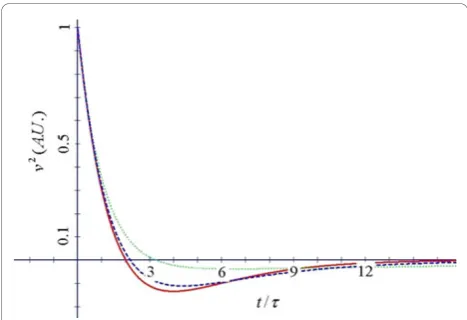
The most important characteristics of the results are illustrated by concrete examples in Figures 1, 2, 3, 4, and 5. In Figure 1, we show R2 for doped Si. For this semi-conductor, the conductivity is the contribution of two terms, a Drude–Lorentz term and a Drude term [7]. At large times the Drude–Lorentz term leads to an R2 approaching a constant value (see Figure 2), while the Drude term alone (Figure 1) is the dominant term at large times. Therefore for sufficiently large times, only the Drude term survives.
We observe that the linear relation at large times becomes quadratic at smaller times. The cross-over between the two regimes occurs at times comparable to the scattering time. This means that diffusion occurs after sufficient time has elapsed so that scattering events become significant, while at smaller times the motion is essentially ballistic.
From these figures we can evaluate the diffusion
coef-ficient D R
t =1
2 2 d
d . It is remarkable that high D are obtained at t/τ of order unity. As an example, from Figure 3 the deduced that diffusion coefficient is D ~ 1 cm2/s forτ = 10-13s, i.e. comparable to the value ~1 cm2/s of the single crystal rutile [2].
From the other hand, much smaller Dcan develop at long times, with values D= 10-4–10-6cm2/s typical of a disordered strong scattering system. So, our results indi-cate quite different behaviour in Si where normal diffu-sion occurs, and in TiO2 where the Drude–Lorentz
model indicates anomalous diffusion.
The physical reason and mechanism of such increase can be traced back to ballistic-like motion of the carriers at early time when scattering is moderate yielding nor-mal diffusion satisfying Eintein’s rule and to strong
localization due to the scattering at long times with anomalous diffusion with depression ofD.
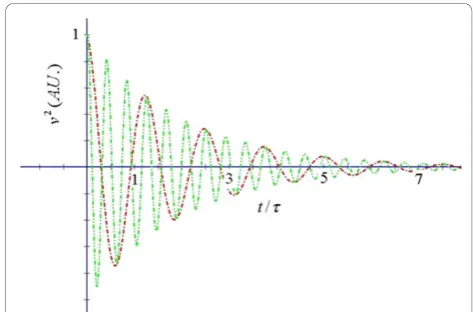
Figures 4 and 5 report the behaviour of the velocity correlation function.
We observe that, according to the equations of our model [8,9], the correlation function of velocities is never a single decreasing exponential of time, but it is in general a more complicated combination of exponen-tials, or an oscillating function of time.
[image:3.595.304.539.88.250.2]When 1−4 2 02>0, there is a change of sign of velocity with respect to initial velocity, a backscattering mechanism as indicated by Smith [10]: there are two regimes in the temporal response characterized by two different characteristic times, the inverted region being dominated by the longer decay time, and the positive velocity region being due to the shorter time; this region becomes the normal state diffusion region whenω0 = 0.
Figure 2R2vs.x=t/τfor 2 values ofτ(ω0= 1.12 × 10¹¹Hz dot-dashed;ω0= 2.24 × 10¹¹Hzdashed) for TiO2(m= 6me,T=
300 K). Saturation values occur at sufficiently larget.
Figure 3R2vs.x=t/τat constantω
0τ, for 3 values ofτ(ω0=
0.5 × 10¹³Hzsolid;ω
[image:3.595.58.303.88.249.2]0= 1013Hzdot-dashed;ω0= 0.5 × 10¹⁴Hz dashed) for TiO2(m= 6me,T= 300 K).
Figure 4Velocity correlation function vs.x=t/τfor two values ofaR(R2=4 2 02−1) (m= 6me,T= 300 K). Clear exponentially damped oscillations are displayed in this case.
Figure 1 R2vs. x=t/τfor some representative values ofτ, typical of doped Si[7](ω0= 0,T= 300 K) (Drude model). A
[image:3.595.56.295.525.691.2] [image:3.595.302.539.533.689.2]These two regimes will give rise to small and large diffu-sion constants respectively, which will be discussed in connection with time-resolved techniques.
When 4 2 02− >1 0, we observe the presence of
damped oscillations of the velocity in time with strong coupling leading to oscillating currents which average to zero in a sufficiently long interval along with the diffu-sion constant. This regime appearing at large frequen-cies for a given time constant does not seem to have been observed in real systems.
The results above give a precise indication on response times of a system subjected to charge motion. In the case of doped Si [7] we have verified the Einstein rule, giving rise to normal diffusion. In the case of TiO2
[2,3], anomalous diffusion is found with time-dependent diffusion coefficient vanishing at long times and oscillat-ing behaviour in time of the transport parameters. We have compared our effective diffusion coefficients directly with experimental results [11-13] and with Monte Carlo simulations [14,15], which take into account the overall mechanisms of scattering, including phonons, imperfections and doping centres, and traps, finding that the diffusion coefficient reproduces the values of experimental or simulated coefficients.
We suggest the possibility that our results can give an explanation of the ultra-short times and of high mobili-ties with which the charges spread in mesoporous nano-particle TiO2 systems, of deep interest in photocatalitic
and photovoltaic systems [16,17]. In particular, the rela-tive short times (few τ) with which charges can reach much larger distances than typical dimensions of nano-particles indicate easy diffusion for charges photopro-duced inside the nanoparticles towards the surface. The unexplained fact found experimentally of ultrashort injection of charge carriers (particularly in Graetzel’s cells) can be related to this phenomenon [16,17].
Similar high diffusivity is found in a number of other devices, i.e. GaAs nanowires and ZnO nanoparticles on which terahertz time-resolved spectroscopy has revealed different time transport regimes with high diffusion pro-cesses at short times of the order of the scattering time and longer time localized motion due to the effects of scattering [18,19]. Interpretations of these results in terms of the model suggested here can be given.
Recently, an approach for converting nanoscale mechanical energy into electrical energy has been sug-gested by using piezoelectric zinc oxide (ZnO) nano-wires and TiO2 [20]. Such devices have been shown to
convert mechanical energy into electric energy with typical ∼1 nW output power per cm2area. These unex-pected efficiencies can be explained by anomalous high diffusion in the oxides of the type presented here.
In summary, we have evaluated the correlation func-tions for systems for which the Drude–Lorentz model is valid through the formulation of a new Drude– Lorentz-like model [8,9], in which such functions can be obtained as complete Fourier transform of the real part of the frequency-dependent complex conductivity s(ω). From our results we deduce some important conse-quences connected with the nanometric film systems, in particular the possibility of a fast response of the trans-port of charge carriers with a direct consequence for the efficiencies of present devices based on such systems. Of particular interest for nanostructures is the fact that the
limiting value of ⎡⎣R t
( )
−R( )
0 ⎤⎦2 reaches several nanometers in only few τ times, which means that R becomes comparable to dimensions of nanoparticles in few scattering events. This implies the possibility of hav-ing high mobility of carriers from and towards the sur-face of nanostructures. This result has possible and interesting implications in photocatalysis and in energy generators, i.e. in photochemical, photoelectrochemical cells and dye-sensitized solar cells (DSSCs) [3]. The principal consequence is the possibility to have high charge conversion efficiencies in particular time inter-vals. We can thus explain the rather unwaited experi-mental result that some film oxides as TiO2, in whichthe percolative layer structure would be expected to provide a low mobility, are in reality endowed with high response times of charge injection and with high mobility.
Author details
1
Department of Computer Science, Faculty of Science, Verona University, Strada Le Grazie 15, 37134, Verona, Italy.2Faculty of Computer Science, Free
University of Bozen, Piazza Domenicani 3, 39100, Bozen-Bolzano, Italy.
3
[image:4.595.56.290.88.248.2]Accademia Nazionale dei Lincei, via della Lungara 10, Rome, Italy. Received: 29 May 2010 Accepted: 9 September 2010 Published: 28 September 2010
References
1. Ventura PJ, Costa LC, Carmo MC, Roman HE, Pavesi L:J Porous Mater2000, 7:107.
2. Hendry E, Wang F, Shan J, Heinz TF, Bonn M:Phys Rev B2004,69:081101(R). 3. Schmuttenmaer CA:Terahertz Sci Technol2008,1(1):1.
4. Ziman M:Principles of the Theory of Solids.Cambridge University Press, New York; 1979.
5. Kittel C:Introduction to Solid State Physics.Wiley, New York; 1995. 6. Rudin W:Real and Complex Analysis.McGraw-Hill International Editions:
Mathematics Series, McGraw-Hill Publishing Co.; 1987. 7. Pirozhenko I, Lambrecht A:Phys Rev A2008,77:013811. 8. Di Sia P:J Comput Theor Nanosci2011,8:1.
9. Di Sia P, Dallacasa V, Dallacasa F:J Nano Res2010,11:45. 10. Smith NV:Phys Rev B2001,64:155106.
11. Vanmaekelberg D, de Jough PE:Phys Rev B2000,61:4699.
12. Kambili A, Walker AB, Qiu FL, Fisher AC, Savin AD, Peter LM:Physica E Low Dimens Syst Nanostruct2002,14:203.
13. Schlichtherle G,et al:J Phys Chem B1999,103:782. 14. Romanò L, Dallacasa V:J Phys Condens Matter1990,2:4717.
15. Bettinelli M, Speghini A, Falcomer D, Daldosso M, Dallacasa V, Romanò L:
J Phys Condens Matter2006,18:S2149. 16. Graetzel M:Inorg Chem2005,44(20):6841.
17. Graetzel M:J Photochem Photobiol C: Photochem Rev2003,4:145. 18. Dallacasa V, Dallacasa F, Di Sia P, Scavetta E, Tonelli D:J Nanosci
Nanotechnol2010,10:1043.
19. Parkinson P, Lloyd-Hughes J, Gao Q, Tan HH, Jagadish C, Johnston MB, Herz LM:Nano Lett2007,7(7):2162.
20. Wang ZL:Adv Funct Mater2008,18:3553. doi:10.1007/s11671-010-9783-y
Cite this article as:Di Sia and Dallacasa:A High Diffusive Model for Nanomaterials.Nanoscale Res Lett20116:39.
Submit your manuscript to a
journal and benefi t from:
7Convenient online submission 7Rigorous peer review
7Immediate publication on acceptance 7Open access: articles freely available online 7High visibility within the fi eld
7Retaining the copyright to your article