Alsmith, A.J.T. and Ferre, Elisa and Longo, Matthew R. (2017) Dissociating
contributions of head and torso to spatial reference frames: the misalignment
paradigm. Consciousness and Cognition 53 , pp. 105-114. ISSN 1053-8100.
Downloaded from:
Usage Guidelines:
Please refer to usage guidelines at or alternatively
1 RUNNING HEAD: The Misalignment Paradigm
Dissociating Contributions of Head and Torso to Spatial Reference Frames:
The misalignment paradigm
Adrian J. T. Alsmith1, Elisa R. Ferrè2 & Matthew R. Longo3
1Center for Subjectivity Research, University of Copenhagen, Denmark
2Department of Psychology, Royal Holloway, University of London, UK
3Department of Psychological Sciences, Birkbeck, University of London, UK
Address correspondence to:
Adrian Alsmith ([email protected]) or Matthew R. Longo ([email protected])
2
Abstract
When we represent someone's view of a scene as egocentrically structured, where do we
represent the origin of the reference frame? By analysing responses in a spatial
perspective-taking task as a function of spatial location with respect to both head and torso, we isolated
the respective contribution of each part to spatial judgments. Both the head and the torso
contributed to judgements, though with greater contributions from the torso. A second
experiment manipulating visual contrast of the torso showed that this does not reflect
low-level differences in visual salience between body parts. Our results demonstrate that spatial
perspective-taking relies on a weighted combination of reference frames centred on different
3
Introduction
In egocentric frames of reference, coordinate axes are locked to one’s body and move
along with it. Facing east looking at the Duomo in Milan, the Museo del Novecento is to your
right and the Galleria is to your left; facing west from the steps of the Duomo, the opposite is
true (Bisiach & Luzzatti, 1978). Egocentric representations are perspectival in this sense.
They capture a way the world is experienced from an individual’s location, in a manner
sensitive to how the individual’s body is disposed. Hence, what you see as ‘to the left’ would
be seen as ‘to the right’ for someone facing you. Consequently, egocentric representations are
thought to be essential to the self-specifying nature of spatial perception, presenting the world
in relation to oneself (Bermúdez, 1998, 2002; Cassam, 1997; Evans, 1982). Moreover, recent
research on self-consciousness is dominated by the idea that the experienced first-person
perspective should be identified with the point of origin of an egocentric frame of reference
(Blanke & Metzinger, 2009; Foley, Whitwell, & Goodale, 2015; Vogeley & Fink, 2003).
This, however, raises a difficulty: human bodies are not points. Rather, they are
composed of articulated parts, which can move independently. Accordingly, changes in
relative orientation can dissociate frames of reference anchored to different parts. This might
affect the way things appear, as Peacocke describes:
Looking straight ahead at Buckingham Palace is one experience. It is another to look at the palace with one's face still toward it but with one's body turned toward a point on the right. In this second case the palace is experienced as being off to one side from the direction of straight ahead, even if the view remains exactly the same as in the first case. (Peacocke, 1992, p. 62)
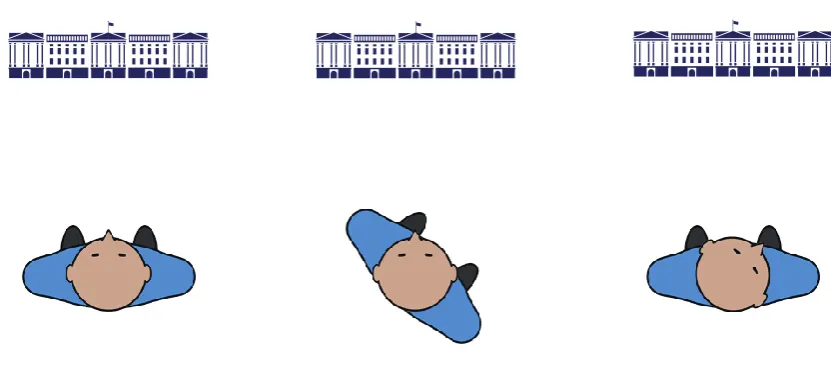
Figure 1 shows a schematic depiction of Peacocke’s scenario. In the left panel, the
observer is facing Buckingham Palace directly, whereas in the centre panel the observer’s
torso is turned to the right. The intuition here is that the Palace would then be experienced as
to the left. Critically, however, this intuition is torso-centric. To probe Peacocke’s conclusion,
4 the converse were the case: what if one turned one’s face to the right whilst keeping one’s
body still toward the palace? Would the palace then be experienced as straight-ahead or off to
[image:5.595.87.503.145.328.2]the side? In short, where is the ego in egocentric representation?
Figure 1: A schematic depiction of Peacocke’s (1992) Buckingham Palace scenario. With both torso and head in alignment, the Palace is directly in front of the observer in both head and torso anchored reference frames (left panel). Peacocke asks us to imagine the torso being turned to the right (centre panel), expressing the intuition that the Palace would be experienced by the observer as being to the left. This intuition, however, privileges the torso. To fully explore the scenario, the additional case of the head being turned to the right (right panel) must also be considered. Would Buckingham Palace also be experienced as to the left in this latter case?
As noted above, much of the interest in studying egocentric representation is to learn
something about the structure of first-person experience. There are well known difficulties
involved in asking subjects to report upon the structure of their own experience
(Schwitzgebel, 2011). However, one interpretation of Peacocke’s Buckingham Palace
scenario above suggests a slightly oblique approach to the problem. When engaging in the
thought experiment we are not asked to judge how the world appears from our own
perspective, rather we are asked to predict how the world would be experienced from an
imagined perspective. This general ability, known as perspective-taking, may involve
representing any of a large variety of an agent’s internal states and their relations to objects
and other individuals in their environment (Moll & Meltzoff, 2011). Spatial
perspective-taking tasks, in particular, concern spatial relations between an object and an individual
5 Spatial perspective taking involves a reference frame of a similar kind to an
egocentric reference frame, in that both specify how things are presented to an individual
viewing a scene from a particular position. But it is not, strictly speaking, egocentric, in that it
does not specify how things are presented to the subject herself. Hence, we shall use the term
‘alter-egocentric representation’ to describe the form of spatial representation employed here
(Grush, 2000, 2007) and thus pursue the corresponding question: where is the ego in
alter-egocentric representation?
A sense of the range of plausible answers to this question can be gained by
considering the complexity of the processes involved in egocentric representation and their
connection with the structure of experience. Sensory systems are known to process
information in frames of reference anchored to specific body-parts (e.g., Graziano, Yap, &
Gross, 1994), as well as hybrid frames involving combinations of these (e.g., Carrozzo &
Lacquaniti, 1994), and idiosyncratic frames for transformation between body-part anchored
frames (e.g., Chang & Snyder, 2010; Gazzaniga, Ledoux, & Wilson, 1977). Though frames
of reference of this kind are often called ‘egocentric’, some are keen to distinguish this range
of body-part anchored coding from the ‘egocentric’ structure of perceptual experience
(Brewer & Pears, 1993; Foley et al., 2015; Levinson, 1996). Indeed, first-person reflection
suggests that perceptual experience is unified according to a single perspective (Bayne, 2010;
Bermúdez, 1998; Husserl, 1952). To the extent that the perspectival character of experience is
due to body-part anchored spatial representation, this would suggest the general hypothesis
that information in distinct frames of reference is translated into a single, ultimate frame of
reference.
From this general hypothesis, we may draw distinct hypotheses concerning which
body-part would anchor an ultimate frame. Research on spatial representation suggests
6 Denève, Olivier, Pouget, & Duhamel, 2005) or to the torso (e.g., Grubb & Reed, 2002;
Karnath, Schenkel, & Fischer, 1991). A key motivation for a head-centric hypothesis is the
number and significance of the sensory organs found in the head: the eyes, ears, and the
vestibular labyrinth. As Sherrington noted, the latter is a particularly significant source of
self-specific information, in that the vestibular system “maintains not merely a limb in flexion
or extension, but a posture of the whole animal in regard to gravitation” (Sherrington, 1907,
p. 480). But considering morphological structure, the torso is, effectively, the great continent
of the body, relative to which other parts are mere peninsulas (Alsmith & Longo, 2014).
Accordingly, a key motivation for a torso-centric hypothesis is that the torso is the most
stable anchor for the construction of a consistent egocentric representation (Blanke, 2012;
Grush, 2000).
Both of these hypotheses face a common difficulty, which is that there is a lack of any
strong theoretical basis for thinking that there must be such an ultimate frame anchored to a
single body part. Correspondingly, there is as yet little exploration of the alternative general
hypothesis that the complex structure of egocentric representation is reflected in experience,
such that both the head and the torso contribute to the determination of egocentric perspective
(Alsmith & Longo, 2014; Smith, 2010). This would accommodate the fact that the head and
torso are each functionally significant in the ways outlined above. But it would violate the
largely introspective intuition that egocentric spatial perception involves a single, ultimate
egocentric frame of reference.
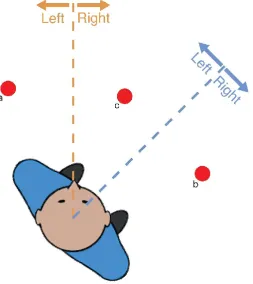
The Misalignment Paradigm, the logic of which is shown in Figure 2, provides a
means of testing these general hypotheses. By rotating the head relative to the torso one can
dissociate frames of reference centred upon the two body parts. Thus, a single object may be
7 how responses change as a function of spatial relation to head and torso, one can isolate the
respective contributions of each body part to egocentric representation.
We investigated the structure of alter-egocentric representation through a third-person
implementation of the Misalignment Paradigm – essentially, a psychophysical version of the
Buckingham Palace thought-experiment. We showed participants a bird’s eye view of an
avatar whose head and torso were misaligned and asked them to judge whether objects were
“to the person’s left” or “to the person’s right”. By measuring how these judgments change as
a function of the position of the ball relative to the head and torso, we were able to determine
the respective contributions of each body part to alter-egocentric spatial judgments of this
kind. In Experiment 1, we show that both head and torso contribute to alter-egocentric
judgments, though the weight given to the torso is greater. In Experiment 2, we show that the
[image:8.595.173.427.406.691.2]greater weight given to the torso is not an artefact of greater visual salience.
8
On this trial, the torso is in the ‘Northeast’ orientation with the head turned 45° to the left. The three balls are shown at the ‘Mid’ distance.
Experiment 1: Dissociating head- and torso-centred contributions
Methods
Participants. Twenty participants (nine female) between 18 and 60 years of age
participated. All but two were right-handed as assessed by the Edinburgh Inventory (Oldfield,
1971; M: 72.8, range: -90.9 – 100). Procedures were approved by the local ethics committee.
Procedures. Sample stimuli are shown in Figure 1. Stimuli were displayed on a
monitor (approximately 40 cm from the participant) controlled by a custom MATLAB
(Mathworks, Natick, MA) script. On each block of trials the torso (200 pixels in width,
10.63˚ visual angle) was centred on the monitor, oriented towards one of five compass
directions (E, NE, N, NW, W), with the head rotated 45° to either the right or left, resulting in
ten different positions. Each of the ten positions was presented once in random order.
Rotating the body across blocks forced participants to respond based on the location of the
ball with respect to the person, rather than using cues such as whether the ball appeared on
the right or left side of the screen. The S, SE, and SW orientations were not used because
pilot testing revealed that they imposed a high cognitive load in trying to rotate one’s own
perspective to match the person’s, consistent with previous results showing that
perspective-taking tasks of this kind are more difficult when there is a rotation of the avatar and the
participant (Kessler & Rutherford, 2010; Surtees, Apperly, & Samson, 2013b).
Within each block, the ball appeared at one of thirteen angles between -90° and +90°
degrees calculated from their deviation from the line midway between the orientation of the
head and torso. For each angle, there were three distances of the ball from the person, Near
9 pixels, 19.17˚). It has long been established that perceptual processes partition space
surrounding an observer according to increased distance from the body (Cutting & Vishton,
1995; Previc, 1998). One particularly salient (though gradual) transition is between the
peripersonal region immediately surrounding the body and the region beyond (Longo &
Lourenco, 2006; Lourenco & Longo, 2007). Recent work on peripersonal spatial
representation (PPS) has demonstrated that its extent is not uniform across the body. Rather,
“the size of PPS” varies “according to the stimulated body part, being progressively bigger
for the hand, then face, and largest for the trunk” (Serino et al., 2015, p. 1). Accordingly, for
the near distance the ball was well within the person’s arm reach, in the mid condition it was
at about the limit of arm’s reach, and in the far condition was well outside of arm’s reach.
This allowed us to investigate the spatial gradient of the respective influences of head and
torso.
In order to maximize the number of most informative judgments, within each distance
the three centre angles (0°, 15°, -15°) were each presented three times, the next three most
extreme on each side (30°, 45°, 60°, -30°, -45°, -60°) were each presented twice, and the
most extreme angles (75°, 90°, -75°, -90) were each presented once. Thus, there were a total
of 75 trials on each block and 750 overall.
Participants were instructed to “judge whether the ball is to the person’s left or to their
right”. They made unspeeded responses by pressing the ‘q’ key on the keyboard with the left
index finger if they judged the ball as being to the person’s left and the ‘p’ key with their
right index finger if they judged it as being to the person’s right. After each response the ball
disappeared and there was a random inter-trial interval between 200 and 500 ms. The person
remained on the screen during the interval. Participants were asked to be careful with their
responses, but to not spend a lot of time thinking about individual responses and to use
10
Analysis
The data were analysed in two different ways to isolate contributions of the head and
of the torso to judgments. First, to isolate contributions of the head, we analysed responses as
a function of angular deviation of the ball from an axis aligned with the torso, comparing the
conditions in which the head was rotated to the right vs. to the left. If judgments were based
entirely on the torso, with no contribution from the head, these conditions should not differ
from each other, since they are identical aside from the orientation of the head. Analogously,
to isolate contributions of the torso, we analysed responses as a function of angular deviation
of the ball from an axis aligned with the head, comparing the conditions in which the torso
was rotated to the right vs. to the left. If judgments were based entirely on the head, with no
contribution from the torso, these conditions should not differ from each other, since they are
identical aside from the orientation of the torso.
In each case, psychometric functions were fit to the data using the Palamedes toolbox
for MATLAB (Prins & Kingdon, 2009). Best-fitting cumulative Gaussian functions were fit
using maximum-likelihood estimation for each participant in each condition. For each
psychometric function, the point of subjective equality (PSE) was calculated as the angular
deviation at which participants were equally likely to judge the ball as being to the person’s
left or to their right. We quantified the contribution of the head and of the torso by calculating
the PSE Shift for each part, defined as the difference in PSE between the conditions in which
the relevant part was rotated to the left and to the right. If a part makes no contribution to
judgments, PSE Shifts for that part should be clustered around zero, whereas if it does make a
contribution, PSE Shifts should be greater than 0. By definition, the PSE Shifts for the head
11 the two parts, we can estimate the contribution of each to judgments of alter-egocentric
location.
Results and Discussion
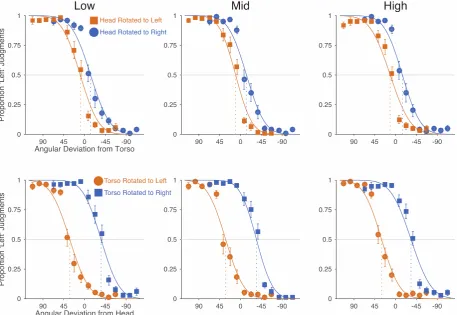
The results are shown in Figure 3. Overall, the psychometric functions showed
excellent fit to the data, with an average R2 of 0.957 (range: 0.764 – 1). The top panel shows
data locked to the torso, meaning that the two conditions differ only in terms of the rotation
of the head. A clear contribution of the head to judgments was apparent at all distances (i.e.,
the blue curves are shifted relative to the orange ones). The bottom panel shows the same
data locked to the head, meaning that the two conditions differ only in terms of the rotation of
the torso. A clear contribution of the torso was also apparent at all distances, and was of
12
Figure 3: Results from Experiment 1. The top panel shows data locked to the torso for each of the three ball distances. If the head were irrelevant to judgments, then the blue and orange curves should lie directly on top of each other. The observed separation between these curves (i.e., the PSE Shift) reflects the contribution of the head to judgments. The bottom panel shows the same data locked to the head. If the torso were irrelevant to judgments, the blue and orange curves should overlap. The observed separation between the curves thus reflects the contribution of the torso to judgments, which is clearly larger than that of the head.
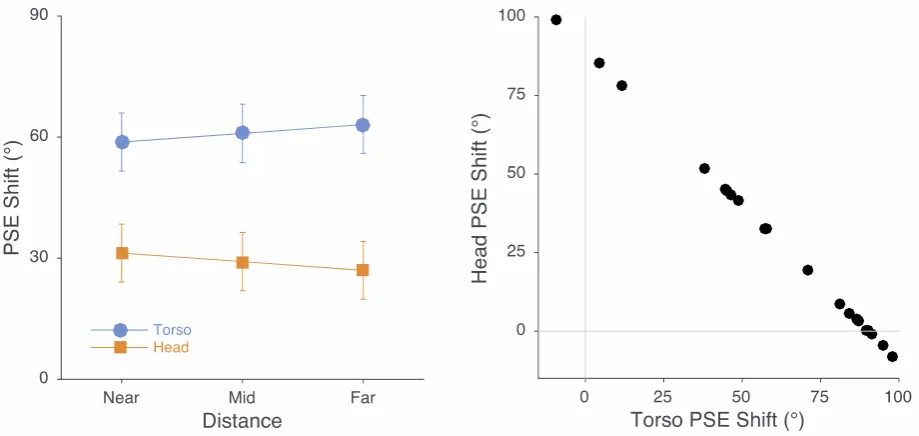
The contribution of each body part was quantified by calculating the PSE Shift. These
PSE shifts are shown in the left panel of Figure 4. PSE shifts for both body parts were clearly
greater than 0 at all distances (torso: t(19) = 8.18, 8.41, 8.81, for the three distances,
respectively, all p’s < .0001, Cohen’s d = 1.89, 1.88, 1.97; head: t(19) = 4.36, 4.03, 3.78, all
p’s < 0.002, Cohen’s d = 0.97, 0.90, 0.84).
To compare PSE shifts across distances and body parts we conducted a
repeated-measures Analysis of Variance (ANOVA) with factors ‘body part’ (torso, head) and
‘distance’ (near, mid, far). As is clear in Figure 4, there was a significant main effect of body
part, F(1, 19) = 4.97, p < .05, ηp2 = 0.207, with significantly larger coefficients for the torso
than the head. There was no main effect of distance, F(1.50, 28.51) = 0.72, p < .05, ηp2 =
0.036, but there was a significant interaction, F(1.47, 27.88) = 4.06, p < 0.05, ηp2 = 0.176.
The interaction reflects an increase in the contribution of the torso, and a corresponding
13
Figure 4: Left panel: Mean PSE Shifts for the torso and head at each of the three distances in Experiment 1. PSE Shifts were clearly greater than 0 for both body parts at all distances, suggesting contributions of both head and torso to alter-egocentric judgments. The overall contribution from the torso, however, was clearly greater than that of the head. Error bars are standard errors. Right panel:
Scatterplot of PSE Shifts for the torso and head, averaged across the three distances. Because the PSE Shifts for torso and head add to 90˚, their correlation is -1 by definition. The interest in the scatterplot is in the range of inter-subject variability in judgments, with some participants relying exclusively on the head (at top-left), others on the torso (at bottom-right), and others still using a weighted combination of the two.
The right panel of Figure 4 shows a scatterplot of PSE Shifts for the head and for the
torso, averaged across the three distances. By definition, the correlation between these
variables is -1, since they must sum to 90˚. The range of inter-subject variability is striking.
For example, the three participants at the top-left relied almost exclusively on the head,
whereas the larger group at the bottom-right relied almost exclusively on the torso. Finally,
another group of participants in the centre of the plot relied on both head and torso. Thus, the
pattern seen in the left panel of Figure 4 masks considerable individual differences.
Both the head and the torso contribute to judgments of alter-egocentric spatial location.
This calls into question the idea that any single body part constitutes the unique ‘origin’ of
the alter-egocentric reference frame. However, the torso’s overall contribution to judgments
was substantially stronger than that of the head. Further, people appear to divide into three
distinct groups: 'torso' people, 'head' people, and 'both' people. The overall stronger weighting
for the torso comes about because there are simply more 'torso' than 'head' people. This still
leaves open the question of why overall the torso is preferred. We investigated one potential
interpretation of this result in a second experiment.
Experiment 2: Weights do not reflect differences in visual salience
One potential interpretation of the overall greater weight given to the torso than the
head could be the greater salience of the torso. This idea could play out in different ways. In
one sense, the torso is more visually salient simply in the sense that it’s substantially larger
14 about the structure of human bodies. It could very well be the case that the torso is weighted
heavily exactly because it constitutes the major bulk of the physical body. But it could also be
that differences in the visual salience of the torso and head in our stimuli specifically might
have affected performance. To investigate this possibility, the second experiment
manipulated the contrast between the colour of the torso and the screen background. If the
visual salience of a body part affects the extent to which participants base their judgments on
that part, then the contribution given to the torso should increase systematically with the
contrast between it and the background. We chose to manipulate visual contrast, rather than
the size of the torso because we were concerned that using unrealistic proportions between
different body parts could make the figure less human, and therefore reduce the extent to
which participants were able to adopt the avatar’s perspective.
Methods
Participants. An additional twenty participants (nine female) between 18 and 58 years
participated. All but one were right-handed as assessed by the Edinburgh Inventory (M: 71.9,
range: -83.3 – 100).
Procedures. Procedures were identical to Experiment 1 with two exceptions. First,
and most critically, the torso was of three different colours across blocks to manipulate the
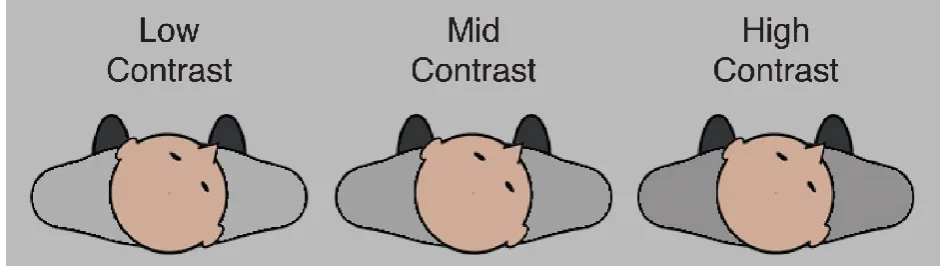
visual salience of the torso against the background (see Figure 5). The three torso colours
were all shades of grey. The middle contrast was set to have the same difference in colour
from the background as the head, where difference was defined as the Euclidean distance of
the two colours in RGB space. The low contrast torso had half the Euclidean distance to the
background, while the high contrast torso has 150% of the distance. Second, all balls
15
Figure 5: Examples of stimuli used in Experiment 2. Across blocks, the torso was displayed in three different colours to manipulate its visual salience against the background. In the mid contrast condition, the colour difference between the torso and background was set to equal the difference between the head and background. In the low contrast condition, this difference was halved, while in the high contrast condition it was increased by 50%.
Results and Discussion
Results from Experiment 2 are shown in Figure 6. The psychometric functions
showed excellent fit to the data, with an average R2 of 0.945 (range: 0.709 – 1). As in the first
experiment, there were clear effects of both the head and the torso, which were apparent for
all three levels of contrast. In every case, the contribution of the torso was of larger
16
Figure 6: Results from Experiment 2. As in Experiment 1, clear contributions of both the head and torso were apparent, with the contribution of the torso being clearly larger. The same pattern was apparent across all levels of contrast.
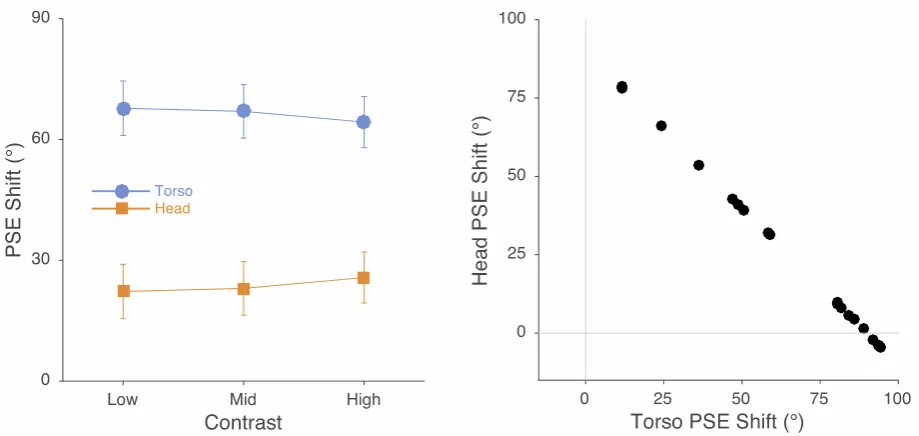
PSE Shifts are shown in Figure 7. These were significantly greater than 0 for both
torso and head at all three contrasts (torso: t(19) = 10.01, 10.07, 10.12, for the three contrasts,
respectively, all p’s <0.0001, Cohen’s d = 2.24, 2.25, 2.26; head: t(19) = 3.29, 3.46, 4.05, all
p’s < 0.005, Cohen’s d = 0.74, 0.77, 0.91).
An ANOVA on PSE Shifts revealed a significant main effect of body part, F(1, 19) =
10.88, p < 0.0005, ηp2 = 0.364, with larger shifts for the torso than for the head. Critically,
however, there was no main effect of contrast level, F(2, 38) = 1.05, n.s., ηp2 = 0.053, nor an
17
Figure 7: Left panel: Mean PSE Shifts in Experiment 2. As in Experiment 1, clear contributions were apparent for both the head and the torso, with the torso’s contribution being larger than the head’s. Critically, this effect was not affected by the contrast of the torso against the background, suggesting that the difference between the body parts is unlikely to reflect a difference in visual salience. Right panel: Also as in Experiment 1, there was a large range of individual differences in the weights given to the head and torso.
These results replicate the key effects from Experiment 1. Critically, they also show
that the difference between the contribution of the head and the torso is unlikely to reflect
greater visual salience of the torso.
General Discussion
Our results are consistent with the general hypothesis that both the head and the torso
contribute to the determination of alter-egocentric perspective. Our task involves
third-person, alter-egocentric judgements, but it raises the question of what misalignment might tell
us about the structure of first-person experience. There is certainly evidence that spatial
structures involved in first-person experience are also used in imagined experience of objects
from elsewhere (Creem, Wraga, & Proffitt, 2001; Wraga, Creem, & Proffitt, 2000).
Moreover, it has been shown that ‘left’/‘right’ judgements are affected by the angular
18 subject making the judgement (Michelon & Zacks, 2006). Subsequent studies have also
demonstrated that reaction times increase when a subject’s posture is incongruent with that of
the avatar (Kessler & Rutherford, 2010; Surtees et al., 2013b). This suggests that subjects
perform tasks of this kind by transforming their own perspective accordingly. They imagine
rotating their own body until it aligns with that of the avatar, in order to judge the relative
position of the object (Kessler & Thomson, 2010). Nothing in our study demonstrates that
subjects do in fact perform the task in this way, but this possibility warrants a comparison
between egocentric judgements in the first-person case and in the third-person case.
To our knowledge, no existing study of spatial perception has implemented the
misalignment paradigm per se, i.e., independently manipulating the orientation of both head
and torso to create a critical region with opposite laterality in relation to different body parts.
Some studies have employed rotation of the torso in order to demonstrate its contribution to
spatial attention, with mixed results. Rorden, Karnath, and Driver (2001) found that inducing
illusions of torso rotation did not produce concomitant effects in attentional orientation.
However, Grubb and Reed (2002) were able to induce pseudoneglect in a covert attention
task by leftward rotation of the torso. Hasselbach-Heitzeg and Reuter-Lorenz (2002) also
found that rightward rotation reduced response times for targets on the right. Using a similar
paradigm (adapted to enable treadmill walking) Grubb, Reed, Bate, Garza, and Roberts
(2008) show that torso orientation facilitates target detection only when subjects are under
increased motor load.
The misalignment paradigm, here employed in an alter-egocentric task, allows the
determination of the relative contributions of body parts to spatial judgements. We found that
both the head and the torso contributed to judgements, with slightly greater reliance on the
torso, despite the fact that motor load remained constant. Future research should address
19 Considering the contributions of multiple body parts to spatial perspective highlights
an often unconsidered complexity inherent in the concept of an egocentric frame of reference.
In the simplest case, the axes of an egocentric frame of reference are all anchored to a single
body part and the origin of that frame is embedded within that body part. But this need not be
the case (cf. Bisiach, 1996; Howard, 1982). Consider, for instance, Peacocke’s example of
viewing an object when one’s torso is twisted to the right. Even if the object is seen as off to
the side due to the orientation of the torso, it might still be the case that the origin is
embedded within the head. Hence, what is seen may be seen from the head, but in a manner
determined by the orientation of the torso; or even vice versa.
Closely related to the idea that there is a single, ultimate egocentric frame of reference
is the idea that a particular part of the body fixes a subject’s ultimate location. Recent studies
have explored this latter idea, with varying methods and somewhat mixed results. Starmans
and Bloom (2012) found that pre-school children and adults deemed an object to be closest to
a subject when it is in front of the subject’s eyes, suggesting that “children and adults
intuitively think of the self as occupying a physical location within the body, close to the
eyes” (Starmans & Bloom, 2012, p. 317). By contrast, Limanowski and Hecht (2011) found
that participants asked to mark the location of the self within an outline of a human body
provided responses clustered around both the head and torso. Similarly, Alsmith & Longo
(2014) found that perceptually based self-location judgements distribute between particular
regions of the head and torso.
These mixed results are difficult to reconcile with the idea of an ultimate egocentric
frame, but are wholly consistent with the hypothesis that both the head and torso play a key
role in determining the position of objects relative to an individual. Indeed, if egocentric
representations involved in first-person experience of a surrounding world do not have a
20 origin: when one sees something relative to oneself, one may see it relative to various parts of
one’s body, even simultaneously. By using an alter-egocentric task in which head and torso
orientations could be systematically misaligned, we are able to demonstrate the feasibility of
these otherwise perhaps counter-intuitive ideas as fruitful areas of research on egocentric
representation.
Our study also advances the spatial perspective-taking literature’s increasing concern
with subjects’ sensitivity to the bodily disposition of the avatar. Early studies in this area used
unarticulated dolls as avatars, focusing principally on manipulations of the relative position
of the avatar and the target object (Michelon & Zacks, 2006; Salatas & Flavell, 1976). More
recent studies have investigated the extent to which such mental transformations are
‘embodied’ by manipulating proprioceptive input through changes in posture, specifically
hand position relative to torso (Furlanetto, Gallace, Ansuini, & Becchio, 2014) and torso
orientation (Kessler & Rutherford, 2010; Kessler & Thomson, 2010; Surtees et al., 2013b).
The present study demonstrates that if subjects perform such tasks by means of imagined
alignment with the body of the avatar, they could do so by either imaginatively aligning their
head or their torso with that of the avatar.
In Experiment 1 there was a significant interaction between distance and body part,
with the weight given to the head decreasing with the distance of the ball from the avatar,
though this effect was quite small in comparison to the overall difference between the head
and torso. Indeed, the role of distance in perspective-taking studies is somewhat unclear.
Michelon & Zachs (2006) found longer response times at greater distance in a left-right task,
but they were able to determine that this was likely due to a conflation of linear distance and
angular distance from the avatar's midline. More recently, Surtees et al. (2013a) did a
comparison of four different kinds of perspective-taking task (including a left-right task) and
21 in another study, Surtees et al. (2013b) found no effect of distance in a left-right spatial
perspective-taking task. A compelling hypothesis here is that distance effects could be due to
demands on spatial attention, i.e., that “this difference in difficulty is really more due to the
distance across which we must sustain our visual attention to connect the Other and the
Object” (see also Carlson & Van Deman, 2008; Surtees et al., 2013a, p. 436).
Conclusion
Egocentric representations present the world in relation to oneself, taking the body as
their point of origin. This seemingly simple statement, however, masks a complexity: bodies
are not points. Rather, they are composed of articulated, independently mobile parts.This
raises the question: Where on the body is the origin of the egocentric reference frame? A
corresponding issue arises for judgements of the egocentric location of objects from another
person’s perspective, involving ‘alter-egocentric’ representation. When we represent another
person’s view of a scene as egocentrically structured, where on their body do we represent
the origin of the alter-egocentric reference frame? Intuition suggests that frames of reference
anchored to particular body parts are translated into an ultimate egocentric frame of
reference. Existing research on spatial representation is inconsistent on this point, suggesting
independent motivation for both the head and the torso being the anchor for such an ultimate
frame. Our results demonstrate that alter-egocentric spatial judgments rely on a weighted
combination of reference frames centred on at least two different parts of the body. This calls
into question the idea that any single body part constitutes the unique ‘origin’ of the
egocentric reference frame. The Misalignment Paradigm thus opens up otherwise
counter-intuitive avenues of research into the role of bodily disposition in perspective-taking and its
22
References
Alsmith, A., & Longo, M. (2014). Where exactly am I? Self-location judgements distribute between head and torso. Consciousness and Cognition, 24(0), 70-74.
doi:http://dx.doi.org/10.1016/j.concog.2013.12.005
Avillac, M., Denève, S., Olivier, E., Pouget, A., & Duhamel, J.-R. (2005). Reference frames for representing visual and tactile locations in parietal cortex. Nature Neuroscience, 8, 941-949.
Bayne, T. (2010). The unity of consciousness. Oxford: Oxford University Press.
Bermúdez, J. L. (1998). The paradox of self-consciousness. Cambridge, MA: MIT Press. Bermúdez, J. L. (2002). The Sources of Self-Consciousness. Proceedings of the Aristotelian
Society (Hardback), 102(1), 87-107. doi:10.1111/j.0066-7372.2003.00044.x Bisiach, E. (1996). Unilateral neglect and the structure of space representation. Current
Directions in Psychological Science, 62-65.
Bisiach, E., & Luzzatti, C. (1978). Unilateral neglect of representational space. Cortex, 14(1), 129-133.
Blanke, O. (2012). Multisensory brain mechanisms of bodily self-consciousness. Nat Rev Neurosci, 13(8), 556 - 571.
Blanke, O., & Metzinger, T. (2009). Full-body illusions and minimal phenomenal selfhood.
Trends in Cognitive Sciences, 13, 7–13.
Brewer, B., & Pears, J. (1993). Introduction: Frames of Reference. In N. Eilan, R. A.
McCarthy, & B. Brewer (Eds.), Spatial Representation: Problems in Philosophy and Psychology (pp. 25 - 31). Oxford: Oxford University Press.
Carlson, L. A., & Van Deman, S. R. (2008). Inhibition within a reference frame during the interpretation of spatial language. Cognition, 106(1), 384-407.
doi:http://dx.doi.org/10.1016/j.cognition.2007.03.009
Carrozzo, M., & Lacquaniti, F. (1994). A hybrid frame of reference for visuo-manual coordination. NeuroReport, 5(4), 453-456.
Cassam, Q. (1997). Self and world. Oxford: Oxford University Press.
Chang, S. W., & Snyder, L. H. (2010). Idiosyncratic and systematic aspects of spatial
representations in the macaque parietal cortex. Proceedings of the National Academy of Sciences, 107(17), 7951-7956.
Creem, S. H., Wraga, M., & Proffitt, D. R. (2001). Imagining physically impossible self-rotations: geometry is more important than gravity. Cognition, 81(1), 41-64. doi:http://dx.doi.org/10.1016/S0010-0277(01)00118-4
Cutting, J., & Vishton, P. (1995). Perceiving layout and knowing distances: The integration, relative potency, and contextual use of information about depth. In W. Epstein & S. Rogers (Eds.), Perception of space and motion (pp. 69 - 117). San Diego, CA: Academic Press.
Evans, G. (1982). The varieties of reference. Oxford: Oxford University Press.
Foley, R. T., Whitwell, R. L., & Goodale, M. A. (2015). The two-visual-systems hypothesis and the perspectival features of visual experience. Consciousness and Cognition. Furlanetto, T., Gallace, A., Ansuini, C., & Becchio, C. (2014). Effects of Arm Crossing on
Spatial Perspective-Taking. PLoS ONE, 9(4), e95748. doi:10.1371/journal.pone.0095748
Gazzaniga, M. S., Ledoux, J. E., & Wilson, D. H. (1977). Language, praxis, and the right hemisphere. Neurology, 27(12), 1144.
Graziano, M., Yap, G., & Gross, C. (1994). Coding of visual space by premotor neurons.
23 Grubb, J. D., & Reed, C. L. (2002). Trunk orientation induces neglect-like lateral biases in
covert attention. Psychological Science, 13(6), 553 - 556.
Grubb, J. D., Reed, C. L., Bate, S., Garza, J., & Roberts, R. J. (2008). Walking reveals trunk orientation bias for visual attention. Attention, Perception, & Psychophysics, 70(4), 688-696.
Grush, R. (2000). Self, world and space: The meaning and mechanisms of ego-and allocentric spatial representation. Brain and Mind, 1, 59–92.
Grush, R. (2007). Agency, emulation, and other Minds. Cognitive Semiotics, 0, 49-67. Hasselbach-Heitzeg, M. M., & Reuter-Lorenz, P. A. (2002). Egocentric body-centered
coordinates modulate visuomotor performance. Neuropsychologia, 40(11), 1822-1833.
Howard, I. P. (1982). Human visual orientation. London: John Wiley & Sons.
Husserl, E. (1952). Ideen zur einer reinen Phänomenologie und phänomenologischen Philosophie (Zweites Buch): Phänomenologische Untersuchungen zur Konstitution. The Hague: Martinus Nijhoff Publishers.
Karnath, H. O., Schenkel, P., & Fischer, B. (1991). Trunk orientation as the determining factor of the 'contralateral' deficit in the neglect syndrome and as the physical anchor of the internal representation of body orientation in space. Brain, 114, 1997 - 2014. Kessler, K., & Rutherford, H. (2010). The two forms of Visuo-Spatial Perspective Taking are
differently embodied and subserve different spatial prepositions. Frontiers in Psychology, 1. doi:10.3389/fpsyg.2010.00213
Kessler, K., & Thomson, L. A. (2010). The embodied nature of spatial perspective taking: Embodied transformation versus sensorimotor interference. Cognition, 114(1), 72-88. doi:http://dx.doi.org/10.1016/j.cognition.2009.08.015
Levinson, S. C. (1996). Frames of reference and Molyneux’s question: Crosslinguistic evidence. In P. Bloom, M. A. Peterson, L. Nadel, & M. Garrett (Eds.), Language and space (pp. 109-169). Cambridge, MA: MIT Press.
Limanowski, J., & Hecht, H. (2011). Where do we stand on locating the self? Psychology, 2(4), 312.
Longo, M. R., & Lourenco, S. F. (2006). On the nature of near space: Effects of tool use and the transition to far space. Neuropsychologia, 44(6), 977-981.
doi:http://dx.doi.org/10.1016/j.neuropsychologia.2005.09.003
Lourenco, S. F., & Longo, M. R. (2007). Space perception and body morphology: Extent of near space scales with arm length. Experimental Brain Research, 177, 285-290. Michelon, P., & Zacks, J. M. (2006). Two kinds of visual perspective taking. Perception &
Psychophysics, 68(2), 327-337.
Moll, H., & Meltzoff, A. N. (2011). Perspective taking and its foundation in joint attention. In N. Eilan, H. Lerman, & J. Roessler (Eds.), Perception, causation and objectivity (pp. 286-304). Oxford: Oxford University Press.
Peacocke, C. (1992). A study of concepts. Cambridge, MA: MIT Press.
Previc, F. H. (1998). The neuropsychology of 3-D space. Psychological bulletin, 124(2), 123 - 164.
Prins, N., & Kingdon, F. (2009). Palamedes: Matlab routines for analyzing psychophysical data. Palamedes: Matlab routines for analyzing psychophysical data.
Rorden, C., Karnath, H.-O., & Driver, J. (2001). Do neck-proprioceptive and caloric-vestibular stimulation influence covert visual attention in normals, as they influence visual neglect? Neuropsychologia, 39(4), 364-375.
doi:http://dx.doi.org/10.1016/S0028-3932(00)00126-3
24 Schwitzgebel, E. (2011). Perplexities of consciousness. Cambridge, MA: MIT Press.
Serino, A., Noel, J.-P., Galli, G., Canzoneri, E., Marmaroli, P., Lissek, H., & Blanke, O. (2015). Body part-centered and full body-centered peripersonal space representations.
Scientific Reports, 5, 18603. doi:10.1038/srep18603
http://www.nature.com/articles/srep18603#supplementary-information
Sherrington, C. (1907). On the proprio-ceptive system, especially in its reflex aspect. Brain: A Journal of Neurology, 29(4), 467-482. doi:10.1093/brain/29.4.467
Smith, A. J. T. (2010). Comment: Minimal conditions on the simplest form of
self-consciousness. In T. Fuchs, H. Sattel, & P. Henningsen (Eds.), The embodied self: Dimensions, coherence, disorders (pp. 35 - 41). Stuttgart: Schattauer.
Starmans, C., & Bloom, P. (2012). Windows to the soul: Children and adults see the eyes as the location of the self. Cognition, 123(2), 313-318.
doi:http://dx.doi.org/10.1016/j.cognition.2012.02.002
Surtees, A., Apperly, I., & Samson, D. (2013a). Similarities and differences in visual and spatial perspective-taking processes. Cognition, 129(2), 426-438.
doi:http://dx.doi.org/10.1016/j.cognition.2013.06.008
Surtees, A., Apperly, I., & Samson, D. (2013b). The use of embodied self-rotation for visual and spatial perspective-taking. Front Hum Neurosci, 7.
doi:10.3389/fnhum.2013.00698
Vogeley, K., & Fink, G. R. (2003). Neural correlates of the first-person-perspective. Trends in Cognitive Sciences, 7(1), 38-42.
25
Acknowledgments