BIROn - Birkbeck Institutional Research Online
Bednarek, Rebecca and Chalkias, Konstantinos (2016) Constructing risk
objects and their controllability in the insurance industry.
Academy of
Management Proceedings , pp. 1-40. ISSN 0065-0668.
Downloaded from:
Usage Guidelines:
Please refer to usage guidelines at or alternatively
1
Constructing risk objects and their controllability in the insurance industry
This study examines the interrelationship between the social construction of a risk object and the
associated means of controlling it within organizations. Drawing on data from 35 insurance
organizations, we develop a framework that theorizes how organizations construct risk objects along
different dimensions of proximity/distance and tangibility/abstraction, which shapes and is shaped
by how they construct their ability to control those risk objects as a matter of protection or capital
efficiency. We show that organizations vary in these constructions of risk, developing three
categories of Risk Protector, Risk Optimizer and Risk Jugglers. We explain this variation and offer
an expanded conceptualization of the construction of the risk object and its controllability through
three explanatory organizational features of centralizing, modelling and diversifying. Our findings
are drawn together into a conceptual framework that illuminates two types pathways that
organizations follow in constructing and controlling risk: coherent pathways (with consistent
either/or choices) or composite pathways (individual both/and approaches). In doing so, we
theoretically extend the notion of the risk object within organizational studies and provide a
platform for additional studies into this important but nascent area of organizational research.
Keywords: risk object, controllability of risk, social construction of risk, insurance, risk transfer, risk
2
INTRODUCTION
Uncertainty and risk are argued to have increased in the new global risk landscape, becoming
extremely difficult for organizations to understand and control (Beck, 1992; Gephart, Van
Maanen, & Oberlechner, 2009; Giddens, 1999, 2002). Yet, despite organizations being the
critical agents for managing risk and this task becoming increasingly difficult (Hutter & Power,
2005; Scheytt, Soin, Sahlin, Andersson, & Power, 2006), organizational scholars have paid
infrequent attention to how organizations construct and control risk (Gephart et al., 2009;
Maguire & Hardy, 2013). We know little about the association between, and dynamics of,
different constructions of risk and their control (Hilgartner, 1992). We address this issue by
drawing from the “risk object” framework (Hilgartner, 1992) which outlines how harm caused
by hazards or danger “is articulated as a social fact, as a ‘risk object’” by organizations (Power,
Scheytt, Soin, & Sahlin, 2009: 304) and what this means for how those organizations construct
the controllability of that risk object. Our focus is thus not on the “first-order ‘thing’” (Garland,
2003: 52) - such as an earthquake - but the meanings attached to those objects as organizations
construct them as risky (Maguire & Hardy, 2013).
Empirically we focus on a particular type of risk and industry – financial risk transfer in the
insurance industry (Collier, 2008; Ericson & Doyle, 2004a). This industry trades in events
associated with high uncertainty; that is things that cannot easily be measured (Knight, 1921;
Sullivan-Taylor & Wilson, 2009), such as the likelihood and magnitude of an earthquake or
hurricane (Ericson & Doyle, 2004b). Our qualitative study combines interviews, observations
and secondary data to explore how 35 insurance organizations construct risk and the associated
means of control as they transfer it to the reinsurance industry. Theorizing about insurance risk
3
between organizational constructions of the risk object and its controllability (Hilgartner, 1992).
We show that the risk object can be constructed as proximate to or distant from the insurer and as
abstract or tangible, which influences and is influenced by, how the insurer constructs the
controllability of that object as a matter of either capital efficiency or organizational protection.
We show the variation in constructing the risk object and its associated controllability by
different insurance organizations and explain this variation by highlighting three underlying
organizational features: centralizing decision making, belief in modelling of risk, and belief in
diversifying the risk portfolio as a means to contain exposure to risk. Finally, we bring these
concepts together to show how some organizations, that we label ‘Risk Optimizers’ and ‘Risk
Protectors’, enact contrasting but similarly coherent pathways through these organizational
features. We also show how other organizations, that we label ‘Risk Jugglers’, enact composite
pathways, mixing the various organizational features in individualized ways. Rather than judge
the “correctness” or otherwise of these enactments, we point out their usefulness (Millo &
MacKenzie, 2009) in providing insurance organizations with sufficient confidence to manage
and trade their risk; a critical expectation of many organizations in complex risk societies (Beck,
1992; Gephart et al., 2009; Miller, 2009).
Our conceptual framework makes a number of contributions to the nascent organizational
literature on the social construction of risk (Gephart et al., 2009). First, we provide a rare
exploration and extension of the risk object framework (Hilgartner, 1992; Maguire & Hardy,
2013). In particular, we establish this as a useful theoretical lens within organization studies,
advancing understanding through a systematic framework that explores varied patterns of
entanglement in the construction of a risk object and its controllability. Second, we advance
4
interrelate to explain variation in the construction of the risk object and its associated
controllability. Finally, we develop new understanding of how organizations gain confidence to
transact under the extreme uncertainty of risk (Sullivan-Taylor & Wilson, 2009). We show how
these constructions are necessary (aside from any assessments of accuracy), in order to enable
organizations to trade in risks and operate amidst such uncertainty (Beck, 1992).
THEORETICAL FRAMING
It is ever more difficult for organizations and individuals within them to calculate and control
risk (Gephart et al., 2009; Giddens, 1999; Tsoukas, 1999). Risks have “become more global, less
readily identifiable, more problematic, less easily managed, and more anxiety-provoking” (Beck,
1992: 26; 1999; Beck & Holzer, 2007; Gephart et al., 2009). Financial markets in particular
illustrate how globalization has decreased control and increased risk for society, as demonstrated
by the 2007 financial crisis. A local event associated with U.S. sub-prime mortgages developed,
and spread into a global crisis with the failure of several large financial institutions, the bailout of
banks by national governments, and dramatic falls in the values of stock markets, with far
reaching global consequences (MacKenzie, 2011).
Within this context there is growing interest in risk within organizational studies (Gephart et
al., 2009). In particular, how organizations construct and conceive of risk matters. For instance
Sullivan-Taylor and Wilson (2009) show that the way travel organizations constructed the threat
of terrorism directly impacted whether they were proactive or reactive (or not active at all) to
such threat. Further, organizations are increasingly required and expected to manage the risk to
which they are exposed (Power, 2007) and are “the critical agents of risk society” because they
are the “centres for processing and handling risk” (Hutter & Power, 2005: 1). In particular, a
5
object’, to be managed and made into the responsibility of an organization or organizations”
(Power et al., 2009: 304; Hilgartner, 1992). As organizations and society are part of an
interdependent system, as complexity increases in a globalized world, so do the resulting
challenges associated with risk assessment and management for organizations (Miller, 2009).
Hence, it is increasingly hard for organizations to control and manage risks; yet increasingly
important and expected that they do so (Maguire & Hardy, 2013; Power et al., 2009). There has
consequently been a call for more research into how organizations construct and manage risk
(Maguire & Hardy, 2013), with scholars pointing out that there has been surprisingly little
research into the social construction of risk within organizational studies (Gephart et al., 2009).
In seeking to address this gap, we draw from the sociological tradition that has
conceptualized risk as socially constructed (Gephart et al., 2009; Hilgartner, 1992; Lupton, 1999;
Maguire & Hardy, 2013; Miller, 2009; Tierney, 1999). Specifically, we draw on the concept of
‘risk objects’ (Hilgartner, 1992), which focuses scholarship on how particular objects are
variously constructed as risky through being causally linked to a particular harm or danger.
Hilgartner (1992) thus focuses on the dynamic meanings attached to objects as they become risky
in varied ways (Maguire & Hardy, 2013). This variability is related to differences in how various
actors conceptualize objects as a source of risk (Samsonova-Taddei & Humphrey, 2015) and
engage in struggles over its control (Hilgartner, 1992). For instance, Samsonova-Taddei and
Humphrey (2015) explored how the policy-making process of establishing European
transnational audit was characterized, and indeed frustrated, by competing conceptualizations of
the risk object at the state level. In essence, objects are not “simply waiting in the world to be
perceived or defined as risky” (Hilgartner, 1992: 40) and risks objects are “never fully objective
6
Studies have collectively developed a constructivist foundation to risk in organizational theory
(Brown, 2000, 2004; Gephart, 1993; Topal, 2009). While approaching the question of the
construction of risk within organizational settings in different ways, these approaches all
similarly reject notions that risk is objective, “out there” (Maguire & Hardy, 2013) and able to be
uniformly interpreted. Rather, they assert fundamental ambiguity and diversity in the
construction of risk and resultant organizational responses to it (Clarke & Short Jr., 1993).
However, we still have little specific insight into how the process of constructing risk by
organizational actors can shape, or is shaped by, organizational attempts to control risk; a central
tenant of the risk object framework (Hilgartner, 1992). Controlling risk involves organizational
attempts to minimize its unpredictability and variability (Lane & Quack, 1999). Risk can be
controlled by weakening the linkages between the constructed risk object and the existent danger
or hazard, a process Hilgartner (1992) labels ‘displacing’ risk. Given that defining risk is an
“inherently ambiguous and subjective process” (Tsoukas, 1999: 523), controlling risk is similarly
complex and open to social interpretations. Studies suggest that the very notion of controllability
as well as risk is a social construction. Holt (2004) advocates for risk management without
assumptions regarding the ability to control the activity but instead an awareness of its
limitations. Further, Maguire and Hardy (2013) point out that organizations can display very
different assumptions around the controllability of risk, suggesting risk management can be
premised on certainties that are known and accepted (normalizing) but also by invoking
uncertainties and thus the need to manage risk in a “precautious” manner (problematizing).
Despite these important foundations regarding the question of how the construction and control
of risk objects can be entangled, explanations of the interplay between the two remain vague.
7
First, constructing and controlling risk is said to be entangled within organizational structures
and their organizing processes. Focusing on micro-organizing practices, Maguire and Hardy
(2013) investigate the construction of risk objects through the organizing processes used to
assess and manage risk, as well as the discursive work of actors to change the meanings of risk
objects. They focus on micro, often discursive, organizing practices such as instances where
scientific knowledge, past decisions and experiences (continuity), timelines, and involvement of
scientific or organizational stakeholders are emphasized. The importance of organizing is
similarly apparent in recent work within the accounting literature on risk management. Mikes
(2011) sheds light on how different cultures of risk management were reflected in organizational
structure, and particularly different boundary work by risk officers to claim relevance in the
control and management of risk. This work shows that the organizational processes of managing
and controlling risk objects manifests in different organizational structures.
Second, risk objects and the “definitions of risk get built into technology” and their
associated systems of control are technical as much as they are social (Hilgartner, 1992: 39).
Indeed, quantification though metrics/models is the most pervasive way that the literature has
examined organizational attempts to control and manage risk (see Beunza & Stark, 2004; Beunza
et al., 2006; MacKenzie, 2012; Mikes, 2009, 2011; Millo & MacKenzie, 2009). While Mikes
(2011) suggests that some organizations find ways to resist this quantification of risk
management, variation in approaches to quantification of risk has not been fully explored.
Rather, the literature argues that metrics are creeping into areas of risk assessment that more
properly involve human judgement, leading to excessive and dysfunctional quantification in risk
management (Power, 2004; Power et al., 2009; Taleb, 2007; Scheytt et al., 2006). For example,
8
can create side-effects – or second-order dangers - through the use of risk assessment and
management systems. Further, the availability of information is central, playing an important
role in the ability to quantify, measure and monitor risk and thus control it (Clarke & Short Jr.,
1993). Yet, a problem for organizations is that both framing and managing risks is nearly always
made in the context of incomplete information (Gephart et al., 2009). Sullivan-Taylor and
Wilson (2009) build on this argument, outlining that organizational actors nearly always try to
make incomplete information sufficient either by ignoring information that does not fit or by
framing their own interpretations of incomplete data.
In summary, existing research that has pointed to organizational structures, organizing
practices, and quantitative metrics provides only partial insights into the social construction of
risk and its controllability. There is considerable scope to explore what social construction of risk
means for organizations and how this is entangled with their attempts to control it (Gephart et al.,
2009; Maguire & Hardy, 2013). Our study builds on the concept of risk objects (Hilgartner,
1992) to ask: how is the organizational construction of risk objects entangled with constructions
of risk object controllability, and what might explain variation in such entangled constructions?
We address this question in the particular context of risk-transfer, a setting we now explain.
RESEARCH DESIGN AND METHODS
Research context and sample
We conducted a qualitative study of the transfer of financial risk from insurance organizations to
the reinsurance industry. Insurance organizations seek protection from these particularly large
losses that might arise from events such as hurricanes, floods, and terrorism, by transferring risk
to the reinsurance industry; essentially buying their own insurance. This is a particularly salient
context to explore the social construction of risk as these organizations actively trade in the risk
9
make decisions about how much risk from their insurance portfolio they transfer to the
reinsurance industry and how much they are willing to carry themselves. To do so they construct
their own risk portfolios as risk objects (Hilgartner, 1992) that might present potential hazards to
their organization in the unpredictable event of a large loss. Our study focuses on this
risk-transfer process, exploring how insurance organizations construct these risk objects and their
organizational attempts to control them.
Based on our desire to explore variability in risk conceptualizations (Maguire & Hardy, 2013;
Mikes, 2011) our sample of 35 insurers encompasses a wide range of different organizations in
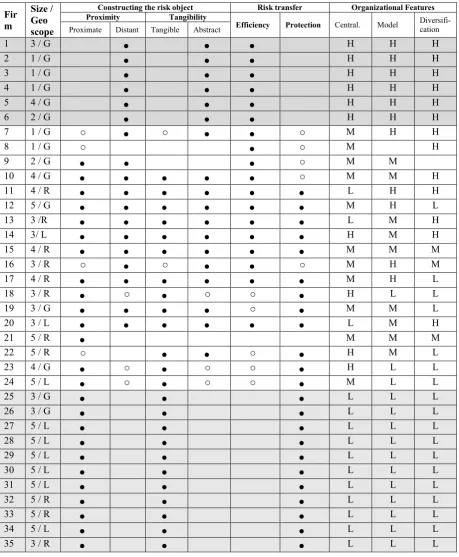
terms of size and geographic scope (see Table 1; column 2). The selected organizations span
seventeen countries from more developed insurance markets like the United States to countries
where the insurance sector was developing such as the Philippines. They include the largest
insurers in the world with turnover as high as US$ 50 billion and global reach1 as well as some
of the smallest with a turnover of around US$ 100 million focused on a single smaller territory.
However, consistent with the objective of this study, all these organizations transfer risk to the
reinsurance industry to ‘insure’ their risk portfolio against large-scale losses.
[Insert Table 1]
Data collection
We collected multiple sources of qualitative data, namely interviews, observations and secondary
data. First, during 2011-2012 we conducted 48 interviews with 52 individuals across the 35
insurance organizations. In each case we interviewed those most involved in the risk-transfer
process for the organization (e.g., whether that was the CEO and/or chief reinsurance buyer). The
interviews were semi-structured and mainly focused on four general areas: (1) Risk transfer in
general; (2) Organizing risk transfer; (3) Relationships with reinsurers and brokers during risk
10
transfer; (4) Specific details related to transferring their particular risk portfolio. Each interview
lasted at least 60 minutes and in some cases as long as three hours and were all audio recorded
and fully transcribed. Second, we accessed further reflections through 16 supplementary
background interviews with a reinsurer or reinsurance broker focused specifically on the risk
transfer process of one of our case organizations. Third, we also conducted 17 observations
across 12 of our insurance organizations. These were usually meetings between insurers, brokers
and reinsurers in which they discussed the risk transfer process. Finally, we collected numerous
documentary secondary data including annual reports, media articles and reports. This included
85 annual reports for our organizations (2011-2013; not available for two cases). Our aim in this
regard was to advance our understating of these organizations and their risk transfer process and
extract information about their size and geographic scope.
Data analysis
We engaged in several phases (Langley, 1999) of thematic analysis (Miles & Huberman, 1994),
moving from intra-case analysis to cross-cases comparison that surfaced patterns (Eisenhardt,
1989). First, having uploaded the data in NVivo10, we coded the interview data around the four
areas covered in our interview schedule to capture the data as a whole. We discovered six major
themes under which we clustered the data: (1) conceptualization of risk; (2) purpose of risk
transfer; (3) organizational internal structure and decision making; (4) data and information
quality; (5) risk portfolio composition; (6) risk transfer practices such as pricing and quoting.
This preliminary coding became the basis for all our following layers of analysis. Having coded
each case in NVivo, we created summary tables that allowed us to compare the coding across
cases; for example, the various ways they described risk transfer.
Second, to assist in our cross-case comparison we initially drew on extreme cases that
emerged as particularly different and compared them (Eisenhardt, 1989). Two central themes
emerged. First, we observed central differences in how these organizations talked about the risk
11
drivers they insure) or abstract terms (e.g., describing their insurance portfolio in terms of figures
and numbers). We also noticed differences in how “close” they positioned themselves in relation
to that risk, either as proximate (e.g., an insurer might spend much of the interview describing
the social and cultural norms as well as the geography of insurance in Pakistan) or distant (e.g.,
an insurer might not mention a particular or shared social-cultural or geographic locality).
Second, we observed that these organizations articulated different primary reasons for risk
transfer; namely for protection (to cover them for loss) or capital efficiency (as part of a broader
drive to make the most efficient use of their capital). We clustered the cases based on this
variation using data tables, with a pattern emerging between how they describe the risk (in terms
of its ‘tangibility’ and ‘proximity’) and what they prioritized in risk transfer (‘protection’ and
‘efficiency’). Turning to the wider dataset we started clustering our organizations into groups to
see if these categories remained explanatory. We identified three main clusters which insurance
organizations form when they construct their risk objects (see different colours in Table 1). We
labelled these: Risk Optimizers (one extreme cluster of six organizations that emphasized
efficiency and discussed risk as abstract and distant), Risk Protectors (the second extreme cluster
of eleven organizations that, by contrast, emphasised protection and discussed risk as tangible
and proximate) and Risk Jugglers (a cluster of eighteen organizations that were oscillated
between these two extremes, attempting to balance a degree of both efficiency and protection).
Third, we sought to explain this variation, seeking to understand how organizations that
essentially do the same thing, transfer insurance risk to the reinsurance industry, understand and
perform this process very differently. We used secondary data to classify the 35 insurers
according to size (scale 1, largest, to 5, smallest) and geographical scope (global, regional and
local) (see Table 1). However, these two variables only partially explained the variation in terms
of how these organizations transferred risk to the reinsurance market and thus we decide to delve
further into the risk transfer process of each organization. The organizations did not cluster
neatly by size. For example, of the six Risk Optimizers, only three were in the largest category
12
had surfaced, three additional explanatory features emerged as particularly influential: structure
in terms of whether they centralized or decentralized the risk transfer decision (centralizing),
whether they exhibited a strong belief in the ability to model risk (modelling), and finally, their
belief in diversification as a way to manage their exposure to risk (diversifying). These
explanatory-underlying organizational features, in addition to general tendencies related to size
and geographic scope, explained the variation we observed. On a case-by-case basis, we
examined and re-examined the links between these three different themes and the patterns that
were emerging, primarily using data-summary tables (Miles & Huberman, 1994), further
confirming our understanding of these as an explanatory framework for our findings.
Fourth, we engaged in a final more interpretive layer of analysis (Wolcott, 1994) to
conceptualize the patterns in our data. First, we theorized the dynamic in the data that we were
observing. Hilgartner’s (1992) concept of “risk objects” proved illuminating. This framework
that explains why organizations perceive and construct the same risks differently, helped us
understand how organizations construct their risk portfolios as risk objects in different ways,
according to whether they define the object and associated hazard as abstract or tangible and
proximate or distant. Hilgartner’s framework also enabled us to explain an emerging dynamic in
our data around the entanglement of constructing and controlling the risk object. This provided
the theoretical scaffolding for the pattern we had observed: how insurers constructed the risk
object was entangled with their constructions of its controllability. Second, we interpreted the
patterns that had emerged and made sense of them in the following ways. In particular, we found
coherent patterns whereby organizational features reinforced each other (e.g., high in
centralizing, modelling, and diversifying) and a consistent construction of the risk object (e.g.,
either abstract and distant or tangible and proximate) and its control (e.g., either efficiency or
protection). We observed that Risk Optimizers and Risk Protectors applied different patterns but
followed the same coherent pathway in constructing the risk object, which was consistent with
their specific constructions of control. By contrast, we showed how Risk Jugglers enacted
13
each other (e.g., low in modelling and high in diversifying) or a consistent construction of the
risk object (e.g., seeing the risk object as both abstract and tangible) or its controllability (e.g.,
attempting to balance protection and efficiency). Such organizations were embracing some of the
contradictions inherent our framework via a both/and approach to seemingly contradictory
enactments of risk (Lewis, 2000). We discuss these layers of our findings below and bring them
together in a theoretical model.
FINDINGS
Constructing the risk object
We define the insurance portfolio as the ‘risk object’ for insurance firms; the ‘object’ to which
harmful consequences (for the insurer) are attached (Hilgartner, 1992). Our findings show
considerable variation in the way that insurance organizations describe their portfolio and
construct it as risky by linking it to potential harm to their firms.
Proximity of risk. The insurance portfolios and the potential harm associated with them were
constructed as proximate or distant to the specific geographic and sociocultural context of the
insurance firm. On the one hand, risk objects were constructed as proximate when insurance
organizations conceptualize their insurance portfolios (i.e. risk object) as situated within a
specific and shared geographic and socio-cultural context. For instance, below a Pakistani insurer
describes the specific Pakistan context to a reinsurer:
Insurance manager (Amid) states his is a country that are making a war on terrorism and therefore they would like their reinsurer (Scott) to visit and see what they are doing. Scott says that they will be coming to Pakistan this year, and Amid says that that would be good; he will show them some of the properties and the efforts they are taking to protect them. Amid takes out some documents to further put the Pakistani market in context. (Organization 34. Observation)
In this meeting, the insurer is emphasizing that understanding of their risk object is intrinsically
entwined with understanding the local Pakistani context in which is situated.
On the other hand, the risk object can be constructed as distant, dissociated from any
particular geographic and sociocultural context and instead conceptualized as a nexus of multiple
14
is part of a global balance, distant from any specific local context or event: “We don't have a
specific property division in Japan. But we can add some margins to our global risk profile, so
we can basically write Japanese business at zero capital cost” (Organization 2, Interview). In this
case any notion of the insurer being close to or sharing the local Japanese context is absent;
rather a little bit of Japanese risk is added to the (more important) global portfolio. As this
shows, even though the actual harm, such as disasters caused by earthquakes, occurs in specific
regions, some insurers construct the risk object as distant from, rather than proximate to, any
specific geography or sociocultural context.
Tangibility of risk. Insurance organizations also construct the risk object by emphasizing the
tangible or abstract nature of the object and its potential harm. First, some insurance
organizations construct the risk object by highlighting the actual tangible and physical
implications of harmful events. Interviewees might talk about risk in terms of the “build quality”
of particular properties or the “likelihood of an earthquake”. For instance, in the indicative quote
below descriptions of specific high-value cars are used to describe the risk object:
With motor risks the most expensive motor loss would be maybe say $1.5 million, if you buy a Rolls Royce maybe about $1.5 million. Most of the cars are in the range of $100,000, maybe $2-300,000 if you're buying a Continental. So if you look at per risk level then we can absorb this (Organization 28, Interview)
In such an example, insurers articulate damage to a particular type of car as a tangible risk, in a
way that is at least partly relatable to how we ourselves might be aware of an open fire as a
physical ‘risk’ when a toddler is in the room.
Second, other insurance organizations construct the risk object as abstract. The risk object is
defined in terms of a carefully balanced and modelled numerical portfolio rather than as actual
earthquakes or floods. For example:
15
Within this example, the focus is on the numbers associated with risks and then the overall
average grade of the portfolio. These variations from abstract to tangible emerged as the second
critical dimension explaining how insurance organizations variably construct risk objects.
Risk Transfer: constructing the risk object and its controllability
Insurance organizations transfer risk as a financial product to the reinsurance industry in order to
minimize the harm that is associated with the insurance portfolio that is their risk object.
Transferring risk to the reinsurance industry is a means of controlling the risk object by
weakening the linkage between them and the source of harm (a large scale catastrophe)
(Hilgartner, 1992). Consider an insurance portfolio – the risk object – that includes large-scale
catastrophes such as Japanese earthquake risk. Insurance organizations attempt to control this
risk object by transferring the risk of claims from a Japanese earthquake from their own portfolio
to the reinsurance industry, for which they will pay a premium.
How insurance organizations understand the controllability of the risk object varies,
according to whether they construct it as a matter of protection or capital efficiency. The way
they do so is associated with how they construct the risk object. In this regard, we identified
three main clusters of insurance organizations that we labelled ‘Risk Protectors’, ‘Risk
Optimizers’ and ‘Risk Jugglers’ according to variation in how they construct the risk object and
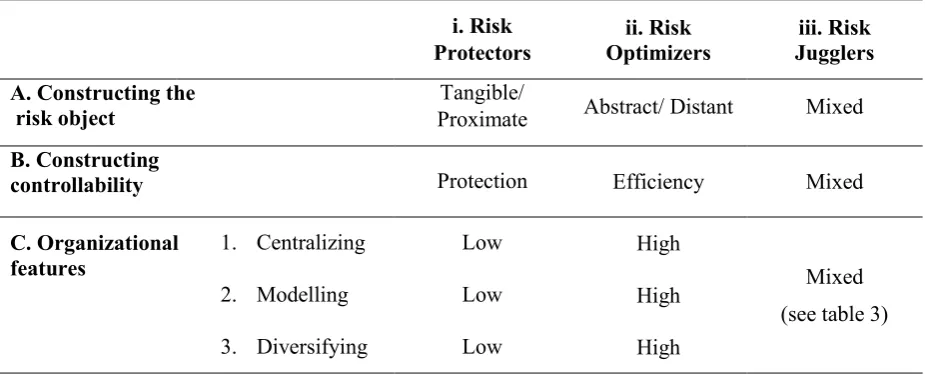
their understanding of its controllability (see table 2). We explain each of these clusters below.
[Insert Table 2]
Risk Protectors. The first group that emerged from our data consists of eleven insurance
organizations that constructed the risk object as proximate and tangible. They also understood
risk transfer as a process for protecting their risk portfolio, thus constructing the controllability of
their risk object as a matter of protection. In articulating the proximate and tangible nature of the
risk object these organizations construct themselves as vulnerable to harm, effectively ‘bringing
the risk to life’. This has implications for how they conceptualize the control of the risk object
16
Insurance organizations are exposed to uncertainty over whether their risk portfolios will
sustain a major loss. Protection from such loss is fundamental and achieved through risk transfer
to the reinsurance industry. Organizations that are Risk Protectors transfer a significant degree of
the potential for major loss to the reinsurance industry. For instance, in the quote below, the
insurer articulates threat from the risk object and thus constructs it as controllable through
risk-transfer of the volatile (most exposed to loss) elements of the portfolio to the reinsurance
industry to mitigate the degree of harm to the organization.
It [risk transfer] is more an issue of transferring volatility. I think that's the main thing... So if it was up to me as a reinsurance manager, we would have brought reinsurance on everything (Organization 31, Interview)
The emphasis is on ensuring adequate protection across the entire portfolio – “reinsurance on
everything” even if this costs more due to the need to cover even small risks: “We tend to buy at
a fairly low attachment point to keep a lot of the volatility out of our portfolio and use
reinsurance to cover fairly low levels of risk” (Organization 32, Observation, Meeting with
Reinsurer). Risk Protectors thus construct the controllability of the risk object as protection
through transferring a significant portion of risk to the reinsurance industry to ensure they are
covered; so retaining less risk themselves (see Table 2).
Risk Optimizers. We also found a second group of six insurance organizations2 that constructed
the risk object as distant and abstract. Their risk object was an abstracted portfolio of numbers
that is not situated in any specific geographical or sociocultural context. These organizations
emphasize risk transfer as a means of developing capital efficiency in their risk portfolio, thus
constructing the risk object as controllable through capital efficiency (see Table 2).
A focus on efficiency is about using capital wisely, for example ensuring that the
diversification benefits of a large portfolio are fully maximized. This efficiency, which is
attained internally, drives the risk-transfer process and control over the risk object:
17
It’s about the way you utilise your capital, your investment strategy, you know, it’s a whole package. You know, and [CEO’s] a very clever guy and he looks at reinsurance as one of our largest expenses, what I can do to make it more efficient, you know (Organization 1, Interview).
Capital efficiency underlies the risk-transfer decision, with these insurance organizations
configuring and calculating their portfolio internally in order to buy the least reinsurance they
can to ensure capital is not wasted. They only purchase more reinsurance when it comes at a
cheaper cost of capital than using their own capital to cover the risk, for instance because of
interest rates or market prices. Rather than focus on the need for protection they focus on what
they can cover or retain internally, as one CEO explained, snapping his fingers dismissively:
“100m loss does not make a difference, not even to the profit forecast” (Organization 2,
Interview). In this group, the way organizations understand the control of the risk object moves
from risk transfer as an external means for protection, to being part of an internally focused view
of their risk portfolio and use of capital, which they seek to maximize. For these organizations
the construction of their risk object was a matter of risk optimization whereby optimizing capital
deployment is critical to risk-transfer.
Risk Jugglers. The first two groups provided contrasting constructions of the risk object and its
controllability when transferring risk. However, eighteen organizations within our sample
clustered within the middle of these two extremes. We labelled these organizations “Risk
Jugglers” because they wrestle with the tensions between the dimensions of risk proximity and
risk tangibility in their construction of the risk object. Some of these insurance organizations
described the risk object as simultaneously proximate and distant and/or abstract and tangible, as
shown in the following indicative example from a single organization:
Tangible and proximate: We have engineers that will go out to individual locations and do an onsite inspection so we can determine what the fire risk is, what the wind risk is, what the quake risk is, what the flood risk is…we do not depend on the model to say here's what our exposure is, we know from our engineering report and from the onsite visits what our exposure is (Organization 19, Interview)
18
In this example, the firm constructs the risk object as something tangible that needs to be
determined by ‘engineers’ though ‘onsite inspections’ to ‘individual locations’, but at the same
time it is an abstract portfolio of risks that are ‘all the same’ regardless of the fact that the
tangible attributes of ‘quake’ and ‘wind’ vary.
Risk Jugglers also oscillated between competing constructions of the controllability of the
risk object:
[Reinsurance] is a capital management tool [efficiency], but also a volatility tool on behalf of the group [protection].” (Organization 16, Interview).
[Reinsurance is] not only to protect the balance sheet, but also to be capital-efficient. (Organization 10, Interview)
This meant that an active tension was apparent in how to control the risk object through risk
transfer. For example, the very question of how much reinsurance to buy was fraught, involving
juggling the protection impulse to buy a substantial reinsurance protection with the efficiency
impulse to manage capital carefully by buying the minimum essential reinsurance.
As this suggests, Risk Jugglers construct the controllability of the risk object in varied and
individual ways, oscillating between the two polarised concepts of risk-transfer for capital
efficiency and risk-transfer for protection.
Underlying organizational features
Attempting to explain the variation we observed between the construction of the risk object and
its controllability we surfaced three organizational features that underlie this interrelationship:
centralizing, modelling and diversifying. We explain these in turn, before our final section relates
these more closely to the clusters above.
Centralizing risk. Centralization concerns the organizational structure for making decisions
about risk transfer, and thus who controls that process inside the organization. This
organizational feature represents how far away the risk-transfer decisions are made from the
19
underwriters and managers in business divisions or subsidiaries where the actual policies are
held that make up the insurance portfolio are the people close to the risk. The CEO, other chief
executives and managers at the corporate headquarters are the people far away from the risk.
Some organizations had highly centralized decision-making with decisions about risk-transfer for
the organization as a whole at the corporate headquarters:
Compared to some of the other insurance firms, they give far more autonomy, especially in the far-reaching areas of the world than we would ever allow. We have a standard reporting… a strict ‘they [underwriters] must do as we ask’, and we deliberately do that in all our decisions. (Organization 1, Interview)
By contrast, other organizations demonstrated de-centralized decision making structures
regarding risk transfer decisions. In these instances high autonomy was given to underwriters and
managers in subsidiaries and business divisions:
My underwriters can handle it [reinsurance buying], I leave it to them…small to medium, within our capacity, I let my underwriter decide. (Organization 30, Interview)
As this shows, organizations vary in the degree of centralization of the decision-making
structures associated with risk-transfer (also see table 1 above).
Modelling risk. A second feature involved the belief in calculative models as a means to
understand the risk object. Modelling risk via standardized industry tools has become ubiquitous
in the insurance industry. Information on risk exposures, such as geocoded data, physical
characteristics and other financial data, is the input into these standardized models and enables
mathematical calculations to predict loss estimates associated with potential catastrophic events.
Here, we explore the articulated belief of insurance organizations in the ability of these models to
help them understand and control their risk portfolios. Some organizations articulated a strong
belief in the modelability of the risk object:
We believe that what we believe is correct through those numbers. It’s the more transparent, the more easy, straightforward you make these things, the better. [Organization 10, Interview]
Organizations that articulate a strong belief in the accurate comprehension of risk through
models also regard their access to information, which they use as input to these models, as high
20
Confidence that risk can be accurately understood and calculated was therefore evident.
Conversely, other insurance organizations explicitly prioritize contextual judgement over
numerical models. For instance: “we do not depend on the model to say here's what our exposure
is” (Organization 19, Interview). These organizations emphasize that models are simply
numerical representations of risks that can never accurately be defined, highlighting instead the
inherent uncertainty of risk. This articulated belief that risk cannot be known or modelled in turn
drives the risk-transfer process for such organizations:
I keep on seeing unmodelled events. And, you know, Rumsfeld put it well, the unknown unknowns, and that's what we have to think about. You know, we're buying, we’re buying out what we don't know, we’re buying out what we don't understand, we're buying out the tail. (Organization 9, Interview)
These organizations also often highlighted the imperfect nature of information they received
about risk to explain the incompetence of numerical models to make risk knowable: “we don't
get good information” (Organization 35, Interview). In summary, some insurance organizations
believe that they have access to all the information they needed to model and thus to accurately
understand risk and define risk exposure and potential losses. Others are sceptical about the
accuracy of numerical representations of risk and favour human judgement over models.
Diversifying risk. Diversification is the concept that risk can be made more managed by bringing
together uncorrelated types of risks and geographies. Namely, when insurance organizations
build portfolios of uncorrelated risks of different types and geographic locations, the probability
of experiencing losses in several parts of the portfolio at the same time reduces significantly.
That is, diversification implies that risk of losses in one part of the portfolio – such as earthquake
in Japan – will be paid for by other parts of the portfolio that are not correlating – such as
bushfire in California – as these parts of their portfolio will not experience loss at the same time
from the same event. While some diversification is fundamental to the notion of all insurance,
insurance organizations nonetheless believe in or rely on diversification to different degrees.
Some insurance organizations believe strongly in diversification as a way to feel in control of
21
the risks we are facing” [Organization 10, Interview]. Such belief in the ability to diversify
creates confidence, with organizations feeling increasingly protected, even as they take on more
risk: “We believe that in some areas we can add a new component [risk] to the portfolio which
just gives diversification” [Organization 2, Interview]. By taking on more risk they believe that
they have better internally diversified protection and, hence, need proportionally to transfer less
to the reinsurance industry. By contrast, others insurance organizations demonstrate a weak
belief in diversification as a means of controlling their portfolio. Such organizations might
highlight the unpredictable nature of risk, including the fact that different types of events, such as
floods in Thailand and earthquakes in Chile, can occur simultaneously, meaning diversification
cannot be relied upon. For example, one insurer discussed how multiple events in 2011
reinforced their belief that they could not rely on supposedly non-correlating risk:
You had New Zealand 1, New Zealand 2, Japan and New Zealand 3. You had two huge tornadoes in the States in excess of 5 billion on each one of them, the Copenhagen floods, there were so many losses in that period of time. So you had frequency and severity of losses from October 2010 right until probably that whole calendar year period. [Organization 11, Interview]
Similarly, one manager queried whether his competitors were as “secure” as their
highly-diversified portfolios might suggest: “Firm A and Firm B have got the [security] ratings and all
that kind of things but, you know, they've got monstrous exposures everywhere” [Organization
22, Interview]. Indeed, these organizations believe more strongly in a close association to a
bounded portfolio of risks that they know well:
We can break that [portfolio] down into very small component parts to say “this type of risk is really good, this one isn’t”, and then we work with the clients to do risk improvement” (Organization 19, Interview).
Thus, beliefs in the amount of protection afforded by diversification varied widely.
Constructing the risk object and its associated controllability
Different configurations of these organizational features – centralizing, modelling, diversifying –
22
Risk Optimizers and Risk Protectors: coherence amidst uncertainty. We observed two groups of
insurance organization that enact contrasting constructions of the risk object and its
controllability. First, as detailed above, Risk Optimizers construct the risk object as abstract and
distant and their ability to control the risk object as a means for capital efficiency. This is
supported by high centralizing, modelling and diversifying. That is, centralizing enables the
whole portfolio to be viewed and modelled according to consistent views about the benefits of
high diversification in enabling capital efficiency, as illustrated in the following examples:
Centralizing and diversifying linked to efficiency (retaining more risk): “It’s the beauty of being part of a big group because you contribute from that part of the world and other people contribute from a completely different part of the world and you get that diversification and jointly we have the power actually to retain more” (Organization 3, Interview)#
Modelling linked to confidence to prioritize efficiency rather than protection: “These are all the outputs from models, here's what the exposure looks like, so this is why you don't need to worry about it” (Organization 1, Interview)
As evident in these quotes, a focus on modelling and centralizing decision-making is entwined
with the risk object being constructed as abstract (the risk is seen through the modelled outputs)
and distant (the centralized decision makers are further away from the risk). Similarly, a belief in
diversifying is tied in with a distant view of risk as part of an abstract construction of the risk
portfolio. Thus, consistent high prioritization of the three organizational features explains
construction of the risk object (as abstract and distant) and construction of the ability to control
this risk object (in terms of capital efficiency).
Second, Risk Protectors construct the risk object as tangible and proximate and their ability to
control the risk object as a means for protection. These specific constructions are aligned with
prioritization of local judgement and decision-making (low centralizing), rather than focus on
models (low modelling) and the benefit of diversification (low diversifying). They construct the
controllability of the risk object through their intimate local knowledge of it as an object with
23
I can’t say there is no Cat [risk of natural catastrophe disaster]: after what happened in Thailand no one dares to say that! So it’s a matter of how remote the thing is. So as far as Cat is concerned our concern is purely restricted perhaps to a bit of localised flooding. (Organization 29, Interview)
Risk Protectors accept the inherent ‘wildness’ of risk and thus attempt to weaken the link
between harm and the risk object by constructing risk transfer as a means of protection that gives
them control over the risk object. Due to assumptions about the bounded nature of the risk,
localized in-depth knowledge of underwriters is understood as the best means to trade in risk,
amidst uncertainty.
For Risk Optimizers and Risk Protectors the organizational features are themselves
intertwined and reinforcing. For example, in the case of the Risk Optimizers centralizing
decision-making about risk transfer enabled diversification benefits to be attained, as decisions
about the different risks within the risk portfolio were brought together centrally and their
diversification benefits considered. Meanwhile, a belief in modelling negated the need for
localized underwriting judgement and thus aligned with centralizing the decision-making
process. By contrast, for Risk Protectors, a belief in underwriting judgement, rather than models,
is associated with a belief in prioritizing the localized decision making of those underwriters over
centralizing.
Juggling in the ‘middle’: fragmentation in a world of tensions. Many organizations do not
construct a coherent pattern in their approach to risk but rather enact individualized, often
tension-filled, approaches. Building on their constructions of the risk object, which iterate
between proximate/distant and tangible/abstract, they wrestle with the tension of emphasizing
both protection and capital efficiency when it comes to constructing their ability to control the
risk object. This struggle is in turn reflected in their iteration between or mix of the underlying
organizational features (see Table 1). There was no single way that Risk Jugglers mixed the
various features, so that they sat in varied positions between the patterns of “Risk Optimizer” or
24
First, Organization 7 was an example of a Risk Juggler positioned close to the Risk
Optimizers, yet somewhat deviating from this pattern (see Table 3, Case 1). They constructed the
risk object as distant and abstract, but with some evidence of proximity and tangibility.
Stemming from this they constructed the controllability of the risk object as an act that was
performed mainly through risk transfer for capital efficiency (i.e., as per the Risk Optimizers).
However they also attempted not to neglect the importance of protection, in particular to enable
their underwriters the confidence to trade by ensuring that they knew they had adequate cover to
smooth the profit and loss of their individual portfolios (see Table 3). This in turn manifests
through a particular configuration of the underlying organizational features of Organization 7.
While they had a high belief in modelling and diversifying, they did not prioritize centralizing,
explicitly differentiating themselves from well-known, highly-centralised competitors who they
believed to have reduced the decision-making autonomy of underwriters and managers within
their local contexts. This mixed configuration with two out of three features marked as ‘high’
positions this organization as being close to a Risk Optimizer. However, their moderate degree of
centralizing decision making means Organization 7 was instead a Risk Juggler that even as they
prioritized efficiency, wrestled with also constructing controllability for protection, based on
their belief in localised judgement over risk (i.e., low in centralizing).
Second, other Risk Jugglers were more balanced in their approach, enacting moderation in
the organizational features, instead of necessarily being ‘high’ or ‘low’ in any of them. These
Risk Jugglers oscillated between constructing the risk object as proximate and distant as well as
abstract and tangible and understood controlling the risk object as an act that is performed
through transferring risk for both protection and capital efficiency, without apparently
prioritizing either. An example is Organization 15 depicted in Table 3 (Case 2) whose struggle to
balance the different ways of constructing the risk object and its associated controllability
manifests in moderate centralizing, modelling and diversifying. For example, Organization 15
organized risk transfer decisions centrally while at the same time providing some autonomy to
25
numerical modelability to understand risk, while emphasizing the uncertainty of ‘unmodelled’
events. Finally, they believed in geographical diversification but this did not completely drive
their risk transfer process, as they still kept much of their reinsurance purchasing separate rather
than bundling it to model diversification benefits. We can see therefore how some reinsurance
organizations existed “in the middle”, balancing moderate manifestations elements of the
phenomena we observed even when these appeared contradictory.
Third, another example of individualized mixing of the features was Organization 23, a firm
that was similar but not identical to the Risk Protectors (Table 3, Case 3). They emphasized
tangibility and proximity in construction of the risk object, but also at times described it as
abstract and distant. Similarly, while they prioritized protection, they also demonstrated capital
efficiency considerations in constructing the controllability of the risk object. For instance,
saying the main reason they needed to transfer risk was to reduce volatility, providing the capital
protection to enable them to trade, but also that cost/benefit analysis of the magnitude of
reinsurance spend was important to their process. Underlying this was a particular individual mix
of the features; moderately high centralization, but low belief in modelling and diversifying. This
configuration with two out of three features being ‘low’ explains the ‘close to a Risk Protector’
position of this organization and why certain elements were prioritized in the construction of the
risk object and its controllability. However, the fact that they were ‘high’ in centralizing explains
this organization’s attempts to incorporate capital efficiency by centralizing risk transfer
decisions rather than focus solely on protection
To summarize, we found that the construction of the risk object, the construction of its
controllability and the organizational features are strongly intertwined. This is summarized in
Table 4, which is underpinned by the case specific analyses outlined Table 1. That is, we
observed three groups of insurance organization – Risk Protectors, Risk Optimizers and Risk
Jugglers (see Table 4) – that enact different constructions of the risk object (see Table 4; A-i, ii,
iii) and its controllability (see Table 4; B-i, ii, iii), and different configurations of the
26
[Insert Table 4 here]
DISCUSSION
We now bring these empirical findings together into a conceptual framework (Figure 1 below)
that explains the entangled interrelation between the social construction of a risk object and its
control in the risk transfer process (Hilgartner, 1992). We also highlight and explain the inherent
variation we found in how these constructions unfold (Huault & Rainelli-Weiss, 2011;
Samsonova-Taddei & Humphrey, 2015; Sullivan-Taylor & Wilson, 2009).
[Insert Figure 1 here]
Our framework builds on Hilgartner’s (1992) call for further explanation of the interplay
between the construction and control of the risk object. It highlights how particular constructions
of the risk object are entangled with particular constructions of its controllability as depicted by
the insurance organizations studied. First, we showed how insurance organizations construct
their risk portfolio in terms of its proximity (proximate vs. distant) and its tangibility (tangible
vs. abstract) (Figure 1, A). We call this the process of constructing the risk object, as the risk
portfolio as a mere object is variably constructed to become a social fact, namely a risk object,
by associating the portfolio with the actual harm or danger. For instance, as our findings show
Risk Protectors construct the risk object as tangible/proximate (A-i), Risk Optimizers construct
the risk object as abstract/distant (A-ii), and Risk Jugglers variably mix these dimensions (A-iii).
Second, we showed how this construction of the risk object is entangled with the construction of
its controllability (Figure 1, B), namely the variable understanding of the organizational attempt
to control risk. Risk Protectors describe how they control the risk object primarily through
buying protection (B-i), Risk Optimizers through emphasizing capital efficiency of their
portfolio (B-ii), and Risk Jugglers as a mix of the two (B-iii). We therefore show how the degree
to which the risk object (i.e., the insurance portfolio linked to the potential harm associated with
it) is constructed as tangible and proximate or abstract and distant is related to organizational
27
efficiency. The foundation to our framework is this dynamic, recursive loop between the
construction of the risk object and its associated controllability.
The second aspect of our framework is the organizational features of centralizing, modelling
and diversifying (Figure 1, C) that explain the variation we observed in the interrelationship
between the constructions of the risk object and its controllability. The concept of centralizing
(C1) highlights the importance of structure and organizing in constructing the risk object and its
controllability (Maguire & Hardy, 2013; Mikes, 2011). Our specific finding signifies that where
the decision-making authority in relation to risk transfer is located in an organization impacts the
construction process of the risk object and its controllability. For example, low centralizing of
decision-making (C1-i) was entwined with the risk object being constructed as tangible and
proximate and its controllability being constructed through a focus on protection (Risk
Protectors; also see table 4). Two, the organizational relationship to risk modelling (C2), defined
on a spectrum from a high belief in risk modelability to scepticism about models, also informs
how an organization constructs its risk objects and its associated ability to control them (Power,
2004). Our findings and framework show how variation in the belief in modelling is associated
with how the risk object and its controllability are constructed. For instance, a high belief in the
ability to model risk (C2-ii) was associated with a conceptualization of risk as distant/abstract
and a construction of it as controllable through capital efficiency (Risk Optimizers; also see table
4). Three, variation in the beliefs in diversification (C3) – that is a belief in the ability to reduce
risk through a portfolio constituted by varied and uncorrelated risk (Markowitz, 1952) – was also
central to explaining the construction of risk objects and their controllability in financial
organizations. In essence, some firms had a high belief in diversification (C3-ii): the more
diverse and globalized their portfolio the better. Other firms, by contrast, exhibited scepticism
about the merits of diversification (C3-i), instead favouring local portfolios that they could
control through targeted protection. This low belief in diversification was entangled with
constructing the risk object as local and tangible (the risk of flooding to a specific territory such
28
The third aspect of our framework brings the above elements together to describe the
pathways organizations follow in constructing risk objects and their controllability (Figure 1, D).
Having introduced three explanatory organizational features, we now outline two pathways –
coherent and composite – that further explain the relationship between the construction of the
risk object and its controllability. Two manifestations of a coherent pathway are depicted in our
model (Figure 1, D1) and explain the dynamics of the Risk Protectors (i) and Risk Optimizers
(ii). This coherent pathway represents consistently applied either/or choices with regards to the
construction of the risk object (e.g., A-i: tangible/proximate - Risk Protectors - or A-ii:
abstract/distance - Risk Optimizers) and construction of the controllability of that risk object
(e.g., B-i: protection - Risk Protectors – or B-ii: efficiency - Risk Optimizers). This is entangled
with a reinforcing loop of high centralizing, modelability, and diversification (Risk Optimizer,
C1-3, ii) or low centralizing, modelability, and diversification (Risk Protector, C1-3, i).
A different pathway was, however, also evident. The majority of organizations appear to seek
a both/and position (Lewis, 2000; Smith & Lewis, 2011) in relation to the dimensions outlined in
our framework through a composite pathway (Figure 1, D2). This pathway deviates from the
consistent either/or patterns inherent within the coherent pathway outlined above. These
organizations combine dimensions of proximity and tangibility and efficiency/protection as well
as mixing the underlying features in varying, individual, and sometimes contradictory ways
(Lewis, 2000; Scherer, Palazzo, & Seidl, 2013). Our findings show that, with risk being
ultimately uncontrollable and uncertain (Gephart et al., 2009), many organizations navigate the
complexity of this through individual pathways, living with the tensions involved rather than
seeking either/or positions. Thus, for Risk Jugglers the various organizational features do not
manifest in a particular or similar way. Nonetheless, the individual ways a Risk Juggler navigates
these tensions still reinforces the relationship we observed between particular constructions of
the risk object and its controllability and how this is reinforced by the three underlying
organization features we identified (also see Tables 1 and the mini-cases of different risk jugglers
29
object largely in abstract and distant terms (than the reverse) and be moderately high rather than
moderately low on the majority of organizational features. This composite pathway therefore
supports the dynamic co-constitutive relationships inherent in our model but demonstrates the
flexibility inherent in both the framework and the construction of risk objects (Figure 1, A-B-C).
Drawing on the concept of risk objects (Hilgartner, 1992; Maguire & Hardy, 2013) we have
taken seriously the notion of organizational risk and its controllability by organizations as a
social construction (Gephart et al., 2009; Power et al., 2009). The way centralizing, modelling
and diversification are enacted in relation to the risk object and controllability gives each
organization involved the necessary confidence to transfer risk; a confidence that is central to the
marketization of risk by and amongst organizations (Callon & Muniesa, 2005; Huault &
Rainelli-Weiss, 2011). Our framework shows that while there is no way to fully control
something as uncertain and unpredictable as catastrophic risk (Beck, 1992, 2002; Ericson &
Doyle, 2004b; Huault & Rainelli-Weiss, 2011), there are pathways in which organizations work
through such complexity. Working through risk is, after all, the job of many organizations and
especially those in the insurance industry. Our framework explains this process.
CONTRIBUTION AND CONCLUSION
Our paper contributes to the growing interest in organizational theory in the social construction
of risk (e.g., Huault & Rainelli-Weiss, 2011; Maguire & Hardy, 2013; Power et al., 2009;
Sullivan-Taylor & Wilson, 2009; Tsoukas, 1999), which has rarely been explored in the
organization studies literature (Gephart et al., 2009; Maguire & Hardy, 2013). Our framework
seeks to address this lack of understanding by developing a conceptual framework that explains
the relationship between the construction and control of risk and how variation in this
relationship is underpinned by different combinations of organizational features.
First, our study depicts the fundamental dynamic between construction and control of the risk
object in organizations (Hilgartner, 1992). We provide a rare exploration of the notion of risk