N A N O E X P R E S S
Open Access
Temperature and Wavelength Dependence
of Energy Transfer Process Between
Quantized States and Surface States in
CdSe Quantum Dots
Lei Zhang
1, Qinfeng Xu
1*, Mingliang Liu
1, Lingbin Kong
1, Mengmeng Jiao
1, Haifeng Mu
1, Dehua Wang
1,
Honggang Wang
1,2, Jiannong Chen
1and Chuanlu Yang
1*Abstract
Temperature and wavelength dependence of energy transfer (ET) process between quantized states and surface trap states of CdSe quantum dots was investigated, respectively. The experimental results demonstrate that the photoluminescence (PL) intensity of the quantized states decreases with respect to the trap state emission, especially at lower temperatures. The observed ET process between quantized states and trap states which is influenced by the thermal population behavior. At the same temperature, the silver films can greatly enhance the energy transfer (ET) rate from the quantized states to trap states due to surface plasmonic coupling effect.
Keywords:Quantum dots, Quantized states, Surface trap states, Energy transfer (ET)
Background
Colloidal quantum dots (QDs) have displayed extensive applications for QD LEDs [1, 2], QD lasers [3–7], and QD solar cells [8–10]. For some applications, surface trap states of the QDs should be adequately suppressed to obtain high fluorescence efficiency of core quantized states. As a result, many researchers have employed vari-ous surface chemistry methods to eliminate surface emission [11]. However, the surface state of QDs also plays an important role in photoluminescence (PL) quantum yield [12], photoluminescence (PL) lifetime [13], multi-exciton recombination [14–16], and opto-electronic processes [17–19]. Recently, some experimen-tal results demonstrate that the emission of surface trap states with the wide visible light range can be applied to white LEDs [20–22]. Hu et al. have realized the fluores-cent color tuning by post-synthesis thermal annealing method which enhances the PL intensity of surface trap states for CdSe QDs on polymethyl methacrylate (PMMA) silver films [23, 24].
However, the photoluminescence (PL) properties of surface states remain poorly understood with respect to our understanding of the quantized states. To elucidate the role of surface trap states, the surface state emission has been the focus of many investigations. Lifshitz et al. [25, 26] have confirmed the existence of recombination between shallow trapped electrons and deep trapped holes in the surface trap states of CdSe QDs by magnetic resonance. Wang et al. investigated the up-converted PL process of CdTe QDs at room temperature which confirms the existence of surface states [27]. More importantly, Wang et al. further analyzed the photoluminescence (PL) dynamic process of surface states by time-resolved photolu-minescence (PL) measurement at room temperature [28]. We have reported that multi-excitons created in the quan-tized states can be effectively extracted to the acceptor trap states by utilizing an intrinsic energy transfer system in CdSe nanocrystals (NCs) [29]. One can conclude that sim-ple PL spectroscopy at room temperature does not reveal the nature of the surface states.
D. Kim et al. [30–33] have systematically reported the temperature effect on photoluminescence (PL) dynamics of the CdSe QDs, and the experimental result demon-strates that the bound-exciton state causes a significant
* Correspondence:[email protected];[email protected] 1School of Physics and Optoelectronic Engineering, Ludong University,
YanTai 264025, China
Full list of author information is available at the end of the article
impact on radiative decay lifetime. Temperature depend-ence of thermal population behavior is an important fac-tor for the ET process from quantized states to surface states. However, researches paid little attention to the temperature-dependent dynamics of trap states and ET process between quantized states and trap states. The photoluminescence (PL) mechanism of trap states is be-ing highly debated. Therefore, in order to better under-stand the photoluminescence (PL) origin of surface trap states in the CdSe QDs, it is important to explore temperature effect on photoluminescence (PL) decay and photoluminescence (PL) spectra of quantized states and surface trap states, respectively. Here, we investigate temperature and wavelength dependence of photolumi-nescence (PL) properties of surface states and ET process from low temperature to room temperature in this paper.
Methods
Synthesize Samples
The CdSe quantum dots were diluted by toluene solu-tion and the diluted CdSe quantum dot solusolu-tion was added with PMMA powders on the scale of 30:1. In order to dissolve the PMMA powders, the mixed sam-ples were placed in a dark room for several days. Then, the silicon wafer was deposited with 60-nm silver films by thermal evaporation method and the deposition film thickness was checked by the crystal thickness monitor. The PMMA–QD mixture was spin-coated on silicon wafer with 60-nm silver films at a speed of 3000 rpm. Consequently, the PMMA–QD silver film samples were prepared.
Experiment Apparatus
For PL spectral measurements, the 800-nm picosecond Ti: Sapphire laser with 76 MHz repetition rate was used to generate the 266-nm and 400-nm wavelength pulse laser based on second harmonic and third harmonic conversion technique, respectively. The 266-nm and 400-nm pulse lasers were focused onto the sample sur-face with a power density of ~100 W/cm2at an incident angle of ~45°. The photoluminescence (PL) from sam-ples was collected vertically by a 60× objective and sent to the spectrometer, and the emission photolumines-cence (PL) spectra were recorded with a monochrom-ator (Acton SP-2500i, 0.5 m, 150 lines mm−1 grating, blazed at 500 nm). For time-resolved PL decay measure-ments, the photoluminescence (PL) from the samples was collected by the same objective and then was de-tected by the single-photon counting system with the 250 ps time resolution. Temperature dependence of PL and lifetime measurements were performed in the liquid helium cryogenic system from low temperature to room temperature.
Results and Discussion
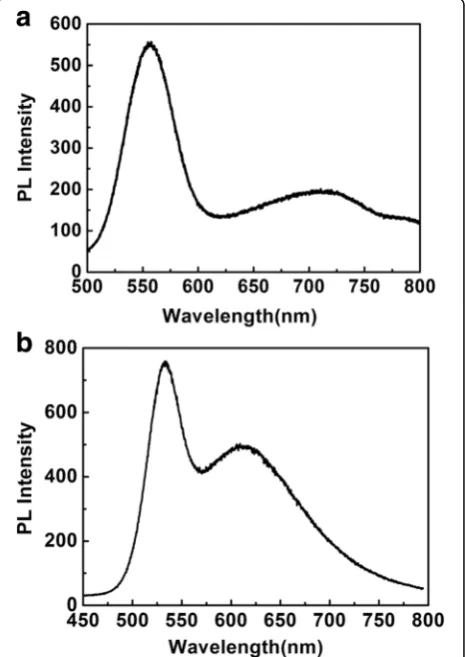
The PL spectra of quantized states and surface trap states for QDs on quartz coverslip at room temperature are shown in Fig. 1a, which consists of two peaks at 550 and 700 nm for the core quantized states and surface trap states, respectively. From the PL spectra, the PL in-tensity of quantized states is dominant and the PL inten-sity of trap states is weak. Figure 1b shows PL spectra of the quantized states and trap states for QDs on the silver films at room temperature which consists of two peaks at the wavelength 525 and 625 nm from the core quan-tized states and surface trap states, respectively. For QDs on the silver films, the QDs had been coated with PMMA films and then spin-coated on silicon wafer with 60-nm silver films, so that the PMMA films can prevent the energy transfer from quantum dots to silver films which causes the fluorescence quenching effect. As com-pared with the PL properties of the CdSe on quartz coverslip, the lower PL intensity of quantized states emission and the enhancement PL intensity of trap states emission for QDs on the silver films are observed, which can be attributed to the enhanced carrier recom-bination in trap states and the enhanced ET rate from
[image:2.595.306.539.373.702.2]the quantized states to the trap states due to plasmonic coupling effect on the corrugated silver films. From the absorption spectra, the PL intensity of trap states be-came obvious only when the excitation wavelength was tuned within the quantized absorption band and the small surface volume of trap states could prevent their efficient absorption transitions [34, 35]. Therefore, It can be concluded that the energy transfer process should be the origin of the activation energy.
To explicate the above steady-state PL measurements, the time-resolved PL measurements of quantized states and trap states were investigated, respectively. The PL decay curves of quantized states and trap states for CdSe QDs on the quartz coverslip and silver films are shown in Fig. 2. The lifetime decay curve of quantized state emission (green line) for CdSe QDs on the quartz cover-slip is well fitted with double exponential functions which exhibit a fast component of 2.2 ns and a slow component of 21.1 ns. The fast component can be at-tributed to the intrinsic energy transfer process between quantized states and surface trap states. And the lifetime decay curve of trap states emission (black line) is fitted with single exponential function which only exhibits a slow component of 61.7 ns as shown in Fig. 2. However, the lifetime decay curve of quantized states emission (red curves) for CdSe on PMMA silver films with a slow component of 16.1 ns and a fast component of 1.6 ns and the lifetime decay curve of trap states emission (blue line) with 26.9 ns are shown in Fig. 2. By the above ana-lysis, the relative faster component corresponds to ET lifetime between quantized states and trap states of semiconductor NCs, which strongly suggests that the
surface states capture the excitons through the ET process [36], instead of direct carrier trapping or Auger-assisted carrier transfer through the multi-exciton ionization effect. According to above lifetime compari-son, the PL lifetimes of quantized states and trap states on the PMMA silver films become shorter and the cor-responding ET rate is greatly enhanced. The results demonstrate that the local surface plasmon from the QD/silver hybrid structures enhances trap state emission and accelerate ET process in QDs.
To further verify ET process from the quantized states to trap states inside QDs and eliminate ET process be-tween QDs, we carried out time-resolved and spectrally resolved PL measurement within narrow spectral bands across the whole emission spectrum of quantized states for QDs in solution. The PL spectrum of CdSe QDs in solution is shown in Fig. 3a. However, the ET process between the QDs is absent in these diluted QD solutions due to the longer distance between the QDs. Figure 3b shows different wavelength PL decay curves of quantized states for CdSe QDs in solution. The PL decay curves were measured at the several emission peaks with 10 nm spectral width for CdSe QDs in solution. The lifetime
Fig. 2Time-resolved PL decays for the CdSe QDs on quartz coverslip surface and PMMA silver films measured at quantized states emission and trap states emission, respectively. Trap states emission (black lifetime curve) and quantized states emission (green lifetime curve) on quartz coverslip surface; trap states emission (blue lifetime curve) and quantized states emission (red lifetime curve) on the PMMA silver films, respectively
[image:3.595.305.539.378.694.2] [image:3.595.58.293.487.653.2]decay curves are well fitted with double exponential functions which exhibit the fast component of 2.11, 2.25, 2.33, 2.37, and 2.41 ns at the peak value of wavelength 530, 540, 550, 560, and 570 nm, respectively. The results clearly demonstrate that the ET dynamic process is not homogeneous between quantized states and surface trap states, and the exciton decay lifetimes of quantized states become slower from the shorter wavelength to the lon-ger wavelength. It is consistent with the nature of the spectral overlap between the different QDs [37]: for this ET process, the shorter wavelength has a better spectral overlap than the longer wavelength and thus exhibits faster energy transfer process. The spectral dependence of the ET rate is in reasonably good agreement with the steady-state PL measurements. The wavelength-dependent PL decay curves provide clear evidence that the efficient ET process occurs inside the CdSe QDs.
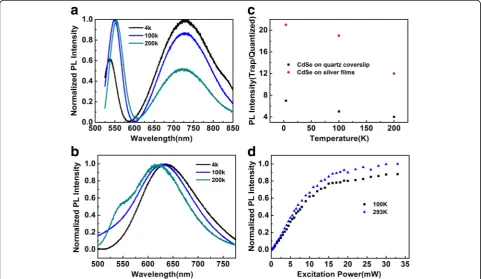
Temperature dependence of thermal population behav-ior is an important factor for the ET process from quan-tized states to surface states. In order to understand the PL mechanism of surface trap states, it is necessary to sys-tematically investigate temperature effect on PL spectra and PL decay of quantized states and surface trap states, respectively. Figure 4a shows the PL spectra of quantized states and surface trap states for CdSe QDs on quartz coverslip with different temperatures (4, 100, and 200 K),
respectively. From these results, the PL intensity of quan-tized states decreases and the blue shift is observed at low temperature (4 K), which can be explained by the temperature dependence of band gap. However, the PL intensity of trap states increases by decreasing the temperature from 200 to 4 K for CdSe QDs on quartz coverslip. Figure 4b shows the PL spectra of CdSe QDs on PMMA silver films at different temperatures (4, 100, and 200 K), respectively. Therefore, the PL measurement typ-ically reveals that the PL intensity of surface states in-creases at low temperature with respect to the PL intensity of quantized states. This observation suggests that thermal population behavior causes an important im-pact on the fluorescence emission of surface trap states and quantized states. The red-shift indicates an evidence for the occurrence of ET process between quantized states and trap states. Moreover, ET rate is not only influenced by the dipole strengths but also influenced by wave func-tion overlaps between the donors and acceptors. However, the two influence factors are temperature dependence. At lower temperatures, the radiative recombination rates and nonradiative recombination rates in quantized states and trap states are remarkably suppressed. Therefore, the de-creased ET rate at the lower temperature qualitatively ex-plains the decreased spectral overlap and dipole strength of the excitonic emission of QDs.
[image:4.595.57.539.414.693.2]To elaborate temperature effect on PL intensity of quantized states and trap states, we compare PL inten-sity of quantized states with that of trap states for CdSe on the quartz coverslip and silver films, respectively. The integrated PL intensity ratio of quantized states and trap states run up to 7.1 and 23 for CdSe QDs on the quartz coverslip surface and silver films at lower temperature (4 K) as shown in Fig. 4c, respectively. From the ratio of PL intensities of quantized states and trap states, it can be concluded that the silver films fur-ther enhance the energy transfer (ET) process from the quantized states to trap states due to the surface plas-monic coupling effect. To elucidate the temperature ef-fect on energy transfer process from quantized states to surface states, the energy transfer model consisting of core quantized state, surface state, and ground state was established [34].
In Fig. 4d, we also plot integrated PL intensities of quan-tized state emission for CdSe on the quartz coverslip with different excitation power. Under high-power excitation, the quantized states can absorb multiple photons and gen-erate multiple excitons per quantized state. More import-antly, the saturation power for the quantized state emission decreases with lowering the temperature to 100 K. Therefore, more excitons generated with high exci-tation power in quantized states easily move to surface trap states by ET process at lower temperature. Compared
the PL spectra of CdSe QDs on quartz coverslip with that of CdSe QDs on the silver films, these results obviously indicate the occurrence of the ET process from the quan-tized states to surface trap states as a function of temperature and ET rate is obviously enhanced due to the surface plasmonic coupling effect as shown in Fig. 4b.
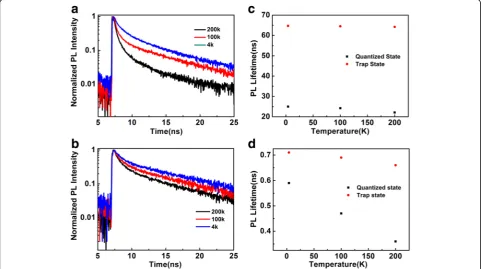
In order to investigate the temperature effect on surface states, the observed temperature-dependent PL lifetimes were monitored by the time-resolved PL mea-surements. Figure 5a, b shows the temperature-dependent PL decay curves of quantized states and trap states on the quartz coverslip at 4, 100, and 200 K, re-spectively. The PL decay curves with biexponential com-ponents consisting of radiative decay and nonradiative decay were observed. The PL lifetimes of quantized states emission can be obtained by fittingτ1andτ2that
correspond to the slow and fast component as shown in Fig. 5a. The difference between these components is ob-vious at 200 K with τ1= 22.1 ns andτ2= 0.34 ns. As the
temperature is lowered to 100 K, there is a slight change in the fast component (~0.46 ns). And the slow compo-nent with a lifetime of τ1= 25.1 ns and the fast
compo-nent with a lifetime of τ2= 0.51 ns are observed by
further cooling to 4 K. By comparing with PL lifetime of quantized states emission, the PL lifetime (~65.1 ns) of trap states can be mainly regarded as radiative decay rate due to the negligence of thermal quenching effect.
[image:5.595.57.539.424.693.2]The different PL decay curves of the quantized states emission and trap states emission can be fitted as shown in Fig. 5c, d. As can be seen from the two figures, the nonra-diative decay rate becomes larger at 200 K and thus, the PL decay of quantized states is faster. However, the corre-sponding PL decay of trap states becomes slower at lower temperature. As mentioned above, the conventional three-state model can perfectly explain the temperature effect on PL dynamic process between quantized states and surface trap states [38, 39]. Therefore, the temperature-dependent PL intensity of quantized states and surface trap states as shown in Fig. 4a, b suggests the energy transfer that occurs through thermally activated process.
Conclusions
The temperature and wavelength dependence of energy transfer process between quantized states and trap states of CdSe QDs has been investigated by measuring PL spectra and PL decay on the quartz coverslip surface and silver films, respectively. The normalized PL intensity of the quantized states decreases at the lower temperature with respect to the trap state emission. And the enhanced ET process occurs from the quantized states to the sur-face trap states within the CdSe QDs, especially for CdSe QDs on the silver films at lower temperature. It can be concluded that the enhanced ET process attributes to plasmonic coupling effect at the lower temperature re-gion and temperature dependence of thermal population behavior also plays an important role in the ET rate, es-pecially for lower temperature.
Abbreviations
ET:Energy transfer; NC: Nanocrystal; PL: Photoluminescence;
PMMA: Polymethyl methacrylate; QDs: Quantum dots; TRPL: Time-resolved photoluminescence
Acknowledgements
This work was supported by the National Science Foundation of China under Grant No. 61307067 and No.11574125, the Science Foundation of Shandong Province under Grant No. ZR2015JL024, the Taishan Scholar Project of Shandong Province under Grant No. ts201511055, and the Fundamental Research Funds for the Central Universities under Grant No. 30920130129625.
Authors’Contributions
QFX and CLY conceived and designed the experiments. LZ, LBK, and MLL prepared the samples. MMJ, HFM, DHW, and JNC performed the optical experiments. QFX and CLY co-wrote the manuscript. All authors read and approved the final manuscript.
Competing Interests
The authors declare that they have no competing interests.
Publisher’s Note
Springer Nature remains neutral with regard to jurisdictional claims in published maps and institutional affiliations.
Author details
1School of Physics and Optoelectronic Engineering, Ludong University,
YanTai 264025, China.2Ministerial Key Laboratory of JGMT, Nanjing University
of Science and Technology, Nanjing 210094, China.
Received: 4 January 2017 Accepted: 1 March 2017
References
1. Coe S, Woo WK, Bawendi MG, Bulovic V (2002) Electroluminescence from single monolayers of nanocrystals in molecular organic devices. Nature 420: 800–803
2. Tessler N, Medvedev V, Kazes M, Kan SH, Banin U (2002) Efficient near-infrared polymer nanocrystal light-emitting diodes. Science 295:1506 3. Thompson BJ, Klimov VI (2003) Semiconductor and metal nanocrystals[M] 4. Klimov VI, Mikhailovsky AA, Xu S, Malko A, Hollingsworth JA, Leatherdale CA,
Eisler HJ, Bawendi MG (2000) Optical gain and stimulated emission in nanocrystal quantum dots. Science 290:314
5. Kambhampati P (2011) Unraveling the structure and dynamics of excitons in semiconductor quantum dots. Acc Chem Res 44:1
6. Cooney RR, Sewall SL, Sagar DM, Kambhampati P (2009) State-resolved manipulations of optical gain in semiconductor quantum dots: size universality, gain tailoring, and surface effects. J Chem Phys 131:164706 7. Cooney RR, Sewall SL, Sagar DM, Kambhampati P (2009) Gain control in
semiconductor quantum dots via state-resolved optical pumping. Phys Rev Lett 102:127404
8. Nozik AJ (2002) Quantum dot solar cells. Phys E 14:115
9. Gur I, Fromer NA, Geier ML, Alivisatos AP (2005) Air-stable all-inorganic nanocrystal solar cells processed from solution. Science 310:462
10. Greenham NC, Peng X, Alivisatos AP (1996) Charge separation and transport in conjugated-polymer/semiconductor-nanocrystal composites studied by photoluminescence quenching and photoconductivity. Phys Rev B 54:17628 11. Kortan AR, Hull R, Opila RL, Bawendi MG, Steigerwald ML, Carroll PJ, Brus LE
(1990) Nucleation and growth of cadmium selendie on zinc sulfide quantum crystallite seeds, and vice versa, in inverse micelle media. J Am Chem Soc 112:1327
12. Kuno M, Lee JK, Dabbousi BO, Mikulec FV, Bawendi MG (1997) The band edge luminescence of surface modified CdSe nanocrystallites: Probing the luminescing state. J Chem Phys 106:9869
13. Garrett MD, Bowers MJ, McBride JR, Orndorff RL, Pennycook SJ, Rosenthal SJ (2008) Band edge dynamics in CdSe nanocrystals observed by ultrafast fluorescence upconversion. J Phys Chem C 112:436
14. Kambhampati P (2011) Hot exciton relaxation dynamics in semiconductor quantum dots: radiationless transitions on the nanoscale. J Phys Chem C 115:22089
15. Tyagi P, Kambhampati P (2011) False multiple exciton recombination and multiple exciton generation signals in semiconductor quantum dots arise from surface charge trapping. J Chem Phys 134:094706
16. McGuire JA, Sykora M, Joo J, Pietryga JM, Klimov VI (2010) Apparent versus true carrier multiplication yields in semiconductor nanocrystals. Nano Lett 10:2049
17. Galland C, Ghosh Y, Steinbruck A, Sykora M, Hollingsworth JA, Klimov VI, Htoon H (2011) Two types of luminescence blinking revealed by spectroelectrochemistry of single quantum dots. Nature 479:203 18. Rosen S, Schwartz O, Oron D (2010) Transient fluorescence of the off state
in blinking CdSe/CdS/ZnS semiconductor nanocrystals is not governed by Auger recombination. Phys Rev Lett 104:157404
19. Bowers MJI, McBride JR, Garrett MD, Sammons JA, Dukes ADI, Schreuder MA, Watt TL, Lupini AR, Pennycook SJ, Rosenthal SJ (2009) Structure and ultrafast dynamics of white-light-emitting CdSe nanocrystals. J Am Chem Soc 131:5730 20. Schreuder MA, Xiao K, Ivanov IN, Weiss SM, Rosenthal SJ (2010) White light-emitting diodes based on ultrasmall CdSe nanocrystal electroluminescence. Nano Lett 10:573–576
21. Baker DR, Kamat PV (2010) Tuning the emission of CdSe quantum dots by controlled trap enhancement. Langmuir 26:11272
22. Bowers MJ, McBride JR, Rosenthal SJ (2005) White-light emission from magic-sized cadmium selenide nanocrystals. J Am Chem Soc 127:15378 23. Hu L, Wu HZ, Wan ZF, Cai CF, Xu TN, Lou TG et al (2012) Physical
approaches to tuning the luminescence color patterns of colloidal quantum dots. New J Phys 14:013059
24. Hu L, Wu HZ, Du LX, Ge HY, Chen X, Dai N (2011) The effect of annealing and photoactivation on the optical transitions of band-band and surface trap states of colloidal quantum dots in PMMA. Nanotech 22:125202 25. Lifshitz E, Dag I, Litvin ID, Hodes G, Gorer S, Reisfeld R et al (1998) Optical
26. Lifshitz E, Dag I, Litvitn ID, Hodes G (1998) Optically detected magnetic resonance study of electron/hole traps on CdSe quantum dot surfaces. J Phys Chem B 102:9245–9250
27. Wang X, Yu WW, Zhang J, Aldana J, Peng X, Xiao M (2003)
Photoluminescence upconversion in colloidal CdTe quantum dots. Phys Rev B 68:125318
28. Wang X, Qu L, Zhang J, Peng X, Xiao M (2003) Surface-related emission in highly luminescent CdSe quantum dots. Nano Lett 3:1103
29. Xu QF, Huang XN, Hua Z, Hu L, Du LX, Wu HZ et al (2016) Extended storage of multiple excitons in trap states of semiconductor nanocrystals. Appl Phys Lett 108:093110
30. Valerini D, Cretí A, Lomascolo M (2005) Temperature dependence of the photoluminescence properties of colloidal CdSe/ZnS core/shell quantum dots embedded in a polystyrene matrix. Phys Rev B 71:235409
31. Kim D, Yokota H, Shimura K, Nakayama M (2013) Temperature dependence of photoluminescence dynamics of self-assembled monolayers of CdSe quantum dots: the influence of the bound-exciton state. Phys Chem Chem Phys 15:21051
32. Yokota H, Okazaki K, Shimura K, Nakayama M, Kim D (2012)
Photoluminescence properties of self-assembled monolayers of CdSe and CdSe/ZnS quantum dots. J Phys Chem C 116:5456–5459
33. Yokota H, Shimura K, Nakayama M, Kim D (2012) Optical properties of self-assembled monolayer of CdSe quantum dots. Phys Status Solidi C 9:2465–2468 34. Mooney J, Krause MM, Saari JI, Kambhampati P (2013) Challenge to the
deep-trap model of the surface in semiconductor nanocrystals. Phys Rev B 87:081201
35. Chuang CH, Doane TL, Lo SS, Scholes GD, Burda C (2011) Measuring electron and hole transfer in core/shell nanoheterostructures. ACS Nano 5:6016
36. Kagan CR, Murray CB, Nirmal M, Bawendi MG (1996) Electronic energy transfer in CdSe quantum dot solids. Phys Rev Lett 76:1517
37. Crooker SA, Hollingsworth JA, Tretiak S, Klimov VI (2002) Spectrally resolved dynamics of energy transfer in quantum-dot assemblies: towards engineered energy flows in artificial materials. Phys Rev Lett 89:186802 38. Kim D, Okazaki K, Nakayama M (2009) Temperature dependence of the
energy transfer of exciton states in bilayer structures of CdSe/ZnS quantum dots. Phys Rev B 80:045322
39. Labeau O, Tamarat P, Lounis B (2003) Temperature dependence of the luminescence lifetime of single CdSe/ZnS quantum dots. Phys Rev Lett 90:257404
Submit your manuscript to a
journal and benefi t from:
7Convenient online submission
7Rigorous peer review
7Immediate publication on acceptance
7Open access: articles freely available online
7High visibility within the fi eld
7Retaining the copyright to your article