Pooley, Simon and Mendelsohn, J.A. and Milner-Gulland, E.J. (2014)
Hunting down the chimera of multiple disciplinarity in conservation science.
Conservation Biology 28 (1), pp. 22-32. ISSN 0888-8892.
Downloaded from:
Usage Guidelines:
Please refer to usage guidelines at
or alternatively
Hunting Down the Chimera of Multiple Disciplinarity
in Conservation Science
SIMON P. POOLEY,
∗‡ J. ANDREW MENDELSOHN,† AND E. J. MILNER-GULLAND
∗∗Imperial College Conservation Science, Munro Building, Silwood Park Campus, Buckhurst Road, Ascot, Berkshire, SL5 7PY,
United Kingdom
†School of History, Queen Mary, University of London, London E1 4NS, United Kingdom
Abstract: The consensus is that both ecological and social factors are essential dimensions of conservation research and practice. However, much of the literature on multiple disciplinary collaboration focuses on the difficulties of undertaking it. This review of the challenges of conducting multiple disciplinary collaboration offers a framework for thinking about the diversity and complexity of this endeavor. We focused on conceptual challenges, of which 5 main categories emerged: methodological challenges, value judgments, theories of knowledge, disciplinary prejudices, and interdisciplinary communication. The major problems identified in these areas have proved remarkably persistent in the literature surveyed (c.1960–2012). Reasons for these failures to learn from past experience include the pressure to produce positive outcomes and gloss over disagreements, the ephemeral nature of many such projects and resulting lack of institutional memory, and the apparent complexity and incoherence of the endeavor. We suggest that multiple disciplinary collabora-tion requires conceptual integracollabora-tion among carefully selected multiple disciplinary team members united in investigating a shared problem or question. We outline a 9-point sequence of steps for setting up a successful multiple disciplinary project. This encompasses points on recruitment, involving stakeholders, developing research questions, negotiating power dynamics and hidden values and conceptual differences, explaining and choosing appropriate methods, developing a shared language, facilitating on-going communications, and discussing data integration and project outcomes. Although numerous solutions to the challenges of multiple disciplinary research have been proposed, lessons learned are often lost when projects end or experienced individuals move on. We urge multiple disciplinary teams to capture the challenges recognized, and solutions proposed, by their researchers while projects are in process. A database of well-documented case studies would showcase theories and methods from a variety of disciplines and their interactions, enable better comparative study and evaluation, and provide a useful resource for developing future projects and training multiple disciplinary researchers.
Keywords: conceptual challenges, humanities, interdisciplinary, multidisciplinary, natural sciences, social sciences, transdisciplinary
Cazando la Quimera de la Multidisciplina en la Ciencia de la Conservaci´on
Resumen: El consenso es que tanto los factores ecol´ogicos como los sociales son dimensiones esenciales
de la investigaci´on y la pr´actica de la conservaci´on. Sin embargo, mucha de la literatura sobre
colabora-ciones multidisciplinarias se enfoca en las dificultades de sobreponerse a ´esta. Esta revisi´on de los retos de
conducir una colaboraci´on multidisciplinaria ofrece un marco de trabajo para pensar sobre la diversidad
y la complejidad de este esfuerzo. Nos enfocamos en los retos conceptuales, de los cuales emergieron cinco
categor´ıas principales: retos metodol´ogicos, juicios de valor, teor´ıas del conocimiento, prejuicios disciplinarios
y comunicaci´on interdisciplinaria. Los problemas m´as grandes que se identificaron en estas ´areas han
comprobado ser extraordinariamente persistentes en la literatura revisada (c. 1960 – 2012). Las razones
por las cuales no se aprende de estas fallas anteriores incluyen la presi´on para producir resultados positivos
‡email [email protected]
Paper submitted December 3, 2012; revised manuscript accepted July 2, 2013.
y pasar por alto desacuerdos, la naturaleza ef´ımera de muchos proyectos y la resultante falta de memoria
institucional, y la aparente complejidad e incoherencia del esfuerzo. Sugerimos que la colaboraci´on
multi-disciplinaria requiere de integraci´on conceptual entre integrantes de equipo cuidadosamente seleccionados
unidos en la investigaci´on de una pregunta o problema compartidos. Resaltamos una secuencia de pasos de
nueve puntos para establecer un proyecto multidisciplinario exitoso. Esto incluye puntos sobre reclutamiento,
involucramiento de las partes interesadas, desarrollo de preguntas de investigaci´on, negociaci´on de din´amicas
de poder, valores escondidos y diferencias conceptuales, explicar y escoger m´etodos apropiados, desarrollar
un lenguaje compartido, facilitar la comunicaci´on continua y discutir la integraci´on de datos y los
resul-tados de los proyectos. Mientras que se han propuesto numerosas soluciones a los retos de la investigaci´on
multidisciplinaria, las lecciones aprendidas continuamente se pierden cuando los proyectos terminan o los
in-dividuos con experiencia contin´uan en otros proyectos. Instamos a los equipos multidisciplinarios a capturar
los retos reconocidos, y soluciones propuestas, por sus investigadores mientras los proyectos est´an en proceso.
Una base de datos de casos bien documentados podr´ıa mostrar teor´ıas y m´etodos a partir de una variedad
de disciplinas y sus interacciones, permitir mejores estudios comparativos y evaluaciones y proporcionar un
recurso ´util para desarrollar futuros proyectos y entrenar investigadores multidisciplinarios.
Palabras Clave: ciencias naturales, ciencias sociales, humanidades, interdisciplina, multidisciplinario, retos conceptuales, transdisciplina
Introduction
For anyone tackling real world environmental problems, the challenges of multiple disciplinary collaboration are virtually unavoidable. Indeed, the pressure of peer ex-pectations and funding requirements make it appear that this is the sine qua non for successful and useful re-search on environmental challenges. Rere-searchers from different disciplines are encouraged to come together to form a kind of chimera, in the biological sense of a sin-gle animal composed of several different populations of genetically distinct cells. Despite the assumed virtues of multiple disciplinary collaboration however, much of the literature has focused on the problems (di Castri 1976), barriers (Fox et al. 2006; Adams 2007; Stafford-Smith et al. 2012), obstacles (Endter-Wada et al. 1998; Campbell 2005), difficulties (L´el´e & Norgaard 2005), and challenges (Zube 1982; Mascia et al. 2003) of undertaking this kind of research. Some of these authors express these problems so persuasively that multiple disciplinarity can seem an impractical ideal, more akin to the mythical chimera: an ungainly (and impossible) conglomerate of a lion’s head, a goat’s body, and a serpent’s tail.
At first glance, a review of the literature over the last few decades conjures up the hydra: a multitude of differ-ent kinds of problems beyond the capacity of anyone to comprehensively resolve. We argue that to cut through this tangle, it is necessary to clarify what is meant by multi-ple disciplinary collaboration; identify the core recurrent problems of doing it; and devise a coherent approach to overcoming these problems and monitoring research outcomes.
First, some clarification of terminology is necessary. The proliferation of research activities across disciplines over the past half-century has inspired a wealth of clas-sification schemes for multiple disciplinary studies (see Klein [2010] for a summary). We use multiple
disci-plinaryto cover multidisciplinary, interdisciplinary, and
transdisciplinary approaches. Where differentiated, these terms for multiple disciplinarity are usually defined as fol-lows (adapted from Tress et al. 2006).Multidisciplinary
projects involve different academic disciplines research-ing a sresearch-ingle problem or theme but workresearch-ing in parallel without integration. Interdisciplinary projects involve unrelated academic disciplines in a way that requires them to cross disciplinary boundaries to create new knowledge and theory in pursuit of a common research goal. Transdisciplinaryprojects integrate academic re-searchers from unrelated disciplines, and nonacademic participants, in pursuing a common goal, and creating new knowledge and theory.
The natural sciences study the physical or natural world (including biology, chemistry, earth science, and physics). The social sciences study human society and be-havior (e.g., sociology, psychology, and economics). The humanities study the human condition (e.g., philosophy, literature, and religious studies). Subjects such as history straddle the latter 2 categories.
0 100 200 300 400 500 600 700
conservaƟon biology +
conservaƟon + environmental problems +
ecology +
Number of publica
Ɵ
ons
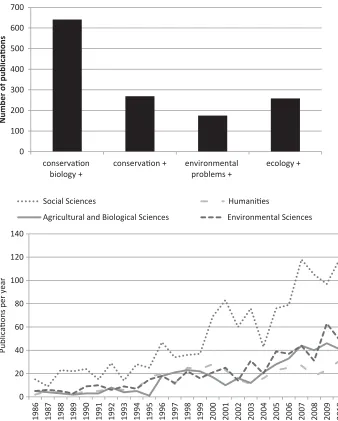
Figure 1. Numbers of publications (published from 1986 to 2010) found using 4 selected search terms paired with “multidisciplinary.”
0 20 40 60 80 100 120 140
1986 1987 1988 1989 1990 1991 1992 1993 1994 1995 1996 1997 1998 1999 2000 2001 2002 2003 2004 2005 2006 2007 2008 2009 2010
Publica
Ɵ
ons
pe
r
year
Social Sciences
Agricultural and Biological Sciences
HumaniƟes
[image:4.594.46.384.53.474.2]Environmental Sciences
Figure 2. SCOPUS database search results showing number of papers, books, and reviews (1986-2010) described as “multidisciplinary,” by disciplinary grouping.
Methods
We used SCOPUS (an abstract and citation database of peer-reviewed literature) and JSTOR (a digital library of peer-reviewed articles) to find the most productive search terms (yielding the most results) to capture arti-cles on multiple disciplinary research on environmental problems (1960–2010). We used the 4 SCOPUS cate-gories which yielded the most results, and added arts and humanities, as a neglected dimension. In JSTOR we used the categories area studies, biological sciences, development studies, social sciences, and humanities. We searched for the terms conservation biology,
con-servation,environmental problem, andecology—each
paired with the term multidisciplinary (see Figs. 1 & 2). Individual conservation-specific journals including
Conservation Biology, Ecology and Society,
Environ-mental Conservation, and Oryx were also searched
for the term multidisciplinary. The term
multidisci-plinary was used because it captured (was also used
in) most papers also described as transdisciplinary or
interdisciplinary.
The searches yielded nearly 800 papers from 61 jour-nals, most from 1986 onward. The most productive SCO-PUS categories were environmental science, agricultural and biological sciences, social sciences, and earth and planetary sciences. We refined the selection by choosing only papers written in English that explicitly addressed the challenges of multiple disciplinary research on prob-lems of the environment involving natural scientists with social scientists or humanities researchers or that were the outputs of such collaborative research. We sorted these papers into categories by abstract and key words: case studies (45); secondary literature (26); position pa-pers (68); reviews or histories (31); and tools (methods 69 papers, and theories, 40).
of paper (review, editorial, etc. [http://www.iccs.org.uk/ research-themes/past-projects/sharpen/]). S.P. read and coded these using a grounded theory approach, open to emergent themes and theoretical categories (Strauss & Corbin 1998). Codes were devised for disciplines in-volved; mode of multiple disciplinary work; and key-words and themes as they emerged.
Results
Across the time period surveyed (with key recent pa-pers added) certain challenges to multiple disciplinary work recurred. These were divided into structural, con-ceptual, and practical challenges. Structural challenges— educational and sectoral institutional cultures and bound-aries and how these are reflected in and entrenched by allocations of funding and policy and managerial responsibilities—are too complex and wide-ranging to include here. They arise from the widely held dualism in Western society between environmental subjects and is-sues which are coupled with the natural sciences and so-cial and cultural issues which are coupled with the soso-cial sciences and humanities (Head et al. 2005; Strang 2009). Practical challenges include recruitment, allocation of re-sources across disciplines and territories, managing per-sonalities, and so forth. We chose to focus on conceptual challenges. Five main categories emerged (from most-mentioned to least): methodological challenges; value judgments; theories of knowledge; disciplinary preju-dices; and interdisciplinary communication. Sixty-eight papers addressing these were reviewed in detail.
Methodological Challenges
The key methodological challenges which emerged from the papers reviewed were time and phasing; scale; data integration and management; and understanding human motivations and behavior.
Most academic researchers struggle to keep abreast of the literature in their own disciplines, let alone tackle related literatures in other fields (Campbell 2005; Drew & Henne 2006; Welch-Devine & Campbell 2010). A review of articles evaluating interdisciplinary research found vir-tually no crossover between natural science and social science journals (MacMynowski 2007). This makes it un-likely that researchers will be aware of methodological developments in fields other than their own.
A common theme is the need to spend more time on the initial stages of multiple disciplinary projects. This is important for developing mutual understanding and trust around unfamiliar research methods. This heavy time investment has costs for academic researchers, notably in time away from productive disciplinary research and slowed publication rates. Further, it requires patience and understanding from funders and managers and
stake-holders not involved in technical aspects of the research (Cowling et al. 2008).
Regarding phasing, because many natural scientists regard social science as informative and facilitative for policy and implementation processes, ignoring the im-portance of data collection and analysis in social science research, social science is often consigned to a supportive role to the primary research (Endter-Wada et al. 1998). Social scientists are therefore introduced at a later stage of the project, are not involved in the framing of the project, have insufficient funds, time and baseline data to conduct their research adequately, and arrive too late really to collaborate (Campbell 2005; Strang 2009; Duraiappah & Rogers 2011; Sievanen et al. 2012). How-ever, this gives rise to a circular problem: for while a “problem cannot be defined until a working team is in place . . . it is impossible to know how deeply to involve specific team members until the problem has been de-fined” (Nicolson et al. 2002: 380).
Time budgeting for data collection is also a challenge, with major mismatches in timescales required by differ-ent disciplines (di Castri 1976; Drew & Henne 2006). Some qualitative data collection and processing requires a long timescale. Strang (2009: 12) argues that “social science research generally requires far more diverse types of data than is commonly encompassed in natural science projects, and . . . it takes more time to collect and analyse such a wide range of data.”
An early challenge for project planners is how to cover the range of temporal and spatial scales required to incor-porate the social and ecological dimensions of the prob-lem in hand (a persistent challenge noted from di Castri et al. 1981; Scoones 1999; Gibson et al. 2000; through to Collins et al. 2011). Heemskerk et al. (2003: 9) report a mismatch between “the spatial and temporal scales at which ecosystems function and ecological problems manifest . . . [and] the scale at which management and re-search occur.” Investigating the interaction of processes occurring at different temporal and spatial scales requires careful thought about which data should be collected and at which scales. Observations of long-term environmental and behavioral changes (where experimental methods may not be feasible) may require very long-term data, or in the case of research, very long-lasting projects (Collins et al. 2011).
such preferences affect the kinds of data they collect and the methods they use. Comments on the difficulties of integrating natural science and social science data often actually refer to difficulties in integrating quantitative and qualitative data.
Hadorn et al. (2010) outline 5 classes of integration methods, 3 of which predominate in the reviewed lit-erature: dialogue methods; model-based methods; and common-metric-based methods. Models are a particularly popular solution for integrating, developing, and manag-ing data and conceptual frameworks (e.g., Zube 1982; Heemskerk et al. 2003; Milner-Gulland 2012; Schl¨uter et al. 2012). For instance, household utility models are used to understand how individual households allocate labor for natural resource use. However if models have in-scrutable inner workings, then collaborating researchers must take the outputs of these models on faith (Nicolson et al. 2002). This is a particular challenge in multiple dis-ciplinary work involving researchers with no background in modeling. Those who do not understand models tend not to engage with their workings or outputs. They dis-trust counter-intuitive model outputs rather than being motivated to investigate the intermediate relationships that generated these results (Nicolson et al. 2002).
Strang (2009) argues that the systems theory underly-ing much of the modelunderly-ing of social–ecological systems aims to maintain a manageable multiplicity of variables and render each factor transparent, definable, and ho-mogenized. This makes such modeling unsuited to “ex-pressing . . . complex and intangible realities of power relations, belief systems, values, understandings of envi-ronmental processes, affective responses to place, iden-tity, social relations and so forth” (Strang 2009: 14). The subtlety of the interrelations of the material and social worlds is distorted and explanatory ethnographic con-text is omitted, rendering human behavior a black box. Qualitative data tend to be compressed “into extinction” (Strang 2009: 14).
It is challenging to model the feedbacks between hu-man and ecological systems, particularly to incorporate influences on human behavior external to ecological feedbacks (Collins et al. 2011). Although policy makers are clamoring for research quantifying the impacts of humans on biological systems or the effects of biodiver-sity loss on human well-being, we need more research on feedbacks between changes to human well-being and human behavior toward nature (Miller et al. 2012). Conservation interventions based on statistical models may themselves change conditions, thereby invalidating the analysis upon which they were predicated (Milner-Gulland 2012). To overcome this requires a better under-standing of how individual humans, and communities, make decisions in a changing world.
“Most of the problems of conservation are to do with people,” comments Adams (2007). It is thus surprising that St John et al. (2010) have to chide ecologists and
conservationists for not using tried-and-tested methods employed by social psychologists to explore (and thus, hopefully, change) individuals’ motivations for specific problematic behavior (see also Saunders et al. 2006). Most conservation research uses economic models assuming people behave rationally, ignoring the importance of key determinants of individual behavior identified by social psychologists, such as subjective and descriptive norms and moral obligations (St John et al. 2010). Jones et al. (2011) advocate “mental models” for understanding indi-vidual behavior.
Understanding human motivations and behavior re-quires more than engaging with just the cognitive, be-havioral, and physiological dimensions of our interac-tions with the environment. It requires an engagement with culture(s). Within Europe, Ressurreic¸˜ao et al. (2012) found local cultural values significantly influence will-ingness to pay for the conservation of particular marine species. The ecosystem services literature was developed primarily by western ecologists and economists focused on capitalist values and systems, where economics plays a central role in assessing values and shaping societies (Reyers et al. 2010). This sidelines the values espoused by other philosophies (Sessions 1995) and cultures.
Head et al. (2005) attack the popular misconception that science and culture are distinct entities, arguing that culture pervades all of our lives and institutions. They rec-ommend more qualitative research on the (dynamic) cul-tural conceptions of the environment of all participants and stakeholders, as well as the cultures of disciplines and how they frame researchers’ world views. Ludwig et al. (2001: 503) observe that “environmental problems may reflect our own culture and attitudes as much as a scientific or technical problem” (and see Cronon 1995). Science and technology studies (STS) and public under-standing of science (PUS) are making significant contribu-tions to research in this area. Some radical approaches are emerging—for instance, rethinking the roles of scientific experts and the public and hybridizing rather than trying to separate science and politics (Lane et al. 2011).
Normative Concerns and Priorities
In this context, the wordconservationimplies action and a stance. However, when it becomes conservation
sciencethis is problematic because for many being a
sci-entist implies a need for detached objectivity (Wilhere 2011). There is a longstanding tension in most natural and some social sciences between scientific objectiv-ity and social engagement. Ecologists and conservation scientists are anxious for their work to appear value free and many distance themselves from environmental advocacy—while promoting the social relevance of their work (Nelson & Vucetich 2009; Wilhere 2011).
L´el´e and Norgaard (2005) observe that most natural sci-entists believe that science is value neutral but argue that seeking objective measures such as ecosystem integrity or green GDP does not eliminate value judgments—each is shaped by the choice of ultimate values or relevant variables or decisions concerning the aggregation of dis-parate values. Such hidden value judgments can mislead those unaware of the value-laden nature of these appar-ently objective analyses and cause friction in multiple disciplinary research teams when social scientists point them out (L´el´e & Norgaard 2005).
Sandbrook et al. (2013) distinguish between 2 kinds of social researchers: those aiming to contribute to the mission of conserving biodiversity (e.g., West et al. 2006; B¨uscher 2013) and those studying conservation as a so-cial phenomenon without necessarily sharing its mission. Sandbrook et al. urge conservationists not to reject the findings of the latter because they may not be on mission or may be hostile (e.g., Guha 1997). Engaging offers the opportunity for critical self-reflection and facilitates an appreciation of the larger context in which conservation interventions are performed and experienced.
Much conservation science and sustainable develop-ment research is informed by notions of what good out-comes are. However, Chan et al. (2007) note that less attention is paid to the ethical implications of the research process. Minteer and Collins (2005: 1804) maintain that although environmental ethics (Pojman 2011) is good on conceptual issues, “there is . . . no . . . subfield of applied or practical ethics devoted expressly to investigating the special kind of ethical issues raised within ecological re-search and biodiversity management contexts.” In light of an increased profile for market-based conservation, there are concerns that social scientists researching the social impacts of conservation interventions may be sidelined (Welch-Devine & Campbell 2010). Nearly a quarter of a century after Soul´e’s statement on ethics and conserva-tion, the training many conservationists receive (mostly natural sciences) still does not incorporate applied ethics (Drew & Henne 2006; Newing 2010).
Theories of Knowledge
Theories of knowledge consider what we think we can know and how we can know it. The importance of
re-solving conceptual differences in the initial stages of in-terdisciplinary research projects is emphasized by many authors (e.g., Nicolson et al. 2002; Heemskerk et al. 2003; Campbell 2005; L´el´e & Norgaard 2005; Newell et al. 2005; Dewulf et al. 2007; Khagram et al. 2010; Sievanen et al. 2012). The perception that this breaks down along sub-jective versus obsub-jective, qualitative versus quantitative, subjectivist versus positivist, social sciences and humani-ties versus natural sciences lines was identified as widely held (Drew & Henne 2006; Adams 2007; Evely et al. 2010) but too simplistic (L´el´e & Norgaard 2005; Khagram et al. 2010). Most of these authors are concerned with either investigating or proposing conceptual frameworks, with the aims of making explicit, defining, and discussing the philosophies of knowledge, theories, and research styles researchers from diverse disciplinary backgrounds bring to framing multiple disciplinary projects. These are usu-ally approaches to the processes of differentiation, clar-ification, and synthesis required to sort out conceptual differences, rather than discussions of particular theories or concepts (for the latter, see Moran 2010).
Disciplinary Prejudices
One reason the acknowledgement and resolution of conceptual differences and related choices regarding problem definition, theory choice, and methodology is so difficult is that the multiple disciplinary landscape is structured by often unacknowledged but widely ac-cepted hierarchies of power. Despite calls to integrate the social sciences into research and management of social–environmental systems, scientific institutions and natural scientists retain their preeminent social authority as mediators of truth and knowledge on environmental matters (MacMynowski 2007; Strang 2009; Welch-Devine & Campbell 2010; Sievanen et al. 2012).
MacMynowski (2007) advocates confronting “the exer-cise of differential power by social and natural scientists, within academia and beyond,” especially regarding de-bates over subjectivity in research. She argues that “[a] deep normative current persists that valorizes mathemat-ics and physmathemat-ics as the objective scientific ideal and views other research, particularly in the social sciences, to be trailing behind in the quest for rigor and valid knowledge” (MacMynowski 2007: 5). Social sciences which acknowl-edge the subjectivity of the observer face a power deficit in multiple disciplinary projects.
are involved and at which stage, conflict resolution, and the level of acceptability of the research outputs to the scientific community (Campbell 2005; Drew & Henne 2006; Sievanen et al. 2012).
A particular complaint of social scientists, borne out by surveys of natural scientists working on multiple disci-plinary projects (Fox et al. 2006; Lowe et al. 2009; Welch-Devine & Campbell 2010; Sievanen et al. 2012), is that the latter regard the social sciences instrumentally as a means to communicate their findings to or change the behav-ior of their target audiences (Whyte 1982; Endter-Wada et al. 1998). Social scientists are thus often brought in at later stages of projects and excluded from the planning process.
This attitude results in natural scientists undertaking tasks such as designing questionnaires and conducting surveys without being aware of the protocols and best practices developed for such work by the social sciences. If this yields poor quality data which cannot generate robust and generalizable results, then this is viewed as a failure of social science techniques, rather than the result of their poor implementation. (Of course, many social scientists do not aim to deliver generalizable results, for example, cultural relativists among anthropologists.) Al-though natural scientists often assume they can manage the social science work required by their conservation projects, the equivalent assumption that social scientists can do natural science research is seldom heard—in fact the opposite view prevails (Welch-Devine & Campbell 2010).
In an online survey of views on the role of the social sciences in conservation, Fox et al. (2006) found that social scientists felt unvalued by conservation scientists. A survey of social science and humanities scholars on engagement in global environmental change (GEC) re-search conducted by the International Human Dimen-sions Programme (IHDP) found that 42% (of 152) agreed that “social/human dimensions of GEC research are not regarded as important or relevant by others in the GEC field” (Duraiappah & Rogers 2011: 24). Lowe et al. (2009) found that most of the ecologists working on the Rural Economy and Land Use (RELU) project who responded to their questionnaire preferred tackling the social dimen-sions of their work by engaging with stakeholders, rather than with social scientists. Welch-Devine and Campbell (2010) found that some natural scientists felt they were doing social science just by working with local commu-nities. On the other hand, Strang (2009) points out that social scientists should not just wait to be invited onto projects initiated by natural scientists, but should invite natural scientists to collaborate on their projects too.
Interdisciplinary Communication
Building trust and familiarity with one another’s men-tal frameworks, including how words and concepts are
used by researchers (and stakeholders) from different backgrounds, is judged essential for collaborative mul-tiple disciplinary work (Nicolson et al. 2002; Heemskerk et al. 2003; Dewulf et al. 2007). Project planners are urged to budget for communication-rich face-to-face meetings and time for social interaction (Daily & Ehrlich 1999) and institutions to jointly house collaborating researchers from different disciplines (Heberlein 1988).
Reading the literatures of other disciplines facilitates collaboration across disciplines. It eases the pressure on multiple disciplinary project leaders to familiarize researchers with the terminologies and writing conven-tions of other disciplines. Unfortunately, few read across disciplines (MacMynowski 2007). Publishing research in the journals of other disciplines also helps break down disciplinary barriers (Wear 1999; Campbell 2005; Drew & Henne 2006). However, the orientation of academic assessment to discipline-specific journals and theoretical work and the perceived lower status of interdisciplinary and applied journals inhibit researchers from publishing multiple disciplinary work (Daily & Ehrlich 1999; Fox et al. 2006; Welch-Devine & Campbell 2010). There are also perceived prejudices against publishing with researchers from other disciplines. Social scientists struggle with the bias toward natural science approaches and methods of conservation journal reviewers and reviewers’ assump-tion that they are competent to comment on the validity of social science methods (Pickett 1999; Campbell 2005). Equally, a lack of social science reviewers risks allowing the publication of substandard social science.
Discussion
The prevailing wisdom is that solving environmental problems requires multiple disciplinary research, despite the manifold challenges of enacting it. It is worth recalling that it is not proven that such studies are more successful in delivering new knowledge, or conservation outcomes, than single disciplinary approaches. One factor compli-cating the assessment of such programs is the pressure exerted by funding bodies to present projects as multiple disciplinary, even if in practice they were not (di Castri & Hadley 1986; Pickett 1999; Huutoniemi 2010). If we are to advocate multiple disciplinary research, it seems necessary to clarify what we mean by this and outline an approach for successfully undertaking such projects. If this is achieved at the conceptual level, structural and practical challenges should be easier to resolve.
generate outputs. Of course, someone has to have had the initial idea. Ideally they recognize the need for a multiple disciplinary approach and send out feelers to colleagues about the putative nature of such collabora-tion. We propose it may be preferable to formalize this process for projects not being undertaken by established multiple disciplinary teams. That is, build in a structural requirement for large multiple disciplinary grants to be preceded by a one-year development period (a scop-ing grant). Prospective participants could develop work-ing relationships and build the conceptual framework together. An anonymous questionnaire survey could help funders and researchers assess the level to which this was achieved and give advance notice of potential problems.
Based on the reviewed literature, we propose that once there is an outline (broad, guiding) question, the follow-ing steps should be followed in settfollow-ing up a successful multiple disciplinary project: (1) recruit the right people (leaders, collaborative workers) from the right disciplines (Nicolson et al. 2002; Sievanen et al. 2012); (2) establish relationships with stakeholders (Drew & Henne 2006); (3) refine the research question and aims with every-one’s input (Heemskerk et al. 2003; Sievanen et al. 2012); (4) develop mutual trust and respect and clarify power relations (Dewulf et al. 2007; MacMynowski 2007); (5) identify, reflect on, and resolve how to accommodate hidden values and conceptual differences (Heemskerk et al. 2003; L´el´e & Norgaard 2005; Newell et al. 2005); (6) educate all researchers about the purpose and use of theories, concepts, methods and data from a range of disciplines (Nicolson et al. 2002; Strang 2009); (7) select appropriate methods, jettison superfluous ones, and de-vise new ones (Pickett 1999; Khagram et al. 2010); (8) discuss data integration and project outcomes (practical and academic; Strang 2009; Sievanen et al. 2012); and (9) develop a shared language and ongoing facilities and opportunities for good communication (Daily & Ehrlich 1999; Newell et al. 2005). The reviewed literature pro-vides useful insights on most of these 9 points, discussed in sequence below.
According to Nicolson et al. (2002: 378), the “right people” are those “committed to studying a complex system by focusing . . . on the interrelationships among components.” Although researchers should be expert in their own disciplines, “the best disciplinary minds are not necessarily the best interdisciplinary team members.” This is especially true for project leaders. They must be secure enough to explore linkages, simplify and com-municate their discipline to others, and guess at the un-known. They must be good listeners whose interest in the problem outweighs the need for power plays and career considerations. In addition, a professional project manager not from any of the disciplines involved could play a key role as a neutral coordinator and facilitator (Heberlein 1988).
Many (e.g., Torkar & McGregor 2012) advocate a community-based conservation approach which requires the input of local stakeholders throughout and at every level. This suggests researchers should engage with tra-ditional, and “popular,” ecological knowledge about spe-cific environments, as well as a spectrum of nonutilitarian values. In practice, these must to be engaged with along-side, rather than subservient to, scientific knowledge and utilitarian and anthropocentric value systems (Fernandez-Gimenez et al. 2007; Shakeroff & Campbell 2007; Pretty et al. 2009; Lane et al. 2011).
If multiple disciplinary conservation research aims to understand and change destructive human behavior, the omission of humanities disciplines producing nuanced cultural analyses is inexplicable (Balsamo & Mitcham 2010). Commentators on the cultural biases and limi-tations of utilitarian and anthropocentric value systems seldom cite the growing body of research in the ecolog-ical humanities which transcends conceptions of natural resources for human use to consider the duty of care to the nonhuman world (Fischer et al. 2007; Robin & Steffen 2007). Jepson and Canney (2003) urge conservationists to re-engage with the ethical and aesthetic arguments which inspire much public interest in conservationism. The out-comes of the applied sciences are interwoven with many factors beyond the control (and focus) of researchers and practitioners. Integrated environmental histories could more adequately frame and interpret the interactions of these interlocking social–ecological systems over time, as has occasionally been suggested (e.g., Worster 1996; Endter-Wada et al. 1998; Szab´o 2010) but seldom enacted in multiple disciplinary contexts.
Despite the recognition that cultural and social values and their political expressions drive policy and manage-ment priorities, which in turn drive how resources are managed and ultimately how knowledge acquisition is structured and funded to enable this, attempts to en-gage with the humanities disciplines which study val-ues, ethics, history, and philosophy have not entered the mainstream of ecology or conservation science (Fischer et al. 2007; Reyers et al. 2010; Pooley 2013).
Ideally, all researchers should consider the shaping effects of their personal and disciplinary values, moti-vations, and conceptual frameworks before they attempt collaborative research. In practice, self-reflection is dif-ficult to achieve, and a variety of proposals are made for tackling this within multiple disciplinary teams (e.g., Newell et al. 2005; MacMynowski 2007; Khagram et al. 2010). Doing so can reveal assumptions about power relations and conceptual frameworks within the group context, allowing these to be renegotiated within the framework of a project.
Therefore, principal outcomes must be agreed at the out-set. It is helpful to address perceptions about the lower status (and quality) of interdisciplinary research. These are largely anecdotal and have been partially challenged by Hicks et al. (2010). They found that more established, larger disciplines are not less inclined to support in-terdisciplinary research than newer disciplines. Further, interdisciplinary research achieved a higher impact fac-tor than more discipline-specific research. Reyers et al. (2010: 508) note “the large number of inter- and transdis-ciplinary publications, reviews, special issues and jour-nals available” and question the “frequently expressed concern that disciplinary journals are usually more pres-tigious and have higher impact factors than interdisci-plinary ones.” That said, multiple disciinterdisci-plinary journals require reviewers competent in the major disciplines in-volved and alert to disciplinary biases (Daily & Ehrlich 1999).
Many, perhaps even most, multiple disciplinary projects are ephemeral. They are also bound up in ways not adequately addressed with the career trajectories of influential individuals and the challenges of assembling and maintaining teams of people with very different per-sonal styles, capabilities, and career aspirations (Zube 1982; Broto et al. 2009). For these reasons, there have been few enduring banks of institutional memory associ-ated with multiple disciplinary research. The experiences gained during projects tend to be lost when projects are wound up, teams fragment, and experienced individu-als move on. Multiple disciplinary teams should attempt to capture the challenges recognized, and solutions pro-posed by, their researchers while projects are in progress (e.g., Lowe et al. 2009; Phillipson et al. 2011). Achieving standardization in definitions of multiple disciplinarity, and techniques and tools of data gathering, would further enable comparative studies (Evely et al. 2010; Newing 2010).
These challenges and recommendations have been gleaned from a long-term review of the literature. What is surprising is the periodic return of calls for major multi-ple disciplinary programs to tackle social–environmental problems, accompanied by assertions of novelty and calls for new kinds of researchers and research (see UNESCO 1971; Soul´e 1985; Folke 2006; Leemans et al. 2009; Stafford-Smith et al. 2012). A productive area for further research and reflection is just why these calls, and many of the challenges they are (repeatedly) required to ad-dress have persisted for at least half a century. This is despite some clear advances in the sciences and tech-nologies involved and the many reviews and opinion pieces about how best to carry out multiple disciplinary research.
It may be that we live in an age of multiple disci-plinarity now and newer initiatives will provide lasting institutional bases for the accumulation of knowledge about the process of conducting multiple disciplinary
research. However, the pressure on the leaders of big funded multiple disciplinary projects to produce positive outcomes will continue to militate against open reflection on the disagreements and failures encountered in such projects. As recommended above, making trial periods and assessment a structural requirement of large-scale project funding may help address this.
The existence of new multiple disciplinary initiatives and institutions should not obscure the considerable but fragmented database that already exists and attempts to capture and analyze it. The accumulation of well-documented case studies on the processes and outcomes of multiple disciplinary research projects should be an im-portant research goal in itself. Captured in an open-access bibliographic database, these would be valuable for train-ing multiple disciplinary researchers. It would showcase theories and methods from a range of disciplines and their interactions (Mascia et al. 2003; Newing 2010). This itself is a recurring recommendation (see Heberlein 1988).
The major categories of challenges to multiple disci-plinary research identified in this review should be focal areas for attempts to better facilitate multiple disciplinary research.
We believe the key is to address conceptual challenges early. We have outlined an approach for doing so. Strate-gies must be monitored and assessed. Apparent obsta-cles should be periodically assessed against contempo-rary practices and circumstances so that anecdotal and outdated perceived obstacles (e.g., overwhelming publi-cation bias against multiple disciplinary research) can be dispensed with. This way we may productively pursue chimeras actual, rather than mythical.
Acknowledgments
The authors gratefully acknowledge a 6-month Arts and Humanities Research Council (AHRC) Science in Culture exploratory award, number AH/J011525/1 and the con-structive comments of 2 anonymous reviewers. E.J.M.G. acknowledges a Royal Society Wolfson Research Merit Award. S.P. acknowledges an Imperial College London Junior Research Fellowship and support from Imperial’s Centre for History of Science, Technology and Medicine, and Imperial College Conservation Science.
Literature Cited
Adams, W. M. 2007. Editorial: Thinking like a human: social science and the two cultures problem. Oryx41:275–276.
Balsamo, A., and C. Mitcham. 2010. Interdisciplinarity in ethics and the ethics of interdisciplinarity. Pages 259–272 in J. T. Klein, editor. The Oxford handbook of interdisciplinarity. Oxford University Press, Oxford, United Kingdom.
B¨uscher, B. 2013. Transforming the frontier: peace parks and the poli-tics of neoliberal conservation in southern Africa. Duke University Press, Durham, North Carolina.
Campbell, L. M. 2005. Overcoming obstacles to interdisciplinary re-search. Conservation Biology19:574–577.
Chan, K. M. A., R. M. Pringle, J. Ranganathan, et al. 2007. When agendas collide: human welfare and biological conservation. Conservation Biology21:59–68.
Collins, S. L., S. R. Carpenter, S. M. Swinton, et al. 2011. An integrated conceptual framework for long-term social–ecological research. Frontiers in Ecology and the Environment9:351–357.
Cowling, R. M., B. Egoh, A. T. Knight, et al. 2008. An operational model for mainstreaming ecosystem services for implementation. Proceedings of the National Academy of Sciences of the United States of America105:9483–9488.
Cronon, W., editor. 1995. Uncommon ground: toward reinventing na-ture. W.W. Norton, New York.
Daily, G. C., and P. R. Ehrlich. 1999. Managing earth’s ecosystems: an interdisciplinary challenge. Ecosystems2:277–280.
Dewulf, A., G. Franc¸ois, C. Pahl-Wostl, and T. Taillieu. 2007. A fram-ing approach to cross-disciplinary research collaboration: experi-ences from a large-scale research project on adaptive water manage-ment. Ecology and Society12:http://www.ecologyandsociety.org/ vol12/iss2/art14/
di Castri, F. 1976. International, interdisciplinary research in ecology: some problems of organization and execution: the case of the man and the biosphere (MAB) programme. Human Ecology4:235–246. di Castri, F., M. Hadley, and J. Damlamian. 1981. MAB: the man and the
biosphere program as an evolving system. Ambio10:52–57. di Castri, F., and M. Hadley. 1986. Enhancing the credibility of ecology:
Is interdisciplinary research for land use planning useful? GeoJournal
13:299–325.
Drew, J. A., and A. P. Henne. 2006. Conservation biology and traditional ecological knowledge: integrating academic disciplines for better conservation practice. Ecology and Society11:34–42.
Duraiappah, A. K., and D. S. Rogers. 2011. Survey of social science schol-ars on engagement in global environmental change research. Inter-national Human Dimensions Programme on Global Environmental Change. Available from http://www.ihdp.unu.edu/file/get/9091 Endter-Wada, J., D. Blahna, R. Krannich, and M. Brunson. 1998. A
frame-work for understanding social science contributions to ecosystem management. Ecological Applications8:891–904.
Evely, A. C., I. Fazey, X. Lambin, E. Lambert, S. Allen, and M. Pinard. 2010. Defining and evaluating the impact of cross-disciplinary con-servation research. Environmental Concon-servation37:442–450. Fernandez-Gimenez, M. E., H. P. Huntington, and K. J. Frost. 2007.
Integration or co-optation? Traditional knowledge and science in the Alaska Beluga Whale Committee. Environmental Conservation
33:306–315.
Fischer, J., A. D. Manning, W. Steffen, D. B. Rose, K. Daniell, A. Felton, and S. Garnett. 2007. Mind the sustainability gap. Trends in Ecology & Evolution22:621–624.
Folke, C. 2006. Resilience: the emergence of a perspective for social – ecological systems analyses. Global Environmental Change16:253– 267.
Fox, H. E., C. Christian, J. C. Nordby, O. R. W. D. Pergams, G. D. Peterson, and C. R. Pyke. 2006. Perceived barriers to integrating social science and conservation. Conservation Biology 20:1817– 1820.
Gibson, C. C., E. Ostrom, and T. K. Ahn. 2000. The concept of scale and the human dimensions of global change: a survey. Ecological Economics32:217–239.
Guha, R. 1997. The authoritarian biologist and the arrogance of anti-humanism: wildlife conservation in the Third World. The Ecologist
27:14–20.
Hadorn, C. H., C. Pohl, and B. Gabriele. 2010. Solving problems through transdisciplinary research. Pages 431–452 in J. T. Klein et al.,
edi-tors. The Oxford handbook of interdisciplinarity. Oxford University Press, Oxford, United Kingdom.
Head, L., D. Trigger, and J. Mulcock. 2005. Culture as concept and in-fluence in environmental research and management. Conservation and Society3:251–264.
Heberlein, T. A. 1988. Improving interdisciplinary research: integrating the social and natural sciences. Society and Natural Resources1:5– 16.
Heemskerk, M., K. Wilson, and M. Pavao-Zuckerman. 2003. Conceptual models as tools for communication across disciplines. Conservation Ecology7:http://www.consecol.org/vol7/iss3/art8
Hicks, C. C., C. Fitzsimmons, and N. V. C. Polunin. 2010. Interdis-ciplinarity in the environmental sciences: barriers and frontiers. Environmental Conservation37:464–477.
Huutoniemi, K. 2010. Evaluating interdisciplinary research. Pages 309– 320 in J. T. Klein, et al., editors. The Oxford handbook of interdis-ciplinarity. Oxford University Press, Oxford, United Kingdom. Jepson, P., and S. Canney. 2003. Values-led conservation. Global Ecology
& Biogeography12:271–274.
Jones, N. A., H. Ross, T. Lynam, P. Perez, and A. Leitch. 2011. Mental models: an interdisciplinary synthesis of theory and meth-ods. Ecology and Society 16:http://www.ecologyandsociety.org/ vol16/iss1/art46/
Khagram, S., K. A. Nicholas, D. M. Bever, J. Warren, E. H. Richards, K. Oleson, and J. Kitzes. 2010. Thinking about knowing: conceptual foundations for interdisciplinary environmental research. Environ-mental Conservation3:388–397.
Klein, J. T. 2010. A taxonomy of interdisciplinarity. Pages 15–30 in J. T. Klein, et al., editors. The Oxford handbook of interdisciplinarity. Oxford University Press, Oxford, United Kingdom.
Lane, S. N., N. Odoni, C. Landstr¨om, S. J. Whatmore, N. Ward, and S. Bradley. 2011. Doing flood risk science differently: an experiment in radical scientific method. Transactions of the Institute of British Geographers36:15–36.
Leemans, R., G. Asrar, A. Busalacchi, et al. 2009. Developing a com-mon strategy for integrative global environmental change research and outreach: the Earth System Science Partnership (ESSP). Current Opinion in Environmental Sustainability1:4–13.
L´el´e, S., and R. B. Norgaard. 2005. Practicing interdisciplinarity. Bio-Science55:967–975.
Lowe, P., G. Whitman, and J. Phillipson. 2009. Ecology and the social sciences. Journal of Applied Ecology46:297–305.
Ludwig, D., M. Mangel, and B. Haddad. 2001. Ecology, conservation, and public policy. Annual Review of Ecological Systems32:481– 517.
MacMynowski, D. P. 2007. Pausing at the brink of interdisciplinarity: power and knowledge at the meeting of social and biophysical sci-ence. Ecology and Society12:http://www.ecologyandsociety.org/ vol12/iss1/art20/
Mascia, M. B., J. P. Brosius, T. A. Dobson, et al. 2003. Conservation and the social sciences. Conservation Biology17:649–650.
Meffe, G. K., D. Ehrenfeld, and R. F. Noss. 2006. Conservation biology at twenty. Conservation Biology20:595–596.
Miller, B. W., S. C. Caplow, and P. W. Leslie. 2012. Feedbacks between conservation and social-ecological systems. Conservation Biology
26:218–227.
Milner-Gulland, E. J. 2012. Interactions between human behavior and ecological systems. Philosophical Transactions of the Royal Society B: Biological Sciences367:270–278.
Minteer, B., and J. P. Collins. 2005. Ecological ethics: building a new tool kit for ecologists and biodiversity managers. Conservation Biology
19:1803–1812.
Moran, E. F. 2010. Environmental social science: human–environment interactions and sustainability. Wiley-Blackwell, Chichester. Nelson, M. P., and J. A. Vucetich. 2009. On advocacy by
environmen-tal scientists: what, whether, why, and how. Conservation Biology
Newell, B., C. L. Crumley, N. Hassan, et al. 2005. A conceptual template for integrative human–environment research. Global Environmental Change5:299–307.
Newing, H. 2010. Interdisciplinary training in environmental conser-vation: definitions, progress and future directions. Environmental Conservation37:410–418.
Nicolson, C. R., A. M. Starfield, G. P. Kofinas, and J. A. Kruse. 2002. Ten heuristics for interdisciplinary modeling projects. Ecosystems
5:376–384.
Noss, R. F. 1999. Is there a special conservation biology? Ecography
22:113–122.
Phillipson, J., P. Lowe, and A. Liddon. 2011. Adventures in science: interdisciplinarity and knowledge exchange in the Relu Programme. Newcastle Upon Tyne, Relu: Available from www.relu.ac.uk Pickett, S. T. A. 1999. Interdisciplinary research: maintaining the
con-structive impulse in a culture of criticism. Ecosystems 2:302– 307.
Pojman, L. P. 2011. Environmental ethics: readings in theory and appli-cation. 6th edition. Wadsworth, Boston, Massachusetts.
Pooley, S. 2013. Historians are from Venus, ecologists are from Mars. Conservation Biology. DOI: 10.1111/cobi.12106.
Pretty, J., B. Adams, F. Berkes, et al. 2009. The intersections of biological diversity and cultural diversity: towards integration. Conservation and Society7:100–112.
Ressurreic¸˜ao, A., J. Gibbons, M. Kaiser, et al. 2012. Different cultures, different values: the role of cultural variation in the public’s WTP for marine species conservation. Biological Conservation145:148– 159.
Reyers, B., D. J. Roux, and P. J. O’Farrell. 2010. Can ecosystem ser-vices lead ecology on a transdisciplinary pathway? Environmental Conservation37:501–511.
Robin, L., and W. Steffen. 2007. History for the Anthropocene. History Compass5:1694–1719.
Ruitenbeek, H. J. 1997. Through privilege and precaution: rediscovering the conservation ethic. Environment and Development Economics
2:39–110.
Sandbrook, C., W. Adams, B. B¨uscher, and V. Bhaskar. 2013. Social research and biodiversity conservation. Conservation Biology DOI: 10.1111/cobi.12141.
Saunders, C. D., A. T. Brook, and O. E. Myers. 2006. Using psychology to save biodiversity and human well-being. Conservation Biology
20:702–705.
Schl¨uter, M., R. R. J. McAllister, N. Bunnefeld, et al. 2012. New horizons for managing the environment: a review of coupled social-ecological systems modelling. Natural Resource Modeling25:219–272. Scoones, I. 1999. New ecology and the social sciences: What prospects
for a fruitful engagement?Annual Review of Anthropology28:479– 507.
Sessions, G., editor. 1995. Deep ecology for the twenty-first century. Shambhala Publications, Boston, Massachusetts.
Shakeroff, J. M., and L. M. Campbell. 2007. Traditional ecological knowl-edge in conservation research: problems and prospects for their constructive engagement. Conservation and Society5:343–360. Sievanen, L., L. M. Campbell, and H. M. Leslie. 2012. Challenges to
interdisciplinary research in ecosystem-based management. Conser-vation Biology26:315–323.
Soul´e, M. 1985. What is conservation biology? A new synthetic dis-cipline addresses the dynamics and problems of perturbed and ecosystems. BioScience35:727–734.
St John, F. A. V., G. Edwards-Jones, and J. P. G. Jones. 2010. Conserva-tion and human behavior: lessons from social psychology. Wildlife Research37:658–667.
Stafford-Smith, M., O. Gaffney, L. Brito, E. Ostrom, and S. Seitzinger. 2012. Interconnected risks and solutions for a planet under pressure – overview and introduction. Current Opinion in Environmental Sustainability4:3–6.
Strang, V. 2009. Integrating the social and natural sciences in environ-mental research: a discussion paper. Environment, Development and Sustainability11:1–18.
Strauss, A., and J. Corbin. 1998. Basics of qualitative research. 2nd edition. Sage Publications, London.
Szab´o, P. 2010. Why history matters in ecology: an interdisciplinary perspective. Environmental Conservation37:380–387.
Torkar, G., and S. L. T. McGregor. 2012. Reframing the conception of nature conservation management by transdisciplinary methodology: from stakeholders to stakesharers. Journal for Nature Conservation
20:65–71.
Tress, B., G. Tress, and G. Fry. 2006. Defining concepts and processes of knowledge production in integrative research. Springer, Dordrecht, The Netherlands.
United Nations Education, Science and Culture Organisation. 1971. In-ternational Co-ordinating Council of the Programme on Man and the Biosphere (MAB). MAB Report Series 1. Paris, UNESCO.
Wear, D. N. 1999. Challenges to interdisciplinary discourse. Ecosystems
2:299–301.
Welch-Devine, M., and L. M. Campbell. 2010. Sorting out roles and defin-ing divides: social sciences at the World Conservation Congress. Conservation and Society8:339–348.
West, P., J. Igoe, and D. Brockington. 2006. Parks and People: the social impact of protected areas. Annual Review of Anthropology35:251– 277.
Whyte, A. 1982. The integration of natural and social sciences in the MAB Programme. International Social Science Journal93:411–426. Wilhere, G. F. 2011. Inadvertent advocacy. Conservation Biology26:39–
46.
Worster, D. 1996. The two cultures revisited: environmental history and the environmental sciences. Environment and History2:3–14. Zube, E. 1982. Increasing the effective participation of social