© 2018, IRJET | Impact Factor value: 6.171 | ISO 9001:2008 Certified Journal | Page 3559
A CLOUD BASED END-TO-END SMART PARKING SOLUTION POWERED
BY IOT
S.Poornimakkani
1, Sushmitha Senthilkumar
2, S.Finney Daniel
31,2,3 Dept. Electronics and Communication Engineering, KPR Institute of Engineering and Technology Coimbatore, Tamil Nadu, India
---***---Abstract—Being one of “lighthouse cities” under the “smart city mission” taken by the Indian government in 2015, Coimbatore [1] , as an urban local body has gone through several stages of improvement, abiding by the globalization trends of the country. The city has evolved through tremendous spatial expansion in several lateral and peripheral areas along its main arterial roads, ensuing in traffic congestion. Although causes for congestion tend to be complex, cruising around for parking creates additional delay and impairs circulation. The study proposes a cloud based end-to-end smart parking solution powered by IoT. This serves to eliminate cruising and eventually adds more sensitivity to urban planning. The Internet of things (IOT) along with cloud technology is what makes smart parking a possibility along with few low-cost sensors, real-time data and a web based application. Reduced stress, fuel conservation, traffic congestion, pollution and enhanced safety, user experience, economy are minimal assured benefits of smart parking.
Keywords—coimbatore; congestion; smart parking; web apllication ; iot.
Introduction
Coimbatore alias Kovai, also celebrated as the Manchester of South India is a substantial city in the Indian state of Tamil Nadu. The city has the second highest vehicle population in the state after the capital [2] , accounting to the addition of about 1.5 lakh vehicles to its roads every five months [3] . The steep acceleration in the on-road vehicle density has led to traffic congestion. Alongside vehicle density, PARKING also facilitates traffic congestion. Although parking may not be the sole facilitator, but parking and congestion are unified, as it says that 30% of the vehicles gyrating the city are on the lookout for empty parking space leading to incalculable amounts of fuel wastage and carbon emissions from environmental stance [4] . As per the Coimbatore Corporation, a systematic parking management under smart city project will be introduced to set up multilevel paid parking in about 28 chosen places around the city [5] .
Many innovative mechanisms like puzzle, crane, rotary and shuttle parking systems are implemented at different places in the city. These new parking technologies are aimed at accommodating more vehicles at any given place and time. Despite such pioneering developments in parking mechanisms, the cruising around for an empty parking slot
still remains primeval. This time consuming routine has the
driver crawling around in search of an optimal parking floor, area or slot. There are cases where parking unavailability results in frustration, chaos, traffic congestion, and fuel wastage and carbon emission. This allures in the idea of smart parking in the city. The work proposes a Smart parking which relies on the advancements in technologies like internet of things that describe the ability to connect, analyze and automate data’s gathered from various entities. The user can monitor the availability of parking slots by the usage of few low cost sensors, real-time data and a web application. The paper also encompasses other services such as automatic billing, availability notifications to provide a complete smart parking suite.
Motivation
Sitraserves as the junction of the “VIP roads” namely the
Kalapatti and the Avinashi roads. Hope Collegeis the stop
before Sitra on the Avinashi road as shown in [figure-2] [6] Nearly 20 schools and colleges, along with number of hospitals, restaurants, hotels, shopping centers including a prominent shopping mall, bus stops and an international airport are located along this stretch. Buses from institutions, staff busses from more than 30 industrial units besides two wheelers and other vehicles uses the road during the peak hours on daily basis. Besides high vehicle density, chaos due to unmonitored on street parking near schools, hospitals, restaurants, mall, and bus stops add to unbridled traffic congestion in the area. At times the traffic gets piled up for hours together to an extent of 2 kilometers during this time. Finding optimal parking slot during the weekends around this area is mayhem. Although several steps to reduce the traffic on this road were carried out by the government, an ultimate parking solution has not been updated in the area till
date. We work towards a cloud based end-to-end smart
parking solution powered by IoT which serves the need of the hour and also adds spine to the smart Coimbatore vision. Prevailing Problem Statement And Contribution.
© 2018, IRJET | Impact Factor value: 6.171 | ISO 9001:2008 Certified Journal | Page 3560
Figure 1 vertical rotary automatic car parking
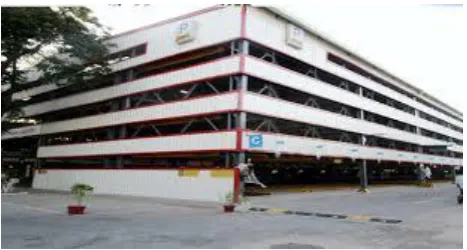
The same center set up multi-layer puzzle parking system in
[image:2.595.45.279.290.415.2]another branch at Gandhipuram [2].
Figure 2 multi-layer puzzle parking system
A multi-specialty hospital by name G.kupuswamy memorial
hospital has established a multilevel puzzle parking in its
facility [3].
Figure 3 multilevel puzzle parking
The above said are the innovations in parking technologies, that are aimed at accommodating more number of vehicles at a given time and space. This innovation does not provide the vehicle owner/driver with the slot availability beforehand, unless he/she arrives at the parking grounds. If the slot is not available at the time of user arrival, the user has to go searching around for another parking area. Despite innovations in parking technologies,
the parking method in the city remains the same centuries old humongous task. Parking in the city has always been at the moment affair in Coimbatore. Having a modest parking system for an unplanned city like ours would be impossible rather our model will be an apt and smart solution which integrates all the available parking slots without waiting for any future developments and enhancement by the Government.
Proposed Solution
System Architecture
Cloud and internet of things technologies have become a common place in all walks of life. Connecting everything and everyone, these advancements are making life smarter with every fleeting moment .our study offers an end-to-end cloud based parking solution powered by internet of things that enhances smart living Smart parking relates to an automated mechanism that helps the vehicle owners/drivers to locate and navigate to optimal parking slots bestowing to their accessibility. By integrating the right sensors, the real-time data regarding slot availability from various registered parking areas are transferred to dedicated application available to users, thus bringing about connectivity among already deployed parking areas in the locality. The application allows users to monitor slot availability, manage decisions and book slots in advance by automating payment through wallet system. This study provides the vehicle drivers/owners an ultimate solution on their drive from the beginning to end without searching for parking, cost, travel time etc. The [figure-] illustrates the system architecture.
Figure 4 Hardware setup
System components
Occupancy Sensors
[image:2.595.310.555.474.619.2] [image:2.595.41.282.495.641.2]© 2018, IRJET | Impact Factor value: 6.171 | ISO 9001:2008 Certified Journal | Page 3561
[image:3.595.52.272.135.186.2]retrieval from the slot. The sensor status is updated in the gateway device. The detection accuracy and the minimum number of false positives is a must.
Figure 5 occupancy sensor
Raspberry pi 3 model B
[image:3.595.315.546.264.365.2]The Raspberry pi 3 model B serves as the control unit for the on field hardware. The module is connected with the cloud server to update data of the local car park in the cloud server database. It encompasses a quad core 64-bit ARM cortex, A53 clocked at 1.2 GHz, 1GB of LPDDR2-900 SDRAM, and the Video core 1v GPU. Besides these, the model now includes on-board 802.11n Wi-Fi and the Bluetooth 4.0.Wi-Fi, wireless keyboards and the wireless mice can now work out of the board.
Figure 6 Raspberry pi 3 model B
Gateway Hardware
Changes in the availability of parking slots will be reflected through a status change of the sensors – and that, in turn, will be collected in a gateway. Unlike the sensors which will be operational only when the status changes, gateways need to be up and running throughout the day. The data collected in the gateway are then sent on to the centralized server. The gateway relies on wireless technology to transmit the sensor status to the server. A single gateway can be used to collect the readings of multiple sensors.
Figure 7 gateway
Cloud/Server.
The server/cloud stands amid the gateway and the web based application. The server/cloud device will collect the
[image:3.595.42.278.368.427.2]status from multiple gateways. It will then compute which parking spaces are free and which are occupied. When a new user enters the parking lot, the server will communicate with the user’s application. The server will send the location of the parking area in order to guide the user. In this way the user will not have to drive around searching, but rather to a specified destination. The server in a smart parking setup needs to have 2-way communication protocol compatibility. . On the one hand, it has to receive the data from the gateways – to generate updated information about the free and occupied parking slots in any facility. On the other end, it sends real-time notifications to the dedicated web application for guidance to the parking area and the particular ‘vacant’ parking slot.
Figure 8 cloud/server
Web application
The final stop in the smart parking architecture is the web based application. The vehicle owners/drivers can use it to find reserve and navigate to the optimal parking slot. After booking, the bill timer starts upon user’s successful authenticated access into the parking area and the corresponding bill amount will be deducted from his account through e wallet system depending upon the sensor output upon vehicle retrieval. This will reduce the amount of time that users have to spend while trying to locate optimal slot.
Figure 9 bookmyslot
System Maneuver
Online Booking
[image:3.595.317.554.554.666.2] [image:3.595.39.275.621.679.2]© 2018, IRJET | Impact Factor value: 6.171 | ISO 9001:2008 Certified Journal | Page 3562
the user is to enter the vehicle details and then can go ahead with the booking. Initially, the user has to specify the booking date, upon doing which he will have to specify his desired location. The optimum parking areas nearer to the entered location will be displayed along with its satellite position, slot availability, and the distance from the entered location. On the user’s selection of convenient parking area, slot page of the corresponding parking will be displayed for booking. After choosing the optimal slot, the user will be asked for time of booking. A minimal amount is to be maintained in the wallet, in case not, further proceedings will be carried out after satisfying the condition. Once booked, a QR code will be generated which after being successfully scanned at the entry gate will help keep track of the bill for the parking time.
Graph 1 online flowchart
On Field Booking
There are two cases of vehicle owners/drivers approaching the parking area.one type of users come under advance booking, who have already registered their slot prior to the arrival at the parking grounds. Such users have to scan their corresponding QR codes generated upon slot booking at the automatic entry toll gate along with entering their vehicle number. Upon successful authentication, the bill timer will start running and the vehicle is granted access in to the parking area. Once the vehicle is parked in the booked slot, the slot sensors will update its engaged value to the site. On vehicle retrieval, the sensor values will again be updated to empty the slot. By scanning the QR code again at the exit gate the bill timer will stop and the accounted amount will be deduced from his/her e-wallet
Users who arrive directly at the slot without prior booking can make use of the display placed at the automatic toll entrance. The vehicle owner/driver can choose the convenient slot from the touch display at the gate along with specifying his vehicle and phone number. QR code will be generated following user entry. Upon scanning the code at
the automatic entry toll gate, the bill timer starts running and the vehicle is granted entry. Once the vehicle is parked, the sensors output will disable the slot on the site for other users. On vehicle retrieval, the change in sensor values will be updated at the site, thereby making it available for other users. On scanning the QR code at gate, the timer stops and the bill can be paid through card at the exit toll gate.
Graph 2 offline flow chart
Implementation
Software system
© 2018, IRJET | Impact Factor value: 6.171 | ISO 9001:2008 Certified Journal | Page 3563
[image:5.595.307.561.114.257.2]Initially the user is either required to sign in or sign up. The first time user has to sign up in order to access the website. The sign up page is shown in the figure [10].
Figure 10 sign up page
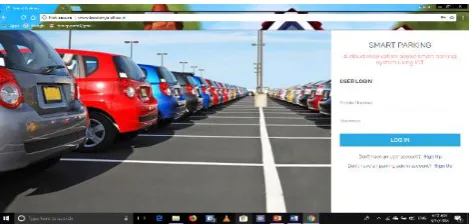
The user with an account can simply login by entering the credentials as illustrated in the figure [9].
[image:5.595.44.279.126.249.2]Once the user has signed in, he is directed to his login page as in figure [9]. The login page of the user shows his dashboard displaying his wallet information, and a menu as in figure [11].he/she can recharge his/her wallet using recharge option. A minimum amount is to be ensured in the wallet.
Figure 11 dashboard page
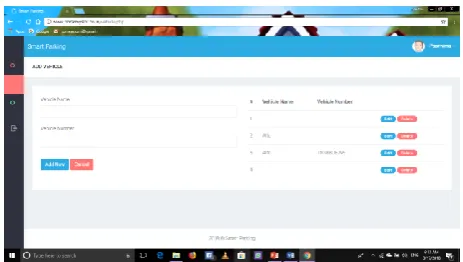
The menu has three options namely vehicle, booking and logout. The vehicle option is useful for multiple vehicle holders. A user can add or delete his vehicle information under the vehicle option as illustrated in figure [12].
Figure 12 vehicle add page
[image:5.595.307.562.338.482.2]The figure [13] displays the booking page, where the user has to specify the date and desired location.
Figure 13 booking page
[image:5.595.40.285.396.518.2]The “get my parking button” showcases the nearest parking areas with their, satellite position, slot availability and their distance from the user location as in figure [14].
Figure 14 location
As displayed in figure [15], the user is directed to the slot page, where he/she can reserve his slot through automated billing proposed by wallet system.
Figure 15 slot page
[image:5.595.308.562.561.708.2] [image:5.595.45.277.608.739.2]© 2018, IRJET | Impact Factor value: 6.171 | ISO 9001:2008 Certified Journal | Page 3564
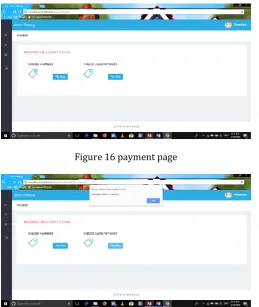
[image:6.595.35.295.113.421.2]recharge as in figure[16]. Once the slot is booked online the data is updated in the hardware setup as in figure [].
[image:6.595.308.562.127.270.2]Figure 16 payment page
Figure 17 payment successful page
Hardware system
[image:6.595.306.562.298.464.2]The prototype design exhibits three different parking areas consiting of four slots each.For demonstration purpose,two slots out of four will be provided with one LED each and one out of four slots will be fitted with two Infrared(IR) sensors as shown in the figure[18]
Figure 18 hardware
For acurate vehicle detection,Out of the two IR sensors, one will is mounted horizontally and the other vertically as shown in the figure[18],with an approprite distance between
them. The reading of both the sensors at the 10th second
after vehicle arrival is accounted for accurate vehicle decision.
The LED fixed in the slots glow when slot is engaged and the color of slot in booking page changes on parking vehicle as shown in figure[19].
Figure 19 booked slot page
Figure 20 hardware setup
Constraints And Future Work
Mobile application
Currently a web based application has been developed. A multi-platform mobile application is in the scope of development.
Structured Real time implementation
The broad idea of the proposal has been put into a prototype model. Given more time, the project will be engaged real time with a novel architecture.
GPS and map integration
[image:6.595.35.277.555.685.2]© 2018, IRJET | Impact Factor value: 6.171 | ISO 9001:2008 Certified Journal | Page 3565 All vehicle types and parking types
The prototype is designed for parallel parking of cars. With more time, our system will accommodate all vehicle and parking types.
On street parking
Our project at present concerns the off street parking. With strict road side ground rules from government, it can also be extended to cover on-street parking.
Smart lightings
Usually the parking area remains illuminated throughout the dark. With motion sensors, only the path ahead of vehicle and engaged slots will be brightened whereas the rest of the lot will be dimmed out.
Coverage area
Coimbatore city is the main concern as of now. Further the project can be extended to similar other cities.
Battery based sensors
The prototype version uses wired sensor at nodes, but in real time wiring a large number of sensors is out of question. Hence battery powered sensors will be
implemented.
Conclusion
Just few miles away from the smart city mission, the scope of unplanned parking for accommodating the congestion due to growing vehicle population has become uncertain. A cloud based end-to-end smart parking solution powered by IOT(Internet Of Things) is where the technology, economy, and the user experience come together to create a more smarter living with sustainable communities, which is the need of the hour. Such solution warrants improved traffic flow, less congestion, better mobility and living conditions. Added efficiency to traffic monitoring and improved panning will return on investment and savings. It also helps improve revenue by providing the real time visibility into the availability of optimal parking spaces across the city. Thus the idea of smart parking solution will be one another feather in the crown.
Acknowledgment
With deepest gratitude and warmest affection, we dedicate our work to our parents, the reason for what we are today.
We would like to express our greatest gratitude to Mr.Rajashekar for his constant source of knowledge and unwavering support through every step of this project.
We would also like to extend our thanks to Assistant Professor Finney Daniel for his collegial guidance and mentorship over the years.
References
[1]
http://www.orfonline.org/research/sustaining-urban- growth-through-ecological-restoration-the-case-of-coimbatore/
[2] https://en.wikipedia.org/wiki/Coimbatore
[3] http://www.thehindu.com/news/cities/Coimbatore/coi
mbatore-tops-list-of-nonmetro-cities-in-road-fatalities/article7577536.ece
[4]
http://www.parking-net.com/parking-news/skyline-parking-ag/traffic-congestion
[5] https://timesofindia.indiatimes.com/city/coimbatore/p
aid-parking-to-become-reality-in-city/articleshow/62610751.cms
[6] http://www.thehindu.com/news/cities/Coimbatore/Un
bridled-traffic-chokes-Kalapatti-Road/article14426668.ece
[7] Thanh Nam Pham,Ming-Fong Tsain,Duc
Binhnyugen,Chyi-Ren Dow,And Der-Jiunn Deng,”A Cloud Based Smart Parking System Based On Internet Of Thing Technologies,” Vol.3, Pp. 1581-1591, July 2015.
[8] T. Subramani And J. Jayalakshmi,” Study On Existing
Parking Condition On Major Roads In Salem And Suggestions For Improvement,” Apr. 2012, Vol. 2(4), Pp: 704-710.
[9] R.Renuka And S. Dhanalakshmi,” Android Based Smart
Parking System Using Slot Allocation & Reservations,” Vol. 10, No. 7, April 2015.
[10] Satish, V. Reve and Sonal Choudhri. 2012.‘Management