© 2017, IRJET | Impact Factor value: 5.181 | ISO 9001:2008 Certified Journal | Page 1164
OFFLINE COMMUNIATION USING EMBEDDED LINUX
Mars Esther
1, Naadhiya Begum.A.R
2, Sivakaami.P
3, Sowmiya.B
4, Mrs.Ramani.M
5Bachelor of Technology, Department of Electronics and Communication Engineering,
[1],[2],[3],[4]Assistant Professor, Department of Electronics and Communication Engineering,
[5]Sri Manakula Vinayagar Engineering College, Puducherry.
---***---Abstract - Audio-visual communication in a real timecontributes better communication to the users. Video conferencing may be a solution to saving both time and money because video conferencing may be a more effective way of communicating to clients and customers. Integrated Network Systems can support video conferencing that will allow you to share real time happenings and meet people face to face. In the last few years, research is being done for real time transmission of audio and video. This paper presents detailed study of audio, video and text transmission through various channels in real time. Most popular is using wireless LAN or Wi-Fi. Here Ethernet connection is used for forming a network. Existing systems cannot have video conferencing when offline. Videoconferencing is the way of a video streaming by a set of telecommunication technologies which will allow two or more locations to communicate by simultaneous two-way video and audio transmissions. Raspberry Pi 3 is used as main source for establishing video conferencing and text chatting for the users present in the same campus without the use of internet. The network can be extended if required. Since Raspberry Pi 3 supports wireless connections also, devices can also be connected through Wi-Fi. But here only a wired model is discussed.
Key Words: Real time transmission, Raspberry pi 3, LAN, Wi-Fi
1. INTRODUCTION
Communication which enables transfer of data between two terminals without the use of internet is called as Offline Communication. Here communication is done in a wired network. The network in offline communication interconnects computers within a limited area such as residence school, laboratory, office building, etc. It can connect only offers limited number of users. This offline communication network is extremely rivat and secure, since existence of the network itself is unknown to the people outside the network. Ethernet over twisted pair and Wi-Fi are the two most common transmission technologies used in offline communication. People in early times used LAN cabling which had various grades of coaxial cabling. Simple LAN consists of cabling and one or more switches. The software design of the Linux kernel is very well suited to embedded systems. It can be configured to provide only required functions, making it very suitable for devices with limited memory and storage resources. Operating systems
that are based on the Linux kernel are used in various applications of embedded systems such as consumer electronics. The Raspberry Pi 3 microcontroller board is connected into a computer monitor, uses a standard keyboard and mouse. It is a capable device that enables people of all ages to explore computing, and to learn how to program in languages like Python. Graphical Processing Unit(GPU) is very important to make the video conferencing possible which is not available in any ordinary processors other than Raspberry Pi. It has RISC-based computer design approach, that is ARM based processors that needs significantly fewer transistors than typical processors. This approach reduces the costs, heat and power use. These are the suitable condition for light, portable battery-powered devices which are mobile phones, laptops, tablet and computers, and other embedded systems devices. An efficient multi-core CPU’s needs to be efficient and simpler in design.
2. RELATED WORKS
Honghai Liu et al [1], has proposed an intelligent video systems (IVS) and Intelligent Video analytics (IVA) scheme in which a person will monitor between two video screens. It is video surveillance systems that can process manipulate and perform actions, automatically without human intervention. Intelligent video systems and services uses the hardware system integration, management, and video processing to provide service to the end users. IVS embeds computer vision technologies into video devices such as cameras, encoders, routers, digital video recorders (DVRs), network video recorders (NVRs), and other video management and storage devices IVS requires processing in either embedded cameras or central servers but embedded cameras have limited processing power, memory and bandwidth.
© 2017, IRJET | Impact Factor value: 5.181 | ISO 9001:2008 Certified Journal | Page 1165 processor in Open CV platform using python as its
programming language. Python coding channelizes the image compression algorithm with Raspberry Pi Processor. Open CV provides modules for programming of algorithm. JPEG standard helps in preserving large number of images with good quality and high compression ratio. There is restriction using this method because compression of data needs a lot of CPU power and hence limits implementing this technique in raspberry pi.
Rhythm Haji et al [3], discussed about web surveillance using raspberry pi. The system consists of RaspiCam, USB Modem and Ethernet connections. Raspberry pi is used to make the price of networked motion sensitive video surveillance cheaper. The web camera is connected as external device to the microcontroller which keeps on recording of the host place and saves it into the computer. When the concerned people in control room, wants to know what is happening in the host section, they log into the host section computer via internet on their own HTML page, and view all information of the field section videos on their PC. Users in the network are identified using IP addresses. Transmission of video takes place via the Internet, thus there is no restriction on the number of users.
Sunil Kanzariya et al [4], provides an embedded real time video monitoring system based on ARM processors. The embedded web streaming server is based on Linux
Operating system. The Raspberry pi chip is used as the
microprocessor in the system. Video data can be captured using USB camera or Raspberry pi camera, compressed into MPEG format. Then the compressed data can be transferred to the 3G network with the help of ARM11 chip and then the client will receive the compressed data frame to restructure and recompose the video images. In order to increase the mobility, wireless medium such as Wi-Fi is used for transmitting video data. MPEG-2 standard is used for the generic coding of moving pictures and associated audio information. It describes a combination of data loss in both video compression and audio data compression methods, which permit the storage and transmission of high memeory data using currently available storage media and transmission bandwidth. A system for video monitoring is implemented but there is no encryption or decryption method for security.
Aditi Shrikanth Jadhav et al [5], proposed embedded video streaming using Raspberry Pi in a real time communication. High-performance S3C6410 chip is used as the microprocessor. Video data is captured from a USB camera, compressed into MPEG format. Video data obtained from the web cam transport (USB) webcam. The live video can be seen by dialling-in the IP address into a web program. Picture resolution on the remote screen by raspberry pi is 60x720 (0.7 is processed by the raspberry pi. The live video can be seen by dialling-in the IP address into a web program. After fetching of IP address of devices video streaming takes
place. This framework, proposed Raspberry Pi Model B associated with a Logitech C300, all inclusive serial megapixels). There are numerous problems in the video framework like the picture is not defined properly. The peculiarities can't be identified naturally and a storage rooms are expected to store the observation data due to the number of problems present in the framework that may cause defect in the picture.
3. PROPOSED WORK
The proposed work involves offline communication between two terminals without the use of Internet using Embedded Linux and Raspberry Pi 3. This system allows the transmission of data (video, audio and text) simultaneously with the appropriate configuration and JAVA programming. It provides real time environment for communication purpose. It creates a private LAN network in which all the users are connected through routers. Each and every user acts both as server and client. The proposed offline communication system consists of three modules. First module deals with video transmission, Second module deals about text transmission and third one deal with audio transmission. Fig 1 shows the block diagram of proposed system with the standard input and output devices having modem as a wifi source.
3.1 Video Conferencing
This module gives the implementation methodology of simultaneous transmission of video between two terminals in a network using motion software and V4L2 codec. The two terminals are connected through the router which acts as a gateway for all the systems connected in the network. This module works under UDP protocol which simultaneously sends the data packets. When the data packets are missed or lost, no acknowledgement is sent, this provides smooth flow of data.
3.1.1 Motion Software:
[image:2.595.311.546.420.520.2]The video signal can be monitored by motion software; in other words it can detect the motion. Motion is a command line base tool whose output can be either jpeg, ppm files or mpeg video sequences. Motion is strictly
Fig -1: Block diagram of proposed system
PC
Web
cam
Keyboard
R-Pi
MODEM
R-Pi
© 2017, IRJET | Impact Factor value: 5.181 | ISO 9001:2008 Certified Journal | Page 1166 command line driven and can run as a daemon. Motion is a
perfect tool for video surveillance.
3.1.2 Installation and Implementation
Open the terminal on the Pi
Update the Raspberry Pi to run the latest version sudo apt-get update
sudo apt-get upgrade
In order to remove the libraries that may conflict with the newer package, use the following command which is given below to remove the unwanted library function affecting new packet data is,
sudo apt-get remove libavcodec-etra-56 libavformat56 libavresample2 libavutil54
Install the following packages, towards which the motion software relies on
wgethttps://github.com/Motion-
Project/motion/releases/download/release-4.0.1/pi_jessie_motion_4.0.1-1_armhf.deb sudo dpkg –I pi_jessie_motion_4.0.1- 1_armhf.deb
For editing the configuration file
sudo nano /etc/motion/motion.conf
To set up the daemon, edit the motion file sudo nano /etc/default/motion
Change the line in motion file as given below start_motion_daemon=yes
Save and exit by pressing ctrl+x then y
The webcam is connected to one of the 4 USB ports.
Run the following command after connecting the camera
sudo service motion start
In order to stop the motion transmission the following command is used
sudo service motion stop
Live capturing can be made possible by giving the IP address of the user with whom you are going to communicate. In order to find the IP address of the Pi, ifconfig command is used.
Enter the IP address in the browser of the Pi.
If the web page isn’t loading then try restarting the service by using the following command
sudo service motion restart
All the above steps must be carried out in each and every system used in the communication network.
The simultaneous video can be viewed either by opening in the browser window or VLC player with the help of the appropriate user’s IP address.
3.2 Text Chatting
This module gives the implementation methodology of transmission of text between two terminals simultaneously without the use of Internet. It provides live chat between the users within the network. All the users in this network are connected to the router. Each and every user can act both as client and server. Every user system has both the server and the client Java program. If the user decides to be the server then that user should run the server program and he/she can also be the client by the client program. If one user acts as a server then the other user will eventually become the client for that server. This module will work under TCP/IP protocol which uses rearranging process at the receiver end.
3.2.1 Implementation
Chat program in java is continuous communication between two systems. Java language is simple to develop applications that are difficult (requires extra practice and experience) in other language. This kind of communication involves knowledge of TCP/IP protocols. Chat communication is the process of exchanging messages between two system continuously. The systems in the network has a few responsibilitiesReading from keyboard. use any input stream like Buffer Reader connected to System.in
Sending data to the other system what is read from keyboard. Uses an output stream like ‘PrintWriter’ connected to ‘getOutputStream()’ method of socket. Receiving data from the other system. Uses an input stream Buffered reader connected to ‘getInputstream()’ method of socket.As the responsibilities are same for all the systems in the network, both client and server programs contains the same stream objects and same code. To come out of the chat type Ctrl+C.
The ‘flush()’ is the method of ‘PrintStream’ class which clears the unwanted memory. Generally when the streams are closed, the buffers are pushed out of all the data contained in. But, no stream is closed; so, using flush() method data should be explicitly removed. Both the client and server programs are using same streams and objects. The difference comes in while loop. Client send first and then receives whereas server first receives and then sends.
3.2.2 TCP protocol:
© 2017, IRJET | Impact Factor value: 5.181 | ISO 9001:2008 Certified Journal | Page 1167 similar computer networks. It is commonly known as TCP/IP
because the original protocols in the suite are Transmission Control Protocol and Internet Protocol. The internet protocol suite provides end to end data communication and also the way the data should be packetized, addressed, transmitted, routed and received. This functionality is structured into four abstraction layer which is used to type all related protocols of networking involved. From lowest to highest, the layers are link layer, containing communication methods for data that remains in a single network segment. The internet layer connects independent networks and providing internetworking. The transport layer handles host to host communication. The application layer offers the data exchange for applications.
[image:4.595.57.266.414.589.2]The Internet protocol suite is a simpler model developed prior to the OSI model. An implementation of this model should be conservative in its sending pattern and liberal in its receiving pattern. Software on the other hosts may contain deficiencies that make it unwise. The datagram should be able to handle this type of situations. Encapsulation is used to render abstraction of protocols and services. It is aligned with the division of protocol suite into layers including general functionality. The sending and receiving pattern can be implementataed using intenet protocol suite as it is similar model to OSI.
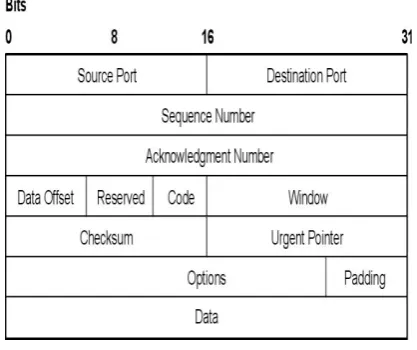
Fig -2: TCP header format
In general, a set of application is used to transmit the data down the layer and to perform encapsulation. The layers of the protocol suite are closer to the user application and those near the bottom are closer to the physical transmission of data. Viewing layers as rendering or consuming a service is a method of abstraction to separate the upper layer protocols from the transmitting bits over. The details of application and protocols has been neglected by lower layer.
Link layer:
This layer has the networking scope of the LAN connection to which a host is attached. It is the lowest
component layer of the TCP/IP. This layer is used to move packets between the internet layer interfaces of two different host on the same link. The process of transmission and reception of packets can be controlled both in the software and firmware. This is also a layer where a packet may be selected to be sent over a virtual private network or other networking tunnel.
Internet layer:
This layer has the responsibility of sending the packets across potentially multiple networks. Internetworking requires the transmission of data from the source to the destination network. This process is called routing. This is accomplished with hierarchical IP addressing system. Another function is packet routing, the task of sending packets of data from source to destination by forwarding them to the next network router closer to the final destination.
Transport layer:
This layer establishes basic data channels that applications use for task specific data exchange. This layer establishes process to process connectivity. Its responsibility includes end to end message transfer. It is independent error control, segmentation, flow control, congestion control and application addressing.
Application Layer:
This layer has the protocols used by most of the applications for rendering user services and also for exchanging application data over the network connections established by the lower level protocols. This may include some basic network support services. Examples for application layer protocols are Hyper Text Transfer Protocol (HTTP) and File Transfer Protocol (FTP). Application layer protocols are often related with specific client – server applications and common services.
3.3 Real Time Audio Transmission
This module gives the implementation of the transmission of audio simultaneously between two users without the use of Internet within the small area of LAN network. This enables the simultaneous transmission between the two users using UDP protocol, which sends the packets rapidly without expecting the acknowledgment in return. The audio transmission is done using Raspberry pi with the help of Audio Codec.
3.3.1 User Datagram Protocol (UDP)
© 2017, IRJET | Impact Factor value: 5.181 | ISO 9001:2008 Certified Journal | Page 1168 A simple connectionless transmission model with a
[image:5.595.44.237.202.284.2]minimum protocol mechanism has been used in UDP. If the network interfaces went through an error correction then, an application implement the Transmission Control Protocol (TCP) or Stream Control Transmission Protocol (SCTP) that are used for this purpose. Internetworking needs transmission of data between users.
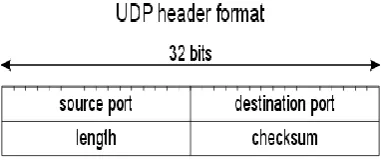
Fig -3: UDP header format
UDP is used for error checking and correction. It avoids the overhead of such processing at the level of the network interface. The application which are time sensitive often use UDP. The dropping of packet is the reason for delayed packets in a real-time system.
3.4 Audio Codec
An audio codec is device or computer program have the ability of coding and decoding a digital data information converted in the form of audio data. An audio codec is a computer software which is used to compresses and decompresses digital audio data that corresponds to a given audio file or streaming media audio coding format in case of software. The objective of the algorithm is to provide high quality in a minimum no f bits. This can effectively reduce the storage space and bandwidth required for transmission of the stored audio file. Most of the codecs are used as libraries that is connected to one or more multimedia players. The audio codec refers to a single device that encodes analog audio to digital signals and decodes digital back into analog in case of hardware. That is, it has both an analog-to-digital convertor (ADC) and digital-to-analog-convertor (DAC) dismiss the same clock. This is used in sound cards that support both audio in and out.
3.4.1 v4 l2 codec
Video 4 Linux 2 Codec can compress, decompress, transform, or otherwise convert video data to any other format. Typically such devices are memory-to-memory devices. A memory-to-memory video node performs just like a normal video node with the difference, it supports both output (transmitting the frames from memory to the hardware of the codec) and capture (receiving the processed frames from the codec hardware into memory) stream I/O. V4L2 Codec requires V4L2 interface to define encode/decode APIs. There is V4L2 input device as camera,
V4L2 output device for 2D rendering. When these two devices are combined together, data flows in and out; it becomes codec interface. V4L2 interface comes with Linux in nature, so V4L2 interface can be widely used. A V4L2 video effect images. For instance, video transitions or wipes. Applications transmit data to be processed and receive the final data either using the functions read () and write () or through the streaming I/O mechanism. The effect in images due to V4L2 can be prevented using appropriate linux operating system.
4. REVIEW ANALYSIS
After reviewing various methods implemented by various authors it is observed that several methods are used for the offline communication using the Embedded Linux. The present systems are used for offline communication process in a local area network without the use of Internet. This is reduces the cost and effort of forming video conferencing within a campus with high security reducing risk.
5. RESULTS
[image:5.595.308.576.416.555.2]The outputs of the simultaneous transmission of video, audio and text between two users using Embedded Linux with the help of Raspberry pi 3 are given below:
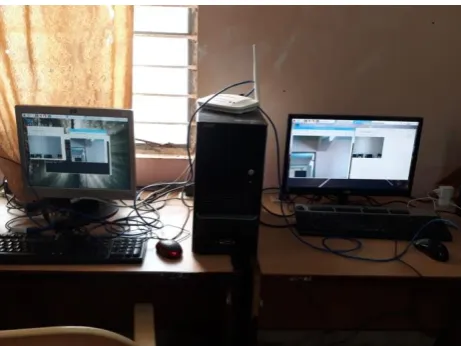
Fig -4: Raspberry Pi 3 connections
Fig.5 and 6 shows video conferencing between two users.
[image:5.595.309.545.606.732.2]© 2017, IRJET | Impact Factor value: 5.181 | ISO 9001:2008 Certified Journal | Page 1169 Fig -6: Video conferencing between two users
Fig.7 and 8 shows real time text transmission between two users.
Fig -7: Chatting window of server
Fig -8: Chatting window of client
6. CONCLUSION
In this project a simultaneous communication was established between two users in a wired network with the help of UDP, TCP/IP and DHCP protocols. With the help of this connection live video, audio and text transmission between two Raspberry Pi modules was successfully
achieved. The real time video is transmitted using “motion” software. Audio was transmitted using ALSA-Utils. The successful transmission of text was done using JAVA programming. Open source, freeware programs and OS were used to keep the cost of the project low.
The future scope of the project is to expand the network for a larger area. This can be done by adding ports to the routers or connecting using Wi-Fi technology. This advancement can make the network wide spread and the communication can be made over large number of users without the use of Internet.
7. REFERENCES
[1] Honghai liu, Shengyong Chen and Naoyuki Kubota.” Intelligent Video Systems and Analytics: a Survey”, IEEE Transactions on Industrial Informatics, vol. 24, no. 5, may 2013
[2] Sahitya S, Lokesha H, Sudha L K,” Real Time Application of Raspberry Pi in
Compression of Images”, IEEE Journal on Recent Trends in Electronics Information Communication Technology, vol.20, no.2, May 2016
[3] Rhythm Haji, Arjun Trivedi, Hitarth Mehta,” Implementation of Web- Surveillance using Raspberry Pi”, vol.3, no. 10, Oct2014
[4] Sunil Kanzariya and Vishal Vora,” Real Time Video Monitoring System Using Raspberry Pi”, National Conference on Emerging Trends in Computer, Electrical & Electronics, Oct 2015
[5] Aditi Shrikant Jadhav and Sudarshan R. Diwate,” Real Time Embedded Video Streaming Using Raspberry Pi”, International Journal of Innovative Research in Science, Engineering and Technology, vol. 5, no 11, Nov 2016
[6] Huu-Quoc Nguyen, Ton Thi Kim Loan, Bui Dinh Mao and Eui-Nam Huh, ” Low Cost Real-Time System Monitoring Using Raspberry Pi”, IEEE Journal on Computer Science Engineering, May 2015
[7] Bur Goode,” Voice Over Internet Protocol (VoIP)”, Proceedings of the IEEE, vol. 90, no. 9, Sep 2002
[8] Wenbo Zhai and Jian Wang,” An Application of VoIP Communication on Embedded System”, International Conference on Computer Application and System Modeling, Sep 2010
© 2017, IRJET | Impact Factor value: 5.181 | ISO 9001:2008 Certified Journal | Page 1170 [10] Rajeeb Lochan Dash and A. Ruhan Bevi,” Real-time
Transmission of Voice over 802.11 Wireless Networks Using Raspberry Pi”, International Journal of Engineering Development and Research, vol. 2, no. 1, April 2014
[11] Sanjana Prasad, P.Mahalakshmi, A.John Clement Sunder and R.Swathi,” Smart Surveillance Monitoring System Using Raspberry Pi and PIR Sensor”,International Journal of Computer Science and Information Technologies, Vol. 5 , no. 6 ,June 2014
[12] Nalini Bagal and Shivani Pandita,” Transmission of Audio Over Wireless Networks Using Raspberry Pi in Real-Time”, International Journal of Innovative Research in Science, Engineering and Technology, vol. 4, no. 9, Sep 2015
[13] Shikhar Arora, Karan Bhatia and Amit V,” Storage Optimization of Video Surveillance from CCTV Camera”, International Conference on Next Generation Computing Technologies, vol. 14, no. 16, Oct 2016