© 2017, IRJET | Impact Factor value: 5.181 | ISO 9001:2008 Certified Journal
| Page 207
Optimal Solution for Santa Fe Trail Ant Problem using MOEA
Framework
Parneet Aulakh
1, Sarvesh Chopra
21
Research Scholar, CT institute of engineering management and technology, Jalandhar,Punjab,India
2
Assistant Professor, CT institute of engineering management and technology, Jalandhar, India
Abstract :
Multi-objective optimization is also a significant topic for research from past few decades. This is because of the multi-objective nature of real world problems. Most of the real world problems are complex and versatile in nature, and quite often need more than one conflicting objective functions to be optimized simultaneously. Researchers have developed many multi-objective optimization procedures. Santa Fe Trail Ant Problem has been widely used to analyze experiment and examine various evolutionary computing methods and multi-objective optimization problems. In this, Santa Fe Trail Ant problem is solved in its best optimization valued solution using various techniques includes mainly Non-dominated Sorting Genetic Algorithm (NSGA II), Simulated Annealing and Scatter Search techniques. In previous work, Genetic Algorithm approach to solve these type of problems produce not much better results and difficult to solve as well. NSGA II algorithm has been implemented to optimize Santa Fe Trail Ant problem. Later we will enhance the algorithms using simulated annealing and scatter search techniques over the NSGA II algorithm to calculate new performance matrices and will be useful for comparative study as well.Keywords:Multi-objective optimization; NSGA II; Santa Fe Trail Ant problem; Simulated Annealing; Scatter Search
1.
INTRODUCTION
Optimization is the process of identifying the best solution among a set of alternatives .Whereas single objective optimization employs a single criterion for identifying the best solution among a set of alternatives, multi-objective optimization employs two or more criteria. The criteria used to compare solutions are known as objectives. As multiple objectives can conflict with one another i.e., improving one objective leads to the deterioration of another there is, generally speaking, no single optimal solution to multi-objective problems. Researchers have developed many multi-objective
optimization procedures. For multi-objective
optimization problems, there is not a single optimum solution, but a set of non-dominated optimal solutions called the Pareto set of solutions. The challenge is in the case of conflicting objectives, which is usually the case in
most real problems. Pareto optimality considers solutions to be superior or inferior to another solution only when it is superior in all objectives or inferior in all objectives, respectively. The Santa Fe Ant Problem is a conventional ideal problem that has been studied over the past two decades and is still being rigorously researched. Santa Fe Trail is well-known of its reputation of being hard due to evolutionary computing methods not solving it at much higher effectiveness than random search. NSGA II is an evolutionary algorithm in which the main advantage is that it handles multi-objective solution given in sets of solutions, which provide computation of an approximation of the entire Pareto front. The main problem with this algorithm is slow execution and on the contrary there is no guarantee for the solution as well. In terms of meta-heuristics, recently, scatter search techniques are getting more attention, because of their capability to efficiently explore a broad range of complex optimization problems. Hybrid algorithm can make good use of the characteristics of various algorithms to attain complementary advantages to optimize the algorithm’s performance and efficiency.
In this, Santa Fe Trail Ant problem is solved in its best optimization valued solution using various techniques includes mainly Non-dominated Sorting Genetic Algorithm (NSGA II), Simulated Annealing and Scatter Search techniques. In previous work, Genetic Algorithm techniques to solve such problems does not produce much better results and hard to solve as well. NSGA II algorithm has been implemented to optimize Santa Fe Trail Ant problem. Later we will enhance the algorithms using simulated annealing and scatter search techniques over the NSGA II algorithm to calculate new performance matrices and will be useful for comparative study as well.
2.
SANTA FE TRAIL ANT PROBLEM
© 2017, IRJET | Impact Factor value: 5.181 | ISO 9001:2008 Certified Journal
| Page 208
to search; being “jagged with many plateaus ruptured bydeep valleys and multiple local and global optima”. The structure of programs has been found “highly deceptive” by fixed length schema analysis [9]. The artificial ant problem is often used as genetic programming benchmark. Concisely the problem is to design a program which can successfully steer an artificial ant along a twisting trail on a 32*32 toroidal grid.Operations can be used in the program; move, right and left to make the ant move ahead one square, turn to the left and turn to the right. It takes one time unit to perform each of these operations. IfFoodAhead(),the sensing function peer into the square that the ant is presently facing and then depending upon whether that square contains food or its empty, it executes one of its two arguments. The artificial ant should follow the “Santa Fe Trail”, it contains 144 squares with 21 turns. It consists of 89 food units that are distributed non-uniformly. Whenever the ant enters a square which contains food, the ant eats that food located in square. The Santa Fe Ant problem is occasionally used as illustrative problem, mostly among the collection of other problems. Usually it is used to show the viability of meta-heuristics or new methods and it can be used as performance benchmark. Studies in grammatical evolution have used the problem to examine the effects of genotypic variety, crossover types, genome length, degeneracy, wrapping on proportions of invalid individuals and cumulative frequency of success. Fig-1 depicts the Santa Fe Trail.
Fig- 1: Santa Fe Trail Ant Problem
3.
MOEA FRAMEWORK
The Multi-objective Evolutionary Algorithm is an open-source java library that is used for experiment and developing MOEA’s and various other general purpose optimization algorithms. MOEA provides number of algorithms such as NSGA II, GDE3 and MOEA/D etc. The MOEA Framework also supply, that are required to rapidly develop, design, execute and statistically test optimization algorithms. During the past decade, a number of MOEA’s have been invented. The main reason for this is their capability to find multiple Pareto-optimal solutions in one single simulation run. As Evolutionary Algorithms service with a population of solutions, a basic evolutionary algorithm may be enhanced to sustain a distinctive set of solutions. With an insistence of going
towards the true Pareto-optimal region, it can be used to find multiple Pareto-optimal solutions in single run. First such successful and most used evolutionary algorithm is NSGA.
4.
SCATTER SEARCH
Scatter Search is an evolutionary technique which has been successfully applied to hard optimization problems. Unlike other evolutionary methods such as Genetic Algorithms, Scatter Search is invented on the state that organized designs and methods for generating new solutions. It utilizes strategies for various search diversification and intensification which have been proved efficient in various optimization problems. The Scatter Search strategy is very flexible, as its various elements can be implemented in various variety of methods and degrees of refinement. The fact in which the methods within the Scatter Search are not restricted to a single uniform design , permits the exploration of deliberate possibilities that may prove effective in a specific implementation.
Scatter Search includes five methods
A Diversification Method that is used to create a set of distinct trail solutions, as an input in which an arbitrary trail solution can be utilized.
An Improvement Method is used to convert trail solution into one or more improved trail solutions.
A Reference Set Update Method to create and maintain a reference set that contains the best solutions. According to their good quality and the diversity solutions get into reference set.
A Subset Generation Method is applied to the reference set, to generate a subset of its solutions, which is used as a base for generating combined Solutions.
Then Solution Combination Method is applied to produce the final solution.
5.
SIMULATED ANNEALING
© 2017, IRJET | Impact Factor value: 5.181 | ISO 9001:2008 Certified Journal
| Page 209
6.
THE PROPOSED HYBRID APPROACH
Simulated annealing can be used with NSGA II, where a probabilistic approach applied to making faster solution category with some sort of probability of solution optimality. Scatter search technique is applied to evolutionary algorithm of hard-optimization problems.it works on search space where different number of optimal solutions along with non-optimal solutions are scattered and algorithm works to search the optimality among the various solutions. NSGA II can be combined with scatter search and simulated annealing where scatter search creates an optimal solution space and out of that space simulated annealing can be applied to find probability. Santa Fe Trail Ant problem is solved using the NSGA-II algorithm of MOEA framework.. NSGA-II is the algorithm that is used for demonstrating genetic programming using the Santa Fe Trail Ant Problem. In Java, packages are used to organize source code into a hierarchical structure. It includes various java classes in the MOEA framework package to demonstrate the working of Santa Fe Trail problem using MOEA framework. Maximum number of moves used here is 500 and 89 food pallets are available for artificial ant in 32*32 toroidal grid.Santafeant.java class includes the main method that is used to run the Santa Fe Trail ant problem with NSGA II. Various classes are developed to perform distinguished tasks according to functions assigned. For example AntProblem.java class is used for controlling an ant through traversing through the world and maximizes the amount of food eaten. The ant should also minimize the number of steps required to do so. The World.java class includes the world that ant occupies the world is cyclic so an ant walking off the boundary on one side will appear on the boundary as the opposite side.
Fig- 2: Depicts the working methodology of Hybrid Approach.
6.1 Implementation of NSGA II on Santa Fe Trail
Ant problem.
First of all, a random parent population is generated .on the basis of non-domination, the generated population is sorted. Depending upon its non-domination level each solution is assigned a fitness or rank. Initially, to generate an offspring population of size N, the typical
binary tournament that includes Selection,
Recombination and Mutation operators are used. It is necessary to observe that even if we use a binary tournament selection operator, but the criteria of selection is now based on the Crowded-Comparison operator. As this operator needs both the crowded distance and the rank of each solution in population, so these quantities are calculated while generating the population.
6.2 Applying Scatter Search along with NSGA II
.To generate a huge set P of diverse solutions, Diversification Generation method is used. The size of P(PSize) is usually at least ten times larger than the size of RefSet. According to the Reference Set Update Method, the initial reference set is generated. It may include, selecting b distinct and maximally diverse solutions from P. The Reference set i.e RefSet, is a compilation of both diverse solutions and high quality solutions which are used to create new solutions by way of applying the Combination Method. This solution is adjoined to RefSet and deleted from P and the minimal distances are upgraded. The resulting RefSet includes b1, solutions of high quality and b2 diverse solutions. To apply the Solution Combination Method, the subsets are placed in a list and then these are selected one at a time in lexicographical order. Trail solutions obtained from these have been subjected to the Improvement method. Once again, the Reference Set method has been applied. After the execution of both the Combination Method and the Improvement Method , updation of Reference set takes place. The process ends after all the subsets created within the current iterations are subjected to the combination method and not any of the improved trail solutions are granted to RefSet under the constraints of the Reference Set Update Method.
6.3 Applying Simulated Annealing on Optimal
Solution Space generated by Scatter Search.
© 2017, IRJET | Impact Factor value: 5.181 | ISO 9001:2008 Certified Journal
| Page 210
7.
RESULTS AND DISCUSSIONS
We have evaluated the working of NSGA II on Santa Fe Trail ant problem using our proposed hybrid approach of scatter search and simulated annealing on MOEA framework using the parameters: Time Consumption, Optimality and Error Ratio. By comparing the existing and proposed approach, it can be concluded which technique is faster, optimized and has less error rate. These parameters are described below one by one.
Time Consumption.
The running time of an Evolutionary algorithm searching for an approximate set is defined as the number of iterations of the Evolutionary Algorithm loop until the population is an approximate set for the considered problem. This parameter allows us to measure the time taken by each approach to solve the given problem.
∑ )
Where m is the number of iterations and is time taken at each iteration to process each objective for each variable.
Table-1: Represents Data of Time Taken by previous and proposed approach
Fig-7.1:Graph represents the Time Comparison of both approaches.
From table 1 and figure 7.1 it is clearly shown that using proposed method it consumes less time to solve the Santa Fe Trail Ant problem as compared to the previous approach. In Hybrid Approach, time consumption becomes constant as the number of iterations increases and shows less deviation as compared to the previous approach.
Optimality
Optimality parameter depicts the optimization values for
each approach. Multi-objective optimization employs
two or more criteria for identifying the best solution among a set of alternatives. The criteria used to compare solutions are known as objectives.
∑
∑
⁄ ⁄
Where m is number of iterations and n is number of objectives taken.
Table- 2: Data representation of Optimal Values for Previous and Proposed approach
No. of Iterations Optimal values for
Previous Approach Optimal values for Hybrid Approach
10 11.29287 11.30825
20
11.15872 11.16793
30 11.18381 11.21809
40
11.11892 11.20132
50 11.10794 11.16843
60
11.10341 11.29272
70
11.17036 11.34821
80 11.11281 11.22236
90
11.15324 11.25628
100 11.07456 11.25884
No. of
Iterations Time taken by Previous Approach(ms) Time taken by Hybrid Approach(ms)
10 3859 2273.14
20 2725 2356.11
30 2611 2287.52
40 2297 2273.86
50 2626 2266.81
60 2584 2307.61
70 2360 2264.17
80 2610 2329.56
90 2625 2270.04
© 2017, IRJET | Impact Factor value: 5.181 | ISO 9001:2008 Certified Journal
| Page 211
Fig -7.2: It depicts the results of Optimal Values for Previous and Hybrid Approach
From Table 2 and figure 7.2 it is clear that hybrid approach produces more optimal results as compared to previous approach. Figure 7.2 shows that as the number of iterations increases optimality increases in Hybrid approach as compared to previous approach where optimality starts declining as number of iterations increases.
Error Ratio
Thisparameter measures the error ratio of each
approach. This parameter also allows us to know the non-convergence of the algorithm towards the pareto-optimal frontier.
∑
∑
⁄ ⁄
Where m is the number of iterations and n is the number of variable taken.
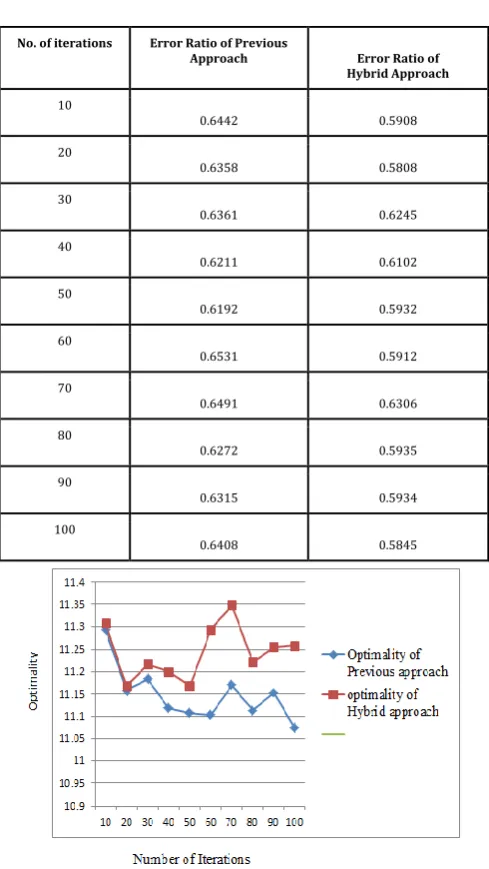
[image:5.595.317.526.237.360.2]Table-3: Data representation of Error Ratio values of Previous and Proposed Approach
Fig -7.3: Graphical representation of Error Ratio on both approaches.
From Table 3 and figure 7.3 it is clear that hybrid approach has less error ratio as compared to the previous approach. Error ratio decreases as number of iterations increases in hybrid approach as compared to the previous approach where error ratio keep on increasing.
It has been implemented and observed that proposed approach with three parameters Time Consumption, Optimality and Error Ratio has shown the better results as compared to the previous approach. The proposed methodology is far successful and enhanced and provides the better and accurate solution to solve the Santa Fe Trail Ant problem.
8 CONCLUSION
We have presented a hybrid approach based on scatter search and simulated annealing to solve the multi-objective optimization problems. Different parameters such as time consumption, optimality values and error rate were used to compare the performance of our approach with previous approach. The results show that our proposed approach is effective and competitive with previous developed approach and performs effectively better on these parameters.
In proposed Hybrid approach, it is depicted that with increase in number of iterations the optimality of results increases with very less deviation in time. The proposed
No. of iterations Error Ratio of Previous
Approach Error Ratio of
Hybrid Approach
10
0.6442 0.5908
20
0.6358 0.5808
30
0.6361 0.6245
40
0.6211 0.6102
50
0.6192 0.5932
60
0.6531 0.5912
70
0.6491 0.6306
80
0.6272 0.5935
90
0.6315 0.5934
100
© 2017, IRJET | Impact Factor value: 5.181 | ISO 9001:2008 Certified Journal
| Page 212
hybrid approach is more successful and provides lesserror rate as compared to the previous approach. On the basis of Time Consumption parameter, previous approach consumes more time and shows more deviation as the number of iterations increases as compared to hybrid approach and in previous approach optimality starts decreasing as number of iterations increases as compared to hybrid approach in which optimality increases as number of iterations increases. On the basis of error ratio, hybrid approach performs much better than previous approach.
The proposed methodology is far successful and enhanced and provides the better and accurate solution for solving Santa Fe Trail Ant Problem as compared to the previous methodology. It has been observed that in the proposed technique the optimality is enhanced, error ratio is decreased and time consumption is less to solve the given problem.
REFERENCES
[1]
Subodh Gupta and AnandJawdekar,”Performance Measurement on
Multi-Objective Optimization with its
Techniques”,International Journal of Database
Theory and
Application,vol.9,No.4(2016),pp(173-186),2016.
[2]
Dai Cai,Wang Yuping and Ye Miao,”a newmulti-objective particle swarm optimization algorithm based on decomposition”,Elsevier Information Science,2015.
[3]
M.Balasubbareddy, S.Sivanagaraju, Chintalapudi V.Suresh,”Multi-objective optimization in the presence of practical constraints using non-dominated sorting hybrid cuckoo searchalgorithm”,Engineering Science and
Technology,an International Journal,2015.
[4]
Tan Liu,Xianwen Gao, LinaWang,”Multi-objective optimization method using an improved NSGA II algorithm for oil-gas production process”,Elsevier Journal of the Taiwan Institute of Chemical Engineers,pp(1-12),2015.
[5]
Leonid Zamdborg,David M.Holloway etal,”Forced evolution in silico by artificial transposons and their genetic operators: The ant navigation problem”,Elsevier Information Sciences,pp(88-110),2015.
[6]
R.Venkata Rao,G.G Waghmare,”A Comparative study of a teaching-learning-based optimization algorithm on multi-objective unconstrained and constrained functions”,Journal of King SaudUniversity-Computer and Information
Sciences,(2014).
[7]
Wu Song, Yong Wang ,”Locating Multiple Optimal Solution Of Nonlinear Equation SystemsBased on Multi-objective Optimization”, IEEE transaction on Evolutionary Computation, pp(1-18),2014.
[8]
Xingyi Zhang,Ye Tian and Yaochu Jin,”An Efficient Approach to Non-dominated Sorting for Evolutionary Multi-objective Optimization”,IEEE Transactions on Evolutionary
Computation, 2014.
[9]
Ramadan A. Zein Eldin,”A Hybrid SS-SAApproach for Solving Multi-Objective
Optimization Problems” European Journal of Scientific Research, vol.121 No.3, pp(310-320), 2014.
[10]
Dominic Wilson and Devinder Kaur,”How SantaFe Ants Evolve”, Cornell University
International Conference , pp(92-103) 6 dec 2013.
[11]
Hideyuki Sugiiea and Takao Mizano,”Santa Fe Trail Problem solution using grammatical evolution”, 2012 Internal Conference onIndustrial and Intelligent
Information,vol:31,pp(36-40),2012.
[12]
Zuzana Oplatkova and Ivan Zelinka,”Santa Fe Trail for Artificial Ant with Simulating Annealing-Preliminary study”,IEEE first Asia International Conference on modelling and simulation,pp(1111-1130),2008.[13]
Steffen Christensen and FranzOppacher,”Solving the artificial ant on the Santa
Fe Trail problem in 20,696 fitness
evaluations”,GECCO ’07:Proceedings of the 9th
annual conference on Genetic and Evolutionary computation, vol:2, pp(1574-1579), 2007.
[14]
W.B. Langdon and R. Poli,”Why ants are hard” inproc. 3rd Annual Conference of genetic
programming, The University of Birmingham, pp(193-201), july 22-25, 1998.
[15]
M. Zamalloa, G. Bordel and L. Rodriguez, Penagarikano,” Feature Selection Based on Genetic Algorithms for Speaker Recognition”, Speaker and Language Recognition Workshop, IEEE Odyssey, (2006), pp(557–564). 2006.[16]
John Doucette and Malcolm I Heywood “noveltybased fitness:an evolution under the santafe trail”,13th European Conference,EuroGP 2010, Istanbul, Turkey, April 7-9, 2010,vol:,pp(50-61),2010.
[17]
Yong-Feng Dong, Jun HuaGu, Na Na Li, Xiang Dan Hou and Wei Liyan,”Combination of Genetic Algorithms and Ant algorithm for distribution network planning”, Proceedings of the Sixth International Conference on Machine Learningand Cybernetics,Hong
© 2017, IRJET | Impact Factor value: 5.181 | ISO 9001:2008 Certified Journal
| Page 213
[18]
M.Zamalloa, G.Bordel and L.Rodriguez,Penagarikano,”Feature Selection Based on Genetic Algorithms for Speaker Recognition”, Speaker and Language Recognition Workshop, IEEE Odyssey, (2006), pp(557–564). 2006.
[19]
G.Andal Jayalakshmi, S. Sathiamoorthy, andR. Rajaram, “A Hybrid Genetic Algorithm – A New Approach to Solve Traveling Salesman
Problem”, International Journal of
Computational Engineering Science, Vol:2, pp (339 – 355),2006.