Hydrol. Earth Syst. Sci., 19, 2945–2961, 2015 www.hydrol-earth-syst-sci.net/19/2945/2015/ doi:10.5194/hess-19-2945-2015
© Author(s) 2015. CC Attribution 3.0 License.
Projected changes in US rainfall erosivity
M. Biasutti and R. Seager
Lamont Doherty Earth Observatory, Columbia University, 61 Route 9W, Palisades, NY, USA
Correspondence to: M. Biasutti ([email protected])
Received: 15 December 2014 – Published in Hydrol. Earth Syst. Sci. Discuss.: 02 February 2015 Accepted: 19 May 2015 – Published: 26 June 2015
Abstract. Downscaled rainfall projections from 21 climate models from the CMIP5 (Coupled Model Intercomparison Project Phase 5) archive are used to estimate future changes in rainfall erosivity in the continental Unites States. To es-timate erosivity from rainfall in the absence of sub-hourly data, we have used both daily rainfall values and the modified Fournier index – which is based on monthly rainfall accumu-lation – and derived the scaling reaccumu-lationship between rainfall and erosivity from observational estimates of both.
The expectation of overall increase in erosivity is con-firmed by these calculations, but a quantitative assessment is marred by large uncertainties. Specifically, the uncertainty in the method of estimation of erosivity is more consequential than that deriving from the spread in climate simulations and leads to changes of uncertain sign in parts of the southwest and Texas.
We suggest that progress can be made by establishing a more reliable functional relationship between daily rainfall and erosivity.
1 Introduction
Soil erosion has significant consequences for the productiv-ity of land and the health of the riverine systems that receive the erosion materials. In an eroded soil, nutrients are lost, the effective root depth decreases, and runoff increases. In rivers, suspended sediments increase turbidity and transport pollutants, reducing the health of algae and fish and degrad-ing the quality of drinkdegrad-ing water, while excess sediments af-fect spawning fish, lower reservoir storage, and interfere with navigation. Erosion by water already causes about 55 % of total global erosion (Bridges and Oldeman, 1999) threaten-ing sustainability and the productive capacity of agriculture (Yang et al., 2003) A knowledgeable forecast of how
ero-sion will change in the coming decades is thus necessary to plan for land stewardship and ecosystem preservation and it is made more urgent and complex by the general expecta-tion that increases in rainfall intensity under global warm-ing (Trenberth et al., 2003) will exacerbate erosion. There is widespread agreement (Soil and Water Conservation Soci-ety, 2003) on an increased risk of soil erosion under climate change, but the potential damage needs to be assessed against other drivers such as land cover (e.g., Nearing et al., 2005) and with better understanding of the uncertainty due to cli-mate scenarios, spread in the clicli-mate projections, and meth-ods of translating large-scale climate anomalies into forcings for erosion models (e.g., Mullan et al., 2012; Zhang, 2007; Zhang et al., 2011).
While climate, vegetation, and soils can all be coupled in complex ways (for example, excessive heat and drought can kill the vegetation cover and induce more soil loss, even if rainfall erosivity declines; see Nearing et al., 2004), we can start to address the role of climate change on soil erosion by first isolating the changes in the erosivity of rainfall while setting aside the impacts of changes in vegetation, soil com-position and topography, land use and management. That is, while we address changes in the direct climatic driver of ero-sion, namely erosive rainfall, future changes in erosion will depend on local susceptibility and thus on geography, land use and management, and the health of the vegetation cover. Addressing erosion changes is beyond the scope of this work. The erosivity factorRis defined as the mean annual sum of erosivity from individual storms with effective rainfall1, i.e., rainfall greater than 0.5 in. (about 12 mm). In turn storm ero-sivity is computed (Angel et al., 2005) as the product of the rainstorm energy (E, an empirically derived function of in-tensity and depth of rainfall) and the maximum 30 min rain-fall intensity for the storm (I30):
R=XEI30. (1)
The unit land plot in the USLE erosion calculation is as-sumed to be only about 20 m in length; accordingly, the for-mula for erosivity assumes that point-wise measurements of rainfall, i.e., rain gauge data, are used. The requirement that we know the maximum 30 min rainfall intensity adds the need for continuous (or at least very high frequency) mea-surements. These are stringent requirements that have made the calculation of erosivity a difficult task even in data-rich regions such as the continental US (Angel et al., 2005). In response, many approximations to the original formula have been developed in the literature. Typically, point-wise erosiv-ity calculated from the original definition is used to derive an approximate formula that uses temporally averaged rainfall data (from 30 min, to annual averages), and the approxima-tion is used for locaapproxima-tions with sparser data. A field of erosiv-ity values is then extrapolated from the available data points using other physical variables as added predictors (e.g., to-pography, annual mean rainfall, average rainfall intensity, or more derived quantities such as the modified Fournier index and the burst factor that will be introduced below).
The erosivity map for the continental United States that is in use at the Environmental Protection Agency was con-structed in such a way (Hollinger et al., 2002; Daly and Tay-lor, 2002; Angel et al., 2005). Annual erosivity could be obtained from the original formula for 1505 stations with 15 min resolution. When aggregated via a cluster analysis into nine climatic regions, this erosivity data set was used as the basis for the storm characteristics and erosivity trends as-sessment published by Palecki et al. (2005) and Angel et al. (2005). Nevertheless, missing data and inhomogeneities in the length of record made the original R-values unfit as the
1Snow is not considered an erosive event.
basis of a continental erosivity map. Instead, they were used to statistically determine an approximation for erosivity that used only daily data. The full daily precipitation time series in stations collocated or nearby the high-frequency gauges were then used to create consistent and complete time se-ries of annual erosivity for the period 1971–2000. Finally, the PRISM spatial distribution method of Daly and Tay-lor (2002) was used to draw a complete erosivity map: the method combines the available point values for estimated R with the gridded mean annual precipitation at 2.5 arcmin (4 km) resolution, under the assumption that additional in-formation on the spatial field structure ofR can be inferred from the spatial structure ofP. As explained below, the ero-sivity map thus produced is used in this study to build our model-based estimate of erosivity and erosivity changes.
Long and complete daily-resolved rainfall time series are still not too common, and many approximate estimates of erosivity that use rainfall records at much coarser tempo-ral resolution have been pursued. Among the indices that use monthly-averaged rainfall data, we focus on the modi-fied Fournier index, F, introduced by Fournier (1960) and Arnoldus (1980) as
F =
12 P
j=1
Pj2
12 P
j=1
Pj
, (2)
wherePjis the monthly rainfall depth for the calendar month
j. In this formulation, a month of intense rainfall is seen to create more erosion than the same rainfall spread over a longer time. Quantitatively, though, the link betweenF and erosivity is not well constrained by observations. Renard and Freimund (1994) proposed a power law for the continental US, but noticed that a quadratic formulation was a better fit for high F values; moreover, more recent estimates of the power-law exponent for the same region but using dif-ferent data have found difdif-ferent values (USDA Agricultural Research Service, 2013). Outside the US, other formulations altogether have also been proposed (see for example Table 3 in Schönbrodt-Stitt et al., 2013).
Although less used for the US, we also present results us-ing the burst factor (Smithen and Schulze, 1982), as it pro-vides the example of an index that gives more weight to the most intense, and erosive, events. This index, alongside monthly rainfall accumulation, takes as input the maximum daily rainfall for the month. In our formulation, it is calcu-lated as
B=
12 P
j=1
MjPje
12 P
j=1
Pj
M. Biasutti and R. Seager: Erosivity projections 2947
whereMj is the maximum daily rainfall in monthj andPje
approximates the effective rainfall as the sum of all daily rainfall with accumulation larger than 12 mm.
The same requirements that make estimating erosivity from observations a complex task make it impossible when using climate models. Even the models with the finest res-olution compute values for rainfall that are meant to repre-sent averages over hundreds of square kilometers. Moreover, even though models use time steps that are less than 30 min, practical storage limitations restrict the temporal resolution archived to 3-hourly at the finest and, more commonly, 6-hourly or daily. Indeed, the volume of data involved in look-ing at decades of climate simulated by dozens of climate models makes even daily data a challenge to work with. How can we then gain an estimate of the projected changes in ero-sivity and potential soil loss for the US?
Some past studies have circumvented these restrictions by applying idealized changes in precipitation amounts and in-tensity (Dabney et al., 2012, for example), thus providing re-sults more akin to a sensitivity assessment than a full projec-tion (see also Pruski and Nearing, 2002). Others have looked at changes in F, as estimated from monthly mean precip-itation changes in a handful of GCMs (global circulation models) (Nearing et al., 2004; Segura et al., 2014), and used the published relationship between R andF to deduce the change in erosivity. Others (e.g., Zhang et al., 2012) have temporally downscaled the GCM monthly output (by linking monthly rainfall totals to the transition probability between dry and wet days and using a weather generator to create daily time series) and used the downscaled precipitation in an erosion model to directly provide estimates of runoff and soil loss.
In contrast to the above studies, this study uses the daily rainfall output from 21 CMIP5 (Coupled Model Intercom-parison Project Phase 5; Taylor et al., 2012) models, bias-corrected and downscaled to 1/8◦ resolution (the BCCDA data set Maurer et al., 2007, 2014), to estimate changes in erosivity in the continental US under the RCP8.5 (representa-tive concentration pathway) emission scenario. Our approach is to duplicate for the models what the literature has done to estimateRwhere observations of high-frequency rainfall were inadequate. Namely, we estimate the parameters of a statistical relationship between erosivity and daily precipita-tion from the available data, i.e., from observaprecipita-tions of the 1980–2000 period, and we then use the same relationship to relate the GCMs’ future projections of daily and monthly rainfall to future projections of erosivity changes. Regret-tably, the erosivity data available to us is limited to the clima-tological values; we do not have access to the full time series of erosivity. Ideally, we would estimate the relationship be-tween daily rainfall and erosivity over a subset of the full time series, and use the remaining independent data to vali-date our results. We acknowledge that a lack of independent validation is a serious drawback. Thus, to overcome this lim-itation, we also estimate change in erosivity using the F and
BF predictors as established in the literature, and we present the full range of uncertainty in our estimates.
The details of the methods used are summarized in Sect. 2. Changes in the characteristics of rainfall and in other pre-dictors for erosivity are presented in Sect. 3.1, followed by changes in erosivity itself, estimated by different methods, in Sect. 3.2. Section 4 summarizes and discusses the remaining challenges.
2 Data and methods 2.1 Overview
This study uses observed rainfall (daily time series for 1980– 2000) and erosivity (mean for 1971–2000) from the PRISM group (Daly and Taylor, 2002) on a 1/24◦grid (about 4 km). The rainfall data set has been extensively documented and used (see Daly et al., 2002, 2008, which have more than a thousand combined citations), while the erosivity data set has been only partially described in the peer-reviewed literature and was obtained courtesy of C. Daly (Oregon State Univer-sity). The station-based calculations of storm characteristics and erosivity on which the map is based are described by An-gel et al. (2005) and Palecki et al. (2005) as well as in a more detailed report to the funding agency (Hollinger et al., 2002). We summarize here the many steps involved.
First, 23 stations with continuous, breakpoint rainfall mea-surements (which record the time of significant change in rain rate, together with the value of the change) were used to estimate a correction to the maximum 30 min intensity I30 values obtained from discrete 15 min averages(I30)B=
1.034·(I30)15. Second, for each storm the storm energy E
was computed as the sum over all time intervals (covering the storm duration) of the product of rainfall depth and rain-fall kinetic energy (an exponential function of intensity; see McGregor et al., 1995). Third, a transfer function was devel-oped for 1842 quality-controlled 15 min stations, linking the storm erosivity valuesEI30 for each rainy day (calculated
as above) to the daily rainfall accumulation P. The trans-fer function has the form EI30=aPband the coefficientsa
andb were computed by least-squares fit using year-round data (r2 values for the regression were reported to be “typ-ically above 0.5”). Note that the regression is based on all storms except those with a return period greater than 100 years – even though snow storms and storms with accumu-lation of less then half an inch of rain are traditionally not included in the calculation of annual erosivityR, but very intense storms are. Finally, the 1971–2000 meanRwas cal-culated for daily-resolved gauge data for stations co-located or nearby the 15 min stations, according to the formula
R=XEI30'
a N
N X
n=1 365 X
d=1
whereN is the number of years (30 years) andPd is daily
precipitation.
The creation of the gridded erosivity map based on the 1842 point values ofR is described in an unpublished EPA report (Daly and Taylor, 2002). In general it follows the PRISM method outlined in Daly et al. (2002), but using mean annual precipitation for the period 1961–1990 as guidance in the interpolation in regions with significant topography or near coastlines. In flat, homogeneous areas the interpo-lation acts instead to smooth out differences which were not deemed physical (but instead due to data issues, such as miss-ing data, difference in measurmiss-ing equipments or period of records, and random noise). The final R field obtained by this procedure has a spatial resolution of 1/24◦but, for com-parison to model data, we regridded it to a resolution of 1/8◦(0.125◦). We refer to this observation-based estimate of Ras our “targetR”.
Climate change is portrayed in this study as the differ-ence from the historical period and the decades 2079–2099 simulated under a business-as-usual scenario (the representa-tive concentration pathway RCP8.5). This signal is estimated from a 21-model subset of the CMIP5 ensemble (Taylor et al., 2012), which has been statistically bias corrected and downscaled to a resolution of 1/8◦according to the method of Maurer et al. (2007, 2010, 2014). This data set, known as the Bias-Correction Constructed Analog version 2 data (BC-CAv2), provides the daily precipitation data that is used to calculate present-day and future erosivity in the contiguous United States in the historical and RCP8.5 simulations. The steps that transform CMIP5 output into BCCAv2 are as fol-lows: GCM output is first regridded to a 2◦ resolution and then a quantile matching procedure adjusts the rainfall values to match the observed climatology, then a constructed analog technique2is used to downscale from coarse to fine resolu-tion. Finally, another step was necessary to correct a dry bias that was reintroduced by the constructed analog downscaling method: a ratio scaling factor was uniformly applied to cor-rect the annual mean precipitation to again match observa-tion. Note that this rescaling is not expected to correct biases in higher moments of the rainfall distribution. Details can be found in Maurer et al. (2007, 2010).
2.2 Rainfall characteristics
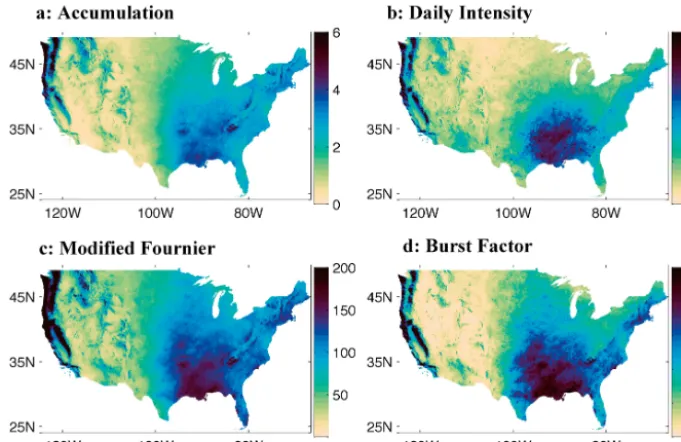
Figures 1 and 2 present, for observations and the model en-semble, respectively, a quick overview of the rainfall charac-teristics that are most likely to influence erosion: mean an-nual accumulation (in mm day−1), mean daily intensity (de-fined as the average rainfall accumulation on days when it rains), the modified Fournier index, and the burst factor. The observed characteristics are well known. The western coast
2An analog for a given daily weather pattern can be constructed
by combining patterns from a library of previously observed pat-terns; using a companion library of high-resolution patterns creates the high-resolution downscaled estimate.
ranges receive plenty of precipitation but otherwise the west-ern states are quite dry; east of the Rockies precipitation is generally more abundant, especially in the southeast and in places along the Appalachian Range. The same pattern is repeated and intensified in the intensity field, with espe-cially high intensities in the southeast. Unsurprisingly, both the burst factorBand the modified Fournier indexF show a mixture of the accumulation and intensity patterns.
The model ensemble reproduces the annual accumulation andF very well, as expected from the fact that we are us-ing bias-corrected data sets. Instead, the quantities that are based on daily, rather than monthly, data are not at all well captured. Maximum values in the intensity field are muted compared to observations by a factor of at least 4 (changing the threshold for a rainy day from 0 to 1 mm day−1does not solve the problem, not shown), and the low-intensity also af-fects the burst factor, especially in the southeast. This can be explained in part by the lower resolution of the model data, but it seems that the bias correction does not fully address the notorious drizzle bias that plagues GCMs (Dai, 2006).
Because of concern with the unresolved bias in daily rain-fall intensities, we proceed by estimating erosivity and ero-sivity changes using two predictors. One predictor is rain-fall daily intensity and the method by which we estimateR (method 1) is more closely related to the original erosivity calculation (but is affected by the intensity bias). The sec-ond predictor isF, which is unaffected by the bias. ForF, the formulation of the erosivity calculation is less well moti-vated and the relationship is more uncertain; thus, we try both a linear (method 2) and a non-linear (method 3) relationship betweenF andR.
2.3 Erosivity calculations using observed daily rainfall (method 1)
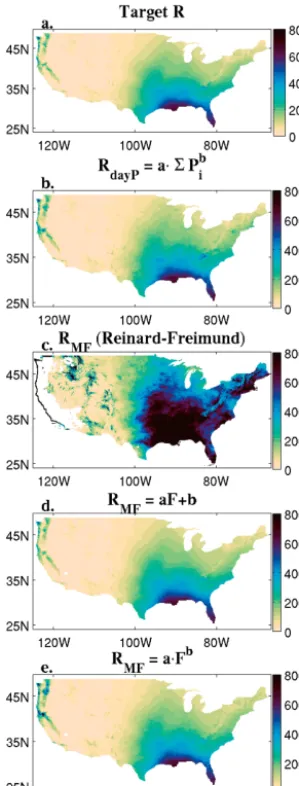
Figure 3a shows the target (observed) 1970–2000 annual ero-sivity. Values are maximum along the gulf coast and Florida, and decline further to the north. Erosivity in the western US is extremely low, aside from the mountain regions of the west coast (note, though, that snow might be contaminating the observational estimate in these areas). Unsurprisingly, theR pattern is reminiscent of both annual meanP and intensity, but some details are different, such as the very high values of R in southern Florida. This pattern differs from that of erosion itself, as steep topography favors erosion in most of the western US (Judson and Ritter, 1964) and land-use prac-tices enhance or mitigate the effect of erosive rainfall (Gys-sels et al., 2005; Montgomery, 2007).
M. Biasutti and R. Seager: Erosivity projections 2949
Figure 1. Observed rainfall characteristics for 1980–2000 in the PRISM data set (mm day−1). (a) Mean annual accumulation. (b) Mean daily intensity (i.e., accumulation on rainy days, where a rainy day is any day with rain above 0 mm day−1). (c) Modified Fournier index, the sum of the squared monthly rainfall, divided by the annual rainfall. (d) Burst factor, the sum of the product of monthly rainfall accumulation with the maximum daily rainfall for the month, divided by the annual rainfall.
Figure 2. As in Fig. 1, but for the average of 21 downscaled CMIP5 models (the BCCAv2 data set).
data set is quite fine, coefficients estimated from gauge val-ues may not necessarily be appropriate for a gridded data set. Still, we want to calculate R from daily rainfall using the same functional form and, in order to do that, we need an al-ternative way to estimate the coefficientsa andbthat do not require temporally resolved values of R. Our choice was to exploit the fine spatial resolution of the griddedR data set, and use that in place of the missing temporal resolution.
For every 1◦×1◦ square, we take the mean 1970–2000 erosivity and daily time series for the period 1980–2000 (PRISM daily rainfall is not available prior to 1980) and use the 625 vertex points of the 4 km resolution data sets that are included in this subdomain to determine the coefficientsa andbin the formulaR' a
N PN
n=1 P365
d=1Pdb. This provides us
[image:5.612.127.469.355.575.2]Figure 3. Overview of observational estimates ofR. (a) Target ero-sivity field. (b) Eroero-sivity calculated by regression from daily precip-itation, using the formulaR= a
N
PN
n
P365
d Pdb(details in the text).
(c) Erosivity calculated from annual modified Fournier indexF, us-ing the published formula of Reinard and Freimund. (d) Erosivity calculated by regression from annual modified Fournier index F
using the formulaR=a·F+b(details in the text). (e) Same as in
(d) but using the formulaR=a·Fb.
smooth to the 1/8◦resolution of the models. In the fitting rou-tine we require thatabe positive andbbe greater or equal to 1 (a choice consistent with the parameter values reported in Hollinger et al., 2002). We want the formula linking rainfall and erosivity to be sufficiently robust to produce a good fit to the targetRwhen applied to rainfall at somewhat different resolution, so we check its performance on the same obser-vational rainfall data, but regridded at the coarser resolution of the downscaled data, 1/8◦. Although this check is not us-ing fully independent data, usus-ing data at coarser resolution as input does introduce some degree of separation from the data
used in the fit. In the eastern domain, grid points for which the fitting routine selected outlier values (very different from nearby points, but without a clear physical feature to justify the sharp gradient) yielded large errors when the regression was applied to the coarser data. To partially avoid this, we imposed as a search criterion in the least-square fitting pro-cedure that the regression coefficients were bound to be close to the large-scale values over homogeneous areas, and outlier values of the regression coefficients were discarded. This is consistent with the choice made by the PRISM team to use a smooth interpolation in the eastern US.
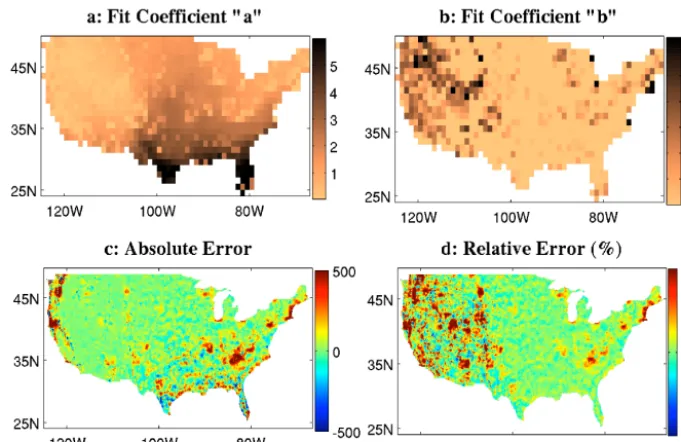
Figure 3b compares to the target map the erosivity ob-tained by regression on the 1980–2000 1/8◦ daily PRISM rainfall. Figure 4 shows maps for thea andb coefficients. The exponentbis close to 1 over the eastern part of the US, but it rises above 1.5 in the west. The multiplicative constant ais most reminiscent of theRandP fields, with values close to 0 in the west (which offsets for the quadratic term in pre-cipitation) and maximum values in the southeast. Figure 4 also shows the absolute and relative error between the two Restimates (between Fig. 3a and b). Overall, the regression produces a good match to the original field, but a close look reveals that there are some regional biases. In particular, the west coast has much lower erosivity in the target field than that calculated by the regression; in fact, when looking at the relative error, most of the west appears to be problematic: the errors are small scale and patchy, so the regional bias is not as strong as the local bias, but there is an overall tendency for the regression model to overpredict erosivity.
2.4 Erosivity calculations using the observed modified Fournier indexF (methods 2 and 3)
An increase in the intensity of rainfall, especially in the frequency of the most extreme events, is a robust expecta-tion for future climate change, supported by theory (e.g., Trenberth, 1999; O’Gorman and Schneider, 2009), model-ing (e.g., O’Gorman, 2012; Tebaldi et al., 2006; Sillmann et al., 2013), and observations (e.g., Alexander et al., 2006; Lenderink et al., 2011; Asadieh and Krakauer, 2015). The effect of such changes on erosivity can only be assessed by using daily rainfall data. For this reason, we have calculated erosivity from daily precipitation, as shown above. Neverthe-less, the biases in daily intensity that persist even in this bias-corrected data set shed doubt on the ability of this method to accurately capture changes in erosivity and, therefore, we in-clude estimates of erosivity obtained from monthly-averaged rainfall data – which is brought close to observations by the bias correction.
M. Biasutti and R. Seager: Erosivity projections 2951
Figure 4. Evaluation of observational estimates of R. Method 1: erosivity calculated from daily precipitation, using the formulaR= a
N
PN n
P365
d Pdb(details in the text). (a) The multiplicative coefficient “a” in the above formula, calculated by regression on the grid points in each 1◦×1◦box (b), as in (a), but for the exponent coefficient “b”. (c) Absolute error between the estimate ofRin Fig. 3b and the target field in Fig. 3a. (d) Relative error in percent.
R=0.7397F1.847, (5)
and
R=95.77−6.081F +0.4770F2, (6)
where Eq. (5) holds for F <55 mm and Eq. (6) holds for F >55 mm and F is defined as in Eq. (2)3. Reinard and Freimund found that neither relationship could be applied to the stations of Washington, Oregon, and California because winter snow was coming into the calculation ofF, but should not contribute toR. Their criterion to exclude such stations was that no month between October and April should con-tribute more than 15 % to the annual accumulation. We have followed the same, quite arbitrary, criterion.
Other scholars have found different relationships for other locations (see the many examples reported in Schönbrodt-Stitt et al., 2013), both linear and of the formR=aFb, and the literature repeats Arnoldus’ (1980) recommendation that relations obtained using the modified Fournier index should be applied only to locations within homogeneous climatic re-gions. Therefore, we also apply the same method described above for daily precipitation and estimate localRtoF rela-tionships for points in each 1◦×1◦square, allowing for both a linear and a power law relationship. Thus, we have three ways of estimatingRfromF.
3Note that these are the equations reported in the figures. The
main text in Reinard and Freimund contains a graphical error in Eq. (5), and subsequent citations in Nearing (2001) and Segura et al. (2014) contain a typo in Eq. (6).
Applying Eqs. (5) and (6) to the gridded PRISM data leads to overestimating the erosivity everywhere in the US, with the only exceptions of eastern Texas and Florida (Fig. 3c). The fact that the error is of the same order of magnitude asR itself is not inconsistent with the errors shown by Reinard and Freimund (see their Fig. 3b), but the positive bias in the es-timate is harder to explain. Nonetheless, we note that the re-lationship betweenF andRin the literature for many world regions is often linear and, as will be shown below, the local-regression methods suggest a much weaker dependence on F than the Reinard and Freimund formulas in all but a few mountainous regions of the US.
Figure 5. Evaluation of observational estimates ofR. Method 2: erosivity calculated from annual modified Fournier indexF, using the formulaR=a·F+b(details in the text). (a) The multiplicative coefficient “a” in the above formula, calculated by regression on the grid-points in each 1◦×1◦box (b), as in (a), but for the coefficient “b”. (c) Absolute error between the estimate ofRin Fig. 3d and the target field in Fig. 3a. (d) Relative error in percent.
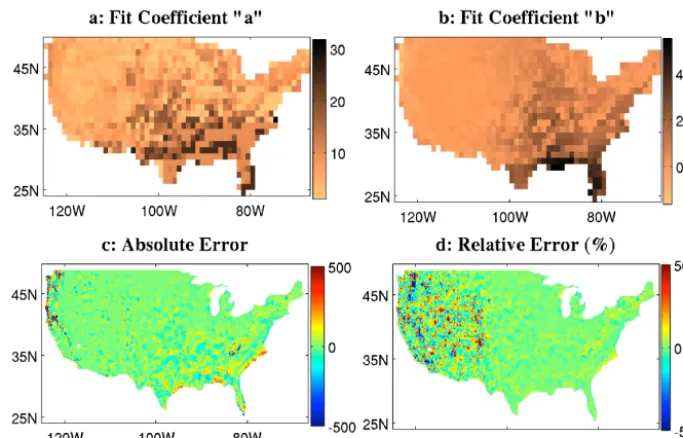
Figure 6. Evaluation of observational estimates ofR. Method 3: erosivity calculated from annual modified Fournier indexF, using the formulaR=a·Fb(a) The multiplicative coefficient “a” in the above formula, calculated by regression on the grid-points in each 1◦×1◦ box (b), as in (a), but for the coefficient “b”. (c) Absolute error between the estimate ofRin Fig. 3e and the target field in Fig. 3a. (d) Relative error in percent.
The end result of the local regressions are presented in Figs. 3d, e, 5, and 6. The case of a linear fit provides the best fit (Fig. 5): the errors are small and very patchy, indicat-ing that there are weak regional biases in the estimate of the erosivity field. The power law produces errors of larger mag-nitude, and their severity is worst in the western US. Here, the
M. Biasutti and R. Seager: Erosivity projections 2953
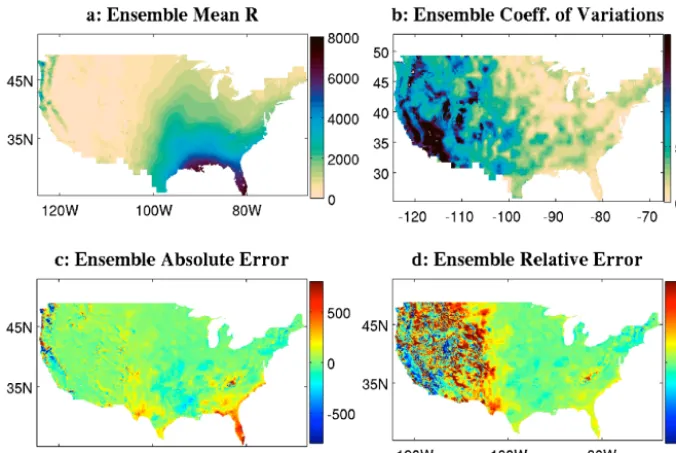
Figure 7. Evaluation of climate model estimates ofR. Method 1 (the method of Fig. 4). (a) Ensemble mean erosivity. (b) Intra-ensemble stan-dard deviation, divided by the ensemble mean erosivity (%). (c) Absolute error of the ensemble mean, compared to the targetR. (d) Relative error of the ensemble mean.
calculation is not properly addressed by any of these meth-ods, although changes from snow to rain might indeed be an important factor in determining future changes in erosivity.
R is better approximated usingF than with the daily pre-cipitation. This is somewhat surprising, given that it is the daily precipitation that goes into the originalR calculation. On the other hand, it might be that the use of annual mean rainfall in the interpolation of R from point measurements to the gridded field introduces a bias inR, making the field more similar to rainfall accumulation than it would otherwise be.
Another possible choice for building the regression be-tween rainfall (either at daily frequency or aggregated into F) and erosivity would be to base it on larger regions that encompass broader variations in the relevant fields than what is seen in a 1◦×1◦square. Taking inspiration from the re-gional clusters of Palecki et al. (2005) – which select regions with fairly homogeneous mean storm characteristics – we have defined eight regions and regressed rainfall and rainfall characteristics across the grid points within each region. The regressions are more biased in this case than in the case of the local regressions, independently of the choice of rainfall variable. This is as expected, given that we use much fewer parameters, and again underscores the uncertainty in the esti-mates or erosivity that are based on rainfall accumulation. In the rest of the study, we proceed using the estimates obtained by local regressions, mindful that these regressions should be interpreted more as a simple scaling than as a robust physical relationship.
2.5 Erosivity calculations using historical model data In this subsection, we describe the performance of the cli-mate models in reproducing the observational esticli-mates of rainfall erosivityR. All three methods of estimatingR are evaluated.
Figure 8. Evaluation of climate model estimates ofR. Method 2 (the method of Fig. 5). (a) Ensemble mean erosivity. (b) Intra-ensemble stan-dard deviation, divided by the ensemble mean erosivity (%). (c) Absolute error of the ensemble mean, compared to the targetR. (d) Relative error of the ensemble mean.
Figure 9. Evaluation of climate model estimates ofR. Method 3 (the method of Fig. 6). (a) Ensemble mean erosivity. (b) Intra-ensemble standard deviation, divided by the ensemble mean erosivity (%). (c) Absolute error of the ensemble mean, compared to the targetR. (d) Relative error of the ensemble mean.
When we calculate erosivity from the models’F, we ob-tain somewhat better results (compare Fig. 8a to Figs. 3d and Fig. 9a to Fig. 3e). Similar to what is seen for the observa-tions, the linear relationship captures R with the least bias (Fig. 8c, d), while the non-linear relationship (Fig. 9c, d) in-duces a worst overestimation of erosivity in coastal regions of the gulf and the southeast and in the western US. Erosivity
[image:10.612.127.467.348.570.2]M. Biasutti and R. Seager: Erosivity projections 2955
Figure 10. Projections of changes in rainfall characteristics: difference between 2079–2099 and 1980–2000, where the future period is
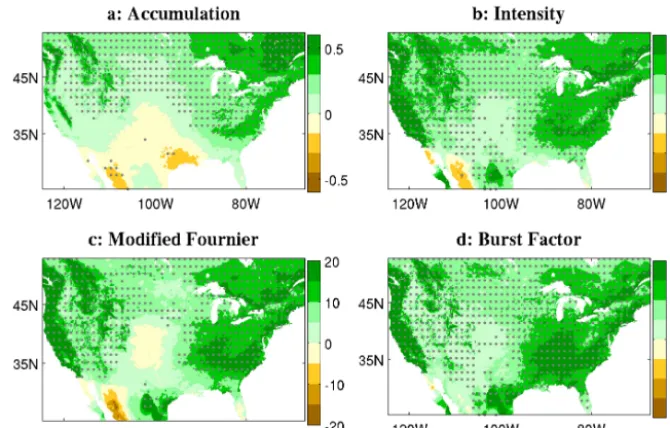
simulated under the RCP8.5 scenario and the past is from the historical simulation. Shown are ensemble mean differences, with stippling indicating that more than two-thirds of the models agree on the sign of the change (stippling is plotted at coarser spatial resolution, for clarity). (a) Annual mean rainfall accumulation. (b) Rainfall mean daily intensity. (c) Modified Fournier index. (d) Burst factor.
3 Projections 3.1 Rainfall
Figure 10 shows the end-of-century projections for annual rainfall accumulation, mean daily intensity, the burst factor, and the modified Fournier index. All four fields show overall future increases over most of the North American continent. The annual precipitation signal in the northern part of the domain (Canada and US) is clearly positive, with anomalies replicated across the ensemble (stippling indicates at least two thirds of the models agreeing on the sign of the anoma-lies), but in the southern part of the domain the anomalies are weak and not very robust. Although barely significant (see the limited extent of the stippling), there is general drying in Mexico and Texas, extending into the southwest US, and more positive anomalies in the eastern gulf and Florida. The pattern of yearly anomalies shown here is consistent with the expectations reported in the literature for both CMIP3 and CMIP5 models (see for example Seager et al., 2007, 2014; Biasutti et al., 2011; Christensen et al., 2013; Maloney et al., 2014). It can be interpreted as the sum of a weak US-wide summertime drying and the wintertime pattern of increase in rainfall north of 40◦N and decrease in precipitation in the southwest and Texas. Areas close to the wintertime zero-anomaly line are areas where the climate signal is projected to be small compared to natural variability, and model dis-agreement is not problematic. But in other areas, such as northern California and Texas, model disagreement is indica-tive of true uncertainty in the response (Maloney et al., 2014).
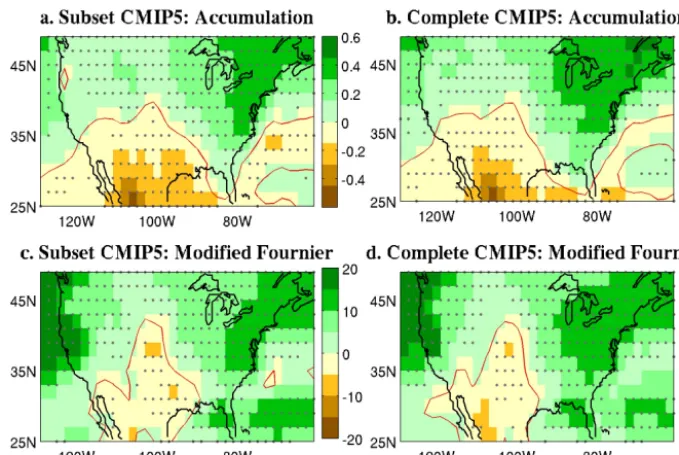
The positive weak anomalies in Arizona and central Mex-ico are not expected from the literature. They are a conse-quence of the bias-correction method: the projections for the same 21 runs in the original CMIP5 ensemble show that the negative rainfall anomalies do extend farther north than their downscaled counterparts. In general, the downscaling seems to dampen the negative anomalies. This is visible for both accumulation and the Fournier index when we compare the downscaled anomalies in Fig. 10 with the anomalies for the corresponding CMIP5 models at the native resolution (see Fig. 11).
The intensity signal (see also Wuebbles et al., 2014) presents a similar pattern of stronger positive signal in the north and along the coasts, but in this case the region of consistency across models is more expansive across the US, with only the Colorado Plateau and the southern Great Plains not showing a robust increase in intensity (anomalies are nonetheless positive). The pattern can be interpreted as the superposition of the general (thermodynamic) tendency for more intense rainfall in a moister atmosphere (O’Gorman and Schneider, 2009), dampened in the middle of the con-tinent by circulation-driven dry anomalies in summertime (Maloney et al., 2014). Where these two effects are of com-parable magnitude in the multi-model mean, the changes in intensity are less robust.
Figure 11. Projections of changes in mean accumulated rainfall (top) and modified Fournier index (bottom): difference between 2079–2099
and 1980–2000, where the future period is simulated under RCP8.5 scenario and the past is from the historical simulation. Shown are ensemble mean differences, with stippling indicating that more than two-thirds of the models agree on the sign of the change. In (a) and
(c) the ensemble is limited to the runs included in the downscaled ensemble used in the rest of this study, but only regridded to a 2◦×2◦ resolution. In (b) and (d) the ensemble includes 38 coupled models from the CMIP archives; and for each model we have used the ensemble mean of all available realizations, for a total of 76 historical and RCP8.5 simulations.
at the gulf coast even though mean annual P declines here, a difference caused by an increase in monthly intensity that dominates over the mean drying. The strengthening of the robust pattern of anomalies inF compared to annual rainfall is an indication that the seasonal cycle of rainfall will be get-ting more peaked, i.e., more rain in the rainy season (Chou and Lan, 2012). As noted above, this behavior is more pro-nounced in the downscaled anomalies, while the same mod-els at the native resolution would indicate negative anomalies extending over Texas, Louisiana, and Mexico (Fig. 11).
Changes in the burst factor B are the most uniformly positive. B values reflect changes in both mean rainfall and rainfall extremes. This is especially true given that we have calculated the effective rainfall entering B using the observation-derived threshold of half an inch, which corre-sponds to higher rainfall percentiles in the models. More-over, the maximum daily rainfall for the month enters the calculation directly. The domain-wide robust increase inB– extending farther than either mean rainfall or mean intensity – is consistent with the expectation that the intensity of ex-treme rainfall events will increase more than average rainfall and average intensity.
Given the pattern of robustness and uncertainty in the pre-dictors of erosivity (that is, in mean annual rainfall, daily in-tensity,F andB), we can expect that erosivity changes will be generally positive but quite uncertain in the southern and central US and dependent on the method used to estimate
erosivity from rainfall. In the following section we look at such changes in a more quantitative way.
We have noted how the downscaling method introduces its own uncertainty in the projected rainfall changes used in this study; another source of uncertainty comes from the scatter across the models itself and can be partially addressed by looking at the sensitivity of our results to the size of the cli-mate model ensemble. Figure 11 compares the mean signal in annual mean accumulation and in the modified Fournier index when we use one realization of the 21 models used for downscaling from the native resolution CMIP5 ensemble to the projection from 76 runs from 38 models in the CMIP5 ensemble. The two patterns are very similar but they differ in details, such as on the sign of the anomalies over Louisiana. Finally, while here we focus on the climate change signal, it is important to remember that natural variability in rainfall is large over North America and capable of masking forced trends even over multi-decadal periods (Deser et al., 2010).
3.2 Erosivity
M. Biasutti and R. Seager: Erosivity projections 2957
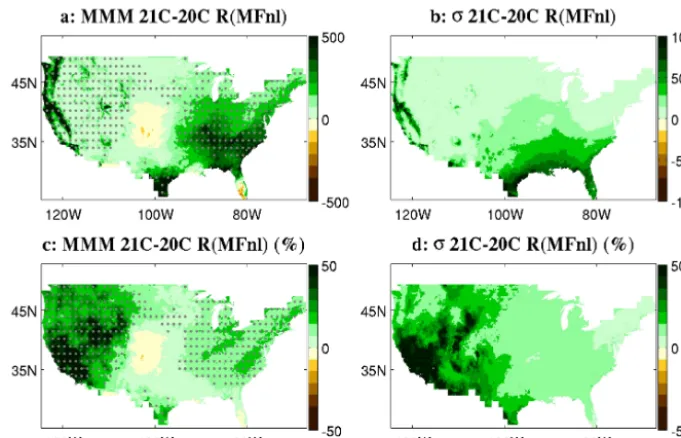
Figure 12. Projections of changes in erosivity: difference between 2079–2099 and 1980–2000, where the future period is simulated under
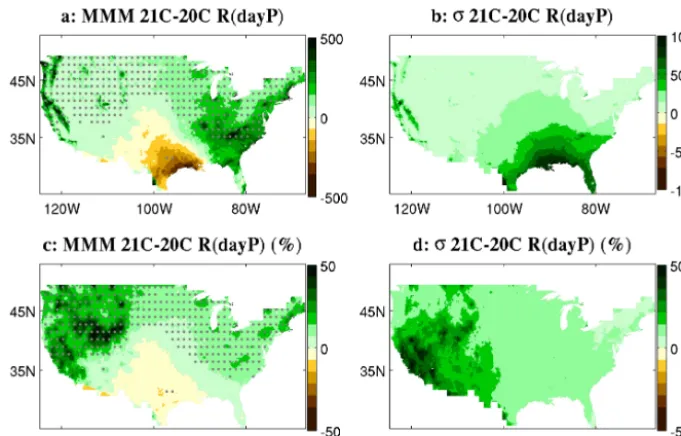
RCP8.5 scenario and the past is from the historical simulation. Erosivity is calculated from daily precipitation values following method 1.
[image:13.612.127.469.353.573.2](a) Ensemble mean difference in erosivity units (MJ mm ha−1h−1year−1). (b) Intra-ensemble standard deviation in erosivity units. (c) En-semble mean difference in percent of mean 20th century values. (d) Intra-enEn-semble standard deviation in percent.
Figure 13. As in Fig. 12, but for erosivity calculated by non-linear regression from the modified Fournier indexF(method 2).
Figures 12, 13, and 14 show the multi-model mean differ-ence in erosivity between 1980–2000 and 2080–2100, both in erosivity units (MJ mm ha−1h−1year−1, top panels) and as percentages of the 20th century values (bottom panels), alongside the intra-ensemble scatter in the same quantities. In Fig. 12, R is estimated from the daily precipitation val-ues (method 1), while in Figs. 13 and 14 it is estimated from F, either through a linear (method 2) or through a non-linear regression (method 3), as described in Sect. 2.
precip-Figure 14. As in Fig. 12, but for erosivity calculated by non-linear regression from the modified Fournier indexF(method 3).
itation is used, the increase in erosivity covers the west, east and north-central US, with negative anomalies in Texas and north into the Colorado Plateau. Conversely, the estimates obtained from the modified Fournier index would indicate positive anomalies in Texas (as in most of the domain) and only a region of very weak decrease in erosivity further north around Colorado and Kansas. For R using daily data the changes are primarily driven by the changes in mean accu-mulation. ForRcalculated viaF, changes in monthly inten-sity are more important and there are regions where, by this estimate,Rincreases even as accumulation declines, because an increase in monthly intensity dominates.
The fact that the pattern of change in rainfall accumula-tion differs from that of the modified Fournier index leads to increased uncertainty in erosivity changes, compared to what has been previously reported in the literature as a con-sequence of the climate uncertainty. For example, in eastern Texas, estimates based onF suggest a robust increase of ero-sivity across a majority of climate models (even if the inter-model spread is large, Fig. 13b, there is strong agreement on the sign of the change, Fig. 13a), but estimates based on daily precipitation accumulation paint the opposite picture. For this region, the uncertainty derived from the rainfall– erosivity relationship is greater than the uncertainty derived from scatter across climate projections.
In spite of the overall uncertainties and biases in the model estimates, it is nonetheless clear that the expectation of in-creased erosivity for most of the US is supported by this analysis and that strategies to prevent soil loss will need to be implemented in a variety of environmental conditions, from the mountains of the west to the northern Great Plains, to the Appalachian Range and the Eastern Seaboard.
4 Conclusions
Changes in soil erosion have many drivers and a full eval-uation of the effect of climate change on soil loss and sed-iment deposition can only be achieved by a truly integrated assessment that takes into consideration changes in vegeta-tion and land use. At the moment, the coupling of climate, vegetation, and landscape dynamics at the scales relevant for erosion is not yet achievable, and an assessment of erosion risks under global warming must, by necessity, take a sim-plified approach. Here, we focus on the one driver of erosion most directly related to climate: rainfall erosivity.
[image:14.612.127.468.66.285.2]M. Biasutti and R. Seager: Erosivity projections 2959
Overall, we confirm that the general expectation of wors-ening erosivity under climate change is correct, but we sug-gest that previous estimates have been too confident for large swaths of the United States, especially in the south and in the interior. The pattern of erosivity change estimated in our study from CMIP5 changes inF is consistent with what was found by Segura et al. (2014) using just three models (with three scenarios each) from the older CMIP3 archive. But the pattern changes when we estimate erosivity with a differ-ent method: when erosivity is estimated from daily rainfall values, the multi-model mean indicates a decrease in Texas and the southern Great Plains, while an increase in erosiv-ity is simulated by a majorerosiv-ity of models when the estimate is done using monthly precipitation. Within this region there are locations where the climate signal itself is not very ro-bust (some climate models project wetting, others drying) but there are also locations where the climate models agree on the rainfall changes. There, uncertainty in the sign of the erosivity changes is solely a consequence of our poor knowl-edge of how best to link erosivity to rainfall accumulation. Thus, we conclude that, for some regions, uncertainty in the method of estimation ofR can be more consequential than uncertainty derived from the spread in climate simulations.
A more quantitative assessment will remain a challenge, hindered both by model deficiencies and by lack of com-plete erosivity records from observations. Ameliorating the biases in the representation of rainfall intensity in climate models is bound to help, and the task is already on the mod-elers’ agenda, as is the need for reducing uncertainty in the projections of regional climate change. But the uncertainty stemming from the relationship between rainfall and erosiv-ity could be ameliorated without having to wait for progress in climate models. Progress could be made by recalculat-ing erosivity time series from quality gauges, and high-frequency, high-resolution satellite estimates of rainfall, so that a more detailed and more reliable record of the connec-tion between daily rainfall and erosivity can be established for the entire US. Outside the Unites States (and few scat-tered localities), the lack of high-frequency, high-resolution data and a worse uncertainty in the relationship between rainfall characteristics and erosion potential (van Dijk et al., 2002) combine to make the challenge even more formidable.
Acknowledgements. We gratefully acknowledge NSF support
through award AGS12-43204: EASM2: Linking Near-Term Future Changes In Weather and Hydroclimate in Western North America to Adaptation for Ecosystem and Water Management (WestCLIM). We thank Dr. Daly and the PRISM group for the erosivity and rainfall data. We acknowledge the World Climate Research Programme’s Working Group on Coupled Modelling, which is responsible for CMIP, and we thank the climate modeling groups for producing and making available their model output. For CMIP the US Department of Energy’s Program for Climate Model Diagnosis and Intercomparison provides coordinating support and led development of software infrastructure in partnership with
the Global Organization for Earth System Science Portals. Haibo Liu and Naomi Henderson were instrumental in accessing and organizing the data. We also gratefully acknowledge the use of the downscaled CMIP5 Climate and Hydrology Projections archive at http://gdo-dcp.ucllnl.org/downscaled_cmip_projections/.
Edited by: P. Gentine
References
Alexander, L., Zhang, X., Peterson, T., Caesar, J., Gleason, B., Tank, A., Haylock, M., Collins, D., Trewin, B., and Rahimzadeh, F.: Global observed changes in daily climate extremes of tem-perature and precipitation, J. Geophys. Res., 111, D05109, doi:10.1029/2005JD006290, 2006.
Angel, J. R., Palecki, M. A., and Hollinger, S. E.: Storm precipita-tion in the United States. Part II: Soil erosion characteristics, J. Appl. Meteorol., 44, 947–959, 2005.
Arnoldus, H. M. J.: An approximation of the rainfall factor in the Universal Soil Loss Equation, in: Assessment of Erosion, edited by: De Boodt, M. and Gabriels, D., 127–132, Chichester, New York, 1980.
Asadieh, B. and Krakauer, N. Y.: Global trends in extreme precip-itation: climate models versus observations, Hydrol. Earth Syst. Sci., 19, 877–891, doi:10.5194/hess-19-877-2015, 2015. Biasutti, M., Sobel, A. H., Camarago, S. J., and Creyts,
T. T.: Projected Changes in the Physical Climate of the Gulf Coast and Caribbean, Climatic Change, 112–, 819–845, doi:10.1007/s10584-011-0254-y, 2011.
Bridges, E. M. and Oldeman, L. R.: Global Assessment of Human-Induced Soil Degradation, Arid Soil Res. Rehabil., 13, 319–325, 1999.
Chou, C. and Lan, C.-W.: Changes in the Annual Range of Precipi-tation under Global Warming, J. Climate, 25, 222–235, 2012. Christensen, J., Kumar, K. K., Aldrian, E., An, S. I., Cavalcanti, I.
F. A., de Castro, M., Dong, W., Goswami, P., Hall, A., Kanyanga, J. K., Kitoh, A., Kossin, J., Lau, N. C., Renwick, J., Stephen-son, D. B., Xie, S.-P., and Zhou, T.: Climate Phenomena and their Relevance for Future Regional Climate Change, in: Cli-mate Change 2013: The Physical Science Basis. Contribution of Working Group I to the Fifth Assessment Report of the Intergov-ernmental Panel on Climate Change, edited by: Stocker, T. F., Qin, D., Plattner, G. K., Tignor, M., Allen, S. K., Boschung, J., Nauels, A., Xia, Y., Bex, V., and Midgley, P. M., 1–92, Cam-bridge University Press, CamCam-bridge, UK and New York, NY, USA, 2013.
Dabney, S. M., Yoder, D. C., and Vieira, D. A. N.: The application of the Revised Universal Soil Loss Equation, Version 2, to evaluate the impacts of alternative climate change scenarios on runoff and sediment yield, J. Soil Water Conserv., 67, 343–353, 2012. Dai, A.: Precipitation characteristics in eighteen coupled climate
models, J. Climate, 19, 4605–4630, 2006.
Daly, C., Gibson, W. P., Taylor, G. H., Johnson, G. L., and Pasteris, P.: A knowledge-based approach to the statistical mapping of cli-mate, Clim. Res., 22, 99–113, 2002.
Daly, C., Halbleib, M., Smith, J. I., Gibson, W. P., Doggett, M. K., Taylor, G. H., Curtis, J., and Pasteris, P. P.: Physiographically sensitive mapping of climatological temperature and precipita-tion across the conterminous United States, Int. J. Climatol., 28, 2031–2064, 2008.
Deser, C., Phillips, A., Bourdette, V., and Teng, H.: Uncertainty in climate change projections: the role of internal variability, Clim. Dynam., 38, 527–546, doi:10.1007/s00382-010-0977-x, 2010. Dissmeyer, G. E. and Foster, G. R.: A guide for predicting sheet
and rill erosion on forestland., Tech. Rep. Technical Publication SA-TP-11, 1980.
Fournier: Climat et Erosion, Presses Universitaires de France, Paris, 1960.
Gyssels, G., Poesen, J., Bochet, E., and Li, Y.: Impact of plant roots on the resistance of soils to erosion by water: a review, Progr. Phys. Geogr., 29, 189–217, 2005.
Hollinger, S. E., Angel, J. R., and Palecki, M. A.: Spatial Distribu-tion, VariaDistribu-tion, and Trends in Storm Precipitation Characteristics Associated with Soil Erosion in the United States, Tech. Rep., 2002.
Judson, S. and Ritter, D. F.: Rates of regional denudation in the United States, J. Geophys. Res., 69, 3395–3401, 1964.
Lenderink, G., Mok, H. Y., Lee, T. C., and van Oldenborgh, G. J.: Scaling and trends of hourly precipitation extremes in two different climate zones – Hong Kong and the Netherlands, Hy-drol. Earth Syst. Sci., 15, 3033–3041, doi:10.5194/hess-15-3033-2011, 2011.
Maloney, E. D., Camargo, S. J., Chang, E., Colle, B., Fu, R., Geil, K. L., Hu, Q., Jiang, X., Johnson, N., Karnauskas, K. B., Kinter, J., Kirtman, B., Kumar, S., Langenbrunner, B., Lombardo, K., Long, L. N., Mariotti, A., Meyerson, J. E., Mo, K. C., Neelin, J. D., Pan, Z., Seager, R., Serra, Y., Seth, A., Sheffield, J., Stroeve, J., Thibeault, J., Xie, S.-P., Wang, C., Wyman, B., and Zhao, M.: North American Climate in CMIP5 Experiments: Part III: Assessment of Twenty-First-Century Projections*, J. Cli-mate, 27, 2230–2270, 2014.
Maurer, E. P., Hidalgo, H. G., Das, T., Dettinger, M. D., and Cayan, D. R.: The utility of daily large-scale climate data in the assess-ment of climate change impacts on daily streamflow in Califor-nia, Hydrol. Earth Syst. Sci., 14, 1125–1138, doi:10.5194/hess-14-1125-2010, 2010.
Maurer, E., Brekke, L., Pruitt, T., Thrasher, B., Long, J., Duffy, P., Dettinger, M., Cayan, D., and Arnold, J.: An Enhanced Archive Facilitating Climate Impacts and Adaptation Analysis, B. Am. Meteorol. Soc., 95, 1011–1019, 2014.
Maurer, E. P., Brekke, L., Pruitt, T., and Duffy, P. B.: Fine-resolution climate projections enhance regional climate change impact stud-ies, Eos Trans. AGU, 88, 504–504, 2007.
Montgomery, D. R.: Soil erosion and agricultural sustainability, Proc. Natl. Acad. Sci., 104, 13268–13272, 2007.
Mullan, D., Favis-Mortlock, D., and Fealy, R.: Addressing key lim-itations associated with modelling soil erosion under the impacts of future climate change, Agr. Forest Meteorol., 156, 18–30, 2012.
Nearing, M. A.: Potential changes in rainfall erosivity in the U.S. with climate change during the 21st century, J. Soil Water Con-serv., 56, 229–232, 2001.
Nearing, M. A., Pruski, F. F., and O’neal, M. R.: Expected climate change impacts on soil erosion rates: a review, J. Soil Water Con-serv., 59, 43–50, 2004.
Nearing, M. A., Jetten, V., Baffaut, C., Cerdan, O., Couturier, A., Hernandez, M., Le Bissonnais, Y., Nichols, M. H., Nunes, J. P., Renschler, C. S., Souchère, V., and van Oost, K.: Modeling re-sponse of soil erosion and runoff to changes in precipitation and cover, CATENA, 61, 131–154, 2005.
O’Gorman, P. A.: Sensitivity of tropical precipitation extremes to climate change, Nat. Geosci., 5, 697–700, 2012.
O’Gorman, P. A. and Schneider, T.: The physical basis for in-creases in precipitation extremes in simulations of 21st-century climate change, Proc. Natl. Acad. Sci., 106, 14773–14777, doi:10.1073/pnas.0907610106, 2009.
Palecki, M. A., Angel, J. R., and Hollinger, S. E.: Storm Precipita-tion in the United States. Part I: Meteorological Characteristics, J. Appl. Meteorol., 44, 933–946, 2005.
Pruski, F. F. and Nearing, M. A.: Climate-induced changes in ero-sion during the 21st century for eight U.S. locations, Water Re-sour. Res., 38, 34-1–34-11, 2002.
Renard, K. G. and Freimund, J. R.: Using monthly precipitation data to estimate the R-factor in the revised USLE, J. Hydrol., 157, 287–306, 1994.
Schönbrodt-Stitt, S., Bosch, A., Behrens, T., Hartmann, H., Shi, X., and Scholten, T.: Approximation and spatial regionalization of rainfall erosivity based on sparse data in a mountainous catch-ment of the Yangtze River in Central China, Environ. Sci. Pollut. Res., 20, 6917–6933, 2013.
Seager, R., Ting, M., Held, I., Kushnir, Y., Lu, J., Vecchi, G., Huang, H., Harnik, N., Leetmaa, A., Lau, N., et al.: Model Projections of an Imminent Transition to a More Arid Cli-mate in Southwestern North America, Science, 316, 1181–1184, doi:10.1126/science.1139601, 2007.
Seager, R., Neelin, D., Simpson, I., Liu, H., Henderson, N., Shaw, T., Kushnir, Y., Ting, M., and Cook, B.: Dynamical and Thermo-dynamical Causes of Large-Scale Changes in the Hydrological Cycle over North America in Response to Global Warming*, J. Climate, 27, 7921–7948, 2014.
Segura, C., Sun, G., McNulty, S., and Zhang, Y.: Potential impacts of climate change on soil erosion vulnerability across the con-terminous United States, J. Soil Water Conserv., 69, 171–181, 2014.
Sillmann, J., Kharin, V., Zwiers, F., Zhang, X., and Bronaugh, D.: Climate extremes indices in the CMIP5 multimodel ensemble: Part 2. Future climate projections, J. Geophys. Res.-Atmos., 118, 2473–2493, 2013.
Smithen, A. A. and Schulze, R. E.: The spatial distribution in south-ern Africa of rainfall erosivity for use in the Universal Soil Loss Equation, Water SA, 8, 74–78, 1982.
Soil and Water Conservation Society: Conservation Implications of Climate Change: Soil Erosion and Runoff from Cropland, Tech. Rep., 2003.
M. Biasutti and R. Seager: Erosivity projections 2961
Tebaldi, C., Hayhoe, K., Arblaster, J., and Meehl, G.: Going to the extremes, Climatic Change, 79, 185–211, 2006.
Trenberth, K. E.: Conceptual framework for changes of extremes of the hydrological cycle with climate change, Climatic Change, 42, 327–339, 1999.
Trenberth, K. E., Dai, A., Rasmussen, R. M., and Parsons, D. B.: The Changing Character of Precipitation, B. Am. Meteorol. Soc., 84, 1205–1217, 2003.
USDA Agricultural Research Service: Revised Universal Soil Loss Equation Version 2 (RUSLE2), Tech. Rep., 2013.
van Dijk, A. I. J. M., Bruijnzeel, L. A., and Rosewell, C. J.: Rain-fall intensity-kinetic energy relationships: a critical literature ap-praisal, J. Hydrol., 261, 1–23, 2002.
Wischmeier, W. H. and Smith, D. D.: Predicting rainfall-erosion losses from cropland east of the Rocky Mountains, Vol. 282 of Agriculture Handbooks, U.S. Department of Agriculture, Agri-cultural Research Service, 1965.
Wischmeier, W. H. and Smith, D. D.: Predicting rainfall erosion losses-A guide to conservation planning, Vol. 537 of Agricul-ture Handbooks, U.S. Department of AgriculAgricul-ture, Agricultural Research Service, 1978.
Wuebbles, D., Meehl, G., Hayhoe, K., Karl, T. R., Kunkel, K., San-ter, B., Wehner, M., Colle, B., Fischer, E. M., Fu, R., Goodman, A., Janssen, E., Kharin, V., Lee, H., Li, W., Long, L. N., Olsen, S. C., Pan, Z., Seth, A., Sheffield, J., and Sun, L.: CMIP5 Climate Model Analyses: Climate Extremes in the United States, B. Am. Meteorol. Soc., 95, 571–583, 2014.
Yang, D., Kanae, S., Oki, T., Koike, T., and Musiake, K.: Global potential soil erosion with reference to land use and climate changes, Hydrol. Process., 17, 2913–2928, 2003.
Zhang, X. C.: A comparison of explicit and implicit spatial down-scaling of GCM output for soil erosion and crop production as-sessments, Climatic Change, 84, 337–363, 2007.
Zhang, X. C., Liu, W. Z., Li, Z., and Chen, J.: Trend and uncer-tainty analysis of simulated climate change impacts with multi-ple GCMs and emission scenarios, Agr. Forest Meteorol., 151, 1297–1304, 2011.