Georgia State University Georgia State University
ScholarWorks @ Georgia State University
ScholarWorks @ Georgia State University
Educational Policy Studies Dissertations Department of Educational Policy Studies
2-12-2010
Power and Bias in Hierarchical Linear Growth Models: More
Power and Bias in Hierarchical Linear Growth Models: More
Measurements for Fewer People
Measurements for Fewer People
Regine Haardoerfer Georgia State University
Follow this and additional works at: https://scholarworks.gsu.edu/eps_diss
Part of the Education Commons, and the Education Policy Commons
Recommended Citation Recommended Citation
Haardoerfer, Regine, "Power and Bias in Hierarchical Linear Growth Models: More Measurements for Fewer People." Dissertation, Georgia State University, 2010.
https://scholarworks.gsu.edu/eps_diss/57
This dissertation, POWER AND BIAS IN HIERARCHICAL LINEAR GROWTH MODELS: MORE MEASUREMENTS OF FEWER PEOPLE by REGINE HAARDOERFER, was prepared under the direction of the candidate’s Dissertation Advisory Committee. It is accepted by the committee members in partial fulfillment of the requirements for the degree Doctor of Philosophy in the College of Education, Georgia State University.
The Dissertation Advisory Committee and the student’s Department Chair, as representatives of the faculty, certify that this dissertation has met all standards of excellence and scholarship as determined by the faculty. The Dean of the College of Education concurs.
_________________________ _________________________
Phill Gagné, Ph.D. Paul A. Alberto, Ph.D.
Committee Chair Committee Member
_________________________ _________________________
L. Juane Heflin, Ph.D. Frances A. McCarty, Ph.D.
Committee Member Committee Member
_______________________ Date
_________________________ Sheryl A. Gowen, Ph.D.
Chair, Department of Educational Policy Studies
_________________________ R. W. Kamphaus, Ph.D.
AUTHOR’S STATEMENT
By presenting this dissertation as a partial fulfillment of the requirements for the
advanced degree from Georgia State University, I agree that the library of Georgia State University shall make it available for inspection and circulation in accordance with its regulations governing materials of this type. I agree that permission to quote, to copy from, or to publish this dissertation may be granted by the professor under whose direction it was written, by the College of Education's director of graduate studies and research, or by me. Such quoting, copying, or publishing must be solely for scholarly purposes and will not involve potential financial gain. It is understood that any copying from or publication of this dissertation which involves potential financial gain will not be allowed without my written permission.
NOTICE TO BORROWERS
All dissertations deposited in the Georgia State University library must be used in
accordance with the stipulations prescribed by the author in the preceding statement. The author of this dissertation is:
Regine Haardoerfer 705 Vista Leaf Court
Roswell, GA 30075
The director of this dissertation is:
Dr. Phill Gagné
Department of Educational Policy Studies College of Education
VITA
Regine Haardoerfer
ADDRESS: 705 Vista Leaf Court
Roswell, Georgia 30075
EDUCATION:
Ph.D. 2010 Georgia State University
Educational Policy Studies: Research,
Measurement, Statistics
M.Ed. 2005 Western Governors University
Management and Innovation
2nd State Exam 1999 State of Bavaria
Teaching Secondary Mathematics, Physics, and Computer Science
1st State Exam 1997 University of Erlangen-Nürnberg
Teaching Secondary Mathematics and
Physics
PROFESSIONAL EXPERIENCE:
2006–2010 Graduate Research Assistant
Georgia State University, Atlanta, GA
2003-2005 Private Tutor
2000-2003 IB Teacher, 12th Grade Advisor, and Technology
Coordinator
Atlanta International School
1999-2000 IT Training and Support
Atlanta International School
PROFESSIONAL SOCIETIES AND ORGANIZATIONS:
2006–present American Educational Research Association 2007–present The Association of Teacher Educators 2008-present American Educational Studies Association
PRESENTATIONS AND PUBLICATIONS:
Davis, D. H., Gagné, P., Haardörfer, R., & Waugh, R. E. (2010, May). Examining
reading instruction for students with moderate intellectual disabilities using visual analysis and growth modeling. Paper accepted for presentation at the
annual convention of the Association for Behavioral Analysis International,
the annual meeting of the American Educational Research Association, Denver, CO.
Haardörfer, R., & Gagné, P. (in press). The use of randomization tests in single-subject
research. Focus on Autism and Other Developmental Disabilities.
Haardörfer, R. (November 2009). International Baccalaureate in a Neoliberal Climate. Paper presented at the Annual Conference for the American Educational Studies Association. Savannah, GA.
Haardörfer, R. (2007). Teacher Autonomy. Paper and Performance presented at the Annual Conference for Curriculum and Pedagogy Group. Austin, TX.
Meyers, B., Swars, S., Schafer, N., Kavanagh, K., Haardörfer, R., Parrish, C., Jacobs, L., Matthews, C., and Taylor, S. (March 2008). Themes and Variations of Critical Friends Groups: A Contextual Look and Virtual Demonstration. Paper presented at the Annual Conference for the American Educational Research. New York, NY.
Meyers, B., Schafer, N., Parrish, C., Taylor, S., Swars, S., Kavanagh, K., Haardoerfer, R., Lick, B., Matthews, S., Jacobs, L. (February 2008). Themes and Variations of Critical Friends Groups: A Contextual Look and a Virtual Demonstration. Paper presented at the Annual Conference for the Association of Teacher Educators, New Orleans, LA.
Schafer, N., Kavanagh, K. Meyers, B., Swars, S., Czaplicki, K., and Haardörfer, R. (April 2009). Virtual Critical Friends Groups: A Vehicle for Professional Development and Supporting Beginning Teachers. Paper presented at the Annual Conference for the American Educational Research. San Diego, CA.
Schafer, N., Meyers, B., Swars, S., Haardörfer, R., Kavanagh, K., and Czaplicki, K. (April 2009). A Comparative Multicase Study Examining the Affordances and Constraints of Critical Friends Groups. Paper presented at the Annual Conference for the American Educational Research. San Diego, CA.
Schafer, N., Meyers, B., Swars, S., Kavanagh, K., Haardoerfer, R., Czaplicki, K.. and Matthews, C. (March 2009). Affordances and Constraints of Critical Friends Groups: Year Two Data of a Longitudinal Comparative Study and Virtual Demonstration. Paper presented at the Annual Conference for the Association of Teacher Educators, Dallas, TX.
ABSTRACT
POWER AND BIAS IN HIERARCHICAL LINEAR GROWTH MODELS: MORE MEASUREMENTS OF FEWER PEOPLE
by
Regine Haardoerfer
Hierarchical Linear Modeling (HLM) sample size recommendations are mostly made
with traditional group-design research in mind, as HLM as been used almost exclusively
in group-design studies. Single-case research can benefit from utilizing hierarchical linear
growth modeling, but sample size recommendations for growth modeling with HLM are
scarce and generally do not consider the sample size combinations typical in single-case
research. The purpose of this Monte Carlo simulation study was to expand sample size
research in hierarchical linear growth modeling to suit single-case designs by testing
larger level-1 sample sizes (N1), ranging from 10 to 80, and smaller level-2 sample sizes
(N2), from 5 to 35, under the presence of autocorrelation to investigate bias and power.
Estimates for the fixed effects were good for all tested sample-size combinations,
irrespective of the strengths of the predictor-outcome correlations or the level of
autocorrelation. Such low sample sizes, however, especially in the presence of
autocorrelation, produced neither good estimates of the variances nor adequate power
rates. Power rates were at least adequate for conditions in which N2 = 20 and N1 = 80 or
N2 = 25 and N1 = 50 when the squared autocorrelation was .25.Conditions with lower
POWER AND BIAS IN HIERARCHICAL LINEAR GROWTH MODELS: MORE MEASUREMENTS OF FEWER PEOPLE
by
Regine Haardoerfer
A Dissertation
Presented in Partial Fulfillment of Requirements of the Degree of
Doctor of Philosophy in
Educational Policy Studies in
the Department of Educational Policy Studies in
the College of Education Georgia State University
Copyright by Regine Haardoerfer
ii
TABLE OF CONTENTS
Page
List of Tables ...iii
Chapter 1 INTRODUCTION ...1
2 LITERATURE REVIEW ...6
3 METHOD ...12
4 RESULTS ...15
Conditions With Zero Autocorrelation ...15
Conditions With Nonzero Autocorrelation...38
5 DISCUSSION ...55
Zero Autocorrelation...55
Nonzero Autocorrelation ...57
Recommendations for Single-Case Researchers ...58
Future Research ...59
iii
1 Biases of Estimating τ00 When N2 = 5 ...16
2 Biases of Estimating τ11 When N2 = 5 ...17
3 Power to Detect β10 When N2 = 5 ...19
4 Power to Detect β10 When N2 = 10 ...20
5 Power to Detect β10 when N2 = 15 ...20
6 Power to Detect β10 When N2 = 25 ...22
7 Power to Detect β10 When N2 = 35 ...23
8 Power to Detect β01 When N2 = 10 ...25
9 Power to Detect β01 When N2 = 15 ...26
10 Power to Detect β01 When N2 = 20 ...27
11 Power to Detect β01 When N2 = 25 ...28
12 Power to Detect β01 When N2 = 30 ...28
13 Power to Detect β01 When N2 = 35 ...29
14 Power to Detect β11 When N2 = 10 ...31
15 Power to Detect β11 When N2 = 15 ...31
16 Power to Detect β11 When N2 = 25 ...32
17 Power to Detect β11 When N2 = 35 ...32
18 Power to Detect τ00 When ρTimeY = 0.2 and ρXY = 0.2 ...34
19 Power to Detect τ00 When ρTimeY = 0.6 and ρXY = 0.3 ...34
20 Power to Detect τ11 When ρTimeY = 0.2 and ρXY = 0.2 ...35
iv
Table Page
22 Biases for τ00 When ρTimeY = .2 and ρXY = .2 and N2 = 5 ...39
23 Biases for τ00 When ρTimeY = .2 and ρXY = .2 and N2 = 10 ...40
24 Biases for τ00 When ρTimeY = .2 and ρXY = .2 and N2 = 15 ...41
25 Biases for τ00 When ρTimeY = .2 and ρXY = .2 and N2 = 25 ...41
26 Biases for τ11 When ρTimeY = .2 and ρXY = .2 and N2 = 5 ...42
27 Biases for τ11 When ρTimeY = .2 and ρXY = .2 and N2 = 10 ...43
28 Biases for τ11 When ρTimeY = .2 and ρXY = .2 and N2 = 15 ...43
29 Biases of 2 e σ When ρTimeY = .2 and ρXY = .2 and N2 = 5...44
30 Biases of 2 e σ When ρTimeY = .2 and ρXY = .2 and N2 = 10...45
31 Biases of 2 e σ When ρTimeY = .2 and ρXY = .2 and N2 = 15...45
32 Biases of 2 auto ρ When ρTimeY = .2 and ρXY = .2 and N2 = 5 ...46
33 Biases of 2 auto ρ When ρTimeY = .2 and ρXY = .2 and N2 = 10 ...47
34 Biases of 2 auto ρ When ρTimeY = .2 and ρXY = .2 and N2 = 15 ...47
35 Power to Detect τ00 When ρTimeY = .2 and ρXY = .2 and N2 = 15 ...49
36 Power to Detect τ00 When ρTimeY = .2 and ρXY = .2 and N2 = 25 ...50
37 Power to Detect τ00 When ρTimeY = .2 and ρXY = .2 and N2 = 35 ...50
38 Power to Detect 2 e σ When ρTimeY = .2 and ρXY = .2 and N1 = 10...51
39 Power to Detect 2 auto ρ When ρTimeY = .2 and ρXY = .2 and N2 = 5 ...52
40 Power to Detect 2 auto ρ When ρTimeY = .2 and ρXY = .2 and N2 = 10 ...53
41 Power to Detect 2 auto ρ When ρTimeY = .2 and ρXY = .2 and N2 = 20 ...54
1
Single-case research aims to assess the changes in the behavior of participants.
This is accomplished by investigating functional relations between the treatments
(independent variable) and the behaviors (dependent variable). A functional relation is “a
quasi-causative relation between the dependent and independent variables [that] exist[s]
if the dependent variable systematically changes in the desired direction as a result of the
introduction and manipulation of the independent variable” (Alberto & Troutman, 2009,
p. 425). Repeated measures are used to investigate the impact of an intervention or
treatment; that is, study participants are measured frequently on an outcome variable
(behavior) under different conditions.
Single-case research can be categorized as time-series research, which is defined
as
a periodic measurement process on some group or individual and the introduction
of an experimental change into this time series of measurement, the results of
which are indicated by a discontinuity in the measurements recorded in the time
series. (Campbell, Stanley, & Gage, 1966, p. 37)
Primarily, the research participant is compared to her- or himself; comparisons across
individuals are important but generally secondary.
Single-case data sets have specific characteristics. The number of participants is
low; often only a few individuals can be recruited for a study. Furthermore, the number
2
where two or three waves are most common, but lower than in classical time-series
research, which often produces more than 100 data points.
The traditional approach to analyzing single-case data is visual analysis. The data
are graphed with time on the horizontal axis and the dependent variable on the vertical
axis. Visual analysis investigates the presence and shape of a functional relation between
the treatment and the outcome measure. The focus of the analysis is on the three main
characteristics of single-case data: central location, trend, and variability (Franklin,
Gorman, Beasley, & Allison, 1997). Central location can take on different definitions
such as mean, mode, or median. Trend indicates a systematic, but not necessarily
monotonic, increase or decrease of the outcome over time. Variability assesses the
residuals after central location and trend have been taken into account.
While visual analysis is an established part of single-case data analysis, its critics
debate several issues. Researchers indicate that interrater reliability might be a problem
(Jones, Weinrott, & Vaught, 1978; Matyas & Greenwood, 1990). Furthermore, visual
analysis is successful at keeping Type I errors low, as visual analysts are conservative in
their assessment of a functional relation (Kazdin, 1982). That, however, leads to low
power, especially for small and medium effect sizes.
One proposed approach to remedying these issues is the use of statistical analyses
in addition to visual analysis. Several suggestions have been made over the last few
decades, but more recently, efforts have increased due to changes in federal funding
requirements. Since 2001, the No Child Left Behind (NCLB) Act ("No Child Left Behind
(NCLB) Act of 2001, Pub. L. No. 107-110, § 115, Stat. 1425," 2002) requires studies to
that involves … objective procedures to obtain reliable and valid knowledge.” ("No Child
Left Behind (NCLB) Act of 2001, Pub. L. No. 107-110, § 115, Stat. 1425," 2002). This
definition excludes studies from receiving federal funding if they rely solely on visual
analysis.
Two schools of thought prevail on the use of statistical analyses for single-case
data. Some researchers advocate non-parametric tests tailored to single-case data. Others
suggest the use of well established group analyses.
Randomization tests are the most popular non-parametric tests that have been
proposed and used in single-case research (Todman & Dugard, 2001). On the surface,
they offer simple methods to determine statistical significance. They are, however,
incompatible with single-case research philosophy and controversial due to
unsubstantiated claims regarding their validity. Their low statistical power only
exacerbates these problems (Haardörfer & Gagné, in press).
Most traditional statistical analyses such as t-tests and ANOVA focus on group
comparisons and condense data into phase averages. The reduction of data into phase
averages results in loss of information regarding individual responses. They are therefore
incongruent with single-case researchers’ interests (Barlow & Hersen, 1984).
Furthermore, such analyses also are based on assumptions that are incongruent with
certain characteristics of single-case data, such as the presence of autocorrelation (also
called serial-dependency), which is a common occurrence when taking many
measurements of the same people in a relatively short amount of time.
Although autocorrelation is an established part of time-series research (Yaffee &
4
discussions about the presence and impact of autocorrelation. A lengthy discussion
originated in the mid-1980s surrounding the question of whether autocorrelation even
exists in single-case data (Busk & Marascuilo, 1988; Huitema, 1985, 1988; Sharpley &
Alavosius, 1988; Sideridis & Greenwood, 1997; Suen, 1987; Suen & Ary, 1987). This
exchange was started by Huitema’s (1985) claim that autocorrelation is merely a myth.
Several studies investigating the presence of autocorrelation in single-case data ensued,
yielding diverse results. Sideridis and Greenwood (1997) suggest that autocorrelation is
present in only 12% of the baselines of an extensive pool of single-case behavioral
experiments. Bengali and Ottenbacher (1998) encountered autocorrelation more often in
treatment than in baseline phases and with higher values. As time-series methodologists
have pointed out for a long time, in research involving treatment that aims to change
behavior, “serial dependency will coexist” (Sideridis & Greenwood, 1997, p. 290). Thus,
regarding autocorrelation Sideridis and Greenwood appropriately urge researchers that
“whenever statistical analyses are contemplated, its presence should always be
examined” (p. 273).
Some researchers have suggested the use of regression analysis as a way to
analyze single-case data (Allison & Gorman, 1993; Center, Skiba, & Casey, 1985).
Regression analysis does not require as many data points as time-series analysis. One
problem, however, is that regression is inappropriate for nested data. Single-case data are
nested as soon as data are collected from more than one participant; measurements are
nested within people.
Expanding on the idea of regression analysis, methodologists have investigated
losing the focus on the individual. Several researchers have suggested that hierarchical
linear modeling (HLM) offers a viable option to single-case researchers (Jenson, Clark,
Kircher, & Kristjansson, 2007; Lumpkin, Silverman, Weems, Markham, & Kurtines,
2002; Shadish & Rindskopf, 2007; Van den Noortgate & Onghena, 2003a, 2003b;
Zucker, Schmid, McIntosh, Agostino, Selker, & Lau, 1997). Originally dealing with
cross-sectional nested data (e.g., students in schools), HLM has been expanded to analyze
repeated measures where measurements are nested in individuals. The first level models
the growth of an individual, just as a single-case researcher displays a graph for each
study participant. The second level of the model includes person-level predictors. A third
level can be introduced, if individuals are nested in groups such as classrooms or therapy
groups.
While single-case data fulfill the key requirements to use HLM analyses, the often
small level-2 sample sizes present a challenge. The HLM literature does not offer
recommendations addressing sample sizes in the range of those used by single-case
researchers. While it is widely acknowledged that larger sample sizes on either level yield
better estimates and higher power (Raudenbush & Bryk, 2002; Snijders & Bosker, 1999),
applied researchers have to consider financial and methodological constraints. Thus,
detailed knowledge regarding sufficient sample sizes would be invaluable. The present
study addressed this issue by investigating sample size combinations that are realistic for
single-case research designs featuring many measurements for relatively fewer people
6
Chapter 2
Literature Review
The majority of HLM power recommendations address cross-sectional studies of
different degrees of model complexity. Recommendations based on analytical approaches
exist for two-level models without level-2 predictors. Raudenbush (1997) provides
formulae to estimate the optimal level-1 (N1) and level-2 (N2) sample size for such
models, including cost factors connected to increasing sample size on either level. A
simulation study by Mok (1995) attempts to address the same questions. Her design
includes a symmetrical use of sample sizes on both levels ranging from 5 to 150,
resulting in total sample sizes ranging from 25 to 22500. Mok’s results indicate that
increasing N2 has a greater positive impact on bias and power than increasing N1. Her
suggestions call for a total sample size of 3500 for an intra-class correlation below .15 to
ensure sufficiently low bias in the estimates. Browne and Draper (2000), however, report
that estimates were close to being unbiased for a total sample size of 216. They
acknowledge that power was not acceptable in this case, but was adequate for a total
sample size of 864. The different results might be attributed to the researchers’ choices in
values for the fixed and random effects.
Beyond the models without level-2 predictors, several authors offer analytical
considerations or formulae for models that include dichotomous predictors at level 2
(O'Connell & McCoach, 2008; Raudenbush, 1997). O’Connell and McCoach offer
recommendations for two- and three-level random-intercept random-slope models.
For these models, the authors provide formulae to estimate sample sizes. They find
random effects, as does including a cluster-level predictor. For more specific
recommendations, they refer to available power analysis software programs that
require researchers to provide estimates of effect sizes, intra-class correlation, and
proportion of variance explained by the level-2 predictor. Expanding on
Raudenbush’s (1997) earlier work, Raudenbush and Liu (2000) conclude that Mok’s
findings that the number of sites has greater effect than the number of participants per
site also holds true for models with dichotomous predictors at level 2.
Regarding models with one or more non-dichotomous predictors at the second
level, advice on minimum sample sizes is less plentiful. Even established textbook
authors offer little in the way of concrete recommendations. Raudenbush and Bryk
(2002) address the issue of sample size toward the end of the book and only in very
general terms. Kreft and De Leeuw (1998) consider group sizes of 10 to be small and
100 to be large. In addition, they cite three unpublished dissertations that provide
research regarding sample size recommendations. The authors conclude that the total
number of observations is key for level-1 parameter estimates, while the number of
groups has a clear impact on the power of level-2 estimates. They suggest that both
sample sizes should be larger than 30 to detect a cross-level interaction. In addition,
they state that having a larger level-2 sample size has a greater impact on power than
a larger level-1 sample size, holding the total number of measurements constant. In
addition, they contend that a level-2 sample size of 150 leads to a high power (0.90)
for a low level-1 sample size of 5. The authors also mention, however, that a
downward bias in variance estimates is present in level-2 samples of less than 300 for
intra-8
class correlation play a role in all of these recommendations but do not make mention
of how these factors could or should be taken into account. Snijders and Bosker
(1993) approach the topic analytically and provide the reader with approximation
formulae to estimate optimal sample sizes. Specifically, Snijders and Bosker
recommend N1 to be larger than 10. The researcher, however, needs to provide a lot
of information regarding the data: variance components, means, and covariance
matrices need to be known or estimated to be able to calculate more specific
minimum sample sizes.
Using simulation methods, Maas and Hox (2005) tested scenarios with N2
being 30, 50, or 100, while N1 was 5, 30, or 50. They crossed these possibilities with
three values for intra-class correlations. Their results supported their hypothesis that
any of the given sample size combinations lead to sufficient power. Two more
general Monte Carlo studies regarding cross-sectional HLM have been conducted
recently by Gagné and Estes (2009a, 2009b). In their comprehensive studies, they
tested models with either one predictor at each level or two in one level and one at the
other level. Furthermore, they included a range of predictor-criterion values as well as
presence or absence of cross-level interaction as parameters, thus producing a
controlled correlational structure. Their studies further support the finding that an
increase of sample size at either level increases power but an increase in level-2
sample size has greater impact. Gagné and Estes (2009a) conclude that level-2 sample
sizes smaller than 35 can yield acceptable power with at least 10 measurements per
The literature regarding minimum sample size recommendation for
hierarchical linear growth models is not plentiful either. The textbook on applied
longitudinal data analysis by Singer and Willet (2003) mentions sample sizes only in
regard to the minimum number of measurements per participant. Two groups of
researchers (Raudenbush & Liu, 2001; Zhang & Wang, 2009) offer advice regarding
sample size recommendations for data with independent error structures. Zhang and
Wang (2009) offer SAS macros to calculate the power given N1, N2, effect size, and
number of participants for linear and quadratic growth models. While the macros can
account for systematic attrition of study participants, they do not include level-2
predictors or non-independent error covariance structures. Sample conditions indicate
that an effect size of 0.2 for the slope might require more than 300 participants when
measured three times and still more than 200 when six measurements are taken per
person. The authors also show power curves dependent on slope effect size which
illustrate that power increases quickly with an increase in effect size.
Raudenbush and Liu (2001) focused on models with a dichotomous level-2
predictor with independent error variance-covariance structures. Like O’Connell and
McCoach (2008), their theoretical work leads them to the general conclusion that an
increase in N1 or N2 increases power. Their recommendations are two-fold:
increasing N1 is best when the degree of the polynomial is high and there is
considerable within-person variance; increasing N2 is best when between-person
heterogeneity is large. Similar to Zhang and Wang (2009), Raudenbush and Liu’s
level-2 sample size recommendations are quite large, ranging from 238 to 800 for an
10
Hedeker, Gibbons, and Waternaux (1999) also offer analytical solutions for
minimum sample sizes. They focus on non-independent error variance-covariance
structures including compound symmetry, random effect, and autocorrelation. Their
formulae allow the researcher to estimate a minimum level-2 sample size to reach
power of .80 if she knows the level-2 sample size, the effect size, all
predictor-outcome correlations, and the within- and between-group variances. The authors
furthermore offer a table with some pre-calculated minimum sample sizes for level-2
for 4, 6, and 8 measurements, each instance pertaining to a power of .80. The authors
estimate that for 4 waves of data with an autocorrelation of .3, adequate power to
detect a small linear effect necessitates 758 participants. The level-2 sample size
recommendation decreases to 48 with large effect sizes and decreases even further for
larger autocorrelations. Interestingly, in the presence of high autocorrelation, an
increase in level-1 sample size calls for an increase in level-2 sample size to achieve
adequate power.
While the aforementioned researchers focused exclusively on power,
estimation bias is of concern as well. As HLM uses maximum likelihood estimations,
any model misspecification can cause bias in the estimation of fixed and random
effects (White, 1982). Ferron, Daily, and Yi (2002) found that assuming
independence of errors instead of allowing for a nonzero autocorrelation introduces
only a small bias in the estimates of the fixed effects but inflated the error variances
much more. The biases diminish slightly, however, with an increase in level-2 sample
models than theirs. Kwok, West, and Green (2007) support these findings and add
that the inflation of estimates of the error variances impacts power negatively.
Two recent studies include autocorrelation in their investigation of bias and
power in using HLM for single-case designs (Ferron, Bell, Hess, Rendina-Gobioff, &
Hibbard, 2009; Jenson et al., 2007). Both focus on the most basic building block of
single subject design (Alberto & Troutman, 2009), the AB design. The model
includes one level-1 predictor, a dummy variable, to indicate the beginning of the
treatment phase. No level-2 predictors were considered. Ferron et al. (2009) indicate
that power was high for very small sample sizes of 4 measurements and 10
participants, though lower in the presence of autocorrelation. Jenson, Clark, Kircher,
and Kristjansson (2007), however, report that power was not sufficient for 15
participants, with 5 baseline and 10 treatment measurements, with or without
autocorrelation. Their simulations suggest that even having 10 baseline and 20
treatment measures for 15 people does not yield adequate power for autocorrelations
of .40 and .80. The discrepancies are likely due to the researchers’ different choices
for the value of the fixed and random effects.
In conclusion, sample size recommendations are fairly common for
cross-sectional HLM, scarce for growth modeling including complex models, and emerging
for single-case models. The purpose of the present study was to expand sample size
recommendations in hierarchical growth modeling to larger numbers of
measurements and smaller numbers of participants. It focused on a two-level model
with one continuous level-1 predictor and one continuous level-2 predictor. The
12
Chapter 3
Method
This is a Monte Carlo simulation with five independent variables: the level-1
sample size (i.e., number of measurements per participant), the level-2 sample size (i.e.,
the number of participants), the magnitude of the autocorrelation factor of the level-1
error with lag 1, the magnitude of the interpredictor correlation, and the magnitude of the
correlation between Time and the outcome variable Y. Data were simulated for a
hierarchical model reflecting linear growth with one level-2 predictor for the intercept
and the same level-2 predictor for the level-1 slope, as illustrated in the following
equations for the level-1, level-2, and combined models
ti 0i 1ij ti ti
Y =π +π (TIME )+e
0i 00 01 i 0i
1i 10 11 i 1i π β +β X +r
π β +β X +r
= =
or
ti 00 01 i 10 ti 11 i ti 0i 1i ti ti
Y =β +β (X )+β (TIME )+β (X )(TIME )+r +r (TIME )+e .
Single-case data do not meet the assumption that eti is normally distributed with a
mean of 0 and a variance of σe2. Instead, single-case researchers have to assume that the
level-1 errors are autocorrelated. Most common is a lag of one, meaning that any
consecutive error is autocorrelated with the error of the previous measurement,
t 1)i (t ti ρe ν
e = − + .
In this formula, ρ represents the constant autocorrelation factor with an absolute value
2 2 ν 2 e ρ 1 σ σ − = ,
where σe2 denotes the apparent, and inflated, error variance as it would be detected if
the analysis were not to look for the possibility of autocorrelation of the level-1
errors; σν2 is the actual level-1 error variance in the data.
SAS 9.1 (SAS Institute, 2004) was used to generate the data and to conduct all
calculations and analyses. For each combination of parameters, 1,000 replications
were conducted, with the data being simulated in IML and then analyzed using the
following PROC MIXED routine (Littell, Milliken, Stroup, Wolfinger, &
Schabenberger, 2006; Singer, 1998):
PROC MIXED DATA=CompleteDataSet COVTEST NOCLPRINT NOITPRINT NOINFO IC;
CLASS ID Wave;
MODEL Y = Time X TimeX /DDFM=BW CL NOTEST; RANDOM Intercept Time /SUB=ID TYPE=UN;
REPEATED Wave /SUB=ID TYPE=AR(1); RUN;
To simplify the situation, time points were spaced equally. Thus, the level-1
sample size was directly proportional to the duration of the “study.” For ease of
interpretation, the spacing was 1. In addition, the level-2 predictor was grand-mean
centered, and Time was simulated such that Time = 0 at the midpoint of the
measurement occasions.
A broad range of sample sizes pertinent to single-case research was
investigated. The level-1 sample size took on seven different values: 10, 15, 20, 30,
40, 50 and 80. The level-2 sample sizes, reflecting the number of participants, were 5,
14
autocorrelation factors were chosen so that their squares were .05, .10, .15, .20, and
.25. Time and the outcome variable were correlated at .2, .3, .4, and .6. The
correlation between the level-2 predictor and the outcome variable was set to .2 and
.3. The correlation between the cross-level interaction and the outcome variable was
fixed at .3, and the correlation between Time and the level-2 predictor was fixed at 0.
These parameters lead to 36 x 6 x 4 x 2 conditions and thus to 1728 cells.
Power for each set of parameters was calculated as the percentage of betas
that are identified as statistically significant. Power results ranging from 0.80 to 0.90
were considered acceptable, while power greater than 0.90 was considered high.
Relative bias in parameter estimates was considered low if it is below 5%, and
relative bias less than 10% in the standard errors was considered low (Hoogland &
Boomsma, 1998), and it was calculated as
. 100 * parameter
parameter
-estimate parameter
15
The results regarding the biases of the estimates are presented in color-coded
tables. The color green is used for magnitudes below 5%. Yellow illustrates biases with
magnitudes between 5% and 10%. Orange signifies conditions in which the magnitudes
of the biases exceeded 10%.
For all power tables, the cells shaded in green indicate high power that is power of
at least .90 but less than 1. Perfect power, a power of 1, is marked dark green. Yellow
signifies conditions in which power was adequate, defined as at least .80 and below .90.
Any cells marked indicate inadequate power, or values below .80.
Conditions With Zero Autocorrelation
Biases. In general, the estimates of the fixed and random values were neither
dependent upon the strength of the correlation between Time and the outcome variable
nor between X and Y for any of the conditions tested. The variations in biases of the
estimates when autocorrelation had been set to 0 only varied due to differences in sample
size combinations. As expected, an increase in either level-1 or level-2 sample size
improved the accuracy of the estimates of the fixedand the random effects.
For the conditions tested with autocorrelation of errors set at 0, the fixed effects
(β00,β01,β10, andβ11) were all estimated with the absolute values of the biases below 5%
when N2 was at least 10, independent of the strength of the correlation between the
predictors. The magnitudes of 9 of the 192 biases were slightly above 5% when N2 = 5
16
For the conditions examined, the biases for the level-2 error variances (τ00 and τ11)
were below 5% for sample size combinations with a total sample size GrandN (N1xN2)
larger than 150. The biases were especially large for conditions with a level-2 sample size
of 5 (Tables 1 and 2). As level-1 sample sizes increased, however, the biases decreased
quickly for both level-2 variances. With N2 = 5 and N1 = 50, biases were below or
around 5%. At a level-1 sample size of 80, the magnitudes of the bias were all below 5%.
Table 1
Biases of Estimating τ00 When N2 = 5
Level-1 Sample Size
ρXY ρTimeY 10 15 20 30 50 80
.2 25.8439 15.3692 9.3136 8.6327 5.1587 3.6403
.3 28.6305 16.4368 13.3016 6.3959 4.9817 2.1879
.4 26.9261 15.7487 13.7419 7.7229 3.1964 1.4446
.2
.6 32.3837 12.9452 12.303 9.3636 2.7376 -0.7201
.2 30.5126 17.8394 14.4369 5.6151 1.312 4.0045
.3 28.0941 12.9102 10.9528 6.0016 7.732 2.777
.4 26.9775 18.3079 7.1991 4.482 1.3091 0.1018
.3
Table 2
Biases of Estimating τ11 When N2 = 5
Level-1 Sample Size
ρXY ρTimeY 10 15 20 30 50 80
.2 32.8617 18.8305 12.5967 7.6518 4.8994 2.919
.3 29.86 14.6556 13.929 9.8568 4.0105 0.3235
.4 30.0971 13.758 13.0104 4.916 0.7321 2.9474
.2
.6 37.9955 17.9014 13.193 3.2803 3.5469 0.9802
.2 36.0297 18.146 10.1988 5.9091 3.0259 1.8507
.3 34.8824 13.5734 10.1184 6.7328 5.0199 3.2689
.4 33.8035 18.8711 11.3961 5.3816 -0.3078 3.98
.3
.6 29.8537 21.3782 15.0326 10.9989 2.0832 2.9362
With N1 = 10 and N2 = 10, about half of the bias values were above 5%. In
addition, many biases for (10, 15)1 or (15, 10) as a sample size combination were
between 5% and 10%. Furthermore, neither an increase in the correlation between Time
and the outcome variable nor an increase in the correlation between X and the outcome
variable seemed to impact the variance estimation of the level-2 variances.
The level-1 error variances were all estimated with biases below 5% for all
conditions tested for which the autocorrelation was 0. The strength of the
predictor-outcome variables had no influence on the estimates. The sample sizes tested were all
sufficiently large to produce good estimates of the level-1 variance.
18
Power. In all but two of the tested conditions with zero autocorrelation, the power
to detect β00 was perfect, that is 100%. When N2 was 5 and N1 was 30, power decreased
to 99.9% under the lowest correlation condition. The same result applied to the
conditions in which both predictor-outcome correlations were set at .3 and the sample
size combination was (5, 30). Power of the other fixed effects varied depending on the
sample size combinations as well as the predictor-outcome correlations. Thus, they will
be discussed separately in more detail.
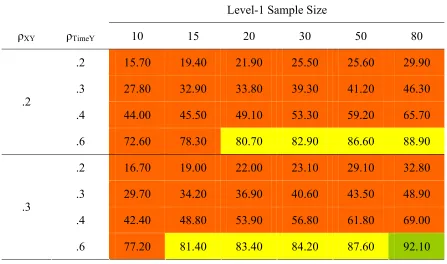
Power to detect β10. In general, power to detect β10 was similar for the two tested
correlations between X and Y, with power values being slightly larger for the larger X-Y
correlation. As expected, the value of the correlation between Time and Y had greater
influence on the power to detect β10. For the lowest level-2 sample size of 5, power was
only adequate for the highest correlation between Time and the outcome variable (Table
3). When ρTimeY was set to .6, however, sample sizes of 15 and above yielded power
greater than .8. Notably, when N2 was only 5 and the highest correlation combination
Table 3
Power to Detect β10 When N2 = 5
Level-1 Sample Size
ρXY ρTimeY 10 15 20 30 50 80
.2 15.70 19.40 21.90 25.50 25.60 29.90
.3 27.80 32.90 33.80 39.30 41.20 46.30
.4 44.00 45.50 49.10 53.30 59.20 65.70
.2
.6 72.60 78.30 80.70 82.90 86.60 88.90
.2 16.70 19.00 22.00 23.10 29.10 32.80
.3 29.70 34.20 36.90 40.60 43.50 48.90
.4 42.40 48.80 53.90 56.80 61.80 69.00
.3
.6 77.20 81.40 83.40 84.20 87.60 92.10
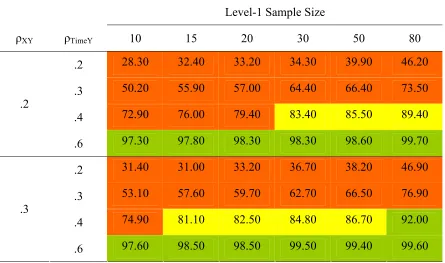
Level-2 sample sizes of 10 and 15 produced high power rates when the
correlation between Time and the outcome variable was large. Specifically, with N2 = 10
and ρTimeY = .6, power was above 90% for all tested level-1 sample sizes and X-Y
correlations (Table 4). Independent of ρXY, when ρTimeY was .4, most conditions showed
adequate or high power; when ρTimeY was .2 or .3, no conditions produced adequate power
to detect β10. Power rates increased when N2 was 15. Almost all conditions with ρTimeY of
20
Table 4
Power to Detect β10 When N2 = 10
Level-1 Sample Size
ρXY ρTimeY 10 15 20 30 50 80
.2 28.30 32.40 33.20 34.30 39.90 46.20
.3 50.20 55.90 57.00 64.40 66.40 73.50
.4 72.90 76.00 79.40 83.40 85.50 89.40
.2
.6 97.30 97.80 98.30 98.30 98.60 99.70
.2 31.40 31.00 33.20 36.70 38.20 46.90
.3 53.10 57.60 59.70 62.70 66.50 76.90
.4 74.90 81.10 82.50 84.80 86.70 92.00
.3
.6 97.60 98.50 98.50 99.50 99.40 99.60
Table 5
Power to Detect β10 when N2 = 15
Level-1 Sample Size
ρXY ρTimeY 10 15 20 30 50 80
.2 37.90 42.60 44.80 45.80 53.10 61.40
.3 67.80 72.30 75.40 77.70 82.10 87.10
.4 89.00 91.10 92.30 94.90 94.70 98.30
.2
.6 99.50 99.80 99.80 100.00 100.00 100.00
.2 39.80 43.30 44.20 47.80 54.10 62.40
.3 70.50 75.10 77.40 80.50 83.70 89.00
.4 90.80 92.20 93.60 96.10 96.10 98.10
.3
[image:33.612.103.548.115.378.2]With N2 = 20 and ρTimeY = .6, almost all tested level-1 sample sizes yielded
perfect power. Furthermore, when ρTimeY was .4, power was always above 90%. Even for
ρTimeY = .3, all but the condition with the lowest values for N1 and ρXY had adequate or
high power. None of the conditions with ρTimeY = .2 had adequate power with 20
participants.
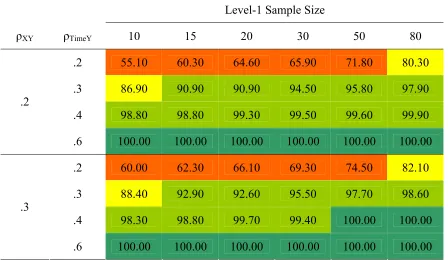
Within a set of predictor-outcome correlations, power increased slowly with an
increase in N2 (Table 6). This was especially pronounced for ρTimeY = .2. For conditions
in which N2 ≥ 25, N1 ≥ 15, and ρTimeY≥ .3 power was high. When only 10 measurements
22
Table 6
Power to Detect β10 When N2 = 25
Level-1 Sample Size
ρXY ρTimeY 10 15 20 30 50 80
.2 55.10 60.30 64.60 65.90 71.80 80.30
.3 86.90 90.90 90.90 94.50 95.80 97.90
.4 98.80 98.80 99.30 99.50 99.60 99.90
.2
.6 100.00 100.00 100.00 100.00 100.00 100.00
.2 60.00 62.30 66.10 69.30 74.50 82.10
.3 88.40 92.90 92.60 95.50 97.70 98.60
.4 98.30 98.80 99.70 99.40 100.00 100.00
.3
.6 100.00 100.00 100.00 100.00 100.00 100.00
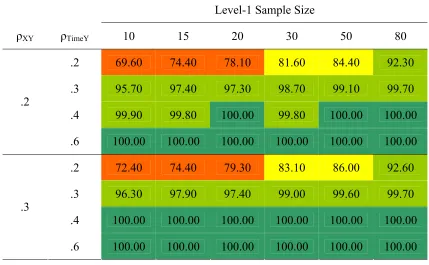
Even for the highest tested level-2 sample size of 35 (Table 7), power was not
adequate for conditions where ρTimeY was .2 and N1 was less than 30. It was, however
Table 7
Power to Detect β10 When N2 = 35
Level-1 Sample Size
ρXY ρTimeY 10 15 20 30 50 80
.2 69.60 74.40 78.10 81.60 84.40 92.30
.3 95.70 97.40 97.30 98.70 99.10 99.70
.4 99.90 99.80 100.00 99.80 100.00 100.00
.2
.6 100.00 100.00 100.00 100.00 100.00 100.00
.2 72.40 74.40 79.30 83.10 86.00 92.60
.3 96.30 97.90 97.40 99.00 99.60 99.70
.4 100.00 100.00 100.00 100.00 100.00 100.00
.3
.6 100.00 100.00 100.00 100.00 100.00 100.00
Overall, the correlation between Time and the outcome variable had great
influence on power to detect β10. This was expected as β10 is the fixed effect that models
the level-1 predictor’s direct influence on the outcome variable. The magnitude of ρXY
24
Power to detect β01. Within any correlation combination, the power to detect β01
increased with an increase in either level-1 or level-2 sample size. It also increased with
an increase in the correlation between the level-2 predictor X and the outcome variable
Y, that is, the correlation associated with β01. Furthermore, an increase in the correlation
between the Time and the outcome variable increased the power of β01 as well. This
increase, however, was not as strong as the one related to the increase in ρXY.
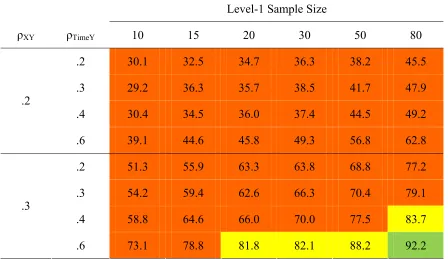
Power to detect β01 under conditions in which N2 = 5 was extremely low, ranging
from 17.7% for the lowest level-1 sample size and lowest correlation combination to a
still low 65.1% for the highest level-1 sample size and highest correlation combination.
Additionally, when the correlation between the level-2 predictor and the outcome
variable was set to .2, power was inadequate for all conditions with a level-2 sample size
of either 10 or 15. For a correlation between X and Y of .3, power was at least adequate
for more than half of the tested conditions, with values increasing with an increase in
level-1 sample size or an increase in the correlation between Time and the outcome
variable. In conditions when 80 measurements were simulated for 15 participants, power
was high at all values tested of the correlation between Time and Y. Also, when the
Time-Y correlation was set to .6, taking at least 15 measurements produced high power.
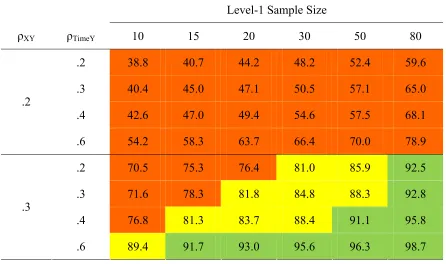
The specific power results for N1 of 10 and 15 are presented in Table 8 and Table 9,
Table 8
Power to Detect β01 When N2 = 10
Level-1 Sample Size
ρXY ρTimeY 10 15 20 30 50 80
.2 30.1 32.5 34.7 36.3 38.2 45.5
.3 29.2 36.3 35.7 38.5 41.7 47.9
.4 30.4 34.5 36.0 37.4 44.5 49.2
.2
.6 39.1 44.6 45.8 49.3 56.8 62.8
.2 51.3 55.9 63.3 63.8 68.8 77.2
.3 54.2 59.4 62.6 66.3 70.4 79.1
.4 58.8 64.6 66.0 70.0 77.5 83.7
.3
26
[image:39.612.102.548.131.395.2]Table 9
Power to Detect β01 When N2 = 15
Level-1 Sample Size
ρXY ρTimeY 10 15 20 30 50 80
.2 38.8 40.7 44.2 48.2 52.4 59.6
.3 40.4 45.0 47.1 50.5 57.1 65.0
.4 42.6 47.0 49.4 54.6 57.5 68.1
.2
.6 54.2 58.3 63.7 66.4 70.0 78.9
.2 70.5 75.3 76.4 81.0 85.9 92.5
.3 71.6 78.3 81.8 84.8 88.3 92.8
.4 76.8 81.3 83.7 88.4 91.1 95.8
.3
.6 89.4 91.7 93.0 95.6 96.3 98.7
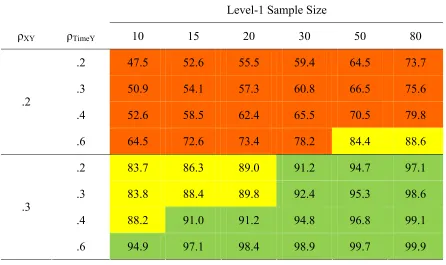
For a level-2 sample size of 20 (Table 10), power was never high when ρXY was
.2 and ρTimeY was .6. It reached adequate values for level-1 sample sizes of 50 and 80.
Power increased substantially when ρXY was increased to .3. All conditions in which ρXY
Table 10
Power to Detect β01 When N2 = 20
Level-1 Sample Size
ρXY ρTimeY 10 15 20 30 50 80
.2 47.5 52.6 55.5 59.4 64.5 73.7
.3 50.9 54.1 57.3 60.8 66.5 75.6
.4 52.6 58.5 62.4 65.5 70.5 79.8
.2
.6 64.5 72.6 73.4 78.2 84.4 88.6
.2 83.7 86.3 89.0 91.2 94.7 97.1
.3 83.8 88.4 89.8 92.4 95.3 98.6
.4 88.2 91.0 91.2 94.8 96.8 99.1
.3
.6 94.9 97.1 98.4 98.9 99.7 99.9
When N2 was 25, power increased such that it was at least adequate for N1 = 80
and ρXY = .2 for all tested Time-outcome correlations. In the case of a high correlation of
.6 between Time and Y and the low correlation of .2 between X and Y, power was
adequate starting at a level-1 sample size of 15 and high when N1 was at least 50. When
ρXY was increased to .3, all but the lowest sample size combination had high power. For
N1 of either 50 or 80 and the correlation between Time and Y being at least .4, power
28
Table 11
Power to Detect β01 When N2 = 25
Level-1 Sample Size
ρXY ρTimeY 10 15 20 30 50 80
.2 53.7 61.8 61.8 69.8 71.8 82.1
.3 60.7 64.9 68 73.3 76.7 84.0
.4 63.0 67.7 70.8 74.0 80.1 87.0
.2
.6 76.7 80.9 83.2 87.6 91.7 95.1
.2 89.0 92.1 94.9 96.6 98.2 99.0
.3 90.9 94.4 95.1 97.7 97.2 99.8
.4 94.3 95.9 96.4 98.5 99.4 99.6
.3
.6 99.2 99.4 99.5 99.8 100 100
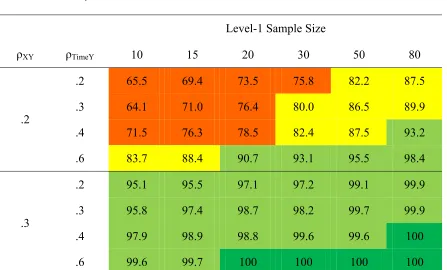
Table 12
Power to Detect β01 When N2 = 30
Level-1 Sample Size
ρXY ρTimeY 10 15 20 30 50 80
.2 65.5 69.4 73.5 75.8 82.2 87.5
.3 64.1 71.0 76.4 80.0 86.5 89.9
.4 71.5 76.3 78.5 82.4 87.5 93.2
.2
.6 83.7 88.4 90.7 93.1 95.5 98.4
.2 95.1 95.5 97.1 97.2 99.1 99.9
.3 95.8 97.4 98.7 98.2 99.7 99.9
.4 97.9 98.9 98.8 99.6 99.6 100
.3
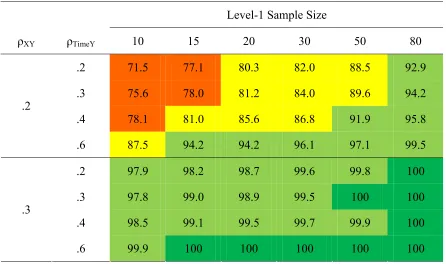
[image:41.612.103.550.442.712.2]For a level-2 sample size of 30 or 35, all Time-Y correlations produced high or
perfect power when ρXY = .3. For the conditions when ρXY was .2, power increased
further with increasing level-1 sample size and ρTimeY. When N2 was 35, all conditions
with N1 being at least 20 produced adequate or high power. For a Time-outcome
correlation of .6, all tested values of N1 produced adequate or high power (Table 13).
[image:42.612.102.548.264.528.2]Table 13
Power to Detect β01 When N2 = 35
Level-1 Sample Size
ρXY ρTimeY 10 15 20 30 50 80
.2 71.5 77.1 80.3 82.0 88.5 92.9
.3 75.6 78.0 81.2 84.0 89.6 94.2
.4 78.1 81.0 85.6 86.8 91.9 95.8
.2
.6 87.5 94.2 94.2 96.1 97.1 99.5
.2 97.9 98.2 98.7 99.6 99.8 100
.3 97.8 99.0 98.9 99.5 100 100
.4 98.5 99.1 99.5 99.7 99.9 100
.3
.6 99.9 100 100 100 100 100
Overall, the correlation between X and the outcome variable had great influence
on power to detect β01. This was expected as β01 is the fixed effect that models the level-2
predictor’s direct influence on the outcome variable. When ρXY was .3, all conditions with
a level-2 sample size of 20 or higher produced adequate or high power. In conditions with
the lower correlation between the level-2 predictor and Y, only larger values of N1 and
30
Power to detect β11. In general, the correlation between Time and the outcome
variable (ρTimeY) had more impact on the power to detect β11 than the correlation between
X and Y. Specifically, power was inadequate for all conditions tested where N2 was 5.
Even for the highest correlation combination (ρTimeY = .6 and ρXY = .3), power to detect
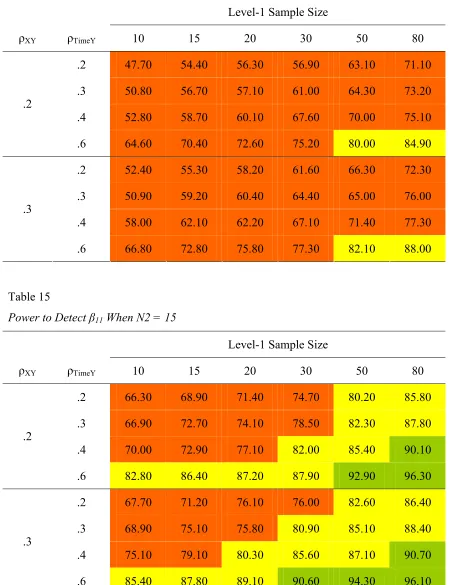
β11 was only 62%. When N2 was doubled to 10 (Table 14), only two conditions produced
adequate power (ρTimeY = .6 and N1 > 50). When the level-2 sample size was increased to
15, power increased appreciably (Table 15). All conditions with a Time-Y correlation of
at least .6 or at least 50 measurement occasions produced power rates above 80%.
This trend of increasing power continued with the increase of the level-2 sample
size. For those conditions where N2 was 20, all but two conditions produced at least
adequate power; for half of them, power was high. Furthermore, 42 conditions with N2 =
25 produced high power; the other 6 conditions produced adequate power (Table 16).
When N2 ≥ 30 power rates to detect the interaction effect were all high; more
specifically, all power rates were above 94.9 %. Seven of the conditions with the highest
number of measurements per person and higher predictor-outcome correlations reached
Table 14
Power to Detect β11 When N2 = 10
Level-1 Sample Size
ρXY ρTimeY 10 15 20 30 50 80
.2 47.70 54.40 56.30 56.90 63.10 71.10
.3 50.80 56.70 57.10 61.00 64.30 73.20
.4 52.80 58.70 60.10 67.60 70.00 75.10
.2
.6 64.60 70.40 72.60 75.20 80.00 84.90
.2 52.40 55.30 58.20 61.60 66.30 72.30
.3 50.90 59.20 60.40 64.40 65.00 76.00
.4 58.00 62.10 62.20 67.10 71.40 77.30
.3
.6 66.80 72.80 75.80 77.30 82.10 88.00
Table 15
Power to Detect β11 When N2 = 15
Level-1 Sample Size
ρXY ρTimeY 10 15 20 30 50 80
.2 66.30 68.90 71.40 74.70 80.20 85.80
.3 66.90 72.70 74.10 78.50 82.30 87.80
.4 70.00 72.90 77.10 82.00 85.40 90.10
.2
.6 82.80 86.40 87.20 87.90 92.90 96.30
.2 67.70 71.20 76.10 76.00 82.60 86.40
.3 68.90 75.10 75.80 80.90 85.10 88.40
.4 75.10 79.10 80.30 85.60 87.10 90.70
.3
[image:44.612.104.548.116.378.2]32
Table 16
Power to Detect β11 When N2 = 25
Level-1 Sample Size
ρXY ρTimeY 10 15 20 30 50 80
.2 86.30 87.90 91.30 92.80 95.40 97.70
.3 87.90 89.50 92.00 92.60 95.80 97.90
.4 90.00 93.30 93.40 95.10 97.00 99.10
.2
.6 95.10 97.30 97.80 98.70 98.80 99.60
.2 85.40 91.00 91.90 94.40 96.60 97.90
.3 88.90 92.30 93.20 94.60 96.50 98.20
.4 90.50 91.70 95.50 96.70 98.10 98.70
.3
.6 97.10 98.90 98.70 99.30 98.70 99.70
Table 17
Power to Detect β11 When N2 = 35
Level-1 Sample Size
ρXY ρTimeY 10 15 20 30 50 80
.2 94.90 96.30 97.20 97.90 98.70 100.00
.3 95.80 97.00 98.50 99.00 99.20 99.80
.4 97.10 97.00 98.10 99.20 99.50 99.90
.2
.6 98.60 99.30 99.80 99.80 100.00 100.00
.2 95.00 98.50 97.70 98.00 99.30 99.80
.3 95.80 98.30 99.20 99.50 99.40 99.90
.4 96.50 98.70 99.00 99.70 99.50 100.00
.3
Overall, both predictor-outcome correlations had great impact on the power to
detect β11. This was expected as β11 is the fixed effect that models the influence of the
cross-level interaction on the outcome variable. All conditions with N2 ≥ 25 produced at
least adequate power to detect β11.
Power to detect the level-2 variances. Changing the correlations between the
outcome variable and either predictor had no discernable effect on the power of detecting
τ00 or τ11. To illustrate this, the results for the combination of the lowest and highest
correlations are presented. Tables 18 and 19 show the pattern of the power to detect τ00
for the lowest and highest predictor-outcome correlation combinations tested. Tables 20
and 21 illustrate the pattern for τ11.
For the conditions tested, the power to detect τ00 depended upon the level-1 and
level-2 sample size. Power was 0 for all conditions where N2 was 5. Doubling N2 to 10
did not improve the situation; power was still less than 1% even for large level-1 sample
sizes. Increasing N2 beyond 10 produced rapid increases in power, with the majority of
conditions reaching adequate, high, or perfect power. Increasing the level-1 sample size
to at least 30 did allow for adequate or high power for N2 = 15. When N2 = 25, 15
measurements were sufficient for high power. For the lowest level-1 sample size of 10,
adequate power was reached for the two highest level-2 sample sizes tested. In addition,
no conditions tested in which N1 = 10 reached power rates above 90%. Overall, high
power was achieved in more than 25% of the conditions; perfect power was reached for
about a quarter of the tested conditions. In general, power increased faster with an
34
Table 18
Power to Detect τ00 When ρTimeY = 0.2 and ρXY = 0.2
N1
N2 10 15 20 30 50 80
5 0.00 0.00 0.00 0.00 0.00 0.00
10 0.00 0.00 0.00 0.00 0.10 0.50
15 18.90 40.50 61.40 85.40 96.90 99.70
20 48.00 79.10 92.80 99.00 99.90 100.00
25 70.70 91.40 98.10 99.80 100.00 100.00
30 82.90 97.20 99.50 100.00 100.00 100.00
[image:47.612.105.440.119.393.2]35 88.40 99.60 100.00 100.00 100.00 100.00
Table 19
Power to Detect τ00 When ρTimeY = 0.6 and ρXY = 0.3
N1
N2 10 15 20 30 50 80
5 0.00 0.00 0.00 0.00 0.00 0.00
10 0.00 0.00 0.00 0.00 0.10 0.40
15 19.90 41.40 61.80 86.00 97.00 99.80
20 49.90 79.10 91.20 99.20 100.00 100.00
25 69.20 93.20 98.00 100.00 100.00 100.00
30 80.20 96.40 99.50 100.00 100.00 100.00
Power to detect τ11 was very similar to detecting power for τ00. The only condition
which produced adequate power for τ11 but not τ00 was the sample size combination of
(15, 20). Also, perfect power for τ11 was reached for fewer conditions with a level-1
sample size of 30.
Table 20
Power to Detect τ11 When ρTimeY = 0.2 and ρXY = 0.2
N1
N2 10 15 20 30 50 80
5 0.00 0.00 0.00 0.00 0.00 0.00
10 0.00 0.00 0.00 0.00 0.00 0.30
15 19.40 42.10 60.90 86.90 97.70 99.50
20 49.60 80.40 91.80 99.10 100.00 100.00
25 71.90 93.90 98.10 99.80 100.00 100.00
30 82.80 97.80 99.30 99.90 100.00 100.00
36
Table 21
Power to Detect τ11 When ρTimeY = 0.6 and ρXY = 0.3
N1
N2 10 15 20 30 50 80
5 0.00 0.00 0.00 0.00 0.00 0.00
10 0.00 0.00 0.00 0.00 0.00 0.60
15 18.90 43.00 64.80 85.50 97.80 99.00
20 50.40 81.00 91.20 98.20 100.00 100.00
25 70.00 93.20 98.20 99.80 100.00 100.00
30 83.40 97.90 99.70 100.00 100.00 100.00
Power to detect the level-1 variance. Under all conditions tested with N2 ≥ 10,
power to detect the level-1 variance was perfect, independent of the predictor-outcome
correlations and sample sizes. When the level-2 sample size was set to 5, some of the
conditions produced power slightly less than perfect. This occurred when the level-1
sample size was either 10 or 15. Under these conditions, power rates were above 99%.
Type I Error Rates. For τ01, all Type I error rates were below 5%, irrespective of
correlations and sample sizes. Increasing the level-1 sample size had no discernable
effect on the Type I error rates for τ01. For all conditions with N2 being 10, the Type I
error rate was 0.10% or 0%. The error rates increased steadily with the increase of N2 for
all tested conditions. The pattern does not indicate whether increasing N2 beyond the
chosen maximum could produce undesirably high Type I error rates for τ01.
The Type I error rate of the autocorrelation factor was around the expected 5% (M
= 5.08, SD = 0.706), but slightly inflated. It was not influenced by any of the variables
that were varied in this study. This means that neither the sample size combination nor
the strengths of the predictor-outcome correlations had any impact on the Type I error
38
Conditions With Nonzero Autocorrelation
Biases. For the conditions tested where N2 was greater than 5, the biases of the
fixed effects were all below 5% regardless of the magnitude of the autocorrelation factor.
For those conditions where N2 was 5, most biases were below 5%. Some values
exceeded 5% but all were below 10%. No discernable pattern that could explain the
marginally inflated biases was present.
Conditions tested with nonzero autocorrelation showed inflated estimates for the
level-2 error variances τ00 and τ11 when the total sample size was small (Table 15). The
inflation of the biases increased further for conditions with non-zero autocorrelation.
Furthermore, the higher the autocorrelation, the higher was the inflation of the estimates
of the level-2 variances. Therefore, more conditions produced biases of τ00 and τ11 beyond
5% and 10%. Under the highest tested autocorrelation, all biases of τ00 were greater than
10% for a level-1 sample size of 10. The average inflation of the intercept variance τ00 for
the lowest sample size combination and the highest autocorrelation factor tested was
above 75%.
For all conditions tested in which N2 = 5, the biases were inflated. Only large
level-1 sample sizes produced biases in the estimates of τ00 that were around or below
5%. Biases were below 5% in less than 7% of the conditions. This was not achieved for
the conditions with 2
auto
Table 22
Biases for τ00 When ρTimeY = .2 and ρXY = .2 and N2 = 5
N1
2
auto
ρ 10 15 20 30 50 80
0 25.844 15.370 9.314 8.633 5.159 3.640
.05 47.755 32.310 21.220 13.293 6.617 5.247
.10 66.169 43.448 30.904 11.870 7.859 5.336
.15 76.404 50.191 35.433 27.589 12.462 4.036
.20 99.842 60.467 54.616 30.933 19.731 8.956
.25 114.653 80.138 57.789 39.523 17.803 12.000
Increasing the level-2 sample size to 10 produced more than 63% of the tested
conditions with desirable levels of biases. The conditions with the highest 2
auto
ρ needed 50
or 80 measurements per person to decrease the biases below 5%. No conditions with (10,
40
[image:53.612.101.524.137.341.2]Table 23
Biases for τ00 When ρTimeY = .2 and ρXY = .2 and N2 = 10
N1
2
auto
ρ 10 15 20 30 50 80
0 8.4221 1.651 1.097 1.167 0.959 -0.808
.05 20.441 4.384 0.835 1.153 0.440 1.053
.10 24.220 13.115 2.336 1.900 -0.161 7.197
.15 38.101 13.791 8.534 6.077 1.184 -2.390
.20 52.315 22.454 12.528 2.828 4.783 -0.970
.25 75.270 29.266 17.738 10.608 0.431 2.968
For even higher level-2 sample sizes, the impact of the autocorrelation factor on
the intercept variance estimates lessened (Table 24). The effect decreased further for N2
= 25 to the point where only conditions with high levels of autocorrelation and a level-1
Table 24
Biases for τ00 When ρTimeY = .2 and ρXY = .2 and N2 = 15
N1
2
auto
ρ 10 15 20 30 50 80
0 0.405 -0.713 -2.884 -0.164 -0.954 0.134
.05 7.913 1.777 1.388 0.731 -0.005 -0.502
.10 13.699 4.604 2.604 2.210 -1.070 -0.158
.15 17.727 9.525 -0.113 0.996 0.336 -0.318
.20 28.868 12.998 3.179 1.157 -0.359 0.198
[image:54.612.99.523.427.639.2].25 42.742 15.116 6.565 4.346 1.477 -1.020
Table 25
Biases for τ00 When ρTimeY = .2 and ρXY = .2 and N2 = 25
N1
2
auto
ρ 10 15 20 30 50 80
0 0.820 0.001 -0.975 -0.362 -1.534 -0.281
.05 4.930 -0.570 -1.382 1.285 0.663 0.081
.10 4.188 0.597 -2.657 -0.354 0.017 0.365
.15 7.937 -0.462 -2.346 -0.789 -0.870 -1.618
.20 13.691 2.467 -2.126 -0.299 -0.865 -0.377
.25 21.828 1.495 -0.594 -0.299 -0.878 1.3044
For larger level-2 sample sizes, the pattern continued. When N2 = 30, two values
42
the lowest level-1 sample size produced an undesirably large bias in the intercept
variance.
The biases for the slope variance τ11 behaved similarly to those of the intercept
variance. The higher the autocorrelation was, the greater was the inflation of the
estimates. Increasing the level-2 sample size produced more conditions with desirable
biases below 5%. For identical conditions the biases for τ11 were lower than those for τ00
(Tables 26 – 28). For all conditions in which the level-2 sample size was 25 or larger, all
biases for the intercept variance were below 5%.
Table 26
Biases for τ11 When ρTimeY = .2 and ρXY = .2 and N2 = 5
N1
2
auto
ρ 10 15 20 30 50 80
0 32.8617 18.8305 12.5967 7.6518 4.8994 2.919
.05 47.852 25.442 16.899 11.440 9.4120 2.841
.10 51.0686 35.2764 21.6302 10.1906 10.052 5.7171
.15 65.3546 40.416 33.9444 24.789 12.4155 6.4905
.20 58.2468 47.2195 38.1037 25.3437 19.6062 9.0961
Table 27
Biases for τ11 When ρTimeY = .2 and ρXY = .2 and N2 = 10
N1
2
auto
ρ 10 15 20 30 50 80
0 4.042 -1.385 -2.783 0.623 -0.086 2.106
.05 11.506 3.655 4.175 1.499 1.417 -0.372
.10 13.529 7.981 5.002 -0.636 0.063 1.173
.15 18.554 10.299 6.566 -0.551 -1.193 -1.187
.20 29.229 9.989 6.711 5.186 -0.380 -0.890
[image:56.612.98.524.418.644.2].25 31.278 14.395 7.346 5.224 0.715 0.567
Table 28
Biases for τ11 When ρTimeY = .2 and ρXY = .2 and N2 = 15
N1
2
auto
ρ 10 15 20 30 50 80
0 0.237 1.434 -0.599 1.990 -0.029 -2.019
.05 5.9213 1.039 0.767 1.007 -1.412 -0.699
.10 6.772 2.119 2.411 -3.284 0.217 -0.850
.15 8.405 1.149 0.809 1.509 -1.401 -0.193
.20 10.22 1.561 -0.858 -1.142 0.023 -0.064
.25 11.673 7.268 0.9041 -1.468 -2.310 -0.702
While the biases for the level-1 error variance were all below 5% when the
44
produced large negative biases. The estimates were severely deflated for some conditions
with low sample size combinations and high autocorrelation.
For a level-2 sample size of 5, about half of the estimates were deflated by more
than 5%. The majority of the biases above 5% were higher than 10%, with the highest
exceeding 30%. As Table 29 illustrates, even the biases below 5% showed a pattern of
[image:57.612.101.522.306.487.2]becoming more negative with increasing autocorrelation.
Table 29
Biases of 2
e
σ When ρTimeY = .2 and ρXY = .2 and N2 = 5
N1
2
auto
ρ 10 15 20 30 50 80
.05 -8.719 -2.998 -1.684 -0.809 -0.453 0.004
.10 -14.489 -6.400 -2.690 -1.371 -0.898 0.047
.15 -19.207 -8.219 -5.398 -2.784 -1.033 -0.033
.20 -25.34 -12.764 -7.951 -3.636 -2.243 -0.805
.25 -31.086 -17.546 -10.819 -5.426 -1.676 -1.193
Similar to the biases of the level-2 variances, increasing the level-2 sample size
improved the estimates of the level-1 variance. At N2 = 10, fewer conditions produced
undesirable biases, with only two conditions having biases in excess of 10% (Table 30)
with one being larger than 20%. This trend of improved biases continued for N2 being
15. Only the condition with the highest autocorrelation and the lowest level-1 sample size
had a negative bias of 2
e