ScholarWorks @ Georgia State University
ScholarWorks @ Georgia State University
Art and Design Theses Ernest G. Welch School of Art and Design
Spring 5-6-2012
Fully Loaded
Fully Loaded
Laura M. Martin Georgia State University
Follow this and additional works at: https://scholarworks.gsu.edu/art_design_theses
Recommended Citation Recommended Citation
Martin, Laura M., "Fully Loaded." Thesis, Georgia State University, 2012. https://scholarworks.gsu.edu/art_design_theses/110
by
LAURA MARIE MARTIN
Under the Direction of Mark Burleson
ABSTRACT
My ceramic sculptures are abstracted portraits of friends and family. They reveal
no clues about the age, the gender, or the physical identity of the subjects. Instead,
they are abstracted character traits rendered in clay with a biomorphic sensibility. I
translate a particular personality trait of a friend or family member into a tangible object
and arrange those pieces referencing botanical forms. I tend to choose the negative
traits that cause friction in our relationship. My work is a way of acknowledging and
dealing with the struggle these traits have caused. I structure my pieces as a floral
arrangement to transfer an otherwise unfavorable experience into a positive one.
by
LAURA MARIE MARTIN
A Thesis Submitted in Partial Fulfillment of the Requirements for the Degree of
Master of Fine Arts
in the College of Arts and Sciences
Georgia State University
Copyright by Laura Marie Martin
by
LAURA MARIE MARTIN
Committee Chair: Mark Burleson
Committee: Christina West
Joe Peragine
Tim Flowers
Electronic Version Approved:
Office of Graduate Studies
College of Arts and Sciences
Georgia State University
DEDICATION
I would like to dedicate this to Eleanor K. Martin and Wayne D. Martin, my Mom
and Dad who are my biggest fans and loyal patrons. Thank you for showing me at an
early age that art is important. I would also like to dedicate this to my two big brothers
David and Stephen who were responsible for every baby tooth I lost and getting my skin
thick enough for art school. The four most important people in my life who have never
let me down. Thank you for showing me the kind of person I want to be. I love you. I
ACKNOWLEDGEMENTS
I would like to thank my thesis committee, Mark Burleson, Christina West, Tim
Flowers and Joe Peragine for their guidance, presence, and time. I would also like to
thank my fellow 3-D graduate students for giving me the feed back, encouragement,
and criticism that allowed me to make this work. I have a special thank you to an
illustrious man and friend Christopher Maschinot, aka Chrissy Macintosh, for installing
my entire show right by my side. I would like to thank Ashley Maxwell, Alex Kerr,
Miranda Smith and Phoenix Savage who for have helped me install, edit, photograph,
and laugh through this process. Thank you to Mona Stevens who took me art shows as
a little kid and exposed me to so much of the art that I still love today. Lastly, thanks to
all the people who are unwillingly and unknowingly featured in my series, FULLY
TABLE OF CONTENTS
ACKNOWLEDGEMENTS...v
LIST OF FIGURES...vii
1 INTRODUCTION...1
2 RONNIE...2
3 PORTRAITURE...6
4 RANDY...9
5 INFLUENCES ...11
6 RED ...16
7 MATERIALS AND PROCESS ...19
8 CONCLUSION...24
LIST OF FIGURES
Figure 1. Sunny 2
Figure 2. Arrangement in Greyand Black No. 1 or Whistler’s Mother by James McNeill Whistler 7 Figure 3. Portrait of Ross in L.A. by Felix Gonzalez-Torres 8
Figure 4. Big Red 10
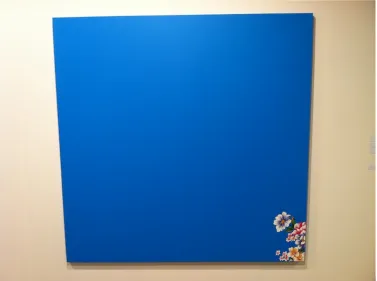
Figure 5. Amazing Blue by Michael Lin 11
Figure 6. Flirt by Jason Briggs 12
Figure 7. Cinesias Entreating Myrrhina to Coition by Aubrey Beardsley 13
Figure 8. Summer by Alphonse Mucha 14
Figure 9. Fables CoverArt by James Jean 15
Figure 10. Just Peachy 18
Figure 11. Just Peachy detail 19
Figure 12. Big Red Detail 21
Figure 11. Gold Finger 22
Figure 11. Triple Dong 23
1 INTRODUCTION
“Taking an alternative approach to traditional portraiture, Martin deters from the
mimetic rendering of facial features to focus on the representation of individual
personality traits, translating abstract characteristics into visual form. Each piece is
loaded with elements that contain imagery and meaning. To balance these human
imperfections, Martin juxtaposes her emblematic body parts with a collection of
meticulously rendered flowers, revealing her own personal penchant for gardening. The
additions stand as symbolic gestures, bringing the artist into the work. Thus, more than
a mere likeness of one person, the final bouquets depict the portrait of a relationship,
extending the metaphor that like a garden, a friendship, too, requires cultivation.”
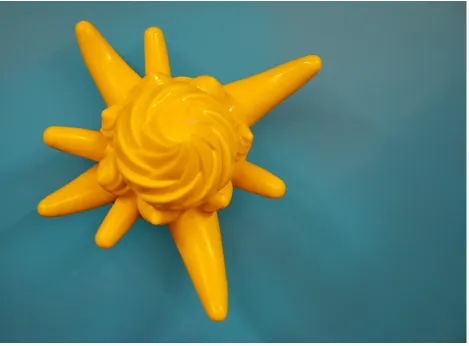
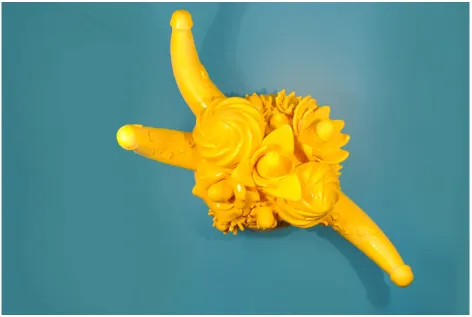
Figure 1. Sunny 9”x8”x7”
2 RONNIE
Ronnie was always the center of attention. He was the class clown, the life of
the party and the bell of the ball. Ronnie was also a junkie. I met him at a party when I
was sixteen. I remember my friend Austin going on and on about how talented Ronnie
was and a “really brilliant person, if only he wouldn’t eat pills all day.” At that moment
Ronnie perked up and said “Pills! I forgot, I’ve got pills!” as he pulled a plastic bag out
the plastic sandwich bag and literally threw a fistful of pills in the direction of his mouth.
He probably managed to get several in the hole. The room watched and laughed as the
other pills rolled down his beard then his coat. This whole scene lasted only seconds
but long enough for Austin to finish his sentence with saying …“Exactly.”
I should have known then, I should have stayed away. That was fair warning,
more than fair. That was a 6’4” red flag. But he was just so funny. He was hard to get
to know, late nights and bad habits gave him a terrible memory. I always had to remind
him who I was. I would see him at a party and I would say “Hi.” I could tell he did not
remember me so I would start to remind him…
“Remember me? I met you at Austin’s party a couple weeks ago…no?, We
were both dressed up as Tom Baker last week for Halloween and we agreed he was the
best Dr. Who…no? You erased all my late charges at the video store when you were
working yesterday…This was yesterday!...no clue, huh.”
As a test, I gave him a plane ticket with my name on it and told him I needed it
back in two weeks before my flight. I told him “It’s very important that you give this
plane ticket back to me before my flight in two weeks but in the mean time you learn my
name.” He said he was nervous about it but up to the challenge. That plane ticket was
two years old. He did not notice.
The next time I saw Ronnie he was trying to sneak KFC into a movie theatre. I
laughed out loud when he got busted with fried chicken by the ticker taker. He must
have heard me because he turned around, and to my surprise not only did he have my
Over the next two years he would introduce me to Ingmar Bergman and Woody
Allen and we would compare and contrast. He read Kurt Vonnegut and Hunter S.
Thompson novels to me. He showed me Koyaanisqatsi and Citizen Cane and we
talked about the importance of lighting and perspective. He played Brian Eno and
Bonnie Prince Billy albums for me. He taught me how to play guitar. He showed me the
wonderful world of John Waters. Before he played Harold and Maude for me he said
“This is gonna be your favorite,” and he was right. I told him I always wanted one of
those big, red balloons that car dealerships have tied to their roofs. The next morning I
had one tied to my truck’s ball hitch. Those balloons are the size of a car once you pull
them down out of the sky. It must have been a running theme with him because when I
got home from school that day I went to my bedroom only to find that it was flooded with
red balloons that flowed out into the hallway and down the stairs when I opened the
door. It was good.
It was good, until it wasn’t. A couple years in I noticed that his memory again
began to fade, like it used to when we first met. He became inconsistent and unreliable.
He started wearing long sleeves in the summer and his head would nod up and down in
slow motion for hours. He was either bouncing off the wall or nodding off. I found him
early one morning with some “new” friends at his apartment watching a stack of Jim
Jarmusch movies projected on a dirty bed sheet. From the looks of them, they had not
slept in days. They were zombies hovered around a table that had a near empty bottle
of whiskey next to a small avalanche. I looked at Ronnie and he back at me with a
blank look on his face. He did not recognize me; it was just like the first few times we
I foolishly stuck around for two more years after that. A terrible two years trying
to save him or fix him or help him. It took me two years to figure out that was not going
to happen without his consent which he was not ready to give. I read about him in The
Blotter several times, I watched him get kicked out of bars, get fired from jobs, and lose
lifelong friends one by one. I was scared that if anything happened to him it would be
my fault which made it almost impossible to leave for good.
One of the last times I saw him he was working in a soup kitchen where I drop off
cans of food once a month. As part of his probation he would serve food but he always
stayed behind to chat with the regulars. He was clean and seeing him that way made
me proud. There he was, even at a soup kitchen he was at the head of the table
surrounded by homeless men discussing the existence of life on the sun. I watched him
listening to them and trying to respect their views on the galaxy. I finally felt free to go.
One year later I got a call from a mutual friend. She was frantic and yelling
something about Ronnie being locked in her bathroom. I got to her house as fast as I
could. I knew what it meant when Ronnie would lock himself inside a room. We broke
the door down. He was laid out on the tile floor next to the dark side of a spoon and his
arm wrapped up tight. He was the color of an eggplant. This was not the first time he
overdosed, but it was the last.
Ronnie often quoted Orson Welles, but the one that always stuck with me the
most was when he said “If you want a happy ending, that depends, of course, on where
3 PORTRAITURE
Portraiture is one of the oldest, most universal forms of art. It deals with the
nature of representation, aesthetic experience, and the relevance of cultural frameworks
in defining the self. It is reasonable to think portraits embody accumulated cultural
wisdom about what if is to be human. Portraits convey aspects of the sitter’s moral
character, class, emotional life, and the personality in their depictions.
Images of pregnant women depicting the importance of fertility are the first
known portraits, such as Venus of Willendorf dating back to 22,000 BC. Ancient
Egyptians made portrait masks so the soul could find its body in the after life. Medieval
art consists of likenesses of Deities and spirits because an artist’s patronage generally
came from the church, the subject of art and the mediums of art shifted to the church as
well.
Traditionally artists look to physical features to express the personality of their
subject. Davinci gave Mona Lisa a mysterious smile. Munch depicted a man on the
edge of insanity, screaming or rather the world screaming around him. The scene is
filled with panic and anxiety as he grasps his face in fear. Whistler’s mother was
painted still and steady with the presence of a woman who would always be there.
These portraits rely on the recognizable elements of human features. The smile, the
Figure 2. Arrangement in Greyand Black No. 1 or Whistler’s Mother by James McNeill Whistler
At the end of the nineteenth Century, abstract painters were working in the first
style of abstract art, cubism. Cubist painters like Braque and Picasso broke the subject
down into geometric shapes that are later reassembled into a pile of objects. This way,
the viewer is able to see from a different viewpoint, one of angles and elements. For
them, cubism allowed the portrait to transition from the conventional physical
More recently, Felix Gonzalez-Torres used a pile of candy to represent a loved
one dying of an AIDS-related illness in Portrait of Ross in L.A. The amount of candy
was equal to Ross’s ideal body weight of 175 pounds. Visitors to the gallery were
welcomed to take a piece of candy and soon the pile deteriorated as did Ross. At the
end of the day after the crowds where gone the candy would be replenished back to its
initial 175 pounds suggesting the idea of perpetual life. By using candy, Felix allowed
the viewer to engage with his piece using multiple senses of sight, touch, scent, and
taste.
4 RANDY
Randy lived up the street from me when I was still in the single digits. She was
older than me and she went to public school which made her kind of tough by default.
She was never very nice to me but I hung out with her anyway for some reason. I
guess it was slim pickings in the neighborhood that year.
Her house was at the top of the hill which is where I saw her one Christmas
morning to see what Santa had brought her. She got a big girl bike. By that I mean
there were no back peddle brakes and no training wheels. It had only two wheels and
hand brakes. It was a serious grown up bike. She asked me if I wanted to ride it and
even as a very little kid I was never one to say no. Now, at the time I was slightly
worried about the lack of training wheels but I did not want to let Randy see me sweat
so I jumped right on and started rolling. The last feeling I had before barreling down the
road were her fingers giving me a much unneeded push.
The seat was so high I could not reach the ground and the brakes were not
working as I feverishly peddled backwards. Randy neglected to tell me the brakes were
on the handles. It was pure terror. I saw the houses pass by in a blur in my periphery
as I searched for a grassy yard in which to crash. I knew I was going to have to take a
dive since the hill was just getting steeper, but when? An oncoming car made that
decision for me. It was like I just unwillingly entered into a game of chicken.
I decided on a modest thicket. The bunch of bushes was rather skimpy but it
was better than crashing into the car. Or so I thought, they were actually threaded with
thorns and poison ivy. The poison ivy I found out about the next day but the thorns and
walking down the hill after me and when she reach the site of my crash and burn she
looked down at me and said “I knew that would happen.” I remember lying there in pain
wondering why she had not let me in on those pearls of wisdom before I took off down
[image:20.612.75.543.233.597.2]the hill. What a jerk.
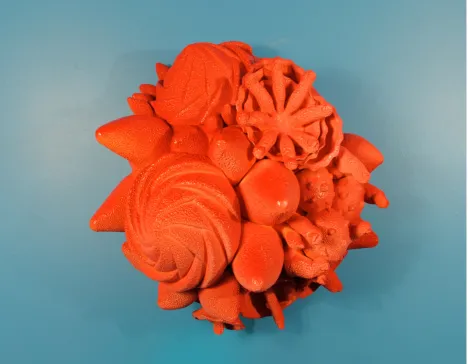
Figure 4. Big Red
5 INFLUENCES
My compositions are highly influenced by Taiwanese artist and designer Michael
Lin. It is in his use of negative space that I am most interested. His work moves away
from the idea of painting as an object and are more about creating a space to occupy.
He covers all surfaces including walls, floors, rugs, couches, and pillows and completely
envelopes the space. His work is surprisingly political given the look of his floral print
paintings, so his message is delivered through a less obvious route. Lin uses the
imagery of indigenous flowers of countries that have had conflict with China, mostly
Taiwanese species. His work is about struggle and political hardship but it is conveyed
through delicate oversized flowers which somewhat softens the blow of a heated
[image:21.612.112.489.403.684.2]subject, like a spoon full of sugar.
I have appropriated Michaels Lin’s signature blue that he uses for almost all of
his painting’s backgrounds. It is a blue the mimics the sky and therefore enhances any
floral hue. I have also arranged my ceramic bouquets on a blue square or rectangle
leaving much of the space as empty as Lin does. The large color field brings attention
to each piece, giving a color to pop off of and a personal spot in space rather than a
bare white wall. The negative space also alludes to the somewhat negative traits that
are being discussed in each piece.
Jason Briggs turns clay into flesh. Through tufting, stitching and puckering
porcelain he creates a corporal collage that makes my skin crawl while pulling me in
closer. His work activates both a sense of repulsion and attraction. I am also
influenced by Aubrey Beardsley’s tawdry sense of humor. He will catch a character with
their pants down or depict them with larger than life phalluses while dressed in the most
proper of late nineteenth century fashions. In this way he reduces his subject’s
personalities down to little sexual deviancies, similar to how I reduce my portraits down
to one particular trait that is not always their best.
My work aspires to have the sense of humor but also the attention to detail that
Briggs and Beardsley incorporate. Adding phalluses to the bouquets can create a
snicker but the intention is for more than a just a laugh. Using private parts are an easy
way to draw attention so I try to disguise them in a heavy coating of texture and glaze to
enhance the reveal and hide it from viewers who pass by too quick to stop and notice.
For color I look to Alphonse Mucha’s flowing organic structures and lines inspired
by nature. He epitomized Parisian art during the fin-de-siecle period, which is the main
era I draw from for form and pallet. I like to candy coat the surfaces in his pastel blues,
greens and pinks with an emphasis on the satin glaze to achieve the soft feel of his
illustrations and his small pops of color.
James Jean inspires me for the same reason but he brings a contemporary
edge through his graphic novel type of illustrations. He has an incredible understanding
and use of light and fluidity. Like Mucha, he uses pops of color to emphasis small
details which is why I use extremely bright colors on the added elements like a neon
green bullet or a bright yellow finger. There is a heightened sense of sexuality in their
work that is captivating without being over the top.
6 RED
The funny thing about this story is that I only knew part of it for a long time, my
part. I overheard my Dad and brother telling the other side of story at a family reunion
ten years after it actually happened.
I grew up in a town known for its music scene. There were so many bands to
see and so many years till I was legal to see them. I have never been known for my
patience so to avoid the wait I carried an I.D. I acquired of a woman who was 37 years
old and 4’10” tall. I was 14 and 9” taller but, hey it worked. Needless to say by the time
I turned 21 the last place I wanted to go was another bar. However, my best friend
used to wait for her Dad to fall asleep around midnight before she would ease his little
sports car out the drive way and over to my house. We would head downtown jamming
out to some Robert Palmer and George Michael all the way there.
It is silly when I think about how many bars I got into with that ladies I.D. but it is
even crazier how I would pass it above my head to my next friend in line and always get
away with it. We already felt like we were pushing it just getting in so we did not want to
risk trying to get drinks too. Her parents were fundraisers who threw lots of parties
which meant there was a never ending supply of wine and cheese at their house at all
times. She would grab a couple bottles of red from the wine closet and I would bring my
older brother’s beer funnel. Try funneling red wine on your knees in a gravel parking lot
between two open car doors so no one can see you. Now, I could not say what band it
was I snuck out to see that night or what hour in the morning it was when I got home but
My room had a balcony coming off two French doors. When I turned twelve my
parents removed the stairs from the balcony. It was almost as if they were thinking “Our
daughter is about to become a teenager, let’s make it a little harder for her to sneak
out.” I remember in the dark of the night, silently stacking a series of lawn furniture tall
enough to climb up and reach the bottom of the deck just to shimmy the rest of the way
up the brick wall. It was a routine. In the summertime those big garden spiders would
spin their webs from the awning to the ledge of the balcony and there was always the
terrifying chance that in the dark of the night I would crawl smack into one. This was a
chance I was not willing to take. I had a fix for that too which consisted of me throwing
whatever I could find from the yard in my line of fire. That night it was a soccer ball.
From where I was standing I thought this was a pretty good idea. The hope was
that the ball would fly through any major webs and clear the path for a gal who cannot
imagine many things worse than unexpectedly walking face first threw a spider’s web.
From where my Dad was standing, it sounded like a burglar trying to get in the house.
Apparently while I was clearing the way for my big break in, my Dad was wide
awake working. See, F.B.I. agents tend to keep rather strange hours and rather lethal
weapons which is a particularly good reason to not sneak into their homes. As soon as
he heard the muffled thumps that was his cue to get armed. He hustled down a flight of
stairs to my brother’s room who was aggressively awakened when my Dad rolled him
over and put a rifle in his arms saying “Get up! We’ve got an intruder.”
By the time I climbed the top of the plastic furniture mountain I had made I was
exhausted and still weary of webs. The doors creaked as I slowly pushed them open to
announce “Surrender!” Did I mention he is also a former Marine and Chicago police
officer? I think he was having flashbacks. Before I could get a word out he let me know
that he had a Glock pointed at my head and strongly suggested I not move. Of course
the red beam from the laser sight in my eye was more than enough proof for me. I did
not even know about the second gun man at the time. I did not say anything at first,
there was still apart of me that was not ready to give myself up, then I realized that was
insane. I finally yelled “Dad! Don’t shoot! It’s me!” I hit the lights to see my brother
standing at one side of the room with an M16 military rifle still pointed at me and my
three hundred pound Father in a pair of BVDs and a Leather Jacket with the Glock he
was yelling about one minute earlier.
[image:28.612.109.543.404.676.2]What a sight. I still have not decided whether I got off easy that night or not.
6 MATERIALS AND PROCESS
I work with clay because it allows me build, bend, stretch, shrink, warp, throw,
alter, adhere, cast, bind, and twist to achieve the structure I desire. The same material
that builds the structure also binds it together. Clay can take on any form so the
possibilities are endless. However, there are rules to working with clay. It needs
attention and care. It requires consideration and awareness and these details reveal
themselves as one’s relationship with the material progresses. Ceramics can be heavy
yet fragile, adding another level of difficulty. I find it interesting that a piece fired to
2200oF can feel so permanent when it gets out of the kiln, but has the potential to break
into a thousand pieces, a reminder of its ephemeral qualities.
I use porcelain to build the forms and also for the surface texture. It makes
sense to use something as natural as clay when reproducing botanical forms. However,
the processes undertaken to finish a piece can be very stressful. The drying process,
the heat from the fire, the silica from the glass all cause stress on the structure of the
clay. I see a connection between this aspect of the clay process and the strain a
relationship can go through at times.
I throw on the wheel to make the foundation, creating the basic shape of the
piece. I throw small pieces off the hump to create the individual elements that will
cover the foundation. I then alter the thrown pieces. Altering can happen through
cutting or darting the clay and then slipping and scoring it back together. Another
alteration happens by knocking the piece on its side to bend or slouch. This way each
piece has more character and distinctiveness then something strictly thrown on the
wheel. It also aids in giving the work a more organic appearance.
After the alteration is done I employ a method known as slip casting. This is a
way to make a copy of a three dimensional object. This first step is to make a plaster
mold of the object. After the plaster dries and the cast object is removed, slip is poured
into the mold. Slip is clay and water mixed into liquid form the consistency of paint. The
plaster pulls the moisture out of the slip which creates a shell. The excess slip is
poured out and the left over shell is left to dry. What is left is a copy of the original
object. Slip casting helps with the production process. This is useful when working in
multiples. It saves a lot of time and produces similar shapes that give the over all form
After the structure is built I apply a coating of slip to each piece by using a spray
gun. The spray gun is filled with the same slip that I used to join the pieces together
and also for the slip cast elements. For a thick application I stand back five to ten feet
from the piece and spray up to thirty coats of slip. A thick coat will take hours to apply.
It is important not to let too much time to pass in between coats however because the
sprayed shell of slip will begin to dry and flake. The thick coats can resemble moss or
algae growth and in depending on the final color can also look a lot like coral. To
achieve a heavily textured surface it is best to let the slip thicken up to the consistency
of syrup and spray at a lower PSI around thirty pounds per square inch. A more subtle
texture, like sandpaper, requires less time because there are less coats needed. Also,
the slip consistency should be close to buttermilk and the PSI can go up to fifty pounds
per square inch. I give about three feet of room between me and the piece when
spraying the texture to create a finer and more delicate finish.
After the surface is built up, it is time for color. Under glazes work well because
they are very stable and come in a large variety of colors. They also keep a very dry
surface which allows for glossy pops of color to be added later for a more dramatic or
wet effect. I use very bright candy coated colors that can be found in picture plants,
orchids, lilies, and tropical species. The vibrant colors are used to reference plant life
but also to draw attention the way flowers use color to attract bees. There are patterns
and stripes which can only be seen in ultra-violet which are invisible to us, but to a bee
are guides to the nectar. I attempt to reproduce these guides through texture and subtle
traces of pattern.
When the work is done being glazed fired it is placed on the wall. Presenting it
on the wall gives it the traditional placement of a portrait and is able to viewed all at
once as a portrait would typically be viewed. They are placed at average eye level as to
be able to confront the piece face to face. Each piece sits on a field of color. It acts as
a frame and a complementary background. The color field is a simple shape as not to
distract from the work but to enhance it.
8 CONCLUSION
The work included in the FULLY LOADED series has been an experimental
process for me. Each piece became a glorified test tile which has been my favorite part
of the process. Working in clay has always provided the gut wrenching experience from
opening the kiln to an explosion to a “just not what I expected” disappointment. It also
makes me wait with bated breath at the excitement and anticipation of what is behind
[image:33.612.72.544.291.608.2]the kiln door and that is what keeps me coming back for more.
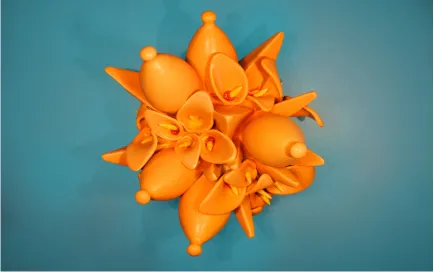
Figure 12. Triple Dong
REFERENCES
Levin, Elaine M. Movers and Shakers in American Ceramics. Westerville: University of Washington Press, 2003.
Peterson, Susan. Contemporary Ceramics. New York: Watson-Guptill Publications, 2000.
Soussloff, Catherine M. The subject in art: Portraiture and the birth of the modern. Durham: Duke University Press, 2006.
West, Shearer. Portraiture. New York: Oxford University Press, 2004.
Zakin, Richard. Ceramics: Ways of Creation. Iola: Krause Publications, 1999.
Copper, Emmanuel. Contemporary Ceramics. New York: Thames and Hudson, 2009.
Schwartz, Judith S. Confrontational Ceramics: The Artist as Social Critic. Philadelphia: University of Pennsylvania Press, 2008.
Del Vecchio, Mark. Postmodern Ceramics. New York: Thames & Hudson, 2001.
Woodall, Joanna. Portraiture: Facing the Subject. New York: Manchester University Press, 1997.
Scruton, Roger. Beauty. New York: Oxford University Press, 2009.
House, Homer Doliver. Wild Flowers: Three Hundred and Sixty -Four Full-Color Illustrations. New York: Macmillian Press, 1942.
Chamberlain, Rachel Prentice. Pre-Emergent: Art Basel Catalogue. Atlanta:Georgia State University Press, 2011.
Miranda, Eve Milton. Fragrant Flowers of the South; Watercolor Illustrations. Sarasota: Pineapple Press, 1991.