https://doi.org/10.5194/hess-22-2903-2018 © Author(s) 2018. This work is distributed under the Creative Commons Attribution 4.0 License.
Time-varying parameter models for catchments with land use
change: the importance of model structure
Sahani Pathiraja1,2, Daniela Anghileri3, Paolo Burlando3, Ashish Sharma2, Lucy Marshall2, and Hamid Moradkhani4
1Institut für Mathematik, Universität Potsdam, Potsdam, Germany
2Water Research Centre, School of Civil and Environmental Engineering, University of New South Wales,
Sydney, NSW, Australia
3Institute of Environmental Engineering, ETH Zurich, Zurich, Switzerland
4Department of Civil, Construction and Environmental Engineering, University of Alabama,
Tuscaloosa, Alabama, USA
Correspondence:Sahani Pathiraja ([email protected]) Received: 30 June 2017 – Discussion started: 4 July 2017
Revised: 7 February 2018 – Accepted: 8 February 2018 – Published: 16 May 2018
Abstract.Rapid population and economic growth in South-east Asia has been accompanied by extensive land use change with consequent impacts on catchment hydrology. Modeling methodologies capable of handling changing land use conditions are therefore becoming ever more important and are receiving increasing attention from hydrologists. A recently developed data-assimilation-based framework that allows model parameters to vary through time in response to signals of change in observations is considered for a medium-sized catchment (2880 km2)in northern Vietnam experienc-ing substantial but gradual land cover change. We investigate the efficacy of the method as well as the importance of the chosen model structure in ensuring the success of a time-varying parameter method. The method was used with two lumped daily conceptual models (HBV and HyMOD) that gave good-quality streamflow predictions during pre-change conditions. Although both time-varying parameter models gave improved streamflow predictions under changed con-ditions compared to the time-invariant parameter model, per-sistent biases for low flows were apparent in the HyMOD case. It was found that HyMOD was not suited to represent-ing the modified baseflow conditions, resultrepresent-ing in extreme and unrealistic time-varying parameter estimates. This work shows that the chosen model can be critical for ensuring the time-varying parameter framework successfully models streamflow under changing land cover conditions. It can also be used to determine whether land cover changes (and not just meteorological factors) contribute to the observed
hy-drologic changes in retrospective studies where the lack of a paired control catchment precludes such an assessment.
1 Introduction
of volume and timing, to properly allocate resources between different water uses and to mitigate flood damage. Vietnam has built many reservoirs in the last decades and more are planned because they are considered to be fundamentally im-portant for electricity production, flood control, water supply and irrigation, ultimately contributing to the development of the country (Giuliani et al., 2016).
The literature on land use change and its impacts on catch-ment hydrology is extensive, with studies examining the ef-fects of (1) conversion to agricultural land use (Thanapak-pawin et al, 2007; Warburton et al., 2012); (2) deforesta-tion (Costa et al., 2003; Coe et al, 2011); (3) afforestadeforesta-tion (e.g., Yang et al., 2012; Brown et al, 2013) and (4) urban-ization (Bhaduri et al., 2001; Rose and Peters, 2001). Fewer studies have examined how traditional modeling approaches must be modified to handle nonstationary conditions, or how modeling methods can be used to assess impacts of land use change. Split sample calibration has been used frequently to retrospectively examine changes to model parameters due to land use or climatic change (Seibert and McDonnell, 2010; Coron et al., 2012; McIntyre and Marshall, 2010; Legesse et al., 2003). Several other studies have employed scenario modeling, whereby hydrologic models are parameterized to represent different possible future land use conditions (e.g., Niu and Sivakumar, 2013; Elfert and Borman, 2010). A re-lated approach involves combining land use change fore-cast models with hydrologic models (e.g., Wijesekara et al., 2012). However, the aforementioned approaches are unsuited to hydrologic forecasting in changing catchments, as the pre-dicted land use change may not reflect actual changes. A po-tentially more suitable approach in such a setting is to al-low model parameters to vary in time, rather than assuming a constant optimal value or stationary probability distribution. Many existing methods utilizing such a framework require some a priori knowledge of the land use change in order to inform variations in model parameters (see for instance Ef-stratiadis et al., 2015; Brown et al., 2006; and Westra et al., 2014). Recent efforts have examined the potential for time-varying parameter models to automatically adapt to changing conditions using information contained in hydrologic obser-vations and sequential data assimilation, without requiring explicit knowledge of the changes (see for example Taver et al., 2015; Pathiraja et al., 2016a, b). Such approaches can objectively modify model parameters in response to signals of change in observations in real time, while simultaneously providing uncertainty estimates of parameters and stream-flow predictions. They can also be used to determine whether land cover changes (and not solely meteorological factors) contribute to observed changes in streamflow dynamics in retrospective studies where the lack of a paired control catch-ment precludes such an assesscatch-ment.
Pathiraja et al. (2016a) presented an ensemble Kalman fil-ter based algorithm (the so-called Locally Linear (LL) Dual EnKF) to estimate time variations in model parameters. The method sequentially assimilates observations into a
numer-ical model in real time to generate improved estimates of model states, fluxes and parameters based on their respec-tive uncertainties. Its purpose is to infer changes to catch-ment properties (e.g., land cover change) from hydrologic observations, without prior knowledge of such changes, at the timescale of the available observations. It can therefore be used for various applications: (1) to retrospectively estimate time variations in model parameters; (2) for short-term pre-dictive modeling (days to weeks), e.g., flood forecasting; and (3) for online/real-time water resource management, e.g., de-termining releases from reservoirs in catchments with chang-ing land cover conditions. In retrospective mode, the method is advantageous compared to split-sample-calibration-type approaches since no a priori knowledge of land use change is needed, and the modeler does not have to make somewhat arbitrary decisions about how to segregate the data. When used for prediction or forecasting, states and parameters are updated sequentially using all available observations up un-til the current time. These updated states and parameters are then used along with the prior parameter-generating model to produce hydrologic predictions over a short time horizon. This allows one to seamlessly obtain predictions without the modeler needing to explicitly modify the model to account for any catchment changes. The efficacy of the method was demonstrated in Pathiraja et al. (2016b) through an applica-tion to small experimental catchments (< 350 ha) with drastic land cover changes and strong signals of change in stream-flow observations.
These issues are investigated for the Nam Muc catchment (2880 km2)in northern Vietnam which has experienced de-forestation largely due to increasing agricultural develop-ment. It serves as an ideal test catchment to study the ef-ficacy of the time-varying parameter algorithm due to its size, spatially complex pattern of land use changes and lack of information on the precise timing of such changes. Land cover change is estimated to have occurred at varying rates, with cropland accounting for roughly 23 % between 1981 and 1994 and 52 % by 2000. We also consider two lumped conceptual hydrologic models (given the availability of point rainfall, temperature and streamflow data) operating at a daily time step to address the second objective. Both models demonstrate similar performance in representing streamflow at the outlet during the pre-change calibration period (1975– 1979), although their performance during and after land use change is unknown. Therefore, the effect of the model struc-ture (i.e., model equations) on hydrologic predictions from the time-varying parameter models is studied. This work rep-resents the first application of a continuously time-varying parameter approach for modeling a real medium-sized catch-ment with no a priori (or partial) knowledge of the type and timing of land use change.
The remainder of this paper is structured as follows. De-tails of the study catchment and the impact of land cover change are analyzed in Sect. 2. Section 3 summarizes the ex-perimental setup including the hydrological models and the time-varying parameter estimation method used. Results are provided in Sect. 4, along with an analysis of whether the time-varying model structures reflect the observed catchment dynamics. Finally, we conclude with a summary of the main outcomes of the study as well as proposed future work.
2 The Nam Muc catchment
The Nam Muc catchment (2880 km2)is located in the Red River Basin, the second largest drainage basin in Vietnam which also drains parts of China and Laos. The local cli-mate is tropical-monsoon-dominated with distinct wet (May to October) and dry (November to April) seasons. The wet season tends to have high temperatures (on average 27 to 29◦C) due to south–southeasterly winds that bring hu-mid air masses. Conversely, during the dry season, circula-tion patterns reverse carrying cooler dry air masses to the basin (leading to average temperatures of 16 to 21◦C). The
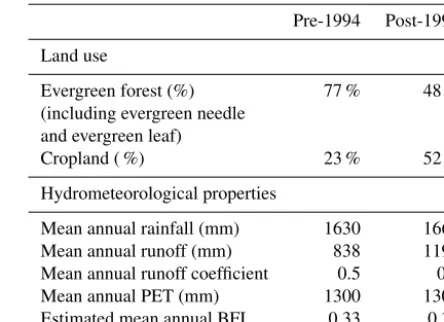
streamflow response is consequently monsoon-driven, with high flows occurring between June and October (generally peaking in July and August) and low flows in the Decem-ber to May period (Vu, 1993). Average annual rainfall at Nam Muc varies between 1300 and 2000 mm (on average 1600 mm) and catchment elevation ranges between 350 and 1500 m a.s.l. A summary of catchment properties is provided in Table 1 for pre-change (prior to 1994) and post-change
(af-Table 1.Study catchment properties.
Pre-1994 Post-1994
Land use
Evergreen forest (%) 77 % 48 %
(including evergreen needle and evergreen leaf)
Cropland ( %) 23 % 52 %
Hydrometeorological properties
Mean annual rainfall (mm) 1630 1660
Mean annual runoff (mm) 838 1190
Mean annual runoff coefficient 0.5 0.7
Mean annual PET (mm) 1300 1300
Estimated mean annual BFI 0.33 0.39
ter 1994) conditions. This separation was based on available land cover information as described below.
2.1 Data and land cover change
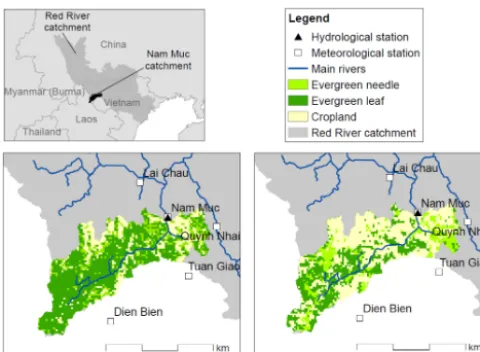
Figure 1 shows the available land cover information for the Nam Muc catchment. Land cover information for the catch-ment is scant; we were able to locate only two sources which unfortunately do not give a complete picture over the entire time period of interest (1970 to 2004). The first land cover map refers to the period 1981–1994 and was obtained by the Vietnamese Forest Inventory and Planning Institute (http: //fipi.vn/Home-en.htm). The second land cover map refers to the year 2000 and was obtained from the FAO Global Land Cover database (http://www.fao.org/geonetwork/srv/ en/metadata.show?id=12749&currTab=simple). A compari-son of the two maps shows a reduction in forest cover in fa-vor of cropland; evergreen leaf decreases from about 60 to 30 %, while cropland increases from about 23 to 52 %. The change in land cover is patchy, although mostly concentrated in the northern part of the catchment. Because of the scant information available, it is not easy to identify the precise time period of these changes. Based on the available land cover map information and the changes to observed runoff (see Sect. 2.2), we posit that a period of rapid extensive de-forestation occurred in the early to mid-1990s.
[image:3.612.315.537.86.247.2]Figure 1. Study catchment showing gauges and changes in land cover over time.
2.2 Impact of land cover change on streamflow
The annual runoff and direct runoff coefficient and baseflow index were used to assess the impact of land cover change on the hydrologic regime. Baseflow was estimated using the two-parameter recursive baseflow filter of Eckhardt (2005) (see Eq. 1), with online updating of baseflow estimates to match low flows:
bk=
1
(1−a·BFImax)
(1−BFImax)·a·bk−1+(1−a)·BFImax·yk, (1)
wherebk is the estimated baseflow at timek,yk is the total
observed streamflow at timek, BFImaxis the maximum value
of the BFI (long-term ratio of baseflow to total streamflow) anda is a filter parameter. In this study, we adopt BFImax=
0.5 anda=0.988 based on manual optimization.
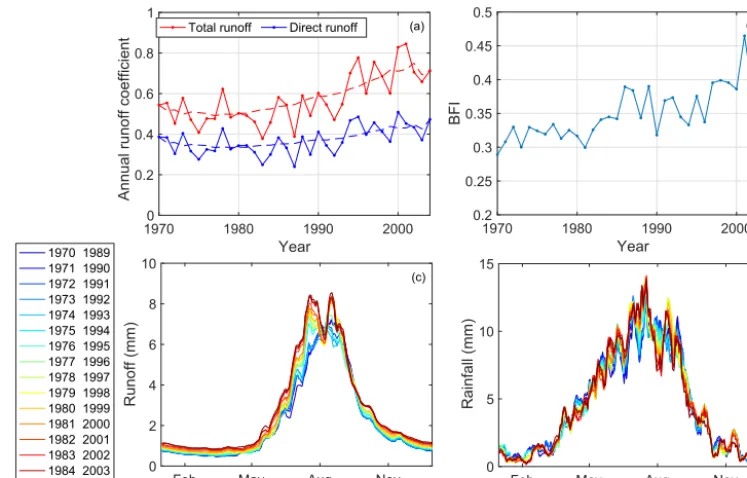
An examination of the observed streamflow and rainfall records shows that distinct changes to the hydrologic regime are evident after the mid-1990s. The annual runoff coeffi-cient rainfallrunoff varies between 0.4 and 0.6 prior to 1994, after which it increases to between 0.6 and 0.8 until 2004 (see Fig. 2a). However, increases in annual yields are driven mostly by changes to baseflow volume. This is evident in Fig. 2a, which shows that the increase in the annual direct runoff coefficientrunoffrainfall−baseflowis less than the increase in the total runoff coefficient (roughly 0.1 increase compared to 0.2 respectively). A small increase in the annual baseflow index baseflowrunoff is also apparent, from about 0.32 on aver-age in the period 1970 to 1982 to 0.39 on averaver-age after 1994 (Fig. 2b). This indicates that the annual increases in base-flow volume exceed the increases in direct runoff volume. Similar changes were found by Wang et al. (2012) who ana-lyzed records in the entire Da River basin, which drains the
largest river in the Red River catchment. The exact physical processes behind the observed increase in baseflow are not precisely known, particularly since the effects of land use change from forest to cropland are not unequivocal (Price, 2011). Deforestation may be associated with an increase in mean annual flow and baseflow because of lower intercep-tion and evapotranspiraintercep-tion rates (e.g., Keppeler and Ziemer, 1990). Nevertheless, permanent forest removal may decrease baseflow because of soil compaction and lower infiltration rates (e.g., Zimmermann et al., 2006; Bormann and Klaassen, 2008). Some authors also show that tillage practices, asso-ciated with forest conversion to cropland, can increase soil porosity, soil water content and infiltration, thus ultimately contributing to baseflow formation (e.g., Alam et al., 2014).
On a seasonal timescale, it is apparent that both wet and dry season flows exhibit temporal variations. We utilized the Moving Average over Shifting Horizon (MASH) (Anghi-leri et al., 2014) and Mann–Kendall test to assess seasonal trends in observed streamflow, precipitation and temperature data. The MASH tool can be used to qualitatively assess in-terannual variations in the seasonal pattern of a variable. It works by calculating a statistic of the data (e.g., mean) over the same block of days in consecutive years. A steady in-crease in baseflow is again apparent (see February to April in Fig. 2c), as well as increases in wet season flows (see June to September in Fig. 2c). The Mann–Kendall test (with signifi-cance level equal to 5 %) on annual and monthly streamflow time series shows increasing trends in almost all months, i.e., from October to July. No concurrent increases are apparent in rainfall (see Fig. 2d). Also, the Mann–Kendall test applied to precipitation time series does not show any statistically sig-nificant trend, except a decrease in September for Nam Muc and Quynh Nhai stations and an increase in July for the Dien Bien station. Temperature variations are not evident from the MASH analysis (not shown) and no significant trend can be detected by applying the Mann–Kendall test. These results indicate that changes in streamflow dynamics are likely due to land use change rather than climatic impacts.
3 Experimental setup 3.1 Hydrologic models
1970 1980 1990 2000
Year
0 0.2 0.4 0.6 0.8 1
Annual runoff coefficient
Total runoff Direct runoff
1970 1980 1990 2000
Year
0.2 0.25 0.3 0.35 0.4 0.45 0.5
BFI
Feb May Aug Nov
0 2 4 6 8 10
Runoff (mm)
1970 1989 1971 1990 1972 1991 1973 1992 1974 1993 1975 1994 1976 1995 1977 1996 1978 1997 1979 1998 1980 1999 1981 2000 1982 2001 1983 2002 1984 2003
1985 2004 Feb May Aug Nov
0 5 10 15
Rainfall (mm)
(a) (b)
[image:5.612.109.483.65.304.2](d) (c)
Figure 2.Impact of land use change on observed streamflow:(a)annual runoff coefficient,(b)annual baseflow index (BFI),(c)Moving Average over Shifting Horizon (MASH) results for total observed runoff and(d)MASH for observed rainfall.
In the HyMOD model, spatial variations in catchment soil storage capacity are represented by a Pareto distribution with shape parameter b and maximum point soil storage depth
cmax. Excess rainfall (V )is partitioned into three cascading
tanks, representing quick flow and a single slow flow store through the splitting parameterα. Outflow from these linear routing tanks is controlled by parameters kq (for the quick
flow store) andks(for the slow flow store). The model has a
total of five states and five parameters.
In the HBV model, input to the soil store is represented by a power-law function (see Fig. 3; note the snow store is ne-glected for this study). Excess rainfall enters a shallow layer store which generates (1) near-surface flow (q0)whenever
the shallow store state (stw1) is above a threshold (hl1) and (2) interflow (q1)through a linear routing mechanism
con-trolled by the K1 parameter. Percolation from the shallow layer store to the deep layer store (controlled by the perc pa-rameter) then leads to the generation of baseflow, also via linear routing (controlled by theK2 parameter). Finally, a tri-angular weighting function of base length, Maxbas, is used to route the sum of all three flow components. There are a total of nine parameters and three states.
The Shuffled Complex Evolution Algorithm (SCE-UA) (Duan et al., 1993) was used to calibrate HyMOD and the Borg Evolutionary Algorithm (Hadka and Reed, 2013) was used to calibrate HBV. The calibration algorithms were se-lected based on previous studies that had successfully used them for calibration of these models (Reed et al., 2013; Moradkhani et al., 2005). The calibration procedure itself is however not critical in our study because the optimal
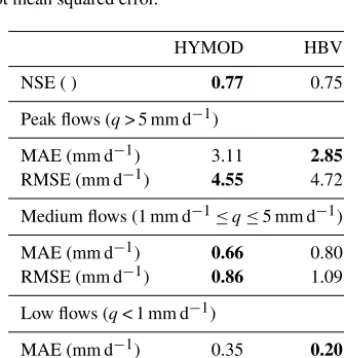
pa-rameter values are only used as initial values for the time-varying parameter method. Both models were calibrated to pre-change conditions. The period 1973 to 1979 was selected for calibration (with 2 years for spin-up) as it was expected to have minimal land cover changes (and is therefore repre-sentative of pre-change conditions) and also to ensure suffi-cient data on pre-change conditions are available for assim-ilation. Both models had very similar performance in terms of reproducing observed runoff (a Nash–Sutcliffe efficiency of 0.75 and 0.77 for HyMOD and HBV respectively). HBV was slightly better at reproducing low flows, while HyMOD was slightly better at mid-range flows (see Table 2). Here the low flow threshold was defined as the average annual 50th percentile flow and the high flow threshold as the average annual 85th percentile flow.
3.2 Time-varying parameter estimation
Figure 3.Schematic of the models used in this study:(a)HBV and(b)HyMOD. Parameters are shown in blue and states are shown in green.
Table 2.Model performance in pre-change conditions used for cal-ibration (1975–1979). Boldface numbers correspond to the model with superior performance for the particular metric. NSE is the Nash–Sutcliffe efficiency; MAE is the mean absolute error; RMSE is the root mean squared error.
HYMOD HBV
NSE ( ) 0.77 0.75
Peak flows (q> 5 mm d−1)
MAE (mm d−1) 3.11 2.85
RMSE (mm d−1) 4.55 4.72
Medium flows (1 mm d−1≤q≤5 mm d−1)
MAE (mm d−1) 0.66 0.80
RMSE (mm d−1) 0.86 1.09
Low flows (q< 1 mm d−1)
MAE (mm d−1) 0.35 0.20
RMSE (mm d−1) 0.42 0.34
practical alternative to sequential Monte Carlo/particle filter methods that propagate the full probability density through
time but suffer from several implementation issues, even in moderate dimensional systems. The LL Dual EnKF method of Pathiraja et al. (2016a) works by sequentially proposing parameters, updating these using the ensemble Kalman fil-ter and available observations and subsequently using these updated parameters to propose and update model states. An approach for proposing parameters in the time-varying set-ting was also presented, for cases where no prior knowledge of parameter variations is available. The method was ver-ified against multiple synthetic case studies as well as for two small experimental catchments experiencing controlled land use change (Pathiraja et al., 2016a, b). The algorithm is summarized below; for full details refer to Pathiraja et al. (2016a).
3.2.1 LL Dual EnKF
Suppose a dynamical system can be described by a vec-tor of states xt and outputs yt and a vector of associated
model parametersθt at any given timet. The uncertain
sys-tem states and parameters are represented by an ensemble of statesxi
t i=1:nand parameters
θit
i=1:neach withn
mem-bers. The prior state and parameter distributionsnxi−t o
i=1:n
[image:6.612.81.253.491.670.2]of the system, usually derived as the output from a numeri-cal model. Suppose also that the system outputs are observed
yo t
but that there is also some uncertainty associated with these observations. The purpose of the data assimilation al-gorithm (here the EnKF) is to combine the prior estimates with measurements, based on their respective uncertainties, to obtain an improved estimate of the system states and pa-rameters. A single cycle of the LL Dual EnKF procedure for a given timet is undertaken as follows. Note that in the fol-lowing, the overbar notation is used to indicate the ensemble mean.
1. Propose a prior parameter ensemble. This involves gen-erating a parameter ensemble using prior knowledge. In this case, our prior knowledge comes from the updated parameter ensemble from the previous time (θi+t−1)and how it has changed over recent time steps. The assumed parameter dynamics is a Gaussian random walk with time-varying mean and variance, given by
θit−∼Nθi+t−1+mt.1t , s26θt−1
for i=1 :n (2)
6θt−1= 1
n−1
n X
i=1
θit+−1−θ+t−1 θi+t−1−θ+t−1T, (3)
where6θ
t−1is the sample covariance matrix of the
up-dated parameter ensemble at timet−1;θ+t−1indicates the ensemble mean of the updated parameters at time
t−1;()T represents the transpose operator; and s2 is a tuning parameter. The prior ensemble mean is deter-mined as the linear extrapolation of the updated ensem-ble means from the previous two time steps; i.e.,
mt[k]=
mt−1[k],|mt−1[k]| ≤mmax
mt−2[k],|mt−1[k]| > mmax
(4)
mt−1=
θ+t−1−θ+t−2
1t (5)
mt−2=
θ+t−2−θ+t−3
1t , (6)
wheremt[k] indicates thekth component of the vector
mt, the estimated rate of change. Note that the
extrap-olation is forced to be less than a predefined maximum rate of changemmaxto minimize overfitting and avoid
parameter drift due to isolated large updates. The max-imum rate of change is model-specific and will depend on the modeler’s judgement regarding expected extreme changes.
2. Consider observation and forcing uncertainty. This is done by perturbing measurements of forcings and sys-tem outputs with random noise sampled from a distri-bution representing the uncertainty in those measure-ments. The result is an ensemble of forcings (uit)and observations (yit)each with nmembers. For example,
if random errors in measurements of system outputs (herein also referred to as observations) are character-ized by a zero mean Gaussian distribution, the ensemble of observations is given by
yit ∼N
yot,6tyoyo for i=1 :n, (7) whereyo
t is the recorded measurement at time t and
6ytoyo is the error covariance matrix of the measure-ments.
3. Generate simulations using prior parameters. The prior parameters from Step 1,θi−t , and updated states from the previous time,xi+t−1, are forced through the model equations to generate an ensemble of model simulations of states (xˆit)and outputs (yˆit):
ˆ
xit=fxi+t−1,θti−,uit for i=1 :n (8) ˆ
yit =hxˆit,θit− for i=1 :n. (9) 4. Perform the Kalman update of parameters. Parameters are updated using the Kalman update equation and the prior parameter and simulated output ensemble from Step 1 and 3:
θi+t =θi−t +Kθt yit− ˆyit for i=1 :n (10)
Ktθ=6θtyˆh6tyˆyˆ+6ytoyo
i−1
, (11)
where6θtyˆis a matrix of the sample cross-covariance between errors in parametersθi−t and simulated output
ˆ
yit ; and6ytˆyˆis the sample error covariance matrix of the simulated output:
6θtyˆ= 1
n−1
n X
i=1
θi−t −θ−t yˆit− ˆytT (12)
6ytˆyˆ= 1
n−1
n X
i=1
ˆ
yit− ˆyt yˆit− ˆytT. (13)
5. Generate simulations using updated parameters. Step 3 is repeated with the updated parameter ensembleθi+t
to generate the prior ensemble of model simulations of states (xit−)and outputs (eyit):
xi−t =fxi+t−1,θti+,uit for i=1 :n (14)
ey i t =h
xi−t ,θi+t for i=1 :n. (15)
them. Since the measurements have already been used to generateeyit, the errors in model simulations and mea-surements are now correlated. The standard Kalman up-date equation (as in the form of Eqs. 10 and 11) can no longer be used as it relies on the assumption that er-rors in measurements and model simulations are inde-pendent.
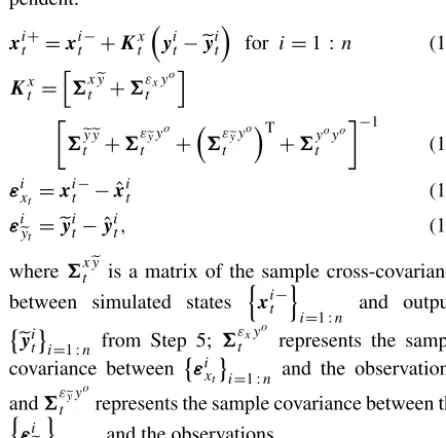
xit+=xit−+Kxt yit−
ey i t
for i=1 :n (16)
Kxt =
h
6xey
t +6 εxyo
t i
6eyey
t +6 ε
e
yyo
t +
6εeyy
o
t T
+6ytoyo
−1
(17)
εix
t =x
i− t − ˆx
i
t (18)
εi
e
yt =ey i
t− ˆyit, (19)
where6xey
t is a matrix of the sample cross-covariance
between simulated states
n
xi−t o
i=1:n and outputs
ey i
t i=1:n from Step 5; 6 εxyo
t represents the sample
covariance between εix
t i=1:n and the observations;
and6εeyy
o
t represents the sample covariance between the n
εi
e
yt
o
i=1:nand the observations.
The above algorithm specifies the updating of states and pa-rameters at any given time, based on available observations. This allows one to retrospectively estimate time variations in model parameters, as well as provide one-time-step-ahead forecasts of states and outputs (as per Eqs. 8 and 9). Fore-casts at longer time horizons (i.e., longer than one time step ahead) would be made by generating prior parameters and states as detailed in Steps 1 to 3, although the local linear extrapolations are only valid close to the current time point. 3.2.2 Application to the Nam Muc catchment
[image:8.612.64.287.146.365.2]Joint state and parameter estimation was undertaken for the Nam Muc catchment over the period 1980 to 2004 by assim-ilating streamflow observations into the HyMOD and HBV models at a daily time step. Additionally, simulations using the time-invariant parameters obtained from calibration over the period 1973–1979 were generated for 1980 to 2004, for comparison. Estimating a large number of parameters from limited data is problematic in that the system is highly under-determined, making it difficult to ensure the estimated pa-rameters are meaningful. Given the fairly low parameter di-mensionality of HyMOD, all model parameters were allowed to vary in time, while for HBV we applied the Sobol method to identify the most sensitive parameters to be included in the time-varying parameter estimation. The Sobol method is a global sensitivity analysis method based on variance decom-position. It identifies the partial variance contribution of each parameter to the total variance of the hydrological model out-put (see for example Saltelli et al., 2008; Nossent et al. 2011).
Table 3.Variance-based sensitivity analysis results for HBV pa-rameters: first-order sensitivity index representing the contribution of varying a single parameter to the variance of the model output. Lower values indicate lower sensitivity.
Sensitivity index
hl1 0.10
lp 0.12
Maxbas 0.14
fcap 0.18
K0 0.23
K2 0.23
K1 0.38
beta 0.41
perc 0.47
The method, implemented through the SAFE toolbox (Pi-anosi et al., 2015), found the lp and Maxbas parameters to be the least sensitive and least important in defining varia-tions in catchment hydrology (see Table 3). These were held fixed (lp=1 and Maxbas=1 day) in the following analy-sis. Note that although the hl1 parameter was found to have low sensitivity, it was retained as a time-varying parameter due to its conceptual importance in separating interflow and near-surface flow (refer Fig. 3).
Unbiased normally distributed ensembles of the parame-ters and states are required to initialize the LL Dual EnKF. Initial parameter ensembles were generated by sampling from a Gaussian distribution with a mean equal to the cal-ibrated parameters over the pre-change period and variance estimated from parameter sets with similar objective function values. Parameter sets with similar objective function values were obtained when using different starting points to the opti-mization algorithm during the model calibration stage. Initial state ensembles were also sampled from normal distributions with a mean equal to the simulated state at the end of the calibration period. An ensemble size of 100 members was adopted and assumed sufficiently large based on the findings of Moradkhani et al. (2005) and Aksoy et al. (2006). Due to the stochastic–dynamic nature of the method, ensemble statistics were calculated over 20 separate realizations of the LL Dual EnKF. The prior parameter-generating method de-scribed in Step 1 of Sect. 3.2 requires specification of the tuning parameters2 to define the variance of the perturba-tions. This was tuned by selecting the s2 value that opti-mized the quality of forecast streamflow over the calibration period. Forecast quality was assessed using the logarithmic score (LS) (Good, 1952) of background streamflow predic-tions (eyti)using updated parameters (Eq. 15), which was av-eraged over the calibration period of lengthT:
LS=
T X
t=1
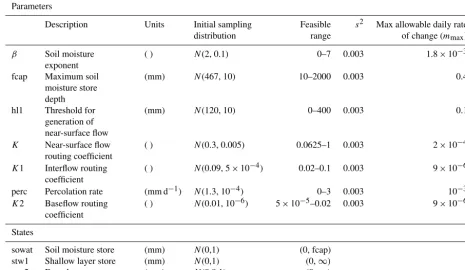
Table 4.LL EnKF inputs for the HBV model case.
Parameters
Description Units Initial sampling Feasible s2 Max allowable daily rate
distribution range of change (mmax)
β Soil moisture exponent
( ) N(2, 0.1) 0–7 0.003 1.8×10⁻³
fcap Maximum soil moisture store depth
(mm) N(467, 10) 10–2000 0.003 0.4
hl1 Threshold for generation of near-surface flow
(mm) N(120, 10) 0–400 0.003 0.1
K Near-surface flow routing coefficient
( ) N(0.3, 0.005) 0.0625–1 0.003 2×10⁻⁴
K1 Interflow routing coefficient
( ) N(0.09, 5×10⁻⁴) 0.02–0.1 0.003 9×10⁻⁶
perc Percolation rate (mm d−1) N(1.3, 10−4) 0–3 0.003 10−3
K2 Baseflow routing coefficient
( ) N(0.01, 10−6) 5×10⁻⁵–0.02 0.003 9×10⁻⁶
States
sowat Soil moisture store (mm) N(0,1) (0, fcap)
stw1 Shallow layer store (mm) N(0,1) (0,∞)
stw2 Deep layer store (mm) N(0,0.1) (0,∞)
LSt=log f y=yto
, (21)
wheref (y)is the probability density function of the back-ground streamflow predictions (represented by the empirical probability density function of the sample pointseyti i=1:n); and yto is the measurement of the system outputs. The s2
value that gave the largest LS was adopted for the assimi-lation period. The maximum allowable daily rate of change in the ensemble mean was based on assuming a linear rate of change within the entire feasible parameter space over a 3-year period.
As detailed in Sect. 3.2, observation and forcing uncer-tainty is considered by perturbing measurements with ran-dom noise. Here streamflow errors were assumed to be zero-mean normally distributed (truncated to ensure positivity) and heteroscedastic. The variance is defined as a proportion of the observed streamflow, to reflect the fact that larger flows tend to have greater errors than low flows:
yti ∼TN yto, dyto for i=1 :n, (22)
whereTNindicates the truncated normal distribution to en-sure positive flows andd=0.1. A multiplier of 0.1 was cho-sen based on estimates adopted for similar gauges in hydro-logic data assimilation (DA) studies (e.g., Clark et al., 2008; Weerts and El Serafy, 2006; Xie et al., 2014).
Several studies have noted that a major source of rainfall uncertainty arises from scaling point rainfall to the catchment scale (Villarini and Krajewski, 2008; McMillan et al., 2011)
and that multiplicative error models are suited to describing such errors (e.g., Kavetski et al., 2006). Rainfall uncertain-ties were therefore described using unbiased, lognormally distributed multipliers:
Pti =PtMi (23)
Mi ∼LN(m, v)
and Xi=logMi∼N (µ, σ2) for i=1: n, (24) wherePt is the measured rainfall at time t; m and v are the mean and variance of the lognormally distributed rainfall multipliersM, respectively; andµandσ2are the mean and variance of the normally distributed logarithm of the rain-fall multipliersM. For unbiased perturbations, we letm=1. The variance of the rainfall multipliers (v)was estimated by considering upper and lower bound error estimates in the Thiessen weights assigned to the four rainfall stations (see Sect. 2.1 for calculation of catchment-averaged rainfall,Pt).
The resulting upper and lower bound catchment-averaged rainfall data were then used to estimate error parameters due to spatial variation in rainfall:
v=e(2µ+σ2)eσ2−1 (25)
σ2=σˆ2 =var
log
P
upper,10 Plower,10
(26)
µ≈log(m)− σ
2
2 = −
σ2
Year 0
200 400 600 800 1000 1200
Fcap
Year 0
100 200 300
hl1
Year 0
1 2 3 4
Year 0
0.1 0.2 0.3 0.4
K0
Year 0
0.02 0.04 0.06 0.080.1
K1
Year 0
0.51 1.52 2.53
Perc
'80 '81 '82 '83 '84 '85 '86 '87 '88 '89 '90 '91 '92 '93 '94 '95 '96 '97 '98 '99 '00 '01 '02 '03 '04 Year
0 0.005 0.01 0.015 0.02
[image:10.612.99.499.60.439.2]K2
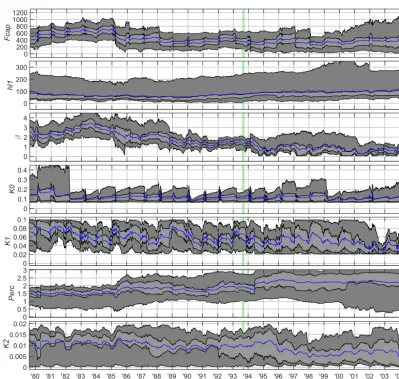
Figure 4.Parameter trajectories using the HBV model. The dark grey shaded areas indicate the middle 90 % of the ensemble, bounded by the 5th and 95th percentiles. The light grey shaded areas indicate the middle 50 % of the ensemble, bounded by the 25th and 75th percentiles. The ensemble mean is indicated by the blue line. The vertical green panel indicates the assumed time period of rapid deforestation.
where Pupper,10 indicates catchment-averaged rainfall data
estimated using the upper bound Thiessen weights with daily depth greater than 10 mm (similar for Plower,10). A 10 mm
rainfall depth threshold was chosen to avoid large rainfall fractions due to small rainfall depths. σˆ2 was found to be 0.05 in this case study. Similarly, we assume the dominant source of uncertainty in temperature data arises from spa-tial variation. Differences in temperature records at Lai Chau and Quynh Nhai (only available gauges with temperature records) were analyzed and found to be approximately nor-mally distributed with a sample mean of 0.2◦C and variance of 1.4◦C. A perturbed temperature ensemble was then gen-erated according to Eq. (28):
Tti ∼TN Ttavg,1.4
for i=1 :n, (28)
whereTtavgrepresents catchment-averaged temperature data (see Sect. 2.1). Note that perturbations were taken to be unbi-ased (zero mean) as the sample mean of the differences in the
temperature records was close to zero. The same perturbed input and observation sequences were used for the HyMOD and HBV runs for the sake of comparison. A summary of the values adopted for the various components of the LL Dual EnKF for each model is provided in Tables 4 and 5.
4 Results and discussion
Year 0
0.5 1 1.5 2 2.5 3
b
Year 200
300 400 500 600 700 800
cm
ax
Year 0.2
0.3 0.4 0.5 0.6 0.7 0.8 0.91
kq
Year 0
0.050.1 0.150.2 0.250.3
ks
'80 '81 '82 '83 '84 '85 '86 '87 '88 '89 '90 '91 '92 '93 '94 '95 '96 '97 '98 '99 '00 '01 '02 '03 '04
Year
[image:11.612.100.499.63.422.2]0 0.2 0.4 0.6 0.8 1
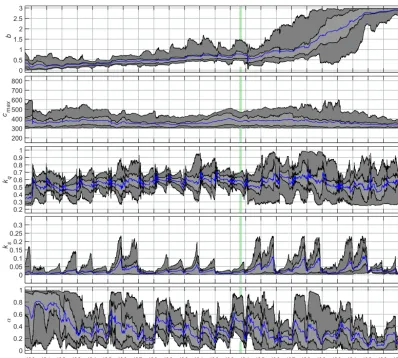
Figure 5.Parameter trajectories using the HyMOD model. The dark grey shaded areas indicate the middle 90 % of the ensemble, bounded by the 5th and 95th percentiles. The light grey shaded areas indicate the middle 50 % of the ensemble, bounded by the 25th and 75th percentiles. The ensemble mean is indicated by the blue line. The vertical green panel indicates the assumed time period of rapid deforestation.
runoff coefficient (Fig. 2) and increase in baseflow volume (as discussed in Sect. 2.2). From an algorithm perspective, these parameters are most strongly correlated with stream-flow (as well as the most sensitive; see Table 3), meaning that they will receive the greatest proportional updates. Sim-ilar parameter adjustments are seen for HyMOD, at least at a qualitative level (see Fig. 5). The sharp increase in theb pa-rameter during the post-change period means that a greater volume of water is available for routing (as largerb values mean that a smaller proportion of the catchment has deep soil storage capacity) and the downward interannual trend inαmeans that a greater portion of excess runoff is routed through the baseflow store. Intra-annual variations in updated model parameters for both HyMOD and HBV are also appar-ent (refer Figs. 4 and 5). This is due to the inability of a sin-gle parameter distribution to accurately model both wet and dry season flows. Such variations were not observed when using the time-varying parameter framework for small defor-ested catchments (< 350 ha) (see Pathiraja et al., 2016b). The
comparatively less clear parameter changes for the Nam Muc catchment are due to a combination of the increased difficulty in accurately modeling the hydrologic response (even in pre-change conditions) and due to the relatively more subtle and gradual changes to land cover. Nonetheless, the method is shown to generate a temporally varying structure that is con-ceptually representative of the observed changes.
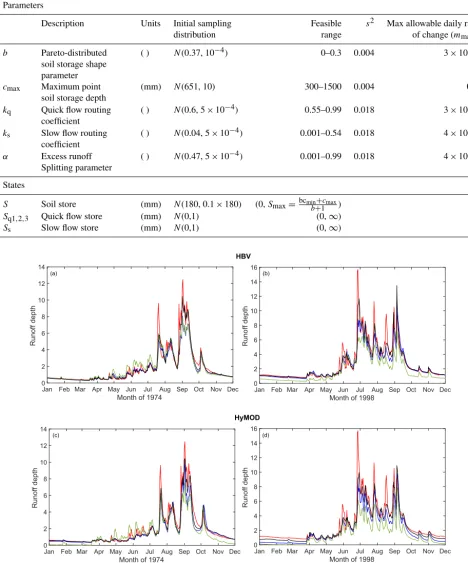
Hy-Table 5.LL EnKF inputs for the HYMOD model case.
Parameters
Description Units Initial sampling Feasible s2 Max allowable daily rate
distribution range of change (mmax)
b Pareto-distributed soil storage shape parameter
( ) N(0.37, 10−4) 0–0.3 0.004 3×10⁻⁴
cmax Maximum point soil storage depth
(mm) N(651, 10) 300–1500 0.004 0.3
kq Quick flow routing coefficient
( ) N(0.6, 5×10⁻⁴) 0.55–0.99 0.018 3×10⁻⁴
ks Slow flow routing coefficient
( ) N(0.04, 5×10⁻⁴) 0.001–0.54 0.018 4×10⁻⁵
α Excess runoff Splitting parameter
( ) N(0.47, 5×10⁻⁴) 0.001–0.99 0.018 4×10⁻⁴
States
S Soil store (mm) N(180, 0.1×180) (0,Smax=bcminb++c1max)
Sq1,2,3 Quick flow store (mm) N(0,1) (0,∞)
Ss Slow flow store (mm) N(0,1) (0,∞)
Jan Feb Mar Apr May Jun Jul Aug Sep Oct Nov Dec
Month of 1974
0 2 4 6 8 10 12 14
Runoff depth
HBV
Obs Mean TVP TIP Mean background TVP
Jan Feb Mar Apr May Jun Jul Aug Sep Oct Nov Dec
Month of 1998
0 2 4 6 8 10 12 14 16
Runoff depth
Jan Feb Mar Apr May Jun Jul Aug Sep Oct Nov Dec
Month of 1974
0 2 4 6 8 10 12 14
Runoff depth
HyMOD
Jan Feb Mar Apr May Jun Jul Aug Sep Oct Nov Dec
Month of 1998
0 2 4 6 8 10 12 14 16
Runoff depth
(a) (b)
[image:12.612.56.536.87.542.2](d) (c)
[image:12.612.65.534.91.655.2]1975 1980 1985 1990 1995 2000 2005
Year
0.3 0.4 0.5 0.6 0.7 0.8 0.9
Annual runoff coefficient
HyMOD
95th perc 5th perc Mean Obs
1975 1980 1985 1990 1995 2000 2005
Year
0 0.1 0.2 0.3 0.4 0.5 0.6
Annual direct runoff coefficient
1975 1980 1985 1990 1995 2000 2005
Year
0 0.2 0.4 0.6 0.8 1
Annual BFI
1975 1980 1985 1990 1995 2000 2005
Year
0.3 0.4 0.5 0.6 0.7 0.8 0.9
Annual runoff coefficient
HBV
1975 1980 1985 1990 1995 2000 2005
Year
0.1 0.2 0.3 0.4 0.5 0.6
Annual direct runoff coefficient
1975 1980 1985 1990 1995 2000 2005
Year
0 0.2 0.4 0.6 0.8 1
Annual BFI
(a) (d)
(e) (b)
[image:13.612.96.500.68.446.2](c) (f)
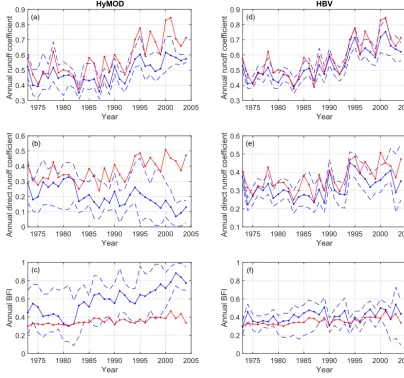
Figure 7.Influence of time-varying parameters on model output (i.e., without state updating) summarized in terms of the annual runoff coefficient (top row), annual direct runoff coefficient (second row) and annual baseflow index (BFI) (third row). Results for HyMOD are shown in the first column, and results for HBV are shown in the second column.
MOD and HBV are generally of similar quality and superior to those from the respective time-invariant parameter models that have been calibrated on pre-change data (1975–1979), although a slight bias in baseflow predictions from HyMOD is evident (see for example Fig. 6). The Nash–Sutcliffe ef-ficiency of one-step-ahead streamflow predictions over the period 1980–2004 from the LL Dual EnKF is 0.87 when us-ing HyMOD or HBV, compared to 0.76 and 0.72 for the re-spective time-invariant parameter models evaluated over the same period. However, differences in predictions from TVP-HBV and TVP-HyMOD are more striking due to the lack of state updating. Figure 7 shows annual statistics of simulated streamflow from the TVP-HBV and TVP-HyMOD models and observed runoff. The TVP-HBV gives direct runoff and baseflow predictions that are consistent with runoff obser-vations, meaning that the parameter adjustments reflect the observed changes in the runoff response. This however is not
the case for the TVP-HyMOD. The annual runoff coefficient and annual direct runoff coefficient are severely underesti-mated in the post-change period by the TVP-HyMOD, while the annual baseflow index has an increasing trend of magni-tude far greater than that observed (Fig. 7c). All three quanti-ties on the other hand are well represented by the TVP-HBV (Fig. 7d–f). Similar conclusions can be drawn from Fig. 8, which shows the results of a Moving Average over Shifting Horizon (MASH) analysis (see Sect. 2.2) on total and direct runoff (observed and simulated). Observed increases in Jan-uary to April flows (see Fig. 8a) and wet season direct flows (July to September) (see Fig. 8e) are well represented by the TVP-HBV but not TVP-HyMOD.
co-Feb May Aug Nov 0 2 4 6 8 10
Total runoff (mm)
Observed
Feb May Aug Nov
0 2 4 6 8
10 TVP - HyMOD
1970 1989 1971 1990 1972 1991 1973 1992 1974 1993 1975 1994 1976 1995 1977 1996 1978 1997 1979 1998 1980 1999 1981 2000 1982 2001 1983 2002 1984 2003 1985 2004
Feb May Aug Nov
0 2 4 6 8 10
TVP - HBV
Feb May Aug Nov
0 2 4 6 8 10
Direct runoff (mm)
Observed
Feb May Aug Nov
0 2 4 6 8 10
TVP - HyMOD
Feb May Aug Nov
0 2 4 6 8 10
TVP - HBV
Feb May Aug Nov
0 2 4 6 8 10
Resampled climate, TVP - HBV
Feb May Aug Nov
0 2 4 6 8 10
Resampled climate, TVP - HBV
(h) (g)
(f) (e)
[image:14.612.79.517.66.276.2](a) (b) (c) (d)
Figure 8.Moving Average over Shifting Horizon (MASH) results for observed streamflow (first column), simulated streamflow from time-varying parameter model (without state DA) for HYMOD (second column), HBV (third column) and resampled climate HBV (fourth column). These are split into total runoff (first row) and direct runoff or surface runoff (second row).
efficient due to the increased baseflow during dry periods, despite having an annual baseflow index far greater than the observed. This occurs due to an inability to generate flow volume during periods of no rain. In joint state–parameter updating using HyMOD, underestimated runoff predictions during dry periods lead to adjustments to the ks andα
pa-rameters to increase baseflow depth (since these are the only parameters that are associated with an active store). Unlike HBV, HyMOD has no continuous supply of water to the rout-ing stores (i.e., the quick flow and slow flow stores) durrout-ing recession periods (which typically have extended periods of no rainfall, so thatVin Fig. 3 is zero). This means thatksand αare updated to extreme values to compensate for the volu-metric shortfall. The HBV structure, on the other hand, has a continuous percolation of water into the deep layer store even during periods of no rain (as long as the shallow water store is non-empty). In summary, the HyMOD model struc-ture is poorly suited to simulating streamflow dynamics in post-change conditions, although it gave reasonable simula-tions in pre-change condisimula-tions. This highlights the need to se-lect a sufficiently flexible model structure prior to undertak-ing forecastundertak-ing or predictive modelundertak-ing usundertak-ing the time-varyundertak-ing parameter approach. In particular, the model structure must be capable of effectively simulating all potential future catch-ment conditions.
Having established that the TVP-HBV provided a good representation of the observed streamflow dynamics, we used a modeling approach to determine whether the observed changes were solely driven by forcings and which (if any) components of runoff were also affected by land use change. A resampled rainfall and temperature time series was
the observed streamflow statistics only when the observed forcing time series is used.
5 Conclusions
As our anthropogenic footprint expands, it will become in-creasingly important to develop modeling methodologies that are capable of handling changing catchment conditions. Previous work proposed the use of models whose parame-ters vary with time in response to signals of change in ob-servations. The so-called Locally Linear (LL) Dual EnKF time-varying parameter estimation algorithm (Pathiraja et al., 2016a) was applied to two sets of small (< 350 ha) paired experimental catchments with deforestation occurring under experimental conditions (rapid clearing of 100 and 50 % of land surface) (Pathiraja et al., 2016b). Here we demonstrate the efficacy of the method for a larger catchment experienc-ing more realistic land cover change, while also investigat-ing the importance of the chosen model structure in ensurinvestigat-ing the success of the time-varying parameter estimation method. We also demonstrate that the time-varying parameter frame-work can be used in a retrospective fashion to determine whether land cover changes (and not just meteorological fac-tors) contribute to the observed hydrologic changes.
Experiments were undertaken in the Nam Muc catchment (2880 km2)in Vietnam, which experienced a relatively grad-ual conversion from forest to cropland over a number of years (cropland increased from roughly 23 % of the catch-ment between 1981 and 1994 to 52 % by 2000). Changes to the hydrologic regime after the mid-1990s were detected and attributed mostly to an increase in baseflow volume. Ap-plication of the LL Dual EnKF with two conceptual mod-els (HBV and HyMOD) showed that the time-varying pa-rameter framework with state updating improved stream-flow prediction in post-change conditions compared to the time-invariant parameter case. However, baseflow predic-tions from the LL Dual EnKF with HBV were generally su-perior to the HyMOD case which tended to have a slight neg-ative bias. It was found that the structure (i.e., model equa-tions) of HyMOD was unsuited to representing the modi-fied baseflow conditions, resulting in extreme and unrealistic time-varying parameter estimates. This work shows that the chosen model is critical for ensuring the time-varying param-eter framework successfully models streamflow in unknown future land cover conditions, particularly when used in a real-time forecasting mode. Appropriate model selection can be a difficult task due to the significant uncertainty associated with future land use change and can be even more problem-atic when multiple models have similar performance in pre-change conditions (as was the case in this study). One pos-sible way to ensure success of the time-varying parameter approach is to use models whose fundamental equations ex-plicitly represent key physical processes (for instance, mod-eling subsurface flow using the Richards equation with
hy-draulic conductivity allowed to vary with time). In this way, time variations in model parameters would more closely re-flect changes to physiographic properties, rather than also having to account for missing processes. The drawback of such physically based models is that they are generally data-intensive, both in generating model simulations (i.e., detailed inputs) and specifying parameters. Additionally, it may be necessary to reduce the dimensionality of the time-varying parameter vector by keeping less sensitive model parame-ters fixed in order to make the estimation problem tractable. Models of intermediate complexity that have explicit process descriptions may be the most promising, although this also remains to be demonstrated.
Data availability. The data used in this paper were collected under
the project IMRR (Integrated and sustainable water Management of Red Thai Binh Rivers System in changing climate), funded by the Italian Ministry of Foreign Affairs (Delibera no. 142 del 8 Novem-bre 2010). Data utilized in this study can be made available from the authors upon request.
Competing interests. The authors declare that they have no conflict
of interest.
Acknowledgements. This study was funded by the Australian
Re-search Council as part of the Discovery Project DP140102394. Lucy Marshall is additionally supported through a Future Fellow-ship FT120100269. The research of Sahani Pathiraja has been partially funded by the Deutsche Forschungsgemeinschaft (DFG) through the grant CRC 1294 “Data Assimilation.”
We greatly acknowledge Andrea Castelletti for provision of data and for discussions on this work.
Edited by: Markus Hrachowitz
Reviewed by: Carine Poncelet and two anonymous referees
References
Aksoy, A., Zhang, F., and Nielsen-Gammon, J.: Ensemble-Based Simultaneous State and Parameter Estimation in a Two-Dimensional Sea-Breeze Model, Mon. Weather Rev., 134, 2951– 2970, 2006.
Alam, M., Islam, M., Salahin, N., and Hasanuzzaman, M.: Ef-fect of tillage practices on soil properties and crop produc-tivity in wheat-mungbean-rice cropping system under sub-tropical climatic conditions, Sci. World J., 2014, 437283, https://doi.org/10.1155/2014/437283, 2014.
Anghileri, D., Pianosi, F., and Soncini-Sessa, R.: Trend detection in seasonal data: From hydrology to water resources, J. Hydrol., 511, 171–179, https://doi.org/10.1016/j.jhydrol.2014.01.022, 2014.
Bhaduri, B. B., Minner, M., Tatalovich, S., Member, A., and Harbor, J.: Long-term hydrologic impact of urbanization: A tale of two models, J. Water Res. Plan. Man., 127, 13–19, 2001.
Bormann, H. and Klaassen, K.: Seasonal and land use dependent variability of soil hydraulic and soil hydrological properties of two Northern German soils, Geoderma, 145, 295–302, 2008. Boyle, D.: Multicriteria calibration of hydrological models, PhD
dissertation, Univ. of Ariz., Tucson, 2001.
Brown, A. E., Mcmahon, T. A., Podger, G. M., and Zhang, L.: A methodology to predict the impact of changes in forest cover on flow duration curves, CSIRO Land and Water Science Report 8/06, 2006.
Brown, A. E., Western, A. W., McMahon, T. A., and Zhang, L.: Impact of forest cover changes on annual streamflow and flow duration curves, J. Hydrol., 483, 39–50, 2013.
Clark, M. P., Rupp, D. E., Woods, R. A., Zheng, X., Ibbitt, R. P., Slater, A. G., Schmidt, J., and Uddstrom, M. J.: Hy-drological data assimilation with the ensemble Kalman fil-ter: Use of streamflow observations to update states in a dis-tributed hydrological model, Adv. Water Resour., 31, 1309– 1324, https://doi.org/10.1016/j.advwatres.2008.06.005, 2008. Coe, M. T., Latrubesse, E. M., Ferreira, M. E., and Amsler, M. L.:
The effects of deforestation and climate variability on the stream-flow of the Araguaia River, Brazil, Biogeochemistry, 105, 119– 131, https://doi.org/10.1007/s10533-011-9582-2, 2011. Coron, L., Andréassian, V., Perrin, C., Lerat, J., Vaze, J.,
Bourqui, M., and Hendrickx, F.: Crash testing hydrological models in contrasted climate conditions: An experiment on 216 Australian catchments, Water Resour. Res., 48, 1–17, https://doi.org/10.1029/2011WR011721, 2012.
Costa, M. H., Botta, A., and Cardille, J. A.: Effects of large-scale changes in land cover on the discharge of the To-cantins River, Southeastern Amazonia, J. Hydrol., 283, 206–217, https://doi.org/10.1016/S0022-1694(03)00267-1, 2003. Duan, Q. Y., Gupta, V. K., and Sorooshian, S.: Shuffled
com-plex evolution approach for effective and efficient global minimization, J. Optimiz. Theory App., 76, 501–521, https://doi.org/10.1007/BF00939380, 1993.
Dwarakish, G. S. and Ganasri, B. P.: Impact of land use change on hydrological systems: A review of current mod-eling approaches, Cogent Geoscience, 1, 1115691–1115691, https://doi.org/10.1080/23312041.2015.1115691, 2015. Eckhardt, K.: How to construct recursive digital filters
for baseflow separation, Hydrol. Process., 19, 507–515, https://doi.org/10.1002/hyp.5675, 2005.
Efstratiadis, A., Nalbantis, I., and Koutsoyiannis, D.: Hydrological modelling of temporally-varying catchments: facets of change and the value of information, Hydrolog. Sci. J., 60, 1438–1461, https://doi.org/10.1080/02626667.2014.982123, 2015.
Elfert, S. and Bormann, H.: Simulated impact of past and possi-ble future land use changes on the hydrological response of the Northern German lowland “Hunte” catchment, J. Hydrol., 383, 245–255, https://doi.org/10.1016/j.jhydrol.2009.12.040, 2010. Evensen, G.: Sequential data assimilation with a nonlinear
quasi-geostrophic model using Monte Carlo methods to fore-cast error statistics, J. Geophys. Res., 99, 10143–10162, https://doi.org/10.1029/94JC00572, 1994.
FAO: Global Forest Resources Assessment 2005, FRA, available at: http://www.fao.org/docrep/008/a0400e/a0400e00.htm (last ac-cess: June 2017), 2005.
Good, I. J.: Rational Decisions, J. Roy. Stat. Soc. B, 14, 107–114, 1952.
Giuliani, M., Anghileri, D., Castelletti, A., Vu, P. N., and Soncini-Sessa, R.: Large storage operations under climate change: expanding uncertainties and evolving tradeoffs, En-viron. Res. Lett., 11, 035009, https://doi.org/10.1088/1748-9326/11/3/035009, 2016.
Gu, Y. and Oliver, D. S.: History matching of the PUNQ-S3 reser-voir model using the ensemble Kalman filter, SPE J., 10, 217– 224, https://doi.org/10.2118/89942-PA, 2005.
Hadka, D. and Reed, P.: Borg: an auto-adaptive many-objective evo-lutionary computing framework, Evol. Comput., 21, 231–259, 2013.
Hamon, W.: Estimating potential evapotranspiration, T. Am. Soc. Civ. Eng., 128, 324–337, 1961.
Kalman, R. E.: A new approach to linear filtering and prediction problems, J. Basic Eng.-T ASME, 82, 35–45, 1960.
Kavetski, D., Kuczera, G., and Franks, S. W.: Bayesian analysis of input uncertainty in hydrological modeling: 1. Theory, Water Resour. Res., 42, https://doi.org/10.1029/2005WR004368, 2006. Keppeler, E. T. and Ziemer, R. R.: Logging effects on streamflow: water yield and summer low flows at Caspar Creek in northwest-ern California, Water Resour. Res., 26, 1669–1679, 1990. Kim, D.-H., Sexton, J. O., and Townshend J. R.: Accelerated
de-forestation in the humid tropics from the 1990s to the 2000s, Geophys. Res. Lett., 42, 3495–3501, https://doi.org/10.1002/ 2014GL062777, 2015.
Komma, J., Blöschl, G., and Reszler, C.: Soil mois-ture updating by Ensemble Kalman Filtering in real-time flood forecasting, J. Hydrol., 357, 228–242, https://doi.org/10.1016/j.jhydrol.2008.05.020, 2008.
Kummer, D. and Turner, B.: The Human Causes of De-forestation in Southeast Asia, BioScience, 44, 323–328, https://doi.org/10.2307/1312382, 1994.
Legesse, D., Vallet-Coulomb, C., and Gasse, F.: Hydrological re-sponse of a catchment to climate and land-use changes in Trop-ical Africa: case study South Central Ethiopia, J. Hydrol., 275, 67–85, https://doi.org/10.1016/S0022-1694(03)00019-2, 2003. Marshall, L., Sharma, A., and Nott, D.: Modeling the catchment
via mixtures: Issues of model specification and validation, Water Resour. Res., 42, 1–14, https://doi.org/10.1029/2005WR004613, 2006.
McIntyre, N. and Marshall, M.: Identification of rural land man-agement signals in runoff response, Hydrol. Process., 24, 3521– 3534, https://doi.org/10.1002/hyp.7774, 2010.
McMillan, H., Jackson, B., Clark, M., Kavetski, D., and Woods, R.: Rainfall uncertainty in hydrological modelling: An evalu-ation of multiplicative error models, J. Hydrol., 400, 83–94, https://doi.org/10.1016/j.jhydrol.2011.01.026, 2011.
Moradkhani, H., Sorooshian, S., Gupta, H. V., and Houser, P. R.: Dual state–parameter estimation of hydrological models us-ing ensemble Kalman filter, Adv. Water Resour., 28, 135–147, https://doi.org/10.1016/j.advwatres.2004.09.002, 2005. Niu, J. and Sivakumar, B.: Study of runoff response to land use
Res. Risk A., 28, 857, https://doi.org/10.1007/s00477-013-0690-5, 2013.
Nossent, J., Elsen, P., and Bauwens, W.: Sobol’sensitivity analysis of a complex environmental model, Environ. Modell. Softw., 26, 1515–1525, 2011.
Pathiraja, S., Marshall, L., Sharma, A., and Moradkhani, H.: Hydrologic modeling in dynamic catchments: A data as-similation approach, Water Resour. Res., 52, 3350–3372, https://doi.org/10.1002/2015WR017192, 2016a.
Pathiraja, S., Marshall, L., Sharma, A., and Moradkhani, H.: De-tecting non-stationary hydrologic model parameters in a paired catchment system using data assimilation, Adv. Water Resour., 94, 103–119, https://doi.org/10.1016/j.advwatres.2016.04.021, 2016b.
Pianosi, F., Sarrazin, F., and Wagener, T.: A Matlab toolbox for Global Sensitivity Analysis, Environ. Modell. Softw., 70, 80–85, https://doi.org/10.1016/j.envsoft.2015.04.009, 2015.
Price, K.: Effects of watershed topography, soils, land use, and cli-mate on baseflow hydrology in humid regions: A review, Prog. Phys. Geog., 35, 465–492, 2011.
Reed, P. M., Hadka, D., Herman, J. D., Kasprzyk, J. R., and Kol-lat, J. B.: Evolutionary multiobjective optimization in water re-sources: The past, present, and future, Adv. Water Resour., 51, 438–456, 2013.
Reichle, R. H., McLaughlin, D. B., and Entekhabi, D.: Hydro-logic Data Assimilation with the Ensemble Kalman Filter, Mon. Weather Rev., 130, 103–114, https://doi.org/10.1175/1520-0493(2002)130<0103:HDAWTE>2.0.CO;2, 2002.
Rose, S. and Peters, N. E.: Effects of urbanization on stream-flow in the Atlanta area (Georgia, USA): a compara-tive hydrological approach, Hydrol. Process., 15, 1441–1457, https://doi.org/10.1002/hyp.218, 2001.
Saltelli, A., Ratto, M., Andres, T., Campolongo, F., Cariboni, J., Gatelli, D., Saisana, M., and Tarantola, S.: Global Sensitivity Analysis, the Primer, Wiley, Chichester, England, 2008. Seibert, J. and McDonnell, J. J.: Land-cover impacts on
stream-flow: a change-detection modelling approach that incorpo-rates parameter uncertainty, Hydrolog. Sci. J., 55, 316–332, https://doi.org/10.1080/02626661003683264, 2010.
Sun, A. Y., Morris, A., and Mohanty, S.: Comparison of deterministic ensemble Kalman filters for assimilating hydrogeological data, Adv. Water Resour., 32, 280–292, https://doi.org/10.1016/j.advwatres.2008.11.006, 2009.
Taver, V., Johannet, A., Borrell-Estupina, V., and Pistre, S.: Feed-forward vs recurrent neural network mod-els for non-stationarity modelling using data assimila-tion and adaptivity, Hydrolog. Sci. J., 60, 1242–1265, https://doi.org/10.1080/02626667.2014.967696, 2015.
Thanapakpawin, P., Richey, J., Thomas, D., Rodda, S., Campbell, B., and Logsdon, M.: Effects of landuse change on the hydrologic regime of the Mae Chaem river basin, NW Thailand, J. Hydrol., 334, 215–230, https://doi.org/10.1016/j.jhydrol.2006.10.012, 2007.
Villarini, G. and Krajewski, W. F.: Empirically-based modeling of spatial sampling uncertainties associated with rainfall mea-surements by rain gauges, Adv. Water Resour., 31, 1015–1023, https://doi.org/10.1016/j.advwatres.2008.04.007, 2008. Vu, V. T.: Evaluation of the impact of deforestation to inflow regime
of the Hoa Binh Reservoir in Vietnam, Hydrology of Warm Hu-mid Regions, Proceedings of the Yokohama Symposium, July 1993, IAHS Publ. no. 216, 1993.
Wang, J., Ishidaira, H., and Xu, Z. X.: Effects of climate change and human activities on inflow into the Hoabinh Reservoir in the Red River basin, Procedia Environ. Sci., 13, 1688–1698, 2012. Warburton, M. L., Schulze, R. E., and Jewitt, G. P. W.:
Hydrological impacts of land use change in three diverse South African catchments, J. Hydrol., 414–415, 118–135, https://doi.org/10.1016/j.jhydrol.2011.10.028, 2012.
Weerts, A. H. and El Serafy, G. Y. H.: Particle filtering and ensemble Kalman filtering for state updating with hydrologi-cal conceptual rainfall-runoff models, Water Resour. Res., 42, https://doi.org/10.1029/2005WR004093, 2006.
Westra, S., Thyer, M., Leonard, M., Kavetski, D., and Lam-bert, M.: A strategy for diagnosing and interpreting hydro-logical model nonstationarity, Water Resour. Res., 5090–5113, https://doi.org/10.1002/2013WR014719, 2014.
Wijesekara, G. N., Gupta, A., Valeo, C., Hasbani, J. G., Qiao, Y., Delaney, P., and Marceau, D. J.: Assessing the impact of future land-use changes on hydrological processes in the Elbow River watershed in southern Alberta, Canada, J. Hydrol., 412–413, 220–232, https://doi.org/10.1016/j.jhydrol.2011.04.018, 2012. WWF: Ecosystems in the Greater Mekong: Past trends, current
sta-tus, possible futures, 2013.
Xie, X., Meng, S., Liang, S., and Yao, Y.: Improving stream-flow predictions at ungauged locations with real-time up-dating: application of an EnKF-based state-parameter esti-mation strategy, Hydrol. Earth Syst. Sci., 18, 3923–3936, https://doi.org/10.5194/hess-18-3923-2014, 2014.
Xu, T. and Gomez-Hernandez, J.: Joint identification of contami-nant source location, initial release time, and initial solute con-centration in an aquifer via ensemble kalman filtering, Water Resour. Res., 600–612, https://doi.org/10.1002/2016WR019111, 2016.
Yang, L., Wei, W., Chen, L., and Mo, B.: Response of deep soil moisture to land use and afforestation in the semi-arid Loess Plateau, China, J. Hydrol., 475, 111–122, https://doi.org/10.1016/j.jhydrol.2012.09.041, 2012.