Malaria is a widespread infectious disease of humans but emergence of resistance has worsened the scenario. Therefore it is important to use novel carriers for treatment of malaria due to their advantages over conventional. Recently, solid lipid nanoparticles (SLNs) have recently received considerable attention as alternative drug delivery carrier. The objective of the present investigation was to explore the potential of SLNs for the intravenous delivery of artemether (ARM). SLNs were prepared using hot melt method. The SLNs were evaluated for particle size, shape, zeta potential, poly dispersity index (P.D.I.), entrapment efficiency, in vitro drug release and in vitro hemolysis. The antimalarial activity of ARM loaded SLNs and marketed formulation was evaluated in Plasmodiumberghei infected mice. Scanning electron microscopy (SEM) revealed the optimized formulation was found to be smooth, spherical and non- aggregated. Zeta potential and P.D.I of optimized formulation was found to be -31.45 mV and 0.025 respectively. SLNs containing artimether showed lesser haemolysis but better anti malarial activity comparable to free drug and marketed formulation in preventative stage. Artemether loaded solid lipid nanoparticles prepared by hot melt method is a significant delivery system for targeting liver cells for the treatment of malaria disease.
Keywords: Solid lipid nanoparticles, artemether, malaria, anti-malarial drugs
ABSTRACT
Submitted: 30/03/2012 Revised: 07/08/2012 Accepted: 09/12/2012INTRODUCTION
Parasitic diseases are of immense global significance as around 30% of the world's population experiences parasitic infections. Moreover, parasitic infections impose a substantial burden of mortality and morbidity round the globe and more particularly in the developing countries. Amongst various parasitic infections, malaria is the most life threatening disease and accounts nearly 3 million deaths
1
round the globe every year . Malaria in humans is mainly caused by four parasite species: Plasmodium vivax, Plasmodium falciparum, Plasmodium malariae and
Plasmodium ovale belonging to apicomplexan phylum. Amongst these, the most severe malaria is caused by P. falciparum which is responsible for almost all malaria related deaths. Existing treatments for malaria include a limited number of clinically effective antimalarial agents. Artemether (ARM) is a potent and rapidly acting antimalarial agent which
2
is enlisted in WHO List of Essential medicines for the treatment of severe multiresistant malaria. It is active against P. vivax as well as sensitive and chloroquine-resistant strains of P. falciparum.
The poor aqueous solubility of ARM significantly hampers its therapeutic efficacy. The oral bioavailability of ARM is low
Development and Characterization of Artemether Loaded Solid Lipid
Nanoparticles
1 1 2 1
Nisha Raina , Amit K. Goyal , Pillai C.R and Goutam Rath*
1
Department of Pharmaceutics, ISF College of Pharmacy, Ghal Kalan, Ferozpur Road, Moga
2
National Institute of Malaria Research (ICMR), Sector 8, Dwarka, DELHI-110077
*Address for Correspondence:
Mr. Goutam Rath, Department of Pharmaceutics, ISF College of Pharmacy, Moga, Punjab, India, 142001
E-mail: [email protected] [email protected]
(~40%), due to its poor aqueous solubility and degradation in
3
stomach acids . Whereas the current oily intramuscular (IM) injection suffers from disadvantages such as severe pain due to oily nature of the formulation and erratic absorption on
4
intramuscular administration . The oily injection is not very suitable when quick eradication of the malarial infections is required. It has been demonstrated that intra venous delivery of ARM results in the highest availability to body as compared to all other routes and can lead to quick eradication
5
of the malarial infection . However, currently, no ARM product is available that enables IV delivery of ARM. So, it is necessary to have IV formulation of ARM that enables its quick availability to the body with concomitant reduction in the pain on injection.
Recently, lipid nanocarriers such as liposomes, nanoemulsions and nanoparticles have demonstrated a great potential in improved parenteral (IV) delivery of the hydrophobic agents since last two decades. The utility of different polymeric, liposome based and lipid nanoparticle based approaches for the treatment of parasitic diseases
6
including malaria has already been established . However, much of work has not been done in this regard. Importance of nanoparticles especially solid lipid nanoparticles for parenteral delivery has also been established.
agents could be useful in combating the recrudescence which
7
is commonly observed with the ARM monotherapy . In view of this, Solid lipid nanoparticles appeared to be a novel approach for improving the delivery of ARM. In the present investigation, Solid lipid nanoparticles of ARM has been formulated by using biocompatible excipients for passive targeting to liver cells and was evaluated for its potential in improving the antimalarial efficacy of ARM in comparison to the conventional IM oily formulation by means of a suitable in vivo model.
MATERIALS AND METHODS
Artemether was provided by Umedica Lab.Ltd., Gujarat, India. Lipid i.e. Tripalmitin was obtained from Himedia Pvt. Ltd., Mumbai, India. Cremophor EL and dialysis bags were purchased from Sigma Chemical Lab. P. berghei strain was used for evaluation of antimalarial activity. This strain was procured from National Institute of Malaria Research, New Delhi, India. All other reagents were of analytical grade.
Preparation of ARM loaded solid lipid nanoparticles
ARM loaded SLNs were prepared by slight modification of previously reported hot homogenization method. The tripalmitin (75 mg) was melted at 70°C (5°C above the melting point of lipid),and methanolic solution of ARM (75 mg) was dissolved therein to obtain drug-lipid mixture .The mixture was then warmed at 65°C to evaporate the methanol completely. The clear lipid melt containing drug was added to hot aqueous surfactant solution (Cremophor EL 0.25%w/w in water) preheated at 10°C above the lipid's melting point. The mixture was homogenized at 5000 rpm for 5 minutes to yield primary emulsion. This primary emulsion was subsequently homogenized at 5000 rpm in water bath maintained at 10°C above the melting point of lipid. The hot nanoemulsion was then cooled at room temperature to recrystallize the lipid back
8
to the solid state in the form of aqueous SLN dispersion The solid lipid nanoparticles obtained were lyophilized using lyophilizer (Alpha 1-2 LD plus, Germany). Formulations were optimized by considering variables like drug: lipid ratio, concentration of surfactant and time of homogenization. The details of the design are listed in Table 1. All the formulations in these experiments were prepared in triplicate.
Determination of particle size, zeta potential and poly dispersity index.
Particle size zeta potential and P.D.I of Solid lipid nanoparticles loaded with ARM was determined by Zetasizer (Beckman Coulter, USA). Prior to the measurements all samples were diluted with double distilled water to produce a suitable scattering intensity. All measurements were performed in triplicate. The photomicroscopy of ARM loaded solid lipid nanoparticles were also captured from motic microscope.
Particle morphology
The particle size and surface morphology of the formulation was determined by SEM (EV-50,Japan). Colloidal suspensions were deposited on a metallic probe, placed in liquid nitrogen for 10 min and evaporated under vacuum. SLNs were metalized with gold/palladium with a cathodic pulverizer.
Determination of drug encapsulation efficiency of ARM
Solid lipid nanoparticles loaded with ARM was diluted with double distilled water and then centrifuged for 15 minutes at 150000 rpm. The entrapment efficiency was than determined by determining absorbance at 254 nm by UV spectrophotometer. The entrapment efficiency was calculated by the following equation:
Percentage entrapment efficiency= (initial drug −free drug)*100/ initial drug
In vitro drug release studies
In vitro release was evaluated using a dialysis bag diffusion
9
technique . Drug loaded solid lipid nanoparticles (2 mg) were placed in dialysis bags. The dialysis bag was tied at both ends. The dialysis bag was then placed 100 ml phosphate buffer solution (pH 7.4) at 37±1 ºC and under 100 rpm stirring. Samples (5 ml) were withdrawn at predetermined time interval and replaced with the same volume of fresh dialyzing medium and the withdrawn samples were assayed for drug content by measuring absorbance at 254 nm for ARM against the blank using UV spectrophotometer (Shimadzu, Japan).
In vitro erythrocyte toxicity
The in vitro hemolytic potential of blank solid lipid nanoparticles and ARM loaded solid lipid nanoparticles was
10
studied by using the method proposed by Jumaa et al . Blood was obtained from two human volunteers. Fresh blood was collected in a vial containing anticoagulant solution was refrigerated for a period of 24 h. Test sample (1 ml) was added to a 100µl aliquot of the erythrocyte stock dispersion.
o
Incubation was carried at 37 C for a period of 1 hour. After incubation, debris and intact erythrocytes were removed by centrifugation and 100µl of resulting supernatant was dissolved in 2 ml of an ethanol/HCl mixture (39 parts of 99% ethanol and 1% HCl). This mixture dissolved all components and avoided the precipitation of hemoglobin. The absorbance of the mixture was determined at 405 nm by Elisa plate monitoring against a blank sample. Control sample of 0% lysis (in buffer) and 100% lysis (in Triton X 00) were employed in the experiment. The percent hemolysis caused by the test sample (n=3) was calculated by following equation:
In vivo antimalarial efficacy testing in P. berghei infected mice
The protocol for animal studies was approved by the institutional animal ethics committee. The study was designed with slight modification as described by Chimanuka
11
et al . The lethal ANKA strain of P. berghei was used for the experiments. In-house bred healthy male Swiss mice (weighing around 30 g each) were infected by intraperitoneal inoculation of donor mouse blood diluted in RPMI media
6
containing approximately 10 infected RBCs on day '0'.The groups were divided into preventive and curative. In preventive group mice were first infected with parasite and treatment was provided on the same day and on next day. In case of curative group, on day 3 and day 5 of postinfection, treatment was provided intraperitoneally. In case of
st
preventive groups, blood samples were collected from the 1
th
day of infection upto 12 day. In case of curative groups, samples were withdrawn from day 3 till the end of the study (day 12), from tail vein and the blood smears were prepared. Blood smears were fixed with methanol and stained with Giemsa's stain and the parasites were counted. Parasitemia was reported as percentage parasitemia after counting 500 RBCs from each slide. Antimalarial activity was calculated by the following formula suggested in the standard protocol
12
by Fidock et al .
Activity = 100 – {mean parasitemia of treated group/mean parasitemia of control group}*100
RESULTS AND DISCUSSION
In-vitro characterization of developed formulation
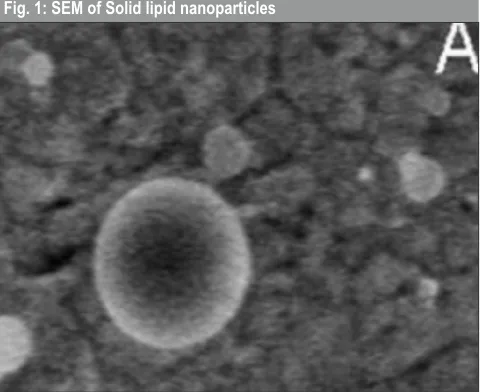
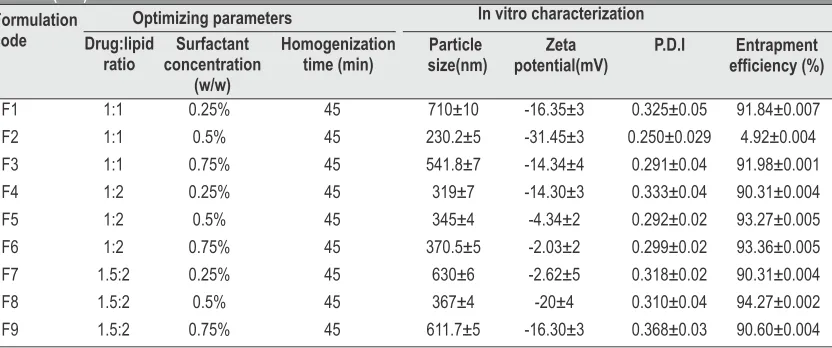
Formulations were characterized for size, shape, zeta potential, P.D.I and entrapment efficiency, summarized in Table 1. Scanning electron microscopy revealed the optimized formulation (F2) was found to be smooth, spherical and non- aggregated (fig 1). The analysis of the zeta potential is a useful to predict the stability of solid lipid nanoparticles. Zeta potential and P.D.I of optimized formulation (F2) was found to be -31.45 mV and 0.025 respectively. Above result indicated that lipid: drug: surfactant (1:1:0.25) was found to be optimum and necessary to produce a stable lipophilic colloid. The average particle size of ARM loaded solid lipid nanoparticles (F2) was found to be 230.2 ± 5 nm. The increase of particle size and P.D.I at higher surfactant concentration could be a consequence of increased SLNs formation. Above lipid concentration could have produced a conducive environment in terms of viscosity which allows lipid to self assemble to produce SLNs. The choice of emulsifier Cremophor EL and their concentration is of great impact on
13
the quality of the SLNs dispersions . The formulation obtained with 0.25% Cremophor EL in formulation F1 were insufficient to stabilize 1% tripalmitin dispersion. High
concentration of Cremophor EL reduces the surface tension and facilitate the particle partition during homogenization. The decrease in particle size in F2 formulation leads to tremendous increase in surface area. Results indicated 0.25% w/w of Cremophor EL found to be optimum, which cover the new surfaces and prevent agglomeration. The encapsulation efficiency of ARM in the nanoparticles was found to be 95.34 ± 2%. This attributes the high solubility of the drug in the lipid melt. Generally, solubility decreases after cooling down the lipid melts . Hence the chemical nature of the lipid is also important determining the entrapment efficiency. Here tripalmitin forms a perfect lattice structure, which prevents drug expulsion and thus improves entrapment efficiency. The solubilized drug would help in giving quick availability of ARM in the body whereas encapsulated drug would be released in a sustained manner which may help in the prevention of recrudescence.
In vitro drug release studies
In vitro release of optimized formulation (F2) was evaluated using a dialysis bag diffusion technique. Approximately 70% drug was released after 48 hr. In-vitro release profile of ARM loaded SLNs inferred a burst release of drug within few minutes. Burst release contributing to the large surface area, a high diffusion coefficient due to small molecular size, low viscosity in the matrix. Burst release was followed by sustained release of drug about 70% after 48 hrs as shown in fig 2 below. The difference in melting temperature of lipid and the homogenization temperature were considered as important parameters determining the structure of the SLNs matrix. Solid lipid nanoparticles solidify at room temperature and hence retarded the release of drug. Achieving prolonged release further indicated that factors, such as interactions between drug–lipid molecules, between surfactant-lipid molecules and solubility of the drug in the molten and solid
14
lipid, play a major role. A possible explanation is the drug lipid interaction will affect the viscosity of solid lipid matrix. In addition surfactant, surfactant concentration and production temperature also affect release profile.
In vitro erythrocyte toxicity study
Hemolytic study was performed to evaluate cytotoxicity of the formulation. Hemolysis is an important parameter and needs to be examined since the drug showed its optimum therapeutic activity at RBC stage. Triton X 100, a known hemolytic agent acted as a positive control in the study and showed 100% hemolysis of erythrocytes, thus validating the experiment. Hemolytic study showed SLNs based formulation showed least hemolysis as compared to plain drug as presented in fig. 3. It was expected that the combination of all these components would give an additive effect resulting in considerably higher hemolysis. However, it was not observed in this study. It can be inferred that the assembling of aforementioned components in solid lipid nanoparticles structure changes their mode and degree of interaction with the erythrocytes and hence the combination of all these components does not show any additive effect on
the hemolysis of erythrocytes. Similar observations have been reported for the lipid emulsions which corroborate this
10
observation. This result further confirmed the biocompatible nature of lipid and surfactant selected for formulation.
In-Vivo studies percentage antimalarial activity
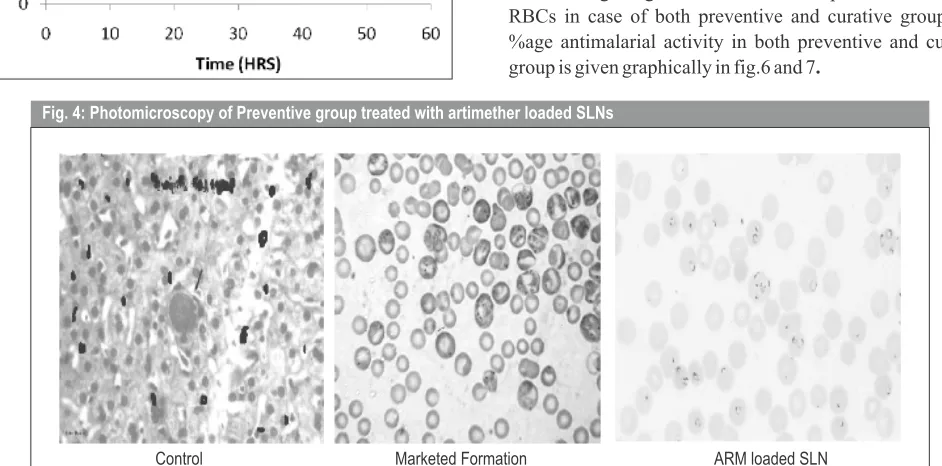
Antimalarial activity of the optimized formulation was evaluated at preventive as well as curative stage. Antimalarial activity was found better in case of drug loaded SLNs followed by plain drug and then marketed formulation in case of preventive than curative stage. Artemether uses iron from hepatic blood circulation and from iron depot transferritin and apoferritin, which is sufficient to convert prodrug to active component dihydroartemisnin which is responsible for antimalarial activity. Further, passive targeting confers the higher concentration of drug in liver. Percentage antimalarial activity observed 70% and 50% for preventive and curative stage respectively indicated artemether based solid lipid nanoparticles was more effective in preventive stage than curative stage. Figure 4 and 5 shows the photomicroscopy of RBCs in case of both preventive and curative group. The %age antimalarial activity in both preventive and curative group is given graphically in fig.6 and 7.
Fig. 2: Cumulative % release of artimether from solid lipid nanoparticles.
Fig. 3: Percentage hemolysis
Control Marketed Formation ARM loaded SLN
Control Marketed Formation ARM loaded SLN
Fig. 5: Photomicroscopy of Preventive group treated with artimether loaded SLNs
Fig. 6: Percentage Antimalarial activity of artimether loaded SLNs in Preventive group
Fig. 7: Percentage Antimalarial activity of artimether loaded SLNs in Curative group
F1 1:1 0.25% 45 710±10 -16.35±3 0.325±0.05 91.84±0.007
F2 1:1 0.5% 45 230.2±5 -31.45±3 0.250±0.029 4.92±0.004
F3 1:1 0.75% 45 541.8±7 -14.34±4 0.291±0.04 91.98±0.001
F4 1:2 0.25% 45 319±7 -14.30±3 0.333±0.04 90.31±0.004
F5 1:2 0.5% 45 345±4 -4.34±2 0.292±0.02 93.27±0.005
F6 1:2 0.75% 45 370.5±5 -2.03±2 0.299±0.02 93.36±0.005
F7 1.5:2 0.25% 45 630±6 -2.62±5 0.318±0.02 90.31±0.004
F8 1.5:2 0.5% 45 367±4 -20±4 0.310±0.04 94.27±0.002
F9 1.5:2 0.75% 45 611.7±5 -16.30±3 0.368±0.03 90.60±0.004
Formulation code
Optimizing parameters In vitro characterization
Drug:lipid ratio
Surfactant concentration
(w/w)
Homogenization time (min)
Particle size(nm)
Zeta potential(mV)
P.D.I Entrapment efficiency (%)
CONCLUSION
The feasibility of hot melt method in the preparation of ARM loaded Solid lipid nanoparticles was successfully established. ARM loaded Solid lipid nanoparticles offer significant improvement in the antimalarial activity and duration of action of ARM as compared to the conventional injectable formulation. There is no sign behavioral change noticed throughout the treatment period, confirmed the optimized formulation is safe and stable. Further in-vitro studies need to be carried out at asexual parasitic stage (sporozoites) to reinforce the hypothesis postulated here.
REFERENCES
1. Greenwood B, Mutabingwa T. Malaria in 2002. Nature 2002;415:670-2. 2. WHO web site. 2007 [cited 2007 July 17] Available from:
http://whqlibdoc.who.int/hq/2005/a87017eng.pdf
3. Karbwang J, Na-Bangchang K, Congpuong K, Molunto P, Thanavibul A. Pharmacokinetics and bioavailability of oral and intramuscular artemether. Eur J Clin Pharmacol 1997;52:307-10.
4. Hien TT, Davis TM, Chuong LV, et al. Comparative pharmacokinetics of intramuscular artesunate and artemether in patients with severe falciparum malaria. Antimicrob Agents Chemother 2004;48:4234-9. 5. Li QG, Peggins JO, Fleckenstein LL, Masonic K, Heiffer MH, Brewer
TG. The pharmacokinetics and bioavailability of dihydroartemisinin, arteether, artemether, artesunic acid and artelinic acid in rats. J Pharm Pharmacol 1998;50:173-82.
6. Date AA, Joshi MD, Patravale VB. Parasitic diseases: Liposomes and polymeric nanoparticles versus lipid nanoparticles. Adv Drug Deliv Rev 2007;59:505-21.
7. de Vries PJ, Dien TK. Clinical pharmacology and therapeutic potential of artemisinin and its derivatives in the treatment of malaria. Drugs 1996;52:818-36.
8. Vivek K, Reddy H, Murthy RSR. Investigations of the effect of the lipid matrix on drug entrapment, in vitro release, and physical stability of olanzapine-loaded solid lipid nanoparticles. AAPS PharmSciTech 2007;8:E83.
9. Yang SC, Lu LF, Cai Y, Zhu JB, Liang BW, Yang CZ. Body distribution in mice of intravenously injected camptothecin solid lipid nanoparticles and targeting effect on brain. J Control Release 1999;59:299-307. 10. Jumaa M, Kleinebudde P, Muller BW. Physicochemical properties and
hemolytic effect of different lipid emulsion formulations using a mixture of emulsifiers. Pharm. Acta Helv 1999;76:293-301.
11. Chimanuka B, Gabriels M, Detaevernier MR, Plaizier-Vercammen JA. Preparation of beta-artemether liposomes, their HPLC-UV evaluation and relevance for clearing recrudescent parasitaemia in Plasmodium chabaudi malaria-infected mice. J Pharm Biomed Anal 2002;28:13-22. 12. Fidock DA, Rosenthal PJ, Croft SL, Brun R, Nwaka S. Antimalarial
efficacy Screening: in vitro and in vivo protocols, Supplemental file, Antimalarial drug Discovery: efficacy model for compound screening supplementary document. Antimicrob. Agents Chemother 2008;48:4234-9.
13. Mehnert W, Mader K. Solid lipid nanoparticles: production, characterization and applications. Adv Drug Deliv Rev 2001;47:165-96. 14. Mu¨hlen. Z, Mehnert W In Drug incorporation and delivery of Prednisolone loaded Solid Lipid Nanoparticles, Proceed. 1st World Meeting APGI/ APV; 1995; Budapest, 9–11 May, Budapest, 1995, p 455.