IOP Conference Series: Materials Science and Engineering
PAPER • OPEN ACCESS
Compressive strength, flexural strength and water
absorption of concrete containing palm oil kernel
shell
To cite this article: Nurazuwa Md Noor et al 2017 IOP Conf. Ser.: Mater. Sci. Eng. 271 012073
View the article online for updates and enhancements.
Related content
Compressive and flexural strength of concrete containing palm oil biomass clinker and polypropylene fibres
M H Wan Ibrahim, Sajjad Ali Mangi, M K Burhanudin et al.
-Quality control of lightweight aggregate concrete based on initial and final water absorption tests
M. Maghfouri, P. Shafigh, Z. Binti Ibrahim et al.
-The optimum content of rubber ash in concrete: flexural strength
M S Senin, S Shahidan, S M Shamsuddin et al.
1234567890
GCoMSE2017 IOP Publishing
IOP Conf. Series: Materials Science and Engineering 271 (2017) 012073 doi:10.1088/1757-899X/271/1/012073
Compressive strength, flexural strength and water absorption
of concrete containing palm oil kernel shell
Nurazuwa Md Noor1, Jun Xiang-ONG1, Hamidun Mohd Noh1,2, Noor Azlina Abdul Hamid1, Salsabila Kuzaiman1,3and Adiwijaya Ali1,3
1
Faculty of Civil and Environmental Engineering, Universiti Tun Hussein Onn Malaysia, Parit Raja, Batu Pahat, 86400, Johor, Malaysia
2
Faculty of Technology Management and Business, Universiti Tun Hussein Onn Malaysia, Parit Raja, Batu Pahat, 86400, Johor, Malaysia
3
Jurusan Teknik Sipil, Politeknik Negeri Ujung Padang, Jalan Perintis Kemerdekaan, KM 10 , Tamalanrea, 90245 Makassar, Indonesia
Corresponding author:[email protected]
Abstract. Effect of inclusion of palm oil kernel shell (PKS) and palm oil fibre (POF) in concrete was investigated on the compressive strength and flexural strength. In addition, investigation of palm oil kernel shell on concrete water absorption was also conducted. Total of 48 concrete cubes and 24 concrete prisms with the size of 100mm x 100mm x 100mm and 100mm x 100mm x 500mm were prepared, respectively. Four (4) series of concrete mix consists of coarse aggregate was replaced by 0%, 25%, 50% and 75% palm kernel shell and each series were divided into two (2) main group. The first group is without POF, while the second group was mixed with the 5cm length of 0.25% of the POF volume fraction. All specimen were tested after 7 and 28 days of water curing for a compression test, and flexural test at 28 days of curing period. Water absorption test was conducted on concrete cube age 28 days. The results showed that the replacement of PKS achieves lower compressive and flexural strength in comparison with conventional concrete. However, the 25% replacement of PKS concrete showed acceptable compressive strength which within the range of requirement for structural concrete. Meanwhile, the POF which should act as matrix reinforcement showed no enhancement in flexural strength due to the balling effect in concrete. As expected, water absorption was increasing with the increasing of PKS in the concrete cause by the porous characteristics of PKS
1.Introduction
2
1234567890
GCoMSE2017 IOP Publishing
IOP Conf. Series: Materials Science and Engineering 271 (2017) 012073 doi:10.1088/1757-899X/271/1/012073
thickness [2]. The previous study showed that the PKS is suitable for light and dense concrete production and also as a road building material [3]. In addition, PKS concrete can achieve an acceptable compressive strength value which is among the design strength of 21 to 35MPa with the density of 800 to 2240kg/m3 [4] .
Besides adding the PKS, palm oil fibres (POF) is added to determine the flexural strength of concrete. POF has a high potential which can slightly improve the flexural strength of concrete in order to affect overall cement fibre properties [5]. Hence, it has a higher demand for production of concrete since Malaysia being the largest palm oil producer in the world [1] .
Another reason for this study is the suitability and effectiveness of PKS and POF which act as a construction material for concrete production. Based on the previous research, PKS is used as lightweight aggregate to build a one-storey building and a foot bridge which is being monitored for their structural behaviour [2]. While for the POF, it is considered as natural fibre which can behave like reinforcement as well as improve the mechanical properties of concrete composite [5]. Hence, this study more concentrates on the comparison of conventional concrete, PKS concrete and PKS concrete containing with POF related with their workability, water absorption and strength as well as the performance of these two materials (PKS and POF) when subject to compressive and flexural strength test. In a nutshell, four series of concrete mix consists of 0%, 25%, 50% and 75% PKS is replaced by volume according to coarse aggregate content. Besides, the concrete is divided into two categories; PKS concrete mixed with and without POF. The use of 5cm length and 0.25% of the volume fraction of POF was conducted in this study.Formatting the title, authors and affiliations
Please follow these instructions as carefully as possible so all articles within a conference have the same style to the title page. This paragraph follows a section title so it should not be indented.
2.Material Preparation and Testing
2.1.Materials
Ordinary Portland cement of Grade 42.5 that conforming Malaysia Standard MS 197-7: 2007 was used as a binder. Fine aggregates origin from river sand was sieved through 5mm. Meanwhile, coarse aggregates, were sieved and minimum size of 10 mm and maximum size of 20 mm was selected. PKS in this study used as partially 0%, 25%, 50% and 75% coarse aggregate replacement. While, POF acted as an additive to determine its effect on the compressive and flexural strength of concrete when combined with PKS. The volume fraction of 0.25% with the 5cm length of POF was used in this study. Details of the density of each material are presented in table 1.
Table 1. Materials Density.
Materials Density (kg/m3) Ordinary Portland cement 3160
Water 1000
Sand 2441
Gravel 3087
1234567890
GCoMSE2017 IOP Publishing
[image:4.595.231.363.152.252.2]IOP Conf. Series: Materials Science and Engineering 271 (2017) 012073 doi:10.1088/1757-899X/271/1/012073
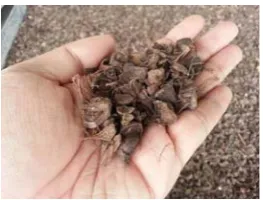
[image:4.595.230.354.281.376.2]Figure 1. Palm oil kernel shell (PKS)
Figure 2. Palm oil fibre (POF)
2.2.Experimental
The compressive strength test was performed based on BS EN 12390-3:2009 Testing Hardened Concrete Part 3: Compressive Strength of Test Specimens [6]. Specimen size of 100 x 100 x 100 mm tested after 7 and 28 days of hydration in tap water. The compressive strength of concrete cube was calculated by the following formula:
A
f
c c
F =
where fc is compressive strength in MPa; F is the maximum load at failure in N; Ac is the concrete
cross sectional area in mm2.
As for flexural strength test, a specimen of size 100 x 100 x 500mm are tested on third-point loading test based on BS EN 12390-5:2009 Testing Hardened Concrete: Flexural Strength of Test Specimens [7]. It involves load at a rate of 0.06 ± 0.04MPa per second until failure. The flexural strength of beam prism was calculated by the following equation:
bd
Fl fcf = 2
where fcf is flexural strength in MPa; F is the maximum load at the fracture point in N; l is the length
of the support in mm; b is the width of the beam in mm; d is the thickness of the beam in mm
3.Result and discussiom
4
1234567890
GCoMSE2017 IOP Publishing
IOP Conf. Series: Materials Science and Engineering 271 (2017) 012073 doi:10.1088/1757-899X/271/1/012073
all concrete mixtures without adding POF still achieve the design slump value ranging between 60 to 180mm. Four concrete mixtures with adding POF showed equal slump which is 30mm that not fulfilled the design slump value. Based on previous research conducted by Jayamani, POF is one of the types of natural fibre which has reduced water resistance, low durability, and poor fibre-matrix interactions. It can establish that composite materials are sensitive to humidity through absorption of water leading to differential swelling between the fibres and the matrix. Therefore, POF is good in water absorption. The dry mixture made the particles of aggregate difficult in the bonding process, resulting in the variation of a slump and concrete strength. In other words, POF absorbs the free water, lowering the water-cement ratio, causing the concrete mixture becomes dry.
Figure 3. Workability performance of concrete with/without PKS and POF
3.2.Physical Properties
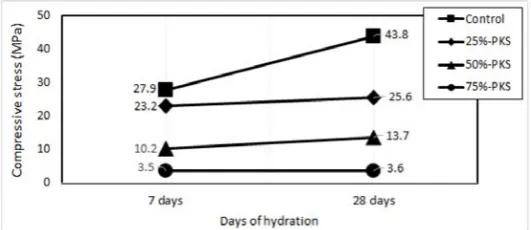
3.2.1.Compressive Strength. Results of compressive strength is presented in figure 4 and figure 5,
[image:5.595.186.417.238.355.2]where conventional concrete gave 28 days’ average compressive strength 43.8MPa and 42.5MPa for concrete without POF and concrete with POF, respectively. The strength was decreasing with the inclusion of PKS. Concrete with 25% PKS (no POF) achieved 25.6MPa lower than target compressive strength but it still above the accepted strength for lightweight structural purposes. Based on the previous study, the minimum compressive strength of lightweight structural concrete for 28 days is 17.0MPa [1]. Therefore, the replacement of coarse aggregate to 50% and 75% of PKS without and with adding POF cannot be considered due to their low compressive strength which achieves below 17MPa at 28 days compared to another specimen. Hence, the replacement of coarse aggregate with PKS in volume fraction (50% and 75%) cannot be applied to structural design due to its failure to achieve above general concrete strength requirement.
[image:5.595.164.430.542.657.2]1234567890
GCoMSE2017 IOP Publishing
[image:6.595.169.427.126.258.2]IOP Conf. Series: Materials Science and Engineering 271 (2017) 012073 doi:10.1088/1757-899X/271/1/012073
Figure 5. Concrete compressive stress with POF
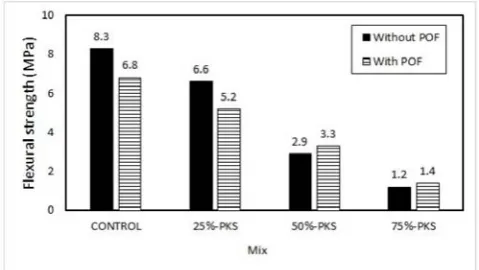
3.2.2.Flexural Strength. Figure 6 showed that the addition of 5cm and 0.25% of the volume fraction
of POF into each concrete mixture does not give any significant improvement in flexural strength. The 50%-PKS and 75%-PKS concrete show a slight increase in flexural strength when adding POF. While for conventional and 25%-PKS concrete with adding POF, the flexural strength drops to 6.8MPa and 5.2MPa, respectively. This was explained by Huzaifa (2008), who concluded that the reduction of the modulus of rupture might be due to the length of fibre used. A longer length of POF tends to give the small value of flexural strength due to too much of POF that contributes to weaker bonding between particles [8].
Figure 6. Flexural stress of concrete with and without POF
[image:6.595.177.417.381.516.2]6
1234567890
GCoMSE2017 IOP Publishing
IOP Conf. Series: Materials Science and Engineering 271 (2017) 012073 doi:10.1088/1757-899X/271/1/012073
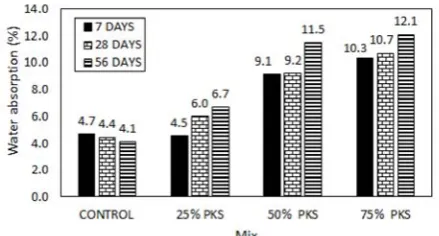
Figure 7. Water absorption of PKS concrete without POF
4.Conclusion
The following conclusions can be derived from the experimental results:
1. Workability of all PKS concrete without POF has a good workability. While for PKS concrete with POF, the slump was below than expected target.
2. The inclusion of PKS reduces the compressive strength of concrete. However, the replacement of 25% PKS gives acceptable values as it falls within the range of requirement for lightweight structural concrete. The 25%-PKS without and with POF achieve acceptable strength value which is 25.6MPa and 19.1MPa, respectively, at 28 days of age.
3. Adding POF into concrete mixture showed no improvement in flexural strength of PKS concrete. The congestion of POF may lead to reducing of bonding and disintegration. As a result, the 5cm length of POF in this study gave no significant result of flexural strength due to the inappropriate POF length which contributes to the possible balling effect.
4. Meanwhile, water absorption was increasing with the increasing percentage of PKS in concrete.
5.References
[1] Khan M, Deepak T and Nair S 2016 Use of palm shell as replacement of coarse aggregate for investigating properties of concrete International Journal of Applied Engineering Research 11 2379–2383
[2] Alengaram U J, Muhit B A A and bin Jumaat M Z 2013 A comparison of the thermal conductivity of palm shell foamed concrete with conventional materials Construction and
Building Materials 38 161–172
[3] Olanipekun E, Olusola K and Ata O 2006 A comparative study of concrete properties using coconut shell and palm kernel shell as coarse aggregates Building and Environment 41 297– 301
[4] Itam Z, Beddu S, Kamal N L M, Alam M A and Ayash U I 2016 The feasibility of palm kernel shell as a replacement for coarse aggregate in lightweight concrete IOP Conference Series:
Earth and Environmental Science vol 32 (London: IOP Publishing) 012040
[5] Raut A N and Gomez C P 2016 Thermal and mechanical performance of oil palm fiber reinforced mortar utilizing palm oil fly ash as a complementary binder Construction and
Building Materials 126 476–483
[6] EN BS 2009 Testing hardened concrete–Part 3: Compressive strength of test specimens (London: British Standard Institution )
[7] EN BS 12390-5 2009 Testing hardened concrete. Flexural strength of test specimens (London:British Standard Institution).
[8] Hashim H 2008 The effect of palm oil fibre on concrete properties
Acknowledgments
[image:7.595.183.403.132.250.2]