Moving on beyond lean thinking
Koskela, LJ
Title
Moving on beyond lean thinking
Authors
Koskela, LJ
Type
Article
URL
This version is available at: http://usir.salford.ac.uk/9385/
Published Date
2004
USIR is a digital collection of the research output of the University of Salford. Where copyright
permits, full text material held in the repository is made freely available online and can be read,
downloaded and copied for noncommercial private study or research purposes. Please check the
manuscript for any further copyright restrictions.
Lauri Koskela
1Abstract
Lean Thinking is currently often positioned as the underlying theory of lean production among practitioners and academics, although its originators, Womack and Jones, seem not to have presented it as a theory. This paper endeavours to analyze whether Lean Thinking can be viewed as a theory of lean production.
For this purpose, a critical assessment of Lean Thinking is carried out. Lean Thinking is argued to lack an adequate conceptualization of production, which has led to imprecise concepts, such as the term “value”. The five principles of Lean Thinking do not systematically cover value generation, and they do not always encapsulate the core topics in their respective areas. The failure to trace the origin of lean concepts and principles reduces the opportunity to justify and explain them.
Despite claims for generality, the application area of the five lean principles is limited to the transformation of mass production, with, for instance, one-of-a-kind production and construction being largely out of scope. It is concluded that it is opportune to move on beyond Lean Thinking, towards a generic theory of production, for acquiring a solid foundation for designing, operating and improving production systems.
Keywords: Lean thinking, theory, production
Introduction
“Lean production is ‘lean’ because it uses less of everything compared with mass production: half the human effort in the factory, half the manufacturing space, half the investments in tools, half the engineering hours to develop a new product in half the time.”
This characterization of lean production, as presented in the book The machine that
changed the world by Womack, Jones and Roos (1990), captured the attention of
production practitioners and researchers worldwide. The description of lean production by Womack and his co-authors has proved to be a highly useful synthesis of advanced manufacturing practices, first developed at Toyota and later adopted by other car manufacturers. The very term “lean production” has become widely used for referring to a specific template and practice of production, also well known as the Toyota Production System.
It is in this spirit that the founders of the International Group for Lean Construction started to use (or maybe coined, instances of prior usage are not known to the author) the term “lean construction” in 1993, for referring to a mode and practice of construction inspired by the Toyota Production System. As is well-known, research, development and implementation of lean construction has since then advanced and diffused to all continents.
However, since the late 1990’s, a subtle, but significant problem with the terms “lean production” and “lean construction” has emerged. It has become evident that many people do not associate these terms with evolutionary production templates developed or inspired by Toyota, but rather with the application of “lean thinking”, and especially the five principles of Lean Thinking2 as presented by Womack and Jones (1996). Unfortunately,
these five principles are a stark and to some extent imprecise simplification of the underlying theoretical framework of the Toyota Production System. The principles have excellently served a pedagogical and marketing function, but real life implementation, as well as further development of lean must – and can — be based on a wider set of ideas and frameworks. Thus, this paper argues that we have to move on, beyond this Lean Thinking oriented understanding of lean production.
The paper is structured as follows. At the outset, the origins and popular interpretation of Lean Thinking are analyzed. Next, the question whether Lean Thinking can be seen a theory in general is dealt with. Based on this consideration, Lean Thinking is then analyzed regarding conceptualization, validity of its principles, justification and range of applicability. Finally, conclusions are drawn from the preceding analyses.
Lean thinking
Origin
As admitted later by two of its authors (Womack and Jones 1996), the book The machine
that changed the world did not concisely summarize the principles of lean production. In
their newer book (1996), Womack and Jones endeavour to improve the theoretical side of the discussion of lean production. They say of the previous book: “…the thought process needed to tie all the methods together into a complete system was left largely implicit.” Further: “… we realized that we needed to concisely summarize the principles of “lean thinking” to provide a sort of North Star, a dependable guide for action for managers striving to transcend the day-to-day chaos of mass production.” Without such a guide, managers are drowning in techniques “without understanding the whole.”
Consequently, Womack and Jones (1996) summarize the principles underpinning Lean Thinking:
1. Precisely specify value by specific product. 2. Identify value stream for each product. 3. Make value flow without interruptions.
4. Let the customer pull value from the producer.
2 In this presentation, Lean Thinking refers to the particular type of lean thinking proposed by Womack and Jones (1996) in their book with the same title. For clarity, the book title is written here in italics: Lean
5. Pursue perfection.
As it is well known, the book Lean Thinking has been hugely successful, and this success has led to conferences and a community around the topic of Lean Thinking.
Interpretation
Lean Thinking is clearly a business book. To the best knowledge of the writer, its authors
have never presented and justified the five principles of Lean Thinking as a theory3 in any
academic journal. However, it seems that the very success of the book has led to misplaced views on Lean Thinking. It has been understood that the five principles provide an exhaustive, mature foundation – equivalent to a theory — for the transformation of any productive activity. For example, the Egan report (Rethinking construction 1998) stated:
“Lean Production is the generic version of the Toyota Production System, recognized as the most efficient system in the world today. Lean Thinking describes the core principles underlying this system that can also be applied to every other business activity – from designing new products and working with suppliers to processing orders from customers.”
A similar view has recently been taken in operations management (OM) literature (Slack, Lewis & Bates 2004):
“For instance, JIT/lean production is a long-established OM research priority that in recent years has probably become less prominent as a subject as the core principles have matured. In terms of practice however, there is still a great deal of scope for applying these, now clearly articulated and tested, principles – especially beyond their traditional manufacturing roots (e.g. Womack and Jones, 1994, 1996)”.
Similarly, Hines et al. (2004), while acknowledging the evolutionary nature of lean production, nevertheless claim that the principles have remained unchanged:
“Such a process of evolution has maintained the adherence to the lean principles developed by Womack and Jones (1996) but has explored different applications and contingencies faced by organizations during the adaptation … process.”
Are the five principles of Lean Thinking valid as a theoretical foundation, in the way they seem to be understood in many circles? This question is not only academic but also highly practical. Namely, from an academic point of view, if this is the general theory, we can reduce our efforts to understand lean production, and we can concentrate on the issues of implementation. And from the practical viewpoint, we can fully trust that by using this theory, we can transform any line of production or service into a lean operation.
Is lean thinking a theory?
Theory is a slippery concept, with many connotations. In one sense, theory refers to general principles of any field or discipline. In this sense of the term, the question is surely about theory, and the assessment reduces to assessing the adequacy of the principles
involved – this will be carried out below. However, in the more stringent sense of the term, a theory refers to a scientific theory. According to Whetten (1989) such a theory will contain four essential elements:
• What. Which factors (variables, constructs, and concepts) logically should be
considered as part of the explanation of the phenomena of interest?
• How. How are factors related? Here, causality is introduced.
• Why. What is the rationale that justifies the selection of factors and the
proposed causal relationships? An explanation is required.
• Who, Where, When. The boundaries of generalisability and thus the range of
the theory have to be set.
Is Lean Thinking a scientific theory? Does it have the parts as suggested by Whetten?
Lean Thinking contains five principles, which at least implicitly present causal
relationships: do this, so waste is minimized and value maximized. It thus contains the “How” element. However, other parts are either lacking or treated in a shallow or partial mode. There is no conceptualization of lean production, i.e. an answer to the “What” question. There is some justification for the principles, but not for the whole approach. Thus, the “Why” question has not been systematically answered. The “Who, where, when” issue is not tackled in any deeper sense, although one gets the impression that the principles are suggested to be generally usable.
Surely theories may be usable and widely diffused without being perfect in Whetten’s (1989) sense. He comments that the last element, the boundaries of the theory, is often the least developed area. Thus, the question is whether the failure to adequately present the “What”, “Why” and “Who, where, when” elements creates detrimental impacts.
Thus, Lean Thinking contains at least some elements of a theory, and these can be evaluated in the normal way by assessing their validity in comparison to empirical reality. However, regarding the missing or in some respect inadequate elements, we ask: In which way are we in a poorer position without those elements?
In the following section we start by inspecting the conceptualization of production (“What”). Then, we proceed to the evaluation of the lean principles (“How”). The way of tackling the “Why” issue is by looking at the historical development process, leading to the introduction of concepts and causalities in question. Lastly, we analyze Lean Thinking from the “Who, where, when” point of view.
Conceptualization of production
Concepts of production
The reader of Lean Thinking cannot avoid noticing that there are two central, allegedly new terms for analyzing production: muda (the word waste in Japanese) and value. However, it is not explained from where these terms originate.
production is a transformation of production factors into the product. Another view is that production is a flow of material through the production system. The third view is that production is value generation, fulfilling the customers' needs and wishes.
The splendid feature of the transformation model is simplicity: it focuses just on what goes in and what goes out of production. Of course, productivity is a related term, being determined by input and output. Here, the first principle is to decompose the total transformation into smaller ones, usually called tasks, and to perform each of them in an optimal manner. Isn't this reasonable: we look at what has to be done, we do all that and production is completed? The crucial assumption here is the independence of these tasks. If it is evident that they are not independent, we can make them (relatively) independent by buffering them.
In the flow model, we introduce time as an attribute. When we look what happens to a piece of material in production, we observe that there are transformations, but also waiting, inspection and moving stages. The last three are not really needed for transformation, and they can be called waste. The first principle is to eliminate or reduce this waste. How can it be done? Already from the twenties it has been known that time compression leads to waste reduction (Koskela 2000, 68-9). A newer insight is that uncertainty (to be precise, variability, that is, random variation in the processing times or arrival of inputs) is an important cause of waste.
In the value generation model, the customer is introduced. The first principle is to create the best value for the customer. The pedigree of the value generation model goes back to Shewhart (1931), who defined two further principles of value generation at the outset of the quality movement:
Looked at broadly there are at a given time certain human wants to be fulfilled through the fabrication of raw materials into finished products of different kinds. […]
The first step of the engineer in trying to satisfy these wants is therefore that of translating as nearly as possible these wants into the physical characteristics of the thing manufactured to satisfy these wants. […]
The second step of the engineer is to set up ways and means of obtaining a product which will differ from the arbitrarily set standards for these quality characteristics by no more than may be left to chance.
There are two important insights here. First, it makes a difference which concept of production is used: depending on what basic concept you select, you end up with very different, even conflicting, prescriptions for production. For example, the transformation model suggests using buffers between workstations; the flow model suggests eliminating buffers. Second, terms such as ‘productivity’, ‘waste’ and ‘value’ are not independent, self-contained concepts – rather they are embedded in different conceptualizations of production, which provide their meaning.
The relationship of waste and value
Womack and Jones write: “Lean thinking also provides a way to make work more satisfying by providing immediate feedback on efforts to convert muda into value.” This suggests that value can be maximized through minimizing waste. Indeed, they define the eighth waste as design of goods and services that do not meet users’ needs (the first seven wastes being those defined by the Japanese originators of the Toyota Production System).
However, these two concepts, waste and value, are better thought of as existing in different, even if intersecting dimensions. A product with a wonderful value may be produced in a most wasteful process. On the other hand, a product with a clearly deficient value may be produced in a most waste-free process. Unfortunately, there is no such handy and direct connection between waste and value as indicated in Lean Thinking.
What is value?
Womack and Jones state: “The critical starting point for lean thinking is value. Value can only be defined by the ultimate customer.” This is a sensible characterization of value, which connects to more general use of the term.
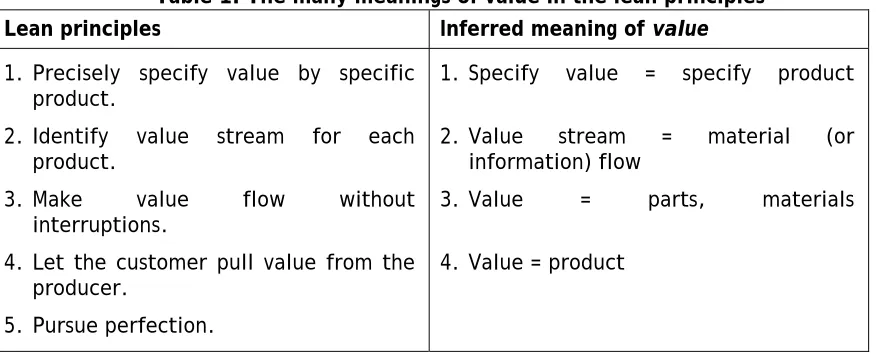
[image:7.612.83.522.423.600.2]However, when we start to inspect the lean principles, we readily realize that something is not in order (Table 1). Regarding the first principle: How can we specify value, if it is something happening between the customer and the product? We cannot. Obviously, value is used instead of the word product (or perhaps product features or functions) there. Then value is flowing in the value stream, and value is pulled at the end. Have we ever seen value flowing or being pulled in factories? No, we see only parts, materials and completed products. Obviously, in turn, value is here used to mean materials, parts or products.
Table 1: The many meanings of value in the lean principles
Lean principles Inferred meaning of value
1. Precisely specify value by specific product.
2. Identify value stream for each product.
3. Make value flow without interruptions.
4. Let the customer pull value from the producer.
5. Pursue perfection.
1. Specify value = specify product
2. Value stream = material (or information) flow
3. Value = parts, materials
4. Value = product
Simply, the authors are using imprecise and unsystematic terms, due to lack of explicit conceptualization.
Assessing the principles of lean thinking
The following questions are posed for assessing the principles: What is meant by the principle? Does the principle encapsulate what we know about its theme area?
Precisely specify value by specific product
What is meant by the principle?
The central message of this principle seems to be to “rethink value from the perspective of the customer” and “to ignore existing assets and technologies”.
Does it encapsulate what we know?
That value should be rethought from the point of view of the customer is now a somewhat tired platitude (we return to this below). Instead, already Shewhart succeeded in defining two high-level principles of value generation, and there are candidates for three others (Koskela 2000). Unfortunately, none of these is treated as Lean Thinking4. But is this
judgement premature, noting that value is explicitly mentioned in three subsequent principles? Unfortunately, “value” in the subsequent principles is a misnomer, as justified above. The first principle is the only one trying to cover value generation, but whether it does the job, is questionable.
Identify value stream for each product
What is meant by the principle?
The question is about the modelling and designing of the production system, including product development, order fulfilment and the production proper, especially with the goal of weeding out avoidable wasteful activities.
Does it encapsulate what we know?
At a high level of abstraction, this principle works reasonably well
5.
Make value flow without interruptions
What is meant by the principle?
This principle, while addressing generally the reduction of lead times, refers primarily to the method of one-piece flow, instead of a flow consisting of batches.
4 This is understandable taking into account that value issues have historically been somewhat outside the Toyota Production System. Cell and Arratia (2003) state from a value engineering (VE) viewpoint: “Unlike VE, Lean has no analytical or methodological mechanism for analyzing the design of the product with the intent of reducing production cost or otherwise increasing customer value”.
Does it encapsulate what we know?
Actually, there are several other conclusions from this principle than one-piece flow – they seem not to be treated. It can easily be shown through queuing theory that variability increases the lead time (Krupka 1992, Hopp & Spearman 1996) and thus work-in-progress. Thus, reduction of variability can be used as one important method of waste elimination. However, variability is not covered in Lean Thinking.
Let the customer pull value from the producer
What is meant by the principle?
According to the principle, the customer is pulling the product from the production system as needed rather than the production system pushing products, often unwanted, onto the customer.
Does it encapsulate what we know?
Push systems schedule the release of work, while pull systems authorize the release of work on the basis of system status (Hopp & Spearman 1996). The underlying feature of the pull systems, like kanban, is that they establish a cap for work-in-progress, which will also keep lead-time in control.
A production control system can also be a mixed push-pull system. Huang and Kusiak (1998) present a push-pull system that pushes through certain manufacturing stages and pulls elsewhere based on the characteristics of these stages. They argue that this is superior to a push system, while avoiding some inherent problems of pull systems. Thus, either push and pull method may be appropriate depending on the characteristics of the production stage in question. Accordingly, the wording of this principle is too categorical.
Pursue perfection
What is meant by the principle?
Womak and Jones say, “there is no end to the process of reducing effort, cost, and mistakes while offering a product which is ever more nearly what the customer actually wants” (1996). Obviously, the question is about continuous minimization of waste and maximization of value, i.e. continuous improvement.
Does it encapsulate what we know?
The principle is defined on a very general level. The book rightly mentions transparency as one of the most important spurs to perfection. Unfortunately, the role of standards (Nakamura 1993) is not treated in connection to continuous improvement. Neither is the scientific experimentation model of Shewhart mentioned (to be discussed below).
Assessment of the principles as a whole
Unfortunately, there are problems here. Indeed, the authors cover a number of crucial principles or practices related to the flow concept; the treatment is selective, however, and several key issues are left out6. Moreover, the value generation concept principles are
left almost without mentioning. How the transformation concept is used in lean production is not discussed at all.
A related problem is that there is a gap between the first principle, addressing product specification, and the following three principles, addressing, in practice, production. It is to be assumed that product development has somehow been completed between the first and second principle.
All in all, it is highly questionable whether all principles, in their starkly compressed form, can be understood in a productive way and whether they come together to a whole.
Justification of the lean principles
Why should we think that just these principles should be adopted? In principle, several ways of justification can be used. However, if the question is about an existing idea or practice, a natural way is to seek for a justification from the situation where the breakthrough of the idea or practice happened. So, the question, from where do the principles originate and what was the related rationale, poses itself.
Specify value
The first principle, in the meaning “rethink value from the perspective of the customer” and “to ignore existing assets and technologies” is well known in the American marketing literature. In 1960, Levitt attacked the then prevailing production paradigm:
Mass-production industries are impelled by a great drive to produce all they can. The prospect of steeply declining unit costs as output rises is more than most companies can usually resist. The profit possibilities look spectacular. All effort focuses on production. The result is that marketing gets neglected.
The difference between marketing and selling is more than semantic. Selling focuses on the needs of the seller, marketing on the needs of the buyer. Selling is preoccupied with the seller’s need to convert his product into cash, marketing with the idea of satisfying the needs of the customer by means of the product and the whole cluster of things associated with creating, delivering and finally consuming it.
…a truly marketing-minded firm tries to create value-satisfying goods and services that consumers want to buy.
Of course, Levitt’s views are fully compatible with Shewhart’s value generation model, explained above. There is nothing wrong in reminding people of these often neglected ideas, even if they have not figured prominently in the framework of the Toyota Production System. However, many a reader of Lean Thinking might have benefited from connecting this idea to its roots and related previous discussions.
Value stream, flow and pull
The three middle principles can be discussed together, as they all are original features of the Toyota Production System, discussed in the books of Ohno and Shingo as well as in the first Western interpretations (for example, Schonberger 1982).
The origin of the second principle might be in the flow oriented principles for designing the factory layout. In addition, this is an area where the re-engineering movement operated during its heyday. It must be added that the idea of modelling production processes has even deeper roots. Frank and Lillian Gilbreth (1922), in a paper advocating process modelling, refer to practices that obviously resemble value stream mapping:
In many instances recording industrial processes in process-chart form has resulted in astonishing improvements.
Similarly, the third principle, focusing on one-piece flow, is one of the issues addressed early by the Japanese originators. The fourth principle on pulling seems to derive from the kanban production control, an original invention of the Toyota Production System.
Again here, the discussion and justification of these principles would have had more depth if the roots had been covered.
Perfection
The fifth principle addresses continuous improvement. In the West, continuous improvement, associated both with JIT and TQC, emerged as a theme in itself especially after the book by Imai (1986). A key idea is to maintain and improve the working standards through small, gradual improvements. The inherent wastes in the process are natural targets for continuous improvement. However, even in this case there is an important predecessor. Shewhart (1931) presented the idea of the scientific experimentation model, which has functioned as the basis of the introduction of continuous improvement in total quality management, and still can be recognized as a backbone in the current Japanese implementation of the Toyota Production System, as described by Spear and Bowen (1999). Unfortunately, without presenting the seminal idea of Shewhart on continuous improvement, only the superficial appearance of continuous improvement is conveyed and shallow justification of it is provided to the reader.
Range of applicability
activity. Let us test this by looking at another significant type of production, one-of-a-kind production, and its one special case, construction
One-of-a-kind production is characterized by the necessity of including the product design stage in any consideration of production. Product design accentuates the issues related to value generation. What support does Lean Thinking give for ensuring that value is maximized? Very little, because, as argued above, value generation is not covered by the principles, except for a most narrow part by the first principle.
Let us focus on a specific type of one-of-a-kind production. Let us assume one-of-a-kind production with temporary location and temporary organization. Construction is the classic example of this. We realize that practically all the principles are in great trouble7. The
client is certainly pulling the end product, but the production system is built up along with the facility to be built, and there might be nobody to pull at site on Monday morning when a certain work should start – if there is no downstream workstation that could pull! Rather, inputs emerge there and the work starts because they have been scheduled to do so, i.e., they are pushed. Work is done in temporary locations all over the facility, and it would be most challenging to create neat production cells where material or intermediate products would flow in one piece mode from one work station to another. What is the meaning of continuous improvement when the production system will anyway be dismantled, the organization disintegrated, and any improvement will be swept away like dust by the wind? The conclusion is that Lean Thinking is deeply contextual8; it has been formulated in the
context of mass production with repetitive activities, occurring in permanent locations, with permanent organization.
But there is a more profound problem. Production of discrete products in large quantities is an ordered activity, with small uncertainty, barring demand fluctuations. However, product development or design cannot be characterized in this way, rather they fall into the category of complex, adaptive systems. It has been argued that even some types of physical production, such as construction, can better be seen as a complex adaptive system (Bertelsen 2004). Lean Thinking does not address this kind of phenomenon, which obviously requires different managerial approaches9.
The conclusion is that Womack and Jones’ failure to address the “Who, where, when” issue led them to imply general applicability of the five lean principles. The evidence does not support that.
7 The following arguments are not meant to discourage the application of lean ideas in construction; rather they try to show that another set of principles is needed for construction. For example, the author has argued (Koskela 2004) that the principle of avoiding making-do is of great significance in construction. Making-do refers to negative buffering: an activity is started before all its inputs are at hand.
8 Koenig et al. (2002) provide further evidence for this standpoint. They claim that not all lean principles are applicable to Japanese shipyards. Moreover, they view that the Japanese shipbuilding industry likely ranks ahead of Toyota in terms of achievement of lean production. In a similar vein, Hines & al. (2004) write: “In particular when applied to sectors outside the high-volume repetitive manufacturing environment, lean production has reached its limitations, and a range of other approaches to counter variability, volatility and variety have been suggested.”
Conclusions
What should the final assessment regarding Lean Thinking be? In its original role, as a popular introduction into lean production, Lean Thinking is admirable. The principles are conveniently compact and surprising enough for captivating the imagination and providing inspiration. The success of the book and its implications, in the form of conferences and institutionalizing of the community around Lean Thinking, prove that the principles have helped practitioners to absorb central ideas of lean production and to start the transformation of mass production into lean.
However, this very success seems to have led to misplaced views on Lean Thinking in many circles. It has been understood that the five principles provide an exhaustive, mature foundation for the transformation of any productive activity. However, analysis shows that
Lean Thinking provides only fragments, albeit important ones, of the universe of existing
understanding.
Especially, Lean Thinking lacks an adequate conceptualization of production, which has led to imprecise concepts, such as the term “value”. The five principles of Lean Thinking don’t systematically cover value generation, and they do not always encapsulate the core topics in their respective areas. The failure to trace the origin of lean concepts and principles reduces the opportunity to justify and explain them. Despite claims for generality, the application area of the five lean principles is limited to the transformation of mass production, with one-of-a-kind production and construction, for instance, being largely out of scope.
Thus, unfortunately, analysis shows that Lean Thinking cannot be viewed as a valid and mature theory of production10. Now it is opportune to go forward, towards a generic theory
of production, for acquiring a solid foundation for designing, operating and improving production systems.
Acknowledgments
My discussions with Sven Bertelsen have greatly inspired and influenced the writing of this presentation. The comments by Glenn Ballard, Greg Howell, Alan Mossman and Tariq Abdelhamid have helped to sharpen the arguments. However, the author solely is responsible for any possible omission, misunderstanding or misjudgement.
References
Bertelsen, Sven. 2004. Construction Management in a Complexity Perspective. 1st International SCRI Symposium, Salford, UK, March 2004.
Cell, Charles L. & Arratia, Boris. 2003. Creating Value with Lean Thinking and Value
Engineering. Paper accepted by the Society of American Value Engineers for
presentation at the 2003 SAVE International Conference, June 7-11, 2003.
Gilbreth, Frank B. and Gilbreth, L.M. 1922. Process Charts and Their Place in Management. Mechanical Engineering, January, pp. 38 - 41, 70.
Hines, Peter, Holwe, Matthias & Rich, Nick. 2004. Learning to evolve: A review of contemporary lean thinking. International Journal of Operations & Production
Management, Vol. 24, No. 10, pp. 994 - 1011.
Hopp, Wallace & Spearman, Mark. 1996. Factory Physics: Foundations of Manufacturing
Management. Irwin/McGraw-Hill, Boston. 668 p.
Huang, C.-C. & Kusiak, A. 1998. Manufacturing control with a push-pull approach. Int. J.
Prod. Res., Vol. 36, No. 1, pp. 251 - 275.
Imai, Masaaki. 1986. Kaizen, the key to Japan’s competitive success. Random House, New York. 259 p.
Koenig, Philip C., Narita, Hitoshi & Baba, Koichi. 2002. Lean Production in the Japanese Shipbuilding Industry? Journal of Ship Production, Vol. 18, No. 3, pp. 167- 174.
Koskela, Lauri. 2000. An exploration towards a production theory and its application to construction. VTT Building Technology, VTT Publications 408, Espoo. 296 p.
Koskela, Lauri. 2004. Making-do – the eighth category of waste. 12th Annual Conference of the International Group for Lean Construction. Helsingør, August 3-5, 2004. Bertelsen, Sven & Formoso, Carlos T. (ed.), Lean Construction – DK, pp. 3 - 12.
Krupka, Dan C. 1992. Time as a Primary System Metric. In: Heim, Joseph A. & Compton, W. Dale (ed.). 1992. Manufacturing systems: foundations of world-class practice. National Academy Press, Washington, DC. Pp. 166 - 172.
Levitt, Theodore. 1960. Marketing Myopia. Harvard Business Review, July-August, pp. 45-56.
Nakamura, S. 1993. The New Standardization. Productivity, Portland. 268 p.
Rethinking construction. 1998. Department of the Environment, Transport and the Regions.
Schonberger, Richard J. 1982. Japanese manufacturing techniques. The Free Press, New York. 260 p.
Schonberger, Richard J. 1986. World class manufacturing. The Free Press, New York. 253 p.
Schonberger, Richard J. 1990. Building a chain of customers. The Free Press, New York. 349 p.
Schonberger, Richard J. 1996. World Class Manufacturing: The Next Decade. The Free Press, New York. 275 p.
Slack, Nigel, Lewis, Michael & Bates, Hilary. 2004. The two worlds of operations management research and practice: Can they meet, should they meet? International
Journal of Operations & Production Management, Vol. 24, No. 4, pp. 372 – 387.
Spear, Steven & Bowen, H. Kent. 1999. “Decoding the DNA of the Toyota Production System.” Harvard Business Review, September 1999.
Whetten, David, A. 1989. What Constitutes a Theoretical Contribution? Academy of
Management Review, Vol. 14, No. 4, pp. 490 - 495.
Womack, James P. & Jones, Daniel T. 1996. Lean Thinking. Simon & Schuster, New York. 350 p.
Womack, James P. & Jones, Dan. 2003. Lean Thinking. Revised and updated. Free Press. 396 p.
Womack, James P., Jones, Daniel T. & Roos, Daniel. 1990. The Machine that Changed the