Journal of Chemical and Pharmaceutical Research, 2014, 6(7):1291-1295
Research Article
CODEN(USA) : JCPRC5
ISSN : 0975-7384
A study of American nanotechnology development based on patent analysis
Bu Yuan-fang, Gao Bai-ning and Gao Wang-wei
Henan University of Science and Technology, China
_____________________________________________________________________________________________
ABSTRACT
In this study, the development of nanotechnology is summarized and at the same time the importance of patent analysis in industry technology development is introduced. With the use of patent information retrieval tools and statistical methods, the development status and tendency of American nanotechnology is intensively probed into, hoping to provide reference for the development of nanotechnology at home from the perspective of total patent output, technology life cycle, the main technological areas and the distribution of patent applicant.
Key words: Nanotechnology; patent analysis; information retrieval; development status
_____________________________________________________________________________________________
INTRODUCTION
Nanotechnology is the frontier and interdisciplinary new subject area gradually developed in the late 1980s. Nanotechnology promotes product miniaturization, high performance and environmental friendly, which will greatly conserve resources and energy, reduce human’s over-reliance on them and accelerate the improvement of ecological environment. All of this will provide material and technical assurance for sustainable human development on a new level. As a high-tech industry, rapid development of nanotechnology will lead to a revolutionary change in almost all industrial fields in the 21st century. At present, all developed countries have carried out a large number of inputs in the research and development of nanotechnology, intending to seize the strategic high ground of technology in this 21st century.
Continuous development and progress of science and technology gave birth to the era of knowledge economy. Science and technology competition has become the main means of market competition in high-tech industry, while intellectual property competition on the basis of patent has become the core competition of technology [1]. It is a new viewpoint to research the development of high-tech industry with patent as a core competency. It is from the perspective of patent that the development of American nanotechnology is scrutinized in this study in order to provide reference for nanotechnology development in domestic.
OVERVIEW OF NANOTECHNOLOGY INDUSTRY DEVELOPMENT AT HOME AND ABOARD
The concept of “molecular nanotechnology” was first put forward by scientists in the middle 1990s. After ten years of technological and scientific progress, all aspects of military construction have been affected by rapid development of nanotechnology. The figure of nanotechnology can be seen from military uniforms, missile weapons, spacecraft and sophisticated weapon technology and equipment. Between 1996 and 1998, Loyola College’s “World Technology Evaluation Center” was funded and commissioned jointly by more than ten government agencies, led by the U.S. National Science Foundation for a three year investigation aimed at assessing and getting hold of the current global research and development situation and future tendency of nanotechnology in America, France, Germany, Belgium, the Netherlands, Sweden, Switzerland, United Kingdom, Russia, Japan and China Taiwan and other places.
significance which America does not have absolute leading superiority since World War II. If America intends to maintain the absolute leading position of technological revolution in the 21st century and to ensure its national security, there is a need for them to increase investment in nanotechnology research and development over the next 10 to 20 years. For this reason, after three years’ preparation in February 2000, the then U.S. president Bill Clinton announced the launch of the National nanotechnology Initiative. Since then, the U.S. government has invested billions of dollars into the field of nanotechnology, and the venture capital funds or private funding has reached as huge as ten billion dollars. Affected by the NNI plan, nanotechnology development program has been launched in Japan, Germany, South Korea and Taiwan. The National Nanotechnology Program for the Development of Science and Technology (2001-2010) was issued in China in 2001, which put forward the basic goals and tasks of nanotechnology development and established “National Coordinating Committee” so as to strengthen comprehensive guidance and coordination of nanotechnology research and development. Over the past ten years, the United States, as the leader of the world nanotechnology, has been copied and chased by other countries around the world in terms of both policy and scientific breakthrough.
PATENT INFORMATION RETRIEVAL
Nanotechnology, as a frontier field embodying interdisciplinary feature of different disciplines, covers physics, chemistry, materials science, biology and electronics and many other subjects, as well as information, microelectronics, precision machinery, computer, energy, aerospace multiple applications in chemical, textile, manufacturing, measurement, control and manufacturing technology etc. many applied fields, covering a wide range of fields. Different disciplines or application fields manifest different characteristics in patent. Therefore, the research of nanotechnology development status requires not only form the overall layout, but also from different application point of view, and further analysis on this basis.
Some national patent offices have categorized nanotechnology, such as the U.S. patent and trademark office and the European patent office, etc [2]. Some scholars have also put forward their own classification of nanotechnology in their studies. For instance, in the study of nanotechnology international trends and cooperation by Chen, nanotechnology has been classified into electronic nanotechnology, biomedicine, chemical processes and material, equipment tools and standards and so forth five areas. In this paper, on the basis of the research, nanotechnology is divided into five fields in accordance with its different application areas—nanotechnology materials and processing, nano-electronics and devices, nano-biotechnology and medicine, nano-devices and nano-characterization as well as other areas. The corresponding patent data is obtained by means of theme retrieval. Since a patent can be attributed to different area simultaneously, therefore the total number of the five area patent can be more than the amount of patents retrieved.
The theme retrieval method is adopted in this paper, in March 20 2014 23927 patents of nanotechnology applied in America is downloaded from the database of Derwent Innovation Index from 1993 to 2012. With Thomson Data Analyzer software the data was cleaned, mined and visualization analyzed. What should be pointed out is that the data of 2012 is only for reference, because generally there is an 18-month lag between patent application and patent disclosure.
ANALYSIS OF AMERICAN NANOTECHNOLOGY PATENT
Top ten countries on the list of nanotechnology patent application number are shown in Figure 1.
Fig.1: The top ten countries on the list of total nanotechnology patent applications
number is 31016 ranking first. Given the great significance of national security and socio-economic development, all countries put nanotechnology research and development in the vital position of national science and technology development. The United States, as a traditional technological power, attaches high priority to the development of nanotechnology. Since 1990s the United States has set related development policies of science and technology and guides the trend of nanotechnology development by absolute scientific research advantage and financial support. America is closely followed by Japan and China respectively. South Korea came in the fourth place with the application number gap between the top three being relatively large.
Technology life cycle analysis is a commonly used patent analysis method, which is a kind of evaluation and management means predicting the trend of technology development by plotting the S curve to determine the status of current development of this technology area [3]. Figure 2 is the technology life cycle S curve plotted according to the U.S. nanotechnology patent statistics. Between 1993 and 1998, the number of patent applications and patentee is relative small, the reason of which is that within the scope of the entire United States, it was still in the preliminary exploration stage of nanotechnology and the market outlook is not clear.
Fig.2: Analysis of U.S. nanotechnology life cycle
Between 1998 and 2007, within these ten years the United States has accomplished the assessment of global nanotechnology development and the formulation and implementation of American national nanotechnology plan. During this period, many companies have been carrying out researches and development of nanotechnology, with either the number of patent applications or the number of companies for patent showing a clean upward trend. From 2008, the number of both patent applications and patent holders has declined. This phenomenon states that in this stage, the core technology of American nanotechnology may probably hold in several large groups leaving the other small and medium enterprises without competitiveness and gradually withdrawing from the research and development of this area. In the meantime, it may be that there emerges problems of nanotechnology research and development in some companies, and the related technology cannot achieve a breakthrough leading to the stopping of research and development of its invested technology area and the number of patent applications. From this perspective, nanotechnology seems to have entered into a period of recession. However, the main countries like the United States, China, South Korea, Russia, and Germany have increased investment in nanotechnology, so the number of nanotechnology patent application declining situation happened in American market in 2008 is not entering into the recession, but after several years of rapid development the circles begin to reposition and thinking the development of nanotechnology. The new nanotechnology development plan is brewing and nanotechnology is stepping into a new active period.
Fig.3: Distribution of American patent application number in different application areas
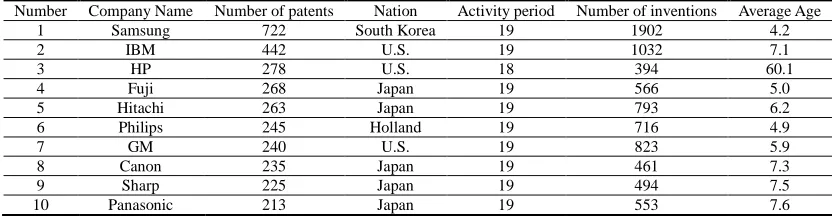
Figure 4 discloses the situation of the top ten companies on the list of nanotechnology patent applications rank within the United States. From the view point of statistical results, among the ten companies there are 5 Japanese companies, 3 American companies, 1 South Korean company and 1 Dutch company. Thus it can be seen that the United States and Japan this two countries occupy the international leading position and extraordinary competitiveness of nanotechnology. However, it’s worth noting that among the ten companies, ranking the first is Samsung in South Korea, 63.8% more than the American IBM ranking the second, which indicates that Samsung has relatively strong power and positive global layout in nanotechnology.
Fig.4: Situation of the top ten companies on the list of patent application number
Tab.1: Comparison of R&D capability of the top ten global companies on the list of American nanotechnology patent application
Number Company Name Number of patents Nation Activity period Number of inventions Average Age
1 Samsung 722 South Korea 19 1902 4.2
2 IBM 442 U.S. 19 1032 7.1
3 HP 278 U.S. 18 394 60.1
4 Fuji 268 Japan 19 566 5.0
5 Hitachi 263 Japan 19 793 6.2
6 Philips 245 Holland 19 716 4.9
7 GM 240 U.S. 19 823 5.9
8 Canon 235 Japan 19 461 7.3
9 Sharp 225 Japan 19 494 7.5
10 Panasonic 213 Japan 19 553 7.6
[image:4.595.180.435.339.496.2] [image:4.595.97.516.538.646.2]invention number we learn that the team squad of research and development of companies on the front of the list is larger that of companies on the backward of the list. With an exception of Hewlett-Packard, integrating the activity period and average age, this company belongs to the enterprise with higher efficiency of R&D.
From the area the ten companies engaged in we can see that various technological patents are involved in the companies’ patents, but most of their patents are generated from their major projects. Among them, Samsung is one of the major enterprises of electronic information industry, so the related patents of nano-electronics and devices are more than other companies. Meanwhile, Samsung nano-materials and processing patent also has the most applications, which is mainly because Samsung has complete industrial chain in electronic products involving semiconductors, displays, precision glass and fine chemistry and other technologies which will generate large number of patents in nano-materials and processing areas. IBM Company mainly engages in information technology, so the company’s nanotechnology patent focuses obviously on nano-electronics and devices and produces the largest number of patents; after the entrance of the 21st century, Philips has developed a new development blueprint in the area of healthcare, so it preceded a lot of patent layouts in the area of nano-biological and pharmaceuticals.
Tab.2: Distribution of patent portfolio of the top ten companies on the list of patent applications
Company Name
Nano-electronics and devices
Nano-biological and pharmaceuticals
Nano-materials and
processing Nano-devices others
Samsung 466 120 332 119 107
IBM 222 77 149 125 90
HP 164 49 103 69 45
Fuji 85 52 136 62 52
Hitachi 122 50 85 69 57
Philips 100 127 118 114 37
GM 110 57 98 56 49
Cannon 103 35 100 72 50
Sharp 82 30 58 29 92
Panasonic 128 34 90 41 45
CONCLUSION
From the patent application cases for nearly 20 years, it is not difficult to see that before 1998, U.S. technology field is on the exploratory stage of nanotechnology, only a handful of institutions involving in the research and development of related technology and market development; from 1998 to 2007, this ten years the U.S. has completed the global nanotechnology development assessment and formulation and implementation of U.S. national nanotechnology plan. During this period, many companies have been carrying out research work related to nanotechnology, thus the number of both patent application and companies applying for patent has shown an obvious upward trend. In the recent 5 years, the Unites States experienced a rapid development of nanotechnology for several years, and started reposition and thinking the development of nanotechnology, which will then usher a new period of rapid development. Therefore, I suppose that now it is a critical period for the government, business and university research institutions combining their strengths and looking for a market breakthrough. The U.S., as the leader nation of nanotechnology, possesses strong R&D strength in different directions in nanotechnology applications. From the five major application direction of nanotechnology materials, which is the foundation and pilot of other high-tech areas, have always been the focus of nanotechnology research and development. Electronic and devices have huge market demand, and at the same time biomedical has always been America’s traditional advantage and investment focus, therefore, the number of patents in these three areas is significantly high in the United States. With the rapid development of materials, electronics, biotechnology and other high-tech industries, it’s sure that the United States will continue to maintain growth in the three areas.
Currently in American market, nanotechnology patent applications in each direction are almost monopolized by companies of Japan, South Korea, the United States, Germany and the Netherlands etc, which makes China in a very passive situation and it will restrict Chinese enterprises’ assess to nanotechnology development and business interests to a large extent. In consequence, it is a problem which the Chinese government and the community worth pondering on that to implement scientific and rational policy early and effectively improve Chinese enterprises’ R&D capabilities and awareness of patent portfolio.
REFERENCES
[1]Li-wenli,Xu-zhengliang. Technology Management Research, n.5, pp.128-131, May, 2011.