International Journal of Emerging Technology and Advanced Engineering
Website: www.ijetae.com (ISSN 2250-2459,ISO 9001:2008 Certified Journal, Volume 3, Issue 3, March 2013)
226
Optimal Routing in Wireless Sensor Networks using MPDSR
R. Raja kishore
1, B. Kalyani
21,2Assistant Professors, ECE Department, Malla Reddy Institute of Engineering and Technology, Hyderabad-500014
Abstract— Wireless sensor networks (WSN) are
increasingly important in recent years due to their ability to detect and convey real-time for many civil and military applications. A “mobile ad hoc network” (MANET) is wireless sensor network which is an autonomous system of mobile routers (and associated hosts) connected by wireless links. The routers are free to move randomly and organize themselves arbitrarily; thus, the network’s wireless topology may change rapidly and unpredictably. Such a network may operate in a stand-alone fashion, or may be connected to the larger Internet. Multipath Dynamic Source Routing (MDSR) protocol is implemented, which balances node energy utilization to increase the network lifetime, it takes network congestion into account to reduce the routing delay and increases the reliability of the packets reaching the destination.It is based on standard on demand routing protocol i.e. Dynamic Source Routing (DSR) and it uses new power aware metric i.e. minimum node cost to find the optimal paths. Due to on demand nature, the maintenance of whole information about network topology in routing tables is eliminated and the dissemination of routing information throughout the network is also eliminated because that will consume a lot of the scarce bandwidth and power when the link state and network topology changes rapidly and it also works well when network size increases. The above protocol is implemented using Network Simulator ns-2 tool by taking simulation parameters such as power consumption, energy,throughput,etc.
Keywords— WSN, MANETS, ROUTING, DSR, MDSR,
ENERGY.
I. INTRODUCTION
In recent years, advances in miniaturization, low-power circuit design, simple, yet reasonably efficient wireless communication equipment; and improved small-scale
energy supplies have combined with reduced
manufacturing costs to make a new technological vision possible: Wireless sensor networks. These networks
combine simple wireless communication, minimal
computation facilities, and some sort of sensing of the physical environment into a new form of network that can be deeply embedded in our physical environment, fueled by the low cost and the wireless communication facilities. Typical sensing tasks for such a device could be temperature, light, vibration, sound and radiation.
According to the wireless nodes movement, ad-hoc network is classified in two major categories: Static ad-hoc network and Mobile ad-hoc network.
In static ad-hoc network, location of mobile node is not frequently changed once network is deployed. In mobile ad-hoc network, all nodes are free to move without any restriction and topology of network is changing dynamically without any prior notice. This kind of network is abbreviated as MANET.
Because of the small size of the sensor node in MANETs and its operation in unattended environment have many challenges. The research areas in wireless sensor network are:
Energy efficiency: Energy efficiency is a dominant consideration no matter what the problem is. This is because sensor nodes only have a small and finite source of energy. Many solutions, both hardware and software related, have been proposed to optimize energy usage.
Localization: In most of the cases, sensor nodes are deployed in an Ad hoc manner. It is up to the nodes to identify themselves in some spatial co-ordinates system. This problem is referred to as localization or positioning of the sensor nodes.
Routing: Communication costs play a great role in deciding the routing technique to be used. Traditional routing schemes are no longer useful since energy consideration demand that only essential minimal routing be done.
International Journal of Emerging Technology and Advanced Engineering
Website: www.ijetae.com (ISSN 2250-2459,ISO 9001:2008 Certified Journal, Volume 3, Issue 3, March 2013)
227
II. WIRELESS SENSOR NETWORKS
A sensor network is a collection of communicating sensing devices, or nodes. All of the nodes are not necessarily communicating at any particular time, and nodes can only communicate with a few nearby nodes. The network has a routing protocol to control the routing of data messages between nodes. The routing protocol also attempts to get messages to the base station in an energy-efficient manner. The base station is a master node. Data sensed by the network is routed back to a base station. The base station is a larger computer where data from the sensor network will be compiled and processed. The base station can be thought of as a controller for the sensor network. Sensory data comes from multiple sensors of different modalities in distributed locations. The smart environment needs information about its surroundings as well as about its internal workings; this is captured in biological systems by the distinction between interceptors and proprioceptors.
MOBILE ADHOC NETWORKS
The mobile ad-hoc network is a collection of two or more wireless nodes which might be mobile and able to communicate with each other either directly within radio range or by multi hop data forwarding operation if they are not directly within radio range. The wireless ad-hoc network is formed by any wireless devices which have networking capability and they are within radio range without any support of central administration and infrastructure. In such way, ad-hoc network has been created, organized and administered by wireless node itself on the fly. None of the wireless node has right of administration and control to support the network. Only interaction among them is used to provide such functions in a network.
Routing protocols in MANETs are classified in three different groups: Proactive, reactive and hybrid. This classification is done based on how the protocol works to find a proper path for a concrete destination.
Proactive protocols follow the same philosophy as link-state and distance vector protocols used for wired networks; each node of the network has its own table with all neighbor nodes and the cost of each different path. The primary problem in proactive routing protocols is that every intermediate node has to update constantly a table with all the information about other nodes in the network. Moreover, each time control messages are sent in the network, this excess of information, may generate congestion in the network and loss of data packets due to buffer overflows and MAC contention.
The maintenance of the paths is expensive because constantly routes can be broken because of the nodes’ mobility, which generate constant updates of information in each node. Therefore, link-state protocols are not suitable in high mobile MANET, with many route table changes, because in each node topology information is replicated. Example of proactive routing protocols is DSDV.
Reactive (or on demand) protocols, start a route discovery each time that they have a packet to send to a destination and its route is not known. Usually, nodes that implement reactive protocols have a cache where all the routes discovered are stored for future uses; routes not used recently are expired even if they are still valid. The key feature of on-demand protocols is acquiring routing information only when it is actually required, avoiding maintaining long routing tables. Sender will have to acquire a route to the destination before the communications start which suppose an increase of the transmission time for the first packet.
The goal of an on-demand protocol is to offer optimal path for each node that requires it, without having obligation to maintain updated information. Examples of reactive routing protocols are DSR and AODV.
Hybrid protocols use both proactive and reactive techniques. Hybrid protocols maintain state information for neighbor links, within a limited area from the node. Route discovery is performed to determine a path for a destination, which is far away from the source node. All these protocols have advantages and disadvantages depending on the mobility, traffic, etc. Example of a hybrid routing protocols is ZRP.
2.1 ENERGY CONSUMPTION
International Journal of Emerging Technology and Advanced Engineering
Website: www.ijetae.com (ISSN 2250-2459,ISO 9001:2008 Certified Journal, Volume 3, Issue 3, March 2013)
228
Clearly, a WAN needs to reduce the energy consumed in each of the radio’s power states (i.e., transmission, reception, and idle) in order to minimize its energy consumption. This requires a WSN to effectively apply all of the aforementioned approaches. More energy efficient for active nodes to use long communication ranges, since this will require fewer nodes to remain awake in order to relay packets. First, we provide a new problem formulation that models the energy conservation in a WAN as a joint optimization problem that considers the overall energy consumption from all power states of the radio according to the network workload secondly we proposed a protocol called Multipath Dynamic source Routing Protocol (MPDSR) for optimal routing for the wireless sensor networks.
III. MULTIPATH DYNAMIC SOURCE ROUTING PROTOCOL
The MPDSR protocol is composed of two mechanisms that work together to allow the discovery and maintenance of source routes in the ad hoc network:
Route discovery
Route Maintenance Route Discovery
When a node wishes to send a packet to some destination node, it checks its route table to determine whether it has a current route to that node. If so, it forwards the packet to the appropriate next hop toward the destination. However, if the node does not have a valid route to the destination, it must initiate a route discovery process. To begin such a process, the node (call it the source) creates a RREQ packet.
Route Request Process
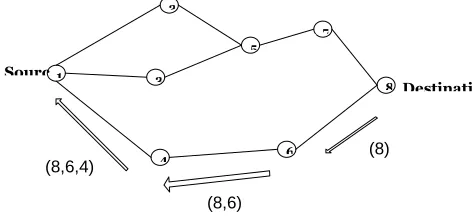
[image:3.612.350.549.141.244.2]The MPDSR protocol works completely on demand, which means that there are no periodic route updates in the network. That means that if a node (Source) wants to send a packet to another node (Destination), it first has to discover a route to node (D). The first step in route discovery is that the Source node (S) searches his own route cache for a route to the Destination node (D). If there is a route to the target to the target node, the source route uses this route to send its data package. If there isn’t a route to the source node sends a Route Request package to its neighbors using broadcasting. This Route Request package identifies the initiator node and the target node of the Route Discovery. Also the packet contains unique request ID, determine by the initiator of the Route Discovery. Route request process is illustrated in Figure 1.
Figure 1: Route request process
When this Route Request is received by another node the node first checks if it has already seen the combination of the source node and the request ID of the Route Request packet. If so, it discards the packet and not processes it further. Otherwise it is checked if this node is the target node the route is searched for. If so, the node returns a Route Reply Packet to the source node of the Route Request containing the route from the source to the target node given by the node list within the Route Request Packet.
Route Reply Process
If a node is the destination, or has a valid route to the destination, it unicasts a route reply message (RREP) back to the source. When a node contains an up-to-date route to a destination that is the target of a Route Request it receives, or is the destination itself, it unicasts a Route Reply (RREP) message back to the node it received the Route Request from. Route Reply process is shown in Figure 2.
Figure 2: Route reply process
Each node along the path that the Route Request was propagated updates its routing table to mark the node from where it received the Route Reply as the next hop for the new route. As such, the Route Reply is propagated along the reverse path all the way to the source of the original Route Request and the routing table of each node along the way is updated to reflect the next hop along the route.
1
2
3
4
5
6 7
8
Sourc
e Destinati
on
(8)
(8,6) (8,6,4)
Destination Source
1
2
5
3
6
[image:3.612.332.570.494.603.2]International Journal of Emerging Technology and Advanced Engineering
Website: www.ijetae.com (ISSN 2250-2459,ISO 9001:2008 Certified Journal, Volume 3, Issue 3, March 2013)
229
In case the node replying to the Route Request was not the destination but instead knew a valid route to the destination, then this node also sends a needless Route Reply to the destination along the path it knows to that destination, such that the destination knows how to reply to the source when it receives data from it, without having to explicitly send out another Route Request to search for the source.
IV. PROPOSED MPDSR PROTOCOL
Due to the ad-hoc nature of sensor networks and severe battery energy limitations, energy efficient protocols are required at all the layers of the protocol stack. The field of wireless sensor network is receiving a lot of attention, and is evolving very fast. Since a sensor network is deployed with an objective of gathering information, for a given initial battery energy, it is desired that the network continues to function and provide data updates for as long as possible. This is referred to as the maximum lifetime problem in sensor networks. During each data gathering phase, nodes spend a part of their battery energy on transmitting, receiving and relaying packets. Hence the routing algorithm should be designed to maximize the time until the first battery expires, or a fraction of the nodes have their batteries expired. While it is easy to show that such an energy efficient routing problem reduces to a linear programming problem, the real challenge lies in devising lightweight and efficient distributed algorithms for solving it.
In this work, the shortest path is calculated based on the distance between the source and destination. Intermediate nodes on receiving request packet checks in its cache whether route to the destination is present or not. If route is present, it then gets the hop count from the source to the destination. Route can not be determined only based on the number of hop counts alone. And so the distance between the nodes is calculated from the time it takes for the RREP which takes minimum time to reach the source from the destination. This ensures conservation of the energy in the nodes, in order to reduce the energy consumption per node. The transmitting nodes are tuned based on the distance between the intermediate nodes to conserve the minimum energy.
Algorithm
The steps that are performed to tune the energy in the source node in MPDSR are as follows:
Step 1: While transmitting the reply packet, check all the entries in the route table at each node in the forward path.
Step 2: If the next node is source node then it will wait until the timer expires and forward the information to the next node.
Step 3: If the next node is not source node them it will calculate the minimum energy (remaining energy) required to transmit.
Step 4: Now the remaining energy is compared with the received energy.
Step 5: If the remaining energy is not less than the received energy going to the step 3.
Step 6: If the remaining energy is less than the received energy then assign the received energy to the transmitter, and then go to the step 2.
Flow chare 1: Flowchart for selecting the minimum energy route
V. SIMULATION RESULTS AND DISCUSSIONS
International Journal of Emerging Technology and Advanced Engineering
Website: www.ijetae.com (ISSN 2250-2459,ISO 9001:2008 Certified Journal, Volume 3, Issue 3, March 2013)
230
Node Mobility Model: This model sets the speed, direction and pause time of each node and allows each node to move in a random direction, this module is called node mobility module. We use random way point mobility model with pause time of each node is 10 sec and speed of each node is 2m/10s.
Route Requests Event Generator: This module accepts the number of requests from user, and then selects source and destination pairs randomly.
Routing Protocol Module: In this module MSR is implemented. This is core module that incorporates several functions like route discovery, route selection, route maintenance, congestion control and increasing network life time.
Computation Module: This module estimates the power consumption, residual energy, number of nodes expired, overhead, throughput, end-to-end delay.
Simulation tools:
For the formation of a mobile adhoc network, network simulator is used which generates a trace file. From that trace file we have to take some multiple paths randomly. Power consumption, residual energy, number of nodes expired, throughput, end-end-delay,overhead can be calculated using C language.
Simulation Parameters:
Simulation area---100m*100m Network size---40 nodes Transmission Range---25m Transmission power---0.7 joules/packet
Receiving power---0.3 joules/packet
Node Mobility Model, Pause Time and Speed---Random way point mobility model, 10sec, 2m/10sec
Initial Energy, Maximum Battery capacity---100 j, 100 j
Weight factors---10,20,30,40
Threshold value---5 joules
Route request arrival rate(lambda)---10,15 per sec
Traffic type, Packet arrival rate, Maximum packet size---Constant Bit Rate(CBR), 20 packets/10sec, 512 bytes
Queue type and queue size---Droptail, 512*20 bytes
Time out interval at intermediate node and total simulation time---5 sec, 100 sec
5.1 Selected Optimal Paths:
Selected Optimal paths for lambda=10 are: 1-2-16-17-18-29-30
3-4-5-19-15-18-29-30-33 6-7-20-21-24-34-35 11-12-25-26-39-40-36-38 12-25-26-39-34
30-29-18-17-16-2 33-31-28-21-20-22 38-36-40-39-26-27 35-33-31-28-15 11-12-25-26-39-34
Selected Optimal paths for lambda=15 1-2-16-17-18-29-30
3-4-5-19-15-18-29-30-33 6-7-20-21-24-34-35 11-12-25-26-39-40-36-38 12-25-26-39-34
International Journal of Emerging Technology and Advanced Engineering
Website: www.ijetae.com (ISSN 2250-2459,ISO 9001:2008 Certified Journal, Volume 3, Issue 3, March 2013)
231
9-12-25-27 12-25-23-22 7-9-12-25-27 10-12-25-26-39 40-39-26-27
For implementing Multipath Dynamic Source Routing Protocol, randomly the forty nodes are distributed in the area of size 1000m x 1000m and parameters such as speed, delay, etc. Tcl script is written taking multiple sources and multiple destinations, and a trace file is generated. From that file, number of paths from each source and destination are taken, from that minimal path which is having least cost is selected for each path. For that paths power consumption, residual energy and number of nodes expired are calculated using c language and compared with DSR. It is assumed that the transmission power, receiving power are fixed for all the nodes and two nodes can hear each other if their distance is in the transmission range. The speeds are uniformly chosen between the minimum and maximum speeds and are set to 0m/s and 3m/s respectively. When the node reaches its destination point, it stays there for a certain pause time, after which it chooses another random destination point and repeats the process. The simulation ends after 100s. All nodes are assumed to have the same amount of battery capacity with full energy at the beginning of the simulation. Initial energy of each node is set to 100 Joules. Three different weight factors 10, 20, 30 are chosen and randomly, a weight factor is assigned to a node.
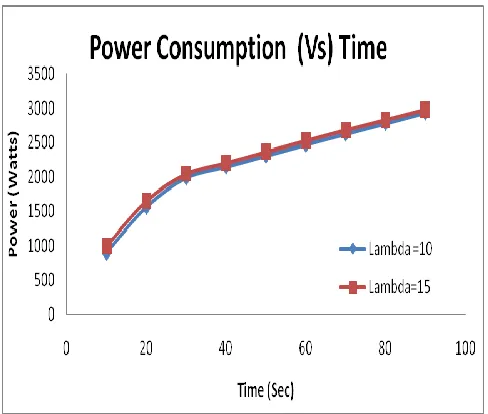
Power consumption
Figure 4: Comparison of Power Consumption to Time with varying the Lambda Value.
From the graph we can observe that the Power consumption is increasing with time as no of paths (lambda) are increasing.
Residual Energy
Figure 5: Comparison of Residual energy to Time with varying the Lambda Value.
From the graph we can observe that the Residual Energy is decreasing with time as no of paths (lambda) are increasing.
Figure 6: Comparison of Number of Nodes Expired to Time with varying the Lambda Value.
From the graph we can observe that the number of nodes expired are increasing exponentially with time as no of paths (lambda) are increasing.
VI. CONCLUSION
[image:6.612.322.578.177.370.2] [image:6.612.325.576.443.591.2] [image:6.612.48.292.482.689.2]International Journal of Emerging Technology and Advanced Engineering
Website: www.ijetae.com (ISSN 2250-2459,ISO 9001:2008 Certified Journal, Volume 3, Issue 3, March 2013)
232
When the size of the network is large and highly mobile the frequency of link failure is also high. Due to this, latency and control load of the network is increased. But these networks are power constrained as most of the mobile nodes today operate with limited battery power. Hence power consumption becomes an important issue.
In this paper, Multipath Dynamic Source Routing Protocol is implemented which is based on standard on demand routing protocol i.e. Dynamic Source Routing (DSR). It uses new power aware metric i.e. minimum node cost to find the optimal paths. The Multipath Dynamic Source Routing Protocol significantly reduces the total number of Route Request packets, this result in an increased packet delivery ratio, decreasing end-to-end delay for the data packets, lower control overhead, fewer collisions of packets, supporting reliability and decreasing power consumption. Hence by reducing energy and power consumption, the optimal routing is obtained.
This project can be extended for measuring various other performance metrics and calculating various factors like network size, route requests arrival rate, packet arrival rate, packet size (header size and payload size), packet collision and retransmissions using network simulator.
REFERENCES
[1 ] R.Raja Kishore, B.Kalyani, K.Rajkumar “Multipath Dynamic Source Routing Protocol for Mobile Adhoc Networks “International Journal of Engineering Research & Technology (IJERT) Vol. 1 Issue 9, November- 2012 ISSN: 2278-0181
[2 ] Holger Karl, Andreas Willig “A short survey of wireless sensor networks”, Technical University Berlin Telecommunication Networks Group TKN Technical Report , August 18, 2003.
[3 ] Charles E. Perkins, “Ad-hoc Networking”, Addison-Wesley Professional Publishers, December 2001.
[4 ] Y. Thomas Hou ,Yi Shi Jianping Pan , Scott F. Midkiff , Kazem Sohraby “Single-Beam Flow Routing for Wireless Sensor Networks” proceedings of IEEE Globecom,, pp. 3263-3268, June 2005.
[5 ] Y. Thomas Hou Yi Shi Jianping Pan Scott F. Midkiff “Optimal Single-Session flow Routing for Wireless Sensor Networks”, IEEE Transaction on mobile computing, pp.2855-2859, September 2003. [6 ] Gautam Barua and Manish Agarwal, “Caching of Routes in Ad hoc
On- Demand Distance Vector (AODV) Routing for Mobile Ad hoc Networks”, Proceedings of the 15th International Conference on Computer Communications, Mumbai, Maharastra, India, pp.768-778, November 2002.
[7 ] Marina and S. Das, “On-demand Multipath Distance Vector Routing in Ad Hoc Networks”, in Proceedings of the International Conference for Network Procotols (ICNP), Riverside, Nov. 2001.
[8 ] Park and M. Corson, ”A Highly Adaptive Distributed Routing Algorithm for Mobile Wireless Networks”, Proceedings of IEEE INFOCOM '97, April 1997.
[9 ] Leung, J. Liu, E. Poon, A. Chan and B. Li, “MP-DSR: A QoS-Aware Multi-Path Dynamic Source Routing Protocol for Wireless Ad-Hoc Networks”, In Proc. of the 26th IEEE Annual Conference on Local Computer Networks (LCN 2001), pp. 132-141, November, 2001.