Challenges to describe QoS requirements
for web services quality prediction to
support web services interoperability in
electronic commerce
Wan Ab Rahman, WN and Meziane, F
Title
Challenges to describe QoS requirements for web services quality
prediction to support web services interoperability in electronic commerce
Authors
Wan Ab Rahman, WN and Meziane, F
Type
Article
URL
This version is available at: http://usir.salford.ac.uk/1802/
Published Date
2008
USIR is a digital collection of the research output of the University of Salford. Where copyright
permits, full text material held in the repository is made freely available online and can be read,
downloaded and copied for noncommercial private study or research purposes. Please check the
manuscript for any further copyright restrictions.
Communications of the IBIMA Volume 4, 2008
Challenges to Describe QoS Requirements for Web Services Quality
Prediction to Support Web Services Interoperability in Electronic
Commerce
Wan Nurhayati WAN AB. RAHMAN and Dr Farid MEZIANE School of Computing, Science & Engineering
University of Salford Greater Manchester, M5 4WT
[email protected], [email protected] Abstract
Quality of service (QoS) is significant and necessary for web service applications quality assurance. Furthermore, web services quality has contributed to the successful implementation of Electronic Commerce (EC) applications. However, QoS is still the big issue for web services research and remains one of the main research questions that need to be explored. We believe that QoS should not only be measured but should also be predicted during the development and implementation stages. However, there are challenges and constraints to determine and choose QoS requirements for high quality web services. Therefore, this paper highlights the challenges for the QoS requirements prediction as they are not easy to identify. Moreover, there are many different perspectives and purposes of web services, and various prediction techniques to describe QoS requirements. Additionally, the paper introduces a metamodel as a concept of what makes a good web service.
Keywords: e-commerce, web service, QoS requirement, QoS metamodel, QoS model
1. Introduction
As the needs for the implementation of complex online systems, large number of requests and cross-architecture communications, crucial needs for dynamic contents and fresh information, simpler, easier and yet powerful mechanism as a medium to communicate and collaborate between servers has aroused. Consequently, the revolution of web technologies has lead to the development and implementation of web services to deal with massive distributed web applications. Web services are seen as the solution to the limitations of previous web technologies and infrastructures including integration, standardization and homogeneous implementation. The basic concept of web services is to simulate everything as services by assuming available functionality from providers as a service [Alonso et al, 2004; Milanovic and Malek, 2004]. The basic infrastructure of web services and their standards comprise of a way to communicate using the Simple Object Access Protocol (SOAP), a way to describe the service using the Web Service
Description Language (WSDL), and a name and directory server using the Universal Description, Discovery and Integration (UDDI) [Alonso et al, 2004].
EC applications have extensively used and adopted web services [Chen et al, 2003]. The advancement of web services has reflected the way humans and applications apply web technology these days especially in the business and technical contexts [Bequet et al, 2002; Leymann et al, 2002]. The main purpose of web services is to expose the internal system functionality and make it discoverable and accessible through the web in a controlled manner. These are the potentials capabilities of web services that have attracted many service providers to implement and use them as their underlying technology. For example, web services are based on platform architecture that are developed to overcome interoperability problems, promote flexible and open environment in handling application, business logic and database intra and inter organizations, between providers and requesters.
There are many web services available and some of these are very similar in the kind of services they provide. Even though they are designed for the same purpose, their quality is not the same. The main question remains, what make a web service better than another service? We believe that a better understanding of quality could assist service providers to provide better services to requesters, and the requesters should be able to get exactly what they want with better quality services. We emphasize that it is essential for developers and service providers to identify the QoS for their web services as early as possible. Even though QoS focuses on the non-functional requirements of web services, but it does affect the functionality of web services.
Communications of the IBIMA Previous researches on quality have concentrated on
quality models and quality measurement using different metrics. Furthermore, none of these approaches allows one to model all the factors that influence quality and the uncertainties associated with each factor. Although there is a considerable amount of research on software quality prediction, the field of web services quality has only concentrated to date on quality metrics and they have proposed a small number of prediction models. Web services and software applications differ thus quality prediction models developed for software are unlikely to be readily applicable to web services.
Web services development and maintenance involve many activities, use various resources and deal with different people. Therefore, it is important for users and organizations to understand quality, able to measure and predict it. However, there are very few guidelines to integrate QoS requirements during the design of web service applications. Most of the existing researches on web services quality prediction only considered the implementation stage that involves communication between requesters and service providers. Alternatively, we highlight the crucial needs for a model to be used as guidelines for service providers to develop better quality web service applications. Besides, it is not easy to determine an appropriate set of QoS requirements to improve web services quality.
In this paper we first review the state of the art on QoS in web services and then we use this as the basis to select a set of important characteristics to include in our model. The aim of our model is to use these characteristics to predict the QoS during the development and implementation stages of web services. The remaining of this paper is organized as follows. Section 2 reviews some research on the most important requirements for QoS for web services. In section 3, we discuss the challenges in identifying and using some of these characteristics and the difficulties faced in using them in our prediction metamodel. Section 4 summarises the work developed so far in the development of our predictive model and we conclude and present our future developments in section 5.
2. QoS Requirements for Good Quality Web Services
Previous works from the literature have considered non-functionality as the main requirements to QoS. The most used QoS characteristics can be summarized as follows:
i. Service time is the length of time for services taken to provide a response to various types of requests [Bhoj et al, 2000;
Chandrasekaran et al, 2002; Menasce, 2002; Agarwal et al, 2005].
ii. Reliability refers to the capability of maintaining the service and service quality [Jin et al, 2002; Silver et al, 2003; Cardoso et al, 2004; Burstein et al, 2005].
iii. Execution price refers to the amount of money that a service requester has to pay for executing an operation [Chen et al, 2003; Liu et al, 2004; Sivashanmugam et al, 2005, Fung et al, 2006].
iv. Availability refers to the presence of a web service for a client to connect to it [Sahai et al, 2001; Al-Ali et al, 2002; Zeng et al, 2003; Day and Deters, 2004].
v. Performance is measured by throughput and latency. Performance can also be determined by response time to guarantee maximum time required to complete a service request [Mani and Nagarajan, 2002; Papazoglou and Georgakopoulos, 2003; Looker et al, 2004; D’Ambrogio, 2006].
vi. Security refers to authentication mechanisms, messages encryption and access control, confidentiality, non-repudiation and resilience to denial-of-service attacks [Sahai et al, 2001; Ran, 2003; Wang et al, 2004; D’Ambrogio, 2006].
Besides, researchers also have considered other QoS characteristics and the details are as follows:
i. Accessibility refers to the capability of satisfying a web service request [Gu et al, 2002; Mani and Nagarajan, 2002; Looker et al, 2004; Mathijssen, 2005].
ii. Transaction relates to ACID property, which contains the following characteristics [Mani and Nagarajan, 2002; Menasce, 2002; Ran, 2003; Schmit and Dudstdar; 2005]:
a. Atomicity – executes entire transactions or not at all.
b. Consistency – maintains the data integrity and consistency in update transaction.
c. Isolation – individual transactions run as if no other transactions are present. d. Durability – is the persistence of
Communications of the IBIMA Volume 4, 2008 iii. Capacity is the maximum number of
concurrent requests that server can process to guarantee performance or the number of concurrent connections that is permitted by the service [Al-Ali et al, 2002; Ran, 2003; Mathijssen, 2005].
iv. Integrity refers to the maintaining of correct and consistent interaction to the source [Mani and Nagarajan, 2002; Papazoglou and Georgakopoulos, 2003; Looker et al, 2004].
v. Regulatory refers to the conformance and compliance to the rules, laws, standards and specifications [Mani and Nagarajan, 2002; Ran, 2003; Looker et al, 2004].
vi. Reputation measures the service trustworthiness based on end user’s experiences of using the service [Zeng et al, 2003].
3. Challenges for QoS Requirements Prediction
As web services became more popular to the Internet world, there are many efforts to improve their QoS to serve users better. There are different types of QoS requirements that have been proposed and applied for the purpose of quality prediction for web services. However, the question remains on which of these requirements are the best. Furthermore, as the consequences from the diverse implementation of the QoS requirements, there are challenges and constraints for researchers to improve. These are among the research and prediction challenges from web services evolution to Software Engineering community.
i. QoS Identification
• How to identify and classify QoS requirements and which ones are the most relevant for high quality web services?
• Which QoS requirements could be associated with more specific attribute and be quantified?
ii. Perspective and Purpose
• The identified QoS requirements can be predicted from different perspectives and purposes that give different results in quality prediction. • Which perspective and/or purpose is
the best in order to gain better QoS for web services?
iii. Prediction Technique
• What are the different techniques that can be applied to predict QoS for web services?
• There are two key phases for web services QoS prediction including development and operation.
QoS will assure a web service application is better than other similar web services that are developed without incorporating QoS requirements. First, a web service must always be available and accessible every time requesters search for it. In addition, web services performance in term of fast in service time is also crucial. The successful implementation of transactions is crucial because it effects overall communication and business activity. Therefore, transactions must describe and present services in a professional manner and their design must be relevant to that particular service. Transactions design affects speed of service time so their design should include response time constraints. Furthermore, transactions must be reliable in the sense that they can serve clients completely. There should be no errors or faults occurring during the communications between service providers and requesters.
Besides, other issues related to QoS of web services are integrity and security. The accurate interactions is very important to ensure both service providers and clients are communicating to the right source. A transaction consists of different types of data from various resources and some of them are confidential. Service providers must guarantee for safe transaction via protected network and all accesses need to be monitored to ensure the originality and secrecy of data that is only the right users can access to the right data/transaction. Requesters always look for very efficient services such as fast, correct and acceptable, and this is a big challenge for service providers. This analysis is equivalent to the reported literature reviews that emphasize on those related factors to assure high QoS for web services.
Communications of the IBIMA also be evaluated from the service providers’
perspective, and the QoS can be described as a combination of several qualities or properties of a service [Menasce, 2002; Ran, 2003]. Other views stated that the QoS is important for the support of fresh information delivery [Liu et al, 2000]. The QoS is also crucial for web service composition [Papazoglou and Georgakopoulos, 2003; Milanovic and Malek, 2004]. Wang et al (2004) have highlighted on QoS management in networked enterprise systems that can optimize system resources and activate computing mechanisms to satisfy QoS requirements of many concurrent applications in the network.
Previous researchers have applied QoS requirements for different purposes with different techniques and approaches including quality architectures, models, metrics and algorithms. Prior research on architecture focused on service selection [Cardellini et al, 2001; Mathijssen, 2005] and service discovery [Chen et al, 2003; Fung et al, 2006]. Besides, they have developed different types of QoS models for service discovery [Al-Ali et al, 2002; Ran, 2003], service composition [Zeng et al, 2003], service selection [Liu et al, 2004] and service workflow [Cardoso et al, 2004]. Furthermore, they have complimented semantic web technique to enable service discovery [Sollazo et al, 2001; Bussler et al, 2002; Burstein et al, 2005], personalization [Balke and Wagner, 2003], service selection [Day and Deters, 2004] and service composition [Sivashanmugam et al, 2005]. In addition, there are different QoS improvement approaches including priority [Bhoj et al, 2000; Ye et al, 2005], SLA [Sahai et al, 2001; Jin et al, 2002], error simulation [Looker et al, 2004] and intelligent agent for service discovery [Lau, 2006]. Other researchers have concentrated on services compositions [Tosic et al, 2001; Chandrasekaran et al, 2002; Casati et al, 2003; Silver et al, 2003; Zeng et al, 2003; Agarwal et al, 2005]. Some of the recent
related works have used the Unified Modeling Language (UML) technique to describe and model QoS requirements for web services. Most of the previous works have applied UML for quantitative prediction regarding timeliness, schedulability and performance [Bertolino and Mirandola, 2003; Woodside and Petriu, 2004; D’Ambrogio and Brocciarelli; 2007]. UML also has been used to represent reliability concepts [Cortellessa and Pompei, 2004; Cortellessa et al, 2005].
4. Proposed Qos Metamodel
QoS Definition and Requirements
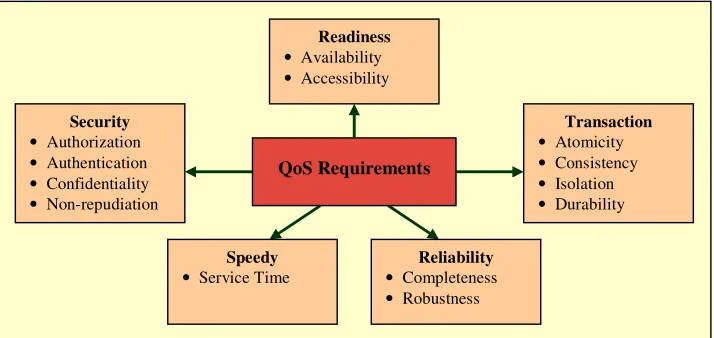
[image:5.612.129.486.532.701.2]In this research, we used the definition given by Wan Ab Rahman (2008) which can be summarised as: “QoS for web service applications is the ability of their services to provide added value to the best solution for requesters’ enquiries, taking into account their specific requirements”. The QoS here is meant for a wide acceptance and satisfaction of users for web services. Web services must be able to fulfil the requirements of other users (humans or other applications). The best solution from the definition refers to the most suitable high quality service that could give exactly what requesters want. However, the quality of a web service is not only measured by its functionality, but QoS also take into account the non-functional requirements such as those included in our model. Besides, we have identified some of the most important QoS requirements that good quality web services must process based on the most used QoS from the previous research. There are five essential QoS requirements as the main non-functionality that service providers must consider when developing their web service applications. These are readiness, transaction, reliability, speedy and security as illustrated in Figure 1.
Figure 1: Components of the QoS prediction model. QoS Requirements
Readiness
• Availability
• Accessibility
Transaction
• Atomicity
• Consistency • Isolation
• Durability Security
• Authorization
• Authentication • Confidentiality
• Non-repudiation
Speedy
• Service Time
Reliability
Communications of the IBIMA Volume 4, 2008 Readiness includes availability and accessibility
in order to guarantee the existence and usability of web service applications. Transaction takes into account attributes such as atomicity, consistency, isolation and durability for smooth execution, integrity and good result assurance. Reliability is to assure for the completeness and robustness of overall transaction and business processes. Speedy guarantees for the fast delivery of services. Security covers authentication for proof of identity, authorization for access control, confidentiality for privacy and non-repudiation as a confirmation of complete transaction. Generally, these five QoS requirements are essential for a good quality web service application apart from its functionality. However, in order to make these qualitative QoS requirements quantifiable, we will transform some of them into quantitative QoS requirements by applying specific attributes that are relevant and strategic for each of them.
The QoS requirements are vital for many reasons, for example, in order to guarantee for the best quality such as availability, accessibility, stability, fast, integrity and security of services. The rationale behind these QoS requirements selection is that they are the most pertinent quality criteria that most of web service applications must have. Moreover, these are the essential QoS requirements for EC web service application in order to guarantee
its high QoS. Additionally, the implementation of these QoS requirements is not restricted to only EC application and they are suitable for other applications. These QoS requirements are the answer to the question: “What makes a good web service application?”
Requirements Definition for the QoS Metamodel
[image:6.612.92.519.402.690.2]This research considers both, web service applications development and implementation stages. The main purpose of the QoS prediction metamodel is to guide service providers towards developing good quality of web service applications. They really need such a metamodel as guidelines to incorporate QoS requirements as early as designing their applications. In addition, the QoS prediction metamodel consists of a framework that outlines some of the crucial QoS requirements that could be applied to produce high quality web service applications. Furthermore, it is important for service providers to alert and consider these QoS requirements before they start to develop their web service applications. Even though the functionality of web service applications is the first thing that service providers need to understand and deliver, and yet non-functional requirements that refer to the QoS also vital and we believe that it does reflect the functional requirements.
Communications of the IBIMA Volume 4, 2008 In the current implementation of our system as
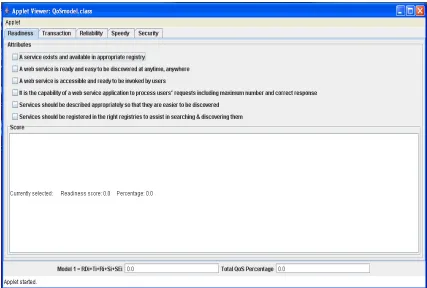
shown in Figure 2, a simple scoring system is used to check if these QoS characteristics are taken into account when developing a web service application. The system is implemented in Java programming language. The interface represents the five QoS requirements including readiness, transaction, reliability, speedy and security, and their attributes that service providers must consider for good quality web service applications. Additionally, the model will assist in predicting the QoS of web service applications by using a mathematical algorithm to calculate the overall QoS percentage for a web service application. Service providers can depend on the model as a guideline to evaluate the QoS of their web service applications by knowing their QoS score to represent the ability to fit in those listed QoS requirements.
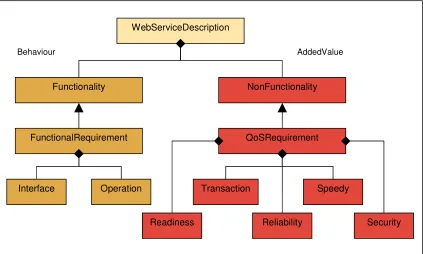
The metamodel as illustrates in Figure 3 illustrates the QoS as a set of non-functional requirements that include readiness, transaction, reliability, speedy and security that could give perfection to web service applications. Consequently, the metamodel will lead to an outstanding performance of web service applications during the implementation stage. Moreover, the outcome from this research will give advantages to service providers and end users. The most important is that both parties can be in a win-win-situation that
everybody will satisfy with the services offered and served. Service providers are responsible for providing the best service to users. Meanwhile, requesters have the right to get the best service from the providers. Therefore, it is prominent for service providers to understand the QoS in order to provide extra value to the best service in order to satisfy users. Furthermore, they must know and recognize the major QoS requirements to achieve high quality web services. The QoS prediction metamodel is necessary and useful to assure the QoS for web service applications as follows:
i. Guide service providers in describing and publishing their web service applications in the right registry to enhance their availability and accessibility.
ii. Provide reliable and complete transactions to build users trust in the web service applications.
iii. Facilitate requesters to get the most relevant services from the genuine service providers. iv. Assist service providers to reply with the most appropriate feedback to requesters in no time.
[image:7.612.95.518.402.656.2]v. Assure for the secure data and transactions to give good perspective of the web service applications for both sides (providers and requesters).
Figure 3: Metamodel for incorporating QoS requirements into web service’s functionality.
5. Conclusion and Future Developments
The development of web service applications is an important stage, and yet, most of the current
research concern with the implementation of high quality web services at the operational stage, focus only on the requesters’ requirements, and fail to address the issue from a development and
WebServiceDescription
Functionality NonFunctionality
FunctionalRequirement QoSRequirement
Operation
Behaviour AddedValue
Readiness Interface
Reliability
Speedy
Communications of the IBIMA Volume 4, 2008 implementation aspects. As a consequence,
developers may not fully incorporate users’ requests and amending these services after delivery might be very costly. We see this as a gap in the research on QoS for web services. Predicting the QoS of web service applications is necessary for service providers and requesters. Therefore, service providers should provide good quality web service applications with QoS requirements being incorporated into their designs. On the other hand, requesters are expecting for good quality services from the providers. So, both of them need such a metamodel in order to realize the QoS prediction.
Service providers need the metamodel as a guideline on how to describe, model and integrate QoS requirements into functional requirements of web service applications. This will be described in our future metamodel development. Whereas, requesters need the metamodel as a reference on what makes good quality web services. Most of the previous works have applied UML for quantitative prediction for software and only few for web service. The UML modeling language itself is insufficient and its integration with other techniques, methodologies, or technologies is necessary. This is the new challenge of the UML capability that we want to explore in the development and specification of this model. The reason behind the choice of UML is that it has big potential for QoS modeling that need to be extended, and to ease service designers and developers to incorporate QoS requirements into the functionality of their web service applications design just with one technique.
References
1 Al-Ali R.J., Rana O.F., Walker D.W., Jha S. and Sohail S. G-QoSM: Grid Service Discovery Using QoS Properties. Retrieved January 17, 2007, from:
http://scholar.google.com/url?sa=U&q=http://wesc.ac.u k/resources/publications/pdf/cijnl.pdf
2 Agarwal V., Dasgupta K., Karnik N., Kumar A., Kundu A., Mittal S. and Srivastava B. “A Service Creation Environment Based on End to End Composition of Web Services”, Proceeding of the 14th International World Wide Web Conference, Japan, 2005, pp. 128-137, ISBN 1 59593 046 9. ACM, New York, USA.
3 Alonso G., Casati F., Kuno H. and Machiraju V. Web Services: Concepts, Architectures and Applications. Springer-Verlag Berlin Heidelberg. Germany, 2004, ISBN 3-540-44008-9.
4 Balke W.T. and Wagner M. Cooperative Discovery for User-centered Web Service Provisioning. Retrieved
January 16, 2007, from:
http://www.docomoeurolabs.de/pdf/publications/FNL_ cooperative_discovery_for_03.pdf
5Bequet H., Kunnumpurath M.M., Rhody S. and Tost A. Beginning Java Web Serivices. Wrox Press. Birmingham, United Kingdom, 2002, ISBN 1-86100-753-1.
6Bertolino A. and Mirandola R. “Modelling and Analysis of Non-functional Properties in Component-based Systems”, Elsevier Science B.V., Electronic Notes in Theoretical Computer Science 82(6), 2003.
7Bhatti N., Bouch A. and Kuchinsky A. “Integrating User-perceived Quality into Web Server Design”, Computer Networks 33(1-16), 2000, pp. 1-16.
8Bhoj P., Ramanathan S. and Singhal S. Web2K: Bringing QoS to Web Servers. Retrieved September 20,
2006, from:
http://nclab.kaist.ac.kr/lecture/te628_2001_Fall/seminar /papers/HPL-2000-61.pdf
9Bouch A., Kuchinsky A. and Bhatti N. “Quality is in the Eye of the Beholder: Meeting Users’ Requirements for Internet Quality of Service”, ACM 2000 1-58113-216-6/00/04, 2(1).
10 Burstein M., Bussler C., Finin T., Huhns M.N., Paolucci M., Sheth A.P., Williams S. and Singh M.P. “A Semantic Web Services Architecture”, IEEE Internet Computing, 2005, pp. 72-81.
11 Bussler C., Fensel D. and Maedche A. “A Conceptual Architecture for Semantic Web Enabled Web Services”, SIGMOD Record, 31(4), 2002, pp. 24-29.
12 Cardellini V., Casalicchio E., Colajanni M. and Tucci S. “Mechanisms for Quality of Service in Web Clusters”, Elsevier Science B.V., Computer Networks, 37(2001), 2001, pp. 761-771.
13 Cardoso J., Sheth A., Miller J., Arnold J. and Kochut K. Quality of Service for Workflows and Web Service Processes. Retrieved January 15, 2007 from:
http://scholar.google.com/url?sa=U&q=http://chief.cs.u ga.edu/~jam/home/theses/cardoso_dissert/CSM%2BQo S-WebSemantics.pdf
14 Casati F., Shan E., Dayal U. and Shan M.C. “Business-Oriented Management of Web Services: Using Tools and Abstractions for Monitoring and Controlling Web Services”, Communications of the ACM, 46(10), 2003, pp. 55-60.
Communications of the IBIMA Commerce and Business Media, 13(2) 2003, pp.
120-132.
16 Chen M., Chen A.N.K. and Shao B.B.M. “The Implications and Impacts of Web Services to Electronic Commerce Research and Practices”, Journal of Electronic Commerce Research, 4(4):128-139, 2003.
17 Chen Z., Chia L.T., Silverajan B. and Lee B.S. “UX- An Architecture Providing QoS - Aware and Federated Support for UDDI”, Proceeding of the 1st International Conference on Web Services, 2003, pp. 1-6.
18 Cortellessa V. and Pompei A. “Towards a UML profile for QoS: a Contribution in the Reliability Domain”, ACM SIGSOFT Software Engineering Notes, session performance and quality of service, 29(1), 2004, pp. 197-206, ISSN 0163-5948, ACM Press New York, USA.
19 Cortellessa V., Marco A.D., Inverardi P., Muccini H. and Pelliccione P. Using UML for SA-based Modelling and Analysis. Retrieved August 2,
2007, from:
http://www.henrymuccini.com/Research/2005/UML&S A/UMLandSA.pdf
20 Day J. and Deters R. “Selecting the Best Web Service”, IBM Centre for Advanced Studies Conference. Proceedings of the Centre for Advanced Studies on Collaborative research, Ontario, Canada, 2004, pp. 293-307, ISSN 1705-7345.
21 D’Ambrogio A. “A Model-driven WSDL Extension for Describing the QoS of Web Services”, IEEE International Conference on Web Services, 2006.
22 D’Ambriogio A. and Bocciarelli P. “A Model-Driven Approach to Describe and Predict the Performance of Composite Services”, Proceedings of the 6th International Workshop on Software and Performance, Buenes Aires, Argentina, session software performance modeling, 2007, pp. 78-89, ISBN 1-59593-297-6.
23 Fung C.K., Hung P.C.K., Linger R.C., Wang G. and Walton G.H. “A Service-Oriented Composition Framework with QoS Management”, International Journal of Web Services Research, 3(3), 2006, pp. 108 -132.
24 Gu X., Nahrstedt K., Yuan W. and Wichadakul D. “An XML-based Quality of Service Enabling Language for the Web”, Journal of Visual Languages and Computing, 2002, pp 1-39.
25 Jin L.J., Machiraju V. and Sahai A. “Analysis on Service Level Agreement of Web Services”, Hewlett Packard. Retrieved October 5, 2006, from
http://athena.union.edu/~hemmendd/Gradseminar/hpl.p df
26 Lau R.Y.K. “Towards a Web Services and Intelligent Agents-based Negotiation System for B2B eCommerce”, Article in Electronic Commerce
Research and Applications,
doi:10.1016/j.elerap.2006.06.007, 2006, Elsevier B.V.
27 Leymann F., Roller D. and Schmidt M.T. “Web Services and Business Process Management”, IBM System Journal, 41(2), 2002.
28 Liu L., Pu C., Schwan K. and Walpole J. InfoFilter: Supporting Quality of Service for Fresh Information Delivery. Retrieved July 7, 2007, from:
http://www.cc.gatech.edu/~calton/publications/final-ngc.pdf
29 Liu Y., Ngu A.H.H. and Zeng L. QoS Computation and Policing in Dynamic Web Service Selection. Retrieved September 3, 2006, from:
http://www.ra.ethz.ch/CDstore/www2004/docs/2p66.pd f
30 Looker N., Munro M. and Xu J. “Simulating Errors in Web Services”, I.J. of Simulation, 5(5), 2004, pp. 29-37.
31 Mani A. and Nagarajan A. Understanding Quality of Services for Web Services. Retrieved July 1, 2005, from: www.ibm.com/developerworks/library/ws-quality.html
32 Mathijssen S. A Fair Model for Quality of Web Services. Retrieved December 6, 2006, from:
http://scholar.google.com/url?sa=U&q=http://wwwhom e.cs.utwente.nl/~referaat/documents/2005_03_B-DATA_AND_APPLICATION_INTEGRATIO 33 Menasce D.A. “QoS Issues in Web Services”, IEEE Internet Computing, 6(6), 2002, pp. 72-75, ISSN: 1089-7801.
34 Milanovic N. and Malek M. “Current Solutions for Web Service Composition”, IEEE Internet Computing, 8(6), 2004, pp. 51-59, ISSN 1089-7801.
35 Papazoglou M.P. and Georgakopoulos D. “Service-Oriented Computing”, Communications of the ACM, 46(10), 2003, pp. 25-28.
36 Ran S. “A Model for Web Services Discovery with QoS”, ACM Inc., 4(1), 2003, pp. 1-10, ISSN 1551 9031.
Communications of the IBIMA Volume 4, 2008
http://www.hwswworld.com/downloads/9_13_05_a_pd fs/HPL-2002-191.pdf
38 Schmit B.A. and Dustdar S. “Model-driven Development of Web Service Transactions”, International Journal of Enterprise Modeling and Information Systems, 1(1), 2005.
39 Silver G.A., Maduko A., Jafri R., Miller J.A. and Sheth A.P. Modeling and Simulation of Quality of Service for Composite Web Services. Retrieved
December 24, 2006, from
http://scholar.google.com/url?sa=U&q=http://www2.ac. edu/faculty/gsilver/UGA/publications/SCI.pdf
40 Sivashanmugam K., Miller J.A., Sheth A.P. and Verma K. “Framework for Semantic Web Process Composition”, International Journal of Electronic Commerce/winter 9(2), 2005, pp. 71-106.
41 Sollazo T., Handschuh S., Staab S. and Frank M. Semantic Web Service Architecture – Evolving Web Service Standards toward the Semantic Web. Retrieved January 12, 2007, from: http://www.aifb.uni-
karlsruhe.de/~sst/Research/Publications/sub-flairs2002.pdf
42 Tosic V., Pagurek B., Esfandiari B. and Patel K. On the Management of Compositions of Web Services. Retrieved November 25, 2006, from:
http://scholar.google.com/url?sa=U&q=http://www.doc .ic.ac.uk/~hf1phd/papers/toread/on-the-management-of.pdf
43 Wan Ab Rahman W.N. “A Quality of Service Prediction Model to Support Web Services Interoperability in Electronic Commerce”, Interim Assessment Report, School of Computing, Science and Engineering, the University of Salford, Manchester, UK, 2008.
44 Wang G., Chen A., Wang C., Fung C. and Uczekaj S. “Integrated Quality of Service (QoS)
Management in Service-Oriented Enterprise Architectures”, Proceedings of the 8th IEEE International Enterprise Distributed Object Computing Conference, 2004, pp. 21-32, ISSN 1541-7719, ISBN 0-7695-2214-9, INSPEC Accession Number 8314546.
45 Woodside M. and Petriu D. Capabilities of the UML Profile or Schedulability Performance and Time (SPT). Retrieved August 7, 2007, from:
http://www.sce.carleton.ca/faculty/petriu/papers/SIVOE S_Woodside.pdf
46 Ye N., Gel E.S., Li X., Farley T. and Lai Y.C. “Web Server QoS Models: Applying Scheduling Rules from Production Planning”, Computers & Operations Research, 32, 2005, pp. 1147-1164.
47 Zeng L., Benatallah B., Dumas M., Kalagnanam J. and Sheng Q.Z. Quality Driven Web Services Composition. Retrieved July 1, 2005, from:
www2003.org/cdrom/papers/refereed/p358/htm/p358-zeng.html
48 Zeng L., Benatallah B., Lei H., Ngu A., Flaxer D. and Chang H. “Flexible Composition of Enterprise Web Services”, Electronic Markets, 13(2), 2003, pp. 141-152.