An evaluation of a nurse led unit: an
action research study
Williamson, T, Rawle, A, Bacon, E, Cooper, E, Davies, N, Eastwood, J, Evans, A,
Freeman, S, Green, J, Hindley, G, Jeffreys, J, Johnson, J, Lee, N, Low, J, Martin, J,
Rayner, J, Reynolds, P, Richardson, M, Sewell, B, Tickner, D and Whitworth, J
Title An evaluation of a nurse led unit: an action research study
Authors Williamson, T, Rawle, A, Bacon, E, Cooper, E, Davies, N, Eastwood, J, Evans, A, Freeman, S, Green, J, Hindley, G, Jeffreys, J, Johnson, J, Lee, N, Low, J, Martin, J, Rayner, J, Reynolds, P, Richardson, M, Sewell, B, Tickner, D and Whitworth, J
Type Monograph
URL This version is available at: http://usir.salford.ac.uk/12868/
Published Date 2006
USIR is a digital collection of the research output of the University of Salford. Where copyright permits, full text material held in the repository is made freely available online and can be read, downloaded and copied for noncommercial private study or research purposes. Please check the manuscript for any further copyright restrictions.
Salford Centre for Nursing,
Midwifery & Collaborative
Research
An evaluation of a nurse-led
unit: an action research study
Tracey Williamson
Alison Rawle
Elaine Bacon
Elma Cooper
Nicola Davies
Janet Eastwood
Alison Evans
Sharon Freeman
Jenny Green
Graham Hindley
John Jeffrey
Joan Johnson
Nancy Lee
Jane Low
John Martin
Janet Rayner
Penny Reynolds
Marion Richardson
Beverley Sewell
David Tickner
June Whitworth
About Us
Inter-disciplinary research that embraces the broad spectrum of health and social care is fundamental to our mission. We have a strong commitment to policy and practice orientated research that makes a difference. Most of our research activity is focused within the SalfordCentre for Nursing, Midwifery and Collaborative Research (SCNMCR). The centre objectives are:
• To develop nursing and midwifery practice and education through collaborative research
• To undertake research and scholarship of national and international standing
We achieve these through:
• Collaboration with inter-agency partners in research and development of theory and practice
• Publication of high quality reports, papers and conference presentations
• Support and supervision of post-graduate study
• Contribution to national and international debate
Research expertise includes:
• Child and family health
• Mental health care
• Evaluation of health services
• Rehabilitation and older people
• Patient experience
Enterprise:
• We engage in project and consultancy work and evaluation projects
• We support new product and service initiatives in partnership with external colleagues and business communities
International:
• We have active and extensive international links
• Partnerships have been forged between staff and students in Australia, Africa, USA, Russia, Malta, Finland, Holland and Germany amongst others
Contact the School of Nursing:
Tel: +44(0)845 234 0184 E-mail: [email protected]
Contact the Salford Centre for Nursing, Midwifery and Collaborative Research:
Wendy Moran
Tel: +44(0)161 295 2768
E-mail: [email protected]
www.ihscr.salford.ac.uk
© University of Salford
This report can be referenced as Williamson, T et al (2006) An evaluation of a nurse-led
unit: an action research study, University of Salford/Derbyshire County PCT.
An evaluation of a nurse-led unit: an action
research study
FINAL REPORT
November 2006
Research Team members and co-authors of this report:
Research Team Member/Co-author Name Title Organisation Tracey Williamson Research Fellow
Co-Project Lead and Lead Researcher
University of Salford
Alison Rawle Nurse Consultant, Older People and Co-Project Lead
Derbyshire County PCT
Elaine Bacon Nurse Practitioner Derbyshire County PCT
Elma Cooper Member North East Derbyshire PPI
Forum
Nicola Davies Physiotherapist Derbyshire County PCT
Janet Eastwood Occupational Therapist Derbyshire County PCT
Alison Evans Occupational Therapist Derbyshire County PCT
Sharon Freeman Nursing Assistant Derbyshire County PCT
Jenny Green Ward Clerk Derbyshire County PCT
Graham Hindley Physiotherapist Derbyshire County PCT
John Jeffrey Member North East Derbyshire PPI
Forum
Joan Johnson Nursing Assistant Derbyshire County PCT
Jane Low Care Manager Derbyshire Social
Services
John Martin Vice Chairman North East Derbyshire PPI
Forum Janet Rayner Admission, Discharge and
Transfer Liaison Nurse
Derbyshire County PCT
Penny Reynolds Occupational Therapist Derbyshire County PCT
Marion Richardson
Ward Manager Derbyshire County PCT
Beverley Sewell Admin Support Derbyshire County PCT
David Tickner Ex-patient Derwent Ward
June Whitworth Chair North East Derbyshire PPI
Forum Nancy Lee
(co-author only)
CONTENTS
Page
CONTENTS I
FOREWORD V
ACKNOWLEDGEMENTS Vi
PLAIN ENGLISH
SUMMARY Viii
CHAPTER 1 - INTRODUCTION
Background 1
Evaluation aims 3
Literature overview 6
Summary 11
CHAPTER 2 - STUDY DESIGN
Evaluation approach 12
Involvement and Partnership working 13
Preparation and training 15
Study organisation 16
Identifying evaluation topics 17
Prioritizing evaluation topics 19
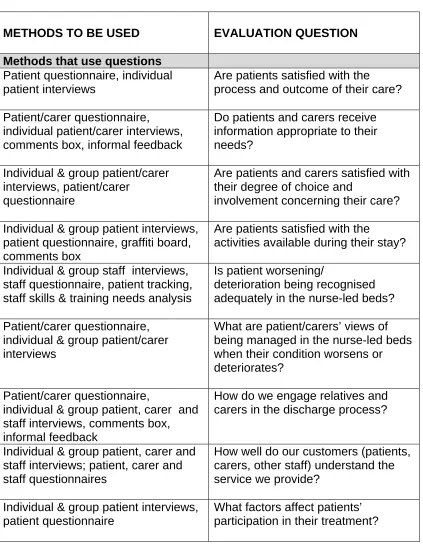
Evaluation questions 20
Developing evaluation research questions, methods and tools
22
Summary 28
CHAPTER 3 - METHODS Methods and data collection tools 29
Sampling and data collection procedure
31
Ethical and research governance arrangements
47
Data preparation, management and storage
49
Study limitations 50
Summary 51
CHAPTER 4 - ANALYSIS
AND FINDINGS Analysis 52
Questionnaires 52
Interviews 52
Graffiti board, first impressions
questionnaire and comments box 53
Patient tracking pro-formas 53
Bed census 53
Findings 54
Patient perspectives 54
1. Questionnaires 54
2. Interviews 58
Carer perspectives 62
1. Questionnaires 62
Nurse-led bed staff perspectives 72
1. Questionnaires 72
2. Interviews 79
Referring staff perspectives 88
1. Questionnaires 88
• Medical consultant questionnaire
93
2. Interviews 94
Audit findings 100
Patient tracking pro-forma - inpatient
journey 100
Patient tracking pro-forma - non-admitted
Patient
103
Patient tracking pro-forma - readmitted/failed discharge
104
Bed census pro-forma 105
Graffiti board, first impressions
questionnaire and comments box 108
Summary 108
CHAPTER 5 - REFLECTION
109
Summary 116
CHAPTER 6 -
CONCLUSIONS AND RECOMMENDATIONS
Conclusions 117
Recommendations 117
GLOSSARY 122
APPENDIX Responses from comments box, graffiti
board and first impressions questionnaires
126
REFERENCES 134
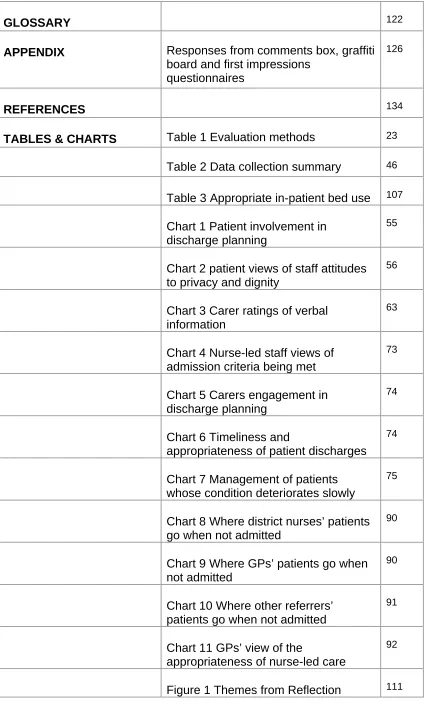
TABLES & CHARTS Table 1 Evaluation methods 23
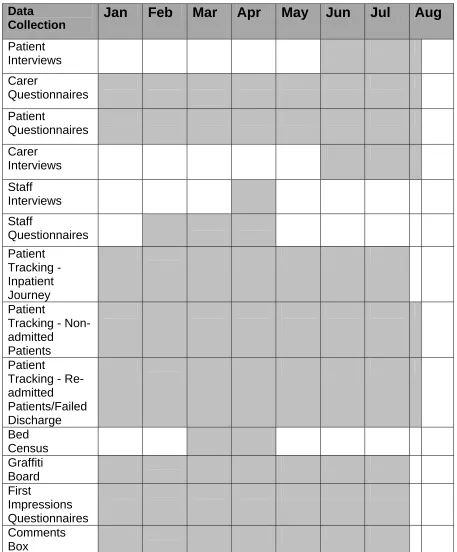
Table 2 Data collection summary 46
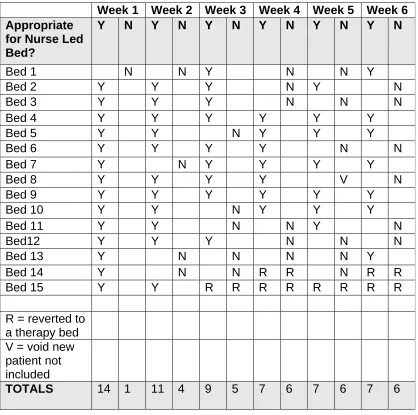
Table 3 Appropriate in-patient bed use 107
Chart 1 Patient involvement in discharge planning
55
Chart 2 patient views of staff attitudes to privacy and dignity
56
Chart 3 Carer ratings of verbal information
63
Chart 4 Nurse-led staff views of admission criteria being met
73
Chart 5 Carers engagement in discharge planning
74
Chart 6 Timeliness and
appropriateness of patient discharges 74
Chart 7 Management of patients whose condition deteriorates slowly
75
Chart 8 Where district nurses’ patients go when not admitted
90
Chart 9 Where GPs’ patients go when not admitted
90
Chart 10 Where other referrers’ patients go when not admitted
91
Chart 11 GPs’ view of the
appropriateness of nurse-led care
92
[image:8.595.92.517.71.798.2]FOREWORD
We are delighted to be sharing the final report of the Evaluation of a Nurse
Led Unit study with you. We hope that like us you recognise that the journey
we have undergone in doing this study has been as valuable as the findings
themselves. Furthermore, we hope you find this report accessible and useful
whatever your background or particular interest, perhaps as a health and
social care professional, service user or member of the public, academic or
participant in the study.
Within our study, we have attempted to promote meaningful engagement of
the public and service users as a means of adding to the quality of the work.
We believe this has ensured the right research questions have been asked
and that the project has been undertaken in the most appropriate way
available to us. Involvement of a range of staff as research team members
has in our view also added greatly in making the focus of the study relevant to
them. We are proud of our achievements as a research team and have put a
lot of personal energy and enthusiasm into the process. Much has been learnt
along the way, not only in terms of research but about ourselves and each
other. We hope the findings are taken forward by those who need to act upon
them to reinforce existing good practices and to prompt change in others
where improvement is needed.
Few teams within the NHS hold themselves up to the scrutiny that the
nurse-led bed team has. They are commended for wanting to take a long hard look
in the mirror in pursuit of opportunities for improvement, when they could have
chosen to merely carry on as before.
Tracey Williamson
ACKNOWLEDGEMENTS
The funding for this study has kindly been provided by the former Chesterfield
Primary Care Trust.
We are grateful to the attendees at the first workshop we held to explore ideas
for the study. These people significantly helped to inform our thinking and
develop our early ideas.
We would like to acknowledge the support we have received from the Trust
Research and Development Department, especially Mick Bond and Roger
Simpson.
We would like to thank the Study Advisory Group members for their
suggestions and views.
We are grateful to the patients and staff working within the Trust who may
have fitted around research team members at times as they attended
meetings and collected research data.
Patients, their carers, families and visitors helped us greatly by taking part in
the study in a variety of ways for which we offer our sincere thanks.
Dr Nancy Lee at the University of Salford is thanked for facilitating reflection
sessions to aid our learning within this study which will in turn help us in future
studies.
Statistical support has been gratefully received from Leah Greene at the
University of Salford
Special thanks go to Beverley Sewell who has provided excellent
administration support throughout and made several useful research
Lastly, an acknowledgement to Alison Rawle whose leadership and
commitment to improving both staff and patient experiences, made the study
PLAIN ENGLISH SUMMARY
INTRODUCTION
This evaluation study was commissioned by Alison Rawle, Nurse Consultant
Older People, Derbyshire County Primary Care Trust (PCT) (formerly
Chesterfield PCT). This study took place within Walton Hospital which is a
community hospital comprising 120 rehabilitation beds and 56 beds for older
adults with mental illness. One of the wards, Derwent Ward, changed focus in
2003 and became the pilot site for 6 nurse-led beds. Nurse-led care is where
nurses, commonly but not always in a nurse consultant or specialist nurse
role, take leadership of one or more patient services, wards or departments
which would traditionally have been led by a consultant doctor. The numbers
of nurse-led beds at Walton Hospital have since grown.
Nurse-led care is still relatively new in the UK and is an area in need of
greater exploration to see whether it provides safe and effective care for
patients compared with traditional approaches. Other concerns are whether
patients and their families view nurse-led care as acceptable and comparable
with traditional, doctor-led care. A research team of nurse-led ward staff, an
ex-patient and patient representatives was set up in early 2005 to plan and
undertake an evaluation study that answered questions of interest to the
different participants.
EVALUATION AIMS
The evaluation aimed to closely examine the structures, processes and
outcomes of nurse-led care.
• To explore staff, patient and carer understandings of a nurse-led approach to care
• To identify how satisfied patients and carers are with their nurse-led experience
• To identify how satisfied staff are with their experience of utilising the
nurse-led bed service
• To examine whether quality of patients’/carers’ journeys through nurse-led care could be improved
• To utilise a partnership approach to the study with patients and their representatives
• To develop research skills amongst research team members
EVALUATION APPROACH
The research team adopted a workshop approach in designing the study.
Eight workshops and three meetings were held to identify what the focus of
the evaluation should be, the research approach and tools to be used, roles of
research team members, training needs, training sessions, reflection on the
experience of doing research, plans to share study findings and final report
content. An action research approach was used as this concerns partnership
working with staff and lay people as equally valued members of the research
team and has a commitment to using the study findings to improve care
where needed. Research team members have been involved in all stages of
METHODS AND DATA COLLECTION
Data collection concerns the information gathered in order to meet the study
objectives. A range of methods was used including:
1. Patient questionnaire (research)
2. Patient interviews (research)
3. Carer questionnaire (research)
4. Carer interviews (research)
5. Staff questionnaire - Derwent Ward staff (research)
6. Staff questionnaire - referrers (research)
7. Staff questionnaire - medical consultants (research)
8. Staff interviews - Derwent Ward staff (research)
9. Staff interviews - referrers (research)
10. Patient tracking - inpatient journey pro-forma (audit)
11. Patient tracking - non-admitted patient pro-forma (audit)
12. Patient tracking - re-admitted/failed discharge pro-forma (audit)
13. Bed census pro-forma (audit)
14. Graffiti board (practice development)
15. First impressions questionnaire (practice development)
16. Comments box (practice development)
To meet research team members’ preferences, not all methods were research
methods. Some were ‘practice development’ methods (informal means of
exploring patient care and people’s views of it) and others were ‘audit’ (used
to gather information available in existing documents such as patient records).
Research methods were used to rigorously gather and analyse new
information through approaches such as interviews and postal surveys.
Questionnaire surveys were undertaken with patients, carers, staff who admit
patients to nurse-led care (‘referrers’ e.g. GPs and district nurses), medical
consultants and nurse-led staff themselves. Individual or group interviews
were also held with participants from most of these groups. Data were
ANALYSIS
Findings from all sixteen methods were analysed for useful, interesting and
important information that could help us to gain an accurate picture of what
care was like for patients, carers and staff on the nurse-led ward.
FINDINGS
The over all findings indicate that patients, carers and staff who refer to the
nurse-led beds are highly satisfied with the service. It is important to note that
whilst participants have indicated a few areas for improvement that we don’t
focus on these without due regard to the fact that overall they were hugely
satisfied. The following summary gives an indication of the balance of
participants’ views that are detailed fully in the Study Final Report.
Patient Perspectives
These findings are drawn mostly from 32 completed questionnaires received
from patients (67 % response rate) and individual interviews with 5
ex-patients.
Findings from the survey show overwhelmingly, that patients were very
satisfied with their over all experience on the nurse-led ward, with 90% rating
it between excellent and satisfactory. General staff communication with
patients was viewed as excellent, very good or satisfactory in 90% of patient
responses. A staggering 94% rated their level of involvement as excellent,
very good or satisfactory. They were also asked to rate the degree of choice
they felt they had concerning their care. Again 90% found it to be excellent,
very good or satisfactory. In terms of involvement in discharge planning a
further 87% were satisfied or above, although 13% found their involvement in
Staff attitudes were rated mostly excellent or satisfactory. In relation to staff
attitudes to privacy and dignity in particular, patients were even more
impressed rating staff as excellent (25 %), very good (59%) and satisfactory
(13%). The majority of patients rated ward social activities highly.
At interview, no participants said they were given any written information prior
to admission to the nurse-led beds and only one recalled being advised
verbally by their doctors that the service was nurse-led and primarily for
rehabilitation. All were happy to trust that professionals were admitting them
to the best place for them.
Generally speaking communication with staff was viewed as positive although
this at times depended on the individual staff member. There was a tendency
for participants to feel they had to ask for information rather than being given it
routinely. One participant viewed listening skills as very good indeed. Whilst
another believed nurse-led staff would get to know patients better than a
doctor would. One comment was that all of the nurses showed kindness,
consideration and were friendly.
Participants expressed mixed views about their involvement in discharge
planning. For some it was unsatisfactory and felt that they had no involvement
in the arrangements, merely being ‘told’ when it was. Others felt a good
degree of involvement. Participants’ perceptions of involvement in care were
mixed. Some did not recall making any choices and did not seem concerned
about this.
Promotion of privacy and dignity was generally viewed favourably.
Carer Perspectives
These findings are primarily drawn from 8 returned questionnaires from carers
Carers were very satisfied with their experience on the nurse-led ward with
100% rating it between very good and satisfactory.
All participants considered verbal information to be very good (63%) or
satisfactory (38%). Responses rating written information were also favourable
with excellent (17%), very good (67%) and satisfactory (17%). General staff
communication with carers was viewed by all seven respondents as very
good (57%) or satisfactory (43%). When asked to rate staff response to
carers’ own attempts at communication with them (e.g. listening skills), staff
were rated highly (very good 86% and satisfactory 14%).
All 100% of respondents (7) rated their involvement in care of their relative as
excellent, very good or satisfactory. In terms of involvement in discharge
planning all carers were at least satisfied (excellent 25%, very good 63% and
satisfactory 13%).
All respondents rated staff attitudes as being between excellent and
satisfactory, with 3 of these specifying excellent (43%). In relation to staff
attitudes to privacy and dignity in particular, carers rated staff as excellent
(14%), very good (71%) and satisfactory (14%), based on seven respondents.
Discharge planning was praised on three occasions. One respondent
indicated that communication with and by staff was dependent on the
individual, although another comment was that communication was good
despite staff being clearly overworked. Staff attitudes were also said to be
variable by one respondent who added they saw much caring, humour and
compassion.
At interview, participants said that no written information was received by
them prior to their relative’s admission to the nurse-led beds. Like patients, all
were content that the right care was being arranged for them.
Most participants expressed no appreciation as to what ‘nurse-led care’ was
Most communication with staff was considered positive although it again
depended on the individual staff member. Participants were generally very
satisfied with arrangements to maintain privacy and dignity.
Generally equipment provision and other arrangements for relatives’
discharge home were satisfactory.
Referring Staff Perspectives
These findings are drawn from 82 completed questionnaires from referrers to
the nurse-led beds (57% response rate). These referrers comprised GPs (41
replies out of 82 sent / 50% response rate), district nurses (25 replies out of
42 sent / 60% response rate) and ‘others’ e.g. Care Managers, community
physiotherapists and practice nurses (16 replies out of 21 sent / 76%
response rate). Findings are also from 1 focus group interview with 4 district
nurses and 2 individual GP interviews.
Of the district nurses who had referred, 94% found the process of accessing a
bed ‘easy/quick/responsive’, compared with 97% of GPs and 92% of ‘others’.
Sometimes no bed was available when a referral was made and referrers
were asked where those patients had gone to instead. Of the 9 occasions this
happened to district nurses, 3 patients stayed at home, 4 went to the
Chesterfield Royal Hospital, 1 went to Red House (a residential rehabilitation
facility) and 1 went to ‘another’ destination. Of the 23 occasions this happened
to GPs, 3 patients stayed at home, 11 went to the Chesterfield Royal Hospital,
2 went to Red House and 7 went to ‘another’ destination. Of the 11 occasions
this happened to ‘other’ referrers, 4 patients stayed at home, 3 went to the
Chesterfield Royal Hospital, 3 went to Red House and 1 went to ‘another’
destination.
When asked if they were aware of the admission criteria for the nurse-led
and 17% of ‘other’ referrers (2). A hundred percent of all district nurses, GPs
and ‘other’ referrers agreed that the nurse-led bed criteria were appropriate.
One question asked if respondents believed that patients admitted to the
nurse-led beds would receive a comparable service to those who would
normally be admitted to medical-led care. Most district nurse respondents
agreed - 31% strongly agreed (5) and 56% agreed (9). GP respondents held
varied views - 22% strongly agreed (7), 47% agreed (15), 19% neither agreed
nor disagreed (6) and 13% disagreed (4). Most ‘other’ referrers agreed - 36%
strongly agreed (4) and 55% agreed (6).
Respondents made numerous comments to reinforce how valuable and
effective they felt the service is. District nurses especially made several
comments about the complexity of their patients’ needs and the need for a
holistic approach to their care. Two GPs suggested a single phone number to
access services for patients whose needs are non-medical rather than
navigating several phone numbers/services.
Only one participant had ever experienced a bed being unavailable within a
suitable time-frame and so the nurse-led beds were viewed as very
accessible. All participants thought the service was invaluable.
Drawing on personal views and feedback from their own patients, all
participants felt the service had a very positive impact on patient experience
and outcomes. Low staffing levels were sometimes commented on by
participants’ patients.
Participants were asked whether the service was really necessary if some
patients could be managed at home for a day or two whilst awaiting a bed. In
response it was clarified that the nurse-led beds are not an emergency
service and some leeway is permissible, usually because family members
have stepped up their input temporarily with the knowledge that admission is
Nurse-led Bed Staff Perspectives
These findings are drawn from 22 completed questionnaires (56% response
rate) and 12 individual interviews with nurse-led bed staff (nurses and
therapists).
Respondents’ satisfaction at working in nurse-led care was variable. When
asked if they felt patients who were admitted met the nurse-led bed admission
criteria, 14% agreed (3), 24% neither agreed nor disagreed (5), 38%
disagreed (8) and 24% strongly disagreed (5).
When asked if patients and relatives are fully engaged in the assessment and
planning of care on the nurse-led ward, 14% strongly agreed (3), 36% agreed
(8), 32% neither agreed nor disagreed (7) and 18% disagreed (4).
When asked if patients and relatives are fully engaged in the discharge
planning process in particular, 9% strongly agreed (2), 36% agreed (8), 32%
neither agreed nor disagreed (7), 14% disagreed (3) and 9% strongly
disagreed (2).
A further discharge-related question asked whether respondents felt patient
discharges from the nurse-led beds were timely and appropriate.
Respondents indicated that 25% agreed (4), 25% neither agreed nor
disagreed (4), 44% disagreed (7) and 6% strongly disagreed (1). This was
because respondents felt that some discharges were hurried due to perceived
pressures to admit new patients.
The next question tried to elicit whether respondents felt the nurse-led beds
met a previously unmet need. Thirty-eight percent agreed (8), 29% neither
agreed nor disagreed (6), 19% disagreed (4) and 14% strongly disagreed (3).
A further question asked whether respondents felt that patients who
deteriorate slowly whilst in a nurse-led bed are managed appropriately and
strongly agreed (1), 43% agreed (9), 10% neither agreed nor disagreed (2),
38% disagreed (8) and 5% strongly disagreed (1).
Large numbers of comments were made about respondents’ views as to the
inappropriateness of some admissions to the nurse-led service. The service
was generally believed to work well when the right patient-types were
admitted.
Past experience of multiple discharges on a single day were viewed as
rushed and stressful. High ward activity in the afternoons when staffing levels
were reduced was also noted as a particular problem.
Drawbacks of nurse-led care mentioned pertain to the risks of patients with
underlying medical needs which may go unmet. This was particularly noted to
put pressure on night staff who were viewed as being ‘out on a limb’, and
weekend staff. A need to improve ‘do not resuscitate procedures’ and how
these are discussed with patients and relatives, was expressed by several
respondents. A further drawback was that nurse-led care was viewed by
some as having to prove itself, which sometimes prompted patient discharges
to make way for new admissions. This is because the nurse-led bed service
aims to be very accessible and to meet this expectation, some participants felt
a degree of pressure to discharge patients when it was known a potential
admission was waiting.
Reasons given as to why patients were admitted who were considered
inappropriate commonly included pressure by GPs needing to find a bed for
somebody and a view that once in the system it would be easier to transfer
patients to the acute hospital if required.
It was felt that a large number of patients were repeat admissions to the
nurse-led ward, sometimes because of deteriorating condition and sometimes
because they had chosen to go home where it may have been difficult to
sustain them. Some would then be readmitted to arrange residential or
A small number of participants expressed not being involved in decisions
about who to admit and lacked appreciation of the processes concerned.
Many participants highlighted the pressure of having multiple admissions and
discharges as a key concern. Admissions late on a Friday afternoon were
considered a risk as on-site medical cover was said to finish at 6pm and there
was no nurse consultant to clerk patients in once the weekend started.
Getting medical assistance when required out-of-hours, was said to be very
difficult by several participants. A lack of notice given of an impending
discharge was also highlighted frequently and it was felt a couple of hours
notice as had sometimes been the case, was insufficient.
A lack of physiotherapy was suggested as an area that did not impact
positively on patient care as some patients had to wait several days for
physiotherapy input. Discontinuity of work within teams was highlighted and
for some staffing levels were viewed as an unhelpful factor.
Despite its issues, all participants felt the service was working well. It was
acknowledged that patients were often in longer than the hoped for 6-8 weeks
period and there was a view by some that a number of patients were in too
long causing some of their progress to be undone. The balanced approach to
RECOMMENDATIONS
Whilst the views of study participants were overwhelmingly in support of the
nurse-led service the point of the study was to reinforce existing good practice
and to identify any areas in need of further improvement. The research team
identified 43 recommendations for enhancing their practice. The nurse-led
ward staff are now taking forward an action plan to prioritise and address all of
these issues.
1. Feed back study findings and develop an action plan/priorities to address
study recommendations
2. Explore nurse-led staff preferences in relation to working in a nurse-led
setting
3. Explore mechanisms for team building and communication e.g.
team-building days
4. Consider involvement of nurse-led staff in pre-admission assessment of
referred patients to gain insight into these processes
5. Review admission and discharge activity in comparison to the staffing
resource and other ward activity
6. Review organisation of care in relation to team nursing
7. Review discharge processes (including involvement of patients/carers,
involvement of therapists, notice given, perception of readiness, provision
of services and equipment/medications, ward activity, delays)
8. Review management of poorly patients
9. Review implementation of resuscitation policy and procedures
10. Review out-of-hours medical cover arrangements
11. Review management of patients with dementia and mental health needs
12. Appraise physiotherapy provision and referral processes for the nurse-led
beds including out-of-hours cover
13. Develop/refine patient/family information giving (to include who is who,
roles, type of ward, uniforms, expectations, purpose of social activities
14. Develop nurse-led bed information material specifically for professionals
e.g. referring staff
15. Review processes for involving and communicating with patients and
relatives e.g. giving updates/test results, explaining purpose of follow-up
appointments, multi-disciplinary meetings (timing, processes, who
present)
16. Review processes for involving patients and carers in their care e.g.
discharge planning and goal setting
17. Review processes for feeding back to patients/carers who make informal
complaints or are dissatisfied
18. Review communication processes between professional groups
(including use of the taped handover whereby different staff shifts update
each other, multi-disciplinary team meetings)
19. Implement a staff training needs analysis and action plan
20. Explore mechanisms to raise awareness about the service for other
professionals e.g. an open day or shadowing/exchange opportunities
21. Consider a single point of referral/phone number for intermediate care
referrals
22. Review opportunities for out-of-hours admissions to the nurse-led beds
23. Explore mechanisms to routinely feed back to GPs regarding patient
progress/reasons for delays
24. Identify opportunities for project participants to apply research skills in
other activities
25. Identify opportunities/preferences of the lay members of the project group
to be involved in future research or activities
26. Implement study dissemination plan
27. Consider each specific improvement/recommendation suggested by
patients, carers, referring staff and nurse-led staff:
a. Provision of patient operated bedside lights
b. Provision of ward staff cover during handovers
c. Provision of hospital hairdressing service
d. Provision of a toenail cutting service
e. Provision of support for patients who smoke to give up
g. Provision of mechanism to check walking stick length
h. Provision of more entertainment in the afternoons/evenings
i. Consider a visiting Welfare Rights Officer service
j. Provision of staff training around communicating with patients
when handling them
k. Consider an afternoon rest period for patients
l. Consider provision of a drinks vending machine for patients
m. Explore mechanisms to integrate patients at home better
n. Appraise need for increased clerical support for staff
o. Consider need for more nurse-led beds and provision for patients
with modest nursing needs
CHAPTER ONE
INTRODUCTION
In this chapter, a brief background is given to set the study in context. The
over all evaluation aims and objectives are given. An overview of the literature
concerning nurse-led and intermediate care is provided.
BACKGROUND
Chesterfield Primary Care Trust is in Derbyshire, in the East Midlands, UK.
This study took place within Walton Hospital which is a community hospital
comprising 120 rehabilitation beds and 56 beds for older adults with mental
illness. One of these wards, Derwent Ward, changed focus in 2003 and
became the pilot site for 6 nurse-led beds. Nurse-led care is where nurses,
commonly but not always in a nurse consultant or specialist nurse role, take
leadership of one or more patient services, wards or departments which would
traditionally have had substantive clinical leadership from a consultant doctor.
Doctors are still available if required, but the day-to-day management of
patients is by nurses. Nurse-led care is still relatively new in the UK and is an
area in need of greater exploration to see whether it provides safe and
effective care for patients compared with traditional approaches. Other
concerns are whether patients and their families view nurse-led care as
acceptable and comparable with traditional, doctor-led care.
The Derwent Ward nurse-led beds increased in number in 2004 to 12.
Throughout most of this study there were also therapy-led beds on Derwent
Ward led by a Consultant Physiotherapist. Patients occupying these beds had
primarily therapy needs such as mobility, as opposed to nursing or medical
needs (although some patients may have a mix of these as well as social
needs e.g. for home aids and adaptations). These therapy-led beds have not
The impetus for an evaluation study came from Alison Rawle (Nurse
Consultant Older People). An approach was made to Tracey Williamson at
the University of Salford to discuss a possible evaluation study. Alison had
previously undertaken an evaluation study of her own on Derwent Ward
(Rawle 2003) concerning the original six nurse-led beds. This earlier
evaluation completed on 31st January 2004. Alison’s wish was for a second study from which to make comparisons to the previous study and to evaluate
any new aspects not previously explored which would be of value.
Alison’s preference was for an action research study and Tracey was an
action researcher. An initial meeting was held between the two at which
possibilities and resources required were discussed. The preference for a
participatory approach was explored further at a second meeting and a
request for Trust funding was made. Funding was forthcoming and so a first
workshop-style event was planned to engage with and invite the views and
ideas of a range of people who may have had a concern or interest in
nurse-led care at the Trust.
This first workshop was held in March 2005 and was facilitated by Tracey.
The twenty-two attendees were identified and invited by Alison who made
efforts to include a range of people including ex-Derwent Ward patients, a
carer organisation, Age Concern, staff from health and social care generally,
staff from Derwent Ward specifically, Public and Patient Involvement Forum
members and the Trust Research and Development Managers. The
programme for the day included:
• Welcome, aims and background
• Demystifying research and evaluation and why action research • Tentative project ideas to date
• The ethical and other approval processes to be followed • What, where and how to evaluate
• Expectations and how to be involved
• Initial support and development needs • Who else needed involving
• Agreeing an action plan, initial thoughts about roles and responsibilities • Timeframes
• Event feedback
The event evaluated well and from that day, 16 attendees agreed to attend a
further meeting with a view to becoming members of the research team. All
these volunteers went on to choose to be co-researchers as opposed to being
involved in other ways e.g. Study Advisory Group member. A research team
was formed with Tracey and Alison appointed as joint Co-leads for the project
with Tracey as Lead Researcher. During the lifetime of the study, (March
2005 to September 2006), three research team members left due to personal
reasons/work commitments and three other people joined the team.
EVALUATION AIMS
The evaluation aimed to provide insight into the structures, processes and
outcomes of nurse-led care focussing on aspects of importance to core
stakeholders – staff, patients and their carers.
Objectives were:
• To explore staff, patient and carer understandings of a nurse-led approach to care
• To identify how satisfied patients and carers are with their nurse-led
experience
• To identify how satisfied staff are with their experience of utilising the nurse-led bed service
• To utilise a partnership approach to the study with patients and their representatives
• To develop research capability amongst research team members
The remainder of this chapter provides an overview of the relevant literature
including nurse-led care and intermediate care written by Alison Rawle.
Chapter 2 outlines the design of the study including ways of working and the
journey from ideas to final tool design.
Chapter 3 sets out the study methods and data collection procedures and
concludes with an overview of data preparation, management and storage. It
also addresses ethics and research governance approval processes and
study limitations.
Chapter 4 outlines the analysis procedures used and study findings. This
evaluation evolved to become a tapestry of methods including those of
research, audit and practice development. Findings from each method are
reported on.
Firstly findings are presented from the patient and carers’ perspective, then
from the nurse-led bed staff’s perspective and lastly from non-nurse-led bed
staff’s perspective. Findings from audits undertaken to complement the
research elements of the study are then presented.
Chapter 5 provides an overview of the reflective elements of the study and
considers the extent that the research capacity building goal of the study was
achieved.
Chapter 6 brings the report to a close with conclusions, key recommendations
A glossary of terms, references and appendix can be found at the back of the
LITERATURE OVERVIEW
This section provides an overview of the literature concerning intermediate
and nurse-led care.
Intermediate Care in Community Hospitals
According to Young and Donaldson (2001) 'community hospitals are
experiencing a revival of interest within the overall policy framework of a
primary care-led NHS'. This is evident by the publication of the health white
paper (Meade 2001) which sets out the government’s vision of more effective
health and social services outside hospitals. To deliver this one clear area for
change includes investment in community hospitals and shifting care safely
away from acute hospitals. The central message of the recent health white
paper ‘Our health, our care, our say: a new direction for community services’
(Department of Health 2006), reflects a far greater proportion of care and
treatment being provided outside hospital and in primary care or community
settings. Young et al (2003) believe that community hospitals have adapted
well to the contemporary NHS and offer a more generic style of intermediate
care than for example similar services provided in residential or nursing
homes which are likely to require more highly selected patients. Community
hospitals are well placed to provide intermediate care particularly in rural
areas and can be expected to have a significant role in alleviating the
pressures on larger specialist hospitals (Seamark et al 2001). However,
caution is urged as there is a need to evaluate the effectiveness of any
alternative provision in order to determine that it does indeed meet patient
need to at least the level currently offered by acute services (Griffiths et al
2004). What is questioned is whether community hospitals can provide the
level of care traditionally provided within the acute sector to chronically ill, frail
elderly. What is of particular interest is whether an equitable level of care can
In exploring the concerns raised in relation to intermediate care generally it is
perhaps not surprising that concerns are predominantly expressed by medical
staff:
“Illness in older people typically presents with non specific symptoms and careful assessment is required if treatment opportunities are not to be delayed or overlooked.’’ (Young and Sharan 2003)
Similar concerns are shared by Young and Donaldson (2001):
“The presentation of acute illness in older people is non specific, diagnosis more complex and unnecessary delays incur increased complications and worse outcomes. Therefore as a group acutely ill older people are not natural candidates to bypass the DGH (District General Hospital).”
Two of the most vociferous critics of intermediate care developments are the
highly respected John Grimley Evans and Raymond Tallis (2001) who state:
“Those geriatricians who have contrived to defend specialist rehabilitation units against the cutbacks of the past 20 years may now have to fight to prevent their being downgraded to intermediate care. Worse yet is the implication for which the text acknowledges there is no justifying evidence that older patients could be sent directly to intermediate care bypassing the skilled diagnostic evaluation that the complexities of disease and disability in old age require.”
Evans and Tallis (2001) are supported in their assertion that there is no
justifying evidence to support developments in intermediate care, by a point
reinforced in a systematic review (Parker et al 2000):
It is clear then that the major concerns revolve around the central issue of
medical assessment and management of frail elderly by skilled physicians
housed within the diagnostic facilities of a district general hospital (which is
where traditionally frail elderly with a precipitating illness have been admitted).
Geriatricians are clearly alarmed at the prospect of frail elderly being admitted
to community hospital facilities where it is felt there are neither the medical
expertise nor the diagnostic facilities available. However, the argument almost
comes full circle as ultimately the question is whether all frail elderly
presenting at the district general hospital need the benefit of a geriatrician and
extensive diagnostic facilities? It is suggested that there is an issue of
‘appropriateness' in terms of where is it most appropriate to manage frail
elderly patients in need of in-patient care? Donald et al (2001) stress this
point:
“Any resources within the NHS should be used wisely - it would be inefficient to care for patients in a community hospital who could be safely managed at home and unwise to care for patients who would have been better if more appropriately managed in the DGH.”
Whilst Round et al (2004) add:
“The GP who can admit to either a community hospital or district general hospital has to decide which facility is better for that patient.”
In accepting the concerns of geriatricians that frail elderly will be
disadvantaged by intermediate care developments it is felt useful to examine
some of the work that has been done around comparing outcomes between
acute and intermediate care. One such study (Round et al 2004) compared
patient-based outcomes at six months following emergency admission to a
district general hospital or community hospital. The quality of life and mortality
in the community hospital cohort was similar to those in the district general
hospital cohort and it was concluded that community hospital care can be
used as an alternative to district general hospital care for a wide range of
the sort of management problem seen regularly in primary care. They were
patients with poor underlying health who developed an additional problem
such as an infection, making hospital admission necessary. A further study
(Martin et al 2004) concluded that acute illness combined with a chronic
illness represents a significant proportion of patients admitted to acute general
hospital. The findings were felt to support the development of better models of
managing chronic disease such as admission avoidance schemes. However,
in contrast to this a further study (Bowcutt et al 2000) demonstrated that
unplanned readmission is generally not preventable and often reflects a highly
dependent and medically frail group of patients in whom early intervention
with readmission is appropriate. These authors suggest:
“Of the readmissions considered to be preventable the most common deficiency in the previous admission was lack of adequate rehabilitation of patients discharged from hospital departments other than the GMU (General Medical Unit).”
Looking again at the study which compared six month outcomes after
emergency admission of elderly patients to a community or district general
hospital (Round et al 2004) it is notable that data suggested that medical staff
contact and use of drugs and investigations were major sources of cost
differences between the cohorts. It is further concluded that exploration of the
benefits and disadvantages of multiple investigations and drug treatments in a
frail elderly cohort would also be worthwhile. Furthermore, there is an
argument that an increasing number of older patients do not require intensive,
diagnostic or invasive procedures; and would be better treated in sub-acute
units offering an interdisciplinary approach to treatment. In this model, team
members synthesize their efforts to encourage and support an independent
and satisfying lifestyle for their older patients (Steiner 2001). This raises yet
another question which asks is it appropriate that all older patients receive
intensive medical management and investigation, or could their needs be
better served within a community hospital where the focus is on
interdisciplinary working rather than medical management? Once again we
some circumstances, admission for medical management and investigation
may be appropriate and clearly in other cases a community hospital with a
specialist rehabilitation team which specialises in older people’s rehabilitation
services will be appropriate.
There is general agreement within the literature that intermediate care
services are supportive rather than directive (Wilson-Barnett et al 2003). This
model of care is seen to be fitting to nursing rather more than medicine in that
patients are viewed holistically and 'care' rather than 'cure' dominates. In
practice there seems to be a general recognition that the patients most likely
to be referred to intermediate care services are elderly and frail with a mixture
of medical and social needs and with highly variable rehabilitative potential
(Wilson-Barnett et al 2003). Nurse-led intermediate beds therefore are a
logical development.
Nurse-led Intermediate Care
Nurse-led beds are not a new development and have been the focus of
several previous studies. Ideally significantly shorter stays, better
rehabilitation and fewer costs would be associated with nurse-led in-patient
care. However, this has not been shown consistently (Wiles et al 2003). The
distinctive feature of nurse-led intermediate care however is that care is led by
nurses. Intermediate care provided in nurse-led beds is based on the premise
that although medical diagnosis and treatment is needed at the stage of acute
biological crisis, in the post acute phase the need is for education,
rehabilitation and supportive interventions which can be appropriately
provided and led by nurses (Griffiths et al 2000).
The argument for the viability and effectiveness of nurse-led intermediate care
is based upon several propositions (Petch 2003):
At present, the evaluative work which has been done with nurse-led
intermediate care has demonstrated significantly longer hospital stays
compared to usual care (Petch 2003). Unfortunately, nurse-led intermediate
care may be as successful at preparing patients for discharge as usual care
but the extended stay is liable to incur considerable additional costs (Petch
2003). It is concluded that future research into intermediate care should
consider the nurse-led intermediate care model further. However, no negative
outcomes are associated with nurse-led intermediate care (Petch 2003). In
their systematic review Parker et al (2000) found the quality of trials on
nurse-led beds not to be high and all were relatively small in size. There were no
firm conclusions in relation to mortality but return home did seem to be more
likely for those who had been cared for in this service setting. Clearly more
rigorously evaluative studies of nurse-led care are required with a particular
emphasis on patients’ views as research exploring patients’ views of
nurse-led in-patient care is viewed as being limited (Griffiths et al 2000).
SUMMARY
This chapter has set the scene for the evaluation study and the current
knowledge-base concerning nurse-led care has been examined. Its design
CHAPTER TWO
STUDY DESIGN
This chapter sets out the overall approach adopted for the evaluation study
which was participatory action research with extensive involvement and
partnership working. The way that the study was organised and delivered is
also set out to illuminate the process for the reader. The approach followed to
arrive at a series of evaluation topics is described. How these topics were
prioritised and translated into research questions to be answered within the
study is further described.
EVALUATION APPROACH – Action Research
As is common in evaluation projects involving organisations, a wide range of
potential elements to focus on was evident in this study. Whilst interesting,
attention to all may have presented an unwieldy and costly evaluation project
and so it has been essential to be clear about what information was needed
and how that information would be used once gained, for example, to inform
future funding decisions or to make improvements.
An action research approach was requested by the study commissioners and
this approach matched well with the preferences of other research team
members. Action research was an appropriate umbrella under which to carry
out an evaluation for a number of reasons. Action research:
• Is educative
• Deals with individuals as members of social groups
• Is problem-focused, context-specific and future-orientated • Involves a change intervention
• Involves a cyclic process in which research, action and evaluation are inter-linked
• Is founded on a research relationship in which those involved are
participants in the change process
(Hart and Bond 1995)
Action research is popular in health care as it offers flexibility to respond to the
changing local situation e.g. staff moves, local reconfigurations of services
and movement of stakeholders.
Within an action research framework, a clearly defined study could not be
described from the outset. What to evaluate, by whom and when, was to be
the responsibility of a number of research team members to determine.
Accordingly, action research designs tend to be loose and fluid to
accommodate the evolving nature of action research whereby new avenues of
enquiry unfold as the project progresses. This emergent design also allows for
meaningful participation in the design of the study especially by
non-professionals such as ex-patients and members of the public. This ensures
that all co-researcher voices are heard and promotes a sense of ownership of
the study, which is important as people are spending valuable time and effort
in taking part.
INVOLVEMENT AND PARTNERSHIP WORKING
A crucial component to this study has been the meaningful involvement of
ex-patients, patient representatives and staff working with patients who use the
nurse-led beds being evaluated. Involvement of users of services in all stages
of research is a Government priority (Calnan & Gabe 2001). Users of
intermediate care services are predominately over 65 years of age. Despite
being the largest consumers of health and social care services, older people
those services (Biggs & Powell 2000; Phillipson et al 2000). Findings from the
National Listening Exercise (National Co-ordinating Centre for NHS Service
Delivery and Organisation - NCCSDO 2000), indicate the importance users
place upon involvement in such service planning, as all too often assumptions
are made by professionals as to the needs and wants of the public, which are
often inaccurate.
The partnership working of staff and the public in this study is consistent with
policy drivers for involvement. We intended the study to be an exemplar of
how to engage these parties and to ensure they were as fully involved as they
wished. Involvement can take many forms and be at any level and the
research team members have been encouraged to decide how much or little
they wish to participate, recognising that this may fluctuate over time. From
the outset it has been continually reinforced that the research team members
could take part in any aspect of the research process from design, data
collection and analysis to dissemination. It was further reiterated that training
and support would be provided by the lead researcher or through external
agencies as appropriate. Although less intense involvement was offered, for
example to read any drafts as a critical reader or to be consulted for a view on
proposals, all research team members wanted to adopt the full partnership
approach of being a co-researcher.
The study design was guided by evidence of best practice in involving older
people in research (Peace 1999) that offers creative and innovative examples
of participatory research with older people. In any partnership working there
has to be a process whereby a final decision is made where a consensus
decision cannot be made. It was agreed at the study outset that final decision
making concerning the conduct of the study rested with the lead researcher
PREPARATION AND TRAINING
In this study, all research team members took part in some if not all of the
training made available to them. Training needs analysis was undertaken
early on and helped to identify people’s skills and abilities to some extent, yet
training was open to all, regardless of previous experience. Only one of the
final four non-staff research team members did not undertake interviewing
training and only one of these undertook the analysis training. Several
research team members (staff and non-staff) exercised their right to take part
in an aspect of training without going on to take part in the activity they were
being trained for. For example, some research team members wanted to
appreciate interviewing processes but did not want to lead interviews
themselves, preferring to observe only. Others were appraised by the lead
researcher as competent and went on to lead interviews sometimes after
having observed one being undertaken by the lead researcher.
Where training took place this was within a relaxed and conducive workshop
environment. The aims of the training and intended learning outcomes were
always stated and any other personal expectations identified. The sequencing
of workshops meant that previous learning could be seen to be applied in
subsequent workshops and earlier learning reinforced or revisited.
Topics included:
Evaluation
Action research
Developing research questions
Questionnaire and audit tool design
Interview guide development
Information leaflet writing
Interviewing
Analysis
Several staff research team members undertook training provided by Trent
Focus Research and Development Unit, which was invaluable in
strengthening their accumulation and application of research skills. Topics
included survey design and qualitative research. Research ethics and
governance was introduced at the first exploratory meeting about the study by
the Trust Research and Development Manager, and reinforced in later
workshops.
STUDY ORGANISATION
The overall organisation of the project was not pre-determined but evolved as
the study went along. It quickly became clear that a series of regular meetings
would be needed and during the lifetime of the study (March 2005 to
September 2006), the research team as a whole met eight times. At one
stage in the study, the team split into two sub-groups to work on particular
issues and so these sub-groups were met with separately on two occasions,
totalling twelve meetings altogether. The first seven of these were workshops
of approximately 5 hours in length, addressing study design issues and
associated training e.g. questionnaire design, interviewing skills. The latter
five meetings were business meetings of approximately 3 hours in length, to
monitor progress, revise action plans and refine the study’s final report. These
workshops and business meetings were supplemented by ad-hoc visits to the
Trust to meet with individuals or small groupings of the research team
members for updates or bespoke training, to liaise with the study’s
administration support person, to collect data and plan dissemination. Several
more meetings were planned for after completion of the study to undertake
local dissemination, promote the uptake of findings and to hold a team
de-briefing meeting and celebratory lunch.
In order to deliver this programme of meetings and activities, the lead
researcher adopted a number of roles and responsibilities. It was agreed that
her skills as the external researcher would be best be employed as co-lead
involved training and support for the research team members and facilitation
of the different stages in the study whilst taking a greater or lesser role
depending on the wishes and abilities of the research team members. As a
commissioned study, the lead researcher was responsible for ensuring the
study was carried out to a high standard, to time and funding, whilst
safeguarding the wellbeing of herself, the research team members and
participants and upholding the best interests of the Trust. As local lead
researcher, Alison acted as a ‘gatekeeper’ to the study and participants,
helped navigate local policies and procedures, undertook the role of
professional development lead for the staff research team members and was
the accountable person within the Trust. Joint responsibilities for both
co-leads included the setting up of a Study Advisory Group, ensuring all the
necessary ethical and research governance approvals were received and
making sure a variety of dissemination activities were undertaken during the
project and planned for after its completion.
The next section will follow a meeting-by-meeting account to best describe
how the study design evolved and what the activities of the team members
were at each stage.
Identifying Evaluation Topics
Workshop 1
Workshop 1 was aimed at a broad audience to gain a variety of perspectives
on the proposal for an evaluation of nurse-led beds. It also provided an
opportunity to successfully recruit sixteen people to join the research team.
The programme aimed to give participants sufficient insight into evaluation
and research to be able to identify what concerns or issues they felt should be
investigated. By the end of the workshop the following suggestions had been
1. Patient concerns (patients have expressed a wish for information as
to why they are in a nurse-led bed, what is wrong with them and
what next?)
2. Staff concerns
3. Carers & families concerns (e.g. don’t perceive discharge as being
well planned - picked up via independent telephone service)
4. Engagement of relatives in discharge planning
5. Existing information (secondary data e.g. from telephone service)
6. Nurse-led versus medical led
7. Staff being seen as approachable
8. Team members’ roles and team role
9. Transition from hospital to home (suggestions regarding follow up
calls, audit of discharges)
10. Patient views at 6 week follow up appointments
11. Do the nurse-led beds meet a previously unmet need, e.g. using
beds simply because they are there?
12. Are patient referrals appropriate?
13. Are beds accessible? More than elsewhere (because available)?
14. What are the routes of patients turned away?
15. What is the Chesterfield Royal Hospital’s view of the service e.g.
bed managers?
16. Nurse-led bed admission criteria – review these and length of stay +
staff perception of these
17. Referrals from the nurse-led beds – patient destination when they
leave
18. Discharge efficiency – what holds things up?
19. Patient information/use
20. Preparation for moves to other wards etc
21. Patient satisfaction from patients’ perspectives
22. Documentation
23. Evaluate goal of nurse-led beds – admission avoidance or
facilitating safe discharge
24. Understanding of each other’s roles
26. Ward environment e.g. Day Room, wardrobes
27. Staffing and skill mix (numbers and types of staff)
28. Staff skills
29. Psychological issues regarding admission e.g. willingness and
motivation to participate
Participants’ hopes and fears were also uncovered and revisited by the lead
researcher at several points as part of her reflective research practice. Fears
included concerns over time, workload, effect on clinical work, own research
abilities, meeting group members’ expectations and the vagueness of an
emergent design. Hopes included improving care, improving the patient
experience, desire to learn from patient feedback, personal development,
more knowledge of NHS working and transferable knowledge.
The outcomes of the workshop included invites for future involvement being
sent to all attendees, identification and invite of other potential research team
members, identification of potential Study Advisory Group members and
transforming of all the suggested evaluation topics into a user-friendly format
for discussion at the following workshop.
Prioritising Evaluation Topics
Workshop 2
When notes of the previous workshop were sent to all attendees, a task was
included for them to choose the three ‘must dos’ and other most important
aspects for the evaluation in their view. Replies were collated so that these
choices could inform discussions at Workshop 2 and lead to agreement on
what topics to include in the study within the limitations of time and funding
available. These were narrowed down to five key themes: