DAHLIA JOHARI
A thesis report submitted in partial fulfillment of the requirement for the award of the
Degree of Master of Engineering
Faculty of Mechanical and Manufacturing Engineering Universiti Tun Hussein Onn Malaysia
CONTENTS
TITLE i
DECLARATION ii
CONTENTS iii
LIST OF TABLE iv
LIST OF FIGURES v
CHAPTER 1 INTRODUCTION 1
1.1 INTRODUCING RFID INTO KEK LAPIS INDUSTRY 1
1.2 PROBLEM STATEMENT 3
1.3 OBJECTIVE OF STUDY 6
1.4 RESEARCH SCOPE 6
CHAPTER 2 LITERATURE REVIEW 7
2.1 INTRODUCTION 2.2 BACKGROUND OF DIWANNIE KEK LAPIS SDN BHD 7
3.1 INTRODUCTION 16
3.2 RESEARCH STRUCTURE 16
3.3 RESEARCH METHODOLOGY 17
3.3.1 IDENTIFY RESEARCH TOPIC 17
3.3.2 PRELIMINARY STUDY AND LITERATURE REVIEW 17
3.4 RFID-BASED KEK LAPIS MANAGEMENT SYSTEM 19
3.4.1 RFID TO QUICKLY DETERMINE MARKET DEMAND AND THE SOURCE REDUCTION PRODUCT 19
3.5 RFKM TO COMPLY AND MAINTAIN HALAL CERTIFICATION 22
3.6 RFIDTIME/TEMPERATURE IN COLD CHAIN MANAGEMENT TO ENSURE VARIETY TYPES OF KEK LAPIS AVAILABLE FOR EXPORT 24
CHAPTER 4 RESULT AND DISCUSSION 26
4.1 INTRODUCTION 4.2 RESULT 26
4.2.1 RFID-BASED KEK LAPIS MANAGEMENT SYSTEM (RFKM) 26
4.2.2 RFID TIME/TEMPERATURE IN COLD CHAIN MANAGEMENT 27
4.3 IMPLEMENTATION COST 28
CHAPTER 5 CONCLUSION 31
5.1 INTRODUCTION 31
5.2 RFID BENEFITS 31
5.3 CONCLUSION 32
REFERENCES 33
LIST OF TABLES
LIST OF FIGURES
1.1 VARIETY TYPES OF KEK LAPIS 1
1.2 BASIC RFID SYSTEM 3
1.3 GENERAL PROCESS OF MAKING KEK LAPIS 5
3.1 RESEARCH PROJECT FLOW CHART 18
3.2 GENERAL OVERVIEW OF RFID ARCHITECTURE 20
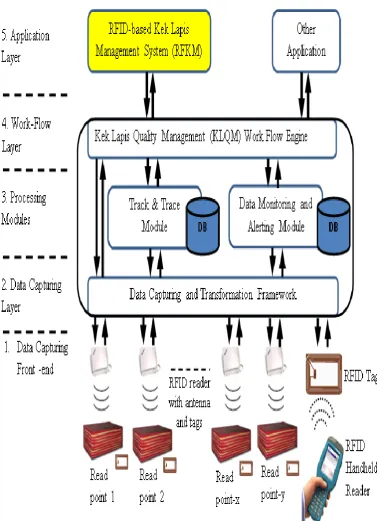
3.3 PROPOSE ARCHITECTURE OF THE RFKM SYSTEM 21
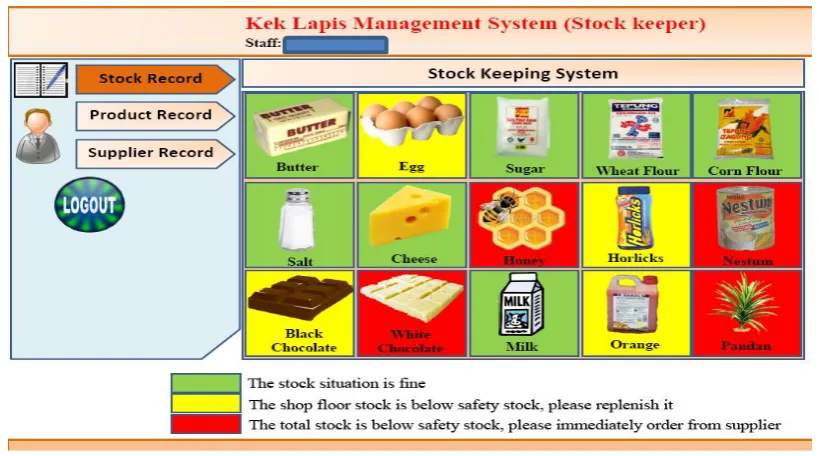
3.4 CURRENT STOCK KEEPING SYSTEM USED IN DIWANNIE KEK LAPIS SDN BHD 22
3.5 STOCK RECORD USING KEK LAPIS MANAGEMENT SYSTEM 23
3.6 PRODUCT RECORD USING KEK LAPIS MANAGEMENT SYSTEM 23
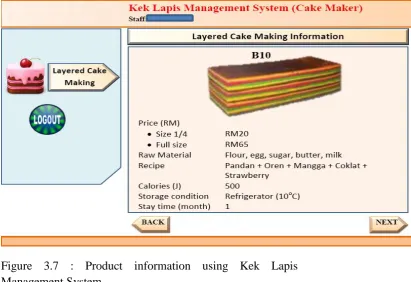
3.7 PRODUCT INFORMATION USING KEK LAPIS MANAGEMENT SYSTEM 24
3.8 TYPES OF STORAGE FOR THE PRODUCT 25
3.9 COLD CHAIN MONITORING AND TRACEABILITY 25
4.1 TEMPERATURE PROFILE IN COLD CHAIN MONITORING AND TRACEABILITY FOR PALLET LEVEL 27
LIST OF APPENDICES
CHAPTER 1
INTRODUCTION
1.1Introducing RFID into Kek Lapis industry
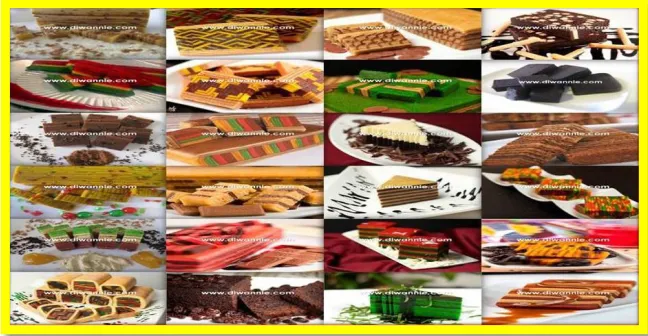
Kek Lapis ( layered cake) Sarawak is a layered cake, traditionally served in Sarawak, Malaysia on special occasions. Sarawak layered cake is a signature product as a souvenir to visitors who come to Sarawak. Its unique taste and its colourful layered design feature have made purchasers willing to pay as high as RM120 for a 1kg piece.Various types of kek lapis are shown in Figure 1.1. The demand of Sarawak layered cake is high especially during the festive Hari Raya season, with sale revenues reaching RM40, 000 per producer.
[image:7.612.160.484.525.693.2]This industry contributes almost RM3 million a year to entrepreneurs. The producers have exported their products to the Peninsular Malaysia, Singapore and Brunei as the demand is very encouraging in those places. The layered cake industry in Sarawak is centered almost entirely in Kuching in response to the One District One Industry Program. A total of 90 Sarawak layered cake entrepreneurs are recorded under the Bumiputera Entrepreneur Development Unit, Department of Sarawak Chief Minister in 2009.
The Deputy Minister in the Department of Agriculture, Sarawak, has claimed that with the growth of the industry from a festive seasonal product to become a successful cottage industry, it thus has potentials as a tourism product for Sarawak.
Therefore, RFID is introduced to further improve the production of the entrepreneur.Radio Frequency Identification (RFID) is an auto-ID technology. One of the key differentiation of RFID is each RFID tag’s identity is unique, and do not require a line of sight.
As compared to other auto-ID technologies like bar codes, optical character readers and some biometric technologies, such as retinal scans, often requires a person to manually scan a label or thumbprint in the case of biometric to capture the data. RFID is designed to enable reader to capture the data on tags and transmit it to a computer system without needing a person to be involved. This is good to reduce human error, and negligent.
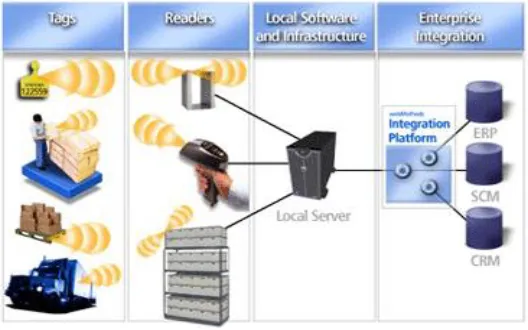
RFID is also used to capture multiple tagged items or boxes at once. This is done by having an antenna to read the tags on boxes stacked on a pallet. In this scenario, a passive RFID tag will be used. A passive RFID tag does not has a battery, and obtain it power via induction from the radio waves send by the antenna. A passive RFID tag consists of a microchip that is attached to a radio antenna mounted on a substrate. The chip can store as much as 2 kilobytes of data.
Apart from a passive RFID tag, there are another two types of RFID tag, namely, an active RFID tag, and a semi-passive RFID tag. An active RFID tag has a battery, while a semi-passive RFID tag has a battery but when the battery is depleted, the semi-passive RFID tag become a semi-passive RFID tag.
Figure 1.2 Basic RFID system
1.2 Problem Statement
The development of the Sarawak Layered Cake Industry is affected by several factors, especially by the increasing trend of prices of its basic ingredients, the traditional non-productive method of production and the imperfect competition in the market structure. To ensure the growth of this industry there is a need for innovation.
According to the survey conducted by the Department of Sarawak Agriculture, the problem of inflation is increasingly affecting the price of basic ingredients of the cake such as flour, sugar, butter, margarine and eggs. A limited number of suppliers of the ingredients in the market have given the suppliers opportunities to administer higher prices.
However at the retail level, intense competition among sellers is forcing sellers to lower prices and thus affecting the profit margin. As compared to the last few years, the price of layered cake was relatively high as there were less competition in the retail level, but at present, each layered cakes could only be sold at RM 10 to RM 25 per piece. According to a producer who was interviewed informally, the profit margin for the layered cake was 70 to 100%, but now it has decreased to 35% due to the greater competition at the retail level but at increased production cost.
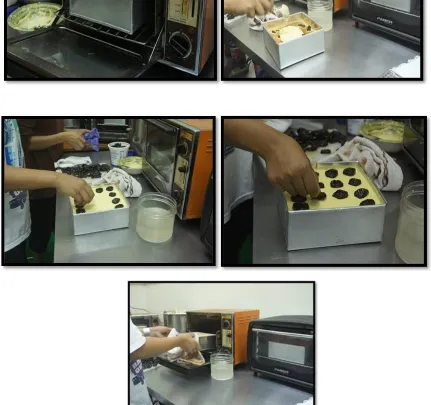
expensive. Figure1.3 shows the general process of making kek lapis.
The survey conducted by the Department of Agriculture has found that only 2 producers are using large capacity oven equipped with temperature control and timers. Each oven is priced at RM 9,000 with the capacity of baking 27 cakes at a time and can be operated by 2 workers only. In comparison to the typical oven that is widely used at present that has a price range of RM250-RM600 per unit which bakes 6 cakes only at a time. Besides, each small oven requires a worker to operate and as the majority of the active producers in Kuching use 20 to 23 ovens each, thus each producer has to employ 20 to 23 workers. The oven also does not have timers and temperature control, thus causing high temperatures in the production area and putting the workers in discomfort.
In addition, as this industry is largely a home-operation industry (83% of the operators), producers are finding difficulties in getting recognition by the Hazard Analysis Critical Control Point or HACCP and HALAL standardizing authorities.
The industry needs to be innovative in order to grow. As every business faces global market competition with changing marketing strategies, quality assurance requirement, changes in franchising structure, consistency in production and guaranteed hygiene practices must be adhered to. Innovation in the industry requires that producers have certain criteria as inducers. The criteria may be related to behavioral and social as well as marketing elements.
As the industry is facing increasing production cost and changes in the market structure, without innovative changes, not only the market demand but also the supply of Sarawak layered cakes will be affected. The industry may not be able to move into the global market if it could not meet consumers’ tastes and international standards.
Hence, stated below are the problems encountered by the company :-
Limited type of kek lapis to be export due to product shelf life. To ensure the food safety, kek lapis need to be monitor in a specific temperature processing, storage and transport.
Identify market demand and reduce waste. RFID tag system will be introduced to ensure accurate market demand and the source reduction product.
1.3 Objective of Study
The objectives of the study are:
To have variety types of cake lapis available for export
To comply and maintain Halal certification
To quickly determine market demand and the source reduction product
Outcome of the case study, is crucially important to ensure the company competitiveness in the market. Perhaps, it will highlights ways to enhance the company needs to growth and survive. The RFID technology which is exactly for value improvement and also a helpful management tools can provide consumers with comfort by its highly- value added products or services, and it can also contribute to the society for making good use of industrial resources.
Through multiple case summaries, Angeles (2005) also illustrates the potential benefits derived from RFID technology adoption in a supply chain context, such as the reliability of the information on the movements of the
physical goods, the better tracking of products in manufacturing processes, the automation of manual processes and the reduction in human-based errors, etc.
1.4Research Scope
The research (case study) was done at DiWannie Kek Lapis Sdn Bhd; a company in Sarawak which is listed under Small and Medium Industries Development Corporation (SMIDEC, 2011).
a) The research is carried out to identify ways to improve the manufacturing practices covering the following aspects namely product technology and innovation, production process, management, quality and customer focus by using RFID tracking system.
b) The current study does not cover interface software development.
CHAPTER 2
LITERATURE REVIEW
2.1 Introduction
Malaysia adopted a common definition of SMEs to facilitate identification of SMEs in the various sectors and subsectors. This has facilitated the Government to formulate effective development policies, support programs as well as provision of technical and financial assistance.
An enterprise is considered an SME in each of the respective sectors based on the Annual Sales Turnover or Number of Full-Time Employees. Small enterprises is classified by the annual sales turnover ranging from RM250,000 (USD83,300) to less than RM10 mil (USD3.3 mil) or having full time employees from 5 to less than 50. For the medium enterprises, the annual sales turnover ranging from RM10 mil (USD3.3 mil) to less than RM25 mil (USD8.3 mil) or having full time employees between 51 and 150. 2.2 Background of DiWannie Kek Lapis Sdn Bhd
Interview has been conducted with the owner of DiWannie Kek Lapis Sdn Bhd. The owner, Zoraidah Leen had started the business since 1985, with RM50’000 as her initial capital. Currently, they are hiring 7 permanent staff and from time to time taking up partime workers to accommodate the demands.The main branch of DeWannie is located at No.345 Lorong Satok 9, Jalan Satok and another kiosk located at Waterfront Kuching.
Raya Aidilfitri , Chinese New Year, Gawai Dayak and Christmas ;the income of DeWannie can achieve up to RM200’000 per month.
2.3 LITERATURE REVIEW
RFID has been identified as one of the ten greatest contributory technologies of the 21st century. RFID technology features remote distance reading ability, larger memory capacities and reading range, and faster processing than bar codes, and identification of objects or human beings.
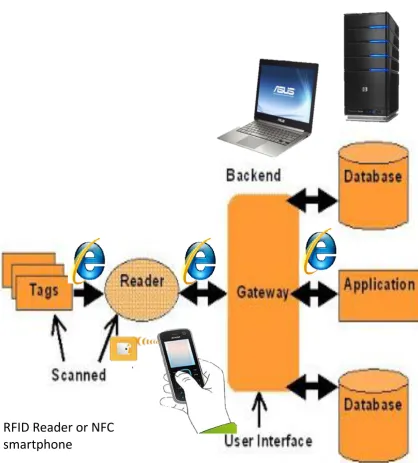
An RFID tag consists of a microchip and an antenna. The RFID reader/writer requests the identifying information contained in the microchip by sending an RF signal to the tag, which then wirelessly transmits the information to a reader/ writer. The reader then digitizes the information and sends it to the application software with the help of middleware. The encoder, often the RFID reader/writer itself, encodes the data for storage in the tag once or many times, depending upon whether the RFID tag is a read-only tag or a read-write tag.
Due to its many advantages, RFID has been applied in many areas, such as supply chain management, telemedicine, manufacturing, inventory control, construction industry, warehouse management, and digital learning. E.W.T. Ngai (2008) Developed an RFID-based sushi management system. The case of a conveyor-belt sushi restaurant to enhance operational efficiency and designed to help a conveyor-belt sushi restaurant to achieve better inventory control, responsive replenishment, and food safety control, as well as to improve its quality of service.
Keeping the stock records of the raw materials for making sushi electronically,
Tracking the real-time consumption and availability of sushi on the belt,
Enabling responsive replenishment,
Removing the expired sushi from the belt automatically to strengthen food safety control,
Simplifying the billing procedure and improving its accuracy, and also;
Providing more transparent sushi information to diners like prices, availability, and calorie content.
T.-H. Tan, C.-S. Chang (2010) developed and evaluated an RFID-based e-restaurant system for customer-centric service. From their study, they found the benefits of RFID in three aspects; namely
technological perspective, -proven technology adopted in food industry and responsive multiple tag real-time read/write capabilities
managerial perspective – enabling responsive replenishment and improving efficiency and accuracy of billing process application perspective – providing inventory level report to
manager , providing replenishment order information for suppliers and providing real-time ordering information to cooks.
reported a total of 1307 processed food product recalls between 1999 and 2003. In Japan, a massive recall was also reported from two Japanese food makers in 2002(Jiji Press, 2003). Demand for higher food hygiene and safety is becoming a growing concern (Kerryet al., 2006).It is verified that RFID technology has already been adopted for use in the food supply chain and to improve the traceability of food (Hutter, 2004). In food supply chain management, a food operator can use RFID technology to record and provide information on all stages from supplier, transportation, and production, to storage and distribution of an individual food item. Food traceability refers to the ability to trace and follow a food, feed, food-producing animal, or ingredients, throughout the production and distribution process (Regattieri et al., 2007).
(A. Sarac et al., 2010) analysed that, the main advantages of RFID technologies in supply chains are:
Improvement of traceability and visibility of products and processes,
Increase of efficiency and speed of processes, Improvement on information accuracy,
Reduction of inventory losses, and
Facilitation of management through real-time information.
costs, optimization of inventory management and increased information accuracy (Chuang & Shaw, 2007), and improvement of customer relationship (Lin, Lo, & Chiang, 2006). Xiao, Shen, Sun, and Cai (2006) proposed two RFID applications in telemedicine to investigate supply and demand of doctors, nurses and patients in hospitals and healthcare and to develop mobile telemedicine services. They also performed a comprehensive survey of security and privacy issues in RFID systems and suggested their solutions. (S.I. Lao et al., 2012)
A real-time food safety management system for receiving operations in distribution centers are identify for major improvement :-
Improvement in operation management,
Improvement in timeframe for resource assignment, and Improvement in customer satisfaction and quality.
Bal (2007) deployed an RFID system on a college campus to guide visually impaired pedestrians. In this implementation, all campus walkways were embedded with electronic tags connected to a Path Finder application Server. Current user location could be identified by RFID tags, and the RFID tag reader actively provided voice information of the location to guide the user.
increased productivity and increased accuracy and speed of information processing.
Domdouzis, Kumar, and Anumba (2007) briefly introduced applications of RFID technology for the uninitiated reader without going into the technical and mathematical details. In their study, RFID is used successfully for the tracking of pipe spools, structural steel members and as an on-site support system. Chow, Choy, Lee, and Lau (2006) proposed an RFID based resource management system (RFID-RMS) that integrated the RFID, case based reasoning and the programming model technologies to help users to select the most suitable resource usage packages for dealing with warehouse operation orders. The practical application of RFID-RMS in a company revealed that the utilization of warehouse resources is expected to be maximized while working efficiency will be significantly improved.
Furthermore, RFID technology was recently adopted in
The experimental results showed that RFID sensor technology was effective in providing context- aware and ubiquitous learning experiences.
J.-P. Qian et al. (2012) analyzed the wheat flour supply chain flow in China, including grading, purifying, grinding, packaging and logistics. Labels with a QR Code were used to identify small wheat flour packages, and RFID tags were used to identify wheat flour bins and record logistics information automatically. J. Song et al. (2006) Automating the task of tracking the delivery and receipt of fabricated pipe spools in industrial projects. Potential benefits from the use of RFID technology in automated pipe spool tracking may include:- reduced time in identifying and locating pipe spools upon
receipt and prior to shipping,
more accurate and timely information on shipping, receiving, and inventory,
reduced misplaced pipes and search time, and increased reliability of pipefitting schedule.
Karkkainen (2003) indicated that adopting RFID technology can improve replenishment productivity as well as reduce stock loss in the supply chain of short-shelf-life products. Jones, Clarke-Hill, and Hillier (2005) reported that RFID technology can be used throughout the supply chain for the UK retail foods industry, including tighter management and control of the supply chain, reduced shrinkage, reduced labour costs, improved customer service and improved compliance with traceability protocols and food safety regulations.
information to choose and buy the most safety food. Kumar and Budin (2006) also concluded that RFID plays a crucial role in the prevention of food product recalls. Recently, Chao, Yang, and Jen (2007) analyzed the contributions of the RFID industry and forecasted technological trends via a historical review and bibliometric analysis.
Their review indicated that the major emerging issues of RFID are supply chain management, health industry applications and privacy issues. This study also demonstrated that the contribution of various enterprises to the adoption of RFID can be divided into four categories according to managerial perspective and enterprise opportunities:
identifying objects and persons, tracking process flow,
authentication, authorization and security and financial record keeping.
Most importantly, Chao et al. (2007) predicted the global diffusion and integration of RFID into daily life in the near future. Many organizations devote considerable resources and knowledge to reconfigure and create innovative new structures in order to conquer the issues in mobile commerce such as user security and privacy, low-quality wireless connectivity and limited screen size of hand-held device (Li, 2005), improve the cost-effective of operations (Edwards, Delbridge, & Munday, 2005) and gain economic benefits (Szántó, 2005).
system in a conveyor-belt sushi restaurant to enhance competitive advantage.
Their case study showed that RFID technology can help improve food safety, inventory control, service quality, operational efficiency and data visibility in sushi restaurants. As competition between restaurants intensifies, restaurants must integrate innovative technologies with business management processes to enhance customer service and improve competitiveness (Kumar,Karunamoorthy, Roth, & Mirnalinee, 2005). This situation motivated the development of this RFID-based e-restaurant system with customer-centric service to enhance customer satisfaction and perceived value (Lee, Fiedler, & Smith, 2008). Consequently, application of RFID is significantly fit to solve the problems encountered by the kek lapis company.
CHAPTER 3
RESEARCH METHODOLOGY
3.1 Introduction
This chapter explains and illustrates the steps and procedures used in this research to generate the case study results and achieve the research objectives. This steps and procedures conducted are called as research methodology. 3.2 Research structure
The main objective of this research is to do case study in the manufacturing company in order to get continuously cost reduction . The company by the name of , DiWannie Kek Lapis Sdn Bhd is the sample of the research . This research can assists to suggest to the company the approach to achieve their objective of cost reduction for their product . Also, to understand the problems faced to further improve the manufacturing product quality. The overall research structure of this research consists of five main areas namely :- 1. Identify the research topic and research scope;
2. Preliminary study and literature review of journal and conference papers;
3. Case study
3.3 Research Methodology
In the research methodology, identifying research topic is done, preliminary study and
literature review and the most important to be learned is the operation and management theory that can be adapted by the company.
3.3.1 Identify Research Topic
The challenges of the globalisation had increased the pressure on industries to
improve their products for commercialisation, in terms of quality, cost and delivery.
An organised process control could be used to maintain and improve the products and services to customers. Effective approaches which will contribute to cost reduction for the company is the main concern without affecting the quality of the product. The selected manufacturing company is listed in SMIDEC and located in the state of Sarawak.
3.3.2 Preliminary study and literature review
In early stage of the research, the author had explored and gained knowledge about the research topic which is related to the company profile , product of the company ,the process and factors affecting extrusion and etc.
3.4RFID-based Kek Lapis Management System (RFKM) 3.4.1 RFKM to quickly determine market demand and the source
reduction product
How can we quickly know the customer's favorites and timely deliver it? Also, can we be more efficient by reducing the materials that goes to waste? The application of RFID-based Kek Lapis Management System (RFKM) could overcome this problem.
For DiWannie shop, it is difficult to always prepare the right number of order according to the customers' tastes, the season, the weekday and special orders. It requires years of analysis on the side of the head chef.
In the system invented, RFKM tags are placed on each package of cakes, which allows it to track each individual cakes. Data is collected by a terminal unit in each chain store and sent to a shared server in the data center. The supply manager in the headquarters can download and browse the data.
The connection between the data center, headquarters and each chain store is done over a VPN, and a VPN software is to be selected.
With the system, the no of sales per cakes in each store can be checked from the headquarters. Headquaters can also direct store managers, and remotely administer the PC systems.
By attaching an RFID tag to the packages of the cakes, each one can be tracked individually. The system can notice changing customers and their tastes, and adjust which items make their way on the shelf line. This improves customer satisfaction and reduces the amount that is thrown away. The investment for the system is balanced by an increase in customer satisfaction, which in turn boosts sales.
RFKM Process Flow Chart
– Step 1: Item to be equipped with RFID Tag
– Step 2: Chef prepare the food and send to shop floor – Step 3: RFID Reader would detect the product and set a new timer for the item
– Step 4: The item timing would be monitored by the RFID readers
Figure 3.2 : General overview of RFID Architecture
3.5 RFKM to comply and maintain Halal certification
Figure 3.4: Current stock keeping system used in DiWannie Kek Lapis Sdn.Bhd
[image:28.595.161.576.99.394.2] [image:28.595.120.530.480.708.2]Figure 3.6 : Product record using Kek Lapis Management System
[image:29.595.155.545.69.328.2] [image:29.595.155.567.436.718.2]REFERENCES
• A.S. Voulodimos et al.,(2010) A complete farm management system based on animal identification using RFID technology. Computers and Electronics in Agriculture 70 (2010) 380–388
• Silvia Estrada-Flores (2009) RFID technologies for cold chain applications.
• A. Sarac et al.,(2010) A literature review on the impact of RFID technologies on supply chain management. Int. J. Production Economics 128 (2010) 77–95
• S.I. Lao et al.,(2012) A real-time food safety management system for receiving operations in distribution centers. Expert Systems with Applications 39 (2012) 2532–2548
• J.-P. Qian et al., (2012) A traceability system incorporating 2D barcode and RFID technology for wheat flour mills. Computers and Electronics in Agriculture 89 (2012) 76–85
• L.C. Lin (2009) An integrated framework for the development of radio frequency identification technology in the logistics and supply chain management. Computers & Industrial Engineering 57 (2009) 832–842
• G. Ferrer et al. (2011) An RFID application in large job shop remanufacturing operations. Int. J. Production Economics 133 (2011) 612–621
• Chunling Sun et al.,(2012) Application of RFID Technology for Logistics on Internet of Things. AASRI Procedia 1 ( 2012 ) 106 – 111 107
• J. Song et al.,(2006) Automating the task of tracking the delivery and receipt of fabricated pipe spools in industrial projects. Automation in Construction 15 (2006) 166– 177 167
• T.-H. Tan, C.-S. Chang (2010) Development and evaluation of an RFID-based e-restaurant system for customer-centric service. Expert Systems with Applications 37 (2010) 6482–6492
• S. Fosso Wamba et al.,(2008) Exploring the impact of RFID technology and the EPC network on mobile B2B eCommerce: A case study in the retail industry. Int. J. Production Economics 112 (2008) 614–629
• Y. Rekik et al.,(2009) Inventory inaccuracy in retail stores due to theft: An analysis of the benefits of RFID. Int. J. Production Economics 118 (2009) 189–198
• S. Piramuthu et al.,(2012) RFID-generated traceability for contaminated product recall in perishable food supply networks. European Journal of Operational Research 225 (2013) 253– 262
• L. Ruiz-Garcia, L. Lunadei (2011) The role of RFID in agriculture: Applications, limitations and challenges. Computers and Electronics in Agriculture 79 (2011) 42–50
• A.S. Martı´nez-Sala et al.,(2009) Tracking of Returnable Packaging and Transport Units with active RFID in the grocery supply chain. Computers in Industry 60 (2009) 161–171
• A.J. Sjolander et al.,(2011) Wireless tracking of cotton modules. Part 2: Automatic machine identification and system testing. Computers and Electronics in Agriculture 75 (2011) 34–43
• Supply Chain Digest (December 17, 2008), Lowry Launches New RFID-Based Solution to Track Food Shipments from Farm to Plate
• E.W.T. Ngai, et.al (2007). Development of an RFID-based sushi management system: The case of a conveyor-belt sushi restaurant. Int. J. Production Economics 112 (2008) 630–645
• Luis Ruiz-Garcia, et.al (2009. A Review of Wireless Sensor Technologies and Applications in Agriculture and Food Industry: State of the Art and Current Trends. Sensors, vol 9, pg 4728-4750
• Emmy Polly and Ahmad Shuib (2010). Factors Influencing the Adoption of Innovative Production Processes among the Sarawak Layered Cake Entrepreneurs. FEB Working Paper Series No. 1001
• http://www.smartag.my/solutions/rfid-healthcare-solutions.aspx
• http://www.edipax.com/pps/RFID_solution.aspx.htm
• http://www.foodylife.com/food-industry/201/rfid-system-and-food-traceability/
• http://blogs.msdn.com/b/bfridley/archive/2009/03/27/sushi-and-rfid.aspx
•
http://www.engadget.com/2009/11/19/wireless-dynamics-brings-the-joys-of-inventory-management-to-the/
•
http://news.thomasnet.com/fullstory/RFID-Wireless-Traceability-System-serves-cold-chain-applications-623252
•
http://www.interempresas.net/Logistics/Articles/50173-Tenenet-analyzes-the-cold-chain-management-to-freeze-concerning-temperature-constraints.html
• http://news.thomasnet.com/news/automatic-id/rf-identification-systems
• http://rfid.thingmagic.com/rfid-blog/?Tag=Agriculture
• http://www.cardsdc.com/Products/?SId=3&SName=RFID+%26+Others&DId=35&PName=RF
ID+Tag+(Label)
• http://www.libramation.com/Pages/prod_radio.html