International Journal of Emerging Technology and Advanced Engineering
Website: www.ijetae.com (ISSN 2250-2459, Volume 2, Issue 10, October 2012)601
Study of GUI Recognition using Pattern Matching in Neural
Networks to improve its Performance
A.Sankaran
1, R.Shankar
2, M.Baskar
3, M S.Maharajan
41
PG Scholar, Department Of Computer Science, Indira Institute Of Engineering And Technology 2
Asst. Prof., Head, Department Of Computer Science, Indira Institute Of Engineering And Technology 3,4
Asst. Prof. Department Of Computer Science, Indira Institute Of Engineering And Technology
Abstract - In this paper we are using the character recognition using pattern matching in a grid box. Which compares the image of alphabets sketched in the grid box, then it searches for the matching alphabets in radio button by using 1 and -1. Which is identified by neural networks(NNs). That how our brain identifies using neurons, dendrites etc for recognition by using a model of "sigmoid" neuron in a neural network.
I.INTRODUCTION
Peripherally reading and talking with colleagues occasionally about the subject for years, found no closer to understanding them than when first learned of them. There has been so much type about the subject of neural nets (NNs). Obviously without an expert in NNs, able to do with just a little code. Like most NN researchers, In this paper to simulate an NN in software rather than create one in hardware. It occurred rudimentary experiment might be a good starting point for other programmers curious about the topic. Also, in this hopes that outsider's context might be helpful for programmers and nonprogrammers alike.
Let be quick to disclaim that all here is surely subject to scrutiny. I'm no expert, and some of my explanations and extrapolations may be just plain wrong, so please take them with a grain a salt.
II.WHAT IS A NEURAL NETWORK
Without going into detail about the history, let's just say neural networks were invented in the sixties by mathematicians (back in those days, computer scientists were often mathematicians; my how things have changed) looking for ways to model processing in the human brain at the lowest level. They took what they knew about a human neuron as a model for creating an electronic neuron.
The Neuron
The neural networks approach which currently being used as robot brain only focus on the surface of human
brain neurons. But the real question is what is dendrites and how to produce the dendritic computations?
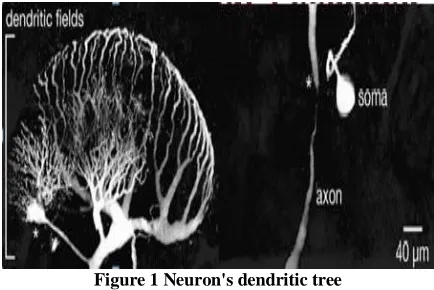
[image:1.612.335.552.346.491.2]These researchers started by boiling down to how they viewed a neuron as working in light of existing knowledge. A neuron, they said, may have many inputs ("dendrites") that a hooked into the single output ("axon") of another neuron.
Figure 1 Neuron's dendritic tree
Signals received by some dendrites would tend to activate the neuron, while signals on others would tend to suppress activation. Figure 2 below shows one kind of model of this:
International Journal of Emerging Technology and Advanced Engineering
Website: www.ijetae.com (ISSN 2250-2459, Volume 2, Issue 10, October 2012)602 Many essays on how neural networks work are available online. Its difficult to follow; for non mathematician. So by skipping the proofs, then, and summarize the exact algorithm used own neurons for the "thinking" done by a single neuron:
Public Sub Think()
Dim Sum As Single, D As Dendrite For Each D In Dendrites
D.Value=D.FromNeuron.AxonValue Sum += D.Value * D.Weight Next
AxonValue=-2/(1+Math.Exp(2*Sum))+1 End Sub
Left some extra lines of code that are to deal with odd cases that are not essential for this discussion. Then variety of ways of creating a neuron. Some use Boolean values for inputs and outputs, while others use linear (floating point) values. Some range their values from 0 to 1, others from -1 to 1, and still others from -infinity to infinity. The model I chose is referred to as having a "sigmoid" output function. This means that it uses linear input values that range from -1 to -1 and whose outputs, which after summation could be anywhere from -infinity to infinity, are instead "crunched" down to fit in a range from -1 to 1. They are not truncated, but are squashed using the equation on the last line of the .Think() function above.
Pattern Matching
Here is where a lot of introductions stop short. What it means for one of these neurons to "know" something before explaining how they work in concert with other such neurons.
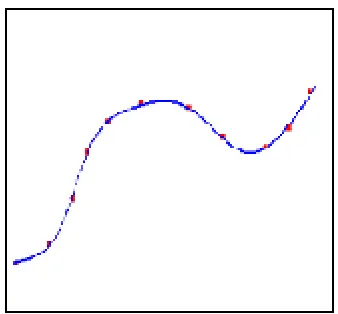
The goal of a neuron of this sort is to fire when it recognizes a known pattern of inputs. Let's say for example that the inputs come from a black and white image 10 x 10 pixels in size. That would mean we have 100 input values. For each pixel that is white, we'll say the input on its corresponding dendrite has a value of -1. Conversely, for each black pixel, we have a value of 1. Let's say our goal is to get this neuron to fire when it sees a letter "A" in the image, but not when it sees any other pattern. Figure 3 below illustrates this:
[image:2.612.358.527.135.292.2]"Firing" occurs when the output is above some threshold. We could choose 0 as the threshold, but in my program, I found 0.5 is a good threshold. Remember; our only output (axon) for this neuron is always going to have a value between -1 and 1.
Figure 3: image of the “graphical representation" and values for the dendrites of our neuron.
Now lets say one of the input pixels was inverted from black to white or vice-versa. That pixel's dendrite would contribute a -1 to the sum, yielding 98 instead of 100. The resulting output would be just a little under 1. In fact, each additional "wrong" pixel color will reduce the sum and hence the output. If 50% of the pixels were "wrong" - not matching what the dendrites say they are expecting as input - the sum would be exactly 0 and hence the output would be 0. Conversely, if the entire image of the "A" were inverted, 100% of them would be wrong, the sum would be -100, and the output would be -1. Since 0 and -1 are obviously below our threshold of 0.5, we would say this neuron does not "fire" in these cases.
So while there are definitive "match" (1) and "non-match" (-1) outputs, there is a whole range in between of somewhat matching.
Training
International Journal of Emerging Technology and Advanced Engineering
Website: www.ijetae.com (ISSN 2250-2459, Volume 2, Issue 10, October 2012)603 Image gets better and better. Because with each step, we only morph the dendrite values a small part of the way towards the "ideal" weights, we guarantee that each training case is factored in. The resulting set of weights will be a compromise that equally balances the interests of all the training cases. Following is the actual code for a neuron to execute one training cycle:
Public Sub AutoTrain()
Dim T As TrainingCase, Td As TrainingCaseDendrite Dim ErrorTerm As Single
Const LearningRate As Single = 0.01
'Learn from each training case in this one cycle
For Each T In Me.TrainingCases
'Preset my dendrite's source axons' values to reflect
For Each Td In T.Dendrites
Td.ForDendrite.FromNeuron.AxonValue = Td.Value Next
'Given the training inputs, generate an output
Think()
'Morph toward the desired output
ErrorTerm = T.AxonValue - Me.AxonValue For Each Td In T.Dendrites
Td.ForDendrite.Weight += Td.Value * ErrorTerm * LearningRate
Next Next End Sub
After a few dozen invocations of this routine for this neuron, the ability to match even a sloppily drawn letter is surprisingly good. Sample program shows the matches as checkboxes that suggest definitiveness, but in fact every letter's neuron has its own output from -1 to 1 indicating how closely it believes the input value matches its view of how such a letter should appear.
The Network
The explanation above gives a sense of the power of an individual neuron to recognize and even "learn" to recognize patterns and to fire (or not) based on recognizing such known patterns. We get into the heart of neural networks' power when we start to link them together.
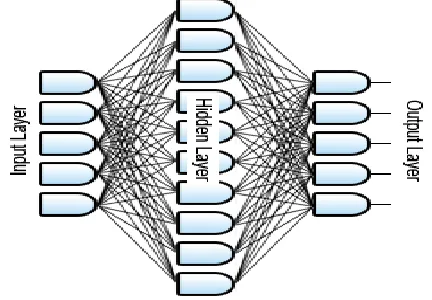
At this point remind the reader not done much experimentation beyond this point. Technically created a neural network program that supports stacks of layers of neurons and even clusters of stacks that can all interact, but beyond the point of having a single set of neurons in one "layer". Figure 4 below illustrates a classic view of how an NN should be arranged:
A layer in this context, if it's not obvious by the diagram, is just a set of neurons that all share the same inputs. That is, every neuron in one layer has dendrites that extend to all the axons of neurons in a prior layer. Technically, an NN may have any number of "layers" of neurons. But it seems in practice, there are usually only two or three.
[image:3.612.335.551.231.381.2]
Figure 4: Schematic of a neural network with three layers of neurons.
The first layer, referred to generally as the "input" layer, is actually just there to make programming easier. Its neurons don't actually have any dendrites. Instead, the input of some input matrix - say, an image of a letter - gets pumped straight into the axon values for each neuron. The neurons themselves are just placeholders so the next layer can tap into these input values in the same way each subsequent layer does.
The last layer is referred to as the "output" layer. Layers between the input and output layers are generally referred to as "hidden" layers. These names sound mysterious, so let me try to ground the thinking behind this.
The next layer could then provide responses appropriate to the combination of both kinds of information. So long as each neuron (outside the input layer) has its own well-crafted set of training cases, they'll all learn to cope well with the goals the designer sets out for such a "stack" of neuron layers.
Biological Neural Nets
International Journal of Emerging Technology and Advanced Engineering
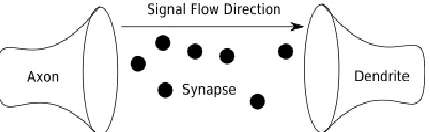
Website: www.ijetae.com (ISSN 2250-2459, Volume 2, Issue 10, October 2012) [image:4.612.62.277.228.294.2]604 In the pre-synaptic membrane of the axon, the electrical signal is converted into a chemical signal in the form of various neurotransmitters. These neurotransmitters, along with other chemicals present in the synapse form the message that is received by the post-synaptic membrane of the dendrite of the next cell, which in turn is converted to an electrical signal.
Figure 5: model of the synapse chemical messages of the synapse moving from the axon to the dendrite.
The above figure 5 shows a model of the synapse showing the chemical messages of the synapse moving from the axon to the dendrite. Synapses are not simply a transmission medium for chemical signals, however. A synapse is capable of modifying itself based on the signal traffic that it receives. In this way, a synapse is able to “learn” from its past activity. This learning happens through the strengthening or weakening of the connection. External factors can also affect the chemical properties of the synapse, including body chemistry and medication.
Back-Propagation
When researchers speak of learning in neural networks, they often refer to the concept of "back-propagation". Technically, the concept of giving each neuron its own training case is not back-propagation. In back-propagation, one would give training cases where the desired inputs would be for the input layer and the desired outputs would be for the output layer. All the layers would then go through a self-organizing process to figure out how best to achieve the goals of the training cases.
III.OTHER INTERESTING POINTS
What I've described here is, again, just one kind of neural network and one conception of how to use them. One other interesting type uses linear inputs and outputs - values from -infinity to infinity - and can be used to learn to approximate linear and perhaps even nonlinear mathematical functions. As such, these can be used, for example, to help control tricky manufacturing processes like chemical vapor deposition (CVD).
One thing that's interesting neural networks today use gradual linear progression functions to ease an NN into its proper behavior, some researchers use genetic algorithms to evolve knowledge. The basic idea behind this is to take an NN that is untrained, to duplicate it hundreds of thousands of times. For each copy, one assigns random values to all the weights for all the dendrites. Then each one is tested using the same set of test cases. A smaller subset - maybe 10% - of the NNs that get close to approximating the desired behavior are kept and the others get thrown out. These are used to repopulate the "world" by mating pairs of them. By "mating", it mean that some of the weights of parent A go to an offspring and the rest of the weights for the offspring come from parent B instead. The result is cross-breed somewhere between A and B. Then the tests begin again and again the poor performers are again thrown out so room is made for a new generation of cross-breeds. Random "mutation" - changing some of the offspring’s weights - occurs to help ensure the system continues to find novel approaches to solving the problem of finding the best combination of weights for the neurons' dendrites.
IV.NOT LIKE OUR BRAIN
There has been a bit of a mystique and aura surrounding them. They are often sold in the popular press as pared down electronic versions of the way the human brain works. They are also envisioned by some as the panacea to the artificial intelligence problem. I suspect that serious researchers in this field know better.
Second, neurons in the brain are not all the same. Some have short axons and dendrites that only span perhaps millimeters and thus propagate local information, while others can have axons that run many inches or perhaps even several feet..
Third, the ideas of training cases and back-propagation seem intuitive enough as a learning paradigm for NNs, but I've never seen any indication that such mechanisms exist in the human brain. Neurons don't take time off every now and then to undergo training and then get switched back into a performance mode. They seem to learn and perform as they go.
International Journal of Emerging Technology and Advanced Engineering
Website: www.ijetae.com (ISSN 2250-2459, Volume 2, Issue 10, October 2012)605 It would have to be lots of individual stacks- what I call a "cluster" of stacks - interacting. Most of the parts of the cluster would have to be pre-trained so they can perform largely unchanging, autonomous functions.
V.CONCLUSION
In this paper able to function in such a way that learning and acting can happen in parallel, or at least in alternating sequences. More realistically, NNs can be used as just one kind of machine in a heterogeneous platform of technologies to provide practical value. Perhaps one part of an AI might decide it wishes to learn to recognize certain patterns in its vision - perhaps different faces or machine parts - and allocate a new neural-net to do the job and control when and what it learns, for example.
It seems the science of neural networks is largely dead and NNs have settled into being an esoteric, if rarely-used, tool in various practical applications like cameras and manufacturing processes.
REFERENCES
[1] Yi-Chong,Zeng Inst. of Inf. Sci., Acad. Sinica,Taipei,Taiwan, “Pattern recognition using rotation-invariant filter-driven template matching,” Image Processing (ICIP), 11-14 Sept. 2011 18th IEEE International Conference, pp. 2389 - 2392 .
[2]Vishwaas, Arjun, M.M. ; Dinesh, R. JSSATE, Bangalore, India “Handwritten Kannada character recognition based on Kohonen Neural Network,” Image Processing (ICIP), 25-27 April Recent Advances in Computing and Software Systems (RACSS), 2012 International Conference, pp. 91 - 97 .
[3]Gupta, Srivastava, M. ; Mahanta, C. Dept. of Electron. & Electr. Eng., IIT Guwahati, India “Offline handwritten character recognition using neural network,” Computer Applications and Industrial Electronics (ICCAIE), 2011 IEEE International Conference, pp. 102 - 107 .
[4] Pradeep, Srinivasan, E. ; Himavathi, S. Dept. of ECE, Pondicherry Eng. Coll., Pondicherry, India “Neural network based handwritten character recognition system without feature extraction,” Computer, Communication and Electrical Technology (ICCCET), 2011 IEEE International Conference, pp. 40 - 44 .
[5] Nan-Chi Huang, Huei-Yung Lin ,Dept. of Electr. Eng. & Adv. Inst. of Manuf., Nat. Chung Cheng Univ., Chiayi, Taiwan “A multi-stage processing technique for character recognition,” Advanced Intelligent Mechatronics (AIM), 2012 IEEE/ASME International Conference on, pp. 1081 - 1085.
AUTHORS PROFILE
A.Sankaran received the Diploma in electronics and communication engineering from Adhiparasakthi Polytechnic College in 2007, B.E. degree in Computer Science engineering from Adhiparasakthi Engineering College, Chennai, India, in 2010.Currently doing M.E. in Computer Science engineering from Indira Institute Of Engineering And Technology, India. His research interest includes wireless communication (WiFi, WiMax), Mobile Ad hoc networks ,Sensor Networks ,Neural Networks and fuzzy logic, Communication networks. And Publications are.
[1] “Computer Network Database Attacks Security From Threats And Hackers,” International Conference On Intelligence
Computing(ICONIC’12)Sponsored By DRDO, pp 18 ISBN 978-93-80757-90-2.
[2] “Start-up and I/O Access Control of Embedded Linux Based Real Time Operating System,” International Conference On Recent Trends In Computer Science And Engineering(ICRTCSE’2012),) 05/2012,ISBN 978-81-9089-8072.
[3] “A Sensing Platform To Support Smartphone’s Accessing Into Wireless Sensor Networks,” International Conference On Recent Trends In Engineering & Computer Application(INRTIEMC-12), 24/02/2012.
[4] “Vehicle Security From Terrorists And License Checking Using Camera In Traffic,” National Conference On Signal Processing And Communication Technology(NCSC’10).
[5] “Nano Drug And Gene Delivery In An Anti-HIV tool,” Published
by Center For Nanotechnology Education, Research & Applications(CENTRA). Sullivan University College Of Pharmacy Louisville, KY, pp 84-93, ISBN 1-4392-5489-3.
[6] “Nano In Anesthesiology- A Pain Killer,” VI Mantra 2008 Project contest, Bangalore.“Security for computer network database attacks,” National Conference On Technical Advancement Computer
Technology (NCTACT-12), 17/03/2012, pp 64-69.
[7]“Mobile Multimedia Sensor Using Peer-To-Peer Networks Architecture And Routing,” National Conference On Technical Advancement Computer Technology (NCTACT-12), 17/03/2012, pp 86-90.
[8] “Mobile Multimedia Sensor Using Adhoc Networks: Architecture And Routing,” National Conference On Innovative Trends on Advanced Computing(NCITA-12), 29/02/2012.
[9]“Smartphone Sensing Using Peer to Peer Computing Wireless Networks,” National Conference On Innovative Trends on Advanced
Computing(NCITA-12), 29/02/2012.
[10]“ Novel Energy-Saving Cell Selection For Multimedia Sensor Routing Networks.,” International Journal Of Communication, Computation And Innovation. 06/2012; Volume-3(ISSUE 1-ISSN 2229-6808):171-176.
Paste
Photo