Munich Personal RePEc Archive
Calorie and Nutrient Consumption as a
Function of Income: A Cross-Country
Analysis
Salois, Matthew and Tiffin, Richard and Balcombe, Kelvin
University of Reading
1 August 2010
Online at
https://mpra.ub.uni-muenchen.de/24726/
1
Calorie and Nutrient Consumption as a Function of Income: A Cross-Country Analysis
Matthew J. Salois*, Richard Tiffin and Kelvin G. Balcombe Department of Food Economics and Marketing
University of Reading PO Box 237
Reading, RG6 6AR United Kingdom
*
2
Abstract
The relationship between calorie and nutrient (fat, protein, and carbohydrates) intake
as a function of income is explored using data for 171 countries over two time periods
1990-1992 and 2003-2005. Three types of analysis are employed: i) nonparametric, ii) panel
regressions, and iii) quantile regressions. Engle curves for calories, fat, and protein are
approximately linear in logs with carbohydrate intakes exhibiting diminishing elasticities as
incomes increase, becoming negative around $US7500 and above. Other nutrient and calorie
elasticity estimates are positive statistically significant. Elasticities range from 0.10 to 0.25,
with fat having the highest elasticities. The estimated elasticities for the quantile regressions
are similar across the 0.25, 0.50 and 0.75 quantiles, but with moderate evidence that countries
in the higher quantiles have lower elasticities than those in the lower quantiles. There has
been a small but significant shift in the elasticities across the two periods.
Keywords: Calorie and Nutrient Consumption, Food and Nutrition Policies, Income
Elasticities, Nonparametric Regression, Panel Data, Quantile Regression.
3
1. INTRODUCTION
"For the first time since 1970, more than one billion people, about 100 million more
than last year and around one-sixth of all of humanity, are hungry and undernourished
worldwide" Food and Agriculture Organization (2009).
"Obesity has reached epidemic proportions globally, with more than 1 billion adults
overweight, at least 300 million of them clinically obese, and is a major contributor to the
global burden of chronic disease and disability" World Health Organization (2004).
The number of undernourished people in the world increased from 854 million in 2006
to an estimated 1.02 billion in 2009, representing the greatest amount of hungry people in
nearly half a century (FAO 2009). The FAO (2009) contends that while the current economic
crisis plays a role in the global escalation of hunger, surging domestic food prices and
deteriorating household incomes are especially to blame. Paradoxically, the growing
international prevalence of hunger and starvation resulting from energy and nutrient
deficiencies continues amidst global concern regarding the rapidly increasing prevalence of
chronic diseases resulting from overweight and obesity. As of 2005, an estimated 1.6 billion
adults over age fifteen were overweight and 400 million were obese (WHO 2006). Although
the spread of obesity was confined historically to the developed countries, emerging trends
indicate the growth of overweight and obesity in the developing world (Seidell 2000; Prentice
2005; Hossain et. al 2007; Misra and Khurana 2008). In fact, in many developing countries,
both childhood malnutrition and adult obesity are concurrently observed within households
resulting in a "dual burden of disease" (Doak et. al 2004; Caballero 2005; Prentice 2005).
A potential key determinant of food consumption is income. Therefore, studies on the
relationship between income and nutrient intake receive considerable attention. Reutlinger
and Selowsky's (1976) influential work sparked a prolific literature on estimating the income
4
a critical component in the design of policies to combat malnutrition in poor countries and to
improve diets in both rich and poor countries. For example, a large elasticity suggests a
policy designed to increase the income of the poor and promote economic growth is an
effective long-term strategy. Conversely, a small elasticity suggests limited scope for
income-enhancing economic policies. Just as important, knowing how calorie and nutrient elasticities
change with income becomes necessary in light of the obesity epidemic. The process of
economic development spurs a "nutrition transition" in which diets high in carbohydrates are
replaced with more varied diets high in fat (Popkin 1994). If calorie-income elasticities show
no indication of decreasing at higher incomes, then there is a stronger need for public
programs to influence diets in developed and developing countries.
The debate regarding the relationship between nutrient intake and income has high
prominence in the development literature. Historically, the "conventional wisdom" of the
World Bank and other institutions in the development arena was that deficient energy intake
and hunger can be assuaged through income growth (World Bank 1980, 1981). However, a
series of articles emerged in the 1980s casting doubt on the role of income (Wolfe and
Behrman 1983; Behrman and Wolfe 1984; Behrman and Deolalikar 1987). In a notable
study, Behrman and Deolalikar (1987) obtain an insignificant income elasticity using
household data from rural Indian villages and conclude that increases in income do not result
in meaningful improvements in nutrient intakes. The role of income in nutrition continues to
spawn serious investigation, with contrasting results appearing throughout the literature.
While the positive relationship between nutrient intake and income is reinforced in some
studies, other studies find either small or insignificant income elasticities. Moreover, some
studies argue that the relationship is linear (Bhargava 1991), while other studies uncover
important nonlinearities in the income-calorie relationship (Gibson and Rozelle 2005;
5
income on calorie intake is affected by the actual level of calorie intake. For example, high
calorie consumers may not be as greatly affected by a marginal increase in income as low
calorie consumers and as such will have a smaller elasticity.
With the evidenced mixed, the debate continues regarding the true relationship between
nutrient intake and income and the appropriate economic policies for combating hunger and
malnutrition. Also left unclear is the extent the nutrition transition is expected to occur in the
developing economies, which involves not only a worsening in diet quality across the
developing world but also a likely global epidemic from diet related chronic disease. The role
of income in nutrition is clearly important for developing countries. However, as people in
developed countries consume calories at increased levels, asking if further increases in
income are likely to aggravate problems associated with obesity also becomes important. The
primary objective of this paper is to assess the relationship between income and nutrient
intake in an international sample of developing and developed countries. In particular, the
analysis utilizes a large cross-sectional sample of 171 developing and developed countries
across two different time periods (1990-1992 and 2003-2005). Most studies tend to focus on
a particular country in a single year using household data. While such an approach is
insightful, estimates from an aggregate Engel curve using international data on nutrient intake
and income provides a global perspective and generalizes results beyond the country level.
The paper proceeds as follows. The second section reviews the recent literature. The
third describes the data and outlines the econometric methods. The fourth section discusses
the empirical results. The final section concludes.
2. THE INCOME ELASTICITY OF CALORIE INTAKE
While estimates of the income elasticity are abundant, the true approximate magnitude
is a controversial topic owing to the wide range of estimates. Bouis and Haddad (1992)
6
0.01 to 1.18, some statistically significant and others not. In one of the earliest studies using
cross-country data to estimate an aggregate Engel curve, Reutlinger and Selowsky's (1976)
obtain a statistically significant but small income elasticity estimate of around 0.17,
suggesting that nutritional status cannot be improved through income-enhancing economic
policies alone. In addition to the studies conducted by Behrman and associates (see,
Behrman, Deolalikar, and Wolfe (1988), for a summary), a number of other papers claim that
income is not the most salient factor in malnutrition, such as Reutlinger and Alderman
(1980), Sahn (1988), Ravallion (1990), Bouis and Haddad (1992), and Bouis (1994).
Even though a substantial literature warns against an income-focused policy, the role of
income is still considered important by many development institutions. According to the
latest FAO (2009, p.36) report on the growing concern of food insecurity, the recent
"diminished economic access to food because of higher prices was compounded by lower
incomes." While a number of early papers substantiate the conventional wisdom of the World
Bank before the "revisionist" papers emerged in the 1980s (Pinstrup-Andersen and Caicedo
1978; Ward and Sanders 1980), more recent studies also counter the revisionist regime
(Subramanian and Deaton 1996; Dawson and Tiffin 1998; Tiffin and Dawson 2002; Abdulai
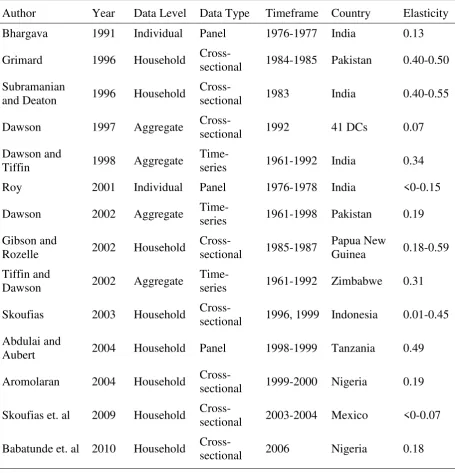
and Aubert 2004). Table 1 provides a summary of recent studies since the review in Bouis
and Haddad (1992). The estimated elasticities are of moderate magnitude (between 0.2 and
0.5) and most authors conclude that improving income is crucial to combating malnutrition.
Different approaches partly explain the variation in estimates.
One difference is how the Engel curve and resulting income elasticity is estimated.
Generally two methods are followed in the literature. The first method uses micro-level data
obtained from household surveys to estimate the elasticity via an indirect approach (using
food expenditure data to estimate a model of demand and then convert food elasticities into
7
data to estimate the nutrient elasticities directly). The second method uses aggregate data on
average per-capita dietary energy supply derived from national food balance sheets.
Aggregate studies also follow one of two approaches. The first approach employs annual time
series data for a specific country. The second approach uses cross-sectional data on a number
of countries in a specific year (panel data approaches are also possible). Both approaches
provide meaningful avenues to explore the relationship between energy intake and income.
This paper follows an aggregate approach which provides an international perspective.
Although the empirical literature has grown considerably, most of the focus is on
single-country analyses. There is a need for cross-single-country comparisons, particularly in light of dual
international efforts relating both to nutrient excess and nutrient deficiency. The WHO (2004)
global strategy on diet, physical activity, and health focuses on improving the quality of diets
across developing and developed countries in order to assuage obesity and prevent
diet-related chronic diseases. Meanwhile, the International Alliance Against Hunger (IAAH
2004), a global partnership of international organizations, works to eradicate hunger and
malnutrition. Such efforts point out the need to complement single-country studies with more
broad-based empirical evidence derived from cross-country econometric analysis.
Another important difference between studies is that some assume a specific parametric
relationship between income and calorie intake, while some generalize the relationship using
nonparametric estimators, which allow for potential nonlinearities. For example, a higher
income elasticity of calorie intake ought to be expected for poor households since they may
have insufficient income to pay for adequate nutrition. Nonparametric regression procedures
allow for such a possibility and mitigate problems of statistical bias resulting from a
misspecified parametric form. Some studies investigate the potential for nonlinearities and
find they are not present (Subramanian and Deaton 1996; Abdulai and Aubert 2004). Other
8
described by a curve rather than a line (Roy 2001; Gibson and Rozelle 2002; Skoufias 2003).
These studies conclude that nonlinearity is an important characteristic in the relationship
between income and calorie intake.
In addition to using a parametric panel estimator to test for time-effects in the
income-nutrient relationship, this paper also uses a nonparametric estimator, which lets the
relationship be both non-linear and non-monotonic. Calorie intakes between poor households
and rich households can respond differently to income. This paper also employs quantile
regression. Since the effect of income may differ across the distribution of calorie intake,
particular segments of the intake distribution are of great interest, especially from a public
health and nutrition policy perspective. Concerns regarding obesity and hunger solicit special
attention to the tails of the intake distribution, where dietary excess and deficiency occurs,
rather than at the means. Since most previous studies rely on a form of ordinary least squares
(either parametric or nonparametric), the marginal effects of income derived from these
studies are assumed to be the same over the distribution of calorie intake. Quantile regression
relaxes this assumption and allows for heterogeneous responses of calorie intake to income.
Despite the strong appeal of quantile regression, very few studies employ them. The few that
do use either focus on food intake rather than calorie or nutrient intake (Variyam et. al 2002;
Gustavsen and Rickertsen 2006; Boukouvalas et. al 2009) or focus only on the nutrient intake
for one country only (Fousekis and Lazaridis 2005; Skoufias et. al 2009; Shankar 2010).
Even if a reasonably sized and statistically significant income-calorie elasticity is
found, the role of income in nutritional status is still unclear since people may shift the
composition of their nutrient consumption as income changes (Behrman and Deolalikar
1989). As incomes rise, expenditure on food may increase because more expensive food is
being purchased but the nutrient content of these foods may not increase proportionately (Pitt
9
in food expenditures or total calorie intake, but this may not coincide with a diet more rich in
nutrients (Brinkman et. al 2010; Behrman and Deolalikar 1987). Households tend to increase
the variety of their diet based on features other than nutrient content, such as taste and
quality, as they substitute away from cheaper sources of calories towards more expensive
ones. Conversely, studies that uncover a small or zero elasticity do not necessarily imply that
a change in income does not affect nutrition. For example, a drop in income may result in
unchanged calorie intake, but the consumption of vital nutrients may fall as household
substitute towards cheaper and less nutritious foods. Regardless of the size of the elasticity
for calories, there is little room for conclusions regarding the consumption of important
nutrients, such as proteins, fats, and carbohydrates (Skoufias 2009).
The existing evidence on income elasticities for nutrient intake from single-country
studies reveals considerable differences. Pitt and Rosenzweig (1985) use farm household data
from Indonesia and find a negative income-calorie elasticity (-0.03), but small and positive
elasticities for protein (0.02), fat (0.03), and carbohydrates (0.01). Berhman and Deolalikar
use household data from India and obtain a mean income elasticity of 0.17 for calories and of
0.06 for protein. This paper decomposes calorie intake into three key nutrients: proteins, fats,
and carbohydrates. In so doing, this paper provides the first income elasticity estimates of key
macronutrients for an international cross-country sample. Obtaining income elasticity
estimates that break down total calorie intake into individual nutrients is important from a
policy perspective. Economic growth may increase total calorie intake, reducing problems
related to hunger and malnutrition, but may also result in a greater proportion of fat in the
diet, causing higher rates of obesity and diet-related chronic diseases. The income-calorie
elasticity alone is not enough to guide policy makers. Understanding the general composition
10
In addition to the problem of deficient calorie and nutrient intake is the problem of
excessive intake which causes overweight and obesity. The World Health Organization
(2006) projects that by 2015 nearly 2.3 billion adults will be overweight and over 700 million
will be obese. As developing countries experience economic growth, overweight and obesity
are on the rise in low- and middle-income countries, particularly in urban areas (WHO 2006).
High income countries tend to obtain most of their dietary energy supply from fat
(Drewnowski 2003). The analysis in Drewnowski and Popkin (1997) reveals a global
convergence towards a diet deriving a higher proportion of energy from fat across a sample
of developed and developing countries. As countries develop, the urbanization process
relocates people out of rural areas and into more urban settings (Bleich at. al 2008). Rural
populations typically engage in more physical activity and eat more varied diets, while urban
populations usually eat spend more time in sedentary activity and eat less varied and more
processed food (Popkin 1999, 2004; Webb 2010). Also worrying is the trend that the nutrition
transition is occurring at lower levels of income than previously thought (Drewnowski 2003;
Popkin 2010). As pointed out in Popkin and Ng (2007, p.200), "even poor nations had access
to a relatively high-fat diet by 1990 when a diet deriving 20% of energy (kilocalories) from
fat was associated with countries that have a GNP of only $750 per capita". Such figures are
cause for concern and Drewnowski and Popkin (1997) warn about the possibility that a diet
containing close to 30% of energy from fat could become the global norm.
3. DATA AND METHODS
Aggregate data on average per capita dietary energy supply are derived from national
food balance sheets obtained from the FAO Statistics Division. A cross-sectional sample of
171 developing and developed countries across two different time periods (1990-1992 and
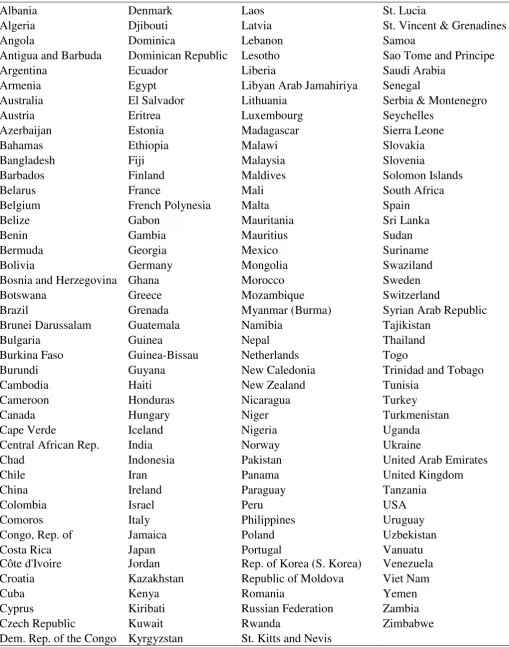
2003-2005) is constructed (please refer to Table A1 in the appendix for the list of countries).
11
day, for each individual in the total population. The measure is based on food available for
human consumption computed as the residual from the total food supply less waste and other
uses, such as from industry or agriculture. Income data, sourced from the International
Financial Statistics of the International Monetary Fund, is the Gross Domestic Product (GDP)
for each country in billions of 2005 U.S. dollars. To convert these values to GDP per capita,
population data is used from the Penn World Tables.
Three main estimation methods are employed in this paper. All three are Bayesian.
First, there is the nonparametric approach outlined in Chapter 10 of Koop (2003). The second
is a linear (in parameters) panel regression that can be estimated using the framework
outlined in Chib and Greenberg (1995). And, finally the recently developed method for
estimating quantile regressions (the Bayesian Exponentially Tilted Empirical Likelihood,
BETEL method) outlined in Lancaster and Sung (2010). When using the panel approach,
alternative models are evaluated using the Bayesian Deviance Information Criteria (DIC)
outlined in Spiegelhalter et al. (2002). A full description of each of the methods can be found
in the references above, therefore, the coverage here is succinct.
The Nonparametric Approach
The motivation for using a nonparametric approach is that the relationships between
calorie or nutrient consumption and income may be highly linear and plausibly
non-monotonic. Nonparametric flexibility allows the examination of whether simple functional
forms are viable. Therefore, this approach is employed first before investigating the
relationships using a parametric approach. The nonparametric method assumes:
i i i
y f x e
where yi is the average consumption in country i of calories or one of the nutrient groups,
and xi is per capita income in country i. Alternatively yi and xi may be logged values of
12
distributed. As outlined in Koop (2003), the nonparametric relationship can be modelled by
estimating f xi at each point value of xi. Crucially, the estimation of the nonparametric
relationship requires a smoothing parameter to be estimated. This parameter is analogous
to a bandwidth selection using classical kernel estimation. Within the Bayesian approach to
estimation, this parameter can be estimated by maximizing the marginal likelihood of the
relationship or through cross-validation. The former method is used, for which readers are
referred to Koop (2003). When using the nonparametric approach, the models are estimated
for the two periods separately. Thus, there are two sets of nonparametric regressions.
The Panel Approach
For the panel approach, the models investigated are of the form (or special cases of)
2 3
1 2 3
it t t it t it t it it
y x x x e
where eit ~N 0, 2 , E e eit, jt 0 for all i j and
2 *
,
it jt
E e e for all t t*. Also,
it
y denotes the dependent variable (calories or nutrients or logs of these variables) for
country i at time t and xit is per capita income (or log values) for country i at time t. Since
there are only two time periods, the values of t are one and two. By allowing the relationship
to be cubic, the model deals with functions that have variable second derivatives whereby the
function may be convex and concave over alternative regions of the variable space. The
imposition of restrictions are investigated, such as it it* (no time effects) and/or 2t 0
and/or 3t 0, in which case the function may become quadratic or linear (or linear in logs).
The Bayesian approach further allows imposition and investigation of whether inequality
restrictions are consistent with the data. For example, in the cubic relationship the hypothesis
might be that 3t 0 since one might expect that consumption of calories or nutrients would
13
approach assumes that jt jt* for all j along with eit* eit zi where zi is a normally
distributed country effect. This "within country/between time" regression is also estimated.
The Quantile Approach
Unlike the previous two approaches, the BETEL does not have an explicit functional
form for the likelihood. Instead, the empirical likelihood is constructed by optimizing an
entropy measure for any given value of the parameters. The empirical likelihood is multiplied
by some relatively diffuse priors to obtain the posterior distribution of the parameters, and
then this can be mapped using a Metropolis-Hastings algorithm. The BETEL approach can be
used more generally than for quantile regressions. The moment conditions are derived from
the condition that (for two variables yi and xi)
Pr yi x xi| i
The parameters and represent the intercept and slopes for the th
quantile. Like
the nonparametric regressions, quantile regressions are run separately for each time period.
4. RESULTS AND DISCUSSION
Discussion of the results proceeds sequentially examining the nonparametric results
first, followed by the results of the panel regressions, followed by the quantile results. As
stated above, the nonparametric regressions were run for each of the variable pairs separately
over the two periods (1990-1992 and 2003-2005). Only the results for the latter period are
presented, since the nonparametric plots are almost the same between the two periods. First,
Figure 1 examines the raw nutrient shares modelled as a function of the raw per capita
variable. The middle line is the fitted (mean) nonparametric relationship, with the two outside
lines containing the 95% confidence intervals for the mean. As can be seen from the plots, the
relationships between shares of nutrients and per capita income appears to be non-linear, with
14
(top left hand corner of Figure 1). As incomes increase, however, the shares of carbohydrates
decrease with a small rise in proteins but a much larger rise in fats. In the poorest countries,
about 80% to 85% of the diet is in the form of carbohydrates and only around 10% in fats. As
incomes increase though, there is a rapid switch to fats, levelling off at around a 50% share in
carbohydrates and a 38% share in fats, with the remainder being proteins. The warnings made
by Drewnowski and Popkin (1997) about the possibility that a diet containing close to 30% of
energy from fat could become the global norm has in fact become the norm for many
countries already. This trend is particularly worrying since changes in diets are typically
irreversible. For example, while increasing income is associated with diets higher in fat,
economic downturns are not associated with a return to healthier eating (Drewnowski 2003).
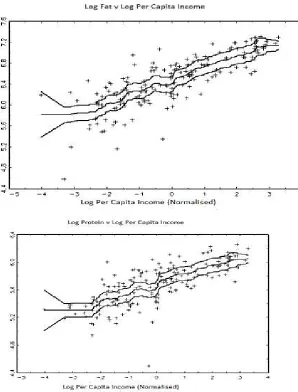
The second set of nonparametric plots in Figure 2 are the log calorie and nutrient
intakes regressed against log per capita income (the relationships between the raw data were
also examined, and these were highly nonlinear and not presented here). What is interesting
about the fitted curves using the log data is that for each of the variable pairs the
nonparametric curves are quite linear. In other words, the data are consistent with being linear
in logs, and therefore have constant elasticities. There is some evidence of a slightly lower
slope at very low levels of per capital income for total calories, fats, and proteins. Perhaps
surprisingly, however, the increases in consumption of these quantities towards the upper end
of the income range do not appear to level off. This implies that as per capita incomes rise, a
given percentage increase in per capita incomes continues to give the same percentage
increase in calories, along with increases in fats, proteins, and carbohydrates. Also evident is
that the carbohydrate line is much flatter, meaning that increases in incomes are not leading
to the same increases in carbohydrates as for fats and proteins. This is consistent with the
15
In view of the nonparametric results, the linear in log specifications represent plausible
empirical characterizations of the relationships between calories/nutrients and per capita
income. This hypothesis is explored further using parametric methods. As outlined in the
methods section, a set of panel regressions are specified, where the variables have been
logged prior to estimation. Before presenting parameter estimates, alternative specifications
including only a quadratic term and excluding a cubic or quadratic term are investigated first.
No other restrictions are imposed at this stage, with further restrictions investigated
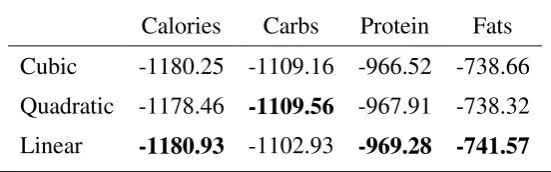
subsequently. The DIC for each of the models is computed, with the preferred model being
the one with the lowest DIC. The results are presented in Table 2. The models with the lowest
DIC are highlighted in bold, and the linear (in variables) specification is preferred for total
calories, protein, and fats. However, the quadratic model is preferred for carbohydrates.
Results conclude that the panel results are in concordance with the nonparametric results.
Evidence suggests total calories, protein, and fats have approximately constant elasticities
over per capita incomes. This is not the case, however, for carbohydrates. The restrictions on
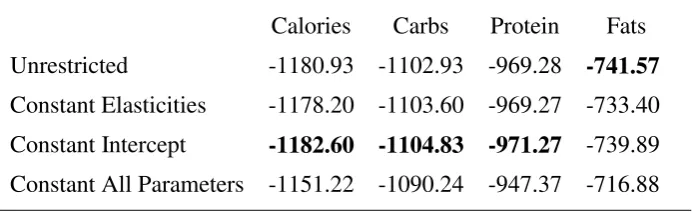
the parameters across the time periods are investigated in Table 3 to test if the relationships
differ across the two periods (1990-92 and 2003-05). For these comparisons the linear models
are used, even for carbohydrates. As seen from the results in Table 3, while there is evidence
that the constants in the models can be restricted across the two periods, none of the models
support constant elasticities across the two periods, suggesting that there have been other
changes in consumption patterns other than those driven by incomes.
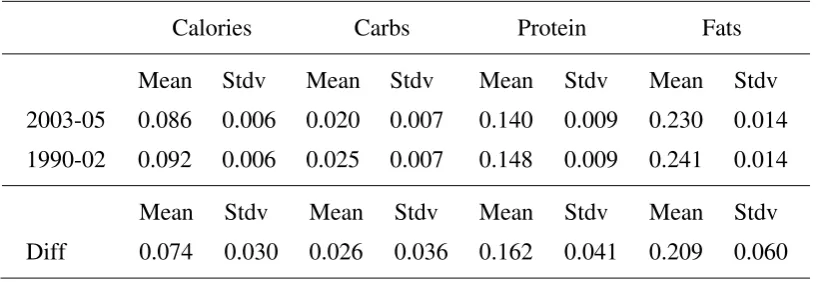
Table 4 presents the elasticity estimates using the Panel approach. Again, the linear
model results are given in Table 4. As mentioned above, the quadratic model is preferred for
carbohydrates, therefore carbohydrates are discussed further below. The estimates in Table 4
reveal that while the DIC does not support constant elasticities over the two periods, the
16
for both periods and both periods have 95% elasticity confidence intervals that would be
contained within the interval (0.072,0.104). Both protein and fat elasticities are significantly
larger than the calorie elasticities (at around 0.14-0.15 and 0.23-0.24, respectively), whereas
the carbohydrate elasticity is much smaller (at around 0.02-0.025). This is consistent with the
previous results regarding nutrient shares. Overall, the results suggest that a 10% increase in
per capita incomes will lead to around a 1% rise in calorie consumption, but with the larger
components being an increase in fat consumption, followed by protein consumption, with a
very small increase in carbohydrate consumption. As noted, however, the carbohydrate
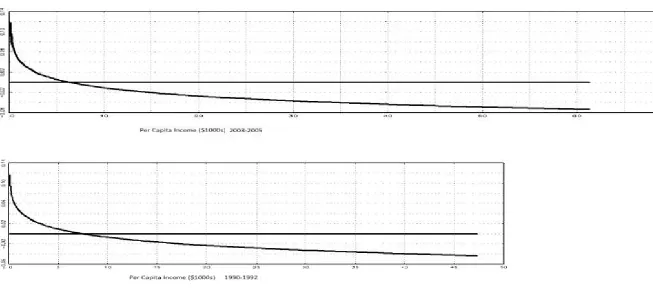
elasticity does not appear to be constant. To further investigate carbohydrate consumption the
income elasticity is estimated at each level of income. These are plotted in Figure 3 for the
two time periods, which again are very similar. The basic picture that emerges is that the
carbohydrate elasticity is around 0.10 for very low levels of income, decreasing at a
decreasing rate from there on, but remaining positive until around $US7500 per year. Beyond
this point carbohydrate consumption has a negative elasticity.
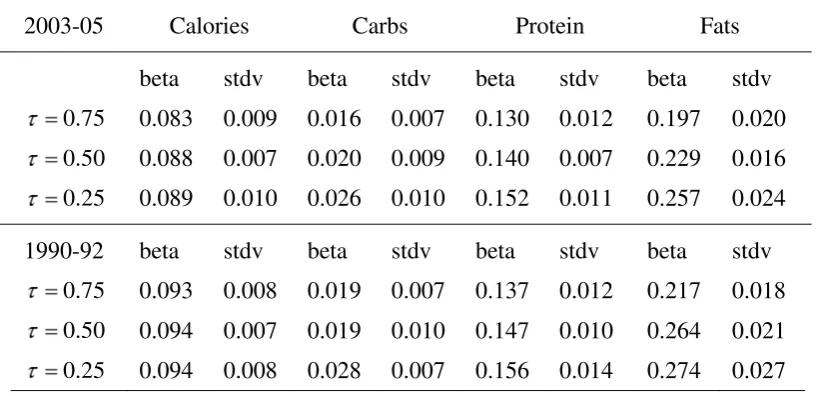
The results for the quantile regressions are presented in Table 5. Again, these are linear
in log specifications for each of the variables. Table 5 reports the upper 75%, the median, and
the lower 25% percentile elasticity estimates. In all cases, for all quantiles, the results are
very similar to the estimated elasticities from the panel results. Of central interest is whether
there seems to be a divergence between the different percentile values. As can be seen by
Table 5, these are very small. A large divergence between the lower and the upper percentiles
would mean that countries with a higher consumption (for a given level of per capita income)
are responding differently to those with a lower consumption (for a given level of per capita
income). For example, if for calories the 0.25 was much smaller than 0.75 then
countries with lower consumption of calories or nutrients would be less responsive to income
17
most worrying scenario, since increased incomes would be having the least effect on those
with the lowest consumption, and increased incomes would be having the highest effect on
those with the highest income. From Table 5, however, the opposite tends to be true. For both
periods, the majority of the variables have non-decreasing or increasing elasticities moving
down the percentile groups. Therefore, those consuming relatively small amounts of calories
or nutrients (for a given level of income) tend to be the most responsive to changes in the
levels of income. As noted though, the divergence between the quantiles is very small indeed.
5. CONCLUSIONS
Hunger and undernutrition is primarily responsible for millions of deaths every year,
mostly in children (Victoria et. al 2008). Around 178 million children suffer from chronic
undernutrition, which causes both physical and mental growth stunting, and over 2 million
children die each year as a result of insufficient dietary intake (Black et. al 2008). At the
other end of the spectrum, developed and developing countries alike face problems with
obesity and high levels of consumption of nutrients, such as saturated fat, which have been
shown to lead to a higher incidence of problems such as hypertension, heart disease, strokes,
diabetes, cancer, and obesity. Understanding the relationship between calorie intake and
income is crucial to developing strategies towards combating chronic diseases associated
with both nutrient deficiency and nutrient excess. The dual burdens of hunger and obesity,
require special attention to the tails of the nutrient intake distribution. Given the historical
difficulty in coordinating effective international action against hunger and undernutrition, in
addition to the escalating global obesity epidemic, there is a continued need for research on
effective policy instruments to combat these dual burdens (Morris et. al 2008).
This paper examined the relationship between calorie/nutrient intakes and per capita
incomes using a two-period panel of 171 countries. The literature is extended in two ways.
18
important nutrient components (carbohydrates, proteins, and fats), which permits the
relationship with income to differ between each nutrient. Most of the literature on nutrition
and income focuses entirely on total calorie intake. While the income elasticity of calories
infers how the total level of energy is affected by income, it reveals nothing about how
income affects diet composition. The few studies that do estimate nutrient-income elasticities
(Pitt and Rosenzweig 1985; Behrman and Deolalikar 1987; Behrman and Wolfe 1987;
Skoufias et. al 2009) confine their analysis to a single country. Second, this study employs
three different estimators (nonparametric, parametric, and quantile) for a robust interpretation
of the income-nutrient relationship. A nonparametric estimator allows the relationship
between income and calorie/nutrient consumption to be non-linear and non-monotonic. The
parametric panel estimator permits estimation of both 'within-country' and 'between-time'
effects and allows for testing of changes in the relationship over time. The quantile estimator
lets the marginal effect of income on calorie/nutrient intake be different over the intake
distribution. In other words, the impact of income may be different between rich and poor
countries, which consume calories at different levels, so improvements in income may not
impart equal benefits. While some studies use both parametric and nonparametric estimators,
few utilize quantile regression.
Calories, fats, and proteins are found to have positive significant income elasticities.
The data on these variables are also consistent with having constant elasticities across the
income range. Carbohydrate consumption has high positive elasticities only at low income
levels, becoming negative at high incomes. Quantile regressions yields similar elasticity
estimates to the nonparametric and panel approaches at both the upper and lower quantiles,
but there is evidence to suggest that higher consuming countries had slightly lower elasticities
than for those in the lower quantiles (for both calories and nutrient components). Findings
19
studies, the small but positive income elasticities suggest income growth will increase calorie
consumption and increase all nutrient consumption for low income countries (below
US$7500). However, elasticity estimates fall below the majority of existing estimates.
In terms of overall calorie consumption, a 10% rise in incomes is required for 1% rise
in calorie consumption. Thus, rather large increases in income are needed for improvements
in the nutrition status of people in poorer countries. The implications for higher income
countries are perhaps no less important. Findings suggest that this overall rise in calorie
consumption as incomes rise holds also for rich countries. Thus, for countries that are already
consuming well beyond the recommended calorie levels, further increases in income will lead
to even larger consumption of calories. Moreover, the consumption of fat has the largest
elasticity at around 2.5 that of overall calorie consumption, meaning the larger component of
increased calorie consumption will be in terms of fats. While these elasticities may seem
small, in the absence of any other change in behavior, extrapolating current income growth
predicts significant cumulative increases in calorie consumption that would exacerbate
existing problems associated with obesity.
Development strategies aimed at improving economic growth may prove to be
insufficient at alleviating hunger and may at worst exacerbate problems of poor diet and
obesity in both developing and developed countries. Even in the absence of targeted food
policies, the global economic crisis will likely worsen the quality of diets internationally. In
response to falling incomes, households are likely turn to fatty and calorie-dense, but nutrient
poor and inexpensive processed foods. As the composition of diets change towards more fatty
foods, countries across the globe will experience deteriorating nutrient status and health.
Global efforts to improve diets require the coordinated design and implementation of policies
20
REFERENCES
Abdulai, A., and D. Aubert. (2004). Nonparametric and parametric analysis of calorie consumption in Tanzania. Food Policy, 29(2): 113-129.
Aromolaran, A.B. (2004). Household income, women's income share and food calorie intake in South Western Nigeria. Food Policy, 29(5): 507-530.
Babatunde, R.O., A.O. Adejobi, and S.B. Fakayode. (2010). Income and calorie intake among farming households in rural Nigeria: results of parametric and nonparametric analysis. Journal of Agricultural Science, 2(2): 135-146.
Boukouvalas, G., B. Shankar, and W.B. Traill. (2009). Determinants of fruit and vegetable intake in England: a re-examination based on quantile regression. Public Health Nutrition, 12(11): 2183-2191.
Behrman, J.R., and A.B. Deolalikar. (1987). Will developing country nutrition improve with income? Journal of Political Economy, 95(3): 492-507.
Behrman, J.R., and A.B. Deolalikar. (1989). Is variety the spice of life? Implications for calorie intake. Review of Economics and Statistics, 71(4): 666-672.
Behrman, J.R., A.B. Deolalikar, and B.L. Wolfe. (1988). Nutrients: impacts and determinants. World Bank Economic Review, 2(3): 299-320.
Behrman, J.R., and B.L. Wolfe. (1984). More evidence on nutrition demand: income seems overrated and women's schooling underemphasized. Journal of Development Economics, 14(1): 105-128.
Behrman, J.R.., and B.L. Wolfe. (1987). How does mother's schooling affect family health, nutrition, medical care usage, and household sanitation? Journal of Econometrics, 36(1-2): 185-204.
Bhargava, A. (1991). Estimating short and long run income elasticities of foods and nutrients for rural South India. Journal of the Royal Statistical Society (Series A), 154(1): 157-174.
Black, R.E., L.H. Allen, Z.A. Bhutta, L.E. Caulfield, M. de Onis, M. Ezzati, C. Mathers, and J. Rivera. (2010). Maternal and child undernutrition: global and regional exposures and health consequences. Lancet, 371(9612): 243-260.
Bleich, S., D. Cutler, C. Murray, and A. Adams. (2008). Why is the developed world obese? Annual Review of Public Health, 29: 273-295.
Bouis, H.E. (1994). The effect of income on demand for food in poor countries: are our food consumption databases giving us reliable estimates? Journal of Development Economics, 44(1): 199-226.
Bouis, H.E., and L.J. Haddad. (1992). Are estimates of calorie-income elasticities too high? A recalibration of the plausible range. Journal of Development Economics, 39(2): 333-364.
Caballero, B. (2005). A nutrition paradox -- underweight and obesity in developing countries. New England Journal of Medicine, 352(15): 1514-1516.
Chib, S., and E. Greenberg (1995). Hierarchical analysis of SUR models with extensions to correlated serial errors and time-varying parameter models. Journal of Econometrics, 68(2): 339-360.
Dawson, P.J. (1997). The demand for calories in developing countries. Oxford Development Studies, 25(3): 361-369.
Dawson, P.J. (2002). Nutrition in Pakistan: estimating the economic demand for calories. Pakistan Journal of Nutrition, 1(1): 64-66.
21
Doak, C.M., L.S. Adair, M. Bentley, C. Monteiro, and B.M. Popkin. (2005). The dual burden household and the nutrition transition paradox. International Journal of Obesity, 29(1): 129-136.
Drewnowski, A. (2003). Fat and sugar: an economic analysis. Journal of Nutrition, 133(3): 838S-840S.
Drewnowski, A., and B.M. Popkin. (1997). The nutrition transition: new trends in the global diet. Nutrition Reviews, 55(2): 31-43.
Food and Agriculture Organization. (2009). State of Food Insecurity in the World. Rome, Italy.
Fousekis, P., and P. Lazaridis. (2005). The demand for selected nutrients by Greek households: an empirical analysis with quantile regressions. Agricultural Economics, 32(3): 267-279.
Friedrich, M.J. (2002). Obesity expands its spread to developing countries. Journal of the American Medical Association, 287(11): 1382-1386.
Gibson, J., and S. Rozelle. (2002). How elastic is calorie demand? Parametric, Nonparametric and Semiparametric results for urban Papua New Guinea. Journal of Development Studies, 38(6): 23-46.
Grimard, F. (1996). Does the poor's consumption of calories respond to changes in income? Evidence from Pakistan. Pakistan Development Review, 35(3): 257-283.
Gustavsen, G.W., and K. Rickertsen. (2006). A censored quantile regression analysis of vegetable demand: the effects of changes in prices and total expenditure. Canadian Journal of Agricultural Economics, 54(4): 631-645.
Hossain, P., B. Kawar, and M. El Nahas. (2007). Obesity and diabetes in the developing world: a growing challenge. New England Journal of Medicine, 356(13): 213-215. International Alliance Against Hunger. (2004). Joining Forces to End World Hunger.
Strategy Paper.
Koop, G. (2003). Bayesian Econometrics. Wiley: Sussex, England.
Lancaster, T., and J.J. Sung. (2008). Bayesian Quantile Regression Methods. Journal of Applied Econometrics, 25(2), 287-307.
Misra, A. and L. Khurana. (2008). Obesity and metabolic syndrome in developing countries. Journal of Clinical Endocrinology and Metabolism, 93(11): S9-S30.
Morris, S.S., B. Cogill, and R. Uauy. (2008). Effective international action against undernutrition: why has it proven so difficult and what can be done to accelerate progress? Lancet, 371(9612): 608-621.
Pinstrup-Andersen, P., and E. Caicedo. (1978). The potential impact of changes in income distribution on food demand and human nutrition. American Journal of Agricultural Economics, 60(3): 402-415.
Popkin, B.M. (1994). The nutrition transition in low-income countries: an emerging crisis. Nutrition Reviews, 52(9): 285-298.
Popkin, B.M. (1999). Urbanization, lifestyle changes, and the nutrition transition. World Development, 27(11): 1905-1916.
Popkin, B.M. (2001). The nutrition transition and obesity in the developing world. Journal of Nutrition, 131(3): 871S-873S.
Popkin, B.M. (2004). The nutrition transition: worldwide obesity dynamics and their determinants. International Journal of Obesity, 28: S2-S9.
Popkin, B.M., and S.W. Ng. (2007). The nutrition transition in high- and low-income countries: what are the policy lessons? Agricultural Economics, 37(S1): 199-211. Prentice, A.M. (2006). The emerging epidemic of obesity in developing countries.
22
Pitt, M.M. (1983). Food preferences and nutrition in rural Bangladesh. Review of Economics and Statistics, 65(1): 105-114.
Pitt, M.M., and M.R. Rosenzweig. (1985). Health and nutrient consumption across and within households. Review of Economics and Statistics, 67(2): 212-223.
Ravallion, M. (1990). Income effects on undernutrition. Economic Development and Cultural Change, 38(3): 489-515.
Reutlinger, S. and H. Alderman. (1980). The prevalence of calorie-deficient diets in developing countries. World Development, 8(5-6): 399-411.
Roy, N. (2001). A semiparametric analysis of calorie response to income change across income groups and gender. Journal of International Trade and Economic Development, 10(1): 93-109.
Sahn, D.E. (1988). The effect of price and income changes on food-energy intake in Sri Lanka. Economic Development and Cultural Change, 36(2): 315-340.
Seidell, J.C. (2000). Obesity, insulin resistance and diabetes -- a worldwide epidemic. British Journal of Nutrition, 83(S1): S5-S8.
Shankar, B. (2010). Socio-economic drivers of overnutrition in China. Journal of Human Nutrition and Dietetics, forthcoming.
Skoufias, E. (2003). Is the calorie-income elasticity sensitive to price changes? Evidence from Indonesia. World Development, 31(7): 1291-1307.
Skoufias, E., V. Di Maro, T. Gonzalez-Cossiom, and S. Rodriguez Ramirez. (2009). Nutrient consumption and household income in rural Mexico. Agricultural Economics, 40(6): 657-675.
Spiegelhalter, D.J., N.G. Best, B.P. Carlin, and A. van der Linde. (2002). Bayesian Measures of Model Complexity and Fit. Journal of the Royal Statistical Society: Series B (Statistical Methodology), 64 (4): 583 - 639
Subramanian, S., and A. Deaton. (1996). The demand for food and calories. Journal of Political Economy, 104(1): 133-162.
Tiffin, R. and P.J. Dawson. (2002). The demand for calories: some further estimates from Zimbabwe. Journal of Agricultural Economics, 53(2): 221-232.
Variyam, J.N., J. Blaylock, and D. Smallwood. (2002). Characterizing the distribution of macronutrient intake among U.S. adults: a quantile regression approach. American Journal of Agricultural Economics, 84(2): 454-466.
Victoria, C.G., L. Adair, C. Fall, P.C. Hallal, R. Martorell, L. Richter, and H.S. Sachdev. (2008). Maternal and child undernutrition: consequences for adult health and human capital. Lancet, 371(9612): 340-357.
Ward, J.O., and J.H. Sanders. (1980). Nutritional determinants and migration in the Brazilian Northeast: a case study of rural and urban Ceará. Economic Development and Cultural Change, 29(1): 141-163.
Webb, P. (2010). Medium- to long-run implications of high food prices for global nutrition. Journal of Nutrition, 140(1): 143S-147S.
Wolfe, B.L. and J.R. Behrman. (1983). Is income overrated in determining adequate nutrition? Economic Development and Cultural Change, 31(3): 525-549.
World Bank. (1980). World Development Report. Washington, DC: USA. World Bank. (1981). World Development Report. Washington, DC: USA.
World Health Organization. (2004). Global Strategy on Diet, Physical Activity and Health. Geneva: Switzerland.
23 Table 1. Summary of recent studies
Author Year Data Level Data Type Timeframe Country Elasticity Bhargava 1991 Individual Panel 1976-1977 India 0.13
Grimard 1996 Household
Cross-sectional 1984-1985 Pakistan 0.40-0.50 Subramanian
and Deaton 1996 Household
Cross-sectional 1983 India 0.40-0.55
Dawson 1997 Aggregate
Cross-sectional 1992 41 DCs 0.07 Dawson and
Tiffin 1998 Aggregate
Time-series 1961-1992 India 0.34 Roy 2001 Individual Panel 1976-1978 India <0-0.15
Dawson 2002 Aggregate
Time-series 1961-1998 Pakistan 0.19 Gibson and
Rozelle 2002 Household
Cross-sectional 1985-1987
Papua New
Guinea 0.18-0.59 Tiffin and
Dawson 2002 Aggregate
Time-series 1961-1992 Zimbabwe 0.31
Skoufias 2003 Household
Cross-sectional 1996, 1999 Indonesia 0.01-0.45 Abdulai and
Aubert 2004 Household Panel 1998-1999 Tanzania 0.49
Aromolaran 2004 Household
Cross-sectional 1999-2000 Nigeria 0.19
Skoufias et. al 2009 Household
Cross-sectional 2003-2004 Mexico <0-0.07
Babatunde et. al 2010 Household
24 Table 2. DIC for Functional Forms
25
Table 3. DIC for Restrictions Across Periods for Linear Models
Calories Carbs Protein Fats Unrestricted -1180.93 -1102.93 -969.28 -741.57
26
Table 4. Elasticity Estimates from Linear Panel Regression
Calories Carbs Protein Fats
Mean Stdv Mean Stdv Mean Stdv Mean Stdv 2003-05 0.086 0.006 0.020 0.007 0.140 0.009 0.230 0.014 1990-02 0.092 0.006 0.025 0.007 0.148 0.009 0.241 0.014
27 Table 5. Elasticity Estimates from Quantile Regression
2003-05 Calories Carbs Protein Fats
beta stdv beta stdv beta stdv beta stdv
0.75 0.083 0.009 0.016 0.007 0.130 0.012 0.197 0.020
0.50 0.088 0.007 0.020 0.009 0.140 0.007 0.229 0.016
0.25 0.089 0.010 0.026 0.010 0.152 0.011 0.257 0.024
1990-92 beta stdv beta stdv beta stdv beta stdv
0.75 0.093 0.008 0.019 0.007 0.137 0.012 0.217 0.018
0.50 0.094 0.007 0.019 0.010 0.147 0.010 0.264 0.021
31 Table A1. List of Countries
Albania Denmark Laos St. Lucia
Algeria Djibouti Latvia St. Vincent & Grenadines
Angola Dominica Lebanon Samoa
Antigua and Barbuda Dominican Republic Lesotho Sao Tome and Principe Argentina Ecuador Liberia Saudi Arabia
Armenia Egypt Libyan Arab Jamahiriya Senegal
Australia El Salvador Lithuania Serbia & Montenegro Austria Eritrea Luxembourg Seychelles
Azerbaijan Estonia Madagascar Sierra Leone
Bahamas Ethiopia Malawi Slovakia
Bangladesh Fiji Malaysia Slovenia
Barbados Finland Maldives Solomon Islands
Belarus France Mali South Africa
Belgium French Polynesia Malta Spain
Belize Gabon Mauritania Sri Lanka
Benin Gambia Mauritius Sudan
Bermuda Georgia Mexico Suriname
Bolivia Germany Mongolia Swaziland
Bosnia and Herzegovina Ghana Morocco Sweden Botswana Greece Mozambique Switzerland
Brazil Grenada Myanmar (Burma) Syrian Arab Republic Brunei Darussalam Guatemala Namibia Tajikistan
Bulgaria Guinea Nepal Thailand
Burkina Faso Guinea-Bissau Netherlands Togo
Burundi Guyana New Caledonia Trinidad and Tobago Cambodia Haiti New Zealand Tunisia
Cameroon Honduras Nicaragua Turkey
Canada Hungary Niger Turkmenistan
Cape Verde Iceland Nigeria Uganda
Central African Rep. India Norway Ukraine
Chad Indonesia Pakistan United Arab Emirates
Chile Iran Panama United Kingdom
China Ireland Paraguay Tanzania
Colombia Israel Peru USA
Comoros Italy Philippines Uruguay
Congo, Rep. of Jamaica Poland Uzbekistan
Costa Rica Japan Portugal Vanuatu
Côte d'Ivoire Jordan Rep. of Korea (S. Korea) Venezuela Croatia Kazakhstan Republic of Moldova Viet Nam
Cuba Kenya Romania Yemen